-
Title
-
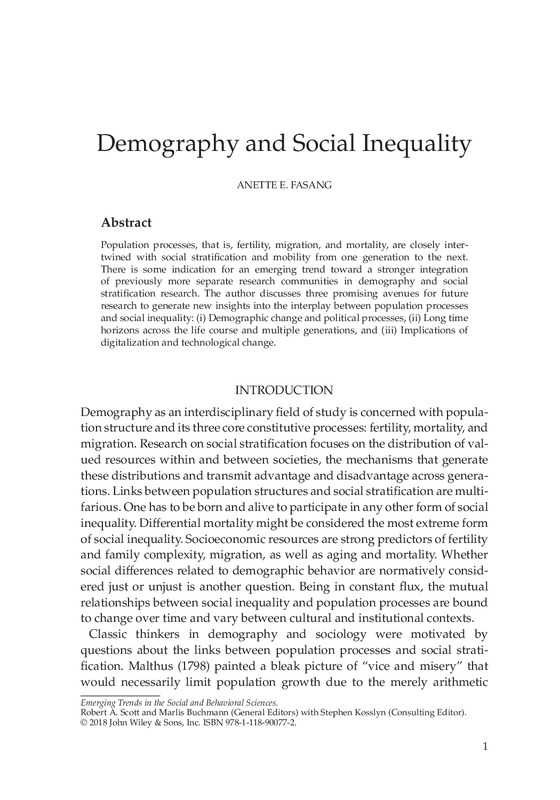
Demography and Social Inequality
-
Author
-
Fasang, Anette E.
-
Research Area
-
Class, Status and Power
-
Topic
-
Social and Economic Inequality
-
Abstract
-
Population processes, that is, fertility, migration, and mortality, are closely intertwined with social stratification and mobility from one generation to the next. There is some indication for an emerging trend toward a stronger integration of previously more separate research communities in demography and social stratification research. The author discusses three promising avenues for future research to generate new insights into the interplay between population processes and social inequality: (i) Demographic change and political processes, (ii) Long time horizons across the life course and multiple generations, and (iii) Implications of digitalization and technological change.
-
Related Essays
-
Family Relationships and Development (Psychology), Joan E. Grusec
-
Economics of Early Education (Economics), W. Steven Barnett
-
Neighborhoods and Cognitive Development (Psychology), Jondou Chen and Jeanne Brooks‐Gunn
-
Social Class and Parental Investment in Children (Sociology), Anne H. Gauthier
-
Below‐Replacement Fertility (Sociology), S. Philip Morgan
-
Limits to Human Longevity (Sociology), Samuel H. Preston and Hiram Beltrán‐Sánchez
-
Demography and Cultural Evolution (Sociology), Stephen Shennan
-
Recent Demographic Trends and the Family (Sociology), Lawrence L. Wu
-
Elites (Sociology), Johan S. G. Chu and Mark S. Mizruchi
-
Enduring Effects of Education (Sociology), Matthew Curry and Jennie E. Brand
-
Intergenerational Mobility (Economics), Steve N. Durlauf and Irina Shaorshadze
-
Stratification in Hard Times (Sociology), Markus Gangl
-
Social Class and Parental Investment in Children (Sociology), Anne H. Gauthier
-
The Emerging Psychology of Social Class (Psychology), Michael W. Kraus
-
Political Inequality (Sociology), Jeff Manza
-
Stratification and the Welfare State (Sociology), Stephanie Moller and Joya Misra
-
Emerging Trends: Social Classification (Sociology), Elizabeth G. Pontikes
-
Class, Cognition, and Face‐to‐Face Interaction (Sociology), Lauren A. Rivera
-
The Future of Class Analyses in American Politics (Political Science), Jeffrey M. Stonecash
-
Family Formation in Times of Labor Market Insecurities (Sociology), Johannes Huinink
-
Gender and Work (Sociology), Christine L. Williams and Megan Tobias Neely
-
Global Income Inequality (Sociology), Glenn Firebaugh
-
A Social Psychological Approach to Racializing Wealth Inequality (Sociology), Joey Brown
-
The Future of Employment, Wages, and Technological Change (Economics), Michael J. Handel
-
Political Inequality (Sociology), Jeff Manza
-
Health and Social Inequality (Sociology), Bernice A. Pescosolido
-
Impact of Limited Education on Employment Prospects in Advanced Economies (Sociology), Heike Solga
-
Public Opinion, the 1%, and Income Redistribution (Sociology), David L. Weakliem
-
Modeling Life Course Structure: The Triple Helix (Sociology), Tom Schuller
-
Telomeres (Psychology), Nancy Adler and Aoife O'Donovan
-
The Intergenerational Transmission of Fertility (Sociology), Laura Bernardi
-
Mulligan: The Emerging Field of Social Behavioral Epigenetics (Anthropology), Connie J. Mulligan
-
The Role of Social Mechanisms in the Formation of Social Inequalities (Sociology), Martin Diewald
-
The Gendered Transition to Parenthood: Lasting Inequalities in the Home and in the Labor Market (Sociology), Marie Evertsson and Katarina Boye
-
Social Inequality across the Life Course: Societal Unfolding and Individual Agency (Psychology), Jutta Heckhausen
-
Social Network Analysis in the Study of Ethnic Inequalities (Psychology), Frank Kalter
-
Changing Work–Family Equilibria and Social Inequality (Sociology), Stefani Scherer
-
The Transnationalized Social Question: Migration and Social Inequalities (Sociology), Thomas Faist
-
Identifier
-
etrds0452
-
extracted text
-
k
PSYHB etrds0452.tex
V2 - 10/22/2018
6:16 P.M.
Page 1
Demography and Social Inequality
ANETTE E. FASANG
Abstract
Population processes, that is, fertility, migration, and mortality, are closely intertwined with social stratification and mobility from one generation to the next.
There is some indication for an emerging trend toward a stronger integration
of previously more separate research communities in demography and social
stratification research. The author discusses three promising avenues for future
research to generate new insights into the interplay between population processes
and social inequality: (i) Demographic change and political processes, (ii) Long time
horizons across the life course and multiple generations, and (iii) Implications of
digitalization and technological change.
k
INTRODUCTION
k
Demography as an interdisciplinary field of study is concerned with population structure and its three core constitutive processes: fertility, mortality, and
migration. Research on social stratification focuses on the distribution of valued resources within and between societies, the mechanisms that generate
these distributions and transmit advantage and disadvantage across generations. Links between population structures and social stratification are multifarious. One has to be born and alive to participate in any other form of social
inequality. Differential mortality might be considered the most extreme form
of social inequality. Socioeconomic resources are strong predictors of fertility
and family complexity, migration, as well as aging and mortality. Whether
social differences related to demographic behavior are normatively considered just or unjust is another question. Being in constant flux, the mutual
relationships between social inequality and population processes are bound
to change over time and vary between cultural and institutional contexts.
Classic thinkers in demography and sociology were motivated by
questions about the links between population processes and social stratification. Malthus (1798) painted a bleak picture of “vice and misery” that
would necessarily limit population growth due to the merely arithmetic
Emerging Trends in the Social and Behavioral Sciences.
Robert A. Scott and Marlis Buchmann (General Editors) with Stephen Kosslyn (Consulting Editor).
© 2018 John Wiley & Sons, Inc. ISBN 978-1-118-90077-2.
1
k
�k
PSYHB etrds0452.tex
2
k
V2 - 10/22/2018
6:16 P.M.
Page 2
EMERGING TRENDS IN THE SOCIAL AND BEHAVIORAL SCIENCES
growth of subsistence against the exponential growth of population.
Resource scarcity would trigger epidemics and social conflict and thereby
keep population growth within certain limits. Malthus arguably underestimated the power of technological change to increase subsistence
exponentially, but climate change, violent conflicts, and epidemics as
HIV-AIDS render his population pessimism as relevant today as 200
years ago. For Durkheim (2005 [1897]), social cohesion and solidarity
were important predictors of suicide mortality, linking the fabric of the
“social” to a demographic outcome. Engels (2015 [1884]) framed the rise
of the monogamous nuclear family as an important precondition for
patriarchal capitalism. Nuclear families secured the inheritance of property
from fathers to sons and facilitated the exploitation of workers through
the unpaid care work of mothers and wives. Robert Easterlin’s (1976)
theory of cyclical fertility linked the micro and macro levels to connect
intergenerational social mobility and fertility levels. He assumed that
aspirations for consumption are formed in the family of origin and that
larger birth cohorts face more intense competition among each other than
small cohorts.
Despite numerous overlaps in terms of disciplinary history, substance,
theoretical background, and methods, demography and social stratification
research form somewhat separate research communities. Yet, publication
and conference activities suggest that the overlap between these two research
communities has increased in recent years. Judging by citations, studies
that examined to what extent demographic behavior is driving increasing
income inequality (McLanahan & Percheski, 2008; Western, Bloome, &
Percheski, 2008) and creating “diverging destinies” for children’s future
(McLanahan, 2004) have attracted broad attention. Similarly, Mare (2011)
prominently promoted a multigenerational view on inequality that accounts
for the “tandem nature of demographic and social reproduction,” while
Goldthorpe (2016) recently elaborated an understanding of “Sociology as a
Population Science.”
Conference themes of central research networks in both fields point to
increasing interest in the interplay between population processes and
social inequality. Two recent conferences of the International Sociological
Association (ISA) Research Committee 28 on Social Stratification and
Mobility (RC 28) for the first time included “population,” “demography,” or
“demographic” in their conference theme (2015 and 2017).1 The European
Consortium for Sociological Research (ECSR) themed its 2016 annual
meeting “Social Stratification and Population Processes in European Societies”2
and launched a new series of thematic conferences with a meeting on
1. https://sites.google.com/site/rc28hp/events/previous
2. http://www.ecsrnet.eu/forthcoming-conferences
k
k
�k
PSYHB etrds0452.tex
V2 - 10/22/2018
Demography and Social Inequality
6:16 P.M.
Page 3
3
“Demography and Social Inequality”.3 Similarly, the 2018 European Population
Conference (EPC) is the first in the history of the EPC to explicitly include
“inequality,” “social mobility,” or “stratification” in its conference theme.4
Several presidential addresses at the annual meeting of the Population
Association of America (PAA) in the past 10 years had an explicit link to
social inequality (2010, 2012, 2014, 2015).
There are many important avenues for future research, including biosociology and genetically sensitive analyses, the rapidly developing field
of wealth inequality research, or time use studies to illuminate the
micro-mechanisms that connect population processes and social inequality.
The author will focus on three additional emerging trends in research
on the interplay of population processes and inequality that seem particularly promising: (i) Demographic change and political processes;
(ii) Long time horizons across individual life courses and multiple
generations, and (iii) Implications of digitalization and technological
change.
DEMOGRAPHIC CHANGE AND POLITICAL PROCESSES
k
Political processes, including voting, partisanship, and interest group
formation set the stage for the distribution and redistribution of resources
within and across generations. Voting is a crucial mediating process
through which demographic change can affect social stratification and
mobility in the long-term. To date, social demographers have largely
ignored outcomes related to political processes, whereas political scientists rarely go beyond including standard sociodemographic controls in
their analyses. Against the backdrop of recent demographic and political developments, established approaches to explain voting behavior,
government formation, and policy making, such as welfare regimes,
varieties of capitalism, and class-based voting no longer seem sufficient to account for shifts in voter demands and current social and
political challenges. Demographic change creates new lines of conflict
that seem increasingly relevant to explain political attitudes, preference formation, and voting (Busemeyer, Goerres, & Weschle, 2009;
García-Albacete, 2014; Pardos-Prado, Lancee, & Sagarzazu, 2014). The
author will briefly discuss how three demographic trends might affect
political processes: population aging, racial/ethnic diversity, and increasing
family complexity.
3. http://www.ecsrnet.eu/thematic-conferences
4. https://www.eaps.nl/scientific-activities/european-population-conferences
k
k
�k
PSYHB etrds0452.tex
4
V2 - 10/22/2018
6:16 P.M.
Page 4
EMERGING TRENDS IN THE SOCIAL AND BEHAVIORAL SCIENCES
POPULATION AGING
k
Population aging is tilting relative voting power to older age groups and
older individuals tend to have higher voter turnout compared to their
younger counterparts (Sanderson & Scherbov, 2007). At the same time,
intergenerational cleavages were core lines of division in recent elections
as demonstrated, for example, by the Brexit referendum (Kelly, 2016). In
contrast to this aggregate intergenerational political polarization, previous
research has shown that within families, parents and their children tend to
have more similar political attitudes and party identification (Kroh & Selb,
2009). How does intergenerational political consensus and disagreement
play out within families? Is there a trend toward weaker intergenerational
transmission of political attitudes or is intergenerational political conflict
only elevated for specific birth cohorts of parents and children due to their
unique sociohistorical experiences? If it really exists, how will heightened
intergenerational political conflict affect electoral outcomes as well as intergenerational transfers, solidarity, inheritance, and caring within families?
A related question is, whether population aging will result in intergenerational conflicts and age-graded competition over scarce resources (Binstock
1974; Busemeyer et al., 2009). Public discourse tends to paint a bleak picture of looming intergenerational wars (Leonhardt, 2012), while research
rather supports a remarkable flexibility and resilience of intergenerational
solidarity within families to changing contextual conditions, even during
large-scale social transformations exemplified by China in the past decades
(Gruijters, 2017). The standard assumption that individuals strictly vote on
issues pertinent to their own age group seems naïve in view of emotionally
close intergenerational family ties. Grandparents might fully support childcare policies that enable their adult children to combine work and family,
whereas young adults might readily favor generous old-age pensions if a
substantial amount of these pensions ends up in their own bank accounts as
birthday or holiday gifts (Leopold & Schneider, 2011).
MIGRATION AND RACIAL/ETHNIC DIVERSITY
Ethnic and racial identities seem to replace traditional class-based voting
patterns in some affluent democracies. For instance, white racial identity
overruled class-based voting patterns for many less-educated whites in the
election of Donald Trump (Case & Deaton, 2015). White grievance politics
are seen as a backlash of the achievements of the civil rights movement and
a reaction to changing population composition with the imminent loss of
majority status of non-Hispanic whites in the United States (Hochschild,
2016). The current success of anti-immigrant parties in Europe as the
Alternative für Deutschland (AFD), the French Front National (FFN) or the
k
k
�k
PSYHB etrds0452.tex
V2 - 10/22/2018
Demography and Social Inequality
6:16 P.M.
Page 5
5
Austrian Freiheitliche Partei Österreichs (FPÖ) builds on the most recent
influx of refugees. Recent research is increasingly turning to social cleavages
between ethnic groups and their impact on partisanship and electoral
outcomes (Frey, 2015; Ramakrishnan, 2005). How will voting behavior
of naturalized, second-, and third-generation immigrants shape electoral
majorities in the decades to come?
FAMILY COMPLEXITY
k
A nascent literature investigates how family complexity—in particular, the
increase in parental separation—affects political preferences and political
participation of the young (Dronkers, 2016; Voorpostel & Coffé, 2014).
Family configurations and events, including widowhood, parenthood,
marriage, and divorce are more or less stressful life events that draw time
and energy away from political participation. Family events can function
as turning-points in the life course that trigger a reorientation of political
priorities. Pioneering research in this field points to substantial differences in voter turnout by family structure in the United States (Wolfinger
and Wolfinger 2008). Married couples have the highest turnout, whereas
divorced individuals are least likely to vote. Irrespective of relationship
status parents are less likely to go to the polls than the childless. Childlessness has increased in many European countries, albeit the gendered
socioeconomic selection into childlessness varies greatly across countries (Kreyenfeld & Konietzka, 2017). Does the political behavior of the
childless systematically vary from parents? How do these associations
vary across countries? Is fertility among conservatives higher and do
they transmit their political partisanship more effectively to the next generation than among liberals? How does differential fertility by political
behavior shape future generations of voters and longer-term political
landscapes?
LONG TIME HORIZONS ACROSS INDIVIDUAL LIFE COURSES
AND MULTIPLE GENERATIONS
Life course research has focused on socioeconomic determinants and outcomes of single demographic transitions and vice versa for several decades
(Mayer, 2009). The interdependency of multiple demographic and socioeconomic events and how they are sequentially linked over longer periods of
time is receiving more attention recently. Taking a “long view in analytical
scope” (Elder 1985) is promising to disentangle how population dynamics are
intertwined with (i) cumulative advantage and disadvantage (CAD) across
k
k
�k
PSYHB etrds0452.tex
6
V2 - 10/22/2018
6:16 P.M.
Page 6
EMERGING TRENDS IN THE SOCIAL AND BEHAVIORAL SCIENCES
individual life courses, and (ii) the (re-) production of social inequality across
multiple generations.
TEMPORAL DYNAMICS ACROSS THE LIFE COURSE
k
Next to the increasing availability of data that cover long time spans of
individual life courses and methodological innovations to analyze these
data, recent research is pushing for more precise conceptual and theoretical
arguments beginning with basic questions such as meaningful conceptualizations of outcomes. Abbott (2016) advocates for complementing
widespread “point in time” or “trend” outcomes of social inequality, for
example, Gini coefficients or parenthood penalties, with “process outcomes”
defined as “[ … ] long run stabilities established by myriads of individual events” (p. 176). Process outcomes resonate with cohort measures in
demography, where they are routinely used for example in the analysis of
cohort fertility. Lifetime income is possibly the most widely used process
outcome in the stratification literature, which typically relies on outcomes
measured at specific points in time. For instance, the motherhood wage
penalty (i.e., percentage difference in hourly wages between mothers and
childless women) is a wide-spread period measure that summarizes average
group differences in a given calendar year. Motherhood wage gaps are
highly sensitive to short-term fluctuations of wages or the composition and
size of the population of mothers, thus obscuring sub-group heterogeneity
and not describing the actual experiences of specific birth cohorts. Recent
research taking a processual perspective shows that motherhood penalties
are not time constant, but tend to attenuate by midlife in the United States
(Kahn et al., 2014) and that distinct welfare state contexts shape different
gendered combinations of long-term work–family life courses from early
adulthood until midlife (Aisenbrey & Fasang, 2017). To date, research taking
a processual life course perspective has strongly focused on the “discovery
stage” (Billari, 2015) of identifying typologies of life course trajectories using
sequence analysis. These typologies provide in-depth thick descriptions
of temporal dynamics over the life course, but they are not dynamic in
themselves as they end and start at fixed time points, such as a given age. It
is both theoretically and methodologically challenging to disentangle which
mechanisms produce them and link them to determinants and outcomes of
interest. Moving the field further toward an “explanation stage” requires (i)
more conceptual and theoretical precision, and (ii) combining a processual
perspective with research designs oriented at causal inference.
First theorizing process outcomes and determinants, which consist of a
series of sequentially linked life course states, are more challenging than
hypothesizing simple x → y relationships. Process determinants can be
k
k
�k
PSYHB etrds0452.tex
V2 - 10/22/2018
Demography and Social Inequality
k
Page 7
7
thought of as complex joint treatment effects that follow a specific temporal
structure. Even though CAD is a ubiquitous buzzword, we have made
relatively little progress in disentangling the actual mechanisms of CAD
since DiPrete and Eirich (2006) conceptual clarifications and formalizations
of CAD-type processes that mainly focus on metric outcomes. But many,
particularly demographic life course states, including family lives and
different reasons for being out of the labor force, are categorical or ordinal
in nature and do not fit within existing frameworks of strict CAD-type
processes. Which family states can be considered advantageous or disadvantageous? Should we only think of them as trigger events that initiate
CAD in metric inequality outcomes? Further, grand social theories on
individualization or flexibilization are often too broad to fruitfully guide
empirical research and require further theoretical specifications of the
middle range (Merton, 1949). If life course experiences are largely unique
to specific times and places, as many previous studies suggest, how useful
is the search for overarching generalizable mechanisms that generate them?
Should we not rather refocus on the conditions, that is the interplay of contextual and compositional factors, under which certain micro-mechanisms
operate?
Second, moving the field deeper into an “explanation stage” will require
both further methodological innovations and linking existing methodology
more closely to theoretical reasoning. To date, we might be understating the
potential of sophisticated descriptive evidence to inform theoretical arguments with an implication-based approach given that empirically identifying a full set of causal linkages is often not feasible in the social sciences
(Bhrolcháin & Dyson, 2007). If strong descriptive evidence is simply not compatible with a precise theoretical mechanism, is this not informative about the
empirical validity of this mechanism even without a formal causal model?
In addition, future research should explore how process-oriented sequential perspectives can be fruitfully combined with causally oriented research
designs, such as instrumental variable approaches, matching methods also
in the context of dyads (Barban, De Luna, Lundholm, Svensson, & Billari,
2017; Raab, Fasang, Karhula, & Erola, 2014), synthetic cohort comparisons in
quasi-experimental settings or by combining sequence analysis with event
history methods (Studer, Struffolino, & Fasang, 2018).
MULTIGENERATIONAL PERSPECTIVES ON INEQUALITY
In his 2010 PAA presidential address, Mare criticized the prevalent
two-generational view on parents and their offspring in inequality and
population research. Instead, he advocated a multigenerational view
that includes grandparents, ancestors, and nonresident contemporary
k
6:16 P.M.
k
�k
PSYHB etrds0452.tex
8
k
V2 - 10/22/2018
6:16 P.M.
Page 8
EMERGING TRENDS IN THE SOCIAL AND BEHAVIORAL SCIENCES
kin. Multigenerational influence operates through differential fertility and
survival, migration, and marriage patterns, as well as the direct transmission
of socioeconomic advantage across multiple generations. If multigenerational effects exist, the concept of CAD transfers to a multigenerational view,
in which advantage and disadvantage accumulate within families across
generations.
Intergenerational transmission of social (dis-) advantage depends on
survival of (potential) parents, assortative mating between partners with
specific social backgrounds and the birth of a next generation. Maralani
(2013) showed that disadvantage among African Americans in the United
States persists across generations among others because those who are
educationally upwardly mobile tend to remain childless. Therefore they
cannot transmit their educational advantage to a next generation. Similarly,
college-educated women’s lower fertility prevents them from transmitting
educational advantage to a next generation relative to their college educated
male peers (Lawrence & Breen, 2016). How does differential fertility affect
the starting conditions for new generations and how powerful are these
intergenerational dynamics compared to the institutional settings children
are born into?
Another emerging line of research turns to the demography of grandparenthood assuming that grandparenthood—whether it occurs, when and
for how long—is socially stratified due to differential mortality and fertility
across generations (Leopold & Skopek, 2015; Margolis, 2016). This draws
attention to the shared years of life between multiple generations as a precondition for grandparents and grandchildren to mutually affect one another
through direct interaction. Research is just beginning to systematically
unravel the socioeconomic gradients and correlates of multigenerational
kinship systems over time. To date, the literature on multigenerational
effects focuses on describing multigenerational regularities and identifying
under which conditions extended kin beyond the nuclear family affect
inequality outcomes. Genetic inheritance, gene-environment interactions
and the mechanisms of wealth accumulation likely play a key role in these
processes. Because of the long time horizons inherent in multigenerational
views on population processes and inequality, they may seem fairly immune
to short-term policy interventions. At a closer look, there are many potential
policy implications. Examples include state-supported family leave not
only for parents, incentives for multigenerational living arrangements,
facilitating the combination of upwardly mobile careers with parenthood
for disadvantaged groups, or an elevated inheritance tax that could be
used to fund an “inheritance” for those whose parents have nothing to
bequest.
k
k
�k
PSYHB etrds0452.tex
V2 - 10/22/2018
Demography and Social Inequality
6:16 P.M.
Page 9
9
IMPLICATIONS OF DIGITALIZATION AND TECHNOLOGICAL
CHANGE
Digitalization and technological change are the focus of emerging research
on demography and social inequality in at least two respects. First, technological developments, including assisted reproductive technologies, social
media, skill-biased technological change, and life-prolonging measures can
fundamentally change the interplay between population processes and social
stratification. Second, the digital revolution is generating massive amounts
of data that offer new possibilities for research. The author will argue that
to date we have focused too little on the first, while possibly overstating the
potential of the second.
TECHNOLOGICAL CHANGE AND THE INTERPLAY BETWEEN POPULATION PROCESSES
AND INEQUALITY
k
New technologies are profoundly transforming population processes.
Cheap air travel, the internet, social media, and communication technologies have completely reformed the logistics of global migration flows
and the daily realities of transnational families. With modern contraception and assisted reproductive technologies (ART) (some), humans have
more control over their reproduction than at any other time in history.
Technological change is often equated with progress. Yet, even though
concerns about the inequality implications of the “digital divide” were
raised almost two decades ago (Norris, 2001), we have a limited understanding of the social stratification effects of technological developments
related to population processes. Consider the example of ARTs. Many
treatments are expensive and access is regulated between a mix of voluntary
regulations, government legislation, and insurance coverage (Präg & Mills,
2017). As a result, ARTs are often confined to a minority of relatively
wealthy individuals, who governments and insurance companies deem
“worthy.” In Germany, for example, many health insurances condition
coverage of ART on marriage and potential parents being within a given
age range. Legal regulations vary greatly across countries, which creates
a largely unregulated global market that lacks systematic quality control
and offers many loopholes for exploitative (reproductive) labor relations.
The booming surrogacy industries in emerging economies including India
are a case in point (Pande, 2014). The ambivalence of surrogate mothers
between social stigma and an opportunity to generate income is well
documented in recent qualitative work (Von Hagel & Mansbach, 2016).
While ART services might reduce inequality between men and women
in affluent democracies, global inequality between women could increase
k
k
�k
PSYHB etrds0452.tex
10
k
V2 - 10/22/2018
6:16 P.M. Page 10
EMERGING TRENDS IN THE SOCIAL AND BEHAVIORAL SCIENCES
as reproductive labor is outsourced by more privileged to less privileged
women.
Global markets for medical services related to demographic processes
escape national regulatory frameworks. This results in bizarre situations
as the recent “Kinderwunsch Tage” in Berlin in 2017 [Child wish Days], a
hugely successful trade fare for ARTs during which international providers
market a range of services that are illegal in Germany.5 Similar global markets exist for services related to the manipulation of the end of life with either
life-prolonging measures or assisted suicide and euthanasia. Assessing the
inequality dynamics associated with new technologies therefore necessarily
requires a global and transnational perspective. Who pays for and benefits
from life-prolonging measures? Which existing inequalities are reduced or
reinforced, and which new inequalities are generated with the proliferation
of new technologies that govern population processes?
Finally, fertility and mortality are processes at the margins of life. Technologies and regulations that control them entail a host of normative and
ethical challenges that have no empirical answers. Demographers and social
stratification researchers tend to be firm believers in Weberian value freedom. Decisions on the regulation of technologies that affect population processes clearly also require normative foundations. Future research should
more seriously engage with the normative and ethical questions surrounding
implications of technological change for the social stratification of population
processes. Possibly the sociological tradition of normative theories of social
justice could be useful in this context. Certainly, closer interdisciplinary collaboration including medical doctors and philosophers could be fruitful to
tackle the ethical and normative challenges ahead.
DIGITAL DEMOGRAPHY AND THE “BIG DATA REVOLUTION”
Currently big data, that is online traces from facebook, twitter, online
dating sites, and many other sources, are heralded as a third major data
revolution to “digital demography,” following the paradigms of “census
and administrative records,” and “theory-driven micro-level data” (Billari
& Zagheni, 2017). Recent research using digital footprints is generating
important insights on global inequality, for example, by using facebook data
to document persistent gender gaps in internet access in the global South
(Fatehkia, Kashyap, & Weber, 2018). Digital trace data will be particularly
useful to address research questions for which other data does not exist or is
difficult to collect and in combination with “traditional” data sources from
surveys and registers (Billari & Zagheni, 2017). To date, fertility research
5. https://www.kinderwunsch-tage.de
k
k
�k
PSYHB etrds0452.tex
V2 - 10/22/2018
Demography and Social Inequality
6:16 P.M. Page 11
11
based on big data has primarily used web searches to show that searches of
terms like “abortion,” “pregnancy,” or “birth” predict future behavior at least
on the level of aggregated averages (Ojala et al., 2017). Mortality researchers
are extracting information on age of death and family trees from online
sources. Possibly the greatest variety of big data is being used to analyze
international migration flows, including location tracking of IP addresses
when individuals log into their email accounts, facebook advertisement
target populations, geo-located twitter data and Google + data (Zagheni &
Weber, 2012). Despite the excitement surrounding digital demography two
issues remain challenging: (i) Selectivity and nonrepresentativeness, and
(ii) ethical questions regarding the collection, access, and analysis of digital
data.
SELECTIVITY AND NONREPRESENTATIVENESS
k
Most digital footprints completely cover a selective sample of users of a
particular online service. They were not collected primarily for research
purposes and are usually not representative of any meaningful population
for social science research questions. This creates challenges akin to biases in
other type of data, such as selective nonresponse in surveys for which more
or less effective methodological remedies have been developed. Similarly,
selectivity and nonrepresentativeness of digital data might reasonably be
quantified and modeled with appropriate statistical procedures. Billari and
Zagheni (2017, p. 9) consider social media and the Internet as “laboratories”
that produce systematically biased estimates of quantities, meaning that
“there are hidden, potentially stochastic rules that determine the relationship between the online data and the offline quantities of interest.” Bias can
be modeled against ground truth data or various hypothetical scenarios
can be assessed to get plausible upper and lower bounds of estimates
and quantities if ground truth data does not exist. Overall selectivity and
nonrepresentativeness seem to be manageable for many substantive applications, particularly when coupled with data from other sources. However,
compared to other data sources, the large-scale involvement of commercial
companies is unique to digital data. A key challenge for this type of data
could well be in convincing companies who collect the data to release the
information necessary for thorough quality control, reasonable assessment
of bias, and replication.
RESEARCH ETHICS
A potentially more severe issue concerns ethical challenges in repurposing
big data for social science research. In contrast to survey and census data,
k
k
�k
PSYHB etrds0452.tex
12
k
V2 - 10/22/2018
6:16 P.M. Page 12
EMERGING TRENDS IN THE SOCIAL AND BEHAVIORAL SCIENCES
users of online services have often not given explicit consent for their data
to be used for research purposes or at least are not aware that they have
given consent. Research findings from big data can be highly sensitive, for
instance when digital traces serve to quantify local populations of vulnerable
groups. It was only decades after the introduction of census and survey data
that their potential for human rights abuses, including genocides and forced
migration became fully apparent (Seltzer & Anderson, 2001). For example,
Dutch Jews had the highest death rates (above 73 percent) of any continental European country during World War II. They were easy to locate because
the Dutch registers meticulously documented their numbers and residences
(Seltzer & Anderson, 2001). In contrast, Jewish refugees from other European
countries who were not included in the Dutch population registers had a substantially higher probability of survival in the Netherlands. There are many
devastating historical cases of population data misuse, they are well documented, and have triggered an intense discussion of potential safeguards.
Against this background, it is rather surprising that research ethics have not
received more attention in the emerging field of digital demography, particularly given the massive involvement of private companies. Recent scandals
surrounding facebook are increasing awareness for ethical issues in the use
of big data, which are already the focus of emerging research (Cesare, Lee,
McCormick, Sprio, & Zagheni, 2016; Salganik, 2017).
To what extent the current big data hype is a veritable revolution remains
to be seen. The qualitative content of big data, that has received much more
attention in political science than in social demography, could prove particularly valuable to inform theory development, for which selectivity and
nonrepresentativeness are less problematic. The systematic study of potential misuse of digital traces, and developing effective safeguards and ethical
guidelines for researchers will remain important.
CONCLUDING REMARKS
Population processes and social stratification and mobility are intertwined
processes on the macro and micro levels. This contribution highlighted a
range of pressing research areas that call for further integrating demography
and stratification research, as well as broader interdisciplinary and global
perspectives.
ACKNOWLEDGMENT
The author would like to thank Heike Klüver, Marcel Raab, Emanuela Struffolino, and the editors of emerging trends for helpful comments on early
versions of the manuscript.
k
k
�k
PSYHB etrds0452.tex
V2 - 10/22/2018
Demography and Social Inequality
6:16 P.M. Page 13
13
REFERENCES
k
Abbott, A. (2016). Processual sociology. Chicago, IL: University of Chicago Press.
Aisenbrey, S., & Fasang, A. (2017). The interplay of work and family trajectories over
the life course: Germany and the United States in comparison. American Journal of
Sociology, 122(5), 1448–1484.
Barban, N., De Luna, X., Lundholm, E., Svensson, I., & Billari, F. C. (2017). Causal
effects of the timing of life-course events: Age at retirement and subsequent health.
Sociological Methods & Research. doi:10.1177/0049124117729697.
Bhrolcháin, M. N., & Dyson, T. (2007). On causation in demography: Issues and illustrations. Population and Development Review, 33(1), 1–36.
Billari, F. C. (2015). Integrating macro-and micro-level approaches in the explanation
of population change. Population Studies, 69(sup1), S11–S20.
Billari, F. C., & Zagheni, E. (2017). Big data and population processes: A revolution?
In A. Petrucci & R. Verde (Eds.), Statistics and data science: New challenges, new generations (pp. 167–178). Proceedings of the Conference of the Italian Statistical Society,
Firenze: Firenze University Press.
Binstock, R. H. (1974). Aging and the future of American politics. The annals of the
american academy of political and social science, 415(1), 199–212.
Busemeyer, M. R., Goerres, A., & Weschle, S. (2009). Attitudes towards redistributive
spending in an era of demographic aging. The rival pressures from age and income
in 14 OECD Countries. Journal of European Social Policy, 19(3), 195–212.
Case, A. and A. Deaton. 2015. “Rising morbidity and mortality in midlife among
white non-Hispanic Americans in the 21st century.” Proceedings of the National
Academy of Sciences of the United States of America 112(49): 15078–15083.
Cesare, N., Lee, H., McCormick, T., Sprio, E., & Zagheni, E. (2016). Promises
and pitfalls of using digital traces for population research (Available at SSRN:
https://ssrn.com/abstract=2839585).
DiPrete, T. A. & Eirich, G. M. (2006). Cumulative advantage as a mechanism for
inequality: A review of theoretical and empirical developments. Annu. Rev. Sociol.,
32, 271–297.
Dronkers, J. (2016). Parent’s living arrangement and children’s the societal political
and civic attitudes: A cross-national comparison of 13- and 14-year-old children
living in different family forms. Zeitschrift für Familienforschung, 28(3), 381–397.
Durkheim, E. (2005 [1897]). Suicide: A study in sociology. Abingdon, UK: Routledge.
Easterlin, R. A. (1976). The conflict between aspirations and resources. Population and
development review, 417–425.
Elder, G. H. (1985. Perspectives on the life course. In G. H. Elder, (Ed.), Life course
dynamics trajectories and transitions, 1968–1980 (pp. 23–49). Ithaca, NY: Cornell
University Press.
Engels, F. (2015 [1884]): Der Ursprung der Familie, des Privateigentums und des
Staats. [The origin of the family, private property, and the state.] Berlin, Germany:
Europäischer Literaturverlag.
Fatehkia, M., Kashyap, R., & Weber, I. (2018). Using Facebook ad data to track the
global digital gender gap. World Development, 107, 189–209.
k
k
�k
PSYHB etrds0452.tex
14
k
V2 - 10/22/2018
6:16 P.M. Page 14
EMERGING TRENDS IN THE SOCIAL AND BEHAVIORAL SCIENCES
Frey, W. H. (2015). Diversity explosion. How new racial demographics are remaking america. Washington, DC: Brookings Institute Press.
García-Albacete, G. (2014). Young people’s political participation in Western Europe: Continuity or generational change? Basingstoke, UK: Palgrave Macmillan.
Goldthorpe, J. H. (2016). Sociology as a population science. Cambridge, UK: Cambridge
University Press.
Gruijters, R. (2017, January). Beyond filial piety: Intergenerational relations and old age
security in contemporary China (Doctoral dissertation). Berlin, Germany: Humboldt Universität zu Berlin. Retrieved from https://edoc.hu-berlin.de/handle/
18452/18812
Hochschild, A. R. (2016). The ecstatic edge of politics: Sociology and Donald Trump.
Contemporary Sociology, 45(6), 683–689.
Kahn, J. R., García-Manglano, J., & Bianchi, S. M. (2014). The motherhood penalty at
midlife: Long-term effects of children on women’s careers. Journal of Marriage and
Family, 76(1), 56–72.
Kelly, J. (2016). Brexit: How much of a generational gap is there? BBC Magazine. Retrieved from http://www.bbc.com/news/magazine-36619342 (accessed
online on May 5, 2018).
Kreyenfeld, M., & Konietzka, D. (Eds.) (2017). Childlessness in Europe: Contexts, causes,
and consequences. Dordrecht, The Netherlands: Springer.
Kroh, M., and Selb P. (2009). Inheritance and the dynamics of party identification.
Political Behavior 31(4), 559.
Lawrence, M., & Breen, R. (2016). And their children after them? The effect of college
on educational reproduction. American Journal of Sociology, 122(2), 532–572.
Leonhardt, D. (2012). Old vs. young. New York Times. Retrieved from https://www.
nytimes.com/2012/06/24/opinion/sunday/the-generation-gap-is-back.html
(accessed online on May 7, 2018).
Leopold, T., & Schneider, T. (2011). Family events and the timing of intergenerational
transfers. Social Forces, 90(2), 595–616.
Leopold, T., & Skopek, J. (2015). The demography of grandparenthood: An international profile. Social Forces, 94(2), 801–832.
Malthus, T. R. (1798). An Essay on the Principle of Population as it Affects the Future
Improvement of Society with Remarks on the Speculations of Mr. Goodwin, M. Condorcet
and Other Writers (1st ed.). London: J. Johnson in St Paul’s Church-yard.
Maralani, V. (2013). The demography of social mobility: Black-white differences
in the process of educational reproduction. American Journal of Sociology, 118(6),
1509–1558.
Mare, R. D. (2011). A multigenerational view of inequality. Demography, 48(1), 1–23.
Margolis, R. (2016). The changing demography of grandparenthood. Journal of Marriage and Family, 78(3), 610–622.
Mayer, K. U. (2009). New directions in life course research. Annual Review of Sociology,
35, 413–433.
McLanahan, S. (2004). Diverging destinies: How children are faring under the second
demographic transition. Demography, 41(4), 607–627.
k
k
�k
PSYHB etrds0452.tex
V2 - 10/22/2018
Demography and Social Inequality
k
6:16 P.M. Page 15
15
McLanahan, S., & Percheski, C. (2008). Family structure and the reproduction of
inequalities. Annual Review of Sociology, 34, 257–276.
Norris, P. (2001). Digital divide: Civic engagement, information poverty, and the Internet
worldwide. Cambridge, UK: Cambridge University Press.
Pande, A. (2014). Wombs in labor: Transnational commercial surrogacy in India. New York
City, NY: Columbia University Press.
Ojala, J., Zagheni, E., Billari, F. C., & Weber, I. (2017) Fertility and its meaning: Evidence from search behavior. Proceedings of the International Conference on Web and Social
Media (ICWSM) 2017.
Pardos-Prado, S., Lancee, B., & Sagarzazu, I. (2014). Immigration and electoral
change in mainstream political space. Political Behavior, 36(4), 847–875.
Präg, P., & Mills, M. C. (2017). Assisted reproductive technology in Europe: usage
and regulation in the context of cross-border reproductive care. In Childlessness
in Europe: Contexts, Causes, and Consequences (pp. 289–309). Cham, Switzerland:
Springer.
Raab, M., Fasang, A. E., Karhula, A., & Erola, J. (2014). Sibling similarity in family
formation. Demography, 51(6), 2127–2154.
Ramakrishnan, S. K. (2005). Democracy in immigrant America: Changing demographics
and political participation. Palo Alto, CA: Stanford University Press.
Robert K., Merton (1949). On SociologicalTheories of the Middle Range. In Robert
K., Merton (ed.), Social Theory and Social Structure, pp. 39–53). New York: Simon &
Schuster, The FreePress.
Salganik, M. J. (2017). Bit by bit: social research in the digital age. Princeton, NJ: Princeton
University Press.
Sanderson, W. C., & Scherbov, S. (2007). A near electoral majority of pensioners:
Prospects and policies. Population and Development Review, 33(3), 543–554.
Seltzer, W., & Anderson, M. (2001). The dark side of numbers: The role of population
data systems in human rights abuses. Social Research, 481–513.
Studer, M., Struffolino, E., & Fasang, A. E. (2018). Estimating the relationship
between time-varying covariates and trajectories: The sequence analysis multistate model procedure. Sociological Methodology. doi:10.1177/0081175017747122.
Von Hagel, A., & Mansbach, D. (2016). The Regulation of Exploitation. International
Feminist Journal of Politics, 18(2), 190–209. DOI: 10.1080/14616742.2014.984479
Voorpostel, M., & Coffé, H. (2014). The effect of parental separation on young adults’
political and civic participation. Social Indicators Research, 124(1), 295–316.
Wolfinger, N. H., & Wolfinger, R. E. (2008). Family structure and voter turnout. Social
forces, 86(4), 1513–1528.
Western, B., Bloome, D., & Percheski, C. (2008). Inequality among American families
with children, 1975 to 2005. American Sociological Review, 73(6), 903–920.
Zagheni, E., & Weber, I. (2012, June). You are where you e-mail: using e-mail data to
estimate international migration rates. In Proceedings of the 4th Annual ACM Web
Science Conference (pp. 348–351). New York, NY: ACM.
Anette E. Fasang is a professor of microsociology at Humboldt University
of Berlin and head of the demography and inequality research group at the
k
k
�k
PSYHB etrds0452.tex
16
V2 - 10/22/2018
6:16 P.M. Page 16
EMERGING TRENDS IN THE SOCIAL AND BEHAVIORAL SCIENCES
WZB Berlin Social Science Center. She obtained her doctorate from Jacobs
University Bremen and completed postdoctoral research at Yale University
and Columbia University. Her research interests include social demography,
stratification, life-course sociology, family demography, and methods for longitudinal data analysis. Recent publications include: “The interplay of work
and family trajectories over the life course: Germany and the United States
in comparison.” Published in the American Journal of Sociology, 2017, 122(5),
1448–1484 with Silke Aisenbrey.
RELATED ESSAYS
k
Family Relationships and Development (Psychology), Joan E. Grusec
Economics of Early Education (Economics), W. Steven Barnett
Neighborhoods and Cognitive Development (Psychology), Jondou Chen and
Jeanne Brooks-Gunn
Social Class and Parental Investment in Children (Sociology), Anne H.
Gauthier
Below-Replacement Fertility (Sociology), S. Philip Morgan
Limits to Human Longevity (Sociology), Samuel H. Preston and Hiram
Beltrán-Sánchez
Demography and Cultural Evolution (Sociology), Stephen Shennan
Recent Demographic Trends and the Family (Sociology), Lawrence L. Wu
Elites (Sociology), Johan S. G. Chu and Mark S. Mizruchi
Enduring Effects of Education (Sociology), Matthew Curry and Jennie E.
Brand
Intergenerational Mobility (Economics), Steve N. Durlauf and Irina
Shaorshadze
Stratification in Hard Times (Sociology), Markus Gangl
Social Class and Parental Investment in Children (Sociology), Anne H.
Gauthier
The Emerging Psychology of Social Class (Psychology), Michael W. Kraus
Political Inequality (Sociology), Jeff Manza
Stratification and the Welfare State (Sociology), Stephanie Moller and Joya
Misra
Emerging Trends: Social Classification (Sociology), Elizabeth G. Pontikes
Class, Cognition, and Face-to-Face Interaction (Sociology), Lauren A. Rivera
The Future of Class Analyses in American Politics (Political Science), Jeffrey
M. Stonecash
Family Formation in Times of Labor Market Insecurities (Sociology), Johannes
Huinink
Gender and Work (Sociology), Christine L. Williams and Megan Tobias Neely
Global Income Inequality (Sociology), Glenn Firebaugh
k
k
�k
PSYHB etrds0452.tex
V2 - 10/22/2018
Demography and Social Inequality
k
6:16 P.M. Page 17
17
A Social Psychological Approach to Racializing Wealth Inequality (Sociology), Joey Brown
The Future of Employment, Wages, and Technological Change (Economics),
Michael J. Handel
Political Inequality (Sociology), Jeff Manza
Health and Social Inequality (Sociology), Bernice A. Pescosolido
Impact of Limited Education on Employment Prospects in Advanced
Economies (Sociology), Heike Solga
Public Opinion, the 1%, and Income Redistribution (Sociology), David L.
Weakliem
Modeling Life Course Structure: The Triple Helix (Sociology), Tom Schuller
Telomeres (Psychology), Nancy Adler and Aoife O’Donovan
The Intergenerational Transmission of Fertility (Sociology), Laura Bernardi
Mulligan: The Emerging Field of Social Behavioral Epigenetics (Anthropology), Connie J. Mulligan
The Role of Social Mechanisms in the Formation of Social Inequalities
(Sociology),Martin Diewald
The Gendered Transition to Parenthood: Lasting Inequalities in the Home
and in the Labor Market (Sociology), Marie Evertsson and Katarina Boye
Social Inequality across the Life Course: Societal Unfolding and Individual
Agency (Psychology), Jutta Heckhausen
Social Network Analysis in the Study of Ethnic Inequalities (Psychology),
Frank Kalter
Changing Work–Family Equilibria and Social Inequality (Sociology), Stefani
Scherer
The Transnationalized Social Question: Migration and Social Inequalities
(Sociology), Thomas Faist
k
k
�
-
k
PSYHB etrds0452.tex
V2 - 10/22/2018
6:16 P.M.
Page 1
Demography and Social Inequality
ANETTE E. FASANG
Abstract
Population processes, that is, fertility, migration, and mortality, are closely intertwined with social stratification and mobility from one generation to the next.
There is some indication for an emerging trend toward a stronger integration
of previously more separate research communities in demography and social
stratification research. The author discusses three promising avenues for future
research to generate new insights into the interplay between population processes
and social inequality: (i) Demographic change and political processes, (ii) Long time
horizons across the life course and multiple generations, and (iii) Implications of
digitalization and technological change.
k
INTRODUCTION
k
Demography as an interdisciplinary field of study is concerned with population structure and its three core constitutive processes: fertility, mortality, and
migration. Research on social stratification focuses on the distribution of valued resources within and between societies, the mechanisms that generate
these distributions and transmit advantage and disadvantage across generations. Links between population structures and social stratification are multifarious. One has to be born and alive to participate in any other form of social
inequality. Differential mortality might be considered the most extreme form
of social inequality. Socioeconomic resources are strong predictors of fertility
and family complexity, migration, as well as aging and mortality. Whether
social differences related to demographic behavior are normatively considered just or unjust is another question. Being in constant flux, the mutual
relationships between social inequality and population processes are bound
to change over time and vary between cultural and institutional contexts.
Classic thinkers in demography and sociology were motivated by
questions about the links between population processes and social stratification. Malthus (1798) painted a bleak picture of “vice and misery” that
would necessarily limit population growth due to the merely arithmetic
Emerging Trends in the Social and Behavioral Sciences.
Robert A. Scott and Marlis Buchmann (General Editors) with Stephen Kosslyn (Consulting Editor).
© 2018 John Wiley & Sons, Inc. ISBN 978-1-118-90077-2.
1
k
�k
PSYHB etrds0452.tex
2
k
V2 - 10/22/2018
6:16 P.M.
Page 2
EMERGING TRENDS IN THE SOCIAL AND BEHAVIORAL SCIENCES
growth of subsistence against the exponential growth of population.
Resource scarcity would trigger epidemics and social conflict and thereby
keep population growth within certain limits. Malthus arguably underestimated the power of technological change to increase subsistence
exponentially, but climate change, violent conflicts, and epidemics as
HIV-AIDS render his population pessimism as relevant today as 200
years ago. For Durkheim (2005 [1897]), social cohesion and solidarity
were important predictors of suicide mortality, linking the fabric of the
“social” to a demographic outcome. Engels (2015 [1884]) framed the rise
of the monogamous nuclear family as an important precondition for
patriarchal capitalism. Nuclear families secured the inheritance of property
from fathers to sons and facilitated the exploitation of workers through
the unpaid care work of mothers and wives. Robert Easterlin’s (1976)
theory of cyclical fertility linked the micro and macro levels to connect
intergenerational social mobility and fertility levels. He assumed that
aspirations for consumption are formed in the family of origin and that
larger birth cohorts face more intense competition among each other than
small cohorts.
Despite numerous overlaps in terms of disciplinary history, substance,
theoretical background, and methods, demography and social stratification
research form somewhat separate research communities. Yet, publication
and conference activities suggest that the overlap between these two research
communities has increased in recent years. Judging by citations, studies
that examined to what extent demographic behavior is driving increasing
income inequality (McLanahan & Percheski, 2008; Western, Bloome, &
Percheski, 2008) and creating “diverging destinies” for children’s future
(McLanahan, 2004) have attracted broad attention. Similarly, Mare (2011)
prominently promoted a multigenerational view on inequality that accounts
for the “tandem nature of demographic and social reproduction,” while
Goldthorpe (2016) recently elaborated an understanding of “Sociology as a
Population Science.”
Conference themes of central research networks in both fields point to
increasing interest in the interplay between population processes and
social inequality. Two recent conferences of the International Sociological
Association (ISA) Research Committee 28 on Social Stratification and
Mobility (RC 28) for the first time included “population,” “demography,” or
“demographic” in their conference theme (2015 and 2017).1 The European
Consortium for Sociological Research (ECSR) themed its 2016 annual
meeting “Social Stratification and Population Processes in European Societies”2
and launched a new series of thematic conferences with a meeting on
1. https://sites.google.com/site/rc28hp/events/previous
2. http://www.ecsrnet.eu/forthcoming-conferences
k
k
�k
PSYHB etrds0452.tex
V2 - 10/22/2018
Demography and Social Inequality
6:16 P.M.
Page 3
3
“Demography and Social Inequality”.3 Similarly, the 2018 European Population
Conference (EPC) is the first in the history of the EPC to explicitly include
“inequality,” “social mobility,” or “stratification” in its conference theme.4
Several presidential addresses at the annual meeting of the Population
Association of America (PAA) in the past 10 years had an explicit link to
social inequality (2010, 2012, 2014, 2015).
There are many important avenues for future research, including biosociology and genetically sensitive analyses, the rapidly developing field
of wealth inequality research, or time use studies to illuminate the
micro-mechanisms that connect population processes and social inequality.
The author will focus on three additional emerging trends in research
on the interplay of population processes and inequality that seem particularly promising: (i) Demographic change and political processes;
(ii) Long time horizons across individual life courses and multiple
generations, and (iii) Implications of digitalization and technological
change.
DEMOGRAPHIC CHANGE AND POLITICAL PROCESSES
k
Political processes, including voting, partisanship, and interest group
formation set the stage for the distribution and redistribution of resources
within and across generations. Voting is a crucial mediating process
through which demographic change can affect social stratification and
mobility in the long-term. To date, social demographers have largely
ignored outcomes related to political processes, whereas political scientists rarely go beyond including standard sociodemographic controls in
their analyses. Against the backdrop of recent demographic and political developments, established approaches to explain voting behavior,
government formation, and policy making, such as welfare regimes,
varieties of capitalism, and class-based voting no longer seem sufficient to account for shifts in voter demands and current social and
political challenges. Demographic change creates new lines of conflict
that seem increasingly relevant to explain political attitudes, preference formation, and voting (Busemeyer, Goerres, & Weschle, 2009;
García-Albacete, 2014; Pardos-Prado, Lancee, & Sagarzazu, 2014). The
author will briefly discuss how three demographic trends might affect
political processes: population aging, racial/ethnic diversity, and increasing
family complexity.
3. http://www.ecsrnet.eu/thematic-conferences
4. https://www.eaps.nl/scientific-activities/european-population-conferences
k
k
�k
PSYHB etrds0452.tex
4
V2 - 10/22/2018
6:16 P.M.
Page 4
EMERGING TRENDS IN THE SOCIAL AND BEHAVIORAL SCIENCES
POPULATION AGING
k
Population aging is tilting relative voting power to older age groups and
older individuals tend to have higher voter turnout compared to their
younger counterparts (Sanderson & Scherbov, 2007). At the same time,
intergenerational cleavages were core lines of division in recent elections
as demonstrated, for example, by the Brexit referendum (Kelly, 2016). In
contrast to this aggregate intergenerational political polarization, previous
research has shown that within families, parents and their children tend to
have more similar political attitudes and party identification (Kroh & Selb,
2009). How does intergenerational political consensus and disagreement
play out within families? Is there a trend toward weaker intergenerational
transmission of political attitudes or is intergenerational political conflict
only elevated for specific birth cohorts of parents and children due to their
unique sociohistorical experiences? If it really exists, how will heightened
intergenerational political conflict affect electoral outcomes as well as intergenerational transfers, solidarity, inheritance, and caring within families?
A related question is, whether population aging will result in intergenerational conflicts and age-graded competition over scarce resources (Binstock
1974; Busemeyer et al., 2009). Public discourse tends to paint a bleak picture of looming intergenerational wars (Leonhardt, 2012), while research
rather supports a remarkable flexibility and resilience of intergenerational
solidarity within families to changing contextual conditions, even during
large-scale social transformations exemplified by China in the past decades
(Gruijters, 2017). The standard assumption that individuals strictly vote on
issues pertinent to their own age group seems naïve in view of emotionally
close intergenerational family ties. Grandparents might fully support childcare policies that enable their adult children to combine work and family,
whereas young adults might readily favor generous old-age pensions if a
substantial amount of these pensions ends up in their own bank accounts as
birthday or holiday gifts (Leopold & Schneider, 2011).
MIGRATION AND RACIAL/ETHNIC DIVERSITY
Ethnic and racial identities seem to replace traditional class-based voting
patterns in some affluent democracies. For instance, white racial identity
overruled class-based voting patterns for many less-educated whites in the
election of Donald Trump (Case & Deaton, 2015). White grievance politics
are seen as a backlash of the achievements of the civil rights movement and
a reaction to changing population composition with the imminent loss of
majority status of non-Hispanic whites in the United States (Hochschild,
2016). The current success of anti-immigrant parties in Europe as the
Alternative für Deutschland (AFD), the French Front National (FFN) or the
k
k
�k
PSYHB etrds0452.tex
V2 - 10/22/2018
Demography and Social Inequality
6:16 P.M.
Page 5
5
Austrian Freiheitliche Partei Österreichs (FPÖ) builds on the most recent
influx of refugees. Recent research is increasingly turning to social cleavages
between ethnic groups and their impact on partisanship and electoral
outcomes (Frey, 2015; Ramakrishnan, 2005). How will voting behavior
of naturalized, second-, and third-generation immigrants shape electoral
majorities in the decades to come?
FAMILY COMPLEXITY
k
A nascent literature investigates how family complexity—in particular, the
increase in parental separation—affects political preferences and political
participation of the young (Dronkers, 2016; Voorpostel & Coffé, 2014).
Family configurations and events, including widowhood, parenthood,
marriage, and divorce are more or less stressful life events that draw time
and energy away from political participation. Family events can function
as turning-points in the life course that trigger a reorientation of political
priorities. Pioneering research in this field points to substantial differences in voter turnout by family structure in the United States (Wolfinger
and Wolfinger 2008). Married couples have the highest turnout, whereas
divorced individuals are least likely to vote. Irrespective of relationship
status parents are less likely to go to the polls than the childless. Childlessness has increased in many European countries, albeit the gendered
socioeconomic selection into childlessness varies greatly across countries (Kreyenfeld & Konietzka, 2017). Does the political behavior of the
childless systematically vary from parents? How do these associations
vary across countries? Is fertility among conservatives higher and do
they transmit their political partisanship more effectively to the next generation than among liberals? How does differential fertility by political
behavior shape future generations of voters and longer-term political
landscapes?
LONG TIME HORIZONS ACROSS INDIVIDUAL LIFE COURSES
AND MULTIPLE GENERATIONS
Life course research has focused on socioeconomic determinants and outcomes of single demographic transitions and vice versa for several decades
(Mayer, 2009). The interdependency of multiple demographic and socioeconomic events and how they are sequentially linked over longer periods of
time is receiving more attention recently. Taking a “long view in analytical
scope” (Elder 1985) is promising to disentangle how population dynamics are
intertwined with (i) cumulative advantage and disadvantage (CAD) across
k
k
�k
PSYHB etrds0452.tex
6
V2 - 10/22/2018
6:16 P.M.
Page 6
EMERGING TRENDS IN THE SOCIAL AND BEHAVIORAL SCIENCES
individual life courses, and (ii) the (re-) production of social inequality across
multiple generations.
TEMPORAL DYNAMICS ACROSS THE LIFE COURSE
k
Next to the increasing availability of data that cover long time spans of
individual life courses and methodological innovations to analyze these
data, recent research is pushing for more precise conceptual and theoretical
arguments beginning with basic questions such as meaningful conceptualizations of outcomes. Abbott (2016) advocates for complementing
widespread “point in time” or “trend” outcomes of social inequality, for
example, Gini coefficients or parenthood penalties, with “process outcomes”
defined as “[ … ] long run stabilities established by myriads of individual events” (p. 176). Process outcomes resonate with cohort measures in
demography, where they are routinely used for example in the analysis of
cohort fertility. Lifetime income is possibly the most widely used process
outcome in the stratification literature, which typically relies on outcomes
measured at specific points in time. For instance, the motherhood wage
penalty (i.e., percentage difference in hourly wages between mothers and
childless women) is a wide-spread period measure that summarizes average
group differences in a given calendar year. Motherhood wage gaps are
highly sensitive to short-term fluctuations of wages or the composition and
size of the population of mothers, thus obscuring sub-group heterogeneity
and not describing the actual experiences of specific birth cohorts. Recent
research taking a processual perspective shows that motherhood penalties
are not time constant, but tend to attenuate by midlife in the United States
(Kahn et al., 2014) and that distinct welfare state contexts shape different
gendered combinations of long-term work–family life courses from early
adulthood until midlife (Aisenbrey & Fasang, 2017). To date, research taking
a processual life course perspective has strongly focused on the “discovery
stage” (Billari, 2015) of identifying typologies of life course trajectories using
sequence analysis. These typologies provide in-depth thick descriptions
of temporal dynamics over the life course, but they are not dynamic in
themselves as they end and start at fixed time points, such as a given age. It
is both theoretically and methodologically challenging to disentangle which
mechanisms produce them and link them to determinants and outcomes of
interest. Moving the field further toward an “explanation stage” requires (i)
more conceptual and theoretical precision, and (ii) combining a processual
perspective with research designs oriented at causal inference.
First theorizing process outcomes and determinants, which consist of a
series of sequentially linked life course states, are more challenging than
hypothesizing simple x → y relationships. Process determinants can be
k
k
�k
PSYHB etrds0452.tex
V2 - 10/22/2018
Demography and Social Inequality
k
Page 7
7
thought of as complex joint treatment effects that follow a specific temporal
structure. Even though CAD is a ubiquitous buzzword, we have made
relatively little progress in disentangling the actual mechanisms of CAD
since DiPrete and Eirich (2006) conceptual clarifications and formalizations
of CAD-type processes that mainly focus on metric outcomes. But many,
particularly demographic life course states, including family lives and
different reasons for being out of the labor force, are categorical or ordinal
in nature and do not fit within existing frameworks of strict CAD-type
processes. Which family states can be considered advantageous or disadvantageous? Should we only think of them as trigger events that initiate
CAD in metric inequality outcomes? Further, grand social theories on
individualization or flexibilization are often too broad to fruitfully guide
empirical research and require further theoretical specifications of the
middle range (Merton, 1949). If life course experiences are largely unique
to specific times and places, as many previous studies suggest, how useful
is the search for overarching generalizable mechanisms that generate them?
Should we not rather refocus on the conditions, that is the interplay of contextual and compositional factors, under which certain micro-mechanisms
operate?
Second, moving the field deeper into an “explanation stage” will require
both further methodological innovations and linking existing methodology
more closely to theoretical reasoning. To date, we might be understating the
potential of sophisticated descriptive evidence to inform theoretical arguments with an implication-based approach given that empirically identifying a full set of causal linkages is often not feasible in the social sciences
(Bhrolcháin & Dyson, 2007). If strong descriptive evidence is simply not compatible with a precise theoretical mechanism, is this not informative about the
empirical validity of this mechanism even without a formal causal model?
In addition, future research should explore how process-oriented sequential perspectives can be fruitfully combined with causally oriented research
designs, such as instrumental variable approaches, matching methods also
in the context of dyads (Barban, De Luna, Lundholm, Svensson, & Billari,
2017; Raab, Fasang, Karhula, & Erola, 2014), synthetic cohort comparisons in
quasi-experimental settings or by combining sequence analysis with event
history methods (Studer, Struffolino, & Fasang, 2018).
MULTIGENERATIONAL PERSPECTIVES ON INEQUALITY
In his 2010 PAA presidential address, Mare criticized the prevalent
two-generational view on parents and their offspring in inequality and
population research. Instead, he advocated a multigenerational view
that includes grandparents, ancestors, and nonresident contemporary
k
6:16 P.M.
k
�k
PSYHB etrds0452.tex
8
k
V2 - 10/22/2018
6:16 P.M.
Page 8
EMERGING TRENDS IN THE SOCIAL AND BEHAVIORAL SCIENCES
kin. Multigenerational influence operates through differential fertility and
survival, migration, and marriage patterns, as well as the direct transmission
of socioeconomic advantage across multiple generations. If multigenerational effects exist, the concept of CAD transfers to a multigenerational view,
in which advantage and disadvantage accumulate within families across
generations.
Intergenerational transmission of social (dis-) advantage depends on
survival of (potential) parents, assortative mating between partners with
specific social backgrounds and the birth of a next generation. Maralani
(2013) showed that disadvantage among African Americans in the United
States persists across generations among others because those who are
educationally upwardly mobile tend to remain childless. Therefore they
cannot transmit their educational advantage to a next generation. Similarly,
college-educated women’s lower fertility prevents them from transmitting
educational advantage to a next generation relative to their college educated
male peers (Lawrence & Breen, 2016). How does differential fertility affect
the starting conditions for new generations and how powerful are these
intergenerational dynamics compared to the institutional settings children
are born into?
Another emerging line of research turns to the demography of grandparenthood assuming that grandparenthood—whether it occurs, when and
for how long—is socially stratified due to differential mortality and fertility
across generations (Leopold & Skopek, 2015; Margolis, 2016). This draws
attention to the shared years of life between multiple generations as a precondition for grandparents and grandchildren to mutually affect one another
through direct interaction. Research is just beginning to systematically
unravel the socioeconomic gradients and correlates of multigenerational
kinship systems over time. To date, the literature on multigenerational
effects focuses on describing multigenerational regularities and identifying
under which conditions extended kin beyond the nuclear family affect
inequality outcomes. Genetic inheritance, gene-environment interactions
and the mechanisms of wealth accumulation likely play a key role in these
processes. Because of the long time horizons inherent in multigenerational
views on population processes and inequality, they may seem fairly immune
to short-term policy interventions. At a closer look, there are many potential
policy implications. Examples include state-supported family leave not
only for parents, incentives for multigenerational living arrangements,
facilitating the combination of upwardly mobile careers with parenthood
for disadvantaged groups, or an elevated inheritance tax that could be
used to fund an “inheritance” for those whose parents have nothing to
bequest.
k
k
�k
PSYHB etrds0452.tex
V2 - 10/22/2018
Demography and Social Inequality
6:16 P.M.
Page 9
9
IMPLICATIONS OF DIGITALIZATION AND TECHNOLOGICAL
CHANGE
Digitalization and technological change are the focus of emerging research
on demography and social inequality in at least two respects. First, technological developments, including assisted reproductive technologies, social
media, skill-biased technological change, and life-prolonging measures can
fundamentally change the interplay between population processes and social
stratification. Second, the digital revolution is generating massive amounts
of data that offer new possibilities for research. The author will argue that
to date we have focused too little on the first, while possibly overstating the
potential of the second.
TECHNOLOGICAL CHANGE AND THE INTERPLAY BETWEEN POPULATION PROCESSES
AND INEQUALITY
k
New technologies are profoundly transforming population processes.
Cheap air travel, the internet, social media, and communication technologies have completely reformed the logistics of global migration flows
and the daily realities of transnational families. With modern contraception and assisted reproductive technologies (ART) (some), humans have
more control over their reproduction than at any other time in history.
Technological change is often equated with progress. Yet, even though
concerns about the inequality implications of the “digital divide” were
raised almost two decades ago (Norris, 2001), we have a limited understanding of the social stratification effects of technological developments
related to population processes. Consider the example of ARTs. Many
treatments are expensive and access is regulated between a mix of voluntary
regulations, government legislation, and insurance coverage (Präg & Mills,
2017). As a result, ARTs are often confined to a minority of relatively
wealthy individuals, who governments and insurance companies deem
“worthy.” In Germany, for example, many health insurances condition
coverage of ART on marriage and potential parents being within a given
age range. Legal regulations vary greatly across countries, which creates
a largely unregulated global market that lacks systematic quality control
and offers many loopholes for exploitative (reproductive) labor relations.
The booming surrogacy industries in emerging economies including India
are a case in point (Pande, 2014). The ambivalence of surrogate mothers
between social stigma and an opportunity to generate income is well
documented in recent qualitative work (Von Hagel & Mansbach, 2016).
While ART services might reduce inequality between men and women
in affluent democracies, global inequality between women could increase
k
k
�k
PSYHB etrds0452.tex
10
k
V2 - 10/22/2018
6:16 P.M. Page 10
EMERGING TRENDS IN THE SOCIAL AND BEHAVIORAL SCIENCES
as reproductive labor is outsourced by more privileged to less privileged
women.
Global markets for medical services related to demographic processes
escape national regulatory frameworks. This results in bizarre situations
as the recent “Kinderwunsch Tage” in Berlin in 2017 [Child wish Days], a
hugely successful trade fare for ARTs during which international providers
market a range of services that are illegal in Germany.5 Similar global markets exist for services related to the manipulation of the end of life with either
life-prolonging measures or assisted suicide and euthanasia. Assessing the
inequality dynamics associated with new technologies therefore necessarily
requires a global and transnational perspective. Who pays for and benefits
from life-prolonging measures? Which existing inequalities are reduced or
reinforced, and which new inequalities are generated with the proliferation
of new technologies that govern population processes?
Finally, fertility and mortality are processes at the margins of life. Technologies and regulations that control them entail a host of normative and
ethical challenges that have no empirical answers. Demographers and social
stratification researchers tend to be firm believers in Weberian value freedom. Decisions on the regulation of technologies that affect population processes clearly also require normative foundations. Future research should
more seriously engage with the normative and ethical questions surrounding
implications of technological change for the social stratification of population
processes. Possibly the sociological tradition of normative theories of social
justice could be useful in this context. Certainly, closer interdisciplinary collaboration including medical doctors and philosophers could be fruitful to
tackle the ethical and normative challenges ahead.
DIGITAL DEMOGRAPHY AND THE “BIG DATA REVOLUTION”
Currently big data, that is online traces from facebook, twitter, online
dating sites, and many other sources, are heralded as a third major data
revolution to “digital demography,” following the paradigms of “census
and administrative records,” and “theory-driven micro-level data” (Billari
& Zagheni, 2017). Recent research using digital footprints is generating
important insights on global inequality, for example, by using facebook data
to document persistent gender gaps in internet access in the global South
(Fatehkia, Kashyap, & Weber, 2018). Digital trace data will be particularly
useful to address research questions for which other data does not exist or is
difficult to collect and in combination with “traditional” data sources from
surveys and registers (Billari & Zagheni, 2017). To date, fertility research
5. https://www.kinderwunsch-tage.de
k
k
�k
PSYHB etrds0452.tex
V2 - 10/22/2018
Demography and Social Inequality
6:16 P.M. Page 11
11
based on big data has primarily used web searches to show that searches of
terms like “abortion,” “pregnancy,” or “birth” predict future behavior at least
on the level of aggregated averages (Ojala et al., 2017). Mortality researchers
are extracting information on age of death and family trees from online
sources. Possibly the greatest variety of big data is being used to analyze
international migration flows, including location tracking of IP addresses
when individuals log into their email accounts, facebook advertisement
target populations, geo-located twitter data and Google + data (Zagheni &
Weber, 2012). Despite the excitement surrounding digital demography two
issues remain challenging: (i) Selectivity and nonrepresentativeness, and
(ii) ethical questions regarding the collection, access, and analysis of digital
data.
SELECTIVITY AND NONREPRESENTATIVENESS
k
Most digital footprints completely cover a selective sample of users of a
particular online service. They were not collected primarily for research
purposes and are usually not representative of any meaningful population
for social science research questions. This creates challenges akin to biases in
other type of data, such as selective nonresponse in surveys for which more
or less effective methodological remedies have been developed. Similarly,
selectivity and nonrepresentativeness of digital data might reasonably be
quantified and modeled with appropriate statistical procedures. Billari and
Zagheni (2017, p. 9) consider social media and the Internet as “laboratories”
that produce systematically biased estimates of quantities, meaning that
“there are hidden, potentially stochastic rules that determine the relationship between the online data and the offline quantities of interest.” Bias can
be modeled against ground truth data or various hypothetical scenarios
can be assessed to get plausible upper and lower bounds of estimates
and quantities if ground truth data does not exist. Overall selectivity and
nonrepresentativeness seem to be manageable for many substantive applications, particularly when coupled with data from other sources. However,
compared to other data sources, the large-scale involvement of commercial
companies is unique to digital data. A key challenge for this type of data
could well be in convincing companies who collect the data to release the
information necessary for thorough quality control, reasonable assessment
of bias, and replication.
RESEARCH ETHICS
A potentially more severe issue concerns ethical challenges in repurposing
big data for social science research. In contrast to survey and census data,
k
k
�k
PSYHB etrds0452.tex
12
k
V2 - 10/22/2018
6:16 P.M. Page 12
EMERGING TRENDS IN THE SOCIAL AND BEHAVIORAL SCIENCES
users of online services have often not given explicit consent for their data
to be used for research purposes or at least are not aware that they have
given consent. Research findings from big data can be highly sensitive, for
instance when digital traces serve to quantify local populations of vulnerable
groups. It was only decades after the introduction of census and survey data
that their potential for human rights abuses, including genocides and forced
migration became fully apparent (Seltzer & Anderson, 2001). For example,
Dutch Jews had the highest death rates (above 73 percent) of any continental European country during World War II. They were easy to locate because
the Dutch registers meticulously documented their numbers and residences
(Seltzer & Anderson, 2001). In contrast, Jewish refugees from other European
countries who were not included in the Dutch population registers had a substantially higher probability of survival in the Netherlands. There are many
devastating historical cases of population data misuse, they are well documented, and have triggered an intense discussion of potential safeguards.
Against this background, it is rather surprising that research ethics have not
received more attention in the emerging field of digital demography, particularly given the massive involvement of private companies. Recent scandals
surrounding facebook are increasing awareness for ethical issues in the use
of big data, which are already the focus of emerging research (Cesare, Lee,
McCormick, Sprio, & Zagheni, 2016; Salganik, 2017).
To what extent the current big data hype is a veritable revolution remains
to be seen. The qualitative content of big data, that has received much more
attention in political science than in social demography, could prove particularly valuable to inform theory development, for which selectivity and
nonrepresentativeness are less problematic. The systematic study of potential misuse of digital traces, and developing effective safeguards and ethical
guidelines for researchers will remain important.
CONCLUDING REMARKS
Population processes and social stratification and mobility are intertwined
processes on the macro and micro levels. This contribution highlighted a
range of pressing research areas that call for further integrating demography
and stratification research, as well as broader interdisciplinary and global
perspectives.
ACKNOWLEDGMENT
The author would like to thank Heike Klüver, Marcel Raab, Emanuela Struffolino, and the editors of emerging trends for helpful comments on early
versions of the manuscript.
k
k
�k
PSYHB etrds0452.tex
V2 - 10/22/2018
Demography and Social Inequality
6:16 P.M. Page 13
13
REFERENCES
k
Abbott, A. (2016). Processual sociology. Chicago, IL: University of Chicago Press.
Aisenbrey, S., & Fasang, A. (2017). The interplay of work and family trajectories over
the life course: Germany and the United States in comparison. American Journal of
Sociology, 122(5), 1448–1484.
Barban, N., De Luna, X., Lundholm, E., Svensson, I., & Billari, F. C. (2017). Causal
effects of the timing of life-course events: Age at retirement and subsequent health.
Sociological Methods & Research. doi:10.1177/0049124117729697.
Bhrolcháin, M. N., & Dyson, T. (2007). On causation in demography: Issues and illustrations. Population and Development Review, 33(1), 1–36.
Billari, F. C. (2015). Integrating macro-and micro-level approaches in the explanation
of population change. Population Studies, 69(sup1), S11–S20.
Billari, F. C., & Zagheni, E. (2017). Big data and population processes: A revolution?
In A. Petrucci & R. Verde (Eds.), Statistics and data science: New challenges, new generations (pp. 167–178). Proceedings of the Conference of the Italian Statistical Society,
Firenze: Firenze University Press.
Binstock, R. H. (1974). Aging and the future of American politics. The annals of the
american academy of political and social science, 415(1), 199–212.
Busemeyer, M. R., Goerres, A., & Weschle, S. (2009). Attitudes towards redistributive
spending in an era of demographic aging. The rival pressures from age and income
in 14 OECD Countries. Journal of European Social Policy, 19(3), 195–212.
Case, A. and A. Deaton. 2015. “Rising morbidity and mortality in midlife among
white non-Hispanic Americans in the 21st century.” Proceedings of the National
Academy of Sciences of the United States of America 112(49): 15078–15083.
Cesare, N., Lee, H., McCormick, T., Sprio, E., & Zagheni, E. (2016). Promises
and pitfalls of using digital traces for population research (Available at SSRN:
https://ssrn.com/abstract=2839585).
DiPrete, T. A. & Eirich, G. M. (2006). Cumulative advantage as a mechanism for
inequality: A review of theoretical and empirical developments. Annu. Rev. Sociol.,
32, 271–297.
Dronkers, J. (2016). Parent’s living arrangement and children’s the societal political
and civic attitudes: A cross-national comparison of 13- and 14-year-old children
living in different family forms. Zeitschrift für Familienforschung, 28(3), 381–397.
Durkheim, E. (2005 [1897]). Suicide: A study in sociology. Abingdon, UK: Routledge.
Easterlin, R. A. (1976). The conflict between aspirations and resources. Population and
development review, 417–425.
Elder, G. H. (1985. Perspectives on the life course. In G. H. Elder, (Ed.), Life course
dynamics trajectories and transitions, 1968–1980 (pp. 23–49). Ithaca, NY: Cornell
University Press.
Engels, F. (2015 [1884]): Der Ursprung der Familie, des Privateigentums und des
Staats. [The origin of the family, private property, and the state.] Berlin, Germany:
Europäischer Literaturverlag.
Fatehkia, M., Kashyap, R., & Weber, I. (2018). Using Facebook ad data to track the
global digital gender gap. World Development, 107, 189–209.
k
k
�k
PSYHB etrds0452.tex
14
k
V2 - 10/22/2018
6:16 P.M. Page 14
EMERGING TRENDS IN THE SOCIAL AND BEHAVIORAL SCIENCES
Frey, W. H. (2015). Diversity explosion. How new racial demographics are remaking america. Washington, DC: Brookings Institute Press.
García-Albacete, G. (2014). Young people’s political participation in Western Europe: Continuity or generational change? Basingstoke, UK: Palgrave Macmillan.
Goldthorpe, J. H. (2016). Sociology as a population science. Cambridge, UK: Cambridge
University Press.
Gruijters, R. (2017, January). Beyond filial piety: Intergenerational relations and old age
security in contemporary China (Doctoral dissertation). Berlin, Germany: Humboldt Universität zu Berlin. Retrieved from https://edoc.hu-berlin.de/handle/
18452/18812
Hochschild, A. R. (2016). The ecstatic edge of politics: Sociology and Donald Trump.
Contemporary Sociology, 45(6), 683–689.
Kahn, J. R., García-Manglano, J., & Bianchi, S. M. (2014). The motherhood penalty at
midlife: Long-term effects of children on women’s careers. Journal of Marriage and
Family, 76(1), 56–72.
Kelly, J. (2016). Brexit: How much of a generational gap is there? BBC Magazine. Retrieved from http://www.bbc.com/news/magazine-36619342 (accessed
online on May 5, 2018).
Kreyenfeld, M., & Konietzka, D. (Eds.) (2017). Childlessness in Europe: Contexts, causes,
and consequences. Dordrecht, The Netherlands: Springer.
Kroh, M., and Selb P. (2009). Inheritance and the dynamics of party identification.
Political Behavior 31(4), 559.
Lawrence, M., & Breen, R. (2016). And their children after them? The effect of college
on educational reproduction. American Journal of Sociology, 122(2), 532–572.
Leonhardt, D. (2012). Old vs. young. New York Times. Retrieved from https://www.
nytimes.com/2012/06/24/opinion/sunday/the-generation-gap-is-back.html
(accessed online on May 7, 2018).
Leopold, T., & Schneider, T. (2011). Family events and the timing of intergenerational
transfers. Social Forces, 90(2), 595–616.
Leopold, T., & Skopek, J. (2015). The demography of grandparenthood: An international profile. Social Forces, 94(2), 801–832.
Malthus, T. R. (1798). An Essay on the Principle of Population as it Affects the Future
Improvement of Society with Remarks on the Speculations of Mr. Goodwin, M. Condorcet
and Other Writers (1st ed.). London: J. Johnson in St Paul’s Church-yard.
Maralani, V. (2013). The demography of social mobility: Black-white differences
in the process of educational reproduction. American Journal of Sociology, 118(6),
1509–1558.
Mare, R. D. (2011). A multigenerational view of inequality. Demography, 48(1), 1–23.
Margolis, R. (2016). The changing demography of grandparenthood. Journal of Marriage and Family, 78(3), 610–622.
Mayer, K. U. (2009). New directions in life course research. Annual Review of Sociology,
35, 413–433.
McLanahan, S. (2004). Diverging destinies: How children are faring under the second
demographic transition. Demography, 41(4), 607–627.
k
k
�k
PSYHB etrds0452.tex
V2 - 10/22/2018
Demography and Social Inequality
k
6:16 P.M. Page 15
15
McLanahan, S., & Percheski, C. (2008). Family structure and the reproduction of
inequalities. Annual Review of Sociology, 34, 257–276.
Norris, P. (2001). Digital divide: Civic engagement, information poverty, and the Internet
worldwide. Cambridge, UK: Cambridge University Press.
Pande, A. (2014). Wombs in labor: Transnational commercial surrogacy in India. New York
City, NY: Columbia University Press.
Ojala, J., Zagheni, E., Billari, F. C., & Weber, I. (2017) Fertility and its meaning: Evidence from search behavior. Proceedings of the International Conference on Web and Social
Media (ICWSM) 2017.
Pardos-Prado, S., Lancee, B., & Sagarzazu, I. (2014). Immigration and electoral
change in mainstream political space. Political Behavior, 36(4), 847–875.
Präg, P., & Mills, M. C. (2017). Assisted reproductive technology in Europe: usage
and regulation in the context of cross-border reproductive care. In Childlessness
in Europe: Contexts, Causes, and Consequences (pp. 289–309). Cham, Switzerland:
Springer.
Raab, M., Fasang, A. E., Karhula, A., & Erola, J. (2014). Sibling similarity in family
formation. Demography, 51(6), 2127–2154.
Ramakrishnan, S. K. (2005). Democracy in immigrant America: Changing demographics
and political participation. Palo Alto, CA: Stanford University Press.
Robert K., Merton (1949). On SociologicalTheories of the Middle Range. In Robert
K., Merton (ed.), Social Theory and Social Structure, pp. 39–53). New York: Simon &
Schuster, The FreePress.
Salganik, M. J. (2017). Bit by bit: social research in the digital age. Princeton, NJ: Princeton
University Press.
Sanderson, W. C., & Scherbov, S. (2007). A near electoral majority of pensioners:
Prospects and policies. Population and Development Review, 33(3), 543–554.
Seltzer, W., & Anderson, M. (2001). The dark side of numbers: The role of population
data systems in human rights abuses. Social Research, 481–513.
Studer, M., Struffolino, E., & Fasang, A. E. (2018). Estimating the relationship
between time-varying covariates and trajectories: The sequence analysis multistate model procedure. Sociological Methodology. doi:10.1177/0081175017747122.
Von Hagel, A., & Mansbach, D. (2016). The Regulation of Exploitation. International
Feminist Journal of Politics, 18(2), 190–209. DOI: 10.1080/14616742.2014.984479
Voorpostel, M., & Coffé, H. (2014). The effect of parental separation on young adults’
political and civic participation. Social Indicators Research, 124(1), 295–316.
Wolfinger, N. H., & Wolfinger, R. E. (2008). Family structure and voter turnout. Social
forces, 86(4), 1513–1528.
Western, B., Bloome, D., & Percheski, C. (2008). Inequality among American families
with children, 1975 to 2005. American Sociological Review, 73(6), 903–920.
Zagheni, E., & Weber, I. (2012, June). You are where you e-mail: using e-mail data to
estimate international migration rates. In Proceedings of the 4th Annual ACM Web
Science Conference (pp. 348–351). New York, NY: ACM.
Anette E. Fasang is a professor of microsociology at Humboldt University
of Berlin and head of the demography and inequality research group at the
k
k
�k
PSYHB etrds0452.tex
16
V2 - 10/22/2018
6:16 P.M. Page 16
EMERGING TRENDS IN THE SOCIAL AND BEHAVIORAL SCIENCES
WZB Berlin Social Science Center. She obtained her doctorate from Jacobs
University Bremen and completed postdoctoral research at Yale University
and Columbia University. Her research interests include social demography,
stratification, life-course sociology, family demography, and methods for longitudinal data analysis. Recent publications include: “The interplay of work
and family trajectories over the life course: Germany and the United States
in comparison.” Published in the American Journal of Sociology, 2017, 122(5),
1448–1484 with Silke Aisenbrey.
RELATED ESSAYS
k
Family Relationships and Development (Psychology), Joan E. Grusec
Economics of Early Education (Economics), W. Steven Barnett
Neighborhoods and Cognitive Development (Psychology), Jondou Chen and
Jeanne Brooks-Gunn
Social Class and Parental Investment in Children (Sociology), Anne H.
Gauthier
Below-Replacement Fertility (Sociology), S. Philip Morgan
Limits to Human Longevity (Sociology), Samuel H. Preston and Hiram
Beltrán-Sánchez
Demography and Cultural Evolution (Sociology), Stephen Shennan
Recent Demographic Trends and the Family (Sociology), Lawrence L. Wu
Elites (Sociology), Johan S. G. Chu and Mark S. Mizruchi
Enduring Effects of Education (Sociology), Matthew Curry and Jennie E.
Brand
Intergenerational Mobility (Economics), Steve N. Durlauf and Irina
Shaorshadze
Stratification in Hard Times (Sociology), Markus Gangl
Social Class and Parental Investment in Children (Sociology), Anne H.
Gauthier
The Emerging Psychology of Social Class (Psychology), Michael W. Kraus
Political Inequality (Sociology), Jeff Manza
Stratification and the Welfare State (Sociology), Stephanie Moller and Joya
Misra
Emerging Trends: Social Classification (Sociology), Elizabeth G. Pontikes
Class, Cognition, and Face-to-Face Interaction (Sociology), Lauren A. Rivera
The Future of Class Analyses in American Politics (Political Science), Jeffrey
M. Stonecash
Family Formation in Times of Labor Market Insecurities (Sociology), Johannes
Huinink
Gender and Work (Sociology), Christine L. Williams and Megan Tobias Neely
Global Income Inequality (Sociology), Glenn Firebaugh
k
k
�k
PSYHB etrds0452.tex
V2 - 10/22/2018
Demography and Social Inequality
k
6:16 P.M. Page 17
17
A Social Psychological Approach to Racializing Wealth Inequality (Sociology), Joey Brown
The Future of Employment, Wages, and Technological Change (Economics),
Michael J. Handel
Political Inequality (Sociology), Jeff Manza
Health and Social Inequality (Sociology), Bernice A. Pescosolido
Impact of Limited Education on Employment Prospects in Advanced
Economies (Sociology), Heike Solga
Public Opinion, the 1%, and Income Redistribution (Sociology), David L.
Weakliem
Modeling Life Course Structure: The Triple Helix (Sociology), Tom Schuller
Telomeres (Psychology), Nancy Adler and Aoife O’Donovan
The Intergenerational Transmission of Fertility (Sociology), Laura Bernardi
Mulligan: The Emerging Field of Social Behavioral Epigenetics (Anthropology), Connie J. Mulligan
The Role of Social Mechanisms in the Formation of Social Inequalities
(Sociology),Martin Diewald
The Gendered Transition to Parenthood: Lasting Inequalities in the Home
and in the Labor Market (Sociology), Marie Evertsson and Katarina Boye
Social Inequality across the Life Course: Societal Unfolding and Individual
Agency (Psychology), Jutta Heckhausen
Social Network Analysis in the Study of Ethnic Inequalities (Psychology),
Frank Kalter
Changing Work–Family Equilibria and Social Inequality (Sociology), Stefani
Scherer
The Transnationalized Social Question: Migration and Social Inequalities
(Sociology), Thomas Faist
k
k
�
k
PSYHB etrds0452.tex
V2 - 10/22/2018
6:16 P.M.
Page 1
Demography and Social Inequality
ANETTE E. FASANG
Abstract
Population processes, that is, fertility, migration, and mortality, are closely intertwined with social stratification and mobility from one generation to the next.
There is some indication for an emerging trend toward a stronger integration
of previously more separate research communities in demography and social
stratification research. The author discusses three promising avenues for future
research to generate new insights into the interplay between population processes
and social inequality: (i) Demographic change and political processes, (ii) Long time
horizons across the life course and multiple generations, and (iii) Implications of
digitalization and technological change.
k
INTRODUCTION
k
Demography as an interdisciplinary field of study is concerned with population structure and its three core constitutive processes: fertility, mortality, and
migration. Research on social stratification focuses on the distribution of valued resources within and between societies, the mechanisms that generate
these distributions and transmit advantage and disadvantage across generations. Links between population structures and social stratification are multifarious. One has to be born and alive to participate in any other form of social
inequality. Differential mortality might be considered the most extreme form
of social inequality. Socioeconomic resources are strong predictors of fertility
and family complexity, migration, as well as aging and mortality. Whether
social differences related to demographic behavior are normatively considered just or unjust is another question. Being in constant flux, the mutual
relationships between social inequality and population processes are bound
to change over time and vary between cultural and institutional contexts.
Classic thinkers in demography and sociology were motivated by
questions about the links between population processes and social stratification. Malthus (1798) painted a bleak picture of “vice and misery” that
would necessarily limit population growth due to the merely arithmetic
Emerging Trends in the Social and Behavioral Sciences.
Robert A. Scott and Marlis Buchmann (General Editors) with Stephen Kosslyn (Consulting Editor).
© 2018 John Wiley & Sons, Inc. ISBN 978-1-118-90077-2.
1
k
�k
PSYHB etrds0452.tex
2
k
V2 - 10/22/2018
6:16 P.M.
Page 2
EMERGING TRENDS IN THE SOCIAL AND BEHAVIORAL SCIENCES
growth of subsistence against the exponential growth of population.
Resource scarcity would trigger epidemics and social conflict and thereby
keep population growth within certain limits. Malthus arguably underestimated the power of technological change to increase subsistence
exponentially, but climate change, violent conflicts, and epidemics as
HIV-AIDS render his population pessimism as relevant today as 200
years ago. For Durkheim (2005 [1897]), social cohesion and solidarity
were important predictors of suicide mortality, linking the fabric of the
“social” to a demographic outcome. Engels (2015 [1884]) framed the rise
of the monogamous nuclear family as an important precondition for
patriarchal capitalism. Nuclear families secured the inheritance of property
from fathers to sons and facilitated the exploitation of workers through
the unpaid care work of mothers and wives. Robert Easterlin’s (1976)
theory of cyclical fertility linked the micro and macro levels to connect
intergenerational social mobility and fertility levels. He assumed that
aspirations for consumption are formed in the family of origin and that
larger birth cohorts face more intense competition among each other than
small cohorts.
Despite numerous overlaps in terms of disciplinary history, substance,
theoretical background, and methods, demography and social stratification
research form somewhat separate research communities. Yet, publication
and conference activities suggest that the overlap between these two research
communities has increased in recent years. Judging by citations, studies
that examined to what extent demographic behavior is driving increasing
income inequality (McLanahan & Percheski, 2008; Western, Bloome, &
Percheski, 2008) and creating “diverging destinies” for children’s future
(McLanahan, 2004) have attracted broad attention. Similarly, Mare (2011)
prominently promoted a multigenerational view on inequality that accounts
for the “tandem nature of demographic and social reproduction,” while
Goldthorpe (2016) recently elaborated an understanding of “Sociology as a
Population Science.”
Conference themes of central research networks in both fields point to
increasing interest in the interplay between population processes and
social inequality. Two recent conferences of the International Sociological
Association (ISA) Research Committee 28 on Social Stratification and
Mobility (RC 28) for the first time included “population,” “demography,” or
“demographic” in their conference theme (2015 and 2017).1 The European
Consortium for Sociological Research (ECSR) themed its 2016 annual
meeting “Social Stratification and Population Processes in European Societies”2
and launched a new series of thematic conferences with a meeting on
1. https://sites.google.com/site/rc28hp/events/previous
2. http://www.ecsrnet.eu/forthcoming-conferences
k
k
�k
PSYHB etrds0452.tex
V2 - 10/22/2018
Demography and Social Inequality
6:16 P.M.
Page 3
3
“Demography and Social Inequality”.3 Similarly, the 2018 European Population
Conference (EPC) is the first in the history of the EPC to explicitly include
“inequality,” “social mobility,” or “stratification” in its conference theme.4
Several presidential addresses at the annual meeting of the Population
Association of America (PAA) in the past 10 years had an explicit link to
social inequality (2010, 2012, 2014, 2015).
There are many important avenues for future research, including biosociology and genetically sensitive analyses, the rapidly developing field
of wealth inequality research, or time use studies to illuminate the
micro-mechanisms that connect population processes and social inequality.
The author will focus on three additional emerging trends in research
on the interplay of population processes and inequality that seem particularly promising: (i) Demographic change and political processes;
(ii) Long time horizons across individual life courses and multiple
generations, and (iii) Implications of digitalization and technological
change.
DEMOGRAPHIC CHANGE AND POLITICAL PROCESSES
k
Political processes, including voting, partisanship, and interest group
formation set the stage for the distribution and redistribution of resources
within and across generations. Voting is a crucial mediating process
through which demographic change can affect social stratification and
mobility in the long-term. To date, social demographers have largely
ignored outcomes related to political processes, whereas political scientists rarely go beyond including standard sociodemographic controls in
their analyses. Against the backdrop of recent demographic and political developments, established approaches to explain voting behavior,
government formation, and policy making, such as welfare regimes,
varieties of capitalism, and class-based voting no longer seem sufficient to account for shifts in voter demands and current social and
political challenges. Demographic change creates new lines of conflict
that seem increasingly relevant to explain political attitudes, preference formation, and voting (Busemeyer, Goerres, & Weschle, 2009;
García-Albacete, 2014; Pardos-Prado, Lancee, & Sagarzazu, 2014). The
author will briefly discuss how three demographic trends might affect
political processes: population aging, racial/ethnic diversity, and increasing
family complexity.
3. http://www.ecsrnet.eu/thematic-conferences
4. https://www.eaps.nl/scientific-activities/european-population-conferences
k
k
�k
PSYHB etrds0452.tex
4
V2 - 10/22/2018
6:16 P.M.
Page 4
EMERGING TRENDS IN THE SOCIAL AND BEHAVIORAL SCIENCES
POPULATION AGING
k
Population aging is tilting relative voting power to older age groups and
older individuals tend to have higher voter turnout compared to their
younger counterparts (Sanderson & Scherbov, 2007). At the same time,
intergenerational cleavages were core lines of division in recent elections
as demonstrated, for example, by the Brexit referendum (Kelly, 2016). In
contrast to this aggregate intergenerational political polarization, previous
research has shown that within families, parents and their children tend to
have more similar political attitudes and party identification (Kroh & Selb,
2009). How does intergenerational political consensus and disagreement
play out within families? Is there a trend toward weaker intergenerational
transmission of political attitudes or is intergenerational political conflict
only elevated for specific birth cohorts of parents and children due to their
unique sociohistorical experiences? If it really exists, how will heightened
intergenerational political conflict affect electoral outcomes as well as intergenerational transfers, solidarity, inheritance, and caring within families?
A related question is, whether population aging will result in intergenerational conflicts and age-graded competition over scarce resources (Binstock
1974; Busemeyer et al., 2009). Public discourse tends to paint a bleak picture of looming intergenerational wars (Leonhardt, 2012), while research
rather supports a remarkable flexibility and resilience of intergenerational
solidarity within families to changing contextual conditions, even during
large-scale social transformations exemplified by China in the past decades
(Gruijters, 2017). The standard assumption that individuals strictly vote on
issues pertinent to their own age group seems naïve in view of emotionally
close intergenerational family ties. Grandparents might fully support childcare policies that enable their adult children to combine work and family,
whereas young adults might readily favor generous old-age pensions if a
substantial amount of these pensions ends up in their own bank accounts as
birthday or holiday gifts (Leopold & Schneider, 2011).
MIGRATION AND RACIAL/ETHNIC DIVERSITY
Ethnic and racial identities seem to replace traditional class-based voting
patterns in some affluent democracies. For instance, white racial identity
overruled class-based voting patterns for many less-educated whites in the
election of Donald Trump (Case & Deaton, 2015). White grievance politics
are seen as a backlash of the achievements of the civil rights movement and
a reaction to changing population composition with the imminent loss of
majority status of non-Hispanic whites in the United States (Hochschild,
2016). The current success of anti-immigrant parties in Europe as the
Alternative für Deutschland (AFD), the French Front National (FFN) or the
k
k
�k
PSYHB etrds0452.tex
V2 - 10/22/2018
Demography and Social Inequality
6:16 P.M.
Page 5
5
Austrian Freiheitliche Partei Österreichs (FPÖ) builds on the most recent
influx of refugees. Recent research is increasingly turning to social cleavages
between ethnic groups and their impact on partisanship and electoral
outcomes (Frey, 2015; Ramakrishnan, 2005). How will voting behavior
of naturalized, second-, and third-generation immigrants shape electoral
majorities in the decades to come?
FAMILY COMPLEXITY
k
A nascent literature investigates how family complexity—in particular, the
increase in parental separation—affects political preferences and political
participation of the young (Dronkers, 2016; Voorpostel & Coffé, 2014).
Family configurations and events, including widowhood, parenthood,
marriage, and divorce are more or less stressful life events that draw time
and energy away from political participation. Family events can function
as turning-points in the life course that trigger a reorientation of political
priorities. Pioneering research in this field points to substantial differences in voter turnout by family structure in the United States (Wolfinger
and Wolfinger 2008). Married couples have the highest turnout, whereas
divorced individuals are least likely to vote. Irrespective of relationship
status parents are less likely to go to the polls than the childless. Childlessness has increased in many European countries, albeit the gendered
socioeconomic selection into childlessness varies greatly across countries (Kreyenfeld & Konietzka, 2017). Does the political behavior of the
childless systematically vary from parents? How do these associations
vary across countries? Is fertility among conservatives higher and do
they transmit their political partisanship more effectively to the next generation than among liberals? How does differential fertility by political
behavior shape future generations of voters and longer-term political
landscapes?
LONG TIME HORIZONS ACROSS INDIVIDUAL LIFE COURSES
AND MULTIPLE GENERATIONS
Life course research has focused on socioeconomic determinants and outcomes of single demographic transitions and vice versa for several decades
(Mayer, 2009). The interdependency of multiple demographic and socioeconomic events and how they are sequentially linked over longer periods of
time is receiving more attention recently. Taking a “long view in analytical
scope” (Elder 1985) is promising to disentangle how population dynamics are
intertwined with (i) cumulative advantage and disadvantage (CAD) across
k
k
�k
PSYHB etrds0452.tex
6
V2 - 10/22/2018
6:16 P.M.
Page 6
EMERGING TRENDS IN THE SOCIAL AND BEHAVIORAL SCIENCES
individual life courses, and (ii) the (re-) production of social inequality across
multiple generations.
TEMPORAL DYNAMICS ACROSS THE LIFE COURSE
k
Next to the increasing availability of data that cover long time spans of
individual life courses and methodological innovations to analyze these
data, recent research is pushing for more precise conceptual and theoretical
arguments beginning with basic questions such as meaningful conceptualizations of outcomes. Abbott (2016) advocates for complementing
widespread “point in time” or “trend” outcomes of social inequality, for
example, Gini coefficients or parenthood penalties, with “process outcomes”
defined as “[ … ] long run stabilities established by myriads of individual events” (p. 176). Process outcomes resonate with cohort measures in
demography, where they are routinely used for example in the analysis of
cohort fertility. Lifetime income is possibly the most widely used process
outcome in the stratification literature, which typically relies on outcomes
measured at specific points in time. For instance, the motherhood wage
penalty (i.e., percentage difference in hourly wages between mothers and
childless women) is a wide-spread period measure that summarizes average
group differences in a given calendar year. Motherhood wage gaps are
highly sensitive to short-term fluctuations of wages or the composition and
size of the population of mothers, thus obscuring sub-group heterogeneity
and not describing the actual experiences of specific birth cohorts. Recent
research taking a processual perspective shows that motherhood penalties
are not time constant, but tend to attenuate by midlife in the United States
(Kahn et al., 2014) and that distinct welfare state contexts shape different
gendered combinations of long-term work–family life courses from early
adulthood until midlife (Aisenbrey & Fasang, 2017). To date, research taking
a processual life course perspective has strongly focused on the “discovery
stage” (Billari, 2015) of identifying typologies of life course trajectories using
sequence analysis. These typologies provide in-depth thick descriptions
of temporal dynamics over the life course, but they are not dynamic in
themselves as they end and start at fixed time points, such as a given age. It
is both theoretically and methodologically challenging to disentangle which
mechanisms produce them and link them to determinants and outcomes of
interest. Moving the field further toward an “explanation stage” requires (i)
more conceptual and theoretical precision, and (ii) combining a processual
perspective with research designs oriented at causal inference.
First theorizing process outcomes and determinants, which consist of a
series of sequentially linked life course states, are more challenging than
hypothesizing simple x → y relationships. Process determinants can be
k
k
�k
PSYHB etrds0452.tex
V2 - 10/22/2018
Demography and Social Inequality
k
Page 7
7
thought of as complex joint treatment effects that follow a specific temporal
structure. Even though CAD is a ubiquitous buzzword, we have made
relatively little progress in disentangling the actual mechanisms of CAD
since DiPrete and Eirich (2006) conceptual clarifications and formalizations
of CAD-type processes that mainly focus on metric outcomes. But many,
particularly demographic life course states, including family lives and
different reasons for being out of the labor force, are categorical or ordinal
in nature and do not fit within existing frameworks of strict CAD-type
processes. Which family states can be considered advantageous or disadvantageous? Should we only think of them as trigger events that initiate
CAD in metric inequality outcomes? Further, grand social theories on
individualization or flexibilization are often too broad to fruitfully guide
empirical research and require further theoretical specifications of the
middle range (Merton, 1949). If life course experiences are largely unique
to specific times and places, as many previous studies suggest, how useful
is the search for overarching generalizable mechanisms that generate them?
Should we not rather refocus on the conditions, that is the interplay of contextual and compositional factors, under which certain micro-mechanisms
operate?
Second, moving the field deeper into an “explanation stage” will require
both further methodological innovations and linking existing methodology
more closely to theoretical reasoning. To date, we might be understating the
potential of sophisticated descriptive evidence to inform theoretical arguments with an implication-based approach given that empirically identifying a full set of causal linkages is often not feasible in the social sciences
(Bhrolcháin & Dyson, 2007). If strong descriptive evidence is simply not compatible with a precise theoretical mechanism, is this not informative about the
empirical validity of this mechanism even without a formal causal model?
In addition, future research should explore how process-oriented sequential perspectives can be fruitfully combined with causally oriented research
designs, such as instrumental variable approaches, matching methods also
in the context of dyads (Barban, De Luna, Lundholm, Svensson, & Billari,
2017; Raab, Fasang, Karhula, & Erola, 2014), synthetic cohort comparisons in
quasi-experimental settings or by combining sequence analysis with event
history methods (Studer, Struffolino, & Fasang, 2018).
MULTIGENERATIONAL PERSPECTIVES ON INEQUALITY
In his 2010 PAA presidential address, Mare criticized the prevalent
two-generational view on parents and their offspring in inequality and
population research. Instead, he advocated a multigenerational view
that includes grandparents, ancestors, and nonresident contemporary
k
6:16 P.M.
k
�k
PSYHB etrds0452.tex
8
k
V2 - 10/22/2018
6:16 P.M.
Page 8
EMERGING TRENDS IN THE SOCIAL AND BEHAVIORAL SCIENCES
kin. Multigenerational influence operates through differential fertility and
survival, migration, and marriage patterns, as well as the direct transmission
of socioeconomic advantage across multiple generations. If multigenerational effects exist, the concept of CAD transfers to a multigenerational view,
in which advantage and disadvantage accumulate within families across
generations.
Intergenerational transmission of social (dis-) advantage depends on
survival of (potential) parents, assortative mating between partners with
specific social backgrounds and the birth of a next generation. Maralani
(2013) showed that disadvantage among African Americans in the United
States persists across generations among others because those who are
educationally upwardly mobile tend to remain childless. Therefore they
cannot transmit their educational advantage to a next generation. Similarly,
college-educated women’s lower fertility prevents them from transmitting
educational advantage to a next generation relative to their college educated
male peers (Lawrence & Breen, 2016). How does differential fertility affect
the starting conditions for new generations and how powerful are these
intergenerational dynamics compared to the institutional settings children
are born into?
Another emerging line of research turns to the demography of grandparenthood assuming that grandparenthood—whether it occurs, when and
for how long—is socially stratified due to differential mortality and fertility
across generations (Leopold & Skopek, 2015; Margolis, 2016). This draws
attention to the shared years of life between multiple generations as a precondition for grandparents and grandchildren to mutually affect one another
through direct interaction. Research is just beginning to systematically
unravel the socioeconomic gradients and correlates of multigenerational
kinship systems over time. To date, the literature on multigenerational
effects focuses on describing multigenerational regularities and identifying
under which conditions extended kin beyond the nuclear family affect
inequality outcomes. Genetic inheritance, gene-environment interactions
and the mechanisms of wealth accumulation likely play a key role in these
processes. Because of the long time horizons inherent in multigenerational
views on population processes and inequality, they may seem fairly immune
to short-term policy interventions. At a closer look, there are many potential
policy implications. Examples include state-supported family leave not
only for parents, incentives for multigenerational living arrangements,
facilitating the combination of upwardly mobile careers with parenthood
for disadvantaged groups, or an elevated inheritance tax that could be
used to fund an “inheritance” for those whose parents have nothing to
bequest.
k
k
�k
PSYHB etrds0452.tex
V2 - 10/22/2018
Demography and Social Inequality
6:16 P.M.
Page 9
9
IMPLICATIONS OF DIGITALIZATION AND TECHNOLOGICAL
CHANGE
Digitalization and technological change are the focus of emerging research
on demography and social inequality in at least two respects. First, technological developments, including assisted reproductive technologies, social
media, skill-biased technological change, and life-prolonging measures can
fundamentally change the interplay between population processes and social
stratification. Second, the digital revolution is generating massive amounts
of data that offer new possibilities for research. The author will argue that
to date we have focused too little on the first, while possibly overstating the
potential of the second.
TECHNOLOGICAL CHANGE AND THE INTERPLAY BETWEEN POPULATION PROCESSES
AND INEQUALITY
k
New technologies are profoundly transforming population processes.
Cheap air travel, the internet, social media, and communication technologies have completely reformed the logistics of global migration flows
and the daily realities of transnational families. With modern contraception and assisted reproductive technologies (ART) (some), humans have
more control over their reproduction than at any other time in history.
Technological change is often equated with progress. Yet, even though
concerns about the inequality implications of the “digital divide” were
raised almost two decades ago (Norris, 2001), we have a limited understanding of the social stratification effects of technological developments
related to population processes. Consider the example of ARTs. Many
treatments are expensive and access is regulated between a mix of voluntary
regulations, government legislation, and insurance coverage (Präg & Mills,
2017). As a result, ARTs are often confined to a minority of relatively
wealthy individuals, who governments and insurance companies deem
“worthy.” In Germany, for example, many health insurances condition
coverage of ART on marriage and potential parents being within a given
age range. Legal regulations vary greatly across countries, which creates
a largely unregulated global market that lacks systematic quality control
and offers many loopholes for exploitative (reproductive) labor relations.
The booming surrogacy industries in emerging economies including India
are a case in point (Pande, 2014). The ambivalence of surrogate mothers
between social stigma and an opportunity to generate income is well
documented in recent qualitative work (Von Hagel & Mansbach, 2016).
While ART services might reduce inequality between men and women
in affluent democracies, global inequality between women could increase
k
k
�k
PSYHB etrds0452.tex
10
k
V2 - 10/22/2018
6:16 P.M. Page 10
EMERGING TRENDS IN THE SOCIAL AND BEHAVIORAL SCIENCES
as reproductive labor is outsourced by more privileged to less privileged
women.
Global markets for medical services related to demographic processes
escape national regulatory frameworks. This results in bizarre situations
as the recent “Kinderwunsch Tage” in Berlin in 2017 [Child wish Days], a
hugely successful trade fare for ARTs during which international providers
market a range of services that are illegal in Germany.5 Similar global markets exist for services related to the manipulation of the end of life with either
life-prolonging measures or assisted suicide and euthanasia. Assessing the
inequality dynamics associated with new technologies therefore necessarily
requires a global and transnational perspective. Who pays for and benefits
from life-prolonging measures? Which existing inequalities are reduced or
reinforced, and which new inequalities are generated with the proliferation
of new technologies that govern population processes?
Finally, fertility and mortality are processes at the margins of life. Technologies and regulations that control them entail a host of normative and
ethical challenges that have no empirical answers. Demographers and social
stratification researchers tend to be firm believers in Weberian value freedom. Decisions on the regulation of technologies that affect population processes clearly also require normative foundations. Future research should
more seriously engage with the normative and ethical questions surrounding
implications of technological change for the social stratification of population
processes. Possibly the sociological tradition of normative theories of social
justice could be useful in this context. Certainly, closer interdisciplinary collaboration including medical doctors and philosophers could be fruitful to
tackle the ethical and normative challenges ahead.
DIGITAL DEMOGRAPHY AND THE “BIG DATA REVOLUTION”
Currently big data, that is online traces from facebook, twitter, online
dating sites, and many other sources, are heralded as a third major data
revolution to “digital demography,” following the paradigms of “census
and administrative records,” and “theory-driven micro-level data” (Billari
& Zagheni, 2017). Recent research using digital footprints is generating
important insights on global inequality, for example, by using facebook data
to document persistent gender gaps in internet access in the global South
(Fatehkia, Kashyap, & Weber, 2018). Digital trace data will be particularly
useful to address research questions for which other data does not exist or is
difficult to collect and in combination with “traditional” data sources from
surveys and registers (Billari & Zagheni, 2017). To date, fertility research
5. https://www.kinderwunsch-tage.de
k
k
�k
PSYHB etrds0452.tex
V2 - 10/22/2018
Demography and Social Inequality
6:16 P.M. Page 11
11
based on big data has primarily used web searches to show that searches of
terms like “abortion,” “pregnancy,” or “birth” predict future behavior at least
on the level of aggregated averages (Ojala et al., 2017). Mortality researchers
are extracting information on age of death and family trees from online
sources. Possibly the greatest variety of big data is being used to analyze
international migration flows, including location tracking of IP addresses
when individuals log into their email accounts, facebook advertisement
target populations, geo-located twitter data and Google + data (Zagheni &
Weber, 2012). Despite the excitement surrounding digital demography two
issues remain challenging: (i) Selectivity and nonrepresentativeness, and
(ii) ethical questions regarding the collection, access, and analysis of digital
data.
SELECTIVITY AND NONREPRESENTATIVENESS
k
Most digital footprints completely cover a selective sample of users of a
particular online service. They were not collected primarily for research
purposes and are usually not representative of any meaningful population
for social science research questions. This creates challenges akin to biases in
other type of data, such as selective nonresponse in surveys for which more
or less effective methodological remedies have been developed. Similarly,
selectivity and nonrepresentativeness of digital data might reasonably be
quantified and modeled with appropriate statistical procedures. Billari and
Zagheni (2017, p. 9) consider social media and the Internet as “laboratories”
that produce systematically biased estimates of quantities, meaning that
“there are hidden, potentially stochastic rules that determine the relationship between the online data and the offline quantities of interest.” Bias can
be modeled against ground truth data or various hypothetical scenarios
can be assessed to get plausible upper and lower bounds of estimates
and quantities if ground truth data does not exist. Overall selectivity and
nonrepresentativeness seem to be manageable for many substantive applications, particularly when coupled with data from other sources. However,
compared to other data sources, the large-scale involvement of commercial
companies is unique to digital data. A key challenge for this type of data
could well be in convincing companies who collect the data to release the
information necessary for thorough quality control, reasonable assessment
of bias, and replication.
RESEARCH ETHICS
A potentially more severe issue concerns ethical challenges in repurposing
big data for social science research. In contrast to survey and census data,
k
k
�k
PSYHB etrds0452.tex
12
k
V2 - 10/22/2018
6:16 P.M. Page 12
EMERGING TRENDS IN THE SOCIAL AND BEHAVIORAL SCIENCES
users of online services have often not given explicit consent for their data
to be used for research purposes or at least are not aware that they have
given consent. Research findings from big data can be highly sensitive, for
instance when digital traces serve to quantify local populations of vulnerable
groups. It was only decades after the introduction of census and survey data
that their potential for human rights abuses, including genocides and forced
migration became fully apparent (Seltzer & Anderson, 2001). For example,
Dutch Jews had the highest death rates (above 73 percent) of any continental European country during World War II. They were easy to locate because
the Dutch registers meticulously documented their numbers and residences
(Seltzer & Anderson, 2001). In contrast, Jewish refugees from other European
countries who were not included in the Dutch population registers had a substantially higher probability of survival in the Netherlands. There are many
devastating historical cases of population data misuse, they are well documented, and have triggered an intense discussion of potential safeguards.
Against this background, it is rather surprising that research ethics have not
received more attention in the emerging field of digital demography, particularly given the massive involvement of private companies. Recent scandals
surrounding facebook are increasing awareness for ethical issues in the use
of big data, which are already the focus of emerging research (Cesare, Lee,
McCormick, Sprio, & Zagheni, 2016; Salganik, 2017).
To what extent the current big data hype is a veritable revolution remains
to be seen. The qualitative content of big data, that has received much more
attention in political science than in social demography, could prove particularly valuable to inform theory development, for which selectivity and
nonrepresentativeness are less problematic. The systematic study of potential misuse of digital traces, and developing effective safeguards and ethical
guidelines for researchers will remain important.
CONCLUDING REMARKS
Population processes and social stratification and mobility are intertwined
processes on the macro and micro levels. This contribution highlighted a
range of pressing research areas that call for further integrating demography
and stratification research, as well as broader interdisciplinary and global
perspectives.
ACKNOWLEDGMENT
The author would like to thank Heike Klüver, Marcel Raab, Emanuela Struffolino, and the editors of emerging trends for helpful comments on early
versions of the manuscript.
k
k
�k
PSYHB etrds0452.tex
V2 - 10/22/2018
Demography and Social Inequality
6:16 P.M. Page 13
13
REFERENCES
k
Abbott, A. (2016). Processual sociology. Chicago, IL: University of Chicago Press.
Aisenbrey, S., & Fasang, A. (2017). The interplay of work and family trajectories over
the life course: Germany and the United States in comparison. American Journal of
Sociology, 122(5), 1448–1484.
Barban, N., De Luna, X., Lundholm, E., Svensson, I., & Billari, F. C. (2017). Causal
effects of the timing of life-course events: Age at retirement and subsequent health.
Sociological Methods & Research. doi:10.1177/0049124117729697.
Bhrolcháin, M. N., & Dyson, T. (2007). On causation in demography: Issues and illustrations. Population and Development Review, 33(1), 1–36.
Billari, F. C. (2015). Integrating macro-and micro-level approaches in the explanation
of population change. Population Studies, 69(sup1), S11–S20.
Billari, F. C., & Zagheni, E. (2017). Big data and population processes: A revolution?
In A. Petrucci & R. Verde (Eds.), Statistics and data science: New challenges, new generations (pp. 167–178). Proceedings of the Conference of the Italian Statistical Society,
Firenze: Firenze University Press.
Binstock, R. H. (1974). Aging and the future of American politics. The annals of the
american academy of political and social science, 415(1), 199–212.
Busemeyer, M. R., Goerres, A., & Weschle, S. (2009). Attitudes towards redistributive
spending in an era of demographic aging. The rival pressures from age and income
in 14 OECD Countries. Journal of European Social Policy, 19(3), 195–212.
Case, A. and A. Deaton. 2015. “Rising morbidity and mortality in midlife among
white non-Hispanic Americans in the 21st century.” Proceedings of the National
Academy of Sciences of the United States of America 112(49): 15078–15083.
Cesare, N., Lee, H., McCormick, T., Sprio, E., & Zagheni, E. (2016). Promises
and pitfalls of using digital traces for population research (Available at SSRN:
https://ssrn.com/abstract=2839585).
DiPrete, T. A. & Eirich, G. M. (2006). Cumulative advantage as a mechanism for
inequality: A review of theoretical and empirical developments. Annu. Rev. Sociol.,
32, 271–297.
Dronkers, J. (2016). Parent’s living arrangement and children’s the societal political
and civic attitudes: A cross-national comparison of 13- and 14-year-old children
living in different family forms. Zeitschrift für Familienforschung, 28(3), 381–397.
Durkheim, E. (2005 [1897]). Suicide: A study in sociology. Abingdon, UK: Routledge.
Easterlin, R. A. (1976). The conflict between aspirations and resources. Population and
development review, 417–425.
Elder, G. H. (1985. Perspectives on the life course. In G. H. Elder, (Ed.), Life course
dynamics trajectories and transitions, 1968–1980 (pp. 23–49). Ithaca, NY: Cornell
University Press.
Engels, F. (2015 [1884]): Der Ursprung der Familie, des Privateigentums und des
Staats. [The origin of the family, private property, and the state.] Berlin, Germany:
Europäischer Literaturverlag.
Fatehkia, M., Kashyap, R., & Weber, I. (2018). Using Facebook ad data to track the
global digital gender gap. World Development, 107, 189–209.
k
k
�k
PSYHB etrds0452.tex
14
k
V2 - 10/22/2018
6:16 P.M. Page 14
EMERGING TRENDS IN THE SOCIAL AND BEHAVIORAL SCIENCES
Frey, W. H. (2015). Diversity explosion. How new racial demographics are remaking america. Washington, DC: Brookings Institute Press.
García-Albacete, G. (2014). Young people’s political participation in Western Europe: Continuity or generational change? Basingstoke, UK: Palgrave Macmillan.
Goldthorpe, J. H. (2016). Sociology as a population science. Cambridge, UK: Cambridge
University Press.
Gruijters, R. (2017, January). Beyond filial piety: Intergenerational relations and old age
security in contemporary China (Doctoral dissertation). Berlin, Germany: Humboldt Universität zu Berlin. Retrieved from https://edoc.hu-berlin.de/handle/
18452/18812
Hochschild, A. R. (2016). The ecstatic edge of politics: Sociology and Donald Trump.
Contemporary Sociology, 45(6), 683–689.
Kahn, J. R., García-Manglano, J., & Bianchi, S. M. (2014). The motherhood penalty at
midlife: Long-term effects of children on women’s careers. Journal of Marriage and
Family, 76(1), 56–72.
Kelly, J. (2016). Brexit: How much of a generational gap is there? BBC Magazine. Retrieved from http://www.bbc.com/news/magazine-36619342 (accessed
online on May 5, 2018).
Kreyenfeld, M., & Konietzka, D. (Eds.) (2017). Childlessness in Europe: Contexts, causes,
and consequences. Dordrecht, The Netherlands: Springer.
Kroh, M., and Selb P. (2009). Inheritance and the dynamics of party identification.
Political Behavior 31(4), 559.
Lawrence, M., & Breen, R. (2016). And their children after them? The effect of college
on educational reproduction. American Journal of Sociology, 122(2), 532–572.
Leonhardt, D. (2012). Old vs. young. New York Times. Retrieved from https://www.
nytimes.com/2012/06/24/opinion/sunday/the-generation-gap-is-back.html
(accessed online on May 7, 2018).
Leopold, T., & Schneider, T. (2011). Family events and the timing of intergenerational
transfers. Social Forces, 90(2), 595–616.
Leopold, T., & Skopek, J. (2015). The demography of grandparenthood: An international profile. Social Forces, 94(2), 801–832.
Malthus, T. R. (1798). An Essay on the Principle of Population as it Affects the Future
Improvement of Society with Remarks on the Speculations of Mr. Goodwin, M. Condorcet
and Other Writers (1st ed.). London: J. Johnson in St Paul’s Church-yard.
Maralani, V. (2013). The demography of social mobility: Black-white differences
in the process of educational reproduction. American Journal of Sociology, 118(6),
1509–1558.
Mare, R. D. (2011). A multigenerational view of inequality. Demography, 48(1), 1–23.
Margolis, R. (2016). The changing demography of grandparenthood. Journal of Marriage and Family, 78(3), 610–622.
Mayer, K. U. (2009). New directions in life course research. Annual Review of Sociology,
35, 413–433.
McLanahan, S. (2004). Diverging destinies: How children are faring under the second
demographic transition. Demography, 41(4), 607–627.
k
k
�k
PSYHB etrds0452.tex
V2 - 10/22/2018
Demography and Social Inequality
k
6:16 P.M. Page 15
15
McLanahan, S., & Percheski, C. (2008). Family structure and the reproduction of
inequalities. Annual Review of Sociology, 34, 257–276.
Norris, P. (2001). Digital divide: Civic engagement, information poverty, and the Internet
worldwide. Cambridge, UK: Cambridge University Press.
Pande, A. (2014). Wombs in labor: Transnational commercial surrogacy in India. New York
City, NY: Columbia University Press.
Ojala, J., Zagheni, E., Billari, F. C., & Weber, I. (2017) Fertility and its meaning: Evidence from search behavior. Proceedings of the International Conference on Web and Social
Media (ICWSM) 2017.
Pardos-Prado, S., Lancee, B., & Sagarzazu, I. (2014). Immigration and electoral
change in mainstream political space. Political Behavior, 36(4), 847–875.
Präg, P., & Mills, M. C. (2017). Assisted reproductive technology in Europe: usage
and regulation in the context of cross-border reproductive care. In Childlessness
in Europe: Contexts, Causes, and Consequences (pp. 289–309). Cham, Switzerland:
Springer.
Raab, M., Fasang, A. E., Karhula, A., & Erola, J. (2014). Sibling similarity in family
formation. Demography, 51(6), 2127–2154.
Ramakrishnan, S. K. (2005). Democracy in immigrant America: Changing demographics
and political participation. Palo Alto, CA: Stanford University Press.
Robert K., Merton (1949). On SociologicalTheories of the Middle Range. In Robert
K., Merton (ed.), Social Theory and Social Structure, pp. 39–53). New York: Simon &
Schuster, The FreePress.
Salganik, M. J. (2017). Bit by bit: social research in the digital age. Princeton, NJ: Princeton
University Press.
Sanderson, W. C., & Scherbov, S. (2007). A near electoral majority of pensioners:
Prospects and policies. Population and Development Review, 33(3), 543–554.
Seltzer, W., & Anderson, M. (2001). The dark side of numbers: The role of population
data systems in human rights abuses. Social Research, 481–513.
Studer, M., Struffolino, E., & Fasang, A. E. (2018). Estimating the relationship
between time-varying covariates and trajectories: The sequence analysis multistate model procedure. Sociological Methodology. doi:10.1177/0081175017747122.
Von Hagel, A., & Mansbach, D. (2016). The Regulation of Exploitation. International
Feminist Journal of Politics, 18(2), 190–209. DOI: 10.1080/14616742.2014.984479
Voorpostel, M., & Coffé, H. (2014). The effect of parental separation on young adults’
political and civic participation. Social Indicators Research, 124(1), 295–316.
Wolfinger, N. H., & Wolfinger, R. E. (2008). Family structure and voter turnout. Social
forces, 86(4), 1513–1528.
Western, B., Bloome, D., & Percheski, C. (2008). Inequality among American families
with children, 1975 to 2005. American Sociological Review, 73(6), 903–920.
Zagheni, E., & Weber, I. (2012, June). You are where you e-mail: using e-mail data to
estimate international migration rates. In Proceedings of the 4th Annual ACM Web
Science Conference (pp. 348–351). New York, NY: ACM.
Anette E. Fasang is a professor of microsociology at Humboldt University
of Berlin and head of the demography and inequality research group at the
k
k
�k
PSYHB etrds0452.tex
16
V2 - 10/22/2018
6:16 P.M. Page 16
EMERGING TRENDS IN THE SOCIAL AND BEHAVIORAL SCIENCES
WZB Berlin Social Science Center. She obtained her doctorate from Jacobs
University Bremen and completed postdoctoral research at Yale University
and Columbia University. Her research interests include social demography,
stratification, life-course sociology, family demography, and methods for longitudinal data analysis. Recent publications include: “The interplay of work
and family trajectories over the life course: Germany and the United States
in comparison.” Published in the American Journal of Sociology, 2017, 122(5),
1448–1484 with Silke Aisenbrey.
RELATED ESSAYS
k
Family Relationships and Development (Psychology), Joan E. Grusec
Economics of Early Education (Economics), W. Steven Barnett
Neighborhoods and Cognitive Development (Psychology), Jondou Chen and
Jeanne Brooks-Gunn
Social Class and Parental Investment in Children (Sociology), Anne H.
Gauthier
Below-Replacement Fertility (Sociology), S. Philip Morgan
Limits to Human Longevity (Sociology), Samuel H. Preston and Hiram
Beltrán-Sánchez
Demography and Cultural Evolution (Sociology), Stephen Shennan
Recent Demographic Trends and the Family (Sociology), Lawrence L. Wu
Elites (Sociology), Johan S. G. Chu and Mark S. Mizruchi
Enduring Effects of Education (Sociology), Matthew Curry and Jennie E.
Brand
Intergenerational Mobility (Economics), Steve N. Durlauf and Irina
Shaorshadze
Stratification in Hard Times (Sociology), Markus Gangl
Social Class and Parental Investment in Children (Sociology), Anne H.
Gauthier
The Emerging Psychology of Social Class (Psychology), Michael W. Kraus
Political Inequality (Sociology), Jeff Manza
Stratification and the Welfare State (Sociology), Stephanie Moller and Joya
Misra
Emerging Trends: Social Classification (Sociology), Elizabeth G. Pontikes
Class, Cognition, and Face-to-Face Interaction (Sociology), Lauren A. Rivera
The Future of Class Analyses in American Politics (Political Science), Jeffrey
M. Stonecash
Family Formation in Times of Labor Market Insecurities (Sociology), Johannes
Huinink
Gender and Work (Sociology), Christine L. Williams and Megan Tobias Neely
Global Income Inequality (Sociology), Glenn Firebaugh
k
k
�k
PSYHB etrds0452.tex
V2 - 10/22/2018
Demography and Social Inequality
k
6:16 P.M. Page 17
17
A Social Psychological Approach to Racializing Wealth Inequality (Sociology), Joey Brown
The Future of Employment, Wages, and Technological Change (Economics),
Michael J. Handel
Political Inequality (Sociology), Jeff Manza
Health and Social Inequality (Sociology), Bernice A. Pescosolido
Impact of Limited Education on Employment Prospects in Advanced
Economies (Sociology), Heike Solga
Public Opinion, the 1%, and Income Redistribution (Sociology), David L.
Weakliem
Modeling Life Course Structure: The Triple Helix (Sociology), Tom Schuller
Telomeres (Psychology), Nancy Adler and Aoife O’Donovan
The Intergenerational Transmission of Fertility (Sociology), Laura Bernardi
Mulligan: The Emerging Field of Social Behavioral Epigenetics (Anthropology), Connie J. Mulligan
The Role of Social Mechanisms in the Formation of Social Inequalities
(Sociology),Martin Diewald
The Gendered Transition to Parenthood: Lasting Inequalities in the Home
and in the Labor Market (Sociology), Marie Evertsson and Katarina Boye
Social Inequality across the Life Course: Societal Unfolding and Individual
Agency (Psychology), Jutta Heckhausen
Social Network Analysis in the Study of Ethnic Inequalities (Psychology),
Frank Kalter
Changing Work–Family Equilibria and Social Inequality (Sociology), Stefani
Scherer
The Transnationalized Social Question: Migration and Social Inequalities
(Sociology), Thomas Faist
k
k
�