-
Title
-
The Rise of Experimentation in Political Science
-
Author
-
Rogowski, Ronald
-
Research Area
-
Methods of Research
-
Topic
-
Research Methods — Quantitative
-
Abstract
-
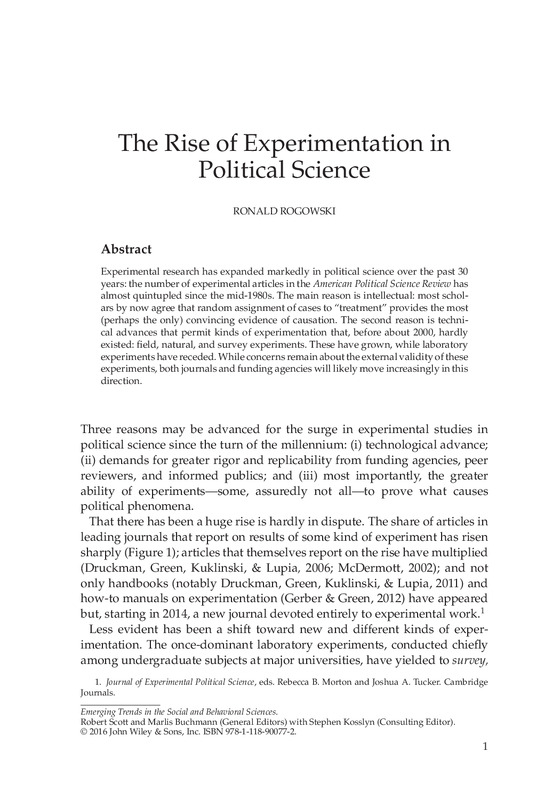
Experimental research has expanded markedly in political science over the past 30 years: the number of experimental articles in the American Political Science Review has almost quintupled since the mid‐1980s. The main reason is intellectual: most scholars by now agree that random assignment of cases to “treatment” provides the most (perhaps the only) convincing evidence of causation. The second reason is technical advances that permit kinds of experimentation that, before about 2000, hardly existed: field, natural, and survey experiments. These have grown, while laboratory experiments have receded. While concerns remain about the external validity of these experiments, both journals and funding agencies will likely move increasingly in this direction.
-
Identifier
-
etrds0409
-
extracted text
-
The Rise of Experimentation in
Political Science
RONALD ROGOWSKI
Abstract
Experimental research has expanded markedly in political science over the past 30
years: the number of experimental articles in the American Political Science Review has
almost quintupled since the mid-1980s. The main reason is intellectual: most scholars by now agree that random assignment of cases to “treatment” provides the most
(perhaps the only) convincing evidence of causation. The second reason is technical advances that permit kinds of experimentation that, before about 2000, hardly
existed: field, natural, and survey experiments. These have grown, while laboratory
experiments have receded. While concerns remain about the external validity of these
experiments, both journals and funding agencies will likely move increasingly in this
direction.
Three reasons may be advanced for the surge in experimental studies in
political science since the turn of the millennium: (i) technological advance;
(ii) demands for greater rigor and replicability from funding agencies, peer
reviewers, and informed publics; and (iii) most importantly, the greater
ability of experiments—some, assuredly not all—to prove what causes
political phenomena.
That there has been a huge rise is hardly in dispute. The share of articles in
leading journals that report on results of some kind of experiment has risen
sharply (Figure 1); articles that themselves report on the rise have multiplied
(Druckman, Green, Kuklinski, & Lupia, 2006; McDermott, 2002); and not
only handbooks (notably Druckman, Green, Kuklinski, & Lupia, 2011) and
how-to manuals on experimentation (Gerber & Green, 2012) have appeared
but, starting in 2014, a new journal devoted entirely to experimental work.1
Less evident has been a shift toward new and different kinds of experimentation. The once-dominant laboratory experiments, conducted chiefly
among undergraduate subjects at major universities, have yielded to survey,
1. Journal of Experimental Political Science, eds. Rebecca B. Morton and Joshua A. Tucker. Cambridge
Journals.
Emerging Trends in the Social and Behavioral Sciences.
Robert Scott and Marlis Buchmann (General Editors) with Stephen Kosslyn (Consulting Editor).
© 2016 John Wiley & Sons, Inc. ISBN 978-1-118-90077-2.
1
�2
EMERGING TRENDS IN THE SOCIAL AND BEHAVIORAL SCIENCES
25
20
15
10
5
19
50
–
19 54
55
–
19 59
60
–
19 64
65
–
19 69
70
–
19 74
75
–
19 79
80
–
19 84
85
–
19 89
90
–
19 94
95
–
20 99
00
–
20 04
05
–
20 09
10
–1
4
0
Figure 1 Experimental Articles in APSR, 1950–2014. (Note: Between 1906 and
1954, no experimental articles appeared.)
field, and “natural” experiments. In each case, the Holy Grail is fully randomized “treatment” of some presumably representative set of subjects. If, for
example, a random subset of voters is allowed to register more conveniently,
by how much, if at all, does the turnout of that “treated” subset change?
The virtue of random assignment, no less in politics than in medicine, is
that it presumably controls for all other sources of variance in the outcome.
If assignment is truly random, then the members of the “control” and the
“treatment” group can differ hardly at all in their composition by gender,
age, political inclination, previous voting history, or indeed any other characteristic. They should of course also not differ in their awareness of whether
they have been “treated,” so most experiments take care to hew to a “single
blind” standard, in which such knowledge is withheld from the subjects; few,
so far, have also attained the medical “gold standard” of double-blindedness
(in which the researchers, too, remain ignorant of who has, and has not, been
treated until the study is complete).
Survey experiments best exemplify the effects of newer technology and most
readily achieve true randomness. Services such as YouGov, now available
in 37 countries (https://yougov.co.uk/about/our-panel/), offer cheap and
ready access to nationally representative panels of Internet responders, who
can then be randomly divided into various treatment and control groups. In
the pioneering study by Michael Tomz and Jessica Weeks (2013), for example,
respondents in the United Kingdom and the United States were presented
with an identical scenario—a hypothetical country is surreptitiously developing a nuclear weapon—and asked whether a preemptive strike was justified. In half the sample, however, the fictitious country was described as a
democracy, and in the other half as an autocracy. In both countries, respondents were far likelier to endorse a preemptive attack against the autocracy,
�The Rise of Experimentation in Political Science
3
thus suggesting a potent reason for the prevalence of the “democratic peace,”
that is, the rarity of armed conflict between democratic states.
What this example also demonstrates, however, along with many others,
is the well-known problem of “external validity,” is the Internet panel fully
representative of the citizenry, would subjects respond in the same way to
an actual crisis as to the hypothetical one, how easily could leaders persuade
them that a threatening democratic state was actually an autocracy, and so
on? We already have some evidence, albeit from a less fraught issue area,
that people’s responses to hypothetical choices fail to predict how they
will behave when faced with the same real choices, with real consequences
(Barabas & Jerit, 2010).
Field experiments face far fewer problems of external validity, approximating as they do the “silver standard” of randomized (but by no means
double-blind) field tests (RFTs; cf. Manzi, 2012, p. 77). In the typical case, as
indeed in what is usually credited as the very first experiment in political
science (Gosnell, 1926), voters, legislators, voting districts, or even the
coverage areas of television stations (Gerber, Gimpel, Green, & Shaw,
2011) are randomly assigned some treatment—a get-out-the vote mailing,
a mailing that invokes peer pressure by listing which of their neighbors
recently voted, a specific television advertisement, the same advertisement
in a different but widely spoken language (usually Spanish)—while others
are assigned a different treatment or no treatment at all. The differences in
response constitute powerful evidence both of the effect (or lack thereof)
and of its magnitude.
Even here, doubts about external validity may arise: would voters in, say,
Kansas respond in the same way as voters have been demonstrated to do in,
for example, Connecticut or Texas? However, the greater obstacles to such
experiments are ones of expense and nondeception. Mailings are expensive,
door-to-door campaigns even more so; ethical researchers cannot run ads or
send mailers that falsely imply they come from a given candidate, political
party, or official agency; nor can the treatment involve untruths (e.g., attributing to a candidate something she never said or a political affiliation he does
not have).
Scholars have proven remarkably adept at avoiding these pitfalls. In “endorsement” surveying, for example, one can state a position that opposing
sides have in fact taken (Taliban vs ASIF; Republicans vs Democrats) but
in half of the sample attribute it solely to one group (e.g., Taliban), in the
other half to their opponents (in this case, ASIF) and in each case ask respondents whether they agree with that position (Lyall, Blair, & Imai, 2013). If
support differs markedly according to which side is named as having “endorsed” the position, that may be taken as tacit support of the one side or the
other. On even more delicate topics, or ones where respondents may fear that
�4
EMERGING TRENDS IN THE SOCIAL AND BEHAVIORAL SCIENCES
their answers will elicit retribution, “list” or “noise-introducing” techniques
may be used (Blair, 2015; Blair, Imai, & Lyall, 2014).2 Equally inventive, and
involving even more delicate issues of funding and of scholarly detachment,
was a pioneering study in which researchers persuaded a primary election
candidate for statewide office in Texas to permit them to assign his different
television ads, in English and in Spanish, randomly to different metropolitan areas (Gerber et al., 2011). Because the campaign was also funding rolling
surveys, it proved possible not only to measure the impact of a given advertisement but the duration of the impact. (For attack ads, the effect waned
quickly.)
Some of the most daring and original field experiments have been
performed in poorer and less stable countries, even in ones that have
experienced recent civil war or genocide. In Rwanda, for example, Paluck
and Green (2009) ascertained, again by random assignment of subjects in
a small set of rural villages that had experienced the genocide, whether
regular viewing of a government-sponsored telenovela that subtly advocated
ethnic reconciliation (vs a “control” set of videos on AIDS prevention)
actually changed expressed attitudes and—far more difficult to pin
down—behaviors.3
Finally, and most controversially, natural experiments have proliferated. In
these, there is no attempt to assign subjects or regions randomly; rather,
evidence is advanced that some exogenous event—the building of an
express highway (Shami, 2012), the drawing or redrawing of state, regional,
or electoral district boundaries (Ansolabehere, Snyder, & Stewart, 2000),
which party held power in London at the time a given Indian province was
subjected to British rule (Banerjee & Iyer, 2005), whether military recruits
from a given area experienced combat (Jha & Wilkinson, 2012)—has yielded
a “quasi-random” assignment of units or persons to “treatment” and
“control” groups. An important subset of natural experiments (although not
always so regarded) involves so-called regression discontinuity analyses, in
which cases on slightly to one side of a “discontinuity” are compared with
those on the other side. In one of the most common examples of such studies,
the researcher compares parliamentary candidates who narrowly won their
2. These techniques obscure the responses of individuals—in that sense, they introduce “noise” into
the “signals” from individual respondents—but still permit valid inference from the set of respondents as
a whole. In the “list” technique, respondents are asked only to indicate how many of the items on a larger
list they endorse, not which ones. In the survey in Afghanistan, for example, the question asked was, “I’m
going to read you a list with the names of different groups and individuals on it. After I read the entire
list, I’d like you to tell me how many of these groups and individuals you broadly support, meaning that
you generally agree with the goals and policies of the group or individual. Please don’t tell me which ones
you generally agree with; only tell me how many groups or individuals you broadly support” (Blair et al.,
2014, p. 1045).
3. Pushed too far, such field experiments raise ethical concerns: Are subjects, for example, being
deceived or being surreptitiously observed? A different concern is that some less developed countries can
become such frequent loci of field experiments that subjects become too knowledgeable, or even jaded.
�The Rise of Experimentation in Political Science
5
seats with rival candidates who narrowly lost. Here the assumption is
maintained that such narrow victories and defeats—whether a candidate
receives 49.9% or 50.1% of the vote—are essentially decided by chance, so
that in all other respects these narrow winners are identical to the narrow
losers. [See, for one recent example, Eggers and Hainmueller (2009).]
Interestingly, one of the earliest known practitioners of the natural experiment was Abraham Lincoln. In the debates in the 1850s over whether to
permit slavery to expand into the territories, Lincoln’s adversary Stephen
Douglas argued that the legal status of slavery did not matter: slavery flourished where soil and climate encouraged plantation agriculture, withered
where they did not. In rebuttal, Lincoln in his famous “Cincinnati Speech” of
September 17, 1859 (Lincoln, 1897) offered a persuasive natural experiment:
Let us take an illustration between the States of Ohio and Kentucky. Kentucky is
separated by this River Ohio, not a mile wide. A portion of Kentucky, by reason
of the course of the Ohio, is further north than this portion of Ohio, in which we
now stand. Kentucky is entirely covered with slavery; Ohio is entirely free from
it. What made that difference? Was it climate? No! A portion of Kentucky was
further north than this portion of Ohio. Was it soil? No! There is nothing in the
soil of the one more favorable to slave labor than the other. It was not climate or
soil that caused one side of the line to be entirely covered with slavery, and the
other side free of it. What was it? Study over it. Tell us, if you can, in all the range
of conjecture, if there be anything you can conceive of that made that difference,
other than that there was no law of any sort keeping it out of Kentucky, while
the Ordinance of ’87 kept it out of Ohio.
Yet, as Lincoln was wise enough to note, the presumption of “quasirandomness” remains always rebuttable in natural experiments. There may
indeed be some difference in “all the range of conjecture” that determines or
explains the contrast between the supposed treatment and control groups,
or that shows them to differ substantially from each other in some way
that random assignment could not yield. If, in a regression discontinuity
analysis, three-quarters of the narrow victories in Congressional races go to
Republicans, while three-quarters of the narrow losers are Democrats, the
quasi-random assumption is violated in an important way. If the systems
of land tenure imposed by the British in India resulted more from preexisting post-Mughal institutions than from the colonial masters’ prevailing
ideology (Foa, 2015), we can no longer assume random assignment. Had
it been the case—and the authors take care to show that it was not—that
combat experience of Indian soldiers in World War II had been confined
largely to groups that the British had regarded as “warlike castes,” again the
assignment to treatment or control would have been far from random.
�6
EMERGING TRENDS IN THE SOCIAL AND BEHAVIORAL SCIENCES
Trenchant criticisms of some early natural experiments along these lines
have been raised, most pithily in an article aptly entitled, “When ‘Natural
Experiments’ Are Neither Natural nor Experiments” [Sekhon and Titiunik
(2012); but see also Imai, Keele, Tingley, and Yamamoto (2011)]. Such exposés
by no means rule out natural experiments—Lincoln’s remains persuasive to
the present day—but they do raise a warning flag: one must demonstrate
convincingly that a “quasi” (literally: “as if”) random assignment has a high
likelihood of being close to random.
In a few extraordinarily lucky instances, a natural experiment offers full
and undoubted randomization. Robert F. Erikson and Laura Stoker (2011), for
example, exploited the Vietnam-era draft lottery, in which men’s birthdays
were literally chosen by being drawn from a rotating drum, to establish that
having been assigned a low “draft number” and, hence exposed to a risk of
conscription, was strongly and enduringly associated with more pacifist and
leftist political attitudes.
Finally, laboratory experiments continue to be performed, but they seem to
be fading from the mainstream journals. From 2012 to the present (Autumn
2015), for example, only two articles based on laboratory experiments have
appeared in the APSR, about 10% of the total number of experimental
papers published during that time. What seems to have undermined this
kind of experimental work is a growing skepticism about its external
validity: do ordinary people, or actual decision-makers, behave in the
same way as undergraduate subjects sitting before a computer? In some
cases, practitioners of this approach have actually tried to buttress their
findings by replicating their studies among more representative subjects.
Laboratory experiments probably convince best when they tap basic human
characteristics—our propensity to miscalculate odds, or to draw false
inferences by “thinking fast” (Kahneman, 2011)—rather than specifically
political reactions. In other words, it seems that laboratory experiments are
migrating to the domain of psychology and away from political science.
The trend therefore is clear; but what has driven it? The first factor, as mentioned earlier, is simply improved technology. By a corollary of “Moore’s
Law,” computerization has made all kinds of experiments cheaper and easier to do, albeit by varying margins. Survey experiments would have been
impossible, or at the very least prohibitively expensive, in the precomputer
age. Field experiments have been aided by video technology, smart phones
(e.g., to register responses instantly or to photograph electoral irregularities),
and faster communications from the field to a central data-gathering point.
Even laboratory experiments have benefited significantly: subjects who once
registered their responses laboriously, often on paper, now do so instantly
from a computer screen. In addition, natural experiments are more easily
elicited through such innovations as digitized archives and GIS mapping.
�The Rise of Experimentation in Political Science
7
A second factor, often underestimated, has involved demands from politicians, opinion makers, and even informed publics for clearer, more convincing, and more reliable findings, ones on which policymakers can actually
rely. The critic Jim Manzi (2012), whose work the New York Times columnist David Brooks (2012) popularized, contends that in the most important
recent crises—the Great Recession, the Iranian nuclear threat, rising income
inequality, overtime variations in crime rates—the social sciences, including
economics, have relied on models that, while “useful” and “interesting,” do
“not establish a causal relationship with sufficient certainty to [permit] rational prediction of the effect of a change in policy (Manzi, 2012, p. 105).” In his
view, only fully randomized testing can establish causation with sufficient
certainty; and such testing must set itself more modest goals, elucidating
pieces of the puzzle—as, in fact, most recent experiments do.
While much of the rising political opposition to governmental funding of
the social sciences betrays simply a “shoot the messenger” attitude toward
findings the politicians or opinion leaders dislike (cf. Rogowski, 2013), political science in particular renders itself vulnerable to attack on precisely the
ground Manzi and Brooks suggest: weak and tentative causal inference, occasioned entirely by lack of fully randomized testing. To draw an unhappy
parallel, if medicine still relied on anecdote and induction, the National Institutes of Health might be similarly subject to political attack. Even massively
evidence-supported science, of course, can be attacked by the ignorant, the
deluded, or the meretricious4 —think only of the current controversies over
global warming, vaccines, and genetically modified organisms—but refuting
such nonsense is far easier if the truth is supported by extensive and repeated
randomized tests, as for example in the case of the vaccine controversy.
Peer reviewers for major journals in political science, to judge by the
experience of the APSR and other leading outlets, have begun, if not to
reject other modes of inquiry, to credit far more the findings of experimental
research. More specifically, the now-frequent criticism of endogeneity, that
is, of possible reverse causation or of causation of two correlated variables
from a third factor not considered, has felled many an otherwise convincing
paper;5 and the by-now conventional answer of employing a clearly exogenous instrumental variable (IV) can never be as convincing as a randomized
experiment—although, of course, such experimentation is hardly possible
in the case of historical data.
4. Thus tobacco companies massively funded research that cast doubt on the link (which they knew
perfectly well to be irrefutable) between smoking and lung cancer; and, in more recent years, large oil companies have sought to create controversy over man-made global warming, while in private they not only
accepted its reality but were taking measures to protect their own investments against such consequences
as rising ocean levels (Krauss, 2015; Lieberman & Rust, 2015).
5. I speak here, albeit only impressionistically, from my 4-year experience (2008–2012) as lead editor
of the APSR.
�8
EMERGING TRENDS IN THE SOCIAL AND BEHAVIORAL SCIENCES
The National Science Foundation (NSF) is moving only glacially in this
direction, likely to its political detriment. Of 237 NSF political science awards
with start dates in the 4 years between September 1, 2011 and August 31, 2015,
16, or not quite 7%, included the words “experiment” or “experimental” in
their titles, and the trend appeared virtually flat: 6% in the first 2 years, just
under 8% in the last two.6 Yet as it becomes evident that the few experimental projects they have funded have been among those with highest impact,
and as it becomes more urgent to fend off political attacks, one suspects that
a greater share of funding will go to experimental work. For now, however,
some of the most startling and fine-grained studies, including notably the
one from the Texas primary election, are being funded by campaigns, other
private sources, or smaller foundations.
The parallel shift in economics, albeit more recent, seems also to be more
rapid, particularly in development economics, where the work of Abhijit
Banerjee and Esther Duflo (2011) has proved revolutionary and is rapidly
coming to dominate. The World Bank, the Inter-American Development
Bank, and the governments of Indonesia and India, among many others,
have tested policy innovations through randomized controlled trials (RCTs)
(Economist, 2013, 2015).
The final advantage, and certainly the most important one, is sheer scientific beauty and honesty. We understand almost immediately that a fully
randomized experiment convinces us as no nonexperimental method can.
At their best, the findings of randomized experiments in political science are
as exciting and important as those of the earliest ones in medicine—which,
surprisingly, date only from the late 1930s (Manzi, 2012, Chapter 7).
It should go without saying that many important questions in political science, especially ones of historical causation, cannot be addressed by randomized trial—although even in cases from the past, there is great value in
searching, as Lincoln did and Banerjee and Iyer have done, for some natural experiment. Other large questions will have to be addressed piecemeal:
Tomz and Weeks have by no means solved the whole puzzle of the democratic peace, but they have certainly shed important light on how much of it
is due, precisely as Immanuel Kant originally argued, to citizens’ reluctance,
on both moral and practical grounds, to enter combat with another democracy. Furthermore, we do not know whether, in general, exposing citizens to
the risks of combat by conscription makes them in later years more bellicose
or more pacific (or neither); but thanks to Erikson and Stokes, we now know
for certain that, in the case of the United States during the Vietnam war, it
made potential draftees lastingly more pacific.
6. Search on NSF Awards database (http://www.nsf.gov/awardsearch/), using “advanced search”
function and keying for SBE Directorate and Program “political science,” within the specified dates. Search
conducted on October 16, 2015.
�The Rise of Experimentation in Political Science
9
It requires little courage to make bold predictions about a future in which
one will no longer be alive, but I will at least speculate that, 50 years from
now, experimentation will play much the same role in political science as
it now does in medicine, and with similar results in public confidence and
material support. If I am wrong, and if political science remains a largely
nonexperimental science, it will continue to be treated with skepticism and
stinginess—and, I fear, rightly so.
REFERENCES
Ansolabehere, S., Snyder, J. M., Jr., & Stewart, C., III, (2000). Old voters, new voters,
and the personal vote. American Journal of Political Science, 44, 17–34.
Banerjee, A., & Duflo, E. (2011). Poor economics: A radical rethinking of the way to fight
global poverty. New York, NY: PublicAffairs.
Banerjee, A., & Iyer, L. (2005). History, institutions, and economic performance: The
legacy of colonial land tenure systems in India. American Economic Review, 95,
1190–1213.
Barabas, J., & Jerit, J. (2010). Are survey experiments externally valid? American Political Science Review, 104, 226–242.
Blair, G. (2015). Survey methods for sensitive topics. APSA Comparative Politics
Newsletter.
Blair, G., Imai, K., & Lyall, J. (2014). Comparing and combining list and endorsement
experiments: Evidence from Afghanistan. American Journal of Political Science, 58,
1043–1063.
Brooks, D. (2012). Is our children learning? The New York Times, 26 April.
Druckman, J. N., Green, D. P., Kuklinski, J. H., & Lupia, A. (2006). The growth and
development of experimental research in political science. American Political Science Review, 100, 627–635.
Druckman, J. N., Green, D. P., Kuklinski, J. H., & Lupia, A. (Eds.) (2011). Cambridge
handbook of experimental political science. Cambridge, England: Cambridge University Press.
Economist. (2013). Random harvest: Once treated with scorn, randomised control
trials [sic] are coming of age. 14 December.
Economist. (2015). Randomized controlled trials: measure for measure. 12 December.
Eggers, A. C., & Hainmueller, J. (2009). MPs for sale? Returns to office in postwar
British politics. American Political Science Review, 103, 1–21.
Erikson, R. F., & Stoker, L. (2011). Caught in the draft: The effects of Vietnam draft
lottery status on political attitudes. American Political Science Review, 105, 221–237.
Foa, R. (2015). The pre-colonial origins of state capacity: Evidence from Indian districts.
Delivered at annual meeting of the American political science association, San
Francisco.
Gerber, A., Gimpel, J. G., Green, D. P., & Shaw, D. R. (2011). How large and
long-lasting are the persuasive effects of televised campaign ads? Results from
a randomized field experiment. American Political Science Review, 105, 135–150.
�10
EMERGING TRENDS IN THE SOCIAL AND BEHAVIORAL SCIENCES
Gerber, A., & Green, D. P. (2012). Field experiments: Design, analysis, and interpretation.
New York, NY: W. W. Norton & Co.
Gosnell, H. F. (1926). An experiment in the stimulation of voting. American Political
Science Review, 20, 869–874.
Imai, K., Keele, L., Tingley, D., & Yamamoto, T. (2011). Unpacking the black box
of causality: Learning about causal mechanisms from experimental and observational studies. American Political Science Review, 105, 765–789.
Jha, S., & Wilkinson, S. (2012). Does combat experience foster organizational skill?
Evidence from ethnic cleansing during the Partition of South Asia. American Political Science Review, 106, 883–907.
Kahneman, D. (2011). Thinking fast and slow. New York, NY: Farrar, Straus, and
Giroux.
Krauss, C. (2015). More oil companies could join Exxon Mobil as focus of climate
investigations. New York Times, 6 November.
Lieberman, A., & Rust, S. (2015). Big oil companies united to fight regulations – but
spent millions bracing for climate change. Los Angeles Times, 31 December.
Lincoln, A. (1897). Political debates between Lincoln and Douglas. Cleveland, OH: Burrows Bros. Co., 1897; Bartleby.com, 2001. Retrieved from www.bartleby.com/251/.
Lyall, J., Blair, G., & Imai, K. (2013). Explaining support for combatants during
wartime: A survey experiment in Afghanistan. American Political Science Review,
107, 679–705.
McDermott, R. (2002). Experimental methods in political science. Annual Review of
Political Science, 5, 31–61.
Manzi, J. (2012). Uncontrolled: The surprising payoff of trial-and-error for business, politics,
and society. New York, NY: Basic Books.
Paluck, E. L., & Green, D. P. (2009). Deference, dissent, and dispute resolution: An
experimental intervention using mass media to change norms and behavior in
Rwanda. American Political Science Review, 103, 622–644.
Rogowski, R. (2013). Shooting (or ignoring) the messenger. Political Studies Review,
11, 216–221.
Sekhon, J. S., & Titiunik, R. (2012). When natural experiments are neither natural nor
experiments. American Political Science Review, 106, 35–57.
Shami, M. (2012). Collective action, clientelism, and connectivity. American Political
Science Review, 106, 588–606.
Tomz, M., & Weeks, J. (2013). Public opinion and the democratic peace. American
Political Science Review, 107, 849–865.
RONALD ROGOWSKI SHORT BIOGRAPHY
Ronald Rogowski is a professor and former chair of political science at
UCLA and served from 2007 to 2012 as lead editor of the American Political
Science Review. He currently serves also part-time as visiting global distinguished professor at New York University, Abu Dhabi. He studied Political
Science, Mathematics, and Sociology at the University of Nebraska, Princeton, Berlin, and Bonn. He has taught at Princeton, Duke, and Minnesota
�The Rise of Experimentation in Political Science
11
and has held research appointments at Harvard, the Center for Advanced
Study in the Behavioral Sciences, and the Wissenschaftskolleg zu Berlin.
His principal books are Rational Legitimacy, Commerce and Coalitions, and
(with Eric Chang, Mark Kayser, and Drew Linzer) Electoral Systems and
the Balance of Consumer-Producer Power. He has worked most recently
on (i) economic consequences of electoral systems (in addition to the book,
articles in AJPS, JOP, BJPS); (ii) inequality and institutions, including a recent
article on the economics and politics of slavery; and (iii) how the economic
downturn of 2008–2009 affected the economies and the voting behavior of
regions within the European Union. He has served as a vice president of the
American Political Science Association and was elected in 1994 as a Fellow
of the American Academy of Arts and Sciences.
RELATED ESSAYS
To Flop Is Human: Inventing Better Scientific Approaches to Anticipating
Failure (Methods), Robert Boruch and Alan Ruby
Repeated Cross-Sections in Survey Data (Methods), Henry E. Brady and
Richard Johnston
Network Research Experiments (Methods), Allen L. Linton and Betsy Sinclair
Content Analysis (Methods), Steven E. Stemler
Quasi-Experiments (Methods), Charles S. Reichardt
Virtual Worlds as Laboratories (Methods), Travis L. Ross et al.
�
-
The Rise of Experimentation in
Political Science
RONALD ROGOWSKI
Abstract
Experimental research has expanded markedly in political science over the past 30
years: the number of experimental articles in the American Political Science Review has
almost quintupled since the mid-1980s. The main reason is intellectual: most scholars by now agree that random assignment of cases to “treatment” provides the most
(perhaps the only) convincing evidence of causation. The second reason is technical advances that permit kinds of experimentation that, before about 2000, hardly
existed: field, natural, and survey experiments. These have grown, while laboratory
experiments have receded. While concerns remain about the external validity of these
experiments, both journals and funding agencies will likely move increasingly in this
direction.
Three reasons may be advanced for the surge in experimental studies in
political science since the turn of the millennium: (i) technological advance;
(ii) demands for greater rigor and replicability from funding agencies, peer
reviewers, and informed publics; and (iii) most importantly, the greater
ability of experiments—some, assuredly not all—to prove what causes
political phenomena.
That there has been a huge rise is hardly in dispute. The share of articles in
leading journals that report on results of some kind of experiment has risen
sharply (Figure 1); articles that themselves report on the rise have multiplied
(Druckman, Green, Kuklinski, & Lupia, 2006; McDermott, 2002); and not
only handbooks (notably Druckman, Green, Kuklinski, & Lupia, 2011) and
how-to manuals on experimentation (Gerber & Green, 2012) have appeared
but, starting in 2014, a new journal devoted entirely to experimental work.1
Less evident has been a shift toward new and different kinds of experimentation. The once-dominant laboratory experiments, conducted chiefly
among undergraduate subjects at major universities, have yielded to survey,
1. Journal of Experimental Political Science, eds. Rebecca B. Morton and Joshua A. Tucker. Cambridge
Journals.
Emerging Trends in the Social and Behavioral Sciences.
Robert Scott and Marlis Buchmann (General Editors) with Stephen Kosslyn (Consulting Editor).
© 2016 John Wiley & Sons, Inc. ISBN 978-1-118-90077-2.
1
�2
EMERGING TRENDS IN THE SOCIAL AND BEHAVIORAL SCIENCES
25
20
15
10
5
19
50
–
19 54
55
–
19 59
60
–
19 64
65
–
19 69
70
–
19 74
75
–
19 79
80
–
19 84
85
–
19 89
90
–
19 94
95
–
20 99
00
–
20 04
05
–
20 09
10
–1
4
0
Figure 1 Experimental Articles in APSR, 1950–2014. (Note: Between 1906 and
1954, no experimental articles appeared.)
field, and “natural” experiments. In each case, the Holy Grail is fully randomized “treatment” of some presumably representative set of subjects. If, for
example, a random subset of voters is allowed to register more conveniently,
by how much, if at all, does the turnout of that “treated” subset change?
The virtue of random assignment, no less in politics than in medicine, is
that it presumably controls for all other sources of variance in the outcome.
If assignment is truly random, then the members of the “control” and the
“treatment” group can differ hardly at all in their composition by gender,
age, political inclination, previous voting history, or indeed any other characteristic. They should of course also not differ in their awareness of whether
they have been “treated,” so most experiments take care to hew to a “single
blind” standard, in which such knowledge is withheld from the subjects; few,
so far, have also attained the medical “gold standard” of double-blindedness
(in which the researchers, too, remain ignorant of who has, and has not, been
treated until the study is complete).
Survey experiments best exemplify the effects of newer technology and most
readily achieve true randomness. Services such as YouGov, now available
in 37 countries (https://yougov.co.uk/about/our-panel/), offer cheap and
ready access to nationally representative panels of Internet responders, who
can then be randomly divided into various treatment and control groups. In
the pioneering study by Michael Tomz and Jessica Weeks (2013), for example,
respondents in the United Kingdom and the United States were presented
with an identical scenario—a hypothetical country is surreptitiously developing a nuclear weapon—and asked whether a preemptive strike was justified. In half the sample, however, the fictitious country was described as a
democracy, and in the other half as an autocracy. In both countries, respondents were far likelier to endorse a preemptive attack against the autocracy,
�The Rise of Experimentation in Political Science
3
thus suggesting a potent reason for the prevalence of the “democratic peace,”
that is, the rarity of armed conflict between democratic states.
What this example also demonstrates, however, along with many others,
is the well-known problem of “external validity,” is the Internet panel fully
representative of the citizenry, would subjects respond in the same way to
an actual crisis as to the hypothetical one, how easily could leaders persuade
them that a threatening democratic state was actually an autocracy, and so
on? We already have some evidence, albeit from a less fraught issue area,
that people’s responses to hypothetical choices fail to predict how they
will behave when faced with the same real choices, with real consequences
(Barabas & Jerit, 2010).
Field experiments face far fewer problems of external validity, approximating as they do the “silver standard” of randomized (but by no means
double-blind) field tests (RFTs; cf. Manzi, 2012, p. 77). In the typical case, as
indeed in what is usually credited as the very first experiment in political
science (Gosnell, 1926), voters, legislators, voting districts, or even the
coverage areas of television stations (Gerber, Gimpel, Green, & Shaw,
2011) are randomly assigned some treatment—a get-out-the vote mailing,
a mailing that invokes peer pressure by listing which of their neighbors
recently voted, a specific television advertisement, the same advertisement
in a different but widely spoken language (usually Spanish)—while others
are assigned a different treatment or no treatment at all. The differences in
response constitute powerful evidence both of the effect (or lack thereof)
and of its magnitude.
Even here, doubts about external validity may arise: would voters in, say,
Kansas respond in the same way as voters have been demonstrated to do in,
for example, Connecticut or Texas? However, the greater obstacles to such
experiments are ones of expense and nondeception. Mailings are expensive,
door-to-door campaigns even more so; ethical researchers cannot run ads or
send mailers that falsely imply they come from a given candidate, political
party, or official agency; nor can the treatment involve untruths (e.g., attributing to a candidate something she never said or a political affiliation he does
not have).
Scholars have proven remarkably adept at avoiding these pitfalls. In “endorsement” surveying, for example, one can state a position that opposing
sides have in fact taken (Taliban vs ASIF; Republicans vs Democrats) but
in half of the sample attribute it solely to one group (e.g., Taliban), in the
other half to their opponents (in this case, ASIF) and in each case ask respondents whether they agree with that position (Lyall, Blair, & Imai, 2013). If
support differs markedly according to which side is named as having “endorsed” the position, that may be taken as tacit support of the one side or the
other. On even more delicate topics, or ones where respondents may fear that
�4
EMERGING TRENDS IN THE SOCIAL AND BEHAVIORAL SCIENCES
their answers will elicit retribution, “list” or “noise-introducing” techniques
may be used (Blair, 2015; Blair, Imai, & Lyall, 2014).2 Equally inventive, and
involving even more delicate issues of funding and of scholarly detachment,
was a pioneering study in which researchers persuaded a primary election
candidate for statewide office in Texas to permit them to assign his different
television ads, in English and in Spanish, randomly to different metropolitan areas (Gerber et al., 2011). Because the campaign was also funding rolling
surveys, it proved possible not only to measure the impact of a given advertisement but the duration of the impact. (For attack ads, the effect waned
quickly.)
Some of the most daring and original field experiments have been
performed in poorer and less stable countries, even in ones that have
experienced recent civil war or genocide. In Rwanda, for example, Paluck
and Green (2009) ascertained, again by random assignment of subjects in
a small set of rural villages that had experienced the genocide, whether
regular viewing of a government-sponsored telenovela that subtly advocated
ethnic reconciliation (vs a “control” set of videos on AIDS prevention)
actually changed expressed attitudes and—far more difficult to pin
down—behaviors.3
Finally, and most controversially, natural experiments have proliferated. In
these, there is no attempt to assign subjects or regions randomly; rather,
evidence is advanced that some exogenous event—the building of an
express highway (Shami, 2012), the drawing or redrawing of state, regional,
or electoral district boundaries (Ansolabehere, Snyder, & Stewart, 2000),
which party held power in London at the time a given Indian province was
subjected to British rule (Banerjee & Iyer, 2005), whether military recruits
from a given area experienced combat (Jha & Wilkinson, 2012)—has yielded
a “quasi-random” assignment of units or persons to “treatment” and
“control” groups. An important subset of natural experiments (although not
always so regarded) involves so-called regression discontinuity analyses, in
which cases on slightly to one side of a “discontinuity” are compared with
those on the other side. In one of the most common examples of such studies,
the researcher compares parliamentary candidates who narrowly won their
2. These techniques obscure the responses of individuals—in that sense, they introduce “noise” into
the “signals” from individual respondents—but still permit valid inference from the set of respondents as
a whole. In the “list” technique, respondents are asked only to indicate how many of the items on a larger
list they endorse, not which ones. In the survey in Afghanistan, for example, the question asked was, “I’m
going to read you a list with the names of different groups and individuals on it. After I read the entire
list, I’d like you to tell me how many of these groups and individuals you broadly support, meaning that
you generally agree with the goals and policies of the group or individual. Please don’t tell me which ones
you generally agree with; only tell me how many groups or individuals you broadly support” (Blair et al.,
2014, p. 1045).
3. Pushed too far, such field experiments raise ethical concerns: Are subjects, for example, being
deceived or being surreptitiously observed? A different concern is that some less developed countries can
become such frequent loci of field experiments that subjects become too knowledgeable, or even jaded.
�The Rise of Experimentation in Political Science
5
seats with rival candidates who narrowly lost. Here the assumption is
maintained that such narrow victories and defeats—whether a candidate
receives 49.9% or 50.1% of the vote—are essentially decided by chance, so
that in all other respects these narrow winners are identical to the narrow
losers. [See, for one recent example, Eggers and Hainmueller (2009).]
Interestingly, one of the earliest known practitioners of the natural experiment was Abraham Lincoln. In the debates in the 1850s over whether to
permit slavery to expand into the territories, Lincoln’s adversary Stephen
Douglas argued that the legal status of slavery did not matter: slavery flourished where soil and climate encouraged plantation agriculture, withered
where they did not. In rebuttal, Lincoln in his famous “Cincinnati Speech” of
September 17, 1859 (Lincoln, 1897) offered a persuasive natural experiment:
Let us take an illustration between the States of Ohio and Kentucky. Kentucky is
separated by this River Ohio, not a mile wide. A portion of Kentucky, by reason
of the course of the Ohio, is further north than this portion of Ohio, in which we
now stand. Kentucky is entirely covered with slavery; Ohio is entirely free from
it. What made that difference? Was it climate? No! A portion of Kentucky was
further north than this portion of Ohio. Was it soil? No! There is nothing in the
soil of the one more favorable to slave labor than the other. It was not climate or
soil that caused one side of the line to be entirely covered with slavery, and the
other side free of it. What was it? Study over it. Tell us, if you can, in all the range
of conjecture, if there be anything you can conceive of that made that difference,
other than that there was no law of any sort keeping it out of Kentucky, while
the Ordinance of ’87 kept it out of Ohio.
Yet, as Lincoln was wise enough to note, the presumption of “quasirandomness” remains always rebuttable in natural experiments. There may
indeed be some difference in “all the range of conjecture” that determines or
explains the contrast between the supposed treatment and control groups,
or that shows them to differ substantially from each other in some way
that random assignment could not yield. If, in a regression discontinuity
analysis, three-quarters of the narrow victories in Congressional races go to
Republicans, while three-quarters of the narrow losers are Democrats, the
quasi-random assumption is violated in an important way. If the systems
of land tenure imposed by the British in India resulted more from preexisting post-Mughal institutions than from the colonial masters’ prevailing
ideology (Foa, 2015), we can no longer assume random assignment. Had
it been the case—and the authors take care to show that it was not—that
combat experience of Indian soldiers in World War II had been confined
largely to groups that the British had regarded as “warlike castes,” again the
assignment to treatment or control would have been far from random.
�6
EMERGING TRENDS IN THE SOCIAL AND BEHAVIORAL SCIENCES
Trenchant criticisms of some early natural experiments along these lines
have been raised, most pithily in an article aptly entitled, “When ‘Natural
Experiments’ Are Neither Natural nor Experiments” [Sekhon and Titiunik
(2012); but see also Imai, Keele, Tingley, and Yamamoto (2011)]. Such exposés
by no means rule out natural experiments—Lincoln’s remains persuasive to
the present day—but they do raise a warning flag: one must demonstrate
convincingly that a “quasi” (literally: “as if”) random assignment has a high
likelihood of being close to random.
In a few extraordinarily lucky instances, a natural experiment offers full
and undoubted randomization. Robert F. Erikson and Laura Stoker (2011), for
example, exploited the Vietnam-era draft lottery, in which men’s birthdays
were literally chosen by being drawn from a rotating drum, to establish that
having been assigned a low “draft number” and, hence exposed to a risk of
conscription, was strongly and enduringly associated with more pacifist and
leftist political attitudes.
Finally, laboratory experiments continue to be performed, but they seem to
be fading from the mainstream journals. From 2012 to the present (Autumn
2015), for example, only two articles based on laboratory experiments have
appeared in the APSR, about 10% of the total number of experimental
papers published during that time. What seems to have undermined this
kind of experimental work is a growing skepticism about its external
validity: do ordinary people, or actual decision-makers, behave in the
same way as undergraduate subjects sitting before a computer? In some
cases, practitioners of this approach have actually tried to buttress their
findings by replicating their studies among more representative subjects.
Laboratory experiments probably convince best when they tap basic human
characteristics—our propensity to miscalculate odds, or to draw false
inferences by “thinking fast” (Kahneman, 2011)—rather than specifically
political reactions. In other words, it seems that laboratory experiments are
migrating to the domain of psychology and away from political science.
The trend therefore is clear; but what has driven it? The first factor, as mentioned earlier, is simply improved technology. By a corollary of “Moore’s
Law,” computerization has made all kinds of experiments cheaper and easier to do, albeit by varying margins. Survey experiments would have been
impossible, or at the very least prohibitively expensive, in the precomputer
age. Field experiments have been aided by video technology, smart phones
(e.g., to register responses instantly or to photograph electoral irregularities),
and faster communications from the field to a central data-gathering point.
Even laboratory experiments have benefited significantly: subjects who once
registered their responses laboriously, often on paper, now do so instantly
from a computer screen. In addition, natural experiments are more easily
elicited through such innovations as digitized archives and GIS mapping.
�The Rise of Experimentation in Political Science
7
A second factor, often underestimated, has involved demands from politicians, opinion makers, and even informed publics for clearer, more convincing, and more reliable findings, ones on which policymakers can actually
rely. The critic Jim Manzi (2012), whose work the New York Times columnist David Brooks (2012) popularized, contends that in the most important
recent crises—the Great Recession, the Iranian nuclear threat, rising income
inequality, overtime variations in crime rates—the social sciences, including
economics, have relied on models that, while “useful” and “interesting,” do
“not establish a causal relationship with sufficient certainty to [permit] rational prediction of the effect of a change in policy (Manzi, 2012, p. 105).” In his
view, only fully randomized testing can establish causation with sufficient
certainty; and such testing must set itself more modest goals, elucidating
pieces of the puzzle—as, in fact, most recent experiments do.
While much of the rising political opposition to governmental funding of
the social sciences betrays simply a “shoot the messenger” attitude toward
findings the politicians or opinion leaders dislike (cf. Rogowski, 2013), political science in particular renders itself vulnerable to attack on precisely the
ground Manzi and Brooks suggest: weak and tentative causal inference, occasioned entirely by lack of fully randomized testing. To draw an unhappy
parallel, if medicine still relied on anecdote and induction, the National Institutes of Health might be similarly subject to political attack. Even massively
evidence-supported science, of course, can be attacked by the ignorant, the
deluded, or the meretricious4 —think only of the current controversies over
global warming, vaccines, and genetically modified organisms—but refuting
such nonsense is far easier if the truth is supported by extensive and repeated
randomized tests, as for example in the case of the vaccine controversy.
Peer reviewers for major journals in political science, to judge by the
experience of the APSR and other leading outlets, have begun, if not to
reject other modes of inquiry, to credit far more the findings of experimental
research. More specifically, the now-frequent criticism of endogeneity, that
is, of possible reverse causation or of causation of two correlated variables
from a third factor not considered, has felled many an otherwise convincing
paper;5 and the by-now conventional answer of employing a clearly exogenous instrumental variable (IV) can never be as convincing as a randomized
experiment—although, of course, such experimentation is hardly possible
in the case of historical data.
4. Thus tobacco companies massively funded research that cast doubt on the link (which they knew
perfectly well to be irrefutable) between smoking and lung cancer; and, in more recent years, large oil companies have sought to create controversy over man-made global warming, while in private they not only
accepted its reality but were taking measures to protect their own investments against such consequences
as rising ocean levels (Krauss, 2015; Lieberman & Rust, 2015).
5. I speak here, albeit only impressionistically, from my 4-year experience (2008–2012) as lead editor
of the APSR.
�8
EMERGING TRENDS IN THE SOCIAL AND BEHAVIORAL SCIENCES
The National Science Foundation (NSF) is moving only glacially in this
direction, likely to its political detriment. Of 237 NSF political science awards
with start dates in the 4 years between September 1, 2011 and August 31, 2015,
16, or not quite 7%, included the words “experiment” or “experimental” in
their titles, and the trend appeared virtually flat: 6% in the first 2 years, just
under 8% in the last two.6 Yet as it becomes evident that the few experimental projects they have funded have been among those with highest impact,
and as it becomes more urgent to fend off political attacks, one suspects that
a greater share of funding will go to experimental work. For now, however,
some of the most startling and fine-grained studies, including notably the
one from the Texas primary election, are being funded by campaigns, other
private sources, or smaller foundations.
The parallel shift in economics, albeit more recent, seems also to be more
rapid, particularly in development economics, where the work of Abhijit
Banerjee and Esther Duflo (2011) has proved revolutionary and is rapidly
coming to dominate. The World Bank, the Inter-American Development
Bank, and the governments of Indonesia and India, among many others,
have tested policy innovations through randomized controlled trials (RCTs)
(Economist, 2013, 2015).
The final advantage, and certainly the most important one, is sheer scientific beauty and honesty. We understand almost immediately that a fully
randomized experiment convinces us as no nonexperimental method can.
At their best, the findings of randomized experiments in political science are
as exciting and important as those of the earliest ones in medicine—which,
surprisingly, date only from the late 1930s (Manzi, 2012, Chapter 7).
It should go without saying that many important questions in political science, especially ones of historical causation, cannot be addressed by randomized trial—although even in cases from the past, there is great value in
searching, as Lincoln did and Banerjee and Iyer have done, for some natural experiment. Other large questions will have to be addressed piecemeal:
Tomz and Weeks have by no means solved the whole puzzle of the democratic peace, but they have certainly shed important light on how much of it
is due, precisely as Immanuel Kant originally argued, to citizens’ reluctance,
on both moral and practical grounds, to enter combat with another democracy. Furthermore, we do not know whether, in general, exposing citizens to
the risks of combat by conscription makes them in later years more bellicose
or more pacific (or neither); but thanks to Erikson and Stokes, we now know
for certain that, in the case of the United States during the Vietnam war, it
made potential draftees lastingly more pacific.
6. Search on NSF Awards database (http://www.nsf.gov/awardsearch/), using “advanced search”
function and keying for SBE Directorate and Program “political science,” within the specified dates. Search
conducted on October 16, 2015.
�The Rise of Experimentation in Political Science
9
It requires little courage to make bold predictions about a future in which
one will no longer be alive, but I will at least speculate that, 50 years from
now, experimentation will play much the same role in political science as
it now does in medicine, and with similar results in public confidence and
material support. If I am wrong, and if political science remains a largely
nonexperimental science, it will continue to be treated with skepticism and
stinginess—and, I fear, rightly so.
REFERENCES
Ansolabehere, S., Snyder, J. M., Jr., & Stewart, C., III, (2000). Old voters, new voters,
and the personal vote. American Journal of Political Science, 44, 17–34.
Banerjee, A., & Duflo, E. (2011). Poor economics: A radical rethinking of the way to fight
global poverty. New York, NY: PublicAffairs.
Banerjee, A., & Iyer, L. (2005). History, institutions, and economic performance: The
legacy of colonial land tenure systems in India. American Economic Review, 95,
1190–1213.
Barabas, J., & Jerit, J. (2010). Are survey experiments externally valid? American Political Science Review, 104, 226–242.
Blair, G. (2015). Survey methods for sensitive topics. APSA Comparative Politics
Newsletter.
Blair, G., Imai, K., & Lyall, J. (2014). Comparing and combining list and endorsement
experiments: Evidence from Afghanistan. American Journal of Political Science, 58,
1043–1063.
Brooks, D. (2012). Is our children learning? The New York Times, 26 April.
Druckman, J. N., Green, D. P., Kuklinski, J. H., & Lupia, A. (2006). The growth and
development of experimental research in political science. American Political Science Review, 100, 627–635.
Druckman, J. N., Green, D. P., Kuklinski, J. H., & Lupia, A. (Eds.) (2011). Cambridge
handbook of experimental political science. Cambridge, England: Cambridge University Press.
Economist. (2013). Random harvest: Once treated with scorn, randomised control
trials [sic] are coming of age. 14 December.
Economist. (2015). Randomized controlled trials: measure for measure. 12 December.
Eggers, A. C., & Hainmueller, J. (2009). MPs for sale? Returns to office in postwar
British politics. American Political Science Review, 103, 1–21.
Erikson, R. F., & Stoker, L. (2011). Caught in the draft: The effects of Vietnam draft
lottery status on political attitudes. American Political Science Review, 105, 221–237.
Foa, R. (2015). The pre-colonial origins of state capacity: Evidence from Indian districts.
Delivered at annual meeting of the American political science association, San
Francisco.
Gerber, A., Gimpel, J. G., Green, D. P., & Shaw, D. R. (2011). How large and
long-lasting are the persuasive effects of televised campaign ads? Results from
a randomized field experiment. American Political Science Review, 105, 135–150.
�10
EMERGING TRENDS IN THE SOCIAL AND BEHAVIORAL SCIENCES
Gerber, A., & Green, D. P. (2012). Field experiments: Design, analysis, and interpretation.
New York, NY: W. W. Norton & Co.
Gosnell, H. F. (1926). An experiment in the stimulation of voting. American Political
Science Review, 20, 869–874.
Imai, K., Keele, L., Tingley, D., & Yamamoto, T. (2011). Unpacking the black box
of causality: Learning about causal mechanisms from experimental and observational studies. American Political Science Review, 105, 765–789.
Jha, S., & Wilkinson, S. (2012). Does combat experience foster organizational skill?
Evidence from ethnic cleansing during the Partition of South Asia. American Political Science Review, 106, 883–907.
Kahneman, D. (2011). Thinking fast and slow. New York, NY: Farrar, Straus, and
Giroux.
Krauss, C. (2015). More oil companies could join Exxon Mobil as focus of climate
investigations. New York Times, 6 November.
Lieberman, A., & Rust, S. (2015). Big oil companies united to fight regulations – but
spent millions bracing for climate change. Los Angeles Times, 31 December.
Lincoln, A. (1897). Political debates between Lincoln and Douglas. Cleveland, OH: Burrows Bros. Co., 1897; Bartleby.com, 2001. Retrieved from www.bartleby.com/251/.
Lyall, J., Blair, G., & Imai, K. (2013). Explaining support for combatants during
wartime: A survey experiment in Afghanistan. American Political Science Review,
107, 679–705.
McDermott, R. (2002). Experimental methods in political science. Annual Review of
Political Science, 5, 31–61.
Manzi, J. (2012). Uncontrolled: The surprising payoff of trial-and-error for business, politics,
and society. New York, NY: Basic Books.
Paluck, E. L., & Green, D. P. (2009). Deference, dissent, and dispute resolution: An
experimental intervention using mass media to change norms and behavior in
Rwanda. American Political Science Review, 103, 622–644.
Rogowski, R. (2013). Shooting (or ignoring) the messenger. Political Studies Review,
11, 216–221.
Sekhon, J. S., & Titiunik, R. (2012). When natural experiments are neither natural nor
experiments. American Political Science Review, 106, 35–57.
Shami, M. (2012). Collective action, clientelism, and connectivity. American Political
Science Review, 106, 588–606.
Tomz, M., & Weeks, J. (2013). Public opinion and the democratic peace. American
Political Science Review, 107, 849–865.
RONALD ROGOWSKI SHORT BIOGRAPHY
Ronald Rogowski is a professor and former chair of political science at
UCLA and served from 2007 to 2012 as lead editor of the American Political
Science Review. He currently serves also part-time as visiting global distinguished professor at New York University, Abu Dhabi. He studied Political
Science, Mathematics, and Sociology at the University of Nebraska, Princeton, Berlin, and Bonn. He has taught at Princeton, Duke, and Minnesota
�The Rise of Experimentation in Political Science
11
and has held research appointments at Harvard, the Center for Advanced
Study in the Behavioral Sciences, and the Wissenschaftskolleg zu Berlin.
His principal books are Rational Legitimacy, Commerce and Coalitions, and
(with Eric Chang, Mark Kayser, and Drew Linzer) Electoral Systems and
the Balance of Consumer-Producer Power. He has worked most recently
on (i) economic consequences of electoral systems (in addition to the book,
articles in AJPS, JOP, BJPS); (ii) inequality and institutions, including a recent
article on the economics and politics of slavery; and (iii) how the economic
downturn of 2008–2009 affected the economies and the voting behavior of
regions within the European Union. He has served as a vice president of the
American Political Science Association and was elected in 1994 as a Fellow
of the American Academy of Arts and Sciences.
RELATED ESSAYS
To Flop Is Human: Inventing Better Scientific Approaches to Anticipating
Failure (Methods), Robert Boruch and Alan Ruby
Repeated Cross-Sections in Survey Data (Methods), Henry E. Brady and
Richard Johnston
Network Research Experiments (Methods), Allen L. Linton and Betsy Sinclair
Content Analysis (Methods), Steven E. Stemler
Quasi-Experiments (Methods), Charles S. Reichardt
Virtual Worlds as Laboratories (Methods), Travis L. Ross et al.
�
The Rise of Experimentation in
Political Science
RONALD ROGOWSKI
Abstract
Experimental research has expanded markedly in political science over the past 30
years: the number of experimental articles in the American Political Science Review has
almost quintupled since the mid-1980s. The main reason is intellectual: most scholars by now agree that random assignment of cases to “treatment” provides the most
(perhaps the only) convincing evidence of causation. The second reason is technical advances that permit kinds of experimentation that, before about 2000, hardly
existed: field, natural, and survey experiments. These have grown, while laboratory
experiments have receded. While concerns remain about the external validity of these
experiments, both journals and funding agencies will likely move increasingly in this
direction.
Three reasons may be advanced for the surge in experimental studies in
political science since the turn of the millennium: (i) technological advance;
(ii) demands for greater rigor and replicability from funding agencies, peer
reviewers, and informed publics; and (iii) most importantly, the greater
ability of experiments—some, assuredly not all—to prove what causes
political phenomena.
That there has been a huge rise is hardly in dispute. The share of articles in
leading journals that report on results of some kind of experiment has risen
sharply (Figure 1); articles that themselves report on the rise have multiplied
(Druckman, Green, Kuklinski, & Lupia, 2006; McDermott, 2002); and not
only handbooks (notably Druckman, Green, Kuklinski, & Lupia, 2011) and
how-to manuals on experimentation (Gerber & Green, 2012) have appeared
but, starting in 2014, a new journal devoted entirely to experimental work.1
Less evident has been a shift toward new and different kinds of experimentation. The once-dominant laboratory experiments, conducted chiefly
among undergraduate subjects at major universities, have yielded to survey,
1. Journal of Experimental Political Science, eds. Rebecca B. Morton and Joshua A. Tucker. Cambridge
Journals.
Emerging Trends in the Social and Behavioral Sciences.
Robert Scott and Marlis Buchmann (General Editors) with Stephen Kosslyn (Consulting Editor).
© 2016 John Wiley & Sons, Inc. ISBN 978-1-118-90077-2.
1
�2
EMERGING TRENDS IN THE SOCIAL AND BEHAVIORAL SCIENCES
25
20
15
10
5
19
50
–
19 54
55
–
19 59
60
–
19 64
65
–
19 69
70
–
19 74
75
–
19 79
80
–
19 84
85
–
19 89
90
–
19 94
95
–
20 99
00
–
20 04
05
–
20 09
10
–1
4
0
Figure 1 Experimental Articles in APSR, 1950–2014. (Note: Between 1906 and
1954, no experimental articles appeared.)
field, and “natural” experiments. In each case, the Holy Grail is fully randomized “treatment” of some presumably representative set of subjects. If, for
example, a random subset of voters is allowed to register more conveniently,
by how much, if at all, does the turnout of that “treated” subset change?
The virtue of random assignment, no less in politics than in medicine, is
that it presumably controls for all other sources of variance in the outcome.
If assignment is truly random, then the members of the “control” and the
“treatment” group can differ hardly at all in their composition by gender,
age, political inclination, previous voting history, or indeed any other characteristic. They should of course also not differ in their awareness of whether
they have been “treated,” so most experiments take care to hew to a “single
blind” standard, in which such knowledge is withheld from the subjects; few,
so far, have also attained the medical “gold standard” of double-blindedness
(in which the researchers, too, remain ignorant of who has, and has not, been
treated until the study is complete).
Survey experiments best exemplify the effects of newer technology and most
readily achieve true randomness. Services such as YouGov, now available
in 37 countries (https://yougov.co.uk/about/our-panel/), offer cheap and
ready access to nationally representative panels of Internet responders, who
can then be randomly divided into various treatment and control groups. In
the pioneering study by Michael Tomz and Jessica Weeks (2013), for example,
respondents in the United Kingdom and the United States were presented
with an identical scenario—a hypothetical country is surreptitiously developing a nuclear weapon—and asked whether a preemptive strike was justified. In half the sample, however, the fictitious country was described as a
democracy, and in the other half as an autocracy. In both countries, respondents were far likelier to endorse a preemptive attack against the autocracy,
�The Rise of Experimentation in Political Science
3
thus suggesting a potent reason for the prevalence of the “democratic peace,”
that is, the rarity of armed conflict between democratic states.
What this example also demonstrates, however, along with many others,
is the well-known problem of “external validity,” is the Internet panel fully
representative of the citizenry, would subjects respond in the same way to
an actual crisis as to the hypothetical one, how easily could leaders persuade
them that a threatening democratic state was actually an autocracy, and so
on? We already have some evidence, albeit from a less fraught issue area,
that people’s responses to hypothetical choices fail to predict how they
will behave when faced with the same real choices, with real consequences
(Barabas & Jerit, 2010).
Field experiments face far fewer problems of external validity, approximating as they do the “silver standard” of randomized (but by no means
double-blind) field tests (RFTs; cf. Manzi, 2012, p. 77). In the typical case, as
indeed in what is usually credited as the very first experiment in political
science (Gosnell, 1926), voters, legislators, voting districts, or even the
coverage areas of television stations (Gerber, Gimpel, Green, & Shaw,
2011) are randomly assigned some treatment—a get-out-the vote mailing,
a mailing that invokes peer pressure by listing which of their neighbors
recently voted, a specific television advertisement, the same advertisement
in a different but widely spoken language (usually Spanish)—while others
are assigned a different treatment or no treatment at all. The differences in
response constitute powerful evidence both of the effect (or lack thereof)
and of its magnitude.
Even here, doubts about external validity may arise: would voters in, say,
Kansas respond in the same way as voters have been demonstrated to do in,
for example, Connecticut or Texas? However, the greater obstacles to such
experiments are ones of expense and nondeception. Mailings are expensive,
door-to-door campaigns even more so; ethical researchers cannot run ads or
send mailers that falsely imply they come from a given candidate, political
party, or official agency; nor can the treatment involve untruths (e.g., attributing to a candidate something she never said or a political affiliation he does
not have).
Scholars have proven remarkably adept at avoiding these pitfalls. In “endorsement” surveying, for example, one can state a position that opposing
sides have in fact taken (Taliban vs ASIF; Republicans vs Democrats) but
in half of the sample attribute it solely to one group (e.g., Taliban), in the
other half to their opponents (in this case, ASIF) and in each case ask respondents whether they agree with that position (Lyall, Blair, & Imai, 2013). If
support differs markedly according to which side is named as having “endorsed” the position, that may be taken as tacit support of the one side or the
other. On even more delicate topics, or ones where respondents may fear that
�4
EMERGING TRENDS IN THE SOCIAL AND BEHAVIORAL SCIENCES
their answers will elicit retribution, “list” or “noise-introducing” techniques
may be used (Blair, 2015; Blair, Imai, & Lyall, 2014).2 Equally inventive, and
involving even more delicate issues of funding and of scholarly detachment,
was a pioneering study in which researchers persuaded a primary election
candidate for statewide office in Texas to permit them to assign his different
television ads, in English and in Spanish, randomly to different metropolitan areas (Gerber et al., 2011). Because the campaign was also funding rolling
surveys, it proved possible not only to measure the impact of a given advertisement but the duration of the impact. (For attack ads, the effect waned
quickly.)
Some of the most daring and original field experiments have been
performed in poorer and less stable countries, even in ones that have
experienced recent civil war or genocide. In Rwanda, for example, Paluck
and Green (2009) ascertained, again by random assignment of subjects in
a small set of rural villages that had experienced the genocide, whether
regular viewing of a government-sponsored telenovela that subtly advocated
ethnic reconciliation (vs a “control” set of videos on AIDS prevention)
actually changed expressed attitudes and—far more difficult to pin
down—behaviors.3
Finally, and most controversially, natural experiments have proliferated. In
these, there is no attempt to assign subjects or regions randomly; rather,
evidence is advanced that some exogenous event—the building of an
express highway (Shami, 2012), the drawing or redrawing of state, regional,
or electoral district boundaries (Ansolabehere, Snyder, & Stewart, 2000),
which party held power in London at the time a given Indian province was
subjected to British rule (Banerjee & Iyer, 2005), whether military recruits
from a given area experienced combat (Jha & Wilkinson, 2012)—has yielded
a “quasi-random” assignment of units or persons to “treatment” and
“control” groups. An important subset of natural experiments (although not
always so regarded) involves so-called regression discontinuity analyses, in
which cases on slightly to one side of a “discontinuity” are compared with
those on the other side. In one of the most common examples of such studies,
the researcher compares parliamentary candidates who narrowly won their
2. These techniques obscure the responses of individuals—in that sense, they introduce “noise” into
the “signals” from individual respondents—but still permit valid inference from the set of respondents as
a whole. In the “list” technique, respondents are asked only to indicate how many of the items on a larger
list they endorse, not which ones. In the survey in Afghanistan, for example, the question asked was, “I’m
going to read you a list with the names of different groups and individuals on it. After I read the entire
list, I’d like you to tell me how many of these groups and individuals you broadly support, meaning that
you generally agree with the goals and policies of the group or individual. Please don’t tell me which ones
you generally agree with; only tell me how many groups or individuals you broadly support” (Blair et al.,
2014, p. 1045).
3. Pushed too far, such field experiments raise ethical concerns: Are subjects, for example, being
deceived or being surreptitiously observed? A different concern is that some less developed countries can
become such frequent loci of field experiments that subjects become too knowledgeable, or even jaded.
�The Rise of Experimentation in Political Science
5
seats with rival candidates who narrowly lost. Here the assumption is
maintained that such narrow victories and defeats—whether a candidate
receives 49.9% or 50.1% of the vote—are essentially decided by chance, so
that in all other respects these narrow winners are identical to the narrow
losers. [See, for one recent example, Eggers and Hainmueller (2009).]
Interestingly, one of the earliest known practitioners of the natural experiment was Abraham Lincoln. In the debates in the 1850s over whether to
permit slavery to expand into the territories, Lincoln’s adversary Stephen
Douglas argued that the legal status of slavery did not matter: slavery flourished where soil and climate encouraged plantation agriculture, withered
where they did not. In rebuttal, Lincoln in his famous “Cincinnati Speech” of
September 17, 1859 (Lincoln, 1897) offered a persuasive natural experiment:
Let us take an illustration between the States of Ohio and Kentucky. Kentucky is
separated by this River Ohio, not a mile wide. A portion of Kentucky, by reason
of the course of the Ohio, is further north than this portion of Ohio, in which we
now stand. Kentucky is entirely covered with slavery; Ohio is entirely free from
it. What made that difference? Was it climate? No! A portion of Kentucky was
further north than this portion of Ohio. Was it soil? No! There is nothing in the
soil of the one more favorable to slave labor than the other. It was not climate or
soil that caused one side of the line to be entirely covered with slavery, and the
other side free of it. What was it? Study over it. Tell us, if you can, in all the range
of conjecture, if there be anything you can conceive of that made that difference,
other than that there was no law of any sort keeping it out of Kentucky, while
the Ordinance of ’87 kept it out of Ohio.
Yet, as Lincoln was wise enough to note, the presumption of “quasirandomness” remains always rebuttable in natural experiments. There may
indeed be some difference in “all the range of conjecture” that determines or
explains the contrast between the supposed treatment and control groups,
or that shows them to differ substantially from each other in some way
that random assignment could not yield. If, in a regression discontinuity
analysis, three-quarters of the narrow victories in Congressional races go to
Republicans, while three-quarters of the narrow losers are Democrats, the
quasi-random assumption is violated in an important way. If the systems
of land tenure imposed by the British in India resulted more from preexisting post-Mughal institutions than from the colonial masters’ prevailing
ideology (Foa, 2015), we can no longer assume random assignment. Had
it been the case—and the authors take care to show that it was not—that
combat experience of Indian soldiers in World War II had been confined
largely to groups that the British had regarded as “warlike castes,” again the
assignment to treatment or control would have been far from random.
�6
EMERGING TRENDS IN THE SOCIAL AND BEHAVIORAL SCIENCES
Trenchant criticisms of some early natural experiments along these lines
have been raised, most pithily in an article aptly entitled, “When ‘Natural
Experiments’ Are Neither Natural nor Experiments” [Sekhon and Titiunik
(2012); but see also Imai, Keele, Tingley, and Yamamoto (2011)]. Such exposés
by no means rule out natural experiments—Lincoln’s remains persuasive to
the present day—but they do raise a warning flag: one must demonstrate
convincingly that a “quasi” (literally: “as if”) random assignment has a high
likelihood of being close to random.
In a few extraordinarily lucky instances, a natural experiment offers full
and undoubted randomization. Robert F. Erikson and Laura Stoker (2011), for
example, exploited the Vietnam-era draft lottery, in which men’s birthdays
were literally chosen by being drawn from a rotating drum, to establish that
having been assigned a low “draft number” and, hence exposed to a risk of
conscription, was strongly and enduringly associated with more pacifist and
leftist political attitudes.
Finally, laboratory experiments continue to be performed, but they seem to
be fading from the mainstream journals. From 2012 to the present (Autumn
2015), for example, only two articles based on laboratory experiments have
appeared in the APSR, about 10% of the total number of experimental
papers published during that time. What seems to have undermined this
kind of experimental work is a growing skepticism about its external
validity: do ordinary people, or actual decision-makers, behave in the
same way as undergraduate subjects sitting before a computer? In some
cases, practitioners of this approach have actually tried to buttress their
findings by replicating their studies among more representative subjects.
Laboratory experiments probably convince best when they tap basic human
characteristics—our propensity to miscalculate odds, or to draw false
inferences by “thinking fast” (Kahneman, 2011)—rather than specifically
political reactions. In other words, it seems that laboratory experiments are
migrating to the domain of psychology and away from political science.
The trend therefore is clear; but what has driven it? The first factor, as mentioned earlier, is simply improved technology. By a corollary of “Moore’s
Law,” computerization has made all kinds of experiments cheaper and easier to do, albeit by varying margins. Survey experiments would have been
impossible, or at the very least prohibitively expensive, in the precomputer
age. Field experiments have been aided by video technology, smart phones
(e.g., to register responses instantly or to photograph electoral irregularities),
and faster communications from the field to a central data-gathering point.
Even laboratory experiments have benefited significantly: subjects who once
registered their responses laboriously, often on paper, now do so instantly
from a computer screen. In addition, natural experiments are more easily
elicited through such innovations as digitized archives and GIS mapping.
�The Rise of Experimentation in Political Science
7
A second factor, often underestimated, has involved demands from politicians, opinion makers, and even informed publics for clearer, more convincing, and more reliable findings, ones on which policymakers can actually
rely. The critic Jim Manzi (2012), whose work the New York Times columnist David Brooks (2012) popularized, contends that in the most important
recent crises—the Great Recession, the Iranian nuclear threat, rising income
inequality, overtime variations in crime rates—the social sciences, including
economics, have relied on models that, while “useful” and “interesting,” do
“not establish a causal relationship with sufficient certainty to [permit] rational prediction of the effect of a change in policy (Manzi, 2012, p. 105).” In his
view, only fully randomized testing can establish causation with sufficient
certainty; and such testing must set itself more modest goals, elucidating
pieces of the puzzle—as, in fact, most recent experiments do.
While much of the rising political opposition to governmental funding of
the social sciences betrays simply a “shoot the messenger” attitude toward
findings the politicians or opinion leaders dislike (cf. Rogowski, 2013), political science in particular renders itself vulnerable to attack on precisely the
ground Manzi and Brooks suggest: weak and tentative causal inference, occasioned entirely by lack of fully randomized testing. To draw an unhappy
parallel, if medicine still relied on anecdote and induction, the National Institutes of Health might be similarly subject to political attack. Even massively
evidence-supported science, of course, can be attacked by the ignorant, the
deluded, or the meretricious4 —think only of the current controversies over
global warming, vaccines, and genetically modified organisms—but refuting
such nonsense is far easier if the truth is supported by extensive and repeated
randomized tests, as for example in the case of the vaccine controversy.
Peer reviewers for major journals in political science, to judge by the
experience of the APSR and other leading outlets, have begun, if not to
reject other modes of inquiry, to credit far more the findings of experimental
research. More specifically, the now-frequent criticism of endogeneity, that
is, of possible reverse causation or of causation of two correlated variables
from a third factor not considered, has felled many an otherwise convincing
paper;5 and the by-now conventional answer of employing a clearly exogenous instrumental variable (IV) can never be as convincing as a randomized
experiment—although, of course, such experimentation is hardly possible
in the case of historical data.
4. Thus tobacco companies massively funded research that cast doubt on the link (which they knew
perfectly well to be irrefutable) between smoking and lung cancer; and, in more recent years, large oil companies have sought to create controversy over man-made global warming, while in private they not only
accepted its reality but were taking measures to protect their own investments against such consequences
as rising ocean levels (Krauss, 2015; Lieberman & Rust, 2015).
5. I speak here, albeit only impressionistically, from my 4-year experience (2008–2012) as lead editor
of the APSR.
�8
EMERGING TRENDS IN THE SOCIAL AND BEHAVIORAL SCIENCES
The National Science Foundation (NSF) is moving only glacially in this
direction, likely to its political detriment. Of 237 NSF political science awards
with start dates in the 4 years between September 1, 2011 and August 31, 2015,
16, or not quite 7%, included the words “experiment” or “experimental” in
their titles, and the trend appeared virtually flat: 6% in the first 2 years, just
under 8% in the last two.6 Yet as it becomes evident that the few experimental projects they have funded have been among those with highest impact,
and as it becomes more urgent to fend off political attacks, one suspects that
a greater share of funding will go to experimental work. For now, however,
some of the most startling and fine-grained studies, including notably the
one from the Texas primary election, are being funded by campaigns, other
private sources, or smaller foundations.
The parallel shift in economics, albeit more recent, seems also to be more
rapid, particularly in development economics, where the work of Abhijit
Banerjee and Esther Duflo (2011) has proved revolutionary and is rapidly
coming to dominate. The World Bank, the Inter-American Development
Bank, and the governments of Indonesia and India, among many others,
have tested policy innovations through randomized controlled trials (RCTs)
(Economist, 2013, 2015).
The final advantage, and certainly the most important one, is sheer scientific beauty and honesty. We understand almost immediately that a fully
randomized experiment convinces us as no nonexperimental method can.
At their best, the findings of randomized experiments in political science are
as exciting and important as those of the earliest ones in medicine—which,
surprisingly, date only from the late 1930s (Manzi, 2012, Chapter 7).
It should go without saying that many important questions in political science, especially ones of historical causation, cannot be addressed by randomized trial—although even in cases from the past, there is great value in
searching, as Lincoln did and Banerjee and Iyer have done, for some natural experiment. Other large questions will have to be addressed piecemeal:
Tomz and Weeks have by no means solved the whole puzzle of the democratic peace, but they have certainly shed important light on how much of it
is due, precisely as Immanuel Kant originally argued, to citizens’ reluctance,
on both moral and practical grounds, to enter combat with another democracy. Furthermore, we do not know whether, in general, exposing citizens to
the risks of combat by conscription makes them in later years more bellicose
or more pacific (or neither); but thanks to Erikson and Stokes, we now know
for certain that, in the case of the United States during the Vietnam war, it
made potential draftees lastingly more pacific.
6. Search on NSF Awards database (http://www.nsf.gov/awardsearch/), using “advanced search”
function and keying for SBE Directorate and Program “political science,” within the specified dates. Search
conducted on October 16, 2015.
�The Rise of Experimentation in Political Science
9
It requires little courage to make bold predictions about a future in which
one will no longer be alive, but I will at least speculate that, 50 years from
now, experimentation will play much the same role in political science as
it now does in medicine, and with similar results in public confidence and
material support. If I am wrong, and if political science remains a largely
nonexperimental science, it will continue to be treated with skepticism and
stinginess—and, I fear, rightly so.
REFERENCES
Ansolabehere, S., Snyder, J. M., Jr., & Stewart, C., III, (2000). Old voters, new voters,
and the personal vote. American Journal of Political Science, 44, 17–34.
Banerjee, A., & Duflo, E. (2011). Poor economics: A radical rethinking of the way to fight
global poverty. New York, NY: PublicAffairs.
Banerjee, A., & Iyer, L. (2005). History, institutions, and economic performance: The
legacy of colonial land tenure systems in India. American Economic Review, 95,
1190–1213.
Barabas, J., & Jerit, J. (2010). Are survey experiments externally valid? American Political Science Review, 104, 226–242.
Blair, G. (2015). Survey methods for sensitive topics. APSA Comparative Politics
Newsletter.
Blair, G., Imai, K., & Lyall, J. (2014). Comparing and combining list and endorsement
experiments: Evidence from Afghanistan. American Journal of Political Science, 58,
1043–1063.
Brooks, D. (2012). Is our children learning? The New York Times, 26 April.
Druckman, J. N., Green, D. P., Kuklinski, J. H., & Lupia, A. (2006). The growth and
development of experimental research in political science. American Political Science Review, 100, 627–635.
Druckman, J. N., Green, D. P., Kuklinski, J. H., & Lupia, A. (Eds.) (2011). Cambridge
handbook of experimental political science. Cambridge, England: Cambridge University Press.
Economist. (2013). Random harvest: Once treated with scorn, randomised control
trials [sic] are coming of age. 14 December.
Economist. (2015). Randomized controlled trials: measure for measure. 12 December.
Eggers, A. C., & Hainmueller, J. (2009). MPs for sale? Returns to office in postwar
British politics. American Political Science Review, 103, 1–21.
Erikson, R. F., & Stoker, L. (2011). Caught in the draft: The effects of Vietnam draft
lottery status on political attitudes. American Political Science Review, 105, 221–237.
Foa, R. (2015). The pre-colonial origins of state capacity: Evidence from Indian districts.
Delivered at annual meeting of the American political science association, San
Francisco.
Gerber, A., Gimpel, J. G., Green, D. P., & Shaw, D. R. (2011). How large and
long-lasting are the persuasive effects of televised campaign ads? Results from
a randomized field experiment. American Political Science Review, 105, 135–150.
�10
EMERGING TRENDS IN THE SOCIAL AND BEHAVIORAL SCIENCES
Gerber, A., & Green, D. P. (2012). Field experiments: Design, analysis, and interpretation.
New York, NY: W. W. Norton & Co.
Gosnell, H. F. (1926). An experiment in the stimulation of voting. American Political
Science Review, 20, 869–874.
Imai, K., Keele, L., Tingley, D., & Yamamoto, T. (2011). Unpacking the black box
of causality: Learning about causal mechanisms from experimental and observational studies. American Political Science Review, 105, 765–789.
Jha, S., & Wilkinson, S. (2012). Does combat experience foster organizational skill?
Evidence from ethnic cleansing during the Partition of South Asia. American Political Science Review, 106, 883–907.
Kahneman, D. (2011). Thinking fast and slow. New York, NY: Farrar, Straus, and
Giroux.
Krauss, C. (2015). More oil companies could join Exxon Mobil as focus of climate
investigations. New York Times, 6 November.
Lieberman, A., & Rust, S. (2015). Big oil companies united to fight regulations – but
spent millions bracing for climate change. Los Angeles Times, 31 December.
Lincoln, A. (1897). Political debates between Lincoln and Douglas. Cleveland, OH: Burrows Bros. Co., 1897; Bartleby.com, 2001. Retrieved from www.bartleby.com/251/.
Lyall, J., Blair, G., & Imai, K. (2013). Explaining support for combatants during
wartime: A survey experiment in Afghanistan. American Political Science Review,
107, 679–705.
McDermott, R. (2002). Experimental methods in political science. Annual Review of
Political Science, 5, 31–61.
Manzi, J. (2012). Uncontrolled: The surprising payoff of trial-and-error for business, politics,
and society. New York, NY: Basic Books.
Paluck, E. L., & Green, D. P. (2009). Deference, dissent, and dispute resolution: An
experimental intervention using mass media to change norms and behavior in
Rwanda. American Political Science Review, 103, 622–644.
Rogowski, R. (2013). Shooting (or ignoring) the messenger. Political Studies Review,
11, 216–221.
Sekhon, J. S., & Titiunik, R. (2012). When natural experiments are neither natural nor
experiments. American Political Science Review, 106, 35–57.
Shami, M. (2012). Collective action, clientelism, and connectivity. American Political
Science Review, 106, 588–606.
Tomz, M., & Weeks, J. (2013). Public opinion and the democratic peace. American
Political Science Review, 107, 849–865.
RONALD ROGOWSKI SHORT BIOGRAPHY
Ronald Rogowski is a professor and former chair of political science at
UCLA and served from 2007 to 2012 as lead editor of the American Political
Science Review. He currently serves also part-time as visiting global distinguished professor at New York University, Abu Dhabi. He studied Political
Science, Mathematics, and Sociology at the University of Nebraska, Princeton, Berlin, and Bonn. He has taught at Princeton, Duke, and Minnesota
�The Rise of Experimentation in Political Science
11
and has held research appointments at Harvard, the Center for Advanced
Study in the Behavioral Sciences, and the Wissenschaftskolleg zu Berlin.
His principal books are Rational Legitimacy, Commerce and Coalitions, and
(with Eric Chang, Mark Kayser, and Drew Linzer) Electoral Systems and
the Balance of Consumer-Producer Power. He has worked most recently
on (i) economic consequences of electoral systems (in addition to the book,
articles in AJPS, JOP, BJPS); (ii) inequality and institutions, including a recent
article on the economics and politics of slavery; and (iii) how the economic
downturn of 2008–2009 affected the economies and the voting behavior of
regions within the European Union. He has served as a vice president of the
American Political Science Association and was elected in 1994 as a Fellow
of the American Academy of Arts and Sciences.
RELATED ESSAYS
To Flop Is Human: Inventing Better Scientific Approaches to Anticipating
Failure (Methods), Robert Boruch and Alan Ruby
Repeated Cross-Sections in Survey Data (Methods), Henry E. Brady and
Richard Johnston
Network Research Experiments (Methods), Allen L. Linton and Betsy Sinclair
Content Analysis (Methods), Steven E. Stemler
Quasi-Experiments (Methods), Charles S. Reichardt
Virtual Worlds as Laboratories (Methods), Travis L. Ross et al.
�