-
Title
-
Epistemological Linguistics
-
Author
-
Greene, Rebecca D.
-
Hakuta, Kenji
-
Research Area
-
Cognition and Emotions
-
Topic
-
Language
-
Abstract
-
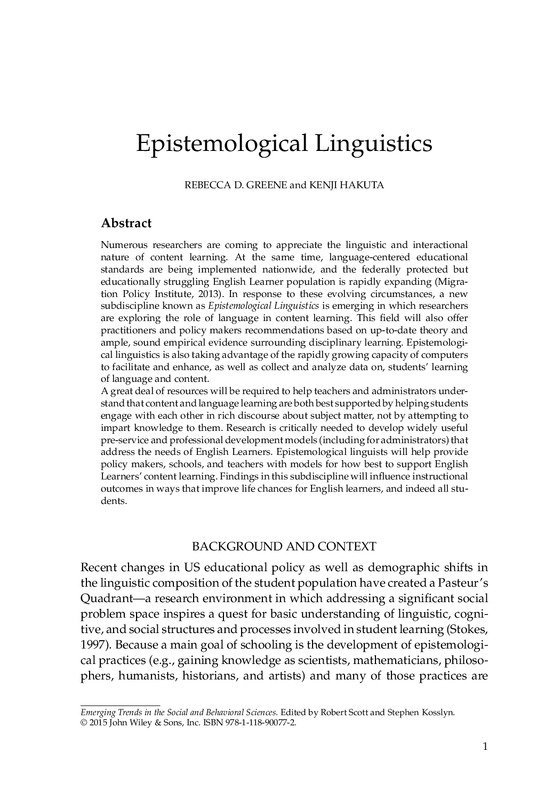
Numerous researchers are coming to appreciate the linguistic and interactional nature of content learning. At the same time, language‐centered educational standards are being implemented nationwide, and the federally protected but educationally struggling English Learner population is rapidly expanding (Migration Policy Institute, 2013). In response to these evolving circumstances, a new subdiscipline known as Epistemological Linguistics is emerging in which researchers are exploring the role of language in content learning. This field will also offer practitioners and policy makers recommendations based on up‐to‐date theory and ample, sound empirical evidence surrounding disciplinary learning. Epistemological linguistics is also taking advantage of the rapidly growing capacity of computers to facilitate and enhance, as well as collect and analyze data on, students' learning of language and content.
-
Related Essays
-
Economics of Early Education (Economics), W. Steven Barnett
-
The impact of Bilingualism on Cognition (Psychology), Ellen Bialystok
-
Language, Perspective, and Memory (Psychology), Rachel A. Ryskin et al.
-
Shadow Education (Sociology), Soo‐yong Byun and David P. Baker
-
Culture and Cognition (Sociology), Karen A. Cerulo
-
Enduring Effects of Education (Sociology), Matthew Curry and Jennie E. Brand
-
The Organization of Schools and Classrooms (Sociology), David Diehl and Daniel A. McFarland
-
Evolutionary Approaches to Understanding Children's Academic Achievement (Psychology), David C. Geary and Daniel B. Berch
-
Language and Thought (Psychology), Susan Goldin‐Meadow
-
Evaluating and Rewarding Teachers (Educ), Cassandra Hart
-
Educational Testing: Measuring and Remedying Achievement Gaps (Educ), Jaekyung Lee
-
Cultural Conflict (Sociology), Ian Mullins
-
A Bio‐Social‐Cultural Approach to Early Cognitive Development: Entering the Community of Minds (Psychology), Katherine Nelson
-
Curriculum as a Site of Political and Cultural Conflict (Sociology), Fabio Rojas
-
Education in an Open Informational World (Educ), Marlene Scardamalia and Carl Bereiter
-
Speech Perception (Psychology), Athena Vouloumanos
-
Identifier
-
etrds0116
-
extracted text
-
Epistemological Linguistics
REBECCA D. GREENE and KENJI HAKUTA
Abstract
Numerous researchers are coming to appreciate the linguistic and interactional
nature of content learning. At the same time, language-centered educational
standards are being implemented nationwide, and the federally protected but
educationally struggling English Learner population is rapidly expanding (Migration Policy Institute, 2013). In response to these evolving circumstances, a new
subdiscipline known as Epistemological Linguistics is emerging in which researchers
are exploring the role of language in content learning. This field will also offer
practitioners and policy makers recommendations based on up-to-date theory and
ample, sound empirical evidence surrounding disciplinary learning. Epistemological linguistics is also taking advantage of the rapidly growing capacity of computers
to facilitate and enhance, as well as collect and analyze data on, students’ learning
of language and content.
A great deal of resources will be required to help teachers and administrators understand that content and language learning are both best supported by helping students
engage with each other in rich discourse about subject matter, not by attempting to
impart knowledge to them. Research is critically needed to develop widely useful
pre-service and professional development models (including for administrators) that
address the needs of English Learners. Epistemological linguists will help provide
policy makers, schools, and teachers with models for how best to support English
Learners’ content learning. Findings in this subdiscipline will influence instructional
outcomes in ways that improve life chances for English learners, and indeed all students.
BACKGROUND AND CONTEXT
Recent changes in US educational policy as well as demographic shifts in
the linguistic composition of the student population have created a Pasteur’s
Quadrant—a research environment in which addressing a significant social
problem space inspires a quest for basic understanding of linguistic, cognitive, and social structures and processes involved in student learning (Stokes,
1997). Because a main goal of schooling is the development of epistemological practices (e.g., gaining knowledge as scientists, mathematicians, philosophers, humanists, historians, and artists) and many of those practices are
Emerging Trends in the Social and Behavioral Sciences. Edited by Robert Scott and Stephen Kosslyn.
© 2015 John Wiley & Sons, Inc. ISBN 978-1-118-90077-2.
1
�2
EMERGING TRENDS IN THE SOCIAL AND BEHAVIORAL SCIENCES
reflected through language, we call this emerging field epistemological linguistics.
One might think of developing epistemological practices as a rather
ambitious goal that departs radically from the current focus on acquisition
of basic knowledge and skills (“the three R’s—reading, writing, and arithmetic” in the regular curriculum, plus a focus on grammar and vocabulary
in English-as-a-Second-Language classes). However, the sea change in
the nation toward the widespread adoption of college- and career-ready
standards, generally referred to as the Common Core State Standards, does
indeed make college-level rigor a goal for all students.1
These influential new standards reflect the linguistic practices that students
must master in order to fully engage in critical practices of the content disciplines (Council of Chief State Schools Officers, 2012; Hakuta, Santos, & Fang,
2013; Moschkovich, 2012; Stage, Asturias, Cheuk, Daro, & Hampton, 2013;
Valdés, Bunch, Snow, & Lee, 2005). Disciplinary knowledge cannot truly be
separated from the ability to use the linguistic forms and registers that make
up the on-the-ground practices of that discipline, such as explaining models, making and supporting claims, understanding others’ arguments, and
validating ideas through peer review. Academic disciplines are all heavily
linguistic in nature. Much of the knowledge of the disciplines consists of
arguments and explanations, and all the disciplines have their own conventions for what counts as evidence, argument, and explanation.
Existing research focused on the relationship between content and
language is limited, and exists primarily under the broader umbrella of
Educational Linguistics. A deep understanding of how language practices
develop into expertise would recruit from virtually all aspects of linguistic
analysis, but particularly sociolinguistics, cognitive linguistics, discourse
analysis, semantics, and pragmatics. We are proposing here to delineate this
growing area of interest as Epistemological Linguistics. The privileging of
the language demands within the content areas in the new standards has
helped spur Epistemological Linguistics to begin creating empirically based
models and theories of the relationship between language and disciplinary
knowledge. This field’s findings will inform classroom instruction as well as
education systems and policy.
The growth in the user end of the Pasteur’s Quadrant, focusing on the role
of language in content learning, is also driven by the rapid growth of the linguistic minority population in the United States. Many of these students are
immigrants or children of immigrants, and their status as learners of English
1. As of this writing, 46 states have adopted the Common Core State Standards in English Language
Arts, Literacy and Mathematics, and a large number of states have adopted or are in the process of adopting the Next Generation Science Standards. Activity is also under way to create a common set of collegeand career-ready set of standards in social studies.
�Epistemological Linguistics
3
as a second language makes them a focus for federal protections (under Title
VI of the Civil Rights Act and the Equal Educational Opportunities Act) as
well as additional federal funding (under Title III of the Elementary and
Secondary Education Act, currently known as No Child Left Behind). English
Learners are also identified as a subgroup of students whose achievement on
content area tests in language arts and math must be reported separately to
show improvement for accountability purposes under a major federal assistance program (Title I of No Child Left Behind), and whose low performance
has been a large focus for federal, state, and local officials (US Department of
Education, 2012).2
Given the heavily linguistic nature of the new performance standards as
well as the inherent challenges that these standards impose on students who
are developmentally in the process of acquiring a second language, educators
are now keen on focusing their instructional improvement efforts that help
advance the goals of both second language development as well as content
knowledge development. How to conceptualize and support this effort is an
engineering problem that requires the support of good practical theory that
focuses the task.
The world of professionals who concern themselves with student learning
in both language and content can be seen along the following simplified spectrum (roughly in order from the student out into the larger system):
•
•
Teachers who see their role as instructional delivery and the facilitation
of learning. They might ask: I know that it is important for me to give
students time to engage in discussions with each other about their work,
and that the mathematics standards call for students to be able to “understand the reasoning of others.” When I listen in on their discussions,
what are the characteristics of language that I should be paying attention
to, and how should I use this information?
School principals who see their role as facilitating a school-wide culture
of learning, often making decisions about how to allocate instructional
time and resources such as funds for professional learning. They might
ask: during the time that I allocate for my teachers to engage with each
other as professional learning communities, our teachers have decided
to focus on samples of student writing. The new standards call for
students to “write arguments from evidence and reason.” I need to
know how to help these teachers provide the right kinds of feedback to
students.
2. English Learners have reached a critical mass nationally. According to the Migration Policy Institute
(2013), in 2007–2008, there were over 5.3 million English Learners in K-12, representing approximately 11%
of the total student population. While English Learners are heavily concentrated in some states and cities
(e.g., California, Nevada, New York City, Chicago), one of the most striking recent trends has been the
growth of EL populations in even rural parts of the country, most notably the South (Capps et al., 2005).
�4
EMERGING TRENDS IN THE SOCIAL AND BEHAVIORAL SCIENCES
•
•
•
•
•
School district leaders who often make decisions about curriculum and
textbook adoption, coordinate district-wide professional development
opportunities for teachers and principals, make personnel decisions, and
answer to the school board. They might ask: our district requires all
students designated as an English Learners to have at least one period
dedicated to English Language Development. This is required of my district through a memorandum of understanding with the federal Office
for Civil Rights to ensure that my district pay attention to the specific
needs of these students. What guidance should I give to our principals
and teachers on the curriculum during this time?
Local school board members who are elected or appointed by elected
officials and therefore are accountable to the public, and who hire and
fire the superintendent. They might ask: my constituents are saying that
too many English Learners are not learning English fast enough, that
they are trapped in the stigma of low-level classes by this label, and that
the schools are not doing enough to move them out of these programs.
How do I know when a program is helping or hurting the students?
State education agency officials who coordinate statewide implementation of content and English Language Proficiency standards. They might
ask: there are two sets of standards that I must coordinate: the new Common Core State Standards and the new English Language Proficiency
standards. We are trying to change two things at the same time, and I
am afraid that the implementation can become confusing. What should
I be communicating to school districts about the relationship between
these two sets of standards?
State education board members who are either elected or appointed,
who make decisions about standards and assessment programs. They
might ask: we as a state board have adopted the Next Generation Science Standards, and the science teachers like the new standards but are
saying that they need better materials and professional development
support to really give ELs access to standards-aligned instruction, especially around how texts are used during instruction. How can I get the
publishers and professional development suppliers who work with the
state to be responsive to these demands?
Federal education officials who manage education programs (especially
Title I and Title III of ESEA) and the flexibility program from NCLB provisions. They might ask: the US Department of Education is asking states
to reform their teacher evaluation system, and in doing so to use student
test scores as part of the system. What special considerations do I need
to give for the teachers who teach significant numbers of English Learners, whose performance on these tests may not be valid if their English
Language Proficiency is low?
�Epistemological Linguistics
•
5
Federal civil rights officials who monitor and enforce the requirements
of Title VI of the Civil Rights Act (as interpreted in Lau v. Nichols and
the Equal Educational Opportunities Act) that prohibits discrimination
on the basis of national origin and English language proficiency. They
might ask: my job is to ensure protection of the legal rights of students
to English language assistance programs. The districts are saying that the
requirement for dedicated time for English Language Development services is too restrictive, but that is the only way that I can ensure that the
students are receiving targeted services. I understand that the new standards require the content teachers to support language development,
but I need court-worthy evidence that this is effective.
These examples portray a complex system united by a need to better
understand the developmental relationship between academic knowledge
and how it is taught, learned, expressed, and assessed. Federal laws have
always paid attention to the duality of the language and academic content
need of students, but have had difficulty expressing it in policy and practice.
The recently adopted standards create a new configuration of how language
and content are put together. The role of theory is to provide knowledge and
insight about the shift to the new standards for educators, create tools for
supporting implementation within their sphere of work, and provide ways
to evaluate the effectiveness of different approaches.
The Castañeda standards, named after a 1981 US Fifth Circuit Court
ruling in interpreting the Equal Educational Opportunities Act (Castañeda
v. Pickard), are useful in this context to bring together theory, policy, and
practice. In that ruling, the judge helped define an “appropriate action” by
an educational agency serving English Learners as meeting three standards:
(i) the approach is based on sound educational theory, (ii) the approach is
implemented adequately with sufficient resources, and (iii) after a period
of time, the approach is shown to be effective in removing the barriers
of English Learner status on key outcomes. An implicit fourth standard
concerns reform, that is, that in the absence of effectiveness, the implementation or approach is to be modified. These principles have become de facto
policy for the Office for Civil Rights in the Department of Education in
investigating complaints about educational programs for English Learners.
Below we elaborate on the foundations of study in Epistemological Linguistics and explain how they have led to the current state of inquiry and
understanding. We also provide examples of specific research questions that
are likely or useful to arise. We base these expectations on current trends
in policy, demographics, and theories of language and learning, as well as
on contact with diverse educators and learners, and leading researchers and
policy makers.
�6
EMERGING TRENDS IN THE SOCIAL AND BEHAVIORAL SCIENCES
EDUCATIONAL LINGUISTICS
Epistemological Linguistics carves out a space from Educational Linguistics
and the broader field of Applied Linguistics, which look at how people learn
and use language but generally separately from how they learn content knowledge
or how language is used specific to domains of knowledge. Applied Linguistics
(typically under the subfield of Second Language Acquisition) tends to focus
on adult learners, whereas Epistemological Linguistics is centered on K-12
students.
Work by Lantolf (2000), Mercer (1995), and Walqui and van Lier (2010)
demonstrates the influence on Educational Linguistics of a growing body
of social science research which views learning not as the acquisition of
knowledge structures (from teacher to student) but as the socioculturally
situated coconstruction of knowledge by learners (Rogoff, 2003; Vygotsky,
1978). A trend toward socially focused linguistic research can also be seen
in the emergence of Interactional Linguistics (Halliday & Matthiessen,
2004; Ochs, Schegloff, & Thompson, 1996; Selting & Couper-Kuhlen,
2001) and Sociolinguistics (Alim, 2006; Geenberg, 2012; Mendoza-Denton,
2008). Research in Epistemological Linguistics will continue the trend of
addressing sociocultural issues alongside more purely “cognitive” ones
such as learners’ information understanding and retrieval, metacognition
(or their thinking about their own learning), and prior knowledge (see, e.g.,
Bransford, Brown, & Cocking, 2000). This new field will help build a theory
of (content and language) learning that encompasses the sociocultural as
well as cognitive aspects of learning.
Future researchers will determine how content knowledge is structured
with regard to higher levels of language, going even beyond vocabulary
structure, grammatical form, and semantic relations. Given current trends,
research will likely arise that looks at how various factors in the classroom, such as interactivity (DeHaan, Reed, & Kuwada, 2010; Tavakoli &
Foster, 2011) and modality (oral vs written) (Anstrom et al., 2010; Leow,
1995; Sheen, 2010) of tasks affect K-12 students’ ability to engage in the
language practices associated with the content disciplines (i.e., arguing from
evidence, critiquing reasoning). Student motivation (Dörnyei & Ushioda,
2009; Norton, 2000) and attention (Gass & Mackey, 2006; Swain, 2005), and
how language interacts with these factors, will also likely be key topics of
interest.
Literacy researchers will be able to determine which characteristics of texts
have the most important consequences for comprehension, and whether this
varies by epistemological domain. In the area of Mathematics, we will learn
more about what features of mathematical word problems cause students
the most difficulty, and how word problems can be improved to focus the
�Epistemological Linguistics
7
difficulty on target concept(s) (Moschkovich, 2012). In science, researchers
are beginning to break down the linguistic demands of scientific practices
such as modeling, developing explanations, and evaluating scientific information into their constituent productive and receptive language functions,
and describing the modalities and registers of science classrooms (Lee,
Quinn, & Valdés, 2013; Osborne, 2013; Schleppegrell & Palinscar, 2013).
SOCIOLINGUISTICS OF LEARNING
Our understanding of the social aspects of language use has grown rapidly
over the last several decades, since Labov (1966) influentially demonstrated
that language use by New York City residents was patterned by social
class. Sociolinguists have discussed how speakers’ language use reflects
sociolinguistic categories such as race (Fought, 1999; Rickford, 1999), class
(Haeri, 1997; Trudgill, 1974), age (Cukor-Avila, 2000; Greene, 2010), gender
(Eckert, 1989; Matsumoto, 2004), and sexuality (Cameron & Kulick, 2003;
Zimman, 2013); linguistic audiences and settings (Podesva, 2007); and social
identities and styles (Bucholtz, 1999; Eckert, 2000). Lippi-Green (1997) also
brought attention to how standard American English is socially valued
above most nonstandard dialects in ways that reflect and perpetuate racial
and other social prejudices. Epistemological linguists may ask, what aspects
of the language of the content classroom are most important for students
to master, in order to actually succeed in various contexts? How does the
income level or race of a student’s family correlate with students’ learning
of the discipline-specific uses of language? How are students affected by
culturally insensitive content learning materials?
Given the crucial nature of the link between schools and English Learners’
homes and communities (US Dept. of Ed., 2012; Williams, Hakuta, & Haertel, 2007), research needs to examine what types of attitudes content teachers
and administrators have toward English Learners, and how these attitudes
affect English Learners performance in content classrooms. What are the best
ways that a school district can engage with English Learners’ home communities, in order to foster student learning of content knowledge and language
development?
Little research has been done in the area of how English Learners’ learning needs are related to those of speakers of nonstandard English dialects,
such as African American Vernacular English (Mufwene, Rickford, Bailey, &
Baugh, 1998) or Appalachian English (Hazen & Fluharty, 2004). Given the
large number of nonstandard dialect speakers and their lack of federal protection, it would be beneficial to draw comparisons between the needs of
English Learners and those of dialect speakers.
�8
EMERGING TRENDS IN THE SOCIAL AND BEHAVIORAL SCIENCES
AUTOMATED LANGUAGE AND EDUCATION
Interest in Epistemological Linguistics is also arising in part due to new
capacities of computers to address new kinds of questions about what
language in the classroom looks like, and how it should look in order to
best foster learning of all types. Since the 1970s and 1980s, the creation of
massive, annotated corpora of language data [e.g., Penn TreeBank (Marcus,
Marcinkiewicz, & Santorini, 1993) and PropBank (Palmer, Gildea, & Kingsbury, 2005)] and the expanding popularity of high-performing computers,
combined with computational linguists’ increasingly advanced use of
statistical modeling, have contributed to an explosive growth in the sophistication of automated Natural (meaning human and not computer) Language
Processing (NLP) technology (Jurafsky & Martin, 2008). These systems or
models can rapidly process large amounts of linguistic data, including both
text and speech. Some of the most up-to-date and widely used automated
language processing technologies are ETS’ e-rater essay scoring engine
(Attali & Burstein, 2006), Google Translate (www.translate.google.com),
Apple’s Siri application (www.apple.com/ios/siri), and the GALE speech
recognition project at SRI (http://www.speech.sri.com/projects/GALE/).
Within the foreseeable future, teachers (if given the time and resources for
training and implementation) may be able to record their entire classrooms
and compare those classroom recordings online to annotated examples from
other classrooms of the same grade level and subject area, in terms of such
factors as syntactic complexity, or even the level of student engagement in
disciplinary practices, or the constructiveness of peer interactions. Teachers
will be able to quickly determine how their classroom discussion can be
improved in order to better support student learning. Aiding our understanding of learning and language, there will likely be a seamless transition
between auditory and digitized representations of speech via automatic
speech recognition and production, and a snowballing of linguistic types of
web content due to crowdsourcing. Technology will allow us to make and
test new and more sophisticated types of claims.
Researchers have had particular difficulty but are beginning to succeed in
automatically processing speech from language learners (Ding, Hoffman,
& Jokisch, 2011; Neri, Cucchiarini, & Strik, 2004; Truong, Neri, Cucchiarini,
& Strik, 2004) and children (Lu, 2009; Sagae, Lavie, & MacWhinny, 2005;
Sahakian & Snyder, 2012). However, with abundant speech data to train
the programs on, such as those that will become increasingly available in
education, NLP technologies will quickly become competent with EL and
child speech.
Researchers will also increasingly be able to develop computer technologies to help schools identify which students are English Learners, distinguish
�Epistemological Linguistics
9
English Learners from students with disabilities (or students who belong to
both categories), assess language and content learning effectively, and allow
English Learners to exit from programs when they are ready. These tools will
help schools, districts, and states support English Learners to thrive rather
than fall through the cracks.
Another key emerging area of interest is the use of games and other adaptive learning technologies to further learning (Kapp, 2012; Lee & Hammer,
2011; Muntean, 2011). Games and other computer learning technologies
allow the learning experience to be tailored to students’ own progress from
one second to the next. This field is especially promising for English Learners
because computers can help schools respond more effectively to the highly
diverse, individualized, and pressing needs of such students (US Dept.
of Ed., 2013). Students can have fun playing a game but at the same time
develop content and English expertise and have learning supports removed
in a way that supports their autonomy. Games also have the potential to be
used to get and keep learners interacting meaningfully with one another,
which socioculturally minded researchers see as the cornerstone of learning
(Rogoff, 2003; Vygostky, 1978).
All of the technologies used in learning (e.g., games, online activities, online
courses) will produce immense collections of (potentially quite sensitive) language data and associated meta-data that researchers must determine how
to structure efficiently, store and manage with the necessary extreme discretion, and manipulate and analyze effectively. Research that provides models
for how schools can report longitudinal performance of English Learners is
especially needed (Hopkins, Thompson, Linquanti, Hakuta, & August, 2013;
Saunders & Marcelletti, 2012).
CONCLUSION
A new subdiscipline of Linguistics known as Epistemological Linguistics is
emerging, which explores the role of language in content learning. Education
researchers are beginning to realize that content learning has key linguistic
and interactional aspects. At the same time, the nation is widely adopting
and implementing language-centered educational standards. Furthermore,
the number of English Learners in the United States is growing with great
speed (Migration Policy Institute, 2013). This population faces a significant
achievement gap, but is federally protected, further spurring research on the
role of language in K-12 content learning. Epistemological Linguistics holds
the promise of producing evidence- and theory-based recommendations for
practitioners and policy. Epistemological Linguistics will also take advantage of the rapidly growing capacity of computers to facilitate and enhance,
as well as collect and analyze data on, students’ learning of language and
content.
�10
EMERGING TRENDS IN THE SOCIAL AND BEHAVIORAL SCIENCES
An immense level of resources will be required to help teachers and administrators understand the interdependence of content and language learning,
and give them models for how to best support students to engage in rich
content-based discussions, rather than simply imparting knowledge to them.
Research is also critically needed to develop widely useful EL-focused preservice and professional development models (including for administrators).
Findings in this subdiscipline will influence instructional outcomes in ways
that improve life chances for English Learners, and indeed all students.
ACKNOWLEDGMENT
We extend special gratitude for the work of Prof. Thomas Wasow, who has
helped make this work possible with his broad expertise in Linguistics and
extensive work in Philosophy of Linguistics, as well as his dedication to making connections across fields and subfields.
REFERENCES
Alim, H. S. (2006). Roc the mic right: The language of Hip Hop culture. London, England:
Routledge.
Anstrom, K., DiCerbo, P., Butler, F., Katz, A., Millet, J., & Rivera, C. (2010). A review
of the literature on academic language: Implications for K-12 English language learners.
Arlington, VA: George Washington University Center for Equity and Excellence
in Education.
Attali, Y., & Burstein, J. (2006). Automated essay scoring with e-rater® V. 2. The Journal of Technology, Learning and Assessment, 4(3).
Bransford, J. D., Brown, A. L., & Cocking, R. R. (Eds.) (2000). How people learn. Washington, DC: National Academy Press.
Bucholtz, M. (1999). “Why be normal?”: Language and identity practices in a community of nerd girls. Language in Society, 28(2), 203–223.
Cameron, D., & Kulick, D. (2003). Language and sexuality. Cambridge, England: Cambridge University Press.
Capps, R., Fix, M. E., Murray, J., Ost, J., Passel, J. S., & Hernandez, S. H.
(2005). The new demography of America’s schools: Immigration and the No
Child Left Behind Act. Urban Institute. Retrieved from http://www.urban.org/
UploadedPDF/311230_new_demography.pdf.
Council of Chief State School Officers (2012). Framework for English Language Proficiency Development Standards corresponding to the Common Core State Standards and
the Next Generation Science Standards. Washington, DC: CCSSO.
Cukor-Avila, P. (2000). The stability of individual vernaculars. MS, University of
North Texas.
DeHaan, J., Reed, W. M., & Kuwada, K. (2010). The effect of interactivity with a music
video game on second language vocabulary recall. About Language Learning & Technology, 14(2), 74–94.
�Epistemological Linguistics
11
Ding, H., Hoffmann, R., & Jokisch, O. (2011). An investigation of tone perception and
production in German learners of Mandarin. Archives of Acoustics, 36(3), 509–518.
Dörnyei, E. Z., & Ushioda, E. (Eds.) (2009). Motivation, language identity and the L2 self .
Tonawanda, NY: Multilingual Matters.
Eckert, P. (1989). The whole woman: Sex and gender differences in variation. Language Variation and Change, 1(3), 245–267.
Eckert, P. (2000). Language variation as social practice: The linguistic construction of identity in Belten High. Oxford, England: Blackwell.
Fought, C. (1999). A majority sound change in a minority community: /u/-fronting
in Chicano English. Journal of Sociolinguistics, 3(1), 5–23.
Gass, S. M., & Mackey, A. (2006). Input, interaction and output: An overview. AILA
Review, 19(1), 3–17.
Geenberg, KR (2012) “The People Who Say TSH TSH”: The social life of cairene Arabic Palatalization, University of Pennsylvania Working Papers in Linguistics: 18: 2,
Article 4. Retrieved from http://repository.upenn.edu/pwpl/vol18/iss2/4.
Greene, R. (2010). Language and ideology in rural Eastern Kentucky. (Unpublished doctoral dissertation). Stanford University, Stanford, California.
Haeri, N. (1997). The sociolinguistic market of Cairo: Gender, class and education. New
York, NY: Kagan Paul International.
Halliday, M. A., & Matthiessen, C. M. (2004). An introduction to functional grammar.
New York, NY: Routledge.
Hakuta, K., Santos, M., & Fang, Z. (2013). Challenges and opportunities for language
learning in the context of the CCSS and the NGSS. Journal of Adolescent & Adult
Literacy, 56(6), 451–454.
Hazen, K., & Fluharty, E. (2004). Defining Appalachian English. In M. C. Bender
(Ed.), Linguistic diversity in the South: Changing codes, practices, and ideology (pp.
50–65). Athens, GA: University of Georgia Press.
Hopkins, M., Thompson, K. D., Linquanti, R., Hakuta, K., & August, D. (2013). Fully
accounting for English Learner performance: A key issue in ESEA reauthorization.
Educational Researcher, 42(2), 101–108. doi:10.3102/0013189X12471426
Jurafsky, D., & Martin, J. H. (2008). Speech and language processing (2nd ed.). Upper
Saddle River, NJ: Pearson Prentice Hall.
Kapp, K. M. (2012). The gamification of learning and instruction: Game-based methods and
strategies for training and education. San Francisco, CA: John Wiley & Sons.
Labov, W. (1966). The social stratification of English in New York City. Cambridge, England: Cambridge University Press.
Lantolf, J. P. (Ed.) (2000). Sociocultural theory and second language learning. Oxford, England: Oxford University Press.
Lee J., & Hammer J. (2011). Gamification in education: What, how, why bother? Academic Exchange Quarterly, 15(2). Retrieved from http://www.gamifyingeducation.
org/files/Lee-Hammer-AEQ-2011.pdf.
Lee, O., Quinn, H., & Valdés, G. (2013). Science and language for English language
learners: Language demands and opportunities in relation to Next Generation Science Standards. Educational Researcher, 42(4), 423–433.
�12
EMERGING TRENDS IN THE SOCIAL AND BEHAVIORAL SCIENCES
Leow, R. P. (1995). Modality and intake in second language acquisition. Studies in
Second Language Acquisition, 17, 79–89.
Lippi-Green, R. (1997). English with an accent: Language, ideology, and discrimination in
the United States. New York, NY: Routledge.
Lu, X. (2009). Automatic measurement of syntactic complexity in child language
acquisition. International Journal of Corpus Linguistics, 14(1), 3–28.
Marcus, M. P., Marcinkiewicz, M. A., & Santorini, B. (1993). Building a large annotated corpus of English: The Penn Treebank. Computational Linguistics, 19(2),
313–330.
Matsumoto, Y. (2004). Alternative femininity: Personae of middle-aged mothers. In
S. Okamoto & J. S. S. Smith (Eds.), Japanese language, gender, and ideology: Cultural
models and real people (pp. 240–255). New York, NY: Oxford University Press.
Mendoza-Denton, N. (2008). Homegirls: Language and cultural practice among Latina
youth gangs. Malden, MA: Blackwell.
Mercer, N. (1995). The guided construction of knowledge: Talk amongst teachers and learners. Tonawanda, NY: Multilingual Matters.
Migration Policy Institute (2013). Retrieved from http://www.migrationinformation.
org/ellinfo/FactSheet_ELL2.pdf.
Moschkovich, J. (2012). Mathematics, the Common Core, and language: Recommendations
for mathematics instruction for ELLs aligned with the Common Core. Paper presented
at the Understanding Language Conference, Stanford, CA.
Mufwene, S. S., Rickford, J. R., Bailey, G., & Baugh, J. (Eds.) (1998). African-American
English: Structure, history and use. New York, NY: Routledge.
Muntean, C. I. (2011). Raising engagement in e-learning through gamification. Proceedings of 6th International Conference on Virtual Learning ICVL (pp. 323–329).
Neri, A., Cucchiarini C., & Strik W. (2004). Segmental errors in Dutch as a second
language: How to establish priorities for CAPT. Proceedings of InSTIL/ICALL2004
Symposium on Computer Assisted Language Learning, Venice, Italy.
Norton, B. (2000). Identity and language learning: Gender, ethnicity and educational
change. London, England: Longman.
Ochs, E., Schegloff, E. A., & Thompson, S. A. (Eds.) (1996). Interaction and grammar.
(Vol. 13). New York, NY: Cambridge University Press.
Osborne, J. (2013). What do science teachers need to know about language in science. Presented at BOSE (NAS) Conference on Literacy for Science in the Common Core
State Standards and Next Generation Science Standards, Washington, DC.
Palmer, M., Gildea, D., & Kingsbury, P. (2005). The proposition bank: An annotated
corpus of semantic roles. Computational Linguistics, 31(1), 71–106.
Podesva, R. J. (2007). Phonation type as a stylistic variable: The use of falsetto in
constructing a persona. Journal of Sociolinguistics, 11(4), 478–504.
Rickford, J. R. (1999). African American Vernacular English: Features, evolution, educational implications. Malden, MA: Blackwell.
Rogoff, B. (2003). The cultural nature of human development. New York, NY: Oxford
University Press.
Sagae, K., Lavie, A., & MacWhinney, B. (2005). Automatic measurement of syntactic development in child language. Proceedings of the 43rd Annual Meeting of the
Association for Computational Linguistics, Ann Arbor, MI, pp. 197–204.
�Epistemological Linguistics
13
Sahakian, S., & Snyder, B. (2012). Automatically learning measures of child language development. Proceedings of the 50th Annual Meeting of the Association for
Computational Linguistics: Short Papers-Volume 2, pp. 95–99. Association for Computational Linguistics.
Saunders, W. M., & Marcelletti, D. J. (2012). The gap that can’t go away: The catch-22
of reclassification in monitoring the progress of English Learners. Educational Evaluation and Policy Analysis, 1–18. doi:10.3102/0162373712461849
Schleppegrell, M. J., & Palinscar, A. S. (2013). What do teachers need to know about
the language of science texts? Presented at BOSE (NAS) Conference on Literacy for
Science in the Common Core State Standards and Next Generation Science Standards,
Washington, DC.
Selting, M., & Couper-Kuhlen, E. (Eds.) (2001). Studies in interactional linguistics.
Philadelphia, PA: John Benjamins.
Sheen, Y. (2010). Differential effects of oral and written corrective feedback in the ESL
classroom. Studies in Second Language Acquisition, 32(2), 201–234.
Stage, E. K., Asturias, H., Cheuk, T., Daro, P. A., & Hampton, S. B. (2013). Opportunities and challenges in Next Generation Standards. Science, 340(6140), 276–277.
Stokes, D. E. (1997). Pasteur’s quadrant: Basic science and technological innovation. Washington, DC: Brookings Institution Press.
Swain, M. (2005). The output hypothesis: Theory and research. Handbook of Research
in Second Language Teaching and Learning, 1, 471–483.
Tavakoli, P., & Foster, P. (2011). Task design and second language performance: The
effect of narrative type on learner output. Language Learning, 61(s1), 37–72.
Trudgill, P. (1974). The social differentiation of English in Norwich. New York, NY: Cambridge University Press.
Truong, K., Neri, A., Cucchiarini, C., & Strik, H. (2004). Automatic pronunciation
error detection: An acoustic-phonetic approach. Proceedings of InSTIL/ICALL2004
Symposium on Computer Assisted Language Learning, Venice, Italy.
US Department of Education Office of Education Technology (2013). Expanding evidence approaches for learning in a digital world. Washington, DC: US DOE Office of
Education Technology.
US Department of Education; Office of Planning, Evaluation and Policy Development; Policy and Program Studies Service (2012). Language instruction educational
programs (LIEPs): A review of the foundational literature. Washington, DC: US DOE
Office of Planning, Evaluation and Policy Development; Policy and Program Studies Service.
Valdés, G., Bunch, G., Snow, C., & Lee, C. (2005). Enhancing the development of
students’ language(s). In L. Darling-Hammond & J. Bransford (Eds.), Preparing
teachers for a changing world: What teachers should learn and be able to do (pp. 126–168).
San Francisco, CA: Jossey Bass.
Vygotsky, L. S. (1978). In M. Cole, V. John-Steiner, S. Scribner & E. Souberman (Eds.)
(A. R. Luria, M. Lopez-Morillas & M. Cole [with J. V. Wertsch], Trans.), Mind in
society: The development of higher psychological processes. Cambridge, MA: Harvard
University Press (Original manuscripts [ca. 1930–1934]).
�14
EMERGING TRENDS IN THE SOCIAL AND BEHAVIORAL SCIENCES
Walqui, A., & van Lier, L. (2010). Scaffolding the academic success of adolescent English
language learners: A pedagogy of promise. San Francisco, CA: WestEd.
Williams, T., Hakuta, K., & Haertel, E. (2007). Similar English learner students, different
results: Why do some schools do better? A follow-up analysis based on a large-scale survey
of California elementary schools serving low- income and EL students. Mountain View,
CA: EdSource.
Zimman, L. (2013). Hegemonic masculinity and the variability of gay-sounding
speech: The perceived sexuality of transgender men. Journal of Language and Sexuality, 2(1), 1–39.
FURTHER READING
Adger, C. T., Snow, C. E., & Christian, D. (2002). What teachers need to know
about language. Washington, DC: Center for Applied Linguistics. Retrieved from
http://files.eric.ed.gov/fulltext/ED482994.pdf.
Bunch, G., Kibler, A., & Pimentel, S. (2012). Realizing opportunities for English Learners
in the Common Core English Language Arts and disciplinary literacy standards. Paper
presented at the Understanding Language Conference, Stanford, CA.
Goldenberg, C. (2013). Unlocking the research on English Learners: What we
know—and don’t yet know—about effective instruction. American Educator, 37(2),
4–12.
Hakuta, K., Santos, M., & Fang, Z. (2013). Challenges and opportunities for language
learning in the context of the CCSS and the NGSS. Journal of Adolescent & Adult
Literacy, 56(6), 451–454.
Lee, O., Quinn, H., & Valdés, G. (2013). Science and language for English language
learners: Language demands and opportunities in relation to Next Generation Science Standards. Educational Researcher, 42(4), 423–433.
Moschkovich, J. (2012). Mathematics, the Common Core, and language: Recommendations
for mathematics instruction for ELLs aligned with the Common Core. Paper presented
at the Understanding Language Conference, Stanford, CA.
Olsen, L. (2010). Reparable harm: Fulfilling the unkept promise of educational opportunities for Long Term English Language Learners. Long Beach, CA: Californians
Together. Retrieved from http://www.californianstogether.org/docs/download.
aspx?fileId=12.
US Department of Education Office of Education Technology (2013). Expanding evidence approaches for learning in a digital world. Washington, DC: US DOE Office of
Education Technology.
US Department of Education; Office of Planning, Evaluation and Policy Development; Policy and Program Studies Service (2012). Language instruction educational
programs (LIEPs): A review of the foundational literature. Washington, DC: US DOE
Office of Planning, Evaluation and Policy Development; Policy and Program Studies Service.
Walqui, A., & van Lier, L. (2010). Scaffolding the academic success of adolescent English
language learners: A pedagogy of promise. San Francisco, CA: WestEd.
�Epistemological Linguistics
15
REBECCA D. GREENE SHORT BIOGRAPHY
Rebecca D. Greene is a Senior Research Associate with the Understanding
Language initiative at Stanford University. Her research work focuses on
issues of language and equity. She received her PhD in Linguistics from
Stanford University. She also received a Certificate in the Teaching of English
as a Second Language from the University of Kentucky. She has teaching
experience in a range of subjects, including ESL.
KENJI HAKUTA SHORT BIOGRAPHY
Kenji Hakuta is the Lee L. Jacks Professor of Education at Stanford University. He is also cochair of the Understanding Language initiative at Stanford
University. His scholarly inquiry is focused on the areas of bilingualism and
second language acquisition, and his policy interest is in improving educational opportunities for language minority students. He received his PhD in
Experimental Psychology from Harvard University.
RELATED ESSAYS
Economics of Early Education (Economics), W. Steven Barnett
The impact of Bilingualism on Cognition (Psychology), Ellen Bialystok
Language, Perspective, and Memory (Psychology), Rachel A. Ryskin et al.
Shadow Education (Sociology), Soo-yong Byun and David P. Baker
Culture and Cognition (Sociology), Karen A. Cerulo
Enduring Effects of Education (Sociology), Matthew Curry and Jennie E.
Brand
The Organization of Schools and Classrooms (Sociology), David Diehl and
Daniel A. McFarland
Evolutionary Approaches to Understanding Children’s Academic Achievement (Psychology), David C. Geary and Daniel B. Berch
Language and Thought (Psychology), Susan Goldin-Meadow
Evaluating and Rewarding Teachers (Educ), Cassandra Hart
Educational Testing: Measuring and Remedying Achievement Gaps (Educ),
Jaekyung Lee
Cultural Conflict (Sociology), Ian Mullins
A Bio-Social-Cultural Approach to Early Cognitive Development: Entering
the Community of Minds (Psychology), Katherine Nelson
Curriculum as a Site of Political and Cultural Conflict (Sociology), Fabio
Rojas
Education in an Open Informational World (Educ), Marlene Scardamalia
and Carl Bereiter
Speech Perception (Psychology), Athena Vouloumanos
�
-
Epistemological Linguistics
REBECCA D. GREENE and KENJI HAKUTA
Abstract
Numerous researchers are coming to appreciate the linguistic and interactional
nature of content learning. At the same time, language-centered educational
standards are being implemented nationwide, and the federally protected but
educationally struggling English Learner population is rapidly expanding (Migration Policy Institute, 2013). In response to these evolving circumstances, a new
subdiscipline known as Epistemological Linguistics is emerging in which researchers
are exploring the role of language in content learning. This field will also offer
practitioners and policy makers recommendations based on up-to-date theory and
ample, sound empirical evidence surrounding disciplinary learning. Epistemological linguistics is also taking advantage of the rapidly growing capacity of computers
to facilitate and enhance, as well as collect and analyze data on, students’ learning
of language and content.
A great deal of resources will be required to help teachers and administrators understand that content and language learning are both best supported by helping students
engage with each other in rich discourse about subject matter, not by attempting to
impart knowledge to them. Research is critically needed to develop widely useful
pre-service and professional development models (including for administrators) that
address the needs of English Learners. Epistemological linguists will help provide
policy makers, schools, and teachers with models for how best to support English
Learners’ content learning. Findings in this subdiscipline will influence instructional
outcomes in ways that improve life chances for English learners, and indeed all students.
BACKGROUND AND CONTEXT
Recent changes in US educational policy as well as demographic shifts in
the linguistic composition of the student population have created a Pasteur’s
Quadrant—a research environment in which addressing a significant social
problem space inspires a quest for basic understanding of linguistic, cognitive, and social structures and processes involved in student learning (Stokes,
1997). Because a main goal of schooling is the development of epistemological practices (e.g., gaining knowledge as scientists, mathematicians, philosophers, humanists, historians, and artists) and many of those practices are
Emerging Trends in the Social and Behavioral Sciences. Edited by Robert Scott and Stephen Kosslyn.
© 2015 John Wiley & Sons, Inc. ISBN 978-1-118-90077-2.
1
�2
EMERGING TRENDS IN THE SOCIAL AND BEHAVIORAL SCIENCES
reflected through language, we call this emerging field epistemological linguistics.
One might think of developing epistemological practices as a rather
ambitious goal that departs radically from the current focus on acquisition
of basic knowledge and skills (“the three R’s—reading, writing, and arithmetic” in the regular curriculum, plus a focus on grammar and vocabulary
in English-as-a-Second-Language classes). However, the sea change in
the nation toward the widespread adoption of college- and career-ready
standards, generally referred to as the Common Core State Standards, does
indeed make college-level rigor a goal for all students.1
These influential new standards reflect the linguistic practices that students
must master in order to fully engage in critical practices of the content disciplines (Council of Chief State Schools Officers, 2012; Hakuta, Santos, & Fang,
2013; Moschkovich, 2012; Stage, Asturias, Cheuk, Daro, & Hampton, 2013;
Valdés, Bunch, Snow, & Lee, 2005). Disciplinary knowledge cannot truly be
separated from the ability to use the linguistic forms and registers that make
up the on-the-ground practices of that discipline, such as explaining models, making and supporting claims, understanding others’ arguments, and
validating ideas through peer review. Academic disciplines are all heavily
linguistic in nature. Much of the knowledge of the disciplines consists of
arguments and explanations, and all the disciplines have their own conventions for what counts as evidence, argument, and explanation.
Existing research focused on the relationship between content and
language is limited, and exists primarily under the broader umbrella of
Educational Linguistics. A deep understanding of how language practices
develop into expertise would recruit from virtually all aspects of linguistic
analysis, but particularly sociolinguistics, cognitive linguistics, discourse
analysis, semantics, and pragmatics. We are proposing here to delineate this
growing area of interest as Epistemological Linguistics. The privileging of
the language demands within the content areas in the new standards has
helped spur Epistemological Linguistics to begin creating empirically based
models and theories of the relationship between language and disciplinary
knowledge. This field’s findings will inform classroom instruction as well as
education systems and policy.
The growth in the user end of the Pasteur’s Quadrant, focusing on the role
of language in content learning, is also driven by the rapid growth of the linguistic minority population in the United States. Many of these students are
immigrants or children of immigrants, and their status as learners of English
1. As of this writing, 46 states have adopted the Common Core State Standards in English Language
Arts, Literacy and Mathematics, and a large number of states have adopted or are in the process of adopting the Next Generation Science Standards. Activity is also under way to create a common set of collegeand career-ready set of standards in social studies.
�Epistemological Linguistics
3
as a second language makes them a focus for federal protections (under Title
VI of the Civil Rights Act and the Equal Educational Opportunities Act) as
well as additional federal funding (under Title III of the Elementary and
Secondary Education Act, currently known as No Child Left Behind). English
Learners are also identified as a subgroup of students whose achievement on
content area tests in language arts and math must be reported separately to
show improvement for accountability purposes under a major federal assistance program (Title I of No Child Left Behind), and whose low performance
has been a large focus for federal, state, and local officials (US Department of
Education, 2012).2
Given the heavily linguistic nature of the new performance standards as
well as the inherent challenges that these standards impose on students who
are developmentally in the process of acquiring a second language, educators
are now keen on focusing their instructional improvement efforts that help
advance the goals of both second language development as well as content
knowledge development. How to conceptualize and support this effort is an
engineering problem that requires the support of good practical theory that
focuses the task.
The world of professionals who concern themselves with student learning
in both language and content can be seen along the following simplified spectrum (roughly in order from the student out into the larger system):
•
•
Teachers who see their role as instructional delivery and the facilitation
of learning. They might ask: I know that it is important for me to give
students time to engage in discussions with each other about their work,
and that the mathematics standards call for students to be able to “understand the reasoning of others.” When I listen in on their discussions,
what are the characteristics of language that I should be paying attention
to, and how should I use this information?
School principals who see their role as facilitating a school-wide culture
of learning, often making decisions about how to allocate instructional
time and resources such as funds for professional learning. They might
ask: during the time that I allocate for my teachers to engage with each
other as professional learning communities, our teachers have decided
to focus on samples of student writing. The new standards call for
students to “write arguments from evidence and reason.” I need to
know how to help these teachers provide the right kinds of feedback to
students.
2. English Learners have reached a critical mass nationally. According to the Migration Policy Institute
(2013), in 2007–2008, there were over 5.3 million English Learners in K-12, representing approximately 11%
of the total student population. While English Learners are heavily concentrated in some states and cities
(e.g., California, Nevada, New York City, Chicago), one of the most striking recent trends has been the
growth of EL populations in even rural parts of the country, most notably the South (Capps et al., 2005).
�4
EMERGING TRENDS IN THE SOCIAL AND BEHAVIORAL SCIENCES
•
•
•
•
•
School district leaders who often make decisions about curriculum and
textbook adoption, coordinate district-wide professional development
opportunities for teachers and principals, make personnel decisions, and
answer to the school board. They might ask: our district requires all
students designated as an English Learners to have at least one period
dedicated to English Language Development. This is required of my district through a memorandum of understanding with the federal Office
for Civil Rights to ensure that my district pay attention to the specific
needs of these students. What guidance should I give to our principals
and teachers on the curriculum during this time?
Local school board members who are elected or appointed by elected
officials and therefore are accountable to the public, and who hire and
fire the superintendent. They might ask: my constituents are saying that
too many English Learners are not learning English fast enough, that
they are trapped in the stigma of low-level classes by this label, and that
the schools are not doing enough to move them out of these programs.
How do I know when a program is helping or hurting the students?
State education agency officials who coordinate statewide implementation of content and English Language Proficiency standards. They might
ask: there are two sets of standards that I must coordinate: the new Common Core State Standards and the new English Language Proficiency
standards. We are trying to change two things at the same time, and I
am afraid that the implementation can become confusing. What should
I be communicating to school districts about the relationship between
these two sets of standards?
State education board members who are either elected or appointed,
who make decisions about standards and assessment programs. They
might ask: we as a state board have adopted the Next Generation Science Standards, and the science teachers like the new standards but are
saying that they need better materials and professional development
support to really give ELs access to standards-aligned instruction, especially around how texts are used during instruction. How can I get the
publishers and professional development suppliers who work with the
state to be responsive to these demands?
Federal education officials who manage education programs (especially
Title I and Title III of ESEA) and the flexibility program from NCLB provisions. They might ask: the US Department of Education is asking states
to reform their teacher evaluation system, and in doing so to use student
test scores as part of the system. What special considerations do I need
to give for the teachers who teach significant numbers of English Learners, whose performance on these tests may not be valid if their English
Language Proficiency is low?
�Epistemological Linguistics
•
5
Federal civil rights officials who monitor and enforce the requirements
of Title VI of the Civil Rights Act (as interpreted in Lau v. Nichols and
the Equal Educational Opportunities Act) that prohibits discrimination
on the basis of national origin and English language proficiency. They
might ask: my job is to ensure protection of the legal rights of students
to English language assistance programs. The districts are saying that the
requirement for dedicated time for English Language Development services is too restrictive, but that is the only way that I can ensure that the
students are receiving targeted services. I understand that the new standards require the content teachers to support language development,
but I need court-worthy evidence that this is effective.
These examples portray a complex system united by a need to better
understand the developmental relationship between academic knowledge
and how it is taught, learned, expressed, and assessed. Federal laws have
always paid attention to the duality of the language and academic content
need of students, but have had difficulty expressing it in policy and practice.
The recently adopted standards create a new configuration of how language
and content are put together. The role of theory is to provide knowledge and
insight about the shift to the new standards for educators, create tools for
supporting implementation within their sphere of work, and provide ways
to evaluate the effectiveness of different approaches.
The Castañeda standards, named after a 1981 US Fifth Circuit Court
ruling in interpreting the Equal Educational Opportunities Act (Castañeda
v. Pickard), are useful in this context to bring together theory, policy, and
practice. In that ruling, the judge helped define an “appropriate action” by
an educational agency serving English Learners as meeting three standards:
(i) the approach is based on sound educational theory, (ii) the approach is
implemented adequately with sufficient resources, and (iii) after a period
of time, the approach is shown to be effective in removing the barriers
of English Learner status on key outcomes. An implicit fourth standard
concerns reform, that is, that in the absence of effectiveness, the implementation or approach is to be modified. These principles have become de facto
policy for the Office for Civil Rights in the Department of Education in
investigating complaints about educational programs for English Learners.
Below we elaborate on the foundations of study in Epistemological Linguistics and explain how they have led to the current state of inquiry and
understanding. We also provide examples of specific research questions that
are likely or useful to arise. We base these expectations on current trends
in policy, demographics, and theories of language and learning, as well as
on contact with diverse educators and learners, and leading researchers and
policy makers.
�6
EMERGING TRENDS IN THE SOCIAL AND BEHAVIORAL SCIENCES
EDUCATIONAL LINGUISTICS
Epistemological Linguistics carves out a space from Educational Linguistics
and the broader field of Applied Linguistics, which look at how people learn
and use language but generally separately from how they learn content knowledge
or how language is used specific to domains of knowledge. Applied Linguistics
(typically under the subfield of Second Language Acquisition) tends to focus
on adult learners, whereas Epistemological Linguistics is centered on K-12
students.
Work by Lantolf (2000), Mercer (1995), and Walqui and van Lier (2010)
demonstrates the influence on Educational Linguistics of a growing body
of social science research which views learning not as the acquisition of
knowledge structures (from teacher to student) but as the socioculturally
situated coconstruction of knowledge by learners (Rogoff, 2003; Vygotsky,
1978). A trend toward socially focused linguistic research can also be seen
in the emergence of Interactional Linguistics (Halliday & Matthiessen,
2004; Ochs, Schegloff, & Thompson, 1996; Selting & Couper-Kuhlen,
2001) and Sociolinguistics (Alim, 2006; Geenberg, 2012; Mendoza-Denton,
2008). Research in Epistemological Linguistics will continue the trend of
addressing sociocultural issues alongside more purely “cognitive” ones
such as learners’ information understanding and retrieval, metacognition
(or their thinking about their own learning), and prior knowledge (see, e.g.,
Bransford, Brown, & Cocking, 2000). This new field will help build a theory
of (content and language) learning that encompasses the sociocultural as
well as cognitive aspects of learning.
Future researchers will determine how content knowledge is structured
with regard to higher levels of language, going even beyond vocabulary
structure, grammatical form, and semantic relations. Given current trends,
research will likely arise that looks at how various factors in the classroom, such as interactivity (DeHaan, Reed, & Kuwada, 2010; Tavakoli &
Foster, 2011) and modality (oral vs written) (Anstrom et al., 2010; Leow,
1995; Sheen, 2010) of tasks affect K-12 students’ ability to engage in the
language practices associated with the content disciplines (i.e., arguing from
evidence, critiquing reasoning). Student motivation (Dörnyei & Ushioda,
2009; Norton, 2000) and attention (Gass & Mackey, 2006; Swain, 2005), and
how language interacts with these factors, will also likely be key topics of
interest.
Literacy researchers will be able to determine which characteristics of texts
have the most important consequences for comprehension, and whether this
varies by epistemological domain. In the area of Mathematics, we will learn
more about what features of mathematical word problems cause students
the most difficulty, and how word problems can be improved to focus the
�Epistemological Linguistics
7
difficulty on target concept(s) (Moschkovich, 2012). In science, researchers
are beginning to break down the linguistic demands of scientific practices
such as modeling, developing explanations, and evaluating scientific information into their constituent productive and receptive language functions,
and describing the modalities and registers of science classrooms (Lee,
Quinn, & Valdés, 2013; Osborne, 2013; Schleppegrell & Palinscar, 2013).
SOCIOLINGUISTICS OF LEARNING
Our understanding of the social aspects of language use has grown rapidly
over the last several decades, since Labov (1966) influentially demonstrated
that language use by New York City residents was patterned by social
class. Sociolinguists have discussed how speakers’ language use reflects
sociolinguistic categories such as race (Fought, 1999; Rickford, 1999), class
(Haeri, 1997; Trudgill, 1974), age (Cukor-Avila, 2000; Greene, 2010), gender
(Eckert, 1989; Matsumoto, 2004), and sexuality (Cameron & Kulick, 2003;
Zimman, 2013); linguistic audiences and settings (Podesva, 2007); and social
identities and styles (Bucholtz, 1999; Eckert, 2000). Lippi-Green (1997) also
brought attention to how standard American English is socially valued
above most nonstandard dialects in ways that reflect and perpetuate racial
and other social prejudices. Epistemological linguists may ask, what aspects
of the language of the content classroom are most important for students
to master, in order to actually succeed in various contexts? How does the
income level or race of a student’s family correlate with students’ learning
of the discipline-specific uses of language? How are students affected by
culturally insensitive content learning materials?
Given the crucial nature of the link between schools and English Learners’
homes and communities (US Dept. of Ed., 2012; Williams, Hakuta, & Haertel, 2007), research needs to examine what types of attitudes content teachers
and administrators have toward English Learners, and how these attitudes
affect English Learners performance in content classrooms. What are the best
ways that a school district can engage with English Learners’ home communities, in order to foster student learning of content knowledge and language
development?
Little research has been done in the area of how English Learners’ learning needs are related to those of speakers of nonstandard English dialects,
such as African American Vernacular English (Mufwene, Rickford, Bailey, &
Baugh, 1998) or Appalachian English (Hazen & Fluharty, 2004). Given the
large number of nonstandard dialect speakers and their lack of federal protection, it would be beneficial to draw comparisons between the needs of
English Learners and those of dialect speakers.
�8
EMERGING TRENDS IN THE SOCIAL AND BEHAVIORAL SCIENCES
AUTOMATED LANGUAGE AND EDUCATION
Interest in Epistemological Linguistics is also arising in part due to new
capacities of computers to address new kinds of questions about what
language in the classroom looks like, and how it should look in order to
best foster learning of all types. Since the 1970s and 1980s, the creation of
massive, annotated corpora of language data [e.g., Penn TreeBank (Marcus,
Marcinkiewicz, & Santorini, 1993) and PropBank (Palmer, Gildea, & Kingsbury, 2005)] and the expanding popularity of high-performing computers,
combined with computational linguists’ increasingly advanced use of
statistical modeling, have contributed to an explosive growth in the sophistication of automated Natural (meaning human and not computer) Language
Processing (NLP) technology (Jurafsky & Martin, 2008). These systems or
models can rapidly process large amounts of linguistic data, including both
text and speech. Some of the most up-to-date and widely used automated
language processing technologies are ETS’ e-rater essay scoring engine
(Attali & Burstein, 2006), Google Translate (www.translate.google.com),
Apple’s Siri application (www.apple.com/ios/siri), and the GALE speech
recognition project at SRI (http://www.speech.sri.com/projects/GALE/).
Within the foreseeable future, teachers (if given the time and resources for
training and implementation) may be able to record their entire classrooms
and compare those classroom recordings online to annotated examples from
other classrooms of the same grade level and subject area, in terms of such
factors as syntactic complexity, or even the level of student engagement in
disciplinary practices, or the constructiveness of peer interactions. Teachers
will be able to quickly determine how their classroom discussion can be
improved in order to better support student learning. Aiding our understanding of learning and language, there will likely be a seamless transition
between auditory and digitized representations of speech via automatic
speech recognition and production, and a snowballing of linguistic types of
web content due to crowdsourcing. Technology will allow us to make and
test new and more sophisticated types of claims.
Researchers have had particular difficulty but are beginning to succeed in
automatically processing speech from language learners (Ding, Hoffman,
& Jokisch, 2011; Neri, Cucchiarini, & Strik, 2004; Truong, Neri, Cucchiarini,
& Strik, 2004) and children (Lu, 2009; Sagae, Lavie, & MacWhinny, 2005;
Sahakian & Snyder, 2012). However, with abundant speech data to train
the programs on, such as those that will become increasingly available in
education, NLP technologies will quickly become competent with EL and
child speech.
Researchers will also increasingly be able to develop computer technologies to help schools identify which students are English Learners, distinguish
�Epistemological Linguistics
9
English Learners from students with disabilities (or students who belong to
both categories), assess language and content learning effectively, and allow
English Learners to exit from programs when they are ready. These tools will
help schools, districts, and states support English Learners to thrive rather
than fall through the cracks.
Another key emerging area of interest is the use of games and other adaptive learning technologies to further learning (Kapp, 2012; Lee & Hammer,
2011; Muntean, 2011). Games and other computer learning technologies
allow the learning experience to be tailored to students’ own progress from
one second to the next. This field is especially promising for English Learners
because computers can help schools respond more effectively to the highly
diverse, individualized, and pressing needs of such students (US Dept.
of Ed., 2013). Students can have fun playing a game but at the same time
develop content and English expertise and have learning supports removed
in a way that supports their autonomy. Games also have the potential to be
used to get and keep learners interacting meaningfully with one another,
which socioculturally minded researchers see as the cornerstone of learning
(Rogoff, 2003; Vygostky, 1978).
All of the technologies used in learning (e.g., games, online activities, online
courses) will produce immense collections of (potentially quite sensitive) language data and associated meta-data that researchers must determine how
to structure efficiently, store and manage with the necessary extreme discretion, and manipulate and analyze effectively. Research that provides models
for how schools can report longitudinal performance of English Learners is
especially needed (Hopkins, Thompson, Linquanti, Hakuta, & August, 2013;
Saunders & Marcelletti, 2012).
CONCLUSION
A new subdiscipline of Linguistics known as Epistemological Linguistics is
emerging, which explores the role of language in content learning. Education
researchers are beginning to realize that content learning has key linguistic
and interactional aspects. At the same time, the nation is widely adopting
and implementing language-centered educational standards. Furthermore,
the number of English Learners in the United States is growing with great
speed (Migration Policy Institute, 2013). This population faces a significant
achievement gap, but is federally protected, further spurring research on the
role of language in K-12 content learning. Epistemological Linguistics holds
the promise of producing evidence- and theory-based recommendations for
practitioners and policy. Epistemological Linguistics will also take advantage of the rapidly growing capacity of computers to facilitate and enhance,
as well as collect and analyze data on, students’ learning of language and
content.
�10
EMERGING TRENDS IN THE SOCIAL AND BEHAVIORAL SCIENCES
An immense level of resources will be required to help teachers and administrators understand the interdependence of content and language learning,
and give them models for how to best support students to engage in rich
content-based discussions, rather than simply imparting knowledge to them.
Research is also critically needed to develop widely useful EL-focused preservice and professional development models (including for administrators).
Findings in this subdiscipline will influence instructional outcomes in ways
that improve life chances for English Learners, and indeed all students.
ACKNOWLEDGMENT
We extend special gratitude for the work of Prof. Thomas Wasow, who has
helped make this work possible with his broad expertise in Linguistics and
extensive work in Philosophy of Linguistics, as well as his dedication to making connections across fields and subfields.
REFERENCES
Alim, H. S. (2006). Roc the mic right: The language of Hip Hop culture. London, England:
Routledge.
Anstrom, K., DiCerbo, P., Butler, F., Katz, A., Millet, J., & Rivera, C. (2010). A review
of the literature on academic language: Implications for K-12 English language learners.
Arlington, VA: George Washington University Center for Equity and Excellence
in Education.
Attali, Y., & Burstein, J. (2006). Automated essay scoring with e-rater® V. 2. The Journal of Technology, Learning and Assessment, 4(3).
Bransford, J. D., Brown, A. L., & Cocking, R. R. (Eds.) (2000). How people learn. Washington, DC: National Academy Press.
Bucholtz, M. (1999). “Why be normal?”: Language and identity practices in a community of nerd girls. Language in Society, 28(2), 203–223.
Cameron, D., & Kulick, D. (2003). Language and sexuality. Cambridge, England: Cambridge University Press.
Capps, R., Fix, M. E., Murray, J., Ost, J., Passel, J. S., & Hernandez, S. H.
(2005). The new demography of America’s schools: Immigration and the No
Child Left Behind Act. Urban Institute. Retrieved from http://www.urban.org/
UploadedPDF/311230_new_demography.pdf.
Council of Chief State School Officers (2012). Framework for English Language Proficiency Development Standards corresponding to the Common Core State Standards and
the Next Generation Science Standards. Washington, DC: CCSSO.
Cukor-Avila, P. (2000). The stability of individual vernaculars. MS, University of
North Texas.
DeHaan, J., Reed, W. M., & Kuwada, K. (2010). The effect of interactivity with a music
video game on second language vocabulary recall. About Language Learning & Technology, 14(2), 74–94.
�Epistemological Linguistics
11
Ding, H., Hoffmann, R., & Jokisch, O. (2011). An investigation of tone perception and
production in German learners of Mandarin. Archives of Acoustics, 36(3), 509–518.
Dörnyei, E. Z., & Ushioda, E. (Eds.) (2009). Motivation, language identity and the L2 self .
Tonawanda, NY: Multilingual Matters.
Eckert, P. (1989). The whole woman: Sex and gender differences in variation. Language Variation and Change, 1(3), 245–267.
Eckert, P. (2000). Language variation as social practice: The linguistic construction of identity in Belten High. Oxford, England: Blackwell.
Fought, C. (1999). A majority sound change in a minority community: /u/-fronting
in Chicano English. Journal of Sociolinguistics, 3(1), 5–23.
Gass, S. M., & Mackey, A. (2006). Input, interaction and output: An overview. AILA
Review, 19(1), 3–17.
Geenberg, KR (2012) “The People Who Say TSH TSH”: The social life of cairene Arabic Palatalization, University of Pennsylvania Working Papers in Linguistics: 18: 2,
Article 4. Retrieved from http://repository.upenn.edu/pwpl/vol18/iss2/4.
Greene, R. (2010). Language and ideology in rural Eastern Kentucky. (Unpublished doctoral dissertation). Stanford University, Stanford, California.
Haeri, N. (1997). The sociolinguistic market of Cairo: Gender, class and education. New
York, NY: Kagan Paul International.
Halliday, M. A., & Matthiessen, C. M. (2004). An introduction to functional grammar.
New York, NY: Routledge.
Hakuta, K., Santos, M., & Fang, Z. (2013). Challenges and opportunities for language
learning in the context of the CCSS and the NGSS. Journal of Adolescent & Adult
Literacy, 56(6), 451–454.
Hazen, K., & Fluharty, E. (2004). Defining Appalachian English. In M. C. Bender
(Ed.), Linguistic diversity in the South: Changing codes, practices, and ideology (pp.
50–65). Athens, GA: University of Georgia Press.
Hopkins, M., Thompson, K. D., Linquanti, R., Hakuta, K., & August, D. (2013). Fully
accounting for English Learner performance: A key issue in ESEA reauthorization.
Educational Researcher, 42(2), 101–108. doi:10.3102/0013189X12471426
Jurafsky, D., & Martin, J. H. (2008). Speech and language processing (2nd ed.). Upper
Saddle River, NJ: Pearson Prentice Hall.
Kapp, K. M. (2012). The gamification of learning and instruction: Game-based methods and
strategies for training and education. San Francisco, CA: John Wiley & Sons.
Labov, W. (1966). The social stratification of English in New York City. Cambridge, England: Cambridge University Press.
Lantolf, J. P. (Ed.) (2000). Sociocultural theory and second language learning. Oxford, England: Oxford University Press.
Lee J., & Hammer J. (2011). Gamification in education: What, how, why bother? Academic Exchange Quarterly, 15(2). Retrieved from http://www.gamifyingeducation.
org/files/Lee-Hammer-AEQ-2011.pdf.
Lee, O., Quinn, H., & Valdés, G. (2013). Science and language for English language
learners: Language demands and opportunities in relation to Next Generation Science Standards. Educational Researcher, 42(4), 423–433.
�12
EMERGING TRENDS IN THE SOCIAL AND BEHAVIORAL SCIENCES
Leow, R. P. (1995). Modality and intake in second language acquisition. Studies in
Second Language Acquisition, 17, 79–89.
Lippi-Green, R. (1997). English with an accent: Language, ideology, and discrimination in
the United States. New York, NY: Routledge.
Lu, X. (2009). Automatic measurement of syntactic complexity in child language
acquisition. International Journal of Corpus Linguistics, 14(1), 3–28.
Marcus, M. P., Marcinkiewicz, M. A., & Santorini, B. (1993). Building a large annotated corpus of English: The Penn Treebank. Computational Linguistics, 19(2),
313–330.
Matsumoto, Y. (2004). Alternative femininity: Personae of middle-aged mothers. In
S. Okamoto & J. S. S. Smith (Eds.), Japanese language, gender, and ideology: Cultural
models and real people (pp. 240–255). New York, NY: Oxford University Press.
Mendoza-Denton, N. (2008). Homegirls: Language and cultural practice among Latina
youth gangs. Malden, MA: Blackwell.
Mercer, N. (1995). The guided construction of knowledge: Talk amongst teachers and learners. Tonawanda, NY: Multilingual Matters.
Migration Policy Institute (2013). Retrieved from http://www.migrationinformation.
org/ellinfo/FactSheet_ELL2.pdf.
Moschkovich, J. (2012). Mathematics, the Common Core, and language: Recommendations
for mathematics instruction for ELLs aligned with the Common Core. Paper presented
at the Understanding Language Conference, Stanford, CA.
Mufwene, S. S., Rickford, J. R., Bailey, G., & Baugh, J. (Eds.) (1998). African-American
English: Structure, history and use. New York, NY: Routledge.
Muntean, C. I. (2011). Raising engagement in e-learning through gamification. Proceedings of 6th International Conference on Virtual Learning ICVL (pp. 323–329).
Neri, A., Cucchiarini C., & Strik W. (2004). Segmental errors in Dutch as a second
language: How to establish priorities for CAPT. Proceedings of InSTIL/ICALL2004
Symposium on Computer Assisted Language Learning, Venice, Italy.
Norton, B. (2000). Identity and language learning: Gender, ethnicity and educational
change. London, England: Longman.
Ochs, E., Schegloff, E. A., & Thompson, S. A. (Eds.) (1996). Interaction and grammar.
(Vol. 13). New York, NY: Cambridge University Press.
Osborne, J. (2013). What do science teachers need to know about language in science. Presented at BOSE (NAS) Conference on Literacy for Science in the Common Core
State Standards and Next Generation Science Standards, Washington, DC.
Palmer, M., Gildea, D., & Kingsbury, P. (2005). The proposition bank: An annotated
corpus of semantic roles. Computational Linguistics, 31(1), 71–106.
Podesva, R. J. (2007). Phonation type as a stylistic variable: The use of falsetto in
constructing a persona. Journal of Sociolinguistics, 11(4), 478–504.
Rickford, J. R. (1999). African American Vernacular English: Features, evolution, educational implications. Malden, MA: Blackwell.
Rogoff, B. (2003). The cultural nature of human development. New York, NY: Oxford
University Press.
Sagae, K., Lavie, A., & MacWhinney, B. (2005). Automatic measurement of syntactic development in child language. Proceedings of the 43rd Annual Meeting of the
Association for Computational Linguistics, Ann Arbor, MI, pp. 197–204.
�Epistemological Linguistics
13
Sahakian, S., & Snyder, B. (2012). Automatically learning measures of child language development. Proceedings of the 50th Annual Meeting of the Association for
Computational Linguistics: Short Papers-Volume 2, pp. 95–99. Association for Computational Linguistics.
Saunders, W. M., & Marcelletti, D. J. (2012). The gap that can’t go away: The catch-22
of reclassification in monitoring the progress of English Learners. Educational Evaluation and Policy Analysis, 1–18. doi:10.3102/0162373712461849
Schleppegrell, M. J., & Palinscar, A. S. (2013). What do teachers need to know about
the language of science texts? Presented at BOSE (NAS) Conference on Literacy for
Science in the Common Core State Standards and Next Generation Science Standards,
Washington, DC.
Selting, M., & Couper-Kuhlen, E. (Eds.) (2001). Studies in interactional linguistics.
Philadelphia, PA: John Benjamins.
Sheen, Y. (2010). Differential effects of oral and written corrective feedback in the ESL
classroom. Studies in Second Language Acquisition, 32(2), 201–234.
Stage, E. K., Asturias, H., Cheuk, T., Daro, P. A., & Hampton, S. B. (2013). Opportunities and challenges in Next Generation Standards. Science, 340(6140), 276–277.
Stokes, D. E. (1997). Pasteur’s quadrant: Basic science and technological innovation. Washington, DC: Brookings Institution Press.
Swain, M. (2005). The output hypothesis: Theory and research. Handbook of Research
in Second Language Teaching and Learning, 1, 471–483.
Tavakoli, P., & Foster, P. (2011). Task design and second language performance: The
effect of narrative type on learner output. Language Learning, 61(s1), 37–72.
Trudgill, P. (1974). The social differentiation of English in Norwich. New York, NY: Cambridge University Press.
Truong, K., Neri, A., Cucchiarini, C., & Strik, H. (2004). Automatic pronunciation
error detection: An acoustic-phonetic approach. Proceedings of InSTIL/ICALL2004
Symposium on Computer Assisted Language Learning, Venice, Italy.
US Department of Education Office of Education Technology (2013). Expanding evidence approaches for learning in a digital world. Washington, DC: US DOE Office of
Education Technology.
US Department of Education; Office of Planning, Evaluation and Policy Development; Policy and Program Studies Service (2012). Language instruction educational
programs (LIEPs): A review of the foundational literature. Washington, DC: US DOE
Office of Planning, Evaluation and Policy Development; Policy and Program Studies Service.
Valdés, G., Bunch, G., Snow, C., & Lee, C. (2005). Enhancing the development of
students’ language(s). In L. Darling-Hammond & J. Bransford (Eds.), Preparing
teachers for a changing world: What teachers should learn and be able to do (pp. 126–168).
San Francisco, CA: Jossey Bass.
Vygotsky, L. S. (1978). In M. Cole, V. John-Steiner, S. Scribner & E. Souberman (Eds.)
(A. R. Luria, M. Lopez-Morillas & M. Cole [with J. V. Wertsch], Trans.), Mind in
society: The development of higher psychological processes. Cambridge, MA: Harvard
University Press (Original manuscripts [ca. 1930–1934]).
�14
EMERGING TRENDS IN THE SOCIAL AND BEHAVIORAL SCIENCES
Walqui, A., & van Lier, L. (2010). Scaffolding the academic success of adolescent English
language learners: A pedagogy of promise. San Francisco, CA: WestEd.
Williams, T., Hakuta, K., & Haertel, E. (2007). Similar English learner students, different
results: Why do some schools do better? A follow-up analysis based on a large-scale survey
of California elementary schools serving low- income and EL students. Mountain View,
CA: EdSource.
Zimman, L. (2013). Hegemonic masculinity and the variability of gay-sounding
speech: The perceived sexuality of transgender men. Journal of Language and Sexuality, 2(1), 1–39.
FURTHER READING
Adger, C. T., Snow, C. E., & Christian, D. (2002). What teachers need to know
about language. Washington, DC: Center for Applied Linguistics. Retrieved from
http://files.eric.ed.gov/fulltext/ED482994.pdf.
Bunch, G., Kibler, A., & Pimentel, S. (2012). Realizing opportunities for English Learners
in the Common Core English Language Arts and disciplinary literacy standards. Paper
presented at the Understanding Language Conference, Stanford, CA.
Goldenberg, C. (2013). Unlocking the research on English Learners: What we
know—and don’t yet know—about effective instruction. American Educator, 37(2),
4–12.
Hakuta, K., Santos, M., & Fang, Z. (2013). Challenges and opportunities for language
learning in the context of the CCSS and the NGSS. Journal of Adolescent & Adult
Literacy, 56(6), 451–454.
Lee, O., Quinn, H., & Valdés, G. (2013). Science and language for English language
learners: Language demands and opportunities in relation to Next Generation Science Standards. Educational Researcher, 42(4), 423–433.
Moschkovich, J. (2012). Mathematics, the Common Core, and language: Recommendations
for mathematics instruction for ELLs aligned with the Common Core. Paper presented
at the Understanding Language Conference, Stanford, CA.
Olsen, L. (2010). Reparable harm: Fulfilling the unkept promise of educational opportunities for Long Term English Language Learners. Long Beach, CA: Californians
Together. Retrieved from http://www.californianstogether.org/docs/download.
aspx?fileId=12.
US Department of Education Office of Education Technology (2013). Expanding evidence approaches for learning in a digital world. Washington, DC: US DOE Office of
Education Technology.
US Department of Education; Office of Planning, Evaluation and Policy Development; Policy and Program Studies Service (2012). Language instruction educational
programs (LIEPs): A review of the foundational literature. Washington, DC: US DOE
Office of Planning, Evaluation and Policy Development; Policy and Program Studies Service.
Walqui, A., & van Lier, L. (2010). Scaffolding the academic success of adolescent English
language learners: A pedagogy of promise. San Francisco, CA: WestEd.
�Epistemological Linguistics
15
REBECCA D. GREENE SHORT BIOGRAPHY
Rebecca D. Greene is a Senior Research Associate with the Understanding
Language initiative at Stanford University. Her research work focuses on
issues of language and equity. She received her PhD in Linguistics from
Stanford University. She also received a Certificate in the Teaching of English
as a Second Language from the University of Kentucky. She has teaching
experience in a range of subjects, including ESL.
KENJI HAKUTA SHORT BIOGRAPHY
Kenji Hakuta is the Lee L. Jacks Professor of Education at Stanford University. He is also cochair of the Understanding Language initiative at Stanford
University. His scholarly inquiry is focused on the areas of bilingualism and
second language acquisition, and his policy interest is in improving educational opportunities for language minority students. He received his PhD in
Experimental Psychology from Harvard University.
RELATED ESSAYS
Economics of Early Education (Economics), W. Steven Barnett
The impact of Bilingualism on Cognition (Psychology), Ellen Bialystok
Language, Perspective, and Memory (Psychology), Rachel A. Ryskin et al.
Shadow Education (Sociology), Soo-yong Byun and David P. Baker
Culture and Cognition (Sociology), Karen A. Cerulo
Enduring Effects of Education (Sociology), Matthew Curry and Jennie E.
Brand
The Organization of Schools and Classrooms (Sociology), David Diehl and
Daniel A. McFarland
Evolutionary Approaches to Understanding Children’s Academic Achievement (Psychology), David C. Geary and Daniel B. Berch
Language and Thought (Psychology), Susan Goldin-Meadow
Evaluating and Rewarding Teachers (Educ), Cassandra Hart
Educational Testing: Measuring and Remedying Achievement Gaps (Educ),
Jaekyung Lee
Cultural Conflict (Sociology), Ian Mullins
A Bio-Social-Cultural Approach to Early Cognitive Development: Entering
the Community of Minds (Psychology), Katherine Nelson
Curriculum as a Site of Political and Cultural Conflict (Sociology), Fabio
Rojas
Education in an Open Informational World (Educ), Marlene Scardamalia
and Carl Bereiter
Speech Perception (Psychology), Athena Vouloumanos
�
Epistemological Linguistics
REBECCA D. GREENE and KENJI HAKUTA
Abstract
Numerous researchers are coming to appreciate the linguistic and interactional
nature of content learning. At the same time, language-centered educational
standards are being implemented nationwide, and the federally protected but
educationally struggling English Learner population is rapidly expanding (Migration Policy Institute, 2013). In response to these evolving circumstances, a new
subdiscipline known as Epistemological Linguistics is emerging in which researchers
are exploring the role of language in content learning. This field will also offer
practitioners and policy makers recommendations based on up-to-date theory and
ample, sound empirical evidence surrounding disciplinary learning. Epistemological linguistics is also taking advantage of the rapidly growing capacity of computers
to facilitate and enhance, as well as collect and analyze data on, students’ learning
of language and content.
A great deal of resources will be required to help teachers and administrators understand that content and language learning are both best supported by helping students
engage with each other in rich discourse about subject matter, not by attempting to
impart knowledge to them. Research is critically needed to develop widely useful
pre-service and professional development models (including for administrators) that
address the needs of English Learners. Epistemological linguists will help provide
policy makers, schools, and teachers with models for how best to support English
Learners’ content learning. Findings in this subdiscipline will influence instructional
outcomes in ways that improve life chances for English learners, and indeed all students.
BACKGROUND AND CONTEXT
Recent changes in US educational policy as well as demographic shifts in
the linguistic composition of the student population have created a Pasteur’s
Quadrant—a research environment in which addressing a significant social
problem space inspires a quest for basic understanding of linguistic, cognitive, and social structures and processes involved in student learning (Stokes,
1997). Because a main goal of schooling is the development of epistemological practices (e.g., gaining knowledge as scientists, mathematicians, philosophers, humanists, historians, and artists) and many of those practices are
Emerging Trends in the Social and Behavioral Sciences. Edited by Robert Scott and Stephen Kosslyn.
© 2015 John Wiley & Sons, Inc. ISBN 978-1-118-90077-2.
1
�2
EMERGING TRENDS IN THE SOCIAL AND BEHAVIORAL SCIENCES
reflected through language, we call this emerging field epistemological linguistics.
One might think of developing epistemological practices as a rather
ambitious goal that departs radically from the current focus on acquisition
of basic knowledge and skills (“the three R’s—reading, writing, and arithmetic” in the regular curriculum, plus a focus on grammar and vocabulary
in English-as-a-Second-Language classes). However, the sea change in
the nation toward the widespread adoption of college- and career-ready
standards, generally referred to as the Common Core State Standards, does
indeed make college-level rigor a goal for all students.1
These influential new standards reflect the linguistic practices that students
must master in order to fully engage in critical practices of the content disciplines (Council of Chief State Schools Officers, 2012; Hakuta, Santos, & Fang,
2013; Moschkovich, 2012; Stage, Asturias, Cheuk, Daro, & Hampton, 2013;
Valdés, Bunch, Snow, & Lee, 2005). Disciplinary knowledge cannot truly be
separated from the ability to use the linguistic forms and registers that make
up the on-the-ground practices of that discipline, such as explaining models, making and supporting claims, understanding others’ arguments, and
validating ideas through peer review. Academic disciplines are all heavily
linguistic in nature. Much of the knowledge of the disciplines consists of
arguments and explanations, and all the disciplines have their own conventions for what counts as evidence, argument, and explanation.
Existing research focused on the relationship between content and
language is limited, and exists primarily under the broader umbrella of
Educational Linguistics. A deep understanding of how language practices
develop into expertise would recruit from virtually all aspects of linguistic
analysis, but particularly sociolinguistics, cognitive linguistics, discourse
analysis, semantics, and pragmatics. We are proposing here to delineate this
growing area of interest as Epistemological Linguistics. The privileging of
the language demands within the content areas in the new standards has
helped spur Epistemological Linguistics to begin creating empirically based
models and theories of the relationship between language and disciplinary
knowledge. This field’s findings will inform classroom instruction as well as
education systems and policy.
The growth in the user end of the Pasteur’s Quadrant, focusing on the role
of language in content learning, is also driven by the rapid growth of the linguistic minority population in the United States. Many of these students are
immigrants or children of immigrants, and their status as learners of English
1. As of this writing, 46 states have adopted the Common Core State Standards in English Language
Arts, Literacy and Mathematics, and a large number of states have adopted or are in the process of adopting the Next Generation Science Standards. Activity is also under way to create a common set of collegeand career-ready set of standards in social studies.
�Epistemological Linguistics
3
as a second language makes them a focus for federal protections (under Title
VI of the Civil Rights Act and the Equal Educational Opportunities Act) as
well as additional federal funding (under Title III of the Elementary and
Secondary Education Act, currently known as No Child Left Behind). English
Learners are also identified as a subgroup of students whose achievement on
content area tests in language arts and math must be reported separately to
show improvement for accountability purposes under a major federal assistance program (Title I of No Child Left Behind), and whose low performance
has been a large focus for federal, state, and local officials (US Department of
Education, 2012).2
Given the heavily linguistic nature of the new performance standards as
well as the inherent challenges that these standards impose on students who
are developmentally in the process of acquiring a second language, educators
are now keen on focusing their instructional improvement efforts that help
advance the goals of both second language development as well as content
knowledge development. How to conceptualize and support this effort is an
engineering problem that requires the support of good practical theory that
focuses the task.
The world of professionals who concern themselves with student learning
in both language and content can be seen along the following simplified spectrum (roughly in order from the student out into the larger system):
•
•
Teachers who see their role as instructional delivery and the facilitation
of learning. They might ask: I know that it is important for me to give
students time to engage in discussions with each other about their work,
and that the mathematics standards call for students to be able to “understand the reasoning of others.” When I listen in on their discussions,
what are the characteristics of language that I should be paying attention
to, and how should I use this information?
School principals who see their role as facilitating a school-wide culture
of learning, often making decisions about how to allocate instructional
time and resources such as funds for professional learning. They might
ask: during the time that I allocate for my teachers to engage with each
other as professional learning communities, our teachers have decided
to focus on samples of student writing. The new standards call for
students to “write arguments from evidence and reason.” I need to
know how to help these teachers provide the right kinds of feedback to
students.
2. English Learners have reached a critical mass nationally. According to the Migration Policy Institute
(2013), in 2007–2008, there were over 5.3 million English Learners in K-12, representing approximately 11%
of the total student population. While English Learners are heavily concentrated in some states and cities
(e.g., California, Nevada, New York City, Chicago), one of the most striking recent trends has been the
growth of EL populations in even rural parts of the country, most notably the South (Capps et al., 2005).
�4
EMERGING TRENDS IN THE SOCIAL AND BEHAVIORAL SCIENCES
•
•
•
•
•
School district leaders who often make decisions about curriculum and
textbook adoption, coordinate district-wide professional development
opportunities for teachers and principals, make personnel decisions, and
answer to the school board. They might ask: our district requires all
students designated as an English Learners to have at least one period
dedicated to English Language Development. This is required of my district through a memorandum of understanding with the federal Office
for Civil Rights to ensure that my district pay attention to the specific
needs of these students. What guidance should I give to our principals
and teachers on the curriculum during this time?
Local school board members who are elected or appointed by elected
officials and therefore are accountable to the public, and who hire and
fire the superintendent. They might ask: my constituents are saying that
too many English Learners are not learning English fast enough, that
they are trapped in the stigma of low-level classes by this label, and that
the schools are not doing enough to move them out of these programs.
How do I know when a program is helping or hurting the students?
State education agency officials who coordinate statewide implementation of content and English Language Proficiency standards. They might
ask: there are two sets of standards that I must coordinate: the new Common Core State Standards and the new English Language Proficiency
standards. We are trying to change two things at the same time, and I
am afraid that the implementation can become confusing. What should
I be communicating to school districts about the relationship between
these two sets of standards?
State education board members who are either elected or appointed,
who make decisions about standards and assessment programs. They
might ask: we as a state board have adopted the Next Generation Science Standards, and the science teachers like the new standards but are
saying that they need better materials and professional development
support to really give ELs access to standards-aligned instruction, especially around how texts are used during instruction. How can I get the
publishers and professional development suppliers who work with the
state to be responsive to these demands?
Federal education officials who manage education programs (especially
Title I and Title III of ESEA) and the flexibility program from NCLB provisions. They might ask: the US Department of Education is asking states
to reform their teacher evaluation system, and in doing so to use student
test scores as part of the system. What special considerations do I need
to give for the teachers who teach significant numbers of English Learners, whose performance on these tests may not be valid if their English
Language Proficiency is low?
�Epistemological Linguistics
•
5
Federal civil rights officials who monitor and enforce the requirements
of Title VI of the Civil Rights Act (as interpreted in Lau v. Nichols and
the Equal Educational Opportunities Act) that prohibits discrimination
on the basis of national origin and English language proficiency. They
might ask: my job is to ensure protection of the legal rights of students
to English language assistance programs. The districts are saying that the
requirement for dedicated time for English Language Development services is too restrictive, but that is the only way that I can ensure that the
students are receiving targeted services. I understand that the new standards require the content teachers to support language development,
but I need court-worthy evidence that this is effective.
These examples portray a complex system united by a need to better
understand the developmental relationship between academic knowledge
and how it is taught, learned, expressed, and assessed. Federal laws have
always paid attention to the duality of the language and academic content
need of students, but have had difficulty expressing it in policy and practice.
The recently adopted standards create a new configuration of how language
and content are put together. The role of theory is to provide knowledge and
insight about the shift to the new standards for educators, create tools for
supporting implementation within their sphere of work, and provide ways
to evaluate the effectiveness of different approaches.
The Castañeda standards, named after a 1981 US Fifth Circuit Court
ruling in interpreting the Equal Educational Opportunities Act (Castañeda
v. Pickard), are useful in this context to bring together theory, policy, and
practice. In that ruling, the judge helped define an “appropriate action” by
an educational agency serving English Learners as meeting three standards:
(i) the approach is based on sound educational theory, (ii) the approach is
implemented adequately with sufficient resources, and (iii) after a period
of time, the approach is shown to be effective in removing the barriers
of English Learner status on key outcomes. An implicit fourth standard
concerns reform, that is, that in the absence of effectiveness, the implementation or approach is to be modified. These principles have become de facto
policy for the Office for Civil Rights in the Department of Education in
investigating complaints about educational programs for English Learners.
Below we elaborate on the foundations of study in Epistemological Linguistics and explain how they have led to the current state of inquiry and
understanding. We also provide examples of specific research questions that
are likely or useful to arise. We base these expectations on current trends
in policy, demographics, and theories of language and learning, as well as
on contact with diverse educators and learners, and leading researchers and
policy makers.
�6
EMERGING TRENDS IN THE SOCIAL AND BEHAVIORAL SCIENCES
EDUCATIONAL LINGUISTICS
Epistemological Linguistics carves out a space from Educational Linguistics
and the broader field of Applied Linguistics, which look at how people learn
and use language but generally separately from how they learn content knowledge
or how language is used specific to domains of knowledge. Applied Linguistics
(typically under the subfield of Second Language Acquisition) tends to focus
on adult learners, whereas Epistemological Linguistics is centered on K-12
students.
Work by Lantolf (2000), Mercer (1995), and Walqui and van Lier (2010)
demonstrates the influence on Educational Linguistics of a growing body
of social science research which views learning not as the acquisition of
knowledge structures (from teacher to student) but as the socioculturally
situated coconstruction of knowledge by learners (Rogoff, 2003; Vygotsky,
1978). A trend toward socially focused linguistic research can also be seen
in the emergence of Interactional Linguistics (Halliday & Matthiessen,
2004; Ochs, Schegloff, & Thompson, 1996; Selting & Couper-Kuhlen,
2001) and Sociolinguistics (Alim, 2006; Geenberg, 2012; Mendoza-Denton,
2008). Research in Epistemological Linguistics will continue the trend of
addressing sociocultural issues alongside more purely “cognitive” ones
such as learners’ information understanding and retrieval, metacognition
(or their thinking about their own learning), and prior knowledge (see, e.g.,
Bransford, Brown, & Cocking, 2000). This new field will help build a theory
of (content and language) learning that encompasses the sociocultural as
well as cognitive aspects of learning.
Future researchers will determine how content knowledge is structured
with regard to higher levels of language, going even beyond vocabulary
structure, grammatical form, and semantic relations. Given current trends,
research will likely arise that looks at how various factors in the classroom, such as interactivity (DeHaan, Reed, & Kuwada, 2010; Tavakoli &
Foster, 2011) and modality (oral vs written) (Anstrom et al., 2010; Leow,
1995; Sheen, 2010) of tasks affect K-12 students’ ability to engage in the
language practices associated with the content disciplines (i.e., arguing from
evidence, critiquing reasoning). Student motivation (Dörnyei & Ushioda,
2009; Norton, 2000) and attention (Gass & Mackey, 2006; Swain, 2005), and
how language interacts with these factors, will also likely be key topics of
interest.
Literacy researchers will be able to determine which characteristics of texts
have the most important consequences for comprehension, and whether this
varies by epistemological domain. In the area of Mathematics, we will learn
more about what features of mathematical word problems cause students
the most difficulty, and how word problems can be improved to focus the
�Epistemological Linguistics
7
difficulty on target concept(s) (Moschkovich, 2012). In science, researchers
are beginning to break down the linguistic demands of scientific practices
such as modeling, developing explanations, and evaluating scientific information into their constituent productive and receptive language functions,
and describing the modalities and registers of science classrooms (Lee,
Quinn, & Valdés, 2013; Osborne, 2013; Schleppegrell & Palinscar, 2013).
SOCIOLINGUISTICS OF LEARNING
Our understanding of the social aspects of language use has grown rapidly
over the last several decades, since Labov (1966) influentially demonstrated
that language use by New York City residents was patterned by social
class. Sociolinguists have discussed how speakers’ language use reflects
sociolinguistic categories such as race (Fought, 1999; Rickford, 1999), class
(Haeri, 1997; Trudgill, 1974), age (Cukor-Avila, 2000; Greene, 2010), gender
(Eckert, 1989; Matsumoto, 2004), and sexuality (Cameron & Kulick, 2003;
Zimman, 2013); linguistic audiences and settings (Podesva, 2007); and social
identities and styles (Bucholtz, 1999; Eckert, 2000). Lippi-Green (1997) also
brought attention to how standard American English is socially valued
above most nonstandard dialects in ways that reflect and perpetuate racial
and other social prejudices. Epistemological linguists may ask, what aspects
of the language of the content classroom are most important for students
to master, in order to actually succeed in various contexts? How does the
income level or race of a student’s family correlate with students’ learning
of the discipline-specific uses of language? How are students affected by
culturally insensitive content learning materials?
Given the crucial nature of the link between schools and English Learners’
homes and communities (US Dept. of Ed., 2012; Williams, Hakuta, & Haertel, 2007), research needs to examine what types of attitudes content teachers
and administrators have toward English Learners, and how these attitudes
affect English Learners performance in content classrooms. What are the best
ways that a school district can engage with English Learners’ home communities, in order to foster student learning of content knowledge and language
development?
Little research has been done in the area of how English Learners’ learning needs are related to those of speakers of nonstandard English dialects,
such as African American Vernacular English (Mufwene, Rickford, Bailey, &
Baugh, 1998) or Appalachian English (Hazen & Fluharty, 2004). Given the
large number of nonstandard dialect speakers and their lack of federal protection, it would be beneficial to draw comparisons between the needs of
English Learners and those of dialect speakers.
�8
EMERGING TRENDS IN THE SOCIAL AND BEHAVIORAL SCIENCES
AUTOMATED LANGUAGE AND EDUCATION
Interest in Epistemological Linguistics is also arising in part due to new
capacities of computers to address new kinds of questions about what
language in the classroom looks like, and how it should look in order to
best foster learning of all types. Since the 1970s and 1980s, the creation of
massive, annotated corpora of language data [e.g., Penn TreeBank (Marcus,
Marcinkiewicz, & Santorini, 1993) and PropBank (Palmer, Gildea, & Kingsbury, 2005)] and the expanding popularity of high-performing computers,
combined with computational linguists’ increasingly advanced use of
statistical modeling, have contributed to an explosive growth in the sophistication of automated Natural (meaning human and not computer) Language
Processing (NLP) technology (Jurafsky & Martin, 2008). These systems or
models can rapidly process large amounts of linguistic data, including both
text and speech. Some of the most up-to-date and widely used automated
language processing technologies are ETS’ e-rater essay scoring engine
(Attali & Burstein, 2006), Google Translate (www.translate.google.com),
Apple’s Siri application (www.apple.com/ios/siri), and the GALE speech
recognition project at SRI (http://www.speech.sri.com/projects/GALE/).
Within the foreseeable future, teachers (if given the time and resources for
training and implementation) may be able to record their entire classrooms
and compare those classroom recordings online to annotated examples from
other classrooms of the same grade level and subject area, in terms of such
factors as syntactic complexity, or even the level of student engagement in
disciplinary practices, or the constructiveness of peer interactions. Teachers
will be able to quickly determine how their classroom discussion can be
improved in order to better support student learning. Aiding our understanding of learning and language, there will likely be a seamless transition
between auditory and digitized representations of speech via automatic
speech recognition and production, and a snowballing of linguistic types of
web content due to crowdsourcing. Technology will allow us to make and
test new and more sophisticated types of claims.
Researchers have had particular difficulty but are beginning to succeed in
automatically processing speech from language learners (Ding, Hoffman,
& Jokisch, 2011; Neri, Cucchiarini, & Strik, 2004; Truong, Neri, Cucchiarini,
& Strik, 2004) and children (Lu, 2009; Sagae, Lavie, & MacWhinny, 2005;
Sahakian & Snyder, 2012). However, with abundant speech data to train
the programs on, such as those that will become increasingly available in
education, NLP technologies will quickly become competent with EL and
child speech.
Researchers will also increasingly be able to develop computer technologies to help schools identify which students are English Learners, distinguish
�Epistemological Linguistics
9
English Learners from students with disabilities (or students who belong to
both categories), assess language and content learning effectively, and allow
English Learners to exit from programs when they are ready. These tools will
help schools, districts, and states support English Learners to thrive rather
than fall through the cracks.
Another key emerging area of interest is the use of games and other adaptive learning technologies to further learning (Kapp, 2012; Lee & Hammer,
2011; Muntean, 2011). Games and other computer learning technologies
allow the learning experience to be tailored to students’ own progress from
one second to the next. This field is especially promising for English Learners
because computers can help schools respond more effectively to the highly
diverse, individualized, and pressing needs of such students (US Dept.
of Ed., 2013). Students can have fun playing a game but at the same time
develop content and English expertise and have learning supports removed
in a way that supports their autonomy. Games also have the potential to be
used to get and keep learners interacting meaningfully with one another,
which socioculturally minded researchers see as the cornerstone of learning
(Rogoff, 2003; Vygostky, 1978).
All of the technologies used in learning (e.g., games, online activities, online
courses) will produce immense collections of (potentially quite sensitive) language data and associated meta-data that researchers must determine how
to structure efficiently, store and manage with the necessary extreme discretion, and manipulate and analyze effectively. Research that provides models
for how schools can report longitudinal performance of English Learners is
especially needed (Hopkins, Thompson, Linquanti, Hakuta, & August, 2013;
Saunders & Marcelletti, 2012).
CONCLUSION
A new subdiscipline of Linguistics known as Epistemological Linguistics is
emerging, which explores the role of language in content learning. Education
researchers are beginning to realize that content learning has key linguistic
and interactional aspects. At the same time, the nation is widely adopting
and implementing language-centered educational standards. Furthermore,
the number of English Learners in the United States is growing with great
speed (Migration Policy Institute, 2013). This population faces a significant
achievement gap, but is federally protected, further spurring research on the
role of language in K-12 content learning. Epistemological Linguistics holds
the promise of producing evidence- and theory-based recommendations for
practitioners and policy. Epistemological Linguistics will also take advantage of the rapidly growing capacity of computers to facilitate and enhance,
as well as collect and analyze data on, students’ learning of language and
content.
�10
EMERGING TRENDS IN THE SOCIAL AND BEHAVIORAL SCIENCES
An immense level of resources will be required to help teachers and administrators understand the interdependence of content and language learning,
and give them models for how to best support students to engage in rich
content-based discussions, rather than simply imparting knowledge to them.
Research is also critically needed to develop widely useful EL-focused preservice and professional development models (including for administrators).
Findings in this subdiscipline will influence instructional outcomes in ways
that improve life chances for English Learners, and indeed all students.
ACKNOWLEDGMENT
We extend special gratitude for the work of Prof. Thomas Wasow, who has
helped make this work possible with his broad expertise in Linguistics and
extensive work in Philosophy of Linguistics, as well as his dedication to making connections across fields and subfields.
REFERENCES
Alim, H. S. (2006). Roc the mic right: The language of Hip Hop culture. London, England:
Routledge.
Anstrom, K., DiCerbo, P., Butler, F., Katz, A., Millet, J., & Rivera, C. (2010). A review
of the literature on academic language: Implications for K-12 English language learners.
Arlington, VA: George Washington University Center for Equity and Excellence
in Education.
Attali, Y., & Burstein, J. (2006). Automated essay scoring with e-rater® V. 2. The Journal of Technology, Learning and Assessment, 4(3).
Bransford, J. D., Brown, A. L., & Cocking, R. R. (Eds.) (2000). How people learn. Washington, DC: National Academy Press.
Bucholtz, M. (1999). “Why be normal?”: Language and identity practices in a community of nerd girls. Language in Society, 28(2), 203–223.
Cameron, D., & Kulick, D. (2003). Language and sexuality. Cambridge, England: Cambridge University Press.
Capps, R., Fix, M. E., Murray, J., Ost, J., Passel, J. S., & Hernandez, S. H.
(2005). The new demography of America’s schools: Immigration and the No
Child Left Behind Act. Urban Institute. Retrieved from http://www.urban.org/
UploadedPDF/311230_new_demography.pdf.
Council of Chief State School Officers (2012). Framework for English Language Proficiency Development Standards corresponding to the Common Core State Standards and
the Next Generation Science Standards. Washington, DC: CCSSO.
Cukor-Avila, P. (2000). The stability of individual vernaculars. MS, University of
North Texas.
DeHaan, J., Reed, W. M., & Kuwada, K. (2010). The effect of interactivity with a music
video game on second language vocabulary recall. About Language Learning & Technology, 14(2), 74–94.
�Epistemological Linguistics
11
Ding, H., Hoffmann, R., & Jokisch, O. (2011). An investigation of tone perception and
production in German learners of Mandarin. Archives of Acoustics, 36(3), 509–518.
Dörnyei, E. Z., & Ushioda, E. (Eds.) (2009). Motivation, language identity and the L2 self .
Tonawanda, NY: Multilingual Matters.
Eckert, P. (1989). The whole woman: Sex and gender differences in variation. Language Variation and Change, 1(3), 245–267.
Eckert, P. (2000). Language variation as social practice: The linguistic construction of identity in Belten High. Oxford, England: Blackwell.
Fought, C. (1999). A majority sound change in a minority community: /u/-fronting
in Chicano English. Journal of Sociolinguistics, 3(1), 5–23.
Gass, S. M., & Mackey, A. (2006). Input, interaction and output: An overview. AILA
Review, 19(1), 3–17.
Geenberg, KR (2012) “The People Who Say TSH TSH”: The social life of cairene Arabic Palatalization, University of Pennsylvania Working Papers in Linguistics: 18: 2,
Article 4. Retrieved from http://repository.upenn.edu/pwpl/vol18/iss2/4.
Greene, R. (2010). Language and ideology in rural Eastern Kentucky. (Unpublished doctoral dissertation). Stanford University, Stanford, California.
Haeri, N. (1997). The sociolinguistic market of Cairo: Gender, class and education. New
York, NY: Kagan Paul International.
Halliday, M. A., & Matthiessen, C. M. (2004). An introduction to functional grammar.
New York, NY: Routledge.
Hakuta, K., Santos, M., & Fang, Z. (2013). Challenges and opportunities for language
learning in the context of the CCSS and the NGSS. Journal of Adolescent & Adult
Literacy, 56(6), 451–454.
Hazen, K., & Fluharty, E. (2004). Defining Appalachian English. In M. C. Bender
(Ed.), Linguistic diversity in the South: Changing codes, practices, and ideology (pp.
50–65). Athens, GA: University of Georgia Press.
Hopkins, M., Thompson, K. D., Linquanti, R., Hakuta, K., & August, D. (2013). Fully
accounting for English Learner performance: A key issue in ESEA reauthorization.
Educational Researcher, 42(2), 101–108. doi:10.3102/0013189X12471426
Jurafsky, D., & Martin, J. H. (2008). Speech and language processing (2nd ed.). Upper
Saddle River, NJ: Pearson Prentice Hall.
Kapp, K. M. (2012). The gamification of learning and instruction: Game-based methods and
strategies for training and education. San Francisco, CA: John Wiley & Sons.
Labov, W. (1966). The social stratification of English in New York City. Cambridge, England: Cambridge University Press.
Lantolf, J. P. (Ed.) (2000). Sociocultural theory and second language learning. Oxford, England: Oxford University Press.
Lee J., & Hammer J. (2011). Gamification in education: What, how, why bother? Academic Exchange Quarterly, 15(2). Retrieved from http://www.gamifyingeducation.
org/files/Lee-Hammer-AEQ-2011.pdf.
Lee, O., Quinn, H., & Valdés, G. (2013). Science and language for English language
learners: Language demands and opportunities in relation to Next Generation Science Standards. Educational Researcher, 42(4), 423–433.
�12
EMERGING TRENDS IN THE SOCIAL AND BEHAVIORAL SCIENCES
Leow, R. P. (1995). Modality and intake in second language acquisition. Studies in
Second Language Acquisition, 17, 79–89.
Lippi-Green, R. (1997). English with an accent: Language, ideology, and discrimination in
the United States. New York, NY: Routledge.
Lu, X. (2009). Automatic measurement of syntactic complexity in child language
acquisition. International Journal of Corpus Linguistics, 14(1), 3–28.
Marcus, M. P., Marcinkiewicz, M. A., & Santorini, B. (1993). Building a large annotated corpus of English: The Penn Treebank. Computational Linguistics, 19(2),
313–330.
Matsumoto, Y. (2004). Alternative femininity: Personae of middle-aged mothers. In
S. Okamoto & J. S. S. Smith (Eds.), Japanese language, gender, and ideology: Cultural
models and real people (pp. 240–255). New York, NY: Oxford University Press.
Mendoza-Denton, N. (2008). Homegirls: Language and cultural practice among Latina
youth gangs. Malden, MA: Blackwell.
Mercer, N. (1995). The guided construction of knowledge: Talk amongst teachers and learners. Tonawanda, NY: Multilingual Matters.
Migration Policy Institute (2013). Retrieved from http://www.migrationinformation.
org/ellinfo/FactSheet_ELL2.pdf.
Moschkovich, J. (2012). Mathematics, the Common Core, and language: Recommendations
for mathematics instruction for ELLs aligned with the Common Core. Paper presented
at the Understanding Language Conference, Stanford, CA.
Mufwene, S. S., Rickford, J. R., Bailey, G., & Baugh, J. (Eds.) (1998). African-American
English: Structure, history and use. New York, NY: Routledge.
Muntean, C. I. (2011). Raising engagement in e-learning through gamification. Proceedings of 6th International Conference on Virtual Learning ICVL (pp. 323–329).
Neri, A., Cucchiarini C., & Strik W. (2004). Segmental errors in Dutch as a second
language: How to establish priorities for CAPT. Proceedings of InSTIL/ICALL2004
Symposium on Computer Assisted Language Learning, Venice, Italy.
Norton, B. (2000). Identity and language learning: Gender, ethnicity and educational
change. London, England: Longman.
Ochs, E., Schegloff, E. A., & Thompson, S. A. (Eds.) (1996). Interaction and grammar.
(Vol. 13). New York, NY: Cambridge University Press.
Osborne, J. (2013). What do science teachers need to know about language in science. Presented at BOSE (NAS) Conference on Literacy for Science in the Common Core
State Standards and Next Generation Science Standards, Washington, DC.
Palmer, M., Gildea, D., & Kingsbury, P. (2005). The proposition bank: An annotated
corpus of semantic roles. Computational Linguistics, 31(1), 71–106.
Podesva, R. J. (2007). Phonation type as a stylistic variable: The use of falsetto in
constructing a persona. Journal of Sociolinguistics, 11(4), 478–504.
Rickford, J. R. (1999). African American Vernacular English: Features, evolution, educational implications. Malden, MA: Blackwell.
Rogoff, B. (2003). The cultural nature of human development. New York, NY: Oxford
University Press.
Sagae, K., Lavie, A., & MacWhinney, B. (2005). Automatic measurement of syntactic development in child language. Proceedings of the 43rd Annual Meeting of the
Association for Computational Linguistics, Ann Arbor, MI, pp. 197–204.
�Epistemological Linguistics
13
Sahakian, S., & Snyder, B. (2012). Automatically learning measures of child language development. Proceedings of the 50th Annual Meeting of the Association for
Computational Linguistics: Short Papers-Volume 2, pp. 95–99. Association for Computational Linguistics.
Saunders, W. M., & Marcelletti, D. J. (2012). The gap that can’t go away: The catch-22
of reclassification in monitoring the progress of English Learners. Educational Evaluation and Policy Analysis, 1–18. doi:10.3102/0162373712461849
Schleppegrell, M. J., & Palinscar, A. S. (2013). What do teachers need to know about
the language of science texts? Presented at BOSE (NAS) Conference on Literacy for
Science in the Common Core State Standards and Next Generation Science Standards,
Washington, DC.
Selting, M., & Couper-Kuhlen, E. (Eds.) (2001). Studies in interactional linguistics.
Philadelphia, PA: John Benjamins.
Sheen, Y. (2010). Differential effects of oral and written corrective feedback in the ESL
classroom. Studies in Second Language Acquisition, 32(2), 201–234.
Stage, E. K., Asturias, H., Cheuk, T., Daro, P. A., & Hampton, S. B. (2013). Opportunities and challenges in Next Generation Standards. Science, 340(6140), 276–277.
Stokes, D. E. (1997). Pasteur’s quadrant: Basic science and technological innovation. Washington, DC: Brookings Institution Press.
Swain, M. (2005). The output hypothesis: Theory and research. Handbook of Research
in Second Language Teaching and Learning, 1, 471–483.
Tavakoli, P., & Foster, P. (2011). Task design and second language performance: The
effect of narrative type on learner output. Language Learning, 61(s1), 37–72.
Trudgill, P. (1974). The social differentiation of English in Norwich. New York, NY: Cambridge University Press.
Truong, K., Neri, A., Cucchiarini, C., & Strik, H. (2004). Automatic pronunciation
error detection: An acoustic-phonetic approach. Proceedings of InSTIL/ICALL2004
Symposium on Computer Assisted Language Learning, Venice, Italy.
US Department of Education Office of Education Technology (2013). Expanding evidence approaches for learning in a digital world. Washington, DC: US DOE Office of
Education Technology.
US Department of Education; Office of Planning, Evaluation and Policy Development; Policy and Program Studies Service (2012). Language instruction educational
programs (LIEPs): A review of the foundational literature. Washington, DC: US DOE
Office of Planning, Evaluation and Policy Development; Policy and Program Studies Service.
Valdés, G., Bunch, G., Snow, C., & Lee, C. (2005). Enhancing the development of
students’ language(s). In L. Darling-Hammond & J. Bransford (Eds.), Preparing
teachers for a changing world: What teachers should learn and be able to do (pp. 126–168).
San Francisco, CA: Jossey Bass.
Vygotsky, L. S. (1978). In M. Cole, V. John-Steiner, S. Scribner & E. Souberman (Eds.)
(A. R. Luria, M. Lopez-Morillas & M. Cole [with J. V. Wertsch], Trans.), Mind in
society: The development of higher psychological processes. Cambridge, MA: Harvard
University Press (Original manuscripts [ca. 1930–1934]).
�14
EMERGING TRENDS IN THE SOCIAL AND BEHAVIORAL SCIENCES
Walqui, A., & van Lier, L. (2010). Scaffolding the academic success of adolescent English
language learners: A pedagogy of promise. San Francisco, CA: WestEd.
Williams, T., Hakuta, K., & Haertel, E. (2007). Similar English learner students, different
results: Why do some schools do better? A follow-up analysis based on a large-scale survey
of California elementary schools serving low- income and EL students. Mountain View,
CA: EdSource.
Zimman, L. (2013). Hegemonic masculinity and the variability of gay-sounding
speech: The perceived sexuality of transgender men. Journal of Language and Sexuality, 2(1), 1–39.
FURTHER READING
Adger, C. T., Snow, C. E., & Christian, D. (2002). What teachers need to know
about language. Washington, DC: Center for Applied Linguistics. Retrieved from
http://files.eric.ed.gov/fulltext/ED482994.pdf.
Bunch, G., Kibler, A., & Pimentel, S. (2012). Realizing opportunities for English Learners
in the Common Core English Language Arts and disciplinary literacy standards. Paper
presented at the Understanding Language Conference, Stanford, CA.
Goldenberg, C. (2013). Unlocking the research on English Learners: What we
know—and don’t yet know—about effective instruction. American Educator, 37(2),
4–12.
Hakuta, K., Santos, M., & Fang, Z. (2013). Challenges and opportunities for language
learning in the context of the CCSS and the NGSS. Journal of Adolescent & Adult
Literacy, 56(6), 451–454.
Lee, O., Quinn, H., & Valdés, G. (2013). Science and language for English language
learners: Language demands and opportunities in relation to Next Generation Science Standards. Educational Researcher, 42(4), 423–433.
Moschkovich, J. (2012). Mathematics, the Common Core, and language: Recommendations
for mathematics instruction for ELLs aligned with the Common Core. Paper presented
at the Understanding Language Conference, Stanford, CA.
Olsen, L. (2010). Reparable harm: Fulfilling the unkept promise of educational opportunities for Long Term English Language Learners. Long Beach, CA: Californians
Together. Retrieved from http://www.californianstogether.org/docs/download.
aspx?fileId=12.
US Department of Education Office of Education Technology (2013). Expanding evidence approaches for learning in a digital world. Washington, DC: US DOE Office of
Education Technology.
US Department of Education; Office of Planning, Evaluation and Policy Development; Policy and Program Studies Service (2012). Language instruction educational
programs (LIEPs): A review of the foundational literature. Washington, DC: US DOE
Office of Planning, Evaluation and Policy Development; Policy and Program Studies Service.
Walqui, A., & van Lier, L. (2010). Scaffolding the academic success of adolescent English
language learners: A pedagogy of promise. San Francisco, CA: WestEd.
�Epistemological Linguistics
15
REBECCA D. GREENE SHORT BIOGRAPHY
Rebecca D. Greene is a Senior Research Associate with the Understanding
Language initiative at Stanford University. Her research work focuses on
issues of language and equity. She received her PhD in Linguistics from
Stanford University. She also received a Certificate in the Teaching of English
as a Second Language from the University of Kentucky. She has teaching
experience in a range of subjects, including ESL.
KENJI HAKUTA SHORT BIOGRAPHY
Kenji Hakuta is the Lee L. Jacks Professor of Education at Stanford University. He is also cochair of the Understanding Language initiative at Stanford
University. His scholarly inquiry is focused on the areas of bilingualism and
second language acquisition, and his policy interest is in improving educational opportunities for language minority students. He received his PhD in
Experimental Psychology from Harvard University.
RELATED ESSAYS
Economics of Early Education (Economics), W. Steven Barnett
The impact of Bilingualism on Cognition (Psychology), Ellen Bialystok
Language, Perspective, and Memory (Psychology), Rachel A. Ryskin et al.
Shadow Education (Sociology), Soo-yong Byun and David P. Baker
Culture and Cognition (Sociology), Karen A. Cerulo
Enduring Effects of Education (Sociology), Matthew Curry and Jennie E.
Brand
The Organization of Schools and Classrooms (Sociology), David Diehl and
Daniel A. McFarland
Evolutionary Approaches to Understanding Children’s Academic Achievement (Psychology), David C. Geary and Daniel B. Berch
Language and Thought (Psychology), Susan Goldin-Meadow
Evaluating and Rewarding Teachers (Educ), Cassandra Hart
Educational Testing: Measuring and Remedying Achievement Gaps (Educ),
Jaekyung Lee
Cultural Conflict (Sociology), Ian Mullins
A Bio-Social-Cultural Approach to Early Cognitive Development: Entering
the Community of Minds (Psychology), Katherine Nelson
Curriculum as a Site of Political and Cultural Conflict (Sociology), Fabio
Rojas
Education in an Open Informational World (Educ), Marlene Scardamalia
and Carl Bereiter
Speech Perception (Psychology), Athena Vouloumanos
�