-
Title
-
Emotion and Decision Making
-
Author
-
Huntsinger, Jeff R.
-
Ray, Cara
-
Research Area
-
Cognition and Emotions
-
Topic
-
Decision Making
-
Abstract
-
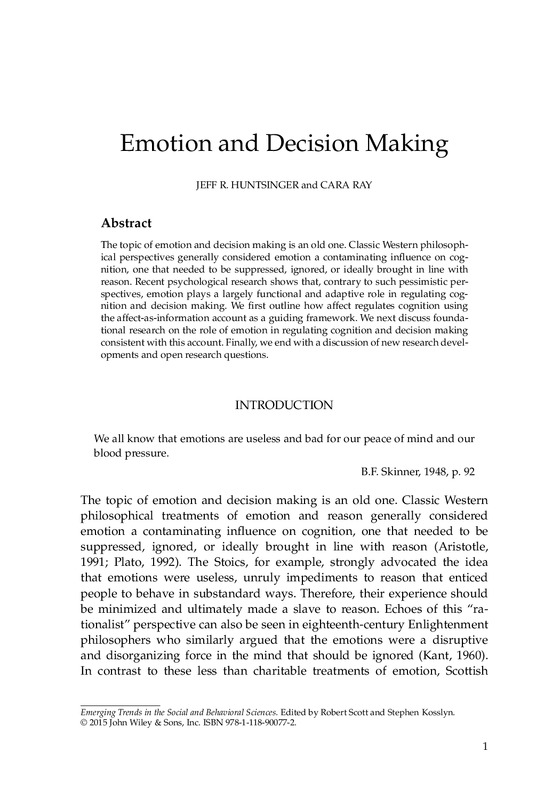
The topic of emotion and decision making is an old one. Classic Western philosophical perspectives generally considered emotion a contaminating influence on cognition, one that needed to be suppressed, ignored, or ideally brought in line with reason. Recent psychological research shows that, contrary to such pessimistic perspectives, emotion plays a largely functional and adaptive role in regulating cognition and decision making. We first outline how affect regulates cognition using the affect‐as‐information account as a guiding framework. We next discuss foundational research on the role of emotion in regulating cognition and decision making consistent with this account. Finally, we end with a discussion of new research developments and open research questions.
-
Related Essays
-
Models of Revealed Preference (Economics), Abi Adams and Ian Crawford
-
Coevolution of Decision‐Making and Social Environments (Sociology), Elizabeth Bruch et al.
-
Choice Architecture (Psychology), Adrian R. Camilleri and Rick P. Larrick
-
Emerging Trends: Asset Pricing (Economics), John Y. Campbell
-
Heuristic Decision Making (Political Science), Edward G. Carmines and Nicholas J. D'Amico
-
Behavioral Economics (Sociology), Guy Hochman and Dan Ariely
-
The Neurobiology and Physiology of Emotions: A Developmental Perspective (Psychology), Sarah S. Kahle and Paul D. Hastings
-
Against Game Theory (Political Science), Gale M. Lucas et al.
-
Emotion and Intergroup Relations (Psychology), Diane M. Mackie et al.
-
Event Processing as an Executive Enterprise (Psychology), Robbie A. Ross and Dare A. Baldwin
-
Emotion Regulation (Psychology), Paree Zarolia et al.
-
Identifier
-
etrds0110
-
extracted text
-
Emotion and Decision Making
JEFF R. HUNTSINGER and CARA RAY
Abstract
The topic of emotion and decision making is an old one. Classic Western philosophical perspectives generally considered emotion a contaminating influence on cognition, one that needed to be suppressed, ignored, or ideally brought in line with
reason. Recent psychological research shows that, contrary to such pessimistic perspectives, emotion plays a largely functional and adaptive role in regulating cognition and decision making. We first outline how affect regulates cognition using
the affect-as-information account as a guiding framework. We next discuss foundational research on the role of emotion in regulating cognition and decision making
consistent with this account. Finally, we end with a discussion of new research developments and open research questions.
INTRODUCTION
We all know that emotions are useless and bad for our peace of mind and our
blood pressure.
B.F. Skinner, 1948, p. 92
The topic of emotion and decision making is an old one. Classic Western
philosophical treatments of emotion and reason generally considered
emotion a contaminating influence on cognition, one that needed to be
suppressed, ignored, or ideally brought in line with reason (Aristotle,
1991; Plato, 1992). The Stoics, for example, strongly advocated the idea
that emotions were useless, unruly impediments to reason that enticed
people to behave in substandard ways. Therefore, their experience should
be minimized and ultimately made a slave to reason. Echoes of this “rationalist” perspective can also be seen in eighteenth-century Enlightenment
philosophers who similarly argued that the emotions were a disruptive
and disorganizing force in the mind that should be ignored (Kant, 1960).
In contrast to these less than charitable treatments of emotion, Scottish
Emerging Trends in the Social and Behavioral Sciences. Edited by Robert Scott and Stephen Kosslyn.
© 2015 John Wiley & Sons, Inc. ISBN 978-1-118-90077-2.
1
�2
EMERGING TRENDS IN THE SOCIAL AND BEHAVIORAL SCIENCES
philosopher David Hume (1739/1888) suggested that emotion formed an
essential element of reason. Indeed, for Hume, it was reason that should be
slave of the passions (i.e., emotion) rather than the other way around.
Early psychological treatments of emotion and decision making generally
accepted this rather dismal view. As illustrated in the epigraph that begins
this essay, Skinner’s view of emotion was decidedly dismissive. It was not
only behaviorists such as Skinner who maintained such a dismal view of
emotion; it was broadly held within the discipline (e.g., Freud, 1930/1961).
Moreover, when the cognitive revolution swept across psychology in the
1960s, empirical examination of emotion fell out of favor as researchers
adopted a cold computational model of the human mind.
The study of emotion only began to regain a foothold in psychology in the
late 1970s and early 1980s. This new research revealed a more rosy view of
how emotion influenced thinking. Rather than having a dysfunctional role,
the consensus view now is that emotion plays a largely functional role in
regulating cognition and decision making. Indeed, when the ability to experience emotion is impaired or absent, people have considerable difficulty effectively navigating even the most mundane decision contexts (Damasio, 1994).
In what follows, we outline how affect regulates cognition and decision
making. We begin by discussing foundational research on this topic across
several different domains. We end with a discussion of new research developments and open research questions.
Before continuing, it is necessary to define some key terms. The first concerns what we mean by affect. Clore and Huntsinger (2007) defined affect
as a representation of value (i.e., the goodness or badness of something)
that can take several different forms including neurological, physiological,
experiential, cognitive, and behavioral. An affective state involves the
co-occurrence of several of these reactions. Emotions represent affective
states with an object and reflect an underlying appraisal. Although emotions
can be classified according to valence (i.e., positive or negative), their
influence on cognition depends on the appraisal pattern that accompanies
their experience. In contrast, moods are diffuse affective states that lack
specific objects and appraisals. We thus speak of affective feelings as the
category that comprises both emotion and mood.
FOUNDATIONAL RESEARCH
Over the past three decades, a significant amount of research across a wide
variety of domains indicates that affective feelings may adaptively influence
how people process information and thus impact decision making. A useful
way to understand the impact of affective states on cognition can be found
in the affect-as-information account (Schwarz & Clore, 1983).
�Emotion and Decision Making
3
AFFECT-AS-INFORMATION ACCOUNT
According to this account, affective feelings are conscious information about
unconscious appraisals of situations. This appraisal process is always active,
giving rise not only to strong emotional feelings but also to weaker affective cues, which are always available as evaluations of our current situation. Said another way, just as emotional facial expressions provide affective
information to others, affective feelings play a role in judgment and cognition
by providing such affective information to oneself. As such, affective feelings serve an adaptive and important feedback function and they provide a
sufficient basis for many judgments and cognitive processing decisions.
The earliest articulations of the affect-as-information account applied
exclusively to affective influences on judgment, asserting that affective
feelings serve as input to evaluative judgments, with positive affect often
resulting in more positive judgments than negative affect (e.g., Schwarz &
Clore, 1983). This early model, however, was later expanded to account for
differences in cognitive processing. Consistent with functional theories of
emotion that assert that affect serves a signaling function that adaptively
directs our behaviors, Schwarz and Clore theorized that affective cues can
similarly serve to direct our cognitive processing by providing information
about our psychological environment (Schwarz & Clore, 1983, 2007).
According to this view, negative affective cues indicate the presence of a
problem, and thus trigger more careful, detailed processing in an attempt
to resolve the perceived problem. In contrast, positive affective cues signal
a safe and benign environment, and thus trigger more heuristic processing,
attention to global or big picture, gist-based information that comes quickly
to mind and that has served them well in the past. Some have suggested
that these differences are the result of positive affect increasing confidence in
global, heuristic processes, and general knowledge structures, thereby promoting reliance on such approaches, whereas negative affect is associated
with decreased confidence in such information, thereby promoting reliance
careful and detailed processing.
The affect-as-information account can also explain the influence of specific
emotions on cognition. The idea here is that different emotions convey different information about the ways in which objects are positive or negative
so that emotions of similar valence can have different effects and their implications for judgment and cognition depend on their object. This idea will be
explained in more detail shortly (see Specific Emotions section below).
In what follows, we first review evidence consistent with the idea that general positive and negative feelings produce reliable differences in judgment
and styles of thinking. Our discussion is organized around domains that have
clear implications for decision making. As will become clear shortly, whether
�4
EMERGING TRENDS IN THE SOCIAL AND BEHAVIORAL SCIENCES
positive or negative affect hinders or helps decision making and cognitive
performance depends on the nature of the task. This literature is now quite
voluminous; therefore, our review is necessarily selective and hence incomplete. We then turn our focus to how specific emotions, such as anger and
disgust, influence judgment and styles of thinking.
GENERAL POSITIVE AND NEGATIVE FEELINGS
Judgment. When making evaluative judgments, people often implicitly
ask themselves “how do I feel about it?” Currently experienced affective
reactions then inform people of the value of whatever happens to be the
object of judgment (Schwarz & Clore, 1983) and are experienced as liking or
disliking.
Schwarz and Clore (1983) first demonstrated the informational influence
of mood in studies examining life-satisfaction judgments. In a telephone
survey people were called on either rainy or sunny spring days and asked
how satisfied they were with their lives as a whole. The weather reliably
influenced people’s moods—people called on sunny days were happier than
those called on dreary days. As part of an implicit misattribution process,
these feelings were then drawn on by respondents when rating their levels
of life satisfaction, leading them to report being more satisfied with life
on a sunny than a rainy day. The influence of mood on judgments of life
satisfaction, however, disappeared when participants were first asked about
the weather. Asking about the weather did not change their feelings, but it
did change what their feelings seemed to be about.
A parallel influence of mood can be seen in risk judgments. The experience
of positive affect, as compared to negative affect, leads people to see less
risk in their environment (Gasper & Clore, 1998). This informational influence of affective feelings on judgment is quite robust, and has been found for
judgments of consumer products, the self, and other people (for a review, see
Schwarz & Clore, 2007).
Perception. Happy people tend to focus on the forest or the big picture and
sad people tend to focus on the trees or the details. As an example, when
judging the similarity between a series of geometric figures people in positive moods base their judgments on the global features of the stimuli more
than people in negative moods who base their judgments on the local features
(Gasper & Clore, 2002). Subsequent research employing a flanker task, which
more directly captures attentional broadening and narrowing, suggests that
positive and negative affect have these effects by fundamentally adjusting
the scope of visual attention (Rowe, Hirsh, & Anderson, 2007). In a flanker
�Emotion and Decision Making
5
task, participants respond to the identity of a central letter while ignoring
irrelevant flanking letters. On some trials the flanking letters are compatible (SSSSS) and other trials the flanking letters are incompatible (HHSHH)
with the central letter. Consistent with the idea that positive affect broadens
attention, happy as compared to sad participants exhibited slower reaction
times to the incompatible trials relative to the compatible ones. Such results
reveal that positive affect promoted a widened focus of attention leading to
distraction by the irrelevant flankers and slowing of responses to the central
stimulus, whereas the narrowed focus generated by negative affect facilitated
performance by reducing such distraction.
Categorization. The tendency of happy moods to produce a focus on the big
picture and heuristic processing facilitates formation of broad or inclusive
categories, whereas the tendency of sad moods to produce a focus on the
details and systematic processing facilitates formation of narrow or exclusive categories. Happy moods, for example, lead individuals to form more
inclusive categories in which atypical or unusual exemplars (e.g., feet) are
assigned to the category vehicle (Isen & Daubman, 1984). Similarly, happy
participants describe past events at a greater level of abstractness than sad
participants who describe such events using more concrete language (Beukeboom & Semin, 2005).
Creative Problem Solving. Work on categorization suggests that positive affect
leads people to perceive greater relatedness among diverse stimuli than negative affect. As a consequence, happy individuals generally outperform sad
individuals on measures of creative problem solving. Relative to sad or neutral moods, for example, happy moods have been associated with increased
performance on the Remote Associates Test (RAT), in which participants are
given three words (e.g., mower, atomic, foreign) and are asked to find one
word that relates to each of them (e.g., power). Likewise, happy individuals have been shown to be better able to entertain ideas about how objects
might serve different purposes and thus, are more successful at completing
Duncker’s candle problem solving task (Isen, Daubman, & Nowicki, 1987).
Analytic Reasoning Tasks. Unlike creative problem solving tasks, in which
performance is boosted by top-down processing and a broadened focus, performance on analytic reasoning tasks is facilitated by systematic processing
and attention to detail. Thus, sad individuals generally outperform happy
�6
EMERGING TRENDS IN THE SOCIAL AND BEHAVIORAL SCIENCES
individuals on such tasks. Melton (1995), for example, found that sad participants performed better on a syllogistic reasoning task than happy participants.
Heuristics and Biases. Judgmental and reasoning biases are nonrandom mistakes that result from application of certain heuristics and general knowledge
structures. These heuristics and biases come to mind easily but point judgment and reasoning toward formally incorrect responses. The superficial and
top-down processing style produced by positive affect should make people
more susceptible to a variety of judgmental and reasoning biases. Conversely,
the systematic and bottom-up processing style produced by negative affect
should make people less susceptible to such biases. Empirically this is the
case. Take for example the availability bias or ease of retrieval heuristic. This
heuristic reflects a judgmental rule under which individuals base their frequency or likelihood estimates on how easily they can recall relevant information (Tversky & Kahneman, 1973). Consistent with the idea that positive
affect foster heuristic processing, and negative affect systematic processing,
individuals in happy moods are more likely to fall prey to the availability
bias than those in sad moods (Ruder & Bless, 2003). A similar effect can be
seen in research on the correspondence bias, which reflects people’s tendency
to jump to dispositional explanations for others behavior even when such
behavior is constrained by situational demands. As with the availability bias,
happy people are more likely to commit this judgmental bias than sad people,
who instead tend to explain others’ behavior as due to situational demands
(Forgas, 1998).
Although the tendency to think more systematically may insulate sad people from many judgmental biases, one exception can be found in research
examining the influence of affective feelings on anchoring effects. Anchoring
effects occur when judgments are influenced by a salient anchor or starting
point, even when the value of the anchor is arbitrary or meaningless. For
example, in a classic demonstration of this effect Tversky and Kahneman
(1974) asked their participants two consecutive questions about the percentage of African countries in the United Nations. The first question asked participants to say whether the percentage of countries was higher or lower than
an arbitrary number (e.g., 65% or 10%) that was chosen by spinning a wheel.
Participants were then asked to estimate of this percentage. Final estimates
were higher when the initial anchor was a higher value and lower when the
anchor was smaller value.
One explanation for anchoring effects is that when people entertain an
initial starting value, they begin by testing the possibility that this value
is correct (Mussweiler, 2003). This biased hypothesis testing calls to mind
�Emotion and Decision Making
7
information consistent with the anchor (e.g., “Africa is huge,” “There must
be a lot of countries in Africa”), which in turn increases the impact of this
initial value on final judgments. The more extensively individuals entertain
the idea that an anchor is correct, the more information consistent with
the anchor that comes to mind, ultimately biasing final judgments toward
the anchor. The more elaborate and extensive processing of information
triggered by negative affect should increase the accessibility of information
consistent with the anchor. As a result sad individuals are more susceptible
to judgmental anchoring (Bodenhausen, Gabriel, & Lineberger, 2000).
Persuasion. Research on persuasion illustrates the idea that positive mood
produces heuristic or superficial processing and sad moods produce systematic or detailed processing. In this research, typically participants in induced
happy and sad moods read a persuasive appeal containing either strong or
weak arguments in favor of some position (e.g., comprehensive exams for
graduating college seniors). Much of this work demonstrates that the attitudes of people in happy moods seem immune to the quality of message
arguments, and are instead often based on heuristic cues, such as source
expertise. In contrast, the attitudes of people in sad moods seem attuned to
the quality of message arguments and immune to the allure of heuristic cues.
Thus, sad individuals tend to process arguments carefully and are more persuaded by strong rather than weak arguments, whereas happy individuals
tend to be equally persuaded by both (Bless, Bohner, Schwarz, & Strack, 1990;
Mackie & Worth, 1989).
Stereotyping and Impression Formation. When forming impressions of other
people, we can rely on global, categorical information (e.g., stereotypes, personality traits) or more local, detailed information (e.g., specific behaviors).
Research indicates that happy individuals are more likely to use stereotypes
and traits as a basis for impression-based judgments than are individuals
in sad or neutral moods. In a mock jury situation, for example, happy
people rely more on stereotypes when assessing a defendant’s guilt than sad
people and those in neutral moods (Bodenhausen & Moreno, 2000). In other
research, Isbell (2004) presented participants with global trait information
about a target (Carol is introverted) along with both trait-consistent behaviors (e.g., Carol is quiet around strangers) and trait-inconsistent behaviors
(e.g., Carol enjoys karaoke) that the target performed. Happy participants’
judgments reflected the trait information, whereas unhappy participants’
judgments instead reflected the mixed set of behaviors.
�8
EMERGING TRENDS IN THE SOCIAL AND BEHAVIORAL SCIENCES
SPECIFIC EMOTIONS
Unlike general positive and negative affective feelings, the information
conveyed by specific emotions is constrained by the pattern of appraisal
that accompanies each emotion (Clore & Huntsinger, 2009; Ortony, Clore, &
Collins, 1988). Thus, two emotions of similar valence (e.g., anger and
sadness) have opposite influences on cognition and decision making.
Disgust. Disgust involves dislike of the unappealing attributes of objects
based on taste. Distasteful things may include anything from foul odors to
offensive ideas. Objects associated with feelings of disgust should decrease
in value and should be avoided or rejected. Disgust has been examined in
an experiment on a phenomenon known as the “endowment effect,” which
refers to people’s tendency to set higher selling prices than buying prices
for objects they own (Lerner, Small, & Loewenstein, 2004). Consistent with
expectations, disgust disrupted the usually robust endowment effect by
decreasing the selling price for a small item (a set of highlighter pens) that
had been given to participants. The influence of disgust on decision making
has been most thoroughly mapped out in studies of moral decision making,
because people often report finding immoral acts physically disgusting.
Experimentally induced feelings of disgust can be misattributed to moral
judgments such that, for example, the feeling of disgust derived from being
exposed to a foul smell is incorrectly interpreted as being diagnostic about a
moral transgression, thus leading the person to infer that a particular moral
action is quite wrong (Schnall, Haidt, Clore, & Jordan, 2008).
Sadness. Sadness reflects displeasure over an undesirable outcome that is
relevant to one’s goals. Sadness therefore is accompanied by feelings of general loss and a lack of control and resources. In an attempt to compensate
for this loss, sadness often evokes an implicit goal to change one’s circumstances. Consistent with this idea, sadness reverses the usual responses that
constitute the endowment effect, lowering the selling price and raising the
buying price (Lerner et al., 2004). In effect, sad people attempt to change their
circumstances by disposing of what they have in exchange for something
new. Similarly, sadness has been shown to increase consumption, especially
hedonic consumption, although this effect can be attenuated by decreasing
feelings of helplessness that accompany the experience of sadness (Garg &
Lerner, 2013). This is especially the case for consumer products that are comforting and rewarding (Raghunathan, Pham, & Corfman, 2006). The sense of
loss associated with sadness also makes people more likely to prefer immediate gratification, rather than waiting for larger gains in the future (Lerner,
Li, & Weber, 2013).
�Emotion and Decision Making
9
Anger. Anger is a rather complex emotion that has two key ingredients: being displeased at an undesirable outcome and disapproval of the
blameworthy actions that caused them. Thus, anger has been shown to
increase judgments of blame (Keltner, Ellsworth, & Edwards, 1993). Because
anger is associated with a feeling of one’s position being correct it has been
shown to increase support for actions associated with one’s group. In the
research on emotional reactions to terrorism, for example, anger after the
September 11 attacks was associated with support for the Iraq war and
the perception that it was less risky (Lerner, Gonzalez, Small, & Fischhoff,
2003). The feeling of confidence associated with anger also encourages a
more heuristic or superficial style of thinking. Thus, anger tends to increase
reliance on stereotypes and on heuristic cues (e.g., source expertise) when
processing persuasive messages (Bodenhausen & Moreno, 2000; Tiedens &
Linton, 2001).
Fear and Anxiety. Fear and anxiety involve displeasure about the prospect
of an undesirable outcome and are accompanied by feelings of threat and
uncertainty. As such, the experience of fear and anxiety is linked to increased
judgments of risk (Gasper & Clore, 1998). In research on perceptions of terrorism and the second Iraq war, for example, fearful people perceived greater
risk from terrorism (Lerner et al., 2003). Fear and anxiety are also linked to a
tendency to make risk-averse decisions, a more pessimistic outlook on future
events (Lerner & Keltner, 2001), and preferences for consumer products that
emphasize safety (Raghunathan et al., 2006). Feelings of threat and uncertainty that accompany the experience of fear and anxiety also encourage a
more systematic or detailed style of thinking. Fearful people, for example,
avoid relying on stereotypes when making judgments and, when processing persuasive message, they also avoid relying on heuristic cues (Tiedens &
Linton, 2001).
CUTTING-EDGE RESEARCH
One way to understand the influence of general positive and negative
feelings (and specific emotions) on cognition is that particular feelings have
particular cognitive signatures. Positive affect and negative affect directly
produce changes in how we process information, with positive feelings
generating a global, heuristic and superficial style of thinking and negative
feelings generating a local, systematic and detailed style of thinking. Indeed,
the research reviewed above would seem to provide convincing evidence
for this idea. New research, however, suggests that the influence of general
positive and negative feelings (and specific emotions) may be quite a bit
�10
EMERGING TRENDS IN THE SOCIAL AND BEHAVIORAL SCIENCES
more flexible than original assumed. We now turn our attention to a new
perspective on how affect influences cognition and decision making.
A COGNITIVE FLEXIBILITY ACCOUNT
The cognitive flexibility account builds on the affect-as-information approach
just described and represents a more flexible variant of the earlier processing
account. Rather than assuming that affect simply provides information about
the benign or problematic nature of a situation, the cognitive malleability
approach emphasizes that the information that affect provides is considerably more general and less constrained than previously thought. According
to this view, the influence of positive affect on cognition is like that of reward
in that it is not dedicated to any one cognitive outcome, but tends to reinforce whatever cognitive responses are associated with it. This view underscores that people more or less automatically tend to experience affective
feelings as reactions to their current mental content. Thus, affective reactions
convey information about the value of accessible mental content, including
whatever thoughts and styles of processing happen to be in mind at the
moment.
In terms of general styles of thinking, positive affect may lead people to
view accessible processing strategies (e.g., heuristic or systematic, global or
local) as appropriate ways of dealing with incoming information. Negative
affect should have the opposite effect. Thus, positive and negative feelings
should adjust whether people rely on accessible thoughts and responses. In
effect, positive affect serves as a green light, or a “go signal” that validates
and facilitates the use of accessible styles of thinking, whereas negative affect
serves as a red light, or a “stop signal” that invalidates and inhibits their use
(Clore & Huntsinger, 2009; Huntsinger & Clore, 2012).
According to a cognitive flexibility account, then, the impact of affective
feelings on cognition should be flexible. That is, because affective feelings
simply confer positive or negative value on cognitively accessible mental
content, their impact on cognition should depend on what thoughts and processing inclinations happen to be accessible at the moment. We now selectively review evidence consistent with this account.
Perception. According to a cognitive flexibility account the seemingly robust
finding that people in happy moods focus broadly, and those in sad moods
focus narrowly, can be explained by the fact that people generally show a tendency to focus broadly. Not only is such a focus the default for most people,
this general tendency is only strengthened in most experimental contexts.
Therefore, rather than directly triggering a broad focus or a narrow focus, in
�Emotion and Decision Making
11
past research positive and negative affect may have had their effects by conferring positive or negative value on this highly accessible way of viewing
the world.
Consistent with this logic, new research shows that the link between
general positive and negative feelings and a focus on the forest or the
trees depends on whether people are inclined to focus broadly or narrowly
(Huntsinger, 2012; Huntsinger, Clore, & Bar-Anan, 2010). In this research,
when a global focus was dominant, happy people focused on the forest
and sad people the trees. However, when a local focus was dominant, now
happy people focused on the trees and sad people the forest. This result
was found for a variety of different measures of broadened or narrowed
attention, including tasks thought to capture fundamental shifts in the
scope of attention such as the flanker task described earlier (for a review,
see Huntsinger, 2013). These results suggest that the influence of affective
feelings on categorization and creativity, which are assumed to result
from affective shifts in attention to the forest or trees, should show similar
flexibility. This possibility awaits empirical examination.
Heuristics. Similar flexibility can be seen in research on what is called the
conjunction fallacy (Tversky & Kahneman, 1974). In a classic example of this
fallacy, people read a personality sketch of a woman named Linda in which
she was described as outspoken and very bright, and was deeply concerned
with issues of discrimination and social justice as a student. Participants were
then asked which of two alternatives was most likely: (i) That Linda is a
bank teller or (ii) Linda is a bank teller and active in the feminist movement.
Most participants chose option two because it seems more “representative”
of Linda based on the description they read (i.e., Linda just “looks like” a feminist), even though the conjunction of two events is necessarily less likely than
either one occurring in isolation. Because this tendency is only reinforced by
a heuristic style of thinking, past research suggests that happy people should
be more apt to commit this logical mistake than sad people. From a cognitive
flexibility account, however, whether happy or sad people fall prey to the
conjunction fallacy ultimately should depend on whether a heuristic or systematic style of thinking is most accessible at the moment. Consistent with
this reasoning, when primed with a heuristic style of thinking, happy people
commit this fallacy more than sad people, but when primed with a systematic style of thinking, happy people commit this fallacy less than sad people
(Huntsinger & Ray, 2014).
Impression Formation and Stereotyping. From a cognitive flexibility account,
the customary influence of positive and negative affect on stereotyping
�12
EMERGING TRENDS IN THE SOCIAL AND BEHAVIORAL SCIENCES
results from the fact that global, category-based processing tends to be
the default tendency in impression formation tasks (Fiske & Taylor, 2008).
Thus, in past research affect may have had its influence merely as a result of
positive affect conferring positive value on this already accessible tendency,
and negative affect conferring negative value. Consistent with this logic,
making a local, item-based processing tendency momentarily dominant
reverses the link between affect and the use of global, category-based
information (Hunsinger, Isbell, & Clore, 2012). Now happy people form
impression based on presented behavioral information and sad people form
impressions based on presented trait information.
SUMMARY
The research just reviewed suggests that general affective feelings are not
tied to particular styles of thinking. Rather, the influence of general affective
feelings on thinking and decision making is flexibly responsive to changing cognitive contexts, including whether different ways of attending to and
thinking about the world are most in mind at the moment (for an extensive
review, see Huntsinger, Isbell, & Clore, 2014).
KEY ISSUES FOR FUTURE RESEARCH
Over the past 30–40 years, researchers have provided a detailed portrait of
how emotion influences cognition and decision making. Although early
research seemed to indicate that emotion has direct and dedicated effects
on cognition, new research suggests that such a conclusion may have been
premature. Indeed, at least for general positive and negative feelings, this
new research suggests that such feelings do not have particular cognitive
signatures. Rather their influence depends on the momentary cognitive
context.
Of course, as with any empirical endeavor, there always remain outstanding, unanswered questions, some of which are suggested by existing research
and some that will only emerge as more work is done. Below we suggest key
issues for future research:
•
•
Future research is needed to determine the neurobiological underpinnings emotional influences on cognition. In order to fully understand
how emotion influences cognition and decision making a neurologically
plausible model of their interaction needs to be developed.
Although researchers have begun to show the flexible impact of general positive and negative feelings on cognition and decision making, it
remains an open question whether specific emotions will display similar
�Emotion and Decision Making
13
flexible effects. This is an important area for future research, and there
reason to suspect similar flexibility. According to the cognitive flexibility
account, emotions associated with certainty (e.g., anger and happiness)
should lead people to adopt whatever style of information processing
is activated, whereas emotions associated uncertainty (e.g., anxiety, sadness) should lead people to reject activated styles of information processing. Thus, like more general positive and negative feelings, this account
suggests that the influence of emotion on cognition should be flexibly
responsive to change in styles of thinking.
REFERENCES
Aristotle (1991). The art of rhetoric. London, England: Penguin.
Beukeboom, C. J., & Semin, G. R. (2005). Mood and representations of behavior: The
how and why. Cognition and Emotion, 19, 1242–1251.
Bless, H., Bohner, G., Schwarz, N., & Strack, F. (1990). Mood and persuasion: A cognitive response analysis. Personality and Social Psychology Bulletin, 16(2), 331–345.
Bodenhausen, G. V., Gabriel, S., & Lineberger, M. (2000). Sadness and susceptibility
to judgmental bias: The case of anchoring. Psychological Science, 11, 320–323.
Bodenhausen, G. V., & Moreno, K. N. (2000). How do I feel about them? The role of
affective reactions in intergroup perception. In H. Bless & J. P. Forgas (Eds.), The
message within: Subjective experience in social cognition and behavior (pp. 283–303).
Philadelphia, PA: Psychology Press.
Clore, G. L., & Huntsinger, J. R. (2007). How emotions inform judgment and regulate
thought. Trends in Cognitive Sciences, 9, 393–399.
Clore, G. L., & Huntsinger, J. R. (2009). How the object of affect guides its impact.
Emotion Review, 1, 39–54.
Damasio, A. (1994). Descartes’ error: emotions, reason, and the human brain. New York,
NY: Avon Books.
Fiske, S. T., & Taylor, S. E. (2008). Social cognition: From brains to culture. New York,
NY: McGraw-Hill.
Forgas, J. P. (1998). On being happy and mistaken: Mood effects on the fundamental
attribution error. Journal of Personality and Social Psychology, 75, 318–331.
Freud, S. (1961). Civilization and its discontents (J. Strachey, Trans.). New York, NY:
Norton (Original work published 1930).
Garg, N., & Lerner, J. S. (2013). Sadness and consumption. Journal of Consumer Psychology, 23, 106–113.
Gasper, K., & Clore, G. L. (1998). The persistent use of negative affect by anxious individuals to estimate risk. Journal of Personality and Social Psychology, 74, 1350–1363.
Gasper, K., & Clore, G. L. (2002). Attending to the big picture: Mood and global vs.
local processing of visual information. Psychological Science, 13, 34–40.
Hume, D. (1739/1888). A treatise of human nature. In L. A. Selby-Bigge (Ed.), Hume’s
treatise of human nature. Oxford, England: Clarendon Press.
�14
EMERGING TRENDS IN THE SOCIAL AND BEHAVIORAL SCIENCES
Hunsinger, M., Isbell, L. M., & Clore, G. L. (2012). Sometimes happy people focus on
the trees and sad people focus on the forest: Context-dependent effects of mood
in impression formation. Personality and Social Psychology Bulletin, 38(2), 220–232.
Huntsinger, J. R. (2013). Does emotion directly tune the scope of attention? Current
Directions in Psychological Science, 22, 265–270.
Huntsinger, J. R. (2012). Does positive affect broaden and negative affect narrow
attentional scope? A new answer to an old question. Journal of Experimental Psychology: General, 141, 595–600.
Huntsinger, J. R., & Clore, G. L. (2012). Emotion and social metacognition. In P. Briñol
& K. DeMarree (Eds.), Social Metacognition (Frontiers of Social Psychology Series)
(pp. 199–217). Psychology Press: New York, NY.
Huntsinger, J. R., Clore, G. L., & Bar-Anan, Y. (2010). Mood and global–local focus:
Priming a local focus reverses the link between mood and global–local processing.
Emotion, 10, 722–726.
Huntsinger, J. R., Isbell, L., & Clore, G. L. (2014). The affective control of thought:
Malleable, not fixed. Psychological Review, 121, 600–618.
Huntsinger, J. R., & Ray, C. (2014). A flexible influence of affective feelings on cognitive performance. Unpublished manuscript.
Isbell, L. M. (2004). Not all happy people are lazy or stupid: Evidence of systematic processing in happy moods. Journal of Experimental Social Psychology, 40(3),
341–349.
Isen, A. M., & Daubman, K. A. (1984). The influence of affect on categorization. Journal of Personality and Social Psychology, 47(6), 1206–1217.
Isen, A. M., Daubman, K. A., & Nowicki, G. P. (1987). Positive affect facilitates creative problem solving. Journal of Personality and Social Psychology, 52(6), 1122–1131.
Kant, I. (1960). Observations on the feeling of the beautiful and the sublime (Translated by
J. T. Goldthwait). Berkeley: University of California Press.
Keltner, D., Ellsworth, P., & Edwards, K. (1993). Beyond simple pessimism: Effects of
sadness and anger on social perception. Journal of Personality and Social Psychology,
64, 740–752.
Lerner, J. S., Gonzalez, R. M., Small, D. A., & Fischhoff, B. (2003). Effects of fear and
anger on perceived risks of terrorism: A national field experiment. Psychological
Science, 14, 144–150.
Lerner, J. S., & Keltner, D. (2001). Fear, anger, and risk. Journal of Personality and Social
Psychology, 81, 146–159.
Lerner, J. S., Li, Y., & Weber, E. U. (2013). The financial costs of sadness. Psychological
Science, 24, 72–79.
Lerner, J. S., Small, D. A., & Loewenstein, G. (2004). Heart strings and purse strings:
Carry-over effects of emotion on economic transactions. Psychological Science, 15,
337–341.
Mackie, D. M., & Worth, L. T. (1989). Processing deficits and the mediation of positive
affect in persuasion. Journal of Personality and Social Psychology, 57(1), 27–40.
Melton, R. J. (1995). The role of positive affect in syllogism performance. Personality
and Social Psychology Bulletin, 21, 788–794.
�Emotion and Decision Making
15
Mussweiler, T. (2003). Comparison processes in social judgment: Mechanisms and
consequences. Psychological Review, 110, 472–489.
Ortony, A., Clore, G. L., & Collins, A. (1988). The cognitive structure of emotions. New
York, NY: Cambridge University Press.
Plato (1992). Republic (trans. Grube, G.). Hackett: Indianapolis, MA.
Raghunathan, R., Pham, M. T., & Corfman, K. P. (2006). Informational properties of
anxiety and sadness, and displaced coping. Journal of Consumer Research, 32(4),
596–601.
Rowe, G., Hirsh, J. B., & Anderson, A. K. (2007). Positive affect increases the breadth
of attentional selection. Proceedings of the National Academy of Sciences of the United
States of America, 104(1), 383–388.
Ruder, M., & Bless, H. (2003). Mood and the reliance on the ease of retrieval heuristic.
Journal of Personality and Social Psychology, 85, 20–32.
Schnall, S., Haidt, J., Clore, G. L., & Jordan, A. H. (2008). Disgust as embodied moral
judgment. Personality and Social Psychology Bulletin, 34, 1096–1109.
Schwarz, N., & Clore, G. L. (1983). Mood, misattribution, and judgments of wellbeing: Informative and directive functions of affective states. Journal of Personality
and Social Psychology, 45, 513–523.
Schwarz, N., & Clore, G. L. (2007). Feelings and phenomenal experiences. In E. T.
Higgins & A. Kruglanski (Eds.), Social psychology: A handbook of basic principles
(Vol. 2, pp. 385–407). New York, NY: Guilford Press.
Skinner, B. F. (1948). Walden two. Englewood Cliffs, NJ: Prentice Hall.
Tiedens, L. Z., & Linton, S. (2001). Judgment under emotional certainty and uncertainty: The effects of specific emotions on information processing. Journal of Personality and Social Psychology, 81(6), 973–988.
Tversky, A., & Kahneman, D. (1973). Availability: A heuristic for judging frequency
and probability. Cognitive Psychology, 5, 207–232.
Tversky, A., & Kahneman, D. (1974). Judgment under uncertainty: Heuristics and
biases. Science, 185, 1124–1131.
FURTHER READING
Huntsinger, J. R. (2013). Does emotion directly tune the scope of attention? Current
Directions in Psychological Science.
Huntsinger, J. R., & Clore, G. L. (2012). Emotion and social metacognition. In P. Briñol
& K. DeMarree (Eds.), Social Metacognition (Frontiers of Social Psychology Series) (pp.
199–217). Psychology Press: New York, NY.
Schwarz, N., & Clore, G. L. (1983). Mood, misattribution, and judgments of wellbeing: Informative and directive functions of affective states. Journal of Personality
and Social Psychology, 45, 513–523.
Schwarz, N., & Clore, G. L. (2007). Feelings and phenomenal experiences. In E. T.
Higgins & A. Kruglanski (Eds.), Social psychology: A handbook of basic principles
(Vol. 2, pp. 385–407). New York, NY: Guilford Press.
�16
EMERGING TRENDS IN THE SOCIAL AND BEHAVIORAL SCIENCES
JEFF R. HUNTSINGER SHORT BIOGRAPHY
Jeff R. Huntsinger is an assistant professor of psychology at Loyola University Chicago. Huntsinger has written and coauthored over 30 peer-reviewed
journal articles and chapters on the topic of emotion–cognition interactions.
His research focuses on the flexible and adaptive impact of emotion in directing the course of cognitive and perceptual activities.
Personal webpage: http://huntsingper.socialpsychology.org/
Curriculum vitae: http://huntsinger.socialpsychology.org/cv/
Huntsinger-Vita-1.pdf
CARA RAY SHORT BIOGRAPHY
Cara Ray is an undergraduate student at Loyola University Chicago majoring in psychology. Her interests include the role of emotion in decision making. She hopes to attend graduate school in order to eventually become an
academic psychologist.
RELATED ESSAYS
Models of Revealed Preference (Economics), Abi Adams and Ian Crawford
Coevolution of Decision-Making and Social Environments (Sociology),
Elizabeth Bruch et al.
Choice Architecture (Psychology), Adrian R. Camilleri and Rick P. Larrick
Emerging Trends: Asset Pricing (Economics), John Y. Campbell
Heuristic Decision Making (Political Science), Edward G. Carmines and
Nicholas J. D’Amico
Behavioral Economics (Sociology), Guy Hochman and Dan Ariely
The Neurobiology and Physiology of Emotions: A Developmental Perspective (Psychology), Sarah S. Kahle and Paul D. Hastings
Against Game Theory (Political Science), Gale M. Lucas et al.
Emotion and Intergroup Relations (Psychology), Diane M. Mackie et al.
Event Processing as an Executive Enterprise (Psychology), Robbie A. Ross
and Dare A. Baldwin
Emotion Regulation (Psychology), Paree Zarolia et al.
�
-
Emotion and Decision Making
JEFF R. HUNTSINGER and CARA RAY
Abstract
The topic of emotion and decision making is an old one. Classic Western philosophical perspectives generally considered emotion a contaminating influence on cognition, one that needed to be suppressed, ignored, or ideally brought in line with
reason. Recent psychological research shows that, contrary to such pessimistic perspectives, emotion plays a largely functional and adaptive role in regulating cognition and decision making. We first outline how affect regulates cognition using
the affect-as-information account as a guiding framework. We next discuss foundational research on the role of emotion in regulating cognition and decision making
consistent with this account. Finally, we end with a discussion of new research developments and open research questions.
INTRODUCTION
We all know that emotions are useless and bad for our peace of mind and our
blood pressure.
B.F. Skinner, 1948, p. 92
The topic of emotion and decision making is an old one. Classic Western
philosophical treatments of emotion and reason generally considered
emotion a contaminating influence on cognition, one that needed to be
suppressed, ignored, or ideally brought in line with reason (Aristotle,
1991; Plato, 1992). The Stoics, for example, strongly advocated the idea
that emotions were useless, unruly impediments to reason that enticed
people to behave in substandard ways. Therefore, their experience should
be minimized and ultimately made a slave to reason. Echoes of this “rationalist” perspective can also be seen in eighteenth-century Enlightenment
philosophers who similarly argued that the emotions were a disruptive
and disorganizing force in the mind that should be ignored (Kant, 1960).
In contrast to these less than charitable treatments of emotion, Scottish
Emerging Trends in the Social and Behavioral Sciences. Edited by Robert Scott and Stephen Kosslyn.
© 2015 John Wiley & Sons, Inc. ISBN 978-1-118-90077-2.
1
�2
EMERGING TRENDS IN THE SOCIAL AND BEHAVIORAL SCIENCES
philosopher David Hume (1739/1888) suggested that emotion formed an
essential element of reason. Indeed, for Hume, it was reason that should be
slave of the passions (i.e., emotion) rather than the other way around.
Early psychological treatments of emotion and decision making generally
accepted this rather dismal view. As illustrated in the epigraph that begins
this essay, Skinner’s view of emotion was decidedly dismissive. It was not
only behaviorists such as Skinner who maintained such a dismal view of
emotion; it was broadly held within the discipline (e.g., Freud, 1930/1961).
Moreover, when the cognitive revolution swept across psychology in the
1960s, empirical examination of emotion fell out of favor as researchers
adopted a cold computational model of the human mind.
The study of emotion only began to regain a foothold in psychology in the
late 1970s and early 1980s. This new research revealed a more rosy view of
how emotion influenced thinking. Rather than having a dysfunctional role,
the consensus view now is that emotion plays a largely functional role in
regulating cognition and decision making. Indeed, when the ability to experience emotion is impaired or absent, people have considerable difficulty effectively navigating even the most mundane decision contexts (Damasio, 1994).
In what follows, we outline how affect regulates cognition and decision
making. We begin by discussing foundational research on this topic across
several different domains. We end with a discussion of new research developments and open research questions.
Before continuing, it is necessary to define some key terms. The first concerns what we mean by affect. Clore and Huntsinger (2007) defined affect
as a representation of value (i.e., the goodness or badness of something)
that can take several different forms including neurological, physiological,
experiential, cognitive, and behavioral. An affective state involves the
co-occurrence of several of these reactions. Emotions represent affective
states with an object and reflect an underlying appraisal. Although emotions
can be classified according to valence (i.e., positive or negative), their
influence on cognition depends on the appraisal pattern that accompanies
their experience. In contrast, moods are diffuse affective states that lack
specific objects and appraisals. We thus speak of affective feelings as the
category that comprises both emotion and mood.
FOUNDATIONAL RESEARCH
Over the past three decades, a significant amount of research across a wide
variety of domains indicates that affective feelings may adaptively influence
how people process information and thus impact decision making. A useful
way to understand the impact of affective states on cognition can be found
in the affect-as-information account (Schwarz & Clore, 1983).
�Emotion and Decision Making
3
AFFECT-AS-INFORMATION ACCOUNT
According to this account, affective feelings are conscious information about
unconscious appraisals of situations. This appraisal process is always active,
giving rise not only to strong emotional feelings but also to weaker affective cues, which are always available as evaluations of our current situation. Said another way, just as emotional facial expressions provide affective
information to others, affective feelings play a role in judgment and cognition
by providing such affective information to oneself. As such, affective feelings serve an adaptive and important feedback function and they provide a
sufficient basis for many judgments and cognitive processing decisions.
The earliest articulations of the affect-as-information account applied
exclusively to affective influences on judgment, asserting that affective
feelings serve as input to evaluative judgments, with positive affect often
resulting in more positive judgments than negative affect (e.g., Schwarz &
Clore, 1983). This early model, however, was later expanded to account for
differences in cognitive processing. Consistent with functional theories of
emotion that assert that affect serves a signaling function that adaptively
directs our behaviors, Schwarz and Clore theorized that affective cues can
similarly serve to direct our cognitive processing by providing information
about our psychological environment (Schwarz & Clore, 1983, 2007).
According to this view, negative affective cues indicate the presence of a
problem, and thus trigger more careful, detailed processing in an attempt
to resolve the perceived problem. In contrast, positive affective cues signal
a safe and benign environment, and thus trigger more heuristic processing,
attention to global or big picture, gist-based information that comes quickly
to mind and that has served them well in the past. Some have suggested
that these differences are the result of positive affect increasing confidence in
global, heuristic processes, and general knowledge structures, thereby promoting reliance on such approaches, whereas negative affect is associated
with decreased confidence in such information, thereby promoting reliance
careful and detailed processing.
The affect-as-information account can also explain the influence of specific
emotions on cognition. The idea here is that different emotions convey different information about the ways in which objects are positive or negative
so that emotions of similar valence can have different effects and their implications for judgment and cognition depend on their object. This idea will be
explained in more detail shortly (see Specific Emotions section below).
In what follows, we first review evidence consistent with the idea that general positive and negative feelings produce reliable differences in judgment
and styles of thinking. Our discussion is organized around domains that have
clear implications for decision making. As will become clear shortly, whether
�4
EMERGING TRENDS IN THE SOCIAL AND BEHAVIORAL SCIENCES
positive or negative affect hinders or helps decision making and cognitive
performance depends on the nature of the task. This literature is now quite
voluminous; therefore, our review is necessarily selective and hence incomplete. We then turn our focus to how specific emotions, such as anger and
disgust, influence judgment and styles of thinking.
GENERAL POSITIVE AND NEGATIVE FEELINGS
Judgment. When making evaluative judgments, people often implicitly
ask themselves “how do I feel about it?” Currently experienced affective
reactions then inform people of the value of whatever happens to be the
object of judgment (Schwarz & Clore, 1983) and are experienced as liking or
disliking.
Schwarz and Clore (1983) first demonstrated the informational influence
of mood in studies examining life-satisfaction judgments. In a telephone
survey people were called on either rainy or sunny spring days and asked
how satisfied they were with their lives as a whole. The weather reliably
influenced people’s moods—people called on sunny days were happier than
those called on dreary days. As part of an implicit misattribution process,
these feelings were then drawn on by respondents when rating their levels
of life satisfaction, leading them to report being more satisfied with life
on a sunny than a rainy day. The influence of mood on judgments of life
satisfaction, however, disappeared when participants were first asked about
the weather. Asking about the weather did not change their feelings, but it
did change what their feelings seemed to be about.
A parallel influence of mood can be seen in risk judgments. The experience
of positive affect, as compared to negative affect, leads people to see less
risk in their environment (Gasper & Clore, 1998). This informational influence of affective feelings on judgment is quite robust, and has been found for
judgments of consumer products, the self, and other people (for a review, see
Schwarz & Clore, 2007).
Perception. Happy people tend to focus on the forest or the big picture and
sad people tend to focus on the trees or the details. As an example, when
judging the similarity between a series of geometric figures people in positive moods base their judgments on the global features of the stimuli more
than people in negative moods who base their judgments on the local features
(Gasper & Clore, 2002). Subsequent research employing a flanker task, which
more directly captures attentional broadening and narrowing, suggests that
positive and negative affect have these effects by fundamentally adjusting
the scope of visual attention (Rowe, Hirsh, & Anderson, 2007). In a flanker
�Emotion and Decision Making
5
task, participants respond to the identity of a central letter while ignoring
irrelevant flanking letters. On some trials the flanking letters are compatible (SSSSS) and other trials the flanking letters are incompatible (HHSHH)
with the central letter. Consistent with the idea that positive affect broadens
attention, happy as compared to sad participants exhibited slower reaction
times to the incompatible trials relative to the compatible ones. Such results
reveal that positive affect promoted a widened focus of attention leading to
distraction by the irrelevant flankers and slowing of responses to the central
stimulus, whereas the narrowed focus generated by negative affect facilitated
performance by reducing such distraction.
Categorization. The tendency of happy moods to produce a focus on the big
picture and heuristic processing facilitates formation of broad or inclusive
categories, whereas the tendency of sad moods to produce a focus on the
details and systematic processing facilitates formation of narrow or exclusive categories. Happy moods, for example, lead individuals to form more
inclusive categories in which atypical or unusual exemplars (e.g., feet) are
assigned to the category vehicle (Isen & Daubman, 1984). Similarly, happy
participants describe past events at a greater level of abstractness than sad
participants who describe such events using more concrete language (Beukeboom & Semin, 2005).
Creative Problem Solving. Work on categorization suggests that positive affect
leads people to perceive greater relatedness among diverse stimuli than negative affect. As a consequence, happy individuals generally outperform sad
individuals on measures of creative problem solving. Relative to sad or neutral moods, for example, happy moods have been associated with increased
performance on the Remote Associates Test (RAT), in which participants are
given three words (e.g., mower, atomic, foreign) and are asked to find one
word that relates to each of them (e.g., power). Likewise, happy individuals have been shown to be better able to entertain ideas about how objects
might serve different purposes and thus, are more successful at completing
Duncker’s candle problem solving task (Isen, Daubman, & Nowicki, 1987).
Analytic Reasoning Tasks. Unlike creative problem solving tasks, in which
performance is boosted by top-down processing and a broadened focus, performance on analytic reasoning tasks is facilitated by systematic processing
and attention to detail. Thus, sad individuals generally outperform happy
�6
EMERGING TRENDS IN THE SOCIAL AND BEHAVIORAL SCIENCES
individuals on such tasks. Melton (1995), for example, found that sad participants performed better on a syllogistic reasoning task than happy participants.
Heuristics and Biases. Judgmental and reasoning biases are nonrandom mistakes that result from application of certain heuristics and general knowledge
structures. These heuristics and biases come to mind easily but point judgment and reasoning toward formally incorrect responses. The superficial and
top-down processing style produced by positive affect should make people
more susceptible to a variety of judgmental and reasoning biases. Conversely,
the systematic and bottom-up processing style produced by negative affect
should make people less susceptible to such biases. Empirically this is the
case. Take for example the availability bias or ease of retrieval heuristic. This
heuristic reflects a judgmental rule under which individuals base their frequency or likelihood estimates on how easily they can recall relevant information (Tversky & Kahneman, 1973). Consistent with the idea that positive
affect foster heuristic processing, and negative affect systematic processing,
individuals in happy moods are more likely to fall prey to the availability
bias than those in sad moods (Ruder & Bless, 2003). A similar effect can be
seen in research on the correspondence bias, which reflects people’s tendency
to jump to dispositional explanations for others behavior even when such
behavior is constrained by situational demands. As with the availability bias,
happy people are more likely to commit this judgmental bias than sad people,
who instead tend to explain others’ behavior as due to situational demands
(Forgas, 1998).
Although the tendency to think more systematically may insulate sad people from many judgmental biases, one exception can be found in research
examining the influence of affective feelings on anchoring effects. Anchoring
effects occur when judgments are influenced by a salient anchor or starting
point, even when the value of the anchor is arbitrary or meaningless. For
example, in a classic demonstration of this effect Tversky and Kahneman
(1974) asked their participants two consecutive questions about the percentage of African countries in the United Nations. The first question asked participants to say whether the percentage of countries was higher or lower than
an arbitrary number (e.g., 65% or 10%) that was chosen by spinning a wheel.
Participants were then asked to estimate of this percentage. Final estimates
were higher when the initial anchor was a higher value and lower when the
anchor was smaller value.
One explanation for anchoring effects is that when people entertain an
initial starting value, they begin by testing the possibility that this value
is correct (Mussweiler, 2003). This biased hypothesis testing calls to mind
�Emotion and Decision Making
7
information consistent with the anchor (e.g., “Africa is huge,” “There must
be a lot of countries in Africa”), which in turn increases the impact of this
initial value on final judgments. The more extensively individuals entertain
the idea that an anchor is correct, the more information consistent with
the anchor that comes to mind, ultimately biasing final judgments toward
the anchor. The more elaborate and extensive processing of information
triggered by negative affect should increase the accessibility of information
consistent with the anchor. As a result sad individuals are more susceptible
to judgmental anchoring (Bodenhausen, Gabriel, & Lineberger, 2000).
Persuasion. Research on persuasion illustrates the idea that positive mood
produces heuristic or superficial processing and sad moods produce systematic or detailed processing. In this research, typically participants in induced
happy and sad moods read a persuasive appeal containing either strong or
weak arguments in favor of some position (e.g., comprehensive exams for
graduating college seniors). Much of this work demonstrates that the attitudes of people in happy moods seem immune to the quality of message
arguments, and are instead often based on heuristic cues, such as source
expertise. In contrast, the attitudes of people in sad moods seem attuned to
the quality of message arguments and immune to the allure of heuristic cues.
Thus, sad individuals tend to process arguments carefully and are more persuaded by strong rather than weak arguments, whereas happy individuals
tend to be equally persuaded by both (Bless, Bohner, Schwarz, & Strack, 1990;
Mackie & Worth, 1989).
Stereotyping and Impression Formation. When forming impressions of other
people, we can rely on global, categorical information (e.g., stereotypes, personality traits) or more local, detailed information (e.g., specific behaviors).
Research indicates that happy individuals are more likely to use stereotypes
and traits as a basis for impression-based judgments than are individuals
in sad or neutral moods. In a mock jury situation, for example, happy
people rely more on stereotypes when assessing a defendant’s guilt than sad
people and those in neutral moods (Bodenhausen & Moreno, 2000). In other
research, Isbell (2004) presented participants with global trait information
about a target (Carol is introverted) along with both trait-consistent behaviors (e.g., Carol is quiet around strangers) and trait-inconsistent behaviors
(e.g., Carol enjoys karaoke) that the target performed. Happy participants’
judgments reflected the trait information, whereas unhappy participants’
judgments instead reflected the mixed set of behaviors.
�8
EMERGING TRENDS IN THE SOCIAL AND BEHAVIORAL SCIENCES
SPECIFIC EMOTIONS
Unlike general positive and negative affective feelings, the information
conveyed by specific emotions is constrained by the pattern of appraisal
that accompanies each emotion (Clore & Huntsinger, 2009; Ortony, Clore, &
Collins, 1988). Thus, two emotions of similar valence (e.g., anger and
sadness) have opposite influences on cognition and decision making.
Disgust. Disgust involves dislike of the unappealing attributes of objects
based on taste. Distasteful things may include anything from foul odors to
offensive ideas. Objects associated with feelings of disgust should decrease
in value and should be avoided or rejected. Disgust has been examined in
an experiment on a phenomenon known as the “endowment effect,” which
refers to people’s tendency to set higher selling prices than buying prices
for objects they own (Lerner, Small, & Loewenstein, 2004). Consistent with
expectations, disgust disrupted the usually robust endowment effect by
decreasing the selling price for a small item (a set of highlighter pens) that
had been given to participants. The influence of disgust on decision making
has been most thoroughly mapped out in studies of moral decision making,
because people often report finding immoral acts physically disgusting.
Experimentally induced feelings of disgust can be misattributed to moral
judgments such that, for example, the feeling of disgust derived from being
exposed to a foul smell is incorrectly interpreted as being diagnostic about a
moral transgression, thus leading the person to infer that a particular moral
action is quite wrong (Schnall, Haidt, Clore, & Jordan, 2008).
Sadness. Sadness reflects displeasure over an undesirable outcome that is
relevant to one’s goals. Sadness therefore is accompanied by feelings of general loss and a lack of control and resources. In an attempt to compensate
for this loss, sadness often evokes an implicit goal to change one’s circumstances. Consistent with this idea, sadness reverses the usual responses that
constitute the endowment effect, lowering the selling price and raising the
buying price (Lerner et al., 2004). In effect, sad people attempt to change their
circumstances by disposing of what they have in exchange for something
new. Similarly, sadness has been shown to increase consumption, especially
hedonic consumption, although this effect can be attenuated by decreasing
feelings of helplessness that accompany the experience of sadness (Garg &
Lerner, 2013). This is especially the case for consumer products that are comforting and rewarding (Raghunathan, Pham, & Corfman, 2006). The sense of
loss associated with sadness also makes people more likely to prefer immediate gratification, rather than waiting for larger gains in the future (Lerner,
Li, & Weber, 2013).
�Emotion and Decision Making
9
Anger. Anger is a rather complex emotion that has two key ingredients: being displeased at an undesirable outcome and disapproval of the
blameworthy actions that caused them. Thus, anger has been shown to
increase judgments of blame (Keltner, Ellsworth, & Edwards, 1993). Because
anger is associated with a feeling of one’s position being correct it has been
shown to increase support for actions associated with one’s group. In the
research on emotional reactions to terrorism, for example, anger after the
September 11 attacks was associated with support for the Iraq war and
the perception that it was less risky (Lerner, Gonzalez, Small, & Fischhoff,
2003). The feeling of confidence associated with anger also encourages a
more heuristic or superficial style of thinking. Thus, anger tends to increase
reliance on stereotypes and on heuristic cues (e.g., source expertise) when
processing persuasive messages (Bodenhausen & Moreno, 2000; Tiedens &
Linton, 2001).
Fear and Anxiety. Fear and anxiety involve displeasure about the prospect
of an undesirable outcome and are accompanied by feelings of threat and
uncertainty. As such, the experience of fear and anxiety is linked to increased
judgments of risk (Gasper & Clore, 1998). In research on perceptions of terrorism and the second Iraq war, for example, fearful people perceived greater
risk from terrorism (Lerner et al., 2003). Fear and anxiety are also linked to a
tendency to make risk-averse decisions, a more pessimistic outlook on future
events (Lerner & Keltner, 2001), and preferences for consumer products that
emphasize safety (Raghunathan et al., 2006). Feelings of threat and uncertainty that accompany the experience of fear and anxiety also encourage a
more systematic or detailed style of thinking. Fearful people, for example,
avoid relying on stereotypes when making judgments and, when processing persuasive message, they also avoid relying on heuristic cues (Tiedens &
Linton, 2001).
CUTTING-EDGE RESEARCH
One way to understand the influence of general positive and negative
feelings (and specific emotions) on cognition is that particular feelings have
particular cognitive signatures. Positive affect and negative affect directly
produce changes in how we process information, with positive feelings
generating a global, heuristic and superficial style of thinking and negative
feelings generating a local, systematic and detailed style of thinking. Indeed,
the research reviewed above would seem to provide convincing evidence
for this idea. New research, however, suggests that the influence of general
positive and negative feelings (and specific emotions) may be quite a bit
�10
EMERGING TRENDS IN THE SOCIAL AND BEHAVIORAL SCIENCES
more flexible than original assumed. We now turn our attention to a new
perspective on how affect influences cognition and decision making.
A COGNITIVE FLEXIBILITY ACCOUNT
The cognitive flexibility account builds on the affect-as-information approach
just described and represents a more flexible variant of the earlier processing
account. Rather than assuming that affect simply provides information about
the benign or problematic nature of a situation, the cognitive malleability
approach emphasizes that the information that affect provides is considerably more general and less constrained than previously thought. According
to this view, the influence of positive affect on cognition is like that of reward
in that it is not dedicated to any one cognitive outcome, but tends to reinforce whatever cognitive responses are associated with it. This view underscores that people more or less automatically tend to experience affective
feelings as reactions to their current mental content. Thus, affective reactions
convey information about the value of accessible mental content, including
whatever thoughts and styles of processing happen to be in mind at the
moment.
In terms of general styles of thinking, positive affect may lead people to
view accessible processing strategies (e.g., heuristic or systematic, global or
local) as appropriate ways of dealing with incoming information. Negative
affect should have the opposite effect. Thus, positive and negative feelings
should adjust whether people rely on accessible thoughts and responses. In
effect, positive affect serves as a green light, or a “go signal” that validates
and facilitates the use of accessible styles of thinking, whereas negative affect
serves as a red light, or a “stop signal” that invalidates and inhibits their use
(Clore & Huntsinger, 2009; Huntsinger & Clore, 2012).
According to a cognitive flexibility account, then, the impact of affective
feelings on cognition should be flexible. That is, because affective feelings
simply confer positive or negative value on cognitively accessible mental
content, their impact on cognition should depend on what thoughts and processing inclinations happen to be accessible at the moment. We now selectively review evidence consistent with this account.
Perception. According to a cognitive flexibility account the seemingly robust
finding that people in happy moods focus broadly, and those in sad moods
focus narrowly, can be explained by the fact that people generally show a tendency to focus broadly. Not only is such a focus the default for most people,
this general tendency is only strengthened in most experimental contexts.
Therefore, rather than directly triggering a broad focus or a narrow focus, in
�Emotion and Decision Making
11
past research positive and negative affect may have had their effects by conferring positive or negative value on this highly accessible way of viewing
the world.
Consistent with this logic, new research shows that the link between
general positive and negative feelings and a focus on the forest or the
trees depends on whether people are inclined to focus broadly or narrowly
(Huntsinger, 2012; Huntsinger, Clore, & Bar-Anan, 2010). In this research,
when a global focus was dominant, happy people focused on the forest
and sad people the trees. However, when a local focus was dominant, now
happy people focused on the trees and sad people the forest. This result
was found for a variety of different measures of broadened or narrowed
attention, including tasks thought to capture fundamental shifts in the
scope of attention such as the flanker task described earlier (for a review,
see Huntsinger, 2013). These results suggest that the influence of affective
feelings on categorization and creativity, which are assumed to result
from affective shifts in attention to the forest or trees, should show similar
flexibility. This possibility awaits empirical examination.
Heuristics. Similar flexibility can be seen in research on what is called the
conjunction fallacy (Tversky & Kahneman, 1974). In a classic example of this
fallacy, people read a personality sketch of a woman named Linda in which
she was described as outspoken and very bright, and was deeply concerned
with issues of discrimination and social justice as a student. Participants were
then asked which of two alternatives was most likely: (i) That Linda is a
bank teller or (ii) Linda is a bank teller and active in the feminist movement.
Most participants chose option two because it seems more “representative”
of Linda based on the description they read (i.e., Linda just “looks like” a feminist), even though the conjunction of two events is necessarily less likely than
either one occurring in isolation. Because this tendency is only reinforced by
a heuristic style of thinking, past research suggests that happy people should
be more apt to commit this logical mistake than sad people. From a cognitive
flexibility account, however, whether happy or sad people fall prey to the
conjunction fallacy ultimately should depend on whether a heuristic or systematic style of thinking is most accessible at the moment. Consistent with
this reasoning, when primed with a heuristic style of thinking, happy people
commit this fallacy more than sad people, but when primed with a systematic style of thinking, happy people commit this fallacy less than sad people
(Huntsinger & Ray, 2014).
Impression Formation and Stereotyping. From a cognitive flexibility account,
the customary influence of positive and negative affect on stereotyping
�12
EMERGING TRENDS IN THE SOCIAL AND BEHAVIORAL SCIENCES
results from the fact that global, category-based processing tends to be
the default tendency in impression formation tasks (Fiske & Taylor, 2008).
Thus, in past research affect may have had its influence merely as a result of
positive affect conferring positive value on this already accessible tendency,
and negative affect conferring negative value. Consistent with this logic,
making a local, item-based processing tendency momentarily dominant
reverses the link between affect and the use of global, category-based
information (Hunsinger, Isbell, & Clore, 2012). Now happy people form
impression based on presented behavioral information and sad people form
impressions based on presented trait information.
SUMMARY
The research just reviewed suggests that general affective feelings are not
tied to particular styles of thinking. Rather, the influence of general affective
feelings on thinking and decision making is flexibly responsive to changing cognitive contexts, including whether different ways of attending to and
thinking about the world are most in mind at the moment (for an extensive
review, see Huntsinger, Isbell, & Clore, 2014).
KEY ISSUES FOR FUTURE RESEARCH
Over the past 30–40 years, researchers have provided a detailed portrait of
how emotion influences cognition and decision making. Although early
research seemed to indicate that emotion has direct and dedicated effects
on cognition, new research suggests that such a conclusion may have been
premature. Indeed, at least for general positive and negative feelings, this
new research suggests that such feelings do not have particular cognitive
signatures. Rather their influence depends on the momentary cognitive
context.
Of course, as with any empirical endeavor, there always remain outstanding, unanswered questions, some of which are suggested by existing research
and some that will only emerge as more work is done. Below we suggest key
issues for future research:
•
•
Future research is needed to determine the neurobiological underpinnings emotional influences on cognition. In order to fully understand
how emotion influences cognition and decision making a neurologically
plausible model of their interaction needs to be developed.
Although researchers have begun to show the flexible impact of general positive and negative feelings on cognition and decision making, it
remains an open question whether specific emotions will display similar
�Emotion and Decision Making
13
flexible effects. This is an important area for future research, and there
reason to suspect similar flexibility. According to the cognitive flexibility
account, emotions associated with certainty (e.g., anger and happiness)
should lead people to adopt whatever style of information processing
is activated, whereas emotions associated uncertainty (e.g., anxiety, sadness) should lead people to reject activated styles of information processing. Thus, like more general positive and negative feelings, this account
suggests that the influence of emotion on cognition should be flexibly
responsive to change in styles of thinking.
REFERENCES
Aristotle (1991). The art of rhetoric. London, England: Penguin.
Beukeboom, C. J., & Semin, G. R. (2005). Mood and representations of behavior: The
how and why. Cognition and Emotion, 19, 1242–1251.
Bless, H., Bohner, G., Schwarz, N., & Strack, F. (1990). Mood and persuasion: A cognitive response analysis. Personality and Social Psychology Bulletin, 16(2), 331–345.
Bodenhausen, G. V., Gabriel, S., & Lineberger, M. (2000). Sadness and susceptibility
to judgmental bias: The case of anchoring. Psychological Science, 11, 320–323.
Bodenhausen, G. V., & Moreno, K. N. (2000). How do I feel about them? The role of
affective reactions in intergroup perception. In H. Bless & J. P. Forgas (Eds.), The
message within: Subjective experience in social cognition and behavior (pp. 283–303).
Philadelphia, PA: Psychology Press.
Clore, G. L., & Huntsinger, J. R. (2007). How emotions inform judgment and regulate
thought. Trends in Cognitive Sciences, 9, 393–399.
Clore, G. L., & Huntsinger, J. R. (2009). How the object of affect guides its impact.
Emotion Review, 1, 39–54.
Damasio, A. (1994). Descartes’ error: emotions, reason, and the human brain. New York,
NY: Avon Books.
Fiske, S. T., & Taylor, S. E. (2008). Social cognition: From brains to culture. New York,
NY: McGraw-Hill.
Forgas, J. P. (1998). On being happy and mistaken: Mood effects on the fundamental
attribution error. Journal of Personality and Social Psychology, 75, 318–331.
Freud, S. (1961). Civilization and its discontents (J. Strachey, Trans.). New York, NY:
Norton (Original work published 1930).
Garg, N., & Lerner, J. S. (2013). Sadness and consumption. Journal of Consumer Psychology, 23, 106–113.
Gasper, K., & Clore, G. L. (1998). The persistent use of negative affect by anxious individuals to estimate risk. Journal of Personality and Social Psychology, 74, 1350–1363.
Gasper, K., & Clore, G. L. (2002). Attending to the big picture: Mood and global vs.
local processing of visual information. Psychological Science, 13, 34–40.
Hume, D. (1739/1888). A treatise of human nature. In L. A. Selby-Bigge (Ed.), Hume’s
treatise of human nature. Oxford, England: Clarendon Press.
�14
EMERGING TRENDS IN THE SOCIAL AND BEHAVIORAL SCIENCES
Hunsinger, M., Isbell, L. M., & Clore, G. L. (2012). Sometimes happy people focus on
the trees and sad people focus on the forest: Context-dependent effects of mood
in impression formation. Personality and Social Psychology Bulletin, 38(2), 220–232.
Huntsinger, J. R. (2013). Does emotion directly tune the scope of attention? Current
Directions in Psychological Science, 22, 265–270.
Huntsinger, J. R. (2012). Does positive affect broaden and negative affect narrow
attentional scope? A new answer to an old question. Journal of Experimental Psychology: General, 141, 595–600.
Huntsinger, J. R., & Clore, G. L. (2012). Emotion and social metacognition. In P. Briñol
& K. DeMarree (Eds.), Social Metacognition (Frontiers of Social Psychology Series)
(pp. 199–217). Psychology Press: New York, NY.
Huntsinger, J. R., Clore, G. L., & Bar-Anan, Y. (2010). Mood and global–local focus:
Priming a local focus reverses the link between mood and global–local processing.
Emotion, 10, 722–726.
Huntsinger, J. R., Isbell, L., & Clore, G. L. (2014). The affective control of thought:
Malleable, not fixed. Psychological Review, 121, 600–618.
Huntsinger, J. R., & Ray, C. (2014). A flexible influence of affective feelings on cognitive performance. Unpublished manuscript.
Isbell, L. M. (2004). Not all happy people are lazy or stupid: Evidence of systematic processing in happy moods. Journal of Experimental Social Psychology, 40(3),
341–349.
Isen, A. M., & Daubman, K. A. (1984). The influence of affect on categorization. Journal of Personality and Social Psychology, 47(6), 1206–1217.
Isen, A. M., Daubman, K. A., & Nowicki, G. P. (1987). Positive affect facilitates creative problem solving. Journal of Personality and Social Psychology, 52(6), 1122–1131.
Kant, I. (1960). Observations on the feeling of the beautiful and the sublime (Translated by
J. T. Goldthwait). Berkeley: University of California Press.
Keltner, D., Ellsworth, P., & Edwards, K. (1993). Beyond simple pessimism: Effects of
sadness and anger on social perception. Journal of Personality and Social Psychology,
64, 740–752.
Lerner, J. S., Gonzalez, R. M., Small, D. A., & Fischhoff, B. (2003). Effects of fear and
anger on perceived risks of terrorism: A national field experiment. Psychological
Science, 14, 144–150.
Lerner, J. S., & Keltner, D. (2001). Fear, anger, and risk. Journal of Personality and Social
Psychology, 81, 146–159.
Lerner, J. S., Li, Y., & Weber, E. U. (2013). The financial costs of sadness. Psychological
Science, 24, 72–79.
Lerner, J. S., Small, D. A., & Loewenstein, G. (2004). Heart strings and purse strings:
Carry-over effects of emotion on economic transactions. Psychological Science, 15,
337–341.
Mackie, D. M., & Worth, L. T. (1989). Processing deficits and the mediation of positive
affect in persuasion. Journal of Personality and Social Psychology, 57(1), 27–40.
Melton, R. J. (1995). The role of positive affect in syllogism performance. Personality
and Social Psychology Bulletin, 21, 788–794.
�Emotion and Decision Making
15
Mussweiler, T. (2003). Comparison processes in social judgment: Mechanisms and
consequences. Psychological Review, 110, 472–489.
Ortony, A., Clore, G. L., & Collins, A. (1988). The cognitive structure of emotions. New
York, NY: Cambridge University Press.
Plato (1992). Republic (trans. Grube, G.). Hackett: Indianapolis, MA.
Raghunathan, R., Pham, M. T., & Corfman, K. P. (2006). Informational properties of
anxiety and sadness, and displaced coping. Journal of Consumer Research, 32(4),
596–601.
Rowe, G., Hirsh, J. B., & Anderson, A. K. (2007). Positive affect increases the breadth
of attentional selection. Proceedings of the National Academy of Sciences of the United
States of America, 104(1), 383–388.
Ruder, M., & Bless, H. (2003). Mood and the reliance on the ease of retrieval heuristic.
Journal of Personality and Social Psychology, 85, 20–32.
Schnall, S., Haidt, J., Clore, G. L., & Jordan, A. H. (2008). Disgust as embodied moral
judgment. Personality and Social Psychology Bulletin, 34, 1096–1109.
Schwarz, N., & Clore, G. L. (1983). Mood, misattribution, and judgments of wellbeing: Informative and directive functions of affective states. Journal of Personality
and Social Psychology, 45, 513–523.
Schwarz, N., & Clore, G. L. (2007). Feelings and phenomenal experiences. In E. T.
Higgins & A. Kruglanski (Eds.), Social psychology: A handbook of basic principles
(Vol. 2, pp. 385–407). New York, NY: Guilford Press.
Skinner, B. F. (1948). Walden two. Englewood Cliffs, NJ: Prentice Hall.
Tiedens, L. Z., & Linton, S. (2001). Judgment under emotional certainty and uncertainty: The effects of specific emotions on information processing. Journal of Personality and Social Psychology, 81(6), 973–988.
Tversky, A., & Kahneman, D. (1973). Availability: A heuristic for judging frequency
and probability. Cognitive Psychology, 5, 207–232.
Tversky, A., & Kahneman, D. (1974). Judgment under uncertainty: Heuristics and
biases. Science, 185, 1124–1131.
FURTHER READING
Huntsinger, J. R. (2013). Does emotion directly tune the scope of attention? Current
Directions in Psychological Science.
Huntsinger, J. R., & Clore, G. L. (2012). Emotion and social metacognition. In P. Briñol
& K. DeMarree (Eds.), Social Metacognition (Frontiers of Social Psychology Series) (pp.
199–217). Psychology Press: New York, NY.
Schwarz, N., & Clore, G. L. (1983). Mood, misattribution, and judgments of wellbeing: Informative and directive functions of affective states. Journal of Personality
and Social Psychology, 45, 513–523.
Schwarz, N., & Clore, G. L. (2007). Feelings and phenomenal experiences. In E. T.
Higgins & A. Kruglanski (Eds.), Social psychology: A handbook of basic principles
(Vol. 2, pp. 385–407). New York, NY: Guilford Press.
�16
EMERGING TRENDS IN THE SOCIAL AND BEHAVIORAL SCIENCES
JEFF R. HUNTSINGER SHORT BIOGRAPHY
Jeff R. Huntsinger is an assistant professor of psychology at Loyola University Chicago. Huntsinger has written and coauthored over 30 peer-reviewed
journal articles and chapters on the topic of emotion–cognition interactions.
His research focuses on the flexible and adaptive impact of emotion in directing the course of cognitive and perceptual activities.
Personal webpage: http://huntsingper.socialpsychology.org/
Curriculum vitae: http://huntsinger.socialpsychology.org/cv/
Huntsinger-Vita-1.pdf
CARA RAY SHORT BIOGRAPHY
Cara Ray is an undergraduate student at Loyola University Chicago majoring in psychology. Her interests include the role of emotion in decision making. She hopes to attend graduate school in order to eventually become an
academic psychologist.
RELATED ESSAYS
Models of Revealed Preference (Economics), Abi Adams and Ian Crawford
Coevolution of Decision-Making and Social Environments (Sociology),
Elizabeth Bruch et al.
Choice Architecture (Psychology), Adrian R. Camilleri and Rick P. Larrick
Emerging Trends: Asset Pricing (Economics), John Y. Campbell
Heuristic Decision Making (Political Science), Edward G. Carmines and
Nicholas J. D’Amico
Behavioral Economics (Sociology), Guy Hochman and Dan Ariely
The Neurobiology and Physiology of Emotions: A Developmental Perspective (Psychology), Sarah S. Kahle and Paul D. Hastings
Against Game Theory (Political Science), Gale M. Lucas et al.
Emotion and Intergroup Relations (Psychology), Diane M. Mackie et al.
Event Processing as an Executive Enterprise (Psychology), Robbie A. Ross
and Dare A. Baldwin
Emotion Regulation (Psychology), Paree Zarolia et al.
�
Emotion and Decision Making
JEFF R. HUNTSINGER and CARA RAY
Abstract
The topic of emotion and decision making is an old one. Classic Western philosophical perspectives generally considered emotion a contaminating influence on cognition, one that needed to be suppressed, ignored, or ideally brought in line with
reason. Recent psychological research shows that, contrary to such pessimistic perspectives, emotion plays a largely functional and adaptive role in regulating cognition and decision making. We first outline how affect regulates cognition using
the affect-as-information account as a guiding framework. We next discuss foundational research on the role of emotion in regulating cognition and decision making
consistent with this account. Finally, we end with a discussion of new research developments and open research questions.
INTRODUCTION
We all know that emotions are useless and bad for our peace of mind and our
blood pressure.
B.F. Skinner, 1948, p. 92
The topic of emotion and decision making is an old one. Classic Western
philosophical treatments of emotion and reason generally considered
emotion a contaminating influence on cognition, one that needed to be
suppressed, ignored, or ideally brought in line with reason (Aristotle,
1991; Plato, 1992). The Stoics, for example, strongly advocated the idea
that emotions were useless, unruly impediments to reason that enticed
people to behave in substandard ways. Therefore, their experience should
be minimized and ultimately made a slave to reason. Echoes of this “rationalist” perspective can also be seen in eighteenth-century Enlightenment
philosophers who similarly argued that the emotions were a disruptive
and disorganizing force in the mind that should be ignored (Kant, 1960).
In contrast to these less than charitable treatments of emotion, Scottish
Emerging Trends in the Social and Behavioral Sciences. Edited by Robert Scott and Stephen Kosslyn.
© 2015 John Wiley & Sons, Inc. ISBN 978-1-118-90077-2.
1
�2
EMERGING TRENDS IN THE SOCIAL AND BEHAVIORAL SCIENCES
philosopher David Hume (1739/1888) suggested that emotion formed an
essential element of reason. Indeed, for Hume, it was reason that should be
slave of the passions (i.e., emotion) rather than the other way around.
Early psychological treatments of emotion and decision making generally
accepted this rather dismal view. As illustrated in the epigraph that begins
this essay, Skinner’s view of emotion was decidedly dismissive. It was not
only behaviorists such as Skinner who maintained such a dismal view of
emotion; it was broadly held within the discipline (e.g., Freud, 1930/1961).
Moreover, when the cognitive revolution swept across psychology in the
1960s, empirical examination of emotion fell out of favor as researchers
adopted a cold computational model of the human mind.
The study of emotion only began to regain a foothold in psychology in the
late 1970s and early 1980s. This new research revealed a more rosy view of
how emotion influenced thinking. Rather than having a dysfunctional role,
the consensus view now is that emotion plays a largely functional role in
regulating cognition and decision making. Indeed, when the ability to experience emotion is impaired or absent, people have considerable difficulty effectively navigating even the most mundane decision contexts (Damasio, 1994).
In what follows, we outline how affect regulates cognition and decision
making. We begin by discussing foundational research on this topic across
several different domains. We end with a discussion of new research developments and open research questions.
Before continuing, it is necessary to define some key terms. The first concerns what we mean by affect. Clore and Huntsinger (2007) defined affect
as a representation of value (i.e., the goodness or badness of something)
that can take several different forms including neurological, physiological,
experiential, cognitive, and behavioral. An affective state involves the
co-occurrence of several of these reactions. Emotions represent affective
states with an object and reflect an underlying appraisal. Although emotions
can be classified according to valence (i.e., positive or negative), their
influence on cognition depends on the appraisal pattern that accompanies
their experience. In contrast, moods are diffuse affective states that lack
specific objects and appraisals. We thus speak of affective feelings as the
category that comprises both emotion and mood.
FOUNDATIONAL RESEARCH
Over the past three decades, a significant amount of research across a wide
variety of domains indicates that affective feelings may adaptively influence
how people process information and thus impact decision making. A useful
way to understand the impact of affective states on cognition can be found
in the affect-as-information account (Schwarz & Clore, 1983).
�Emotion and Decision Making
3
AFFECT-AS-INFORMATION ACCOUNT
According to this account, affective feelings are conscious information about
unconscious appraisals of situations. This appraisal process is always active,
giving rise not only to strong emotional feelings but also to weaker affective cues, which are always available as evaluations of our current situation. Said another way, just as emotional facial expressions provide affective
information to others, affective feelings play a role in judgment and cognition
by providing such affective information to oneself. As such, affective feelings serve an adaptive and important feedback function and they provide a
sufficient basis for many judgments and cognitive processing decisions.
The earliest articulations of the affect-as-information account applied
exclusively to affective influences on judgment, asserting that affective
feelings serve as input to evaluative judgments, with positive affect often
resulting in more positive judgments than negative affect (e.g., Schwarz &
Clore, 1983). This early model, however, was later expanded to account for
differences in cognitive processing. Consistent with functional theories of
emotion that assert that affect serves a signaling function that adaptively
directs our behaviors, Schwarz and Clore theorized that affective cues can
similarly serve to direct our cognitive processing by providing information
about our psychological environment (Schwarz & Clore, 1983, 2007).
According to this view, negative affective cues indicate the presence of a
problem, and thus trigger more careful, detailed processing in an attempt
to resolve the perceived problem. In contrast, positive affective cues signal
a safe and benign environment, and thus trigger more heuristic processing,
attention to global or big picture, gist-based information that comes quickly
to mind and that has served them well in the past. Some have suggested
that these differences are the result of positive affect increasing confidence in
global, heuristic processes, and general knowledge structures, thereby promoting reliance on such approaches, whereas negative affect is associated
with decreased confidence in such information, thereby promoting reliance
careful and detailed processing.
The affect-as-information account can also explain the influence of specific
emotions on cognition. The idea here is that different emotions convey different information about the ways in which objects are positive or negative
so that emotions of similar valence can have different effects and their implications for judgment and cognition depend on their object. This idea will be
explained in more detail shortly (see Specific Emotions section below).
In what follows, we first review evidence consistent with the idea that general positive and negative feelings produce reliable differences in judgment
and styles of thinking. Our discussion is organized around domains that have
clear implications for decision making. As will become clear shortly, whether
�4
EMERGING TRENDS IN THE SOCIAL AND BEHAVIORAL SCIENCES
positive or negative affect hinders or helps decision making and cognitive
performance depends on the nature of the task. This literature is now quite
voluminous; therefore, our review is necessarily selective and hence incomplete. We then turn our focus to how specific emotions, such as anger and
disgust, influence judgment and styles of thinking.
GENERAL POSITIVE AND NEGATIVE FEELINGS
Judgment. When making evaluative judgments, people often implicitly
ask themselves “how do I feel about it?” Currently experienced affective
reactions then inform people of the value of whatever happens to be the
object of judgment (Schwarz & Clore, 1983) and are experienced as liking or
disliking.
Schwarz and Clore (1983) first demonstrated the informational influence
of mood in studies examining life-satisfaction judgments. In a telephone
survey people were called on either rainy or sunny spring days and asked
how satisfied they were with their lives as a whole. The weather reliably
influenced people’s moods—people called on sunny days were happier than
those called on dreary days. As part of an implicit misattribution process,
these feelings were then drawn on by respondents when rating their levels
of life satisfaction, leading them to report being more satisfied with life
on a sunny than a rainy day. The influence of mood on judgments of life
satisfaction, however, disappeared when participants were first asked about
the weather. Asking about the weather did not change their feelings, but it
did change what their feelings seemed to be about.
A parallel influence of mood can be seen in risk judgments. The experience
of positive affect, as compared to negative affect, leads people to see less
risk in their environment (Gasper & Clore, 1998). This informational influence of affective feelings on judgment is quite robust, and has been found for
judgments of consumer products, the self, and other people (for a review, see
Schwarz & Clore, 2007).
Perception. Happy people tend to focus on the forest or the big picture and
sad people tend to focus on the trees or the details. As an example, when
judging the similarity between a series of geometric figures people in positive moods base their judgments on the global features of the stimuli more
than people in negative moods who base their judgments on the local features
(Gasper & Clore, 2002). Subsequent research employing a flanker task, which
more directly captures attentional broadening and narrowing, suggests that
positive and negative affect have these effects by fundamentally adjusting
the scope of visual attention (Rowe, Hirsh, & Anderson, 2007). In a flanker
�Emotion and Decision Making
5
task, participants respond to the identity of a central letter while ignoring
irrelevant flanking letters. On some trials the flanking letters are compatible (SSSSS) and other trials the flanking letters are incompatible (HHSHH)
with the central letter. Consistent with the idea that positive affect broadens
attention, happy as compared to sad participants exhibited slower reaction
times to the incompatible trials relative to the compatible ones. Such results
reveal that positive affect promoted a widened focus of attention leading to
distraction by the irrelevant flankers and slowing of responses to the central
stimulus, whereas the narrowed focus generated by negative affect facilitated
performance by reducing such distraction.
Categorization. The tendency of happy moods to produce a focus on the big
picture and heuristic processing facilitates formation of broad or inclusive
categories, whereas the tendency of sad moods to produce a focus on the
details and systematic processing facilitates formation of narrow or exclusive categories. Happy moods, for example, lead individuals to form more
inclusive categories in which atypical or unusual exemplars (e.g., feet) are
assigned to the category vehicle (Isen & Daubman, 1984). Similarly, happy
participants describe past events at a greater level of abstractness than sad
participants who describe such events using more concrete language (Beukeboom & Semin, 2005).
Creative Problem Solving. Work on categorization suggests that positive affect
leads people to perceive greater relatedness among diverse stimuli than negative affect. As a consequence, happy individuals generally outperform sad
individuals on measures of creative problem solving. Relative to sad or neutral moods, for example, happy moods have been associated with increased
performance on the Remote Associates Test (RAT), in which participants are
given three words (e.g., mower, atomic, foreign) and are asked to find one
word that relates to each of them (e.g., power). Likewise, happy individuals have been shown to be better able to entertain ideas about how objects
might serve different purposes and thus, are more successful at completing
Duncker’s candle problem solving task (Isen, Daubman, & Nowicki, 1987).
Analytic Reasoning Tasks. Unlike creative problem solving tasks, in which
performance is boosted by top-down processing and a broadened focus, performance on analytic reasoning tasks is facilitated by systematic processing
and attention to detail. Thus, sad individuals generally outperform happy
�6
EMERGING TRENDS IN THE SOCIAL AND BEHAVIORAL SCIENCES
individuals on such tasks. Melton (1995), for example, found that sad participants performed better on a syllogistic reasoning task than happy participants.
Heuristics and Biases. Judgmental and reasoning biases are nonrandom mistakes that result from application of certain heuristics and general knowledge
structures. These heuristics and biases come to mind easily but point judgment and reasoning toward formally incorrect responses. The superficial and
top-down processing style produced by positive affect should make people
more susceptible to a variety of judgmental and reasoning biases. Conversely,
the systematic and bottom-up processing style produced by negative affect
should make people less susceptible to such biases. Empirically this is the
case. Take for example the availability bias or ease of retrieval heuristic. This
heuristic reflects a judgmental rule under which individuals base their frequency or likelihood estimates on how easily they can recall relevant information (Tversky & Kahneman, 1973). Consistent with the idea that positive
affect foster heuristic processing, and negative affect systematic processing,
individuals in happy moods are more likely to fall prey to the availability
bias than those in sad moods (Ruder & Bless, 2003). A similar effect can be
seen in research on the correspondence bias, which reflects people’s tendency
to jump to dispositional explanations for others behavior even when such
behavior is constrained by situational demands. As with the availability bias,
happy people are more likely to commit this judgmental bias than sad people,
who instead tend to explain others’ behavior as due to situational demands
(Forgas, 1998).
Although the tendency to think more systematically may insulate sad people from many judgmental biases, one exception can be found in research
examining the influence of affective feelings on anchoring effects. Anchoring
effects occur when judgments are influenced by a salient anchor or starting
point, even when the value of the anchor is arbitrary or meaningless. For
example, in a classic demonstration of this effect Tversky and Kahneman
(1974) asked their participants two consecutive questions about the percentage of African countries in the United Nations. The first question asked participants to say whether the percentage of countries was higher or lower than
an arbitrary number (e.g., 65% or 10%) that was chosen by spinning a wheel.
Participants were then asked to estimate of this percentage. Final estimates
were higher when the initial anchor was a higher value and lower when the
anchor was smaller value.
One explanation for anchoring effects is that when people entertain an
initial starting value, they begin by testing the possibility that this value
is correct (Mussweiler, 2003). This biased hypothesis testing calls to mind
�Emotion and Decision Making
7
information consistent with the anchor (e.g., “Africa is huge,” “There must
be a lot of countries in Africa”), which in turn increases the impact of this
initial value on final judgments. The more extensively individuals entertain
the idea that an anchor is correct, the more information consistent with
the anchor that comes to mind, ultimately biasing final judgments toward
the anchor. The more elaborate and extensive processing of information
triggered by negative affect should increase the accessibility of information
consistent with the anchor. As a result sad individuals are more susceptible
to judgmental anchoring (Bodenhausen, Gabriel, & Lineberger, 2000).
Persuasion. Research on persuasion illustrates the idea that positive mood
produces heuristic or superficial processing and sad moods produce systematic or detailed processing. In this research, typically participants in induced
happy and sad moods read a persuasive appeal containing either strong or
weak arguments in favor of some position (e.g., comprehensive exams for
graduating college seniors). Much of this work demonstrates that the attitudes of people in happy moods seem immune to the quality of message
arguments, and are instead often based on heuristic cues, such as source
expertise. In contrast, the attitudes of people in sad moods seem attuned to
the quality of message arguments and immune to the allure of heuristic cues.
Thus, sad individuals tend to process arguments carefully and are more persuaded by strong rather than weak arguments, whereas happy individuals
tend to be equally persuaded by both (Bless, Bohner, Schwarz, & Strack, 1990;
Mackie & Worth, 1989).
Stereotyping and Impression Formation. When forming impressions of other
people, we can rely on global, categorical information (e.g., stereotypes, personality traits) or more local, detailed information (e.g., specific behaviors).
Research indicates that happy individuals are more likely to use stereotypes
and traits as a basis for impression-based judgments than are individuals
in sad or neutral moods. In a mock jury situation, for example, happy
people rely more on stereotypes when assessing a defendant’s guilt than sad
people and those in neutral moods (Bodenhausen & Moreno, 2000). In other
research, Isbell (2004) presented participants with global trait information
about a target (Carol is introverted) along with both trait-consistent behaviors (e.g., Carol is quiet around strangers) and trait-inconsistent behaviors
(e.g., Carol enjoys karaoke) that the target performed. Happy participants’
judgments reflected the trait information, whereas unhappy participants’
judgments instead reflected the mixed set of behaviors.
�8
EMERGING TRENDS IN THE SOCIAL AND BEHAVIORAL SCIENCES
SPECIFIC EMOTIONS
Unlike general positive and negative affective feelings, the information
conveyed by specific emotions is constrained by the pattern of appraisal
that accompanies each emotion (Clore & Huntsinger, 2009; Ortony, Clore, &
Collins, 1988). Thus, two emotions of similar valence (e.g., anger and
sadness) have opposite influences on cognition and decision making.
Disgust. Disgust involves dislike of the unappealing attributes of objects
based on taste. Distasteful things may include anything from foul odors to
offensive ideas. Objects associated with feelings of disgust should decrease
in value and should be avoided or rejected. Disgust has been examined in
an experiment on a phenomenon known as the “endowment effect,” which
refers to people’s tendency to set higher selling prices than buying prices
for objects they own (Lerner, Small, & Loewenstein, 2004). Consistent with
expectations, disgust disrupted the usually robust endowment effect by
decreasing the selling price for a small item (a set of highlighter pens) that
had been given to participants. The influence of disgust on decision making
has been most thoroughly mapped out in studies of moral decision making,
because people often report finding immoral acts physically disgusting.
Experimentally induced feelings of disgust can be misattributed to moral
judgments such that, for example, the feeling of disgust derived from being
exposed to a foul smell is incorrectly interpreted as being diagnostic about a
moral transgression, thus leading the person to infer that a particular moral
action is quite wrong (Schnall, Haidt, Clore, & Jordan, 2008).
Sadness. Sadness reflects displeasure over an undesirable outcome that is
relevant to one’s goals. Sadness therefore is accompanied by feelings of general loss and a lack of control and resources. In an attempt to compensate
for this loss, sadness often evokes an implicit goal to change one’s circumstances. Consistent with this idea, sadness reverses the usual responses that
constitute the endowment effect, lowering the selling price and raising the
buying price (Lerner et al., 2004). In effect, sad people attempt to change their
circumstances by disposing of what they have in exchange for something
new. Similarly, sadness has been shown to increase consumption, especially
hedonic consumption, although this effect can be attenuated by decreasing
feelings of helplessness that accompany the experience of sadness (Garg &
Lerner, 2013). This is especially the case for consumer products that are comforting and rewarding (Raghunathan, Pham, & Corfman, 2006). The sense of
loss associated with sadness also makes people more likely to prefer immediate gratification, rather than waiting for larger gains in the future (Lerner,
Li, & Weber, 2013).
�Emotion and Decision Making
9
Anger. Anger is a rather complex emotion that has two key ingredients: being displeased at an undesirable outcome and disapproval of the
blameworthy actions that caused them. Thus, anger has been shown to
increase judgments of blame (Keltner, Ellsworth, & Edwards, 1993). Because
anger is associated with a feeling of one’s position being correct it has been
shown to increase support for actions associated with one’s group. In the
research on emotional reactions to terrorism, for example, anger after the
September 11 attacks was associated with support for the Iraq war and
the perception that it was less risky (Lerner, Gonzalez, Small, & Fischhoff,
2003). The feeling of confidence associated with anger also encourages a
more heuristic or superficial style of thinking. Thus, anger tends to increase
reliance on stereotypes and on heuristic cues (e.g., source expertise) when
processing persuasive messages (Bodenhausen & Moreno, 2000; Tiedens &
Linton, 2001).
Fear and Anxiety. Fear and anxiety involve displeasure about the prospect
of an undesirable outcome and are accompanied by feelings of threat and
uncertainty. As such, the experience of fear and anxiety is linked to increased
judgments of risk (Gasper & Clore, 1998). In research on perceptions of terrorism and the second Iraq war, for example, fearful people perceived greater
risk from terrorism (Lerner et al., 2003). Fear and anxiety are also linked to a
tendency to make risk-averse decisions, a more pessimistic outlook on future
events (Lerner & Keltner, 2001), and preferences for consumer products that
emphasize safety (Raghunathan et al., 2006). Feelings of threat and uncertainty that accompany the experience of fear and anxiety also encourage a
more systematic or detailed style of thinking. Fearful people, for example,
avoid relying on stereotypes when making judgments and, when processing persuasive message, they also avoid relying on heuristic cues (Tiedens &
Linton, 2001).
CUTTING-EDGE RESEARCH
One way to understand the influence of general positive and negative
feelings (and specific emotions) on cognition is that particular feelings have
particular cognitive signatures. Positive affect and negative affect directly
produce changes in how we process information, with positive feelings
generating a global, heuristic and superficial style of thinking and negative
feelings generating a local, systematic and detailed style of thinking. Indeed,
the research reviewed above would seem to provide convincing evidence
for this idea. New research, however, suggests that the influence of general
positive and negative feelings (and specific emotions) may be quite a bit
�10
EMERGING TRENDS IN THE SOCIAL AND BEHAVIORAL SCIENCES
more flexible than original assumed. We now turn our attention to a new
perspective on how affect influences cognition and decision making.
A COGNITIVE FLEXIBILITY ACCOUNT
The cognitive flexibility account builds on the affect-as-information approach
just described and represents a more flexible variant of the earlier processing
account. Rather than assuming that affect simply provides information about
the benign or problematic nature of a situation, the cognitive malleability
approach emphasizes that the information that affect provides is considerably more general and less constrained than previously thought. According
to this view, the influence of positive affect on cognition is like that of reward
in that it is not dedicated to any one cognitive outcome, but tends to reinforce whatever cognitive responses are associated with it. This view underscores that people more or less automatically tend to experience affective
feelings as reactions to their current mental content. Thus, affective reactions
convey information about the value of accessible mental content, including
whatever thoughts and styles of processing happen to be in mind at the
moment.
In terms of general styles of thinking, positive affect may lead people to
view accessible processing strategies (e.g., heuristic or systematic, global or
local) as appropriate ways of dealing with incoming information. Negative
affect should have the opposite effect. Thus, positive and negative feelings
should adjust whether people rely on accessible thoughts and responses. In
effect, positive affect serves as a green light, or a “go signal” that validates
and facilitates the use of accessible styles of thinking, whereas negative affect
serves as a red light, or a “stop signal” that invalidates and inhibits their use
(Clore & Huntsinger, 2009; Huntsinger & Clore, 2012).
According to a cognitive flexibility account, then, the impact of affective
feelings on cognition should be flexible. That is, because affective feelings
simply confer positive or negative value on cognitively accessible mental
content, their impact on cognition should depend on what thoughts and processing inclinations happen to be accessible at the moment. We now selectively review evidence consistent with this account.
Perception. According to a cognitive flexibility account the seemingly robust
finding that people in happy moods focus broadly, and those in sad moods
focus narrowly, can be explained by the fact that people generally show a tendency to focus broadly. Not only is such a focus the default for most people,
this general tendency is only strengthened in most experimental contexts.
Therefore, rather than directly triggering a broad focus or a narrow focus, in
�Emotion and Decision Making
11
past research positive and negative affect may have had their effects by conferring positive or negative value on this highly accessible way of viewing
the world.
Consistent with this logic, new research shows that the link between
general positive and negative feelings and a focus on the forest or the
trees depends on whether people are inclined to focus broadly or narrowly
(Huntsinger, 2012; Huntsinger, Clore, & Bar-Anan, 2010). In this research,
when a global focus was dominant, happy people focused on the forest
and sad people the trees. However, when a local focus was dominant, now
happy people focused on the trees and sad people the forest. This result
was found for a variety of different measures of broadened or narrowed
attention, including tasks thought to capture fundamental shifts in the
scope of attention such as the flanker task described earlier (for a review,
see Huntsinger, 2013). These results suggest that the influence of affective
feelings on categorization and creativity, which are assumed to result
from affective shifts in attention to the forest or trees, should show similar
flexibility. This possibility awaits empirical examination.
Heuristics. Similar flexibility can be seen in research on what is called the
conjunction fallacy (Tversky & Kahneman, 1974). In a classic example of this
fallacy, people read a personality sketch of a woman named Linda in which
she was described as outspoken and very bright, and was deeply concerned
with issues of discrimination and social justice as a student. Participants were
then asked which of two alternatives was most likely: (i) That Linda is a
bank teller or (ii) Linda is a bank teller and active in the feminist movement.
Most participants chose option two because it seems more “representative”
of Linda based on the description they read (i.e., Linda just “looks like” a feminist), even though the conjunction of two events is necessarily less likely than
either one occurring in isolation. Because this tendency is only reinforced by
a heuristic style of thinking, past research suggests that happy people should
be more apt to commit this logical mistake than sad people. From a cognitive
flexibility account, however, whether happy or sad people fall prey to the
conjunction fallacy ultimately should depend on whether a heuristic or systematic style of thinking is most accessible at the moment. Consistent with
this reasoning, when primed with a heuristic style of thinking, happy people
commit this fallacy more than sad people, but when primed with a systematic style of thinking, happy people commit this fallacy less than sad people
(Huntsinger & Ray, 2014).
Impression Formation and Stereotyping. From a cognitive flexibility account,
the customary influence of positive and negative affect on stereotyping
�12
EMERGING TRENDS IN THE SOCIAL AND BEHAVIORAL SCIENCES
results from the fact that global, category-based processing tends to be
the default tendency in impression formation tasks (Fiske & Taylor, 2008).
Thus, in past research affect may have had its influence merely as a result of
positive affect conferring positive value on this already accessible tendency,
and negative affect conferring negative value. Consistent with this logic,
making a local, item-based processing tendency momentarily dominant
reverses the link between affect and the use of global, category-based
information (Hunsinger, Isbell, & Clore, 2012). Now happy people form
impression based on presented behavioral information and sad people form
impressions based on presented trait information.
SUMMARY
The research just reviewed suggests that general affective feelings are not
tied to particular styles of thinking. Rather, the influence of general affective
feelings on thinking and decision making is flexibly responsive to changing cognitive contexts, including whether different ways of attending to and
thinking about the world are most in mind at the moment (for an extensive
review, see Huntsinger, Isbell, & Clore, 2014).
KEY ISSUES FOR FUTURE RESEARCH
Over the past 30–40 years, researchers have provided a detailed portrait of
how emotion influences cognition and decision making. Although early
research seemed to indicate that emotion has direct and dedicated effects
on cognition, new research suggests that such a conclusion may have been
premature. Indeed, at least for general positive and negative feelings, this
new research suggests that such feelings do not have particular cognitive
signatures. Rather their influence depends on the momentary cognitive
context.
Of course, as with any empirical endeavor, there always remain outstanding, unanswered questions, some of which are suggested by existing research
and some that will only emerge as more work is done. Below we suggest key
issues for future research:
•
•
Future research is needed to determine the neurobiological underpinnings emotional influences on cognition. In order to fully understand
how emotion influences cognition and decision making a neurologically
plausible model of their interaction needs to be developed.
Although researchers have begun to show the flexible impact of general positive and negative feelings on cognition and decision making, it
remains an open question whether specific emotions will display similar
�Emotion and Decision Making
13
flexible effects. This is an important area for future research, and there
reason to suspect similar flexibility. According to the cognitive flexibility
account, emotions associated with certainty (e.g., anger and happiness)
should lead people to adopt whatever style of information processing
is activated, whereas emotions associated uncertainty (e.g., anxiety, sadness) should lead people to reject activated styles of information processing. Thus, like more general positive and negative feelings, this account
suggests that the influence of emotion on cognition should be flexibly
responsive to change in styles of thinking.
REFERENCES
Aristotle (1991). The art of rhetoric. London, England: Penguin.
Beukeboom, C. J., & Semin, G. R. (2005). Mood and representations of behavior: The
how and why. Cognition and Emotion, 19, 1242–1251.
Bless, H., Bohner, G., Schwarz, N., & Strack, F. (1990). Mood and persuasion: A cognitive response analysis. Personality and Social Psychology Bulletin, 16(2), 331–345.
Bodenhausen, G. V., Gabriel, S., & Lineberger, M. (2000). Sadness and susceptibility
to judgmental bias: The case of anchoring. Psychological Science, 11, 320–323.
Bodenhausen, G. V., & Moreno, K. N. (2000). How do I feel about them? The role of
affective reactions in intergroup perception. In H. Bless & J. P. Forgas (Eds.), The
message within: Subjective experience in social cognition and behavior (pp. 283–303).
Philadelphia, PA: Psychology Press.
Clore, G. L., & Huntsinger, J. R. (2007). How emotions inform judgment and regulate
thought. Trends in Cognitive Sciences, 9, 393–399.
Clore, G. L., & Huntsinger, J. R. (2009). How the object of affect guides its impact.
Emotion Review, 1, 39–54.
Damasio, A. (1994). Descartes’ error: emotions, reason, and the human brain. New York,
NY: Avon Books.
Fiske, S. T., & Taylor, S. E. (2008). Social cognition: From brains to culture. New York,
NY: McGraw-Hill.
Forgas, J. P. (1998). On being happy and mistaken: Mood effects on the fundamental
attribution error. Journal of Personality and Social Psychology, 75, 318–331.
Freud, S. (1961). Civilization and its discontents (J. Strachey, Trans.). New York, NY:
Norton (Original work published 1930).
Garg, N., & Lerner, J. S. (2013). Sadness and consumption. Journal of Consumer Psychology, 23, 106–113.
Gasper, K., & Clore, G. L. (1998). The persistent use of negative affect by anxious individuals to estimate risk. Journal of Personality and Social Psychology, 74, 1350–1363.
Gasper, K., & Clore, G. L. (2002). Attending to the big picture: Mood and global vs.
local processing of visual information. Psychological Science, 13, 34–40.
Hume, D. (1739/1888). A treatise of human nature. In L. A. Selby-Bigge (Ed.), Hume’s
treatise of human nature. Oxford, England: Clarendon Press.
�14
EMERGING TRENDS IN THE SOCIAL AND BEHAVIORAL SCIENCES
Hunsinger, M., Isbell, L. M., & Clore, G. L. (2012). Sometimes happy people focus on
the trees and sad people focus on the forest: Context-dependent effects of mood
in impression formation. Personality and Social Psychology Bulletin, 38(2), 220–232.
Huntsinger, J. R. (2013). Does emotion directly tune the scope of attention? Current
Directions in Psychological Science, 22, 265–270.
Huntsinger, J. R. (2012). Does positive affect broaden and negative affect narrow
attentional scope? A new answer to an old question. Journal of Experimental Psychology: General, 141, 595–600.
Huntsinger, J. R., & Clore, G. L. (2012). Emotion and social metacognition. In P. Briñol
& K. DeMarree (Eds.), Social Metacognition (Frontiers of Social Psychology Series)
(pp. 199–217). Psychology Press: New York, NY.
Huntsinger, J. R., Clore, G. L., & Bar-Anan, Y. (2010). Mood and global–local focus:
Priming a local focus reverses the link between mood and global–local processing.
Emotion, 10, 722–726.
Huntsinger, J. R., Isbell, L., & Clore, G. L. (2014). The affective control of thought:
Malleable, not fixed. Psychological Review, 121, 600–618.
Huntsinger, J. R., & Ray, C. (2014). A flexible influence of affective feelings on cognitive performance. Unpublished manuscript.
Isbell, L. M. (2004). Not all happy people are lazy or stupid: Evidence of systematic processing in happy moods. Journal of Experimental Social Psychology, 40(3),
341–349.
Isen, A. M., & Daubman, K. A. (1984). The influence of affect on categorization. Journal of Personality and Social Psychology, 47(6), 1206–1217.
Isen, A. M., Daubman, K. A., & Nowicki, G. P. (1987). Positive affect facilitates creative problem solving. Journal of Personality and Social Psychology, 52(6), 1122–1131.
Kant, I. (1960). Observations on the feeling of the beautiful and the sublime (Translated by
J. T. Goldthwait). Berkeley: University of California Press.
Keltner, D., Ellsworth, P., & Edwards, K. (1993). Beyond simple pessimism: Effects of
sadness and anger on social perception. Journal of Personality and Social Psychology,
64, 740–752.
Lerner, J. S., Gonzalez, R. M., Small, D. A., & Fischhoff, B. (2003). Effects of fear and
anger on perceived risks of terrorism: A national field experiment. Psychological
Science, 14, 144–150.
Lerner, J. S., & Keltner, D. (2001). Fear, anger, and risk. Journal of Personality and Social
Psychology, 81, 146–159.
Lerner, J. S., Li, Y., & Weber, E. U. (2013). The financial costs of sadness. Psychological
Science, 24, 72–79.
Lerner, J. S., Small, D. A., & Loewenstein, G. (2004). Heart strings and purse strings:
Carry-over effects of emotion on economic transactions. Psychological Science, 15,
337–341.
Mackie, D. M., & Worth, L. T. (1989). Processing deficits and the mediation of positive
affect in persuasion. Journal of Personality and Social Psychology, 57(1), 27–40.
Melton, R. J. (1995). The role of positive affect in syllogism performance. Personality
and Social Psychology Bulletin, 21, 788–794.
�Emotion and Decision Making
15
Mussweiler, T. (2003). Comparison processes in social judgment: Mechanisms and
consequences. Psychological Review, 110, 472–489.
Ortony, A., Clore, G. L., & Collins, A. (1988). The cognitive structure of emotions. New
York, NY: Cambridge University Press.
Plato (1992). Republic (trans. Grube, G.). Hackett: Indianapolis, MA.
Raghunathan, R., Pham, M. T., & Corfman, K. P. (2006). Informational properties of
anxiety and sadness, and displaced coping. Journal of Consumer Research, 32(4),
596–601.
Rowe, G., Hirsh, J. B., & Anderson, A. K. (2007). Positive affect increases the breadth
of attentional selection. Proceedings of the National Academy of Sciences of the United
States of America, 104(1), 383–388.
Ruder, M., & Bless, H. (2003). Mood and the reliance on the ease of retrieval heuristic.
Journal of Personality and Social Psychology, 85, 20–32.
Schnall, S., Haidt, J., Clore, G. L., & Jordan, A. H. (2008). Disgust as embodied moral
judgment. Personality and Social Psychology Bulletin, 34, 1096–1109.
Schwarz, N., & Clore, G. L. (1983). Mood, misattribution, and judgments of wellbeing: Informative and directive functions of affective states. Journal of Personality
and Social Psychology, 45, 513–523.
Schwarz, N., & Clore, G. L. (2007). Feelings and phenomenal experiences. In E. T.
Higgins & A. Kruglanski (Eds.), Social psychology: A handbook of basic principles
(Vol. 2, pp. 385–407). New York, NY: Guilford Press.
Skinner, B. F. (1948). Walden two. Englewood Cliffs, NJ: Prentice Hall.
Tiedens, L. Z., & Linton, S. (2001). Judgment under emotional certainty and uncertainty: The effects of specific emotions on information processing. Journal of Personality and Social Psychology, 81(6), 973–988.
Tversky, A., & Kahneman, D. (1973). Availability: A heuristic for judging frequency
and probability. Cognitive Psychology, 5, 207–232.
Tversky, A., & Kahneman, D. (1974). Judgment under uncertainty: Heuristics and
biases. Science, 185, 1124–1131.
FURTHER READING
Huntsinger, J. R. (2013). Does emotion directly tune the scope of attention? Current
Directions in Psychological Science.
Huntsinger, J. R., & Clore, G. L. (2012). Emotion and social metacognition. In P. Briñol
& K. DeMarree (Eds.), Social Metacognition (Frontiers of Social Psychology Series) (pp.
199–217). Psychology Press: New York, NY.
Schwarz, N., & Clore, G. L. (1983). Mood, misattribution, and judgments of wellbeing: Informative and directive functions of affective states. Journal of Personality
and Social Psychology, 45, 513–523.
Schwarz, N., & Clore, G. L. (2007). Feelings and phenomenal experiences. In E. T.
Higgins & A. Kruglanski (Eds.), Social psychology: A handbook of basic principles
(Vol. 2, pp. 385–407). New York, NY: Guilford Press.
�16
EMERGING TRENDS IN THE SOCIAL AND BEHAVIORAL SCIENCES
JEFF R. HUNTSINGER SHORT BIOGRAPHY
Jeff R. Huntsinger is an assistant professor of psychology at Loyola University Chicago. Huntsinger has written and coauthored over 30 peer-reviewed
journal articles and chapters on the topic of emotion–cognition interactions.
His research focuses on the flexible and adaptive impact of emotion in directing the course of cognitive and perceptual activities.
Personal webpage: http://huntsingper.socialpsychology.org/
Curriculum vitae: http://huntsinger.socialpsychology.org/cv/
Huntsinger-Vita-1.pdf
CARA RAY SHORT BIOGRAPHY
Cara Ray is an undergraduate student at Loyola University Chicago majoring in psychology. Her interests include the role of emotion in decision making. She hopes to attend graduate school in order to eventually become an
academic psychologist.
RELATED ESSAYS
Models of Revealed Preference (Economics), Abi Adams and Ian Crawford
Coevolution of Decision-Making and Social Environments (Sociology),
Elizabeth Bruch et al.
Choice Architecture (Psychology), Adrian R. Camilleri and Rick P. Larrick
Emerging Trends: Asset Pricing (Economics), John Y. Campbell
Heuristic Decision Making (Political Science), Edward G. Carmines and
Nicholas J. D’Amico
Behavioral Economics (Sociology), Guy Hochman and Dan Ariely
The Neurobiology and Physiology of Emotions: A Developmental Perspective (Psychology), Sarah S. Kahle and Paul D. Hastings
Against Game Theory (Political Science), Gale M. Lucas et al.
Emotion and Intergroup Relations (Psychology), Diane M. Mackie et al.
Event Processing as an Executive Enterprise (Psychology), Robbie A. Ross
and Dare A. Baldwin
Emotion Regulation (Psychology), Paree Zarolia et al.
�