-
Title
-
Structural Equation Modeling and Latent Variable Approaches
-
Author
-
Liu, Alex
-
Research Area
-
Methods of Research
-
Topic
-
Statistical Methods
-
Abstract
-
Structural equation modeling and latent variable approach (SEM) is experiencing rapid development with wide application as a result of using big data and modern computing technologies. This essay first gives an introduction of SEM, and then summarizes the foundational research in developing better fit indices and in developing more efficient computing algorithms. Also, we review two most important cutting‐edge researches in using SEM for causal analysis and in managing workflows of SEM. For the future SEM research, we have discussed issues of big data, new applications, equivalent models, and hybrid modeling.
-
Related Essays
-
Social Epigenetics: Incorporating Epigenetic Effects as Social Cause and Consequence (Sociology), Douglas L. Anderton and Kathleen F. Arcaro
-
To Flop Is Human: Inventing Better Scientific Approaches to Anticipating Failure (Methods), Robert Boruch and Alan Ruby
-
Repeated Cross‐Sections in Survey Data (Methods), Henry E. Brady and Richard Johnston
-
Ambulatory Assessment: Methods for Studying Everyday Life (Methods), Tamlin S. Conner and Matthias R. Mehl
-
The Evidence‐Based Practice Movement (Sociology), Edward W. Gondolf
-
The Use of Geophysical Survey in Archaeology (Methods), Timothy J. Horsley
-
Network Research Experiments (Methods), Allen L. Linton and Betsy Sinclair
-
Longitudinal Data Analysis (Methods), Todd D. Little et al.
-
Data Mining (Methods), Gregg R. Murray and Anthony Scime
-
Remote Sensing with Satellite Technology (Archaeology), Sarah Parcak
-
Quasi‐Experiments (Methods), Charles S. Reichard
-
Digital Methods for Web Research (Methods), Richard Rogers
-
Virtual Worlds as Laboratories (Methods), Travis L. Ross et al.
-
Modeling Life Course Structure: The Triple Helix (Sociology), Tom Schuller
-
Content Analysis (Methods), Steven E. Stemler
-
Person‐Centered Analysis (Methods), Alexander von Eye and Wolfgang Wiedermann
-
Translational Sociology (Sociology), Elaine Wethington
-
Identifier
-
etrds0325
-
extracted text
-
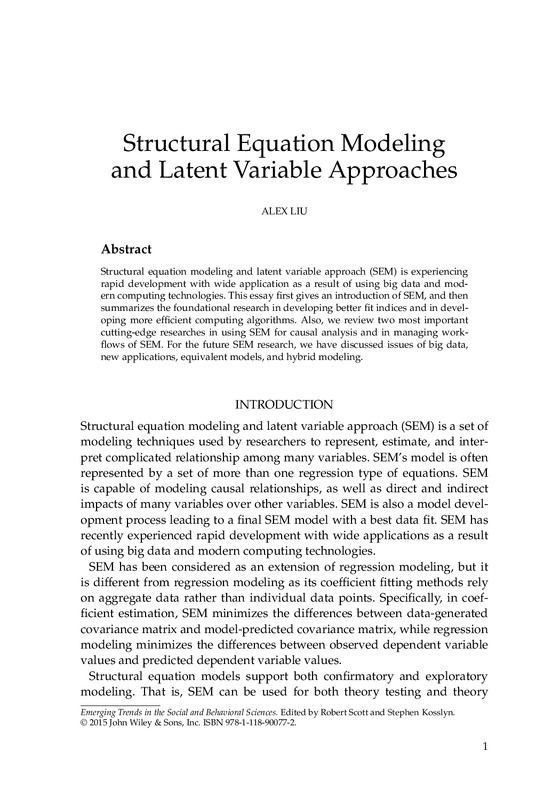
Structural Equation Modeling
and Latent Variable Approaches
ALEX LIU
Abstract
Structural equation modeling and latent variable approach (SEM) is experiencing
rapid development with wide application as a result of using big data and modern computing technologies. This essay first gives an introduction of SEM, and then
summarizes the foundational research in developing better fit indices and in developing more efficient computing algorithms. Also, we review two most important
cutting-edge researches in using SEM for causal analysis and in managing workflows of SEM. For the future SEM research, we have discussed issues of big data,
new applications, equivalent models, and hybrid modeling.
INTRODUCTION
Structural equation modeling and latent variable approach (SEM) is a set of
modeling techniques used by researchers to represent, estimate, and interpret complicated relationship among many variables. SEM’s model is often
represented by a set of more than one regression type of equations. SEM
is capable of modeling causal relationships, as well as direct and indirect
impacts of many variables over other variables. SEM is also a model development process leading to a final SEM model with a best data fit. SEM has
recently experienced rapid development with wide applications as a result
of using big data and modern computing technologies.
SEM has been considered as an extension of regression modeling, but it
is different from regression modeling as its coefficient fitting methods rely
on aggregate data rather than individual data points. Specifically, in coefficient estimation, SEM minimizes the differences between data-generated
covariance matrix and model-predicted covariance matrix, while regression
modeling minimizes the differences between observed dependent variable
values and predicted dependent variable values.
Structural equation models support both confirmatory and exploratory
modeling. That is, SEM can be used for both theory testing and theory
Emerging Trends in the Social and Behavioral Sciences. Edited by Robert Scott and Stephen Kosslyn.
© 2015 John Wiley & Sons, Inc. ISBN 978-1-118-90077-2.
1
�2
EMERGING TRENDS IN THE SOCIAL AND BEHAVIORAL SCIENCES
development, for the later approach, a step-by-step approach is often taken.
The common characteristics of SEM model building processes may be summarized with 4Es—equation, estimation, evaluation, and explanation—as
given.
EQUATION SPECIFICATION
Either used for a confirmatory hypothesis testing or exploratory model
development, an initial model must be correctly specified as based on the
theories or hypotheses that the researcher is attempting to confirm, or based
on initial ideas for a model development plan.
Most SEM model consists of two main components of models: the structural
model representing potential causal dependencies between endogenous and
exogenous variables, and the measurement model representing relations
between latent variables and their indicators.
To represent a specified model, researchers often use path diagrams, matrices, or tables.
ESTIMATION OF COEFFICIENTS
The next step after model specification is to estimate coefficients for all of the
SEM equations, usually by minimizing the difference between the covariance
matrices calculated from the data and the covariance matrices inferred by the
SEM equations. This is often obtained through numerical maximization of
a fit criterion by implementing maximum likelihood estimation algorithms.
This is often accomplished by using a specialized SEM algorithm, provided
by SAS, R, SPSS, and Mplus .
EVALUATION OF MODEL WITH MODEL FIT INDICES
Once all the coefficients are estimated, researchers move forward to examine the “fit” of the estimated SEM model. This is a basic task in SEM
modeling that forms the base for accepting or rejecting models for confirmatory approach and developing model modification hints for exploratory
approach.
Some of the commonly used measures of fit include the following:
•
•
Chi-Squared. This is a basic measure of fit as used in the calculation of
many other fit measures. In calculation, it is a function of the sample
size and the difference between the observed covariance matrix and the
model inferred covariance matrix.
Root Mean Square Residuals. an index directly calculating the difference
between the observed covariance matrix and the model inferred covariance matrix.
�Structural Equation Modeling and Latent Variable Approaches
•
3
Goodness-of-Fit statistic (GFI). Relative amount of the variance in the
observed covariance matrix as predicted by the model inferred covariance matrix.
Model Modification—Going Back to Es. Model evaluation does not necessarily lead to accept or reject a model, but often leads to model modification,
especially when a model development approach is taken. That is, this step
often leads the researchers to go back to the equation specification or estimation step.
EXPLANATION AND COMMUNICATION
Once researchers are satisfied with the model evaluation results, some final
models are selected. Then, their coefficients need to be interpreted so that the
relationship between measures and their indicators, and the causal relationships among all variables can be made clear.
Special caution should always be taken when making claims of causality,
while total effects, direct effects, and indirect effects are often calculated and
used for explanation.
FOUNDATIONAL RESEARCH
Developing better model fit indices and developing more efficient computing algorithm for coefficient estimation are considered as the most important
foundational research.
MODEL FIT INDICES
There are many model fit indices available to evaluate how an SEM model
fits with a data, with more and more of these indices being developed.
Among them, the most important three are absolute fit indices, incremental
fit indices, and parsimonious fit indices.
Absolute Fit Indices. Absolute fit indices demonstrates directly which model
has the best data fit, and are derived directly from the fit of the observed and
predicted covariance matrices and the MLE minimization function. These fit
measures provide the basic indication of how well the developed model fits
the data. Included in this category are the chi-squared, RMSEA, GFI, AGFI,
the RMR and the SRMR.
Model Chi-Square
Chi-square value is the most commonly used and the most basic measure
for evaluating a model’s overall model fit, and for testing the hypothesis
�4
EMERGING TRENDS IN THE SOCIAL AND BEHAVIORAL SCIENCES
about the discrepancy between the sample and fitted covariance matrices.
A good model fit would provide an insignificant Chi-square test result at
a 0.05 threshold; thus, the Chi-square statistic is often referred to as either
a “badness of fit” or a “lack of fit” measure with higher value to indicate
badness.
Chi-square statistics have some limitations. First, this statistical test
assumes multivariate normality of the data so that any severe deviation
from normality may result in model rejections even when the model fits the
data well. Second, the approximation to the Chi-square distribution only
occurs for large samples that this statistical significance test is sensitive to
sample size. So in situations where small samples are used, this Chi-square
statistic lacks power of discriminating between good fitting models and
poor fitting models.
To overcome the restrictiveness of the Model Chi-Square, researchers
have been continuing to create alternative indices of assessing model fit.
One example of them is a statistic like Wheaton et al.’s relative/normed
chi-square (? 2 /df) that tries to minimize the impact of sample size on the
Model Chi-Square.
More and more indices are expected for this line of research.
Root Mean Square Error of Approximation (RMSEA)
The RMSEA was first developed by Steiger and Lind in the 1990s. The
RMSEA measures the different between the model predicted covariance
matrix and the covariance matrix calculated directly from data with a
smaller number to indicate better fit.
On the basis of recent research, recommendations for RMSEA cut-off points
have been reduced considerably in the past 15 years. Up until the early
nineties, an RMSEA in the range of 0.05–0.10 was considered an indication
of fair fit and values above 0.10 indicated poor fit. It was then thought that
an RMSEA of between 0.08 and 0.10 provides a mediocre fit and below 0.08
shows a good fit. However, more recently, a cut-off value close to 0.06 or
a stringent upper limit of 0.07 seems to be the general consensus amongst
experts in this area. Effort has also been made for an RMSEA confidence
interval to be calculated easily, per recent research.
Goodness-of-Fit Statistic (GFI) and the Adjusted Goodness-of-Fit Statistic
(AGFI)
The GFI was created by Jöreskog and Sorbom initially as an alternative to
the Chi-square test. GFI calculates the proportion of covariance variance that
is accounted for by the predicted covariance, with a value ranging from 0
to 1. When there are a large number of degrees of freedom in comparison
�Structural Equation Modeling and Latent Variable Approaches
5
to sample size, the GFI has a downward bias. In addition, it has also been
found that the GFI increases as the number of parameters increases and has
an upward bias with large samples. Traditionally a cut-off point of 0.90 has
been recommended for the GFI. However, simulation studies have shown
that when factor loadings and sample sizes are low, a higher cut-off of 0.95
is more appropriate. Given the sensitivity of this index, it has become less
popular in recent years. Related to the GFI is the AGFI which adjusts the GFI
based upon degrees of freedom, with more saturated models reducing fit.
Thus, more parsimonious models are preferred while penalized for complicated models.
Root Mean Square Residual (RMR) and Standardized Root Mean Square
Residual (SRMR)
The RMR is the square root of the difference between the residuals of the
sample covariance matrix and the model inferred covariance model, while
SRMR is the standardized RMR. Both RMR and SRMR are the simplest fit
indices, and also the most intuitive ones.
Further research is expected to understand more about using residual differences to measure model fit.
Incremental Fit Indices. Incremental fit indices, also known as comparative or
relative fit indices, do not use fit statistics or fit measures in its raw form but
compare fit statistics of the developed model against that of a baseline model.
Normed-Fit Index (NFI)
The most basic of these incremental fit indices is the normed fit index (NFI).
This statistic assesses the model by comparing the ? 2 value of the model to
the ? 2 of the null model. The null/independence model is considered as the
worst case scenario as it specifies that all measured variables are uncorrelated. Values for this statistic range between 0 and 1 with values greater than
0.90 indicating a good fit. A major drawback to this index is that it is sensitive
to sample size, underestimating fit for samples less than 200.
CFI (Comparative Fit Index)
The comparative fit index (CFI) is a revised form of the NFI that takes sample size into consideration, so that it performs well even when sample size is
small. This index was first introduced by Bentler and subsequently included
as part of the fit indices in many computing programs including LISREL.
Similar to the NFI, this statistic assumes that all latent variables are uncorrelated that constitutes a null/independence model and then compares the
sample covariance matrix with this null model. As with the NFI, values for
�6
EMERGING TRENDS IN THE SOCIAL AND BEHAVIORAL SCIENCES
this statistic range between 0.0 and 1.0 with values closer to 1.0 indicating
good fit. A cut-off criterion of CFI ≥0.90 was initially advanced; however,
recent studies have shown that a value greater than 0.90 is needed in order
to ensure that mis-specified models are not accepted. From this, a value of
CFI ≥0.95 is presently recognized as indicative of good fit.
Parsimony Fit Indices. Parsimony fit indices also known as parsimonycorrected fit indices are developed to overcome the problem of obtaining
good fit indices at the cost of saturating a model, for which two types of
parsimony of fit indices have been developed: the parsimony goodness-of-fit
index (PGFI) and the parsimonious normed fit index (PNFI). The PGFI is
based on the GFI by adjusting for degrees of freedom. The PNFI also adjusts
for degrees of freedom; however, it is based on the NFI. That is, both of
them penalize for degrees of freedom, so they result in fit values that take
parsimony into consideration.
A second form of the parsimony fit index is those known as information criteria indices. The best known of these indices is the Akaike Information Criterion (AIC). These statistics are generally used when comparing nonnested
or nonhierarchical models estimated with the same data and indicates to the
researcher which of the models is the most parsimonious. Smaller values suggest a good fitting.
It is worth noting that most of the fit statistics need a sample size of 200
to make their use reliable. In addition, fit indices may point to a well-fitting
model but in fact parts of the model can fit poorly. Therefore, research has
been developed to measure fit of the whole model, as well as submodels.
A lot of research has been completed recently with good results, but considerable controversy has also come up concerning fit indices. Some researchers
claim that fit indices do not add anything to the analysis and only the model
chi square should be interpreted. The major concern is that fit indices may
allow some researchers to claim a miss-specified model as a good model.
Other researchers argue that cutoffs for a fit index can be misleading and
subject to misuse, even all fit indices are good. Overall, most scholars believe
in the value of fit indices, but caution against reliance on cutoffs, for which
more research is expected.
Efficient Computing and Identification. One of the SEM key issues is about how
to obtain the unbiased coefficients of some proposed SEM models efficiently.
And, this issue deserves even more attention here, as SEM faces many special
computing challenges that other modeling approaches do not have to.
First, not all the SEM models are identifiable, while no identification issues
exist for other approaches such as regression modeling.
�Structural Equation Modeling and Latent Variable Approaches
7
Second, not all the SEM algorithms can guarantee results. Some numerical
iterative algorithms do not converge to return estimations for some models
and data, such as the algorithms provided by the popular software LISREL.
MLE is the common used methods for now, as it is asymptotically unbiased
and most efficient. However, the unbiasedness and efficiency may not hold
for data deviated from non-normal distribution. Outlying cases or nonnormally distributed data can make the ML estimator (MLE) biased and inefficient. Many other estimation methods such as robust estimation methods
have been developed.
Currently, most researchers use SPSS or SAS or LISREL or EQS for SEM
computing. These four algorithm providers still play a leading role in SEM
computing.
However, Mplus is worth noting, as it offers great innovation including
some to solve identification issues and convergence issues. It also makes
using categorical indicators and multilevel analysis easy, and even with
Bayesian analysis incorporated into the software system.
Another good alternative is R. R is a popular open source statistical software used by millions of researchers. In R, some packages including SEM,
LAVAAN, and OpenMX have been developed and started to be widely used.
As R is an open source platform, more and more SEM packages are expected
to come, with innovative algorithms being incorporated quickly.
CUTTING-EDGE RESEARCH
A lot of work has been done to further develop SEM. Here, we discuss two of
the most significant cutting-edge researches that are to derive causal insights
from SEM and to develop good workflows for SEM.
CAUSAL INFERENCES
Many researchers come to SEM for causal analysis methods. Therefore, using
SEM to infer causal relationship has big audience. Among all the work of
developing causality out of SEMs, professor Judea Pearl’s work is the leading
one, as summarized in his seminal book CAUSALITY and led him to win the
2012 Tuning award.
The main purpose of professor Judea Pearl’s book CAUSALITY is to
•
•
•
develop graphical tools in representing and assisting causal analysis;
discuss about causality out from SEMs;
develop algorithms using partial correlations to discover causal structure under certain assumptions.
�8
EMERGING TRENDS IN THE SOCIAL AND BEHAVIORAL SCIENCES
Experts of research methods often say that “research methods do not equal
to statistics.” Research methods equal statistics plus something else. Pearl’s
work is to formalize this “something else” and provide tools to work on them
explicitly. In traditional empirical analysis, at least in the mainstream methods teaching, this “something else” for causal analysis is that variable A is a
cause of variable B, if:
•
•
•
A and B are correlated.
The association arises because A causes B and not vice versa because of
temporal or logical or theoretical reasons.
The association between A and B is not spurious.
According to Pearl, statistics deals with mean, variance, correlation,
regression, dependence, conditional independence, association, likelihood,
collapsibility, risk ratio, odd ratio, marginalization, conditionalization,
“controlling for,” … while causal analysis deals with randomization,
influence, effect, confounding, “holding constant,” disturbance, spurious
correlation, instrumental variables, intervention, explanation, attribution,
… The second part minus the first part is the “something else.”
Professor Pearl’s language to formally represent causal analysis and its
components include both structural equation models (linear, nonlinear,
and nonparametric) and graphical diagrams. Pearl uses do(x) to represent
intervention. As many methodologists will agree, with Pearl’s work, method
concepts such as spuriousness and confounding are much better formalized
than ever before.
His proposed rules of causal analysis include criterion to select covariates
for adjustment, intervention calculus, and counterfactual analysis. Professor
Pearl also proposed IC* algorithm to discover causal structures.
These are good contributions made by Pearl’s work. But, this is just a
beginning. In general, there are more questions than answers in his book
CAUSALITY. There are also many missing links we need to bridge, in order
to conduct a good causal analysis. For example, indirect effects are not
covered as much as the direct effects and total effects. How to estimate the
strength of a causal influence is also left out.
Professor D.A. Freedman of UC Berkeley takes a different view than that
of Pearl (Freedman, 2004). Freedman claims that Pearl’s work is based on
many assumptions that are unrealistic and difficulty to confirm in applied
research. In other words, Pearl’s causal analysis needs both SEM work and
some assumptions.
Published in 1993 (2nd edition in 2000 by MIT Press), the book Causation,
Prediction and Search summarize another line of work by Spirtes, Glymour,
and Scheines (SGS) of Carnegie Mellon University that is more data driven,
�Structural Equation Modeling and Latent Variable Approaches
9
and where they actually developed a software for their developed algorithms
and applied to a lot of real research.
In general, to successfully infer causality from statistical evidence such as
correlation does require some subject knowledge, additional statistical methods, and hard work. However, the work of Pearl and SGS helped to improve
the current practice greatly.
INITIAL MODEL GENERATION
Specifying an initial model is a key element and the first step for any SEM
modeling. In the past, initial model is often derived from qualitative research
or from existing theories. Currently, many researchers claim initial model
could be generated from data and even automatically, for which quite a few
outstanding research projects are merging out. The IC algorithm proposed by
professor Judea Pearl and the tetrad software developed by the SGS group
of Carnegie Mellon University are among the good examples in this area.
Per TETRAD project introduction, TETRAD is a program that creates, simulates data from, estimates, tests, predicts with, and searches for causal and
statistical models. The program provides sophisticated methods in a friendly
interface requiring very little statistical sophistication of the user and no programming knowledge. Tetrad is a freeware.
Tetrad is unique in the suite of principled search (“exploration,” “discovery”) algorithms it provides—for example, its ability to search when
there may be unobserved confounders of measured variables, to search for
models of latent structure, and to search for linear feedback models—and
in the ability to calculate predictions of the effects of interventions or
experiments based on a model. All of its search procedures are “pointwise
consistent”—they are guaranteed to converge almost certainly to correct
information about the true structure in the large sample limit, provided
that structure and the sample data satisfy various commonly made (but not
always true!) assumptions.
Tetrad is limited to models of categorical data (which can also be used
for ordinal data) and to linear models (“structural equation models”) with
a Normal probability distribution, and to a very limited class of time-series
models. The Tetrad programs describe causal models in three distinct parts
or stages: a picture, representing a directed graph specifying hypothetical
causal relations among the variables; a specification of the family of probability distributions and kinds of parameters associated with the graphical
model; and a specification of the numerical values of those parameters.
The program and its search algorithms have been developed over several
years, and are currently being used by researchers and practitioners.
�10
EMERGING TRENDS IN THE SOCIAL AND BEHAVIORAL SCIENCES
Per tests performed by many researchers, both the algorithms developed by
Pearl and SGS do not work as well as claimed by their authors, even they do
give good hints to develop initial models. Professor Freedman of UC Berkeley claims these algorithms do not work at all, because they are based on false
assumptions. As I know, quite many scholars including myself tried these
algorithms on some empirical data, and found these algorithms often lead
us to nowhere or to some errors. However, many ideas presented in these
algorithms can be used, in combination with subject knowledge and other
statistical methods such as SEM method, to aid us in generating hypotheses
and also in generating initial models. Professor Bill Shipley of Universite de
Sherbrooke has some good work along this line.
WORKFLOW MANAGEMENT
To many researchers, SEM is also a model development workflow leading to
a final SEM model with a best data fit. That is, good SEM always involves
a long workflow, so that a good workflow management system could take
SEM to a higher level.
Given here is an example of a common used workflow of building a SEM
model from a sampling survey data.
Check data structure to ensure a good understanding of the data
Is the data a cross-sectional data? Is implicit timing incorporated?
Are categorical variables used?
Check sampling
What is the population and sampling method?
Check missing values
don’t know or forget as an answer may be recoded as neutral
OR treated as a special category
some variables may have a lot of missing values
to recode some variables as needed
Study qualitative background
Use this study to form some hypotheses
to select some key dependent variables as the effects
Conduct some descriptive studies to begin telling stories
use comparing means and cross-tabulations
check variability of some key variables (st dev and variance)
Select groups of independent variables (exogenous variables)
as candidates of causes
�Structural Equation Modeling and Latent Variable Approaches
11
Basic descriptive statistics
mean, st dev and frequencies for ALL variables
Measurement work
study dimensions of some measurements (EFA exploratory factor
analysis may be useful here)
may form measurement models
Local models
Identify sections out from the whole picture
To explore about relationship
use cross-tabulations
graphical plots
use logistic regression
use linear regression
Conduct some partial correlation analysis to help model specification
Propose structural equation models by using results of (9)
identify main structures and sub structures
Connect measurements with structure models
Initial fits
create data sets for SEM software
programming in SEM software
Model modification
Use SEM results (mainly model fit indices) to guide
Reanalyze partial correlations
Diagnostics
distribution
residuals
curves
Final model estimation may be reached here
if not repeat step 13 and 14
Explaining the model (causal effects identified and quantified)
Obtaining good statistical models is usually not the end of a research. Deriving causal inference or causal explanation is often needed in order to make
the research useful.
In this step, as a kind of common practice, theoretical knowledge and logic
and common sense are frequently used, but often in an implicit and informal way.
�12
EMERGING TRENDS IN THE SOCIAL AND BEHAVIORAL SCIENCES
In recent years, many computing infrastructures have been developed to
manage workflows, for various disciplines such as neuroscience and market
science. With more and more support coming out from the computer science side, the research and development of SEM workflows are progressing
parallel with the development of new workflow computing systems.
KEY ISSUES FOR FUTURE RESEARCH
There are many issues that could rapidly develop SEM further, if handled
well. Here, we discuss some of these key issues.
BIG DATA
We are in the era of big data. According to IBM and other research, very
day, we create 2.5 quintillion bytes of data—so much that 90% of the data
in the world currently has been created in the past 2 years alone. This data
comes from everywhere: sensors used to gather information, posts to social
media sites, purchase transaction records, and cell phone signals to name
a few. All this data is big data. And now, big data is the next frontier for
innovation, competition, and productivity, for which SEM has a lot to contribute.
SEM will offer great solutions to model big data. First, big data often comes
with hundreds or thousands of variables, for which, SEM is often needed to
represent the complicated relationship among all the key variables.
Second, with so many variables in hands, one way is to treat them as indicators of a latent variable so to simplify and also to make it meaningful.
On the output side, SEM makes results easy to be interpreted and to be
used, as SEM and latent variable approach will allow one to use big data to
measure concepts, and use big data to infer total effects.
To deal with the big data, machine learning is a fast growing discipline, for
which SEM can contribute solutions at least to feature selection and model
stability issues.
NEW APPLICATIONS
SEM has been used in many fields in social studies like in education research
and in consumer behavior research.
SEM could be expanded to many practical areas such as credit risk and
program evaluation.
In credit risk, it has been recognized that every piece of data is a credit data
so that SEM is in demand.
�Structural Equation Modeling and Latent Variable Approaches
13
In program evaluation, causal analysis is in demand to understand the complicated relationship among factors and outputs, and especially to estimate
the total effects of intervention.
Latent variable approaches with new applications are generating fundamental impacts in how people are viewing measurements. In recent years,
many rankings have been developed to rank various subjects including education and democracy. However, each ranking has its own biases. SEM and
latent variables approaches provide perfect tools to evaluate these biases, and
help users to form best measures out from these rankings, which have been
recognized.
As these practical areas are well funded, which may fuel a new life into
SEM?
EQUIVALENT MODELS
In SEM, many models are equivalent in that they fit the data almost the same,
if measured by fit indices. A lot of research has been completed to attack
this issue. Some of them established necessary and sufficient condition for
equivalence of structural equation models. Many rules have been produced
for the equivalent model generation.
However, SEM practitioners are still puzzled by how many equivalent
models they can fit to a data, and if some complicated and simple models
are equivalent. And especially, not many algorithms have been developed
yet for researchers to choose among equivalent models.
A breakthrough is expected when equivalent model research can be combined with SEM workflow management, and with efficient computing.
HYBRID APPROACHES
Graphical modeling and Bayesian modeling could complement SEM greatly,
as well as some other computing intensive methods. But so far, they are progressing separately.
A great breakthrough is expected in the interaction of SEM and other
related approaches including graphical modeling and Bayesian approaches.
Some Bayesian and SEM hybrid models are starting to merge.
Workflow management system may serve as a platform for further developing hybrid approaches, especially in dealing with big data.
REFERENCE
Freedman D. A. (2004). Statistical Models for Causation, UCB Statistics Technical
Report No. 651. www.stat.berkeley.edu/-census/651.pdf
�14
EMERGING TRENDS IN THE SOCIAL AND BEHAVIORAL SCIENCES
FURTHER READING
Bollen, K. A., & Pearl, J. (2013). Eight myths about causality and structural equation
models. In S. L. Morgan (Ed.), Handbook of causal analysis for social research. Ithaca,
NY: Springer.
Liu, A. (2009). Building structural equation models in social science. Los Angeles, CA:
RM.
OpenMx. R for advanced structural equation modeling. Retrieved from http://
openmx.psyc.virginia.edu/
Pearl, J. (2009). Causality. Cambridge, England: Cambridge University Press.
Shipley, B. (2000). Cause and correlation in biology. Cambridge, England: Cambridge
University Press.
ALEX LIU SHORT BIOGRAPHY
Dr. Alex Liu is an expert of quantitative research methods and a director of
the RMA, where he has provided analytics consultation to many large organizations such as AOL, the United Nations, US Government, IBM, Indymac
Bank, Farmers Insurance, Scripps Networks and Ingram Micro. In the past,
Mr. Liu worked as a research fellow for the Asia/Pacific Research Center at
Stanford, as an adjunct assistant professor for the Marshall School of Business
at USC, as a senior scientist for IBM research, as a senior consultant for the
Beyster Institute of UC San Diego, and as a senior consultant for the Global
Entrepreneurship Monitoring of the Babson College and the London Business School. From 2003 to 2011, Dr. Liu taught structural equation modeling
to PhD candidates in the Paul Merage School of Business of the University
of California at Irvine. Alex has a PhD of Sociology and a MS of Statistical
Computing from Stanford University.
RELATED ESSAYS
Social Epigenetics: Incorporating Epigenetic Effects as Social Cause and
Consequence (Sociology), Douglas L. Anderton and Kathleen F. Arcaro
To Flop Is Human: Inventing Better Scientific Approaches to Anticipating
Failure (Methods), Robert Boruch and Alan Ruby
Repeated Cross-Sections in Survey Data (Methods), Henry E. Brady and
Richard Johnston
Ambulatory Assessment: Methods for Studying Everyday Life (Methods),
Tamlin S. Conner and Matthias R. Mehl
The Evidence-Based Practice Movement (Sociology), Edward W. Gondolf
The Use of Geophysical Survey in Archaeology (Methods), Timothy J.
Horsley
�Structural Equation Modeling and Latent Variable Approaches
15
Network Research Experiments (Methods), Allen L. Linton and Betsy Sinclair
Longitudinal Data Analysis (Methods), Todd D. Little et al.
Data Mining (Methods), Gregg R. Murray and Anthony Scime
Remote Sensing with Satellite Technology (Archaeology), Sarah Parcak
Quasi-Experiments (Methods), Charles S. Reichard
Digital Methods for Web Research (Methods), Richard Rogers
Virtual Worlds as Laboratories (Methods), Travis L. Ross et al.
Modeling Life Course Structure: The Triple Helix (Sociology), Tom Schuller
Content Analysis (Methods), Steven E. Stemler
Person-Centered Analysis (Methods), Alexander von Eye and Wolfgang
Wiedermann
Translational Sociology (Sociology), Elaine Wethington
�
-
Structural Equation Modeling
and Latent Variable Approaches
ALEX LIU
Abstract
Structural equation modeling and latent variable approach (SEM) is experiencing
rapid development with wide application as a result of using big data and modern computing technologies. This essay first gives an introduction of SEM, and then
summarizes the foundational research in developing better fit indices and in developing more efficient computing algorithms. Also, we review two most important
cutting-edge researches in using SEM for causal analysis and in managing workflows of SEM. For the future SEM research, we have discussed issues of big data,
new applications, equivalent models, and hybrid modeling.
INTRODUCTION
Structural equation modeling and latent variable approach (SEM) is a set of
modeling techniques used by researchers to represent, estimate, and interpret complicated relationship among many variables. SEM’s model is often
represented by a set of more than one regression type of equations. SEM
is capable of modeling causal relationships, as well as direct and indirect
impacts of many variables over other variables. SEM is also a model development process leading to a final SEM model with a best data fit. SEM has
recently experienced rapid development with wide applications as a result
of using big data and modern computing technologies.
SEM has been considered as an extension of regression modeling, but it
is different from regression modeling as its coefficient fitting methods rely
on aggregate data rather than individual data points. Specifically, in coefficient estimation, SEM minimizes the differences between data-generated
covariance matrix and model-predicted covariance matrix, while regression
modeling minimizes the differences between observed dependent variable
values and predicted dependent variable values.
Structural equation models support both confirmatory and exploratory
modeling. That is, SEM can be used for both theory testing and theory
Emerging Trends in the Social and Behavioral Sciences. Edited by Robert Scott and Stephen Kosslyn.
© 2015 John Wiley & Sons, Inc. ISBN 978-1-118-90077-2.
1
�2
EMERGING TRENDS IN THE SOCIAL AND BEHAVIORAL SCIENCES
development, for the later approach, a step-by-step approach is often taken.
The common characteristics of SEM model building processes may be summarized with 4Es—equation, estimation, evaluation, and explanation—as
given.
EQUATION SPECIFICATION
Either used for a confirmatory hypothesis testing or exploratory model
development, an initial model must be correctly specified as based on the
theories or hypotheses that the researcher is attempting to confirm, or based
on initial ideas for a model development plan.
Most SEM model consists of two main components of models: the structural
model representing potential causal dependencies between endogenous and
exogenous variables, and the measurement model representing relations
between latent variables and their indicators.
To represent a specified model, researchers often use path diagrams, matrices, or tables.
ESTIMATION OF COEFFICIENTS
The next step after model specification is to estimate coefficients for all of the
SEM equations, usually by minimizing the difference between the covariance
matrices calculated from the data and the covariance matrices inferred by the
SEM equations. This is often obtained through numerical maximization of
a fit criterion by implementing maximum likelihood estimation algorithms.
This is often accomplished by using a specialized SEM algorithm, provided
by SAS, R, SPSS, and Mplus .
EVALUATION OF MODEL WITH MODEL FIT INDICES
Once all the coefficients are estimated, researchers move forward to examine the “fit” of the estimated SEM model. This is a basic task in SEM
modeling that forms the base for accepting or rejecting models for confirmatory approach and developing model modification hints for exploratory
approach.
Some of the commonly used measures of fit include the following:
•
•
Chi-Squared. This is a basic measure of fit as used in the calculation of
many other fit measures. In calculation, it is a function of the sample
size and the difference between the observed covariance matrix and the
model inferred covariance matrix.
Root Mean Square Residuals. an index directly calculating the difference
between the observed covariance matrix and the model inferred covariance matrix.
�Structural Equation Modeling and Latent Variable Approaches
•
3
Goodness-of-Fit statistic (GFI). Relative amount of the variance in the
observed covariance matrix as predicted by the model inferred covariance matrix.
Model Modification—Going Back to Es. Model evaluation does not necessarily lead to accept or reject a model, but often leads to model modification,
especially when a model development approach is taken. That is, this step
often leads the researchers to go back to the equation specification or estimation step.
EXPLANATION AND COMMUNICATION
Once researchers are satisfied with the model evaluation results, some final
models are selected. Then, their coefficients need to be interpreted so that the
relationship between measures and their indicators, and the causal relationships among all variables can be made clear.
Special caution should always be taken when making claims of causality,
while total effects, direct effects, and indirect effects are often calculated and
used for explanation.
FOUNDATIONAL RESEARCH
Developing better model fit indices and developing more efficient computing algorithm for coefficient estimation are considered as the most important
foundational research.
MODEL FIT INDICES
There are many model fit indices available to evaluate how an SEM model
fits with a data, with more and more of these indices being developed.
Among them, the most important three are absolute fit indices, incremental
fit indices, and parsimonious fit indices.
Absolute Fit Indices. Absolute fit indices demonstrates directly which model
has the best data fit, and are derived directly from the fit of the observed and
predicted covariance matrices and the MLE minimization function. These fit
measures provide the basic indication of how well the developed model fits
the data. Included in this category are the chi-squared, RMSEA, GFI, AGFI,
the RMR and the SRMR.
Model Chi-Square
Chi-square value is the most commonly used and the most basic measure
for evaluating a model’s overall model fit, and for testing the hypothesis
�4
EMERGING TRENDS IN THE SOCIAL AND BEHAVIORAL SCIENCES
about the discrepancy between the sample and fitted covariance matrices.
A good model fit would provide an insignificant Chi-square test result at
a 0.05 threshold; thus, the Chi-square statistic is often referred to as either
a “badness of fit” or a “lack of fit” measure with higher value to indicate
badness.
Chi-square statistics have some limitations. First, this statistical test
assumes multivariate normality of the data so that any severe deviation
from normality may result in model rejections even when the model fits the
data well. Second, the approximation to the Chi-square distribution only
occurs for large samples that this statistical significance test is sensitive to
sample size. So in situations where small samples are used, this Chi-square
statistic lacks power of discriminating between good fitting models and
poor fitting models.
To overcome the restrictiveness of the Model Chi-Square, researchers
have been continuing to create alternative indices of assessing model fit.
One example of them is a statistic like Wheaton et al.’s relative/normed
chi-square (? 2 /df) that tries to minimize the impact of sample size on the
Model Chi-Square.
More and more indices are expected for this line of research.
Root Mean Square Error of Approximation (RMSEA)
The RMSEA was first developed by Steiger and Lind in the 1990s. The
RMSEA measures the different between the model predicted covariance
matrix and the covariance matrix calculated directly from data with a
smaller number to indicate better fit.
On the basis of recent research, recommendations for RMSEA cut-off points
have been reduced considerably in the past 15 years. Up until the early
nineties, an RMSEA in the range of 0.05–0.10 was considered an indication
of fair fit and values above 0.10 indicated poor fit. It was then thought that
an RMSEA of between 0.08 and 0.10 provides a mediocre fit and below 0.08
shows a good fit. However, more recently, a cut-off value close to 0.06 or
a stringent upper limit of 0.07 seems to be the general consensus amongst
experts in this area. Effort has also been made for an RMSEA confidence
interval to be calculated easily, per recent research.
Goodness-of-Fit Statistic (GFI) and the Adjusted Goodness-of-Fit Statistic
(AGFI)
The GFI was created by Jöreskog and Sorbom initially as an alternative to
the Chi-square test. GFI calculates the proportion of covariance variance that
is accounted for by the predicted covariance, with a value ranging from 0
to 1. When there are a large number of degrees of freedom in comparison
�Structural Equation Modeling and Latent Variable Approaches
5
to sample size, the GFI has a downward bias. In addition, it has also been
found that the GFI increases as the number of parameters increases and has
an upward bias with large samples. Traditionally a cut-off point of 0.90 has
been recommended for the GFI. However, simulation studies have shown
that when factor loadings and sample sizes are low, a higher cut-off of 0.95
is more appropriate. Given the sensitivity of this index, it has become less
popular in recent years. Related to the GFI is the AGFI which adjusts the GFI
based upon degrees of freedom, with more saturated models reducing fit.
Thus, more parsimonious models are preferred while penalized for complicated models.
Root Mean Square Residual (RMR) and Standardized Root Mean Square
Residual (SRMR)
The RMR is the square root of the difference between the residuals of the
sample covariance matrix and the model inferred covariance model, while
SRMR is the standardized RMR. Both RMR and SRMR are the simplest fit
indices, and also the most intuitive ones.
Further research is expected to understand more about using residual differences to measure model fit.
Incremental Fit Indices. Incremental fit indices, also known as comparative or
relative fit indices, do not use fit statistics or fit measures in its raw form but
compare fit statistics of the developed model against that of a baseline model.
Normed-Fit Index (NFI)
The most basic of these incremental fit indices is the normed fit index (NFI).
This statistic assesses the model by comparing the ? 2 value of the model to
the ? 2 of the null model. The null/independence model is considered as the
worst case scenario as it specifies that all measured variables are uncorrelated. Values for this statistic range between 0 and 1 with values greater than
0.90 indicating a good fit. A major drawback to this index is that it is sensitive
to sample size, underestimating fit for samples less than 200.
CFI (Comparative Fit Index)
The comparative fit index (CFI) is a revised form of the NFI that takes sample size into consideration, so that it performs well even when sample size is
small. This index was first introduced by Bentler and subsequently included
as part of the fit indices in many computing programs including LISREL.
Similar to the NFI, this statistic assumes that all latent variables are uncorrelated that constitutes a null/independence model and then compares the
sample covariance matrix with this null model. As with the NFI, values for
�6
EMERGING TRENDS IN THE SOCIAL AND BEHAVIORAL SCIENCES
this statistic range between 0.0 and 1.0 with values closer to 1.0 indicating
good fit. A cut-off criterion of CFI ≥0.90 was initially advanced; however,
recent studies have shown that a value greater than 0.90 is needed in order
to ensure that mis-specified models are not accepted. From this, a value of
CFI ≥0.95 is presently recognized as indicative of good fit.
Parsimony Fit Indices. Parsimony fit indices also known as parsimonycorrected fit indices are developed to overcome the problem of obtaining
good fit indices at the cost of saturating a model, for which two types of
parsimony of fit indices have been developed: the parsimony goodness-of-fit
index (PGFI) and the parsimonious normed fit index (PNFI). The PGFI is
based on the GFI by adjusting for degrees of freedom. The PNFI also adjusts
for degrees of freedom; however, it is based on the NFI. That is, both of
them penalize for degrees of freedom, so they result in fit values that take
parsimony into consideration.
A second form of the parsimony fit index is those known as information criteria indices. The best known of these indices is the Akaike Information Criterion (AIC). These statistics are generally used when comparing nonnested
or nonhierarchical models estimated with the same data and indicates to the
researcher which of the models is the most parsimonious. Smaller values suggest a good fitting.
It is worth noting that most of the fit statistics need a sample size of 200
to make their use reliable. In addition, fit indices may point to a well-fitting
model but in fact parts of the model can fit poorly. Therefore, research has
been developed to measure fit of the whole model, as well as submodels.
A lot of research has been completed recently with good results, but considerable controversy has also come up concerning fit indices. Some researchers
claim that fit indices do not add anything to the analysis and only the model
chi square should be interpreted. The major concern is that fit indices may
allow some researchers to claim a miss-specified model as a good model.
Other researchers argue that cutoffs for a fit index can be misleading and
subject to misuse, even all fit indices are good. Overall, most scholars believe
in the value of fit indices, but caution against reliance on cutoffs, for which
more research is expected.
Efficient Computing and Identification. One of the SEM key issues is about how
to obtain the unbiased coefficients of some proposed SEM models efficiently.
And, this issue deserves even more attention here, as SEM faces many special
computing challenges that other modeling approaches do not have to.
First, not all the SEM models are identifiable, while no identification issues
exist for other approaches such as regression modeling.
�Structural Equation Modeling and Latent Variable Approaches
7
Second, not all the SEM algorithms can guarantee results. Some numerical
iterative algorithms do not converge to return estimations for some models
and data, such as the algorithms provided by the popular software LISREL.
MLE is the common used methods for now, as it is asymptotically unbiased
and most efficient. However, the unbiasedness and efficiency may not hold
for data deviated from non-normal distribution. Outlying cases or nonnormally distributed data can make the ML estimator (MLE) biased and inefficient. Many other estimation methods such as robust estimation methods
have been developed.
Currently, most researchers use SPSS or SAS or LISREL or EQS for SEM
computing. These four algorithm providers still play a leading role in SEM
computing.
However, Mplus is worth noting, as it offers great innovation including
some to solve identification issues and convergence issues. It also makes
using categorical indicators and multilevel analysis easy, and even with
Bayesian analysis incorporated into the software system.
Another good alternative is R. R is a popular open source statistical software used by millions of researchers. In R, some packages including SEM,
LAVAAN, and OpenMX have been developed and started to be widely used.
As R is an open source platform, more and more SEM packages are expected
to come, with innovative algorithms being incorporated quickly.
CUTTING-EDGE RESEARCH
A lot of work has been done to further develop SEM. Here, we discuss two of
the most significant cutting-edge researches that are to derive causal insights
from SEM and to develop good workflows for SEM.
CAUSAL INFERENCES
Many researchers come to SEM for causal analysis methods. Therefore, using
SEM to infer causal relationship has big audience. Among all the work of
developing causality out of SEMs, professor Judea Pearl’s work is the leading
one, as summarized in his seminal book CAUSALITY and led him to win the
2012 Tuning award.
The main purpose of professor Judea Pearl’s book CAUSALITY is to
•
•
•
develop graphical tools in representing and assisting causal analysis;
discuss about causality out from SEMs;
develop algorithms using partial correlations to discover causal structure under certain assumptions.
�8
EMERGING TRENDS IN THE SOCIAL AND BEHAVIORAL SCIENCES
Experts of research methods often say that “research methods do not equal
to statistics.” Research methods equal statistics plus something else. Pearl’s
work is to formalize this “something else” and provide tools to work on them
explicitly. In traditional empirical analysis, at least in the mainstream methods teaching, this “something else” for causal analysis is that variable A is a
cause of variable B, if:
•
•
•
A and B are correlated.
The association arises because A causes B and not vice versa because of
temporal or logical or theoretical reasons.
The association between A and B is not spurious.
According to Pearl, statistics deals with mean, variance, correlation,
regression, dependence, conditional independence, association, likelihood,
collapsibility, risk ratio, odd ratio, marginalization, conditionalization,
“controlling for,” … while causal analysis deals with randomization,
influence, effect, confounding, “holding constant,” disturbance, spurious
correlation, instrumental variables, intervention, explanation, attribution,
… The second part minus the first part is the “something else.”
Professor Pearl’s language to formally represent causal analysis and its
components include both structural equation models (linear, nonlinear,
and nonparametric) and graphical diagrams. Pearl uses do(x) to represent
intervention. As many methodologists will agree, with Pearl’s work, method
concepts such as spuriousness and confounding are much better formalized
than ever before.
His proposed rules of causal analysis include criterion to select covariates
for adjustment, intervention calculus, and counterfactual analysis. Professor
Pearl also proposed IC* algorithm to discover causal structures.
These are good contributions made by Pearl’s work. But, this is just a
beginning. In general, there are more questions than answers in his book
CAUSALITY. There are also many missing links we need to bridge, in order
to conduct a good causal analysis. For example, indirect effects are not
covered as much as the direct effects and total effects. How to estimate the
strength of a causal influence is also left out.
Professor D.A. Freedman of UC Berkeley takes a different view than that
of Pearl (Freedman, 2004). Freedman claims that Pearl’s work is based on
many assumptions that are unrealistic and difficulty to confirm in applied
research. In other words, Pearl’s causal analysis needs both SEM work and
some assumptions.
Published in 1993 (2nd edition in 2000 by MIT Press), the book Causation,
Prediction and Search summarize another line of work by Spirtes, Glymour,
and Scheines (SGS) of Carnegie Mellon University that is more data driven,
�Structural Equation Modeling and Latent Variable Approaches
9
and where they actually developed a software for their developed algorithms
and applied to a lot of real research.
In general, to successfully infer causality from statistical evidence such as
correlation does require some subject knowledge, additional statistical methods, and hard work. However, the work of Pearl and SGS helped to improve
the current practice greatly.
INITIAL MODEL GENERATION
Specifying an initial model is a key element and the first step for any SEM
modeling. In the past, initial model is often derived from qualitative research
or from existing theories. Currently, many researchers claim initial model
could be generated from data and even automatically, for which quite a few
outstanding research projects are merging out. The IC algorithm proposed by
professor Judea Pearl and the tetrad software developed by the SGS group
of Carnegie Mellon University are among the good examples in this area.
Per TETRAD project introduction, TETRAD is a program that creates, simulates data from, estimates, tests, predicts with, and searches for causal and
statistical models. The program provides sophisticated methods in a friendly
interface requiring very little statistical sophistication of the user and no programming knowledge. Tetrad is a freeware.
Tetrad is unique in the suite of principled search (“exploration,” “discovery”) algorithms it provides—for example, its ability to search when
there may be unobserved confounders of measured variables, to search for
models of latent structure, and to search for linear feedback models—and
in the ability to calculate predictions of the effects of interventions or
experiments based on a model. All of its search procedures are “pointwise
consistent”—they are guaranteed to converge almost certainly to correct
information about the true structure in the large sample limit, provided
that structure and the sample data satisfy various commonly made (but not
always true!) assumptions.
Tetrad is limited to models of categorical data (which can also be used
for ordinal data) and to linear models (“structural equation models”) with
a Normal probability distribution, and to a very limited class of time-series
models. The Tetrad programs describe causal models in three distinct parts
or stages: a picture, representing a directed graph specifying hypothetical
causal relations among the variables; a specification of the family of probability distributions and kinds of parameters associated with the graphical
model; and a specification of the numerical values of those parameters.
The program and its search algorithms have been developed over several
years, and are currently being used by researchers and practitioners.
�10
EMERGING TRENDS IN THE SOCIAL AND BEHAVIORAL SCIENCES
Per tests performed by many researchers, both the algorithms developed by
Pearl and SGS do not work as well as claimed by their authors, even they do
give good hints to develop initial models. Professor Freedman of UC Berkeley claims these algorithms do not work at all, because they are based on false
assumptions. As I know, quite many scholars including myself tried these
algorithms on some empirical data, and found these algorithms often lead
us to nowhere or to some errors. However, many ideas presented in these
algorithms can be used, in combination with subject knowledge and other
statistical methods such as SEM method, to aid us in generating hypotheses
and also in generating initial models. Professor Bill Shipley of Universite de
Sherbrooke has some good work along this line.
WORKFLOW MANAGEMENT
To many researchers, SEM is also a model development workflow leading to
a final SEM model with a best data fit. That is, good SEM always involves
a long workflow, so that a good workflow management system could take
SEM to a higher level.
Given here is an example of a common used workflow of building a SEM
model from a sampling survey data.
Check data structure to ensure a good understanding of the data
Is the data a cross-sectional data? Is implicit timing incorporated?
Are categorical variables used?
Check sampling
What is the population and sampling method?
Check missing values
don’t know or forget as an answer may be recoded as neutral
OR treated as a special category
some variables may have a lot of missing values
to recode some variables as needed
Study qualitative background
Use this study to form some hypotheses
to select some key dependent variables as the effects
Conduct some descriptive studies to begin telling stories
use comparing means and cross-tabulations
check variability of some key variables (st dev and variance)
Select groups of independent variables (exogenous variables)
as candidates of causes
�Structural Equation Modeling and Latent Variable Approaches
11
Basic descriptive statistics
mean, st dev and frequencies for ALL variables
Measurement work
study dimensions of some measurements (EFA exploratory factor
analysis may be useful here)
may form measurement models
Local models
Identify sections out from the whole picture
To explore about relationship
use cross-tabulations
graphical plots
use logistic regression
use linear regression
Conduct some partial correlation analysis to help model specification
Propose structural equation models by using results of (9)
identify main structures and sub structures
Connect measurements with structure models
Initial fits
create data sets for SEM software
programming in SEM software
Model modification
Use SEM results (mainly model fit indices) to guide
Reanalyze partial correlations
Diagnostics
distribution
residuals
curves
Final model estimation may be reached here
if not repeat step 13 and 14
Explaining the model (causal effects identified and quantified)
Obtaining good statistical models is usually not the end of a research. Deriving causal inference or causal explanation is often needed in order to make
the research useful.
In this step, as a kind of common practice, theoretical knowledge and logic
and common sense are frequently used, but often in an implicit and informal way.
�12
EMERGING TRENDS IN THE SOCIAL AND BEHAVIORAL SCIENCES
In recent years, many computing infrastructures have been developed to
manage workflows, for various disciplines such as neuroscience and market
science. With more and more support coming out from the computer science side, the research and development of SEM workflows are progressing
parallel with the development of new workflow computing systems.
KEY ISSUES FOR FUTURE RESEARCH
There are many issues that could rapidly develop SEM further, if handled
well. Here, we discuss some of these key issues.
BIG DATA
We are in the era of big data. According to IBM and other research, very
day, we create 2.5 quintillion bytes of data—so much that 90% of the data
in the world currently has been created in the past 2 years alone. This data
comes from everywhere: sensors used to gather information, posts to social
media sites, purchase transaction records, and cell phone signals to name
a few. All this data is big data. And now, big data is the next frontier for
innovation, competition, and productivity, for which SEM has a lot to contribute.
SEM will offer great solutions to model big data. First, big data often comes
with hundreds or thousands of variables, for which, SEM is often needed to
represent the complicated relationship among all the key variables.
Second, with so many variables in hands, one way is to treat them as indicators of a latent variable so to simplify and also to make it meaningful.
On the output side, SEM makes results easy to be interpreted and to be
used, as SEM and latent variable approach will allow one to use big data to
measure concepts, and use big data to infer total effects.
To deal with the big data, machine learning is a fast growing discipline, for
which SEM can contribute solutions at least to feature selection and model
stability issues.
NEW APPLICATIONS
SEM has been used in many fields in social studies like in education research
and in consumer behavior research.
SEM could be expanded to many practical areas such as credit risk and
program evaluation.
In credit risk, it has been recognized that every piece of data is a credit data
so that SEM is in demand.
�Structural Equation Modeling and Latent Variable Approaches
13
In program evaluation, causal analysis is in demand to understand the complicated relationship among factors and outputs, and especially to estimate
the total effects of intervention.
Latent variable approaches with new applications are generating fundamental impacts in how people are viewing measurements. In recent years,
many rankings have been developed to rank various subjects including education and democracy. However, each ranking has its own biases. SEM and
latent variables approaches provide perfect tools to evaluate these biases, and
help users to form best measures out from these rankings, which have been
recognized.
As these practical areas are well funded, which may fuel a new life into
SEM?
EQUIVALENT MODELS
In SEM, many models are equivalent in that they fit the data almost the same,
if measured by fit indices. A lot of research has been completed to attack
this issue. Some of them established necessary and sufficient condition for
equivalence of structural equation models. Many rules have been produced
for the equivalent model generation.
However, SEM practitioners are still puzzled by how many equivalent
models they can fit to a data, and if some complicated and simple models
are equivalent. And especially, not many algorithms have been developed
yet for researchers to choose among equivalent models.
A breakthrough is expected when equivalent model research can be combined with SEM workflow management, and with efficient computing.
HYBRID APPROACHES
Graphical modeling and Bayesian modeling could complement SEM greatly,
as well as some other computing intensive methods. But so far, they are progressing separately.
A great breakthrough is expected in the interaction of SEM and other
related approaches including graphical modeling and Bayesian approaches.
Some Bayesian and SEM hybrid models are starting to merge.
Workflow management system may serve as a platform for further developing hybrid approaches, especially in dealing with big data.
REFERENCE
Freedman D. A. (2004). Statistical Models for Causation, UCB Statistics Technical
Report No. 651. www.stat.berkeley.edu/-census/651.pdf
�14
EMERGING TRENDS IN THE SOCIAL AND BEHAVIORAL SCIENCES
FURTHER READING
Bollen, K. A., & Pearl, J. (2013). Eight myths about causality and structural equation
models. In S. L. Morgan (Ed.), Handbook of causal analysis for social research. Ithaca,
NY: Springer.
Liu, A. (2009). Building structural equation models in social science. Los Angeles, CA:
RM.
OpenMx. R for advanced structural equation modeling. Retrieved from http://
openmx.psyc.virginia.edu/
Pearl, J. (2009). Causality. Cambridge, England: Cambridge University Press.
Shipley, B. (2000). Cause and correlation in biology. Cambridge, England: Cambridge
University Press.
ALEX LIU SHORT BIOGRAPHY
Dr. Alex Liu is an expert of quantitative research methods and a director of
the RMA, where he has provided analytics consultation to many large organizations such as AOL, the United Nations, US Government, IBM, Indymac
Bank, Farmers Insurance, Scripps Networks and Ingram Micro. In the past,
Mr. Liu worked as a research fellow for the Asia/Pacific Research Center at
Stanford, as an adjunct assistant professor for the Marshall School of Business
at USC, as a senior scientist for IBM research, as a senior consultant for the
Beyster Institute of UC San Diego, and as a senior consultant for the Global
Entrepreneurship Monitoring of the Babson College and the London Business School. From 2003 to 2011, Dr. Liu taught structural equation modeling
to PhD candidates in the Paul Merage School of Business of the University
of California at Irvine. Alex has a PhD of Sociology and a MS of Statistical
Computing from Stanford University.
RELATED ESSAYS
Social Epigenetics: Incorporating Epigenetic Effects as Social Cause and
Consequence (Sociology), Douglas L. Anderton and Kathleen F. Arcaro
To Flop Is Human: Inventing Better Scientific Approaches to Anticipating
Failure (Methods), Robert Boruch and Alan Ruby
Repeated Cross-Sections in Survey Data (Methods), Henry E. Brady and
Richard Johnston
Ambulatory Assessment: Methods for Studying Everyday Life (Methods),
Tamlin S. Conner and Matthias R. Mehl
The Evidence-Based Practice Movement (Sociology), Edward W. Gondolf
The Use of Geophysical Survey in Archaeology (Methods), Timothy J.
Horsley
�Structural Equation Modeling and Latent Variable Approaches
15
Network Research Experiments (Methods), Allen L. Linton and Betsy Sinclair
Longitudinal Data Analysis (Methods), Todd D. Little et al.
Data Mining (Methods), Gregg R. Murray and Anthony Scime
Remote Sensing with Satellite Technology (Archaeology), Sarah Parcak
Quasi-Experiments (Methods), Charles S. Reichard
Digital Methods for Web Research (Methods), Richard Rogers
Virtual Worlds as Laboratories (Methods), Travis L. Ross et al.
Modeling Life Course Structure: The Triple Helix (Sociology), Tom Schuller
Content Analysis (Methods), Steven E. Stemler
Person-Centered Analysis (Methods), Alexander von Eye and Wolfgang
Wiedermann
Translational Sociology (Sociology), Elaine Wethington
�
Structural Equation Modeling
and Latent Variable Approaches
ALEX LIU
Abstract
Structural equation modeling and latent variable approach (SEM) is experiencing
rapid development with wide application as a result of using big data and modern computing technologies. This essay first gives an introduction of SEM, and then
summarizes the foundational research in developing better fit indices and in developing more efficient computing algorithms. Also, we review two most important
cutting-edge researches in using SEM for causal analysis and in managing workflows of SEM. For the future SEM research, we have discussed issues of big data,
new applications, equivalent models, and hybrid modeling.
INTRODUCTION
Structural equation modeling and latent variable approach (SEM) is a set of
modeling techniques used by researchers to represent, estimate, and interpret complicated relationship among many variables. SEM’s model is often
represented by a set of more than one regression type of equations. SEM
is capable of modeling causal relationships, as well as direct and indirect
impacts of many variables over other variables. SEM is also a model development process leading to a final SEM model with a best data fit. SEM has
recently experienced rapid development with wide applications as a result
of using big data and modern computing technologies.
SEM has been considered as an extension of regression modeling, but it
is different from regression modeling as its coefficient fitting methods rely
on aggregate data rather than individual data points. Specifically, in coefficient estimation, SEM minimizes the differences between data-generated
covariance matrix and model-predicted covariance matrix, while regression
modeling minimizes the differences between observed dependent variable
values and predicted dependent variable values.
Structural equation models support both confirmatory and exploratory
modeling. That is, SEM can be used for both theory testing and theory
Emerging Trends in the Social and Behavioral Sciences. Edited by Robert Scott and Stephen Kosslyn.
© 2015 John Wiley & Sons, Inc. ISBN 978-1-118-90077-2.
1
�2
EMERGING TRENDS IN THE SOCIAL AND BEHAVIORAL SCIENCES
development, for the later approach, a step-by-step approach is often taken.
The common characteristics of SEM model building processes may be summarized with 4Es—equation, estimation, evaluation, and explanation—as
given.
EQUATION SPECIFICATION
Either used for a confirmatory hypothesis testing or exploratory model
development, an initial model must be correctly specified as based on the
theories or hypotheses that the researcher is attempting to confirm, or based
on initial ideas for a model development plan.
Most SEM model consists of two main components of models: the structural
model representing potential causal dependencies between endogenous and
exogenous variables, and the measurement model representing relations
between latent variables and their indicators.
To represent a specified model, researchers often use path diagrams, matrices, or tables.
ESTIMATION OF COEFFICIENTS
The next step after model specification is to estimate coefficients for all of the
SEM equations, usually by minimizing the difference between the covariance
matrices calculated from the data and the covariance matrices inferred by the
SEM equations. This is often obtained through numerical maximization of
a fit criterion by implementing maximum likelihood estimation algorithms.
This is often accomplished by using a specialized SEM algorithm, provided
by SAS, R, SPSS, and Mplus .
EVALUATION OF MODEL WITH MODEL FIT INDICES
Once all the coefficients are estimated, researchers move forward to examine the “fit” of the estimated SEM model. This is a basic task in SEM
modeling that forms the base for accepting or rejecting models for confirmatory approach and developing model modification hints for exploratory
approach.
Some of the commonly used measures of fit include the following:
•
•
Chi-Squared. This is a basic measure of fit as used in the calculation of
many other fit measures. In calculation, it is a function of the sample
size and the difference between the observed covariance matrix and the
model inferred covariance matrix.
Root Mean Square Residuals. an index directly calculating the difference
between the observed covariance matrix and the model inferred covariance matrix.
�Structural Equation Modeling and Latent Variable Approaches
•
3
Goodness-of-Fit statistic (GFI). Relative amount of the variance in the
observed covariance matrix as predicted by the model inferred covariance matrix.
Model Modification—Going Back to Es. Model evaluation does not necessarily lead to accept or reject a model, but often leads to model modification,
especially when a model development approach is taken. That is, this step
often leads the researchers to go back to the equation specification or estimation step.
EXPLANATION AND COMMUNICATION
Once researchers are satisfied with the model evaluation results, some final
models are selected. Then, their coefficients need to be interpreted so that the
relationship between measures and their indicators, and the causal relationships among all variables can be made clear.
Special caution should always be taken when making claims of causality,
while total effects, direct effects, and indirect effects are often calculated and
used for explanation.
FOUNDATIONAL RESEARCH
Developing better model fit indices and developing more efficient computing algorithm for coefficient estimation are considered as the most important
foundational research.
MODEL FIT INDICES
There are many model fit indices available to evaluate how an SEM model
fits with a data, with more and more of these indices being developed.
Among them, the most important three are absolute fit indices, incremental
fit indices, and parsimonious fit indices.
Absolute Fit Indices. Absolute fit indices demonstrates directly which model
has the best data fit, and are derived directly from the fit of the observed and
predicted covariance matrices and the MLE minimization function. These fit
measures provide the basic indication of how well the developed model fits
the data. Included in this category are the chi-squared, RMSEA, GFI, AGFI,
the RMR and the SRMR.
Model Chi-Square
Chi-square value is the most commonly used and the most basic measure
for evaluating a model’s overall model fit, and for testing the hypothesis
�4
EMERGING TRENDS IN THE SOCIAL AND BEHAVIORAL SCIENCES
about the discrepancy between the sample and fitted covariance matrices.
A good model fit would provide an insignificant Chi-square test result at
a 0.05 threshold; thus, the Chi-square statistic is often referred to as either
a “badness of fit” or a “lack of fit” measure with higher value to indicate
badness.
Chi-square statistics have some limitations. First, this statistical test
assumes multivariate normality of the data so that any severe deviation
from normality may result in model rejections even when the model fits the
data well. Second, the approximation to the Chi-square distribution only
occurs for large samples that this statistical significance test is sensitive to
sample size. So in situations where small samples are used, this Chi-square
statistic lacks power of discriminating between good fitting models and
poor fitting models.
To overcome the restrictiveness of the Model Chi-Square, researchers
have been continuing to create alternative indices of assessing model fit.
One example of them is a statistic like Wheaton et al.’s relative/normed
chi-square (𝜒 2 /df) that tries to minimize the impact of sample size on the
Model Chi-Square.
More and more indices are expected for this line of research.
Root Mean Square Error of Approximation (RMSEA)
The RMSEA was first developed by Steiger and Lind in the 1990s. The
RMSEA measures the different between the model predicted covariance
matrix and the covariance matrix calculated directly from data with a
smaller number to indicate better fit.
On the basis of recent research, recommendations for RMSEA cut-off points
have been reduced considerably in the past 15 years. Up until the early
nineties, an RMSEA in the range of 0.05–0.10 was considered an indication
of fair fit and values above 0.10 indicated poor fit. It was then thought that
an RMSEA of between 0.08 and 0.10 provides a mediocre fit and below 0.08
shows a good fit. However, more recently, a cut-off value close to 0.06 or
a stringent upper limit of 0.07 seems to be the general consensus amongst
experts in this area. Effort has also been made for an RMSEA confidence
interval to be calculated easily, per recent research.
Goodness-of-Fit Statistic (GFI) and the Adjusted Goodness-of-Fit Statistic
(AGFI)
The GFI was created by Jöreskog and Sorbom initially as an alternative to
the Chi-square test. GFI calculates the proportion of covariance variance that
is accounted for by the predicted covariance, with a value ranging from 0
to 1. When there are a large number of degrees of freedom in comparison
�Structural Equation Modeling and Latent Variable Approaches
5
to sample size, the GFI has a downward bias. In addition, it has also been
found that the GFI increases as the number of parameters increases and has
an upward bias with large samples. Traditionally a cut-off point of 0.90 has
been recommended for the GFI. However, simulation studies have shown
that when factor loadings and sample sizes are low, a higher cut-off of 0.95
is more appropriate. Given the sensitivity of this index, it has become less
popular in recent years. Related to the GFI is the AGFI which adjusts the GFI
based upon degrees of freedom, with more saturated models reducing fit.
Thus, more parsimonious models are preferred while penalized for complicated models.
Root Mean Square Residual (RMR) and Standardized Root Mean Square
Residual (SRMR)
The RMR is the square root of the difference between the residuals of the
sample covariance matrix and the model inferred covariance model, while
SRMR is the standardized RMR. Both RMR and SRMR are the simplest fit
indices, and also the most intuitive ones.
Further research is expected to understand more about using residual differences to measure model fit.
Incremental Fit Indices. Incremental fit indices, also known as comparative or
relative fit indices, do not use fit statistics or fit measures in its raw form but
compare fit statistics of the developed model against that of a baseline model.
Normed-Fit Index (NFI)
The most basic of these incremental fit indices is the normed fit index (NFI).
This statistic assesses the model by comparing the 𝜒 2 value of the model to
the 𝜒 2 of the null model. The null/independence model is considered as the
worst case scenario as it specifies that all measured variables are uncorrelated. Values for this statistic range between 0 and 1 with values greater than
0.90 indicating a good fit. A major drawback to this index is that it is sensitive
to sample size, underestimating fit for samples less than 200.
CFI (Comparative Fit Index)
The comparative fit index (CFI) is a revised form of the NFI that takes sample size into consideration, so that it performs well even when sample size is
small. This index was first introduced by Bentler and subsequently included
as part of the fit indices in many computing programs including LISREL.
Similar to the NFI, this statistic assumes that all latent variables are uncorrelated that constitutes a null/independence model and then compares the
sample covariance matrix with this null model. As with the NFI, values for
�6
EMERGING TRENDS IN THE SOCIAL AND BEHAVIORAL SCIENCES
this statistic range between 0.0 and 1.0 with values closer to 1.0 indicating
good fit. A cut-off criterion of CFI ≥0.90 was initially advanced; however,
recent studies have shown that a value greater than 0.90 is needed in order
to ensure that mis-specified models are not accepted. From this, a value of
CFI ≥0.95 is presently recognized as indicative of good fit.
Parsimony Fit Indices. Parsimony fit indices also known as parsimonycorrected fit indices are developed to overcome the problem of obtaining
good fit indices at the cost of saturating a model, for which two types of
parsimony of fit indices have been developed: the parsimony goodness-of-fit
index (PGFI) and the parsimonious normed fit index (PNFI). The PGFI is
based on the GFI by adjusting for degrees of freedom. The PNFI also adjusts
for degrees of freedom; however, it is based on the NFI. That is, both of
them penalize for degrees of freedom, so they result in fit values that take
parsimony into consideration.
A second form of the parsimony fit index is those known as information criteria indices. The best known of these indices is the Akaike Information Criterion (AIC). These statistics are generally used when comparing nonnested
or nonhierarchical models estimated with the same data and indicates to the
researcher which of the models is the most parsimonious. Smaller values suggest a good fitting.
It is worth noting that most of the fit statistics need a sample size of 200
to make their use reliable. In addition, fit indices may point to a well-fitting
model but in fact parts of the model can fit poorly. Therefore, research has
been developed to measure fit of the whole model, as well as submodels.
A lot of research has been completed recently with good results, but considerable controversy has also come up concerning fit indices. Some researchers
claim that fit indices do not add anything to the analysis and only the model
chi square should be interpreted. The major concern is that fit indices may
allow some researchers to claim a miss-specified model as a good model.
Other researchers argue that cutoffs for a fit index can be misleading and
subject to misuse, even all fit indices are good. Overall, most scholars believe
in the value of fit indices, but caution against reliance on cutoffs, for which
more research is expected.
Efficient Computing and Identification. One of the SEM key issues is about how
to obtain the unbiased coefficients of some proposed SEM models efficiently.
And, this issue deserves even more attention here, as SEM faces many special
computing challenges that other modeling approaches do not have to.
First, not all the SEM models are identifiable, while no identification issues
exist for other approaches such as regression modeling.
�Structural Equation Modeling and Latent Variable Approaches
7
Second, not all the SEM algorithms can guarantee results. Some numerical
iterative algorithms do not converge to return estimations for some models
and data, such as the algorithms provided by the popular software LISREL.
MLE is the common used methods for now, as it is asymptotically unbiased
and most efficient. However, the unbiasedness and efficiency may not hold
for data deviated from non-normal distribution. Outlying cases or nonnormally distributed data can make the ML estimator (MLE) biased and inefficient. Many other estimation methods such as robust estimation methods
have been developed.
Currently, most researchers use SPSS or SAS or LISREL or EQS for SEM
computing. These four algorithm providers still play a leading role in SEM
computing.
However, Mplus is worth noting, as it offers great innovation including
some to solve identification issues and convergence issues. It also makes
using categorical indicators and multilevel analysis easy, and even with
Bayesian analysis incorporated into the software system.
Another good alternative is R. R is a popular open source statistical software used by millions of researchers. In R, some packages including SEM,
LAVAAN, and OpenMX have been developed and started to be widely used.
As R is an open source platform, more and more SEM packages are expected
to come, with innovative algorithms being incorporated quickly.
CUTTING-EDGE RESEARCH
A lot of work has been done to further develop SEM. Here, we discuss two of
the most significant cutting-edge researches that are to derive causal insights
from SEM and to develop good workflows for SEM.
CAUSAL INFERENCES
Many researchers come to SEM for causal analysis methods. Therefore, using
SEM to infer causal relationship has big audience. Among all the work of
developing causality out of SEMs, professor Judea Pearl’s work is the leading
one, as summarized in his seminal book CAUSALITY and led him to win the
2012 Tuning award.
The main purpose of professor Judea Pearl’s book CAUSALITY is to
•
•
•
develop graphical tools in representing and assisting causal analysis;
discuss about causality out from SEMs;
develop algorithms using partial correlations to discover causal structure under certain assumptions.
�8
EMERGING TRENDS IN THE SOCIAL AND BEHAVIORAL SCIENCES
Experts of research methods often say that “research methods do not equal
to statistics.” Research methods equal statistics plus something else. Pearl’s
work is to formalize this “something else” and provide tools to work on them
explicitly. In traditional empirical analysis, at least in the mainstream methods teaching, this “something else” for causal analysis is that variable A is a
cause of variable B, if:
•
•
•
A and B are correlated.
The association arises because A causes B and not vice versa because of
temporal or logical or theoretical reasons.
The association between A and B is not spurious.
According to Pearl, statistics deals with mean, variance, correlation,
regression, dependence, conditional independence, association, likelihood,
collapsibility, risk ratio, odd ratio, marginalization, conditionalization,
“controlling for,” … while causal analysis deals with randomization,
influence, effect, confounding, “holding constant,” disturbance, spurious
correlation, instrumental variables, intervention, explanation, attribution,
… The second part minus the first part is the “something else.”
Professor Pearl’s language to formally represent causal analysis and its
components include both structural equation models (linear, nonlinear,
and nonparametric) and graphical diagrams. Pearl uses do(x) to represent
intervention. As many methodologists will agree, with Pearl’s work, method
concepts such as spuriousness and confounding are much better formalized
than ever before.
His proposed rules of causal analysis include criterion to select covariates
for adjustment, intervention calculus, and counterfactual analysis. Professor
Pearl also proposed IC* algorithm to discover causal structures.
These are good contributions made by Pearl’s work. But, this is just a
beginning. In general, there are more questions than answers in his book
CAUSALITY. There are also many missing links we need to bridge, in order
to conduct a good causal analysis. For example, indirect effects are not
covered as much as the direct effects and total effects. How to estimate the
strength of a causal influence is also left out.
Professor D.A. Freedman of UC Berkeley takes a different view than that
of Pearl (Freedman, 2004). Freedman claims that Pearl’s work is based on
many assumptions that are unrealistic and difficulty to confirm in applied
research. In other words, Pearl’s causal analysis needs both SEM work and
some assumptions.
Published in 1993 (2nd edition in 2000 by MIT Press), the book Causation,
Prediction and Search summarize another line of work by Spirtes, Glymour,
and Scheines (SGS) of Carnegie Mellon University that is more data driven,
�Structural Equation Modeling and Latent Variable Approaches
9
and where they actually developed a software for their developed algorithms
and applied to a lot of real research.
In general, to successfully infer causality from statistical evidence such as
correlation does require some subject knowledge, additional statistical methods, and hard work. However, the work of Pearl and SGS helped to improve
the current practice greatly.
INITIAL MODEL GENERATION
Specifying an initial model is a key element and the first step for any SEM
modeling. In the past, initial model is often derived from qualitative research
or from existing theories. Currently, many researchers claim initial model
could be generated from data and even automatically, for which quite a few
outstanding research projects are merging out. The IC algorithm proposed by
professor Judea Pearl and the tetrad software developed by the SGS group
of Carnegie Mellon University are among the good examples in this area.
Per TETRAD project introduction, TETRAD is a program that creates, simulates data from, estimates, tests, predicts with, and searches for causal and
statistical models. The program provides sophisticated methods in a friendly
interface requiring very little statistical sophistication of the user and no programming knowledge. Tetrad is a freeware.
Tetrad is unique in the suite of principled search (“exploration,” “discovery”) algorithms it provides—for example, its ability to search when
there may be unobserved confounders of measured variables, to search for
models of latent structure, and to search for linear feedback models—and
in the ability to calculate predictions of the effects of interventions or
experiments based on a model. All of its search procedures are “pointwise
consistent”—they are guaranteed to converge almost certainly to correct
information about the true structure in the large sample limit, provided
that structure and the sample data satisfy various commonly made (but not
always true!) assumptions.
Tetrad is limited to models of categorical data (which can also be used
for ordinal data) and to linear models (“structural equation models”) with
a Normal probability distribution, and to a very limited class of time-series
models. The Tetrad programs describe causal models in three distinct parts
or stages: a picture, representing a directed graph specifying hypothetical
causal relations among the variables; a specification of the family of probability distributions and kinds of parameters associated with the graphical
model; and a specification of the numerical values of those parameters.
The program and its search algorithms have been developed over several
years, and are currently being used by researchers and practitioners.
�10
EMERGING TRENDS IN THE SOCIAL AND BEHAVIORAL SCIENCES
Per tests performed by many researchers, both the algorithms developed by
Pearl and SGS do not work as well as claimed by their authors, even they do
give good hints to develop initial models. Professor Freedman of UC Berkeley claims these algorithms do not work at all, because they are based on false
assumptions. As I know, quite many scholars including myself tried these
algorithms on some empirical data, and found these algorithms often lead
us to nowhere or to some errors. However, many ideas presented in these
algorithms can be used, in combination with subject knowledge and other
statistical methods such as SEM method, to aid us in generating hypotheses
and also in generating initial models. Professor Bill Shipley of Universite de
Sherbrooke has some good work along this line.
WORKFLOW MANAGEMENT
To many researchers, SEM is also a model development workflow leading to
a final SEM model with a best data fit. That is, good SEM always involves
a long workflow, so that a good workflow management system could take
SEM to a higher level.
Given here is an example of a common used workflow of building a SEM
model from a sampling survey data.
Check data structure to ensure a good understanding of the data
Is the data a cross-sectional data? Is implicit timing incorporated?
Are categorical variables used?
Check sampling
What is the population and sampling method?
Check missing values
don’t know or forget as an answer may be recoded as neutral
OR treated as a special category
some variables may have a lot of missing values
to recode some variables as needed
Study qualitative background
Use this study to form some hypotheses
to select some key dependent variables as the effects
Conduct some descriptive studies to begin telling stories
use comparing means and cross-tabulations
check variability of some key variables (st dev and variance)
Select groups of independent variables (exogenous variables)
as candidates of causes
�Structural Equation Modeling and Latent Variable Approaches
11
Basic descriptive statistics
mean, st dev and frequencies for ALL variables
Measurement work
study dimensions of some measurements (EFA exploratory factor
analysis may be useful here)
may form measurement models
Local models
Identify sections out from the whole picture
To explore about relationship
use cross-tabulations
graphical plots
use logistic regression
use linear regression
Conduct some partial correlation analysis to help model specification
Propose structural equation models by using results of (9)
identify main structures and sub structures
Connect measurements with structure models
Initial fits
create data sets for SEM software
programming in SEM software
Model modification
Use SEM results (mainly model fit indices) to guide
Reanalyze partial correlations
Diagnostics
distribution
residuals
curves
Final model estimation may be reached here
if not repeat step 13 and 14
Explaining the model (causal effects identified and quantified)
Obtaining good statistical models is usually not the end of a research. Deriving causal inference or causal explanation is often needed in order to make
the research useful.
In this step, as a kind of common practice, theoretical knowledge and logic
and common sense are frequently used, but often in an implicit and informal way.
�12
EMERGING TRENDS IN THE SOCIAL AND BEHAVIORAL SCIENCES
In recent years, many computing infrastructures have been developed to
manage workflows, for various disciplines such as neuroscience and market
science. With more and more support coming out from the computer science side, the research and development of SEM workflows are progressing
parallel with the development of new workflow computing systems.
KEY ISSUES FOR FUTURE RESEARCH
There are many issues that could rapidly develop SEM further, if handled
well. Here, we discuss some of these key issues.
BIG DATA
We are in the era of big data. According to IBM and other research, very
day, we create 2.5 quintillion bytes of data—so much that 90% of the data
in the world currently has been created in the past 2 years alone. This data
comes from everywhere: sensors used to gather information, posts to social
media sites, purchase transaction records, and cell phone signals to name
a few. All this data is big data. And now, big data is the next frontier for
innovation, competition, and productivity, for which SEM has a lot to contribute.
SEM will offer great solutions to model big data. First, big data often comes
with hundreds or thousands of variables, for which, SEM is often needed to
represent the complicated relationship among all the key variables.
Second, with so many variables in hands, one way is to treat them as indicators of a latent variable so to simplify and also to make it meaningful.
On the output side, SEM makes results easy to be interpreted and to be
used, as SEM and latent variable approach will allow one to use big data to
measure concepts, and use big data to infer total effects.
To deal with the big data, machine learning is a fast growing discipline, for
which SEM can contribute solutions at least to feature selection and model
stability issues.
NEW APPLICATIONS
SEM has been used in many fields in social studies like in education research
and in consumer behavior research.
SEM could be expanded to many practical areas such as credit risk and
program evaluation.
In credit risk, it has been recognized that every piece of data is a credit data
so that SEM is in demand.
�Structural Equation Modeling and Latent Variable Approaches
13
In program evaluation, causal analysis is in demand to understand the complicated relationship among factors and outputs, and especially to estimate
the total effects of intervention.
Latent variable approaches with new applications are generating fundamental impacts in how people are viewing measurements. In recent years,
many rankings have been developed to rank various subjects including education and democracy. However, each ranking has its own biases. SEM and
latent variables approaches provide perfect tools to evaluate these biases, and
help users to form best measures out from these rankings, which have been
recognized.
As these practical areas are well funded, which may fuel a new life into
SEM?
EQUIVALENT MODELS
In SEM, many models are equivalent in that they fit the data almost the same,
if measured by fit indices. A lot of research has been completed to attack
this issue. Some of them established necessary and sufficient condition for
equivalence of structural equation models. Many rules have been produced
for the equivalent model generation.
However, SEM practitioners are still puzzled by how many equivalent
models they can fit to a data, and if some complicated and simple models
are equivalent. And especially, not many algorithms have been developed
yet for researchers to choose among equivalent models.
A breakthrough is expected when equivalent model research can be combined with SEM workflow management, and with efficient computing.
HYBRID APPROACHES
Graphical modeling and Bayesian modeling could complement SEM greatly,
as well as some other computing intensive methods. But so far, they are progressing separately.
A great breakthrough is expected in the interaction of SEM and other
related approaches including graphical modeling and Bayesian approaches.
Some Bayesian and SEM hybrid models are starting to merge.
Workflow management system may serve as a platform for further developing hybrid approaches, especially in dealing with big data.
REFERENCE
Freedman D. A. (2004). Statistical Models for Causation, UCB Statistics Technical
Report No. 651. www.stat.berkeley.edu/-census/651.pdf
�14
EMERGING TRENDS IN THE SOCIAL AND BEHAVIORAL SCIENCES
FURTHER READING
Bollen, K. A., & Pearl, J. (2013). Eight myths about causality and structural equation
models. In S. L. Morgan (Ed.), Handbook of causal analysis for social research. Ithaca,
NY: Springer.
Liu, A. (2009). Building structural equation models in social science. Los Angeles, CA:
RM.
OpenMx. R for advanced structural equation modeling. Retrieved from http://
openmx.psyc.virginia.edu/
Pearl, J. (2009). Causality. Cambridge, England: Cambridge University Press.
Shipley, B. (2000). Cause and correlation in biology. Cambridge, England: Cambridge
University Press.
ALEX LIU SHORT BIOGRAPHY
Dr. Alex Liu is an expert of quantitative research methods and a director of
the RMA, where he has provided analytics consultation to many large organizations such as AOL, the United Nations, US Government, IBM, Indymac
Bank, Farmers Insurance, Scripps Networks and Ingram Micro. In the past,
Mr. Liu worked as a research fellow for the Asia/Pacific Research Center at
Stanford, as an adjunct assistant professor for the Marshall School of Business
at USC, as a senior scientist for IBM research, as a senior consultant for the
Beyster Institute of UC San Diego, and as a senior consultant for the Global
Entrepreneurship Monitoring of the Babson College and the London Business School. From 2003 to 2011, Dr. Liu taught structural equation modeling
to PhD candidates in the Paul Merage School of Business of the University
of California at Irvine. Alex has a PhD of Sociology and a MS of Statistical
Computing from Stanford University.
RELATED ESSAYS
Social Epigenetics: Incorporating Epigenetic Effects as Social Cause and
Consequence (Sociology), Douglas L. Anderton and Kathleen F. Arcaro
To Flop Is Human: Inventing Better Scientific Approaches to Anticipating
Failure (Methods), Robert Boruch and Alan Ruby
Repeated Cross-Sections in Survey Data (Methods), Henry E. Brady and
Richard Johnston
Ambulatory Assessment: Methods for Studying Everyday Life (Methods),
Tamlin S. Conner and Matthias R. Mehl
The Evidence-Based Practice Movement (Sociology), Edward W. Gondolf
The Use of Geophysical Survey in Archaeology (Methods), Timothy J.
Horsley
�Structural Equation Modeling and Latent Variable Approaches
15
Network Research Experiments (Methods), Allen L. Linton and Betsy Sinclair
Longitudinal Data Analysis (Methods), Todd D. Little et al.
Data Mining (Methods), Gregg R. Murray and Anthony Scime
Remote Sensing with Satellite Technology (Archaeology), Sarah Parcak
Quasi-Experiments (Methods), Charles S. Reichard
Digital Methods for Web Research (Methods), Richard Rogers
Virtual Worlds as Laboratories (Methods), Travis L. Ross et al.
Modeling Life Course Structure: The Triple Helix (Sociology), Tom Schuller
Content Analysis (Methods), Steven E. Stemler
Person-Centered Analysis (Methods), Alexander von Eye and Wolfgang
Wiedermann
Translational Sociology (Sociology), Elaine Wethington
�