-
Title
-
Gender and Women's Influence in Public Settings
-
Author
-
Mendelberg, Tali
-
Karpowitz, Christopher F.
-
Mattioli, Lauren
-
Research Area
-
Class, Status and Power
-
Topic
-
Gender and Gender Inequality
-
Abstract
-
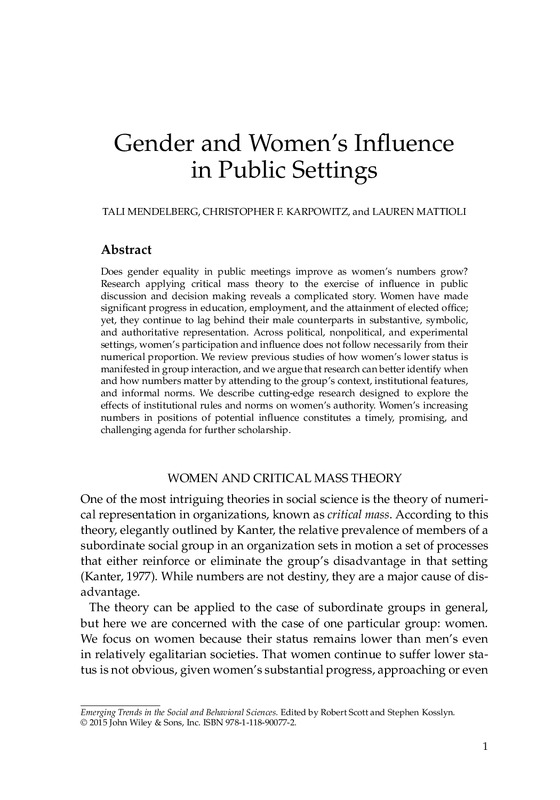
Does gender equality in public meetings improve as women's numbers grow? Research applying critical mass theory to the exercise of influence in public discussion and decision making reveals a complicated story. Women have made significant progress in education, employment, and the attainment of elected office; yet, they continue to lag behind their male counterparts in substantive, symbolic, and authoritative representation. Across political, nonpolitical, and experimental settings, women's participation and influence does not follow necessarily from their numerical proportion. We review previous studies of how women's lower status is manifested in group interaction, and we argue that research can better identify when and how numbers matter by attending to the group's context, institutional features, and informal norms. We describe cutting‐edge research designed to explore the effects of institutional rules and norms on women's authority. Women's increasing numbers in positions of potential influence constitutes a timely, promising, and challenging agenda for further scholarship.
-
Related Essays
-
Party Organizations' Electioneering Arms Race (Political Science), John H. Aldrich and Jeffrey D. Grynaviski
-
The Underrepresentation of Women in Elective Office (Political Science), Sarah F. Anzia
-
The Sexual Division of Labor (Anthropology), Rebecca Bliege Bird and Brian F. Codding
-
Rent, Rent‐Seeking, and Social Inequality (Sociology), Beth Red Bird and David B. Grusky
-
Stereotype Content (Sociology), Beatrice H. Capestany and Lasana T. Harris
-
Why So Few Women in Mathematically Intensive Fields? (Psychology), Stephen J. Ceci and Wendy M. Williams
-
Gender Segregation in Higher Education (Sociology), Alexandra Hendley and Maria Charles
-
Misinformation and How to Correct It (Psychology), John Cook et al.
-
Cognitive Processes Involved in Stereotyping (Psychology), Susan T. Fiske and Cydney H. Dupree
-
Empathy Gaps between Helpers and Help‐Seekers: Implications for Cooperation (Psychology), Vanessa K. Bohns and Francis J. Flynn
-
Controlling the Influence of Stereotypes on One's Thoughts (Psychology), Patrick S. Forscher and Patricia G. Devine
-
Political Advertising (Political Science), Erika Franklin Fowler
-
Changing Family Patterns (Sociology), Kathleen Gerson and Stacy Torres
-
Government Formation and Cabinets (Political Science), Sona N. Golder
-
Divorce (Sociology), Juho Härkönen
-
Grandmothers and the Evolution of Human Sociality (Anthropology), Kristen Hawkes and James Coxworth
-
Exploring Opportunities in Cultural Diversity (Political Science), David D. Laitin and Sangick Jeon
-
Women Running for Office (Political Science), Jennifer L. Lawless
-
Political Inequality (Sociology), Jeff Manza
-
Transformation of the Employment Relationship (Sociology), Arne L. Kalleberg and Peter V. Marsden
-
Gender Inequality in Educational Attainment (Sociology), Anne McDaniel and Claudia Buchmann
-
Implicit Attitude Measures (Psychology), Gregory Mitchell and Philip E. Tetlock
-
Feminists in Power (Sociology), Ann Orloff and Talia Schiff
-
Culture as Situated Cognition (Psychology), Daphna Oyserman
-
Cognitive Bias Modification in Mental (Psychology), Meg M. Reuland et al.
-
Sociology of Entrepreneurship (Sociology), Martin Ruef
-
Born This Way: Thinking Sociologically about Essentialism (Sociology), Kristen Schilt
-
Stereotype Threat (Psychology), Toni Schmader and William M. Hall
-
Gender and the Transition to Adulthood: A Diverse Pathways View (Sociology), Ingrid Schoon
-
Family Income Composition (Economics), Kristin E. Smith
-
Primate Allomaternal Care (Anthropology), Stacey Tecot and Andrea Baden
-
Leadership (Anthropology), Adrienne Tecza and Dominic Johnson
-
Transnational Work Careers (Sociology), Roland Verwiebe
-
Gender and Work (Sociology), Christine L. Williams and Megan Tobias Neely
-
Identifier
-
etrds0139
-
extracted text
-
Gender and Women’s Influence
in Public Settings
TALI MENDELBERG, CHRISTOPHER F. KARPOWITZ, and LAUREN MATTIOLI
Abstract
Does gender equality in public meetings improve as women’s numbers grow?
Research applying critical mass theory to the exercise of influence in public
discussion and decision making reveals a complicated story. Women have made
significant progress in education, employment, and the attainment of elected office;
yet, they continue to lag behind their male counterparts in substantive, symbolic,
and authoritative representation. Across political, nonpolitical, and experimental
settings, women’s participation and influence does not follow necessarily from their
numerical proportion. We review previous studies of how women’s lower status is
manifested in group interaction, and we argue that research can better identify when
and how numbers matter by attending to the group’s context, institutional features,
and informal norms. We describe cutting-edge research designed to explore the
effects of institutional rules and norms on women’s authority. Women’s increasing
numbers in positions of potential influence constitutes a timely, promising, and
challenging agenda for further scholarship.
WOMEN AND CRITICAL MASS THEORY
One of the most intriguing theories in social science is the theory of numerical representation in organizations, known as critical mass. According to this
theory, elegantly outlined by Kanter, the relative prevalence of members of a
subordinate social group in an organization sets in motion a set of processes
that either reinforce or eliminate the group’s disadvantage in that setting
(Kanter, 1977). While numbers are not destiny, they are a major cause of disadvantage.
The theory can be applied to the case of subordinate groups in general,
but here we are concerned with the case of one particular group: women.
We focus on women because their status remains lower than men’s even
in relatively egalitarian societies. That women continue to suffer lower status is not obvious, given women’s substantial progress, approaching or even
Emerging Trends in the Social and Behavioral Sciences. Edited by Robert Scott and Stephen Kosslyn.
© 2015 John Wiley & Sons, Inc. ISBN 978-1-118-90077-2.
1
�2
EMERGING TRENDS IN THE SOCIAL AND BEHAVIORAL SCIENCES
exceeding parity with men in roles that just a few decades ago were the near
exclusive purview of men. Yet women remain highly underrepresented in
the most powerful roles—and power is at the root of gender inequality in
societies around the world.
Women’s lag is on display in the United States. For example, the percentage of female CEOs in Fortune 500 companies remains under 4%, and that
in corporate boards include only 16% (Pande & Ford, 2011). Young women
are more likely to earn college degrees than young men, but their political
engagement and activity—an important correlate of education—rises less
than men’s does. Women are more likely to vote, but less likely to discuss
politics (Burns, Schlozman, & Verba, 2001). Women compose only about 20%
of elected government positions at nearly all levels of office.
Kanter’s theory has been applied to organizations, but has received relatively less scholarly attention in an important setting: public meetings. In a
democratic polity, formal authority is exercised in public meetings, where
binding decisions affecting the collective are made. As many observers
have commented, public meetings about matters of common concern are
the lifeblood of democracy. At the town council, the school board, the
neighborhood committee, the PTA (parent–teacher association), or a host
of other volunteer gatherings, the public meeting is where the voice of the
people is to be found. And an important criterion for democratic success is
equal participation and influence in meetings.
As much as formal rules of equal vote or equal opportunity to speak at
meetings may appear egalitarian, equality of access is a far cry from a reality
in which every voice is heard. Women and other disadvantaged groups may
not participate or influence equally with men, because meetings entail not
only an exchange of information and reasons but also social interaction, and
along with it, women’s authority deficit. When individuals interact, social
inequalities in political representation are not left at the meetinghouse door
(Mansbridge, 1983).
The central question we take up is whether gender equality in official public
meetings improves as women’s numbers grow. The question is all the more
timely now, as governments and related organizations around the world are
instituting various requirements to raise women’s numbers. Most prominent
among these efforts has been the UN official declaration that its member
countries should take measures “to integrate women in elective and nonelective public positions in the same proportion and the same levels as men.” The
UN’s target, established in 1995 and to which it has recommitted as recently
as 2009, is 30% women in decision-making positions. The UN describes this
proportion as the “‘critical mass,’ believed to be necessary for women to
make a visible impact on the style and content of political decision-making”
(United Nations Department of Economic and Social Affairs, 2005). Softer
�Gender and Women’s Influence in Public Settings
3
forms of gender diversity requirements abound as well. For example, the US
Securities and Exchange Commission required in 2010 that corporate boards
disclose their formal efforts to achieve diversity. Neither is the United States
alone (Krook, 2009); for example, India amended its constitution to require
the reservation of one-third of seats in its hundreds of thousands of village
governing bodies for women (Ban & Rao, 2009).
The study of women’s numbers in democratic political settings is thus crucial to our understanding of women, power, and equality. It can inform us
about how numbers affect influence in the places expressly designed for its
exercise.
What is influence? In political science, influence in democratic decisionmaking bodies takes one of several forms. One form of influence is substantive representation. To engage in substantive representation means introducing
items onto the agenda; advocating for them; getting others to advocate for
them; and altering the group decision or outcome consistent with that advocacy. A second form of influence is symbolic representation. This entails the
perception that a social identity group can and should exercise power and
leadership. In the case of women, it is the view that women are appropriate agents of influence (Reingold, 2008). A more dynamic, process-oriented
form of influence in political science is authoritative representation. This form
of influence instantiates symbolic representation during the process of group
discussion or the deliberation of a public meeting. Authoritative representation
is “any feature of communication among decision-makers that affects their
authority during the decision-making process” and “the set of actions that
occur during the process of representation … that affect the expectation that
a person, or group, can exercise power and influence others” (Mendelberg,
Karpowitz, & Oliphant, 2014, pp. 3, 18). To carry authoritative influence is,
first of all, to speak, and then, to receive positive affirmation in the form of
little negative feedback and much positive feedback.
The study of gender and influence in public meetings requires us to explore
all three concepts. In many settings, women have less substantive, symbolic,
and authoritative representation. The question is why, and what can be done
about it.
FOUNDATIONAL RESEARCH
How do numbers shape the various forms of women’s representation or
influence? According to critical mass theory, thresholds for progress in
women’s status occur as women advance from <15% (which renders them
marginalized tokens), to a noticeable minority of approximately one-third,
�4
EMERGING TRENDS IN THE SOCIAL AND BEHAVIORAL SCIENCES
when their status improves, to roughly even, when their status reaches
equality.1
Kanter theorizes that numbers shape the nature of interaction between
social identity groups. Tokens occupy the lowest status because they are
perceptually salient, receive disproportionate attention, and face weighty
performance pressures. The perceived differences between tokens and
the numerically dominant are exaggerated—dominant members become
more conscious of their commonalities and contrast themselves with the
numerical token, drawing sharp boundaries that isolate the numerical
minority. Lacking counterexamples to reform stereotypes of the minority,
dominants engage in overgeneralization from stereotypes and distort their
perception of the token member to assimilate them into those stereotypes.
As a result, tokens can be trapped in stereotypical roles (Kanter, 1977).
The theory of critical mass is well positioned to explain women’s relative
dearth of influence-seeking behavior in public meetings because when
women interact with men, women tend to seek influence less than men do.
For example, in an analysis of survey respondents’ beliefs about their ability
to “speak well enough to make an effective statement” at a town meting,
Karpowitz (2006) showed that women feel significantly less confident in
their speaking abilities than men, even after controlling for education,
political knowledge, and the possession of important civic skills. Experimental studies demonstrate that unless the topic is commonly perceived as
feminine, men are privileged in mixed-gender group discussions (Ridgeway
& Smith-Lovin, 1999). In four-person mixed gender groups tasked with
reaching a decision on a hypothetical dilemma, men were more likely to
offer information, make suggestions, share their opinion, and be perceived
as competent than women (Wood & Karten, 1986). Experimental studies
testing double standards found that women were more likely to defer to men
and to accept male competence and influence even when men underperform
them. Men only yielded to women’s influence when a woman was known
to have outperformed them earlier in the experiment [review in Foschi and
Freeman (1991)].
Seeing as women tend to participate less than men in mixed gender interactions, critical mass theory predicts that as women’s numbers grow and reach
a balance, so should their status. However, that prediction receives some puzzling disconfirmation from political settings. In public meetings, for example,
women’s numbers sometimes bear strikingly little relationship to their willingness to participate actively. Bryan’s extensive research on Vermont town
meetings revealed that on average between 1970 and 1998, about 46% of
1. On this theory, status and influence are closely related. Kanter’s concept of status encompasses the
kinds of influence with which we are concerned here, as well as negative stereotyping and harassment.
�Gender and Women’s Influence in Public Settings
5
meeting attenders were women, but they constituted only 36% of the speakers and only 28% of the speaking turns (speech acts) at the meetings (2004,
p. 214). Overall, Bryan finds that the correlation between women’s meeting
attendance and their speaking behavior is negative: the greater women’s proportion of town hall meeting attendees, the lower is their share of speakers
(p. 222). As he writes, “for the life of me and after thirty years of research, I
remain stumped when it comes to predicting women’s involvement” in public meetings (p. 249). These perplexing results are not unique to the United
States. While some research finds that quotas mandating increased presence
for women facilitate active participation, other studies of Indian villages and
Israeli kibbutzim find that numbers alone do not translate into the active use
of voice (Ban & Rao, 2009; see Karpowitz & Mendelberg, 2014).
Mixed evidence for the effect of women’s numbers is also a feature of scholarship on legislative decision making. Although female legislators do seem
to have distinct preferences from their male colleagues, rising numbers of
women in the legislature do not consistently lift women’s influence or ensure
that women’s distinctive priorities and perspectives receive attention or successful action (Reingold, 2008).
Not only have women struggled to translate increased numbers into policy change, but studies in various settings also report evidence of a backlash.
When elections in Britain raised the proportion of female MPs in the House of
Commons above 15%, women reported that their attempts to use more feminine styles of decision making were rebuffed by their male colleagues, who
pressured them “to conform to the traditional norms of the House” (Childs,
2004). Women in New Zealand experienced more openly hostile opposition
and verbal aggression from male MPs as they debated parental leave and
childcare policy (Grey, 2002). In American state legislative committees composed of a large minority of women, male committee chairs were more verbally dominant and less inclusive of women (Kathlene, 1994). Such backlash
need not always be verbal: Kanthak and Krause (2010) explored an entirely
different but highly consequential type of behavior—campaign contributions
to fellow members—and found that as the proportion of women increases
in the member’s party, men decrease their contributions to women while
increasing them to men.
In sum, achieving critical mass does not always alter the culture of the deliberating body or inexorably lead to the authority that would allow women
to enact real policy change, even on the issues that are especially important
to them (Lovenduski, 2005). Other factors seem much more important than
women’s numbers (Weldon, 2011).
Why do numbers sometimes fail? In addition to backlash from men,
other factors, familiar to students of legislative behavior, can overwhelm
an increase in the presence of women in the legislative chamber. Women’s
�6
EMERGING TRENDS IN THE SOCIAL AND BEHAVIORAL SCIENCES
influence may be depressed by the wages of party loyalty, their lack of
seniority, competing institutional demands, constituency expectations that
require prioritization of issues other than women’s distinctive concerns, and
dependence on other (mostly male) actors who control access to opportunity
(Franceschet, Krook, & Piscopo, 2012).
The problem for critical mass theory is not merely that women do not
always achieve increased authority as their numbers increase. The evidence also shows that women can sometimes exercise authority effectively
when their numbers are few. In some state legislatures, for example,
female “tokens” sponsor and enact women’s issue bills as effectively as
do their male colleagues, and may be as successful as the women in more
gender-balanced legislatures (Bratton, 2005). A few exceptional “token”
women may accomplish as much as or even more than a critical mass,
according to some cross-national studies (e.g., Childs & Krook, 2006). As
Karpowitz and Mendelberg summarize, “small numbers may not be fatal,
just as large numbers may not be sufficient” (2014, p. 18).
Thus, Beckwith and Cowell-Meyers take issue with critical mass theory
itself, concluding that the theory “is both problematic and under-theorized,”
its mechanism “unspecified” and the power of small numbers of women “neglected” (2007, p. 553). Dahlerup also doubts the power of numbers, holding
that women’s use of political power will pivot on other determinants (2006,
p. 520). As Franceschet et al. describe the state of the critical mass research,
raising women’s numbers “may have positive, mixed, and sometimes even
perverse effects on women’s political representation” (2012, p. 13).
CUTTING-EDGE RESEARCH
Given these conclusions, the key question, in our view, is when—under what
conditions—do women’s numbers matter? When will more women lead
to more authority for women, and when is it possible for women achieve
authoritative influence even when their numbers are few?
We conclude that the answers to those questions often come from attending carefully to the institutions and contexts in which women attempt to
exercise authority. Several studies indicate that larger numbers help when
women use institutional mechanisms to work collaboratively. Preparing
for opportunities to make institutional reform by predrafting legislation
and identifying sources of support enabled women to make incremental
changes in state legislative procedures that aided their larger goals (Thomas,
1994). Women, as institutional insiders or outside activists, can provide
resources and actively frame debate to precipitate reform (Duerst-Lahti,
2002). Conversely, when the institution’s incentives or structures undermine
women’s coalition-building efforts or tie women’s fortunes to established
�Gender and Women’s Influence in Public Settings
7
male power structures, women have trouble leveraging their larger numbers
into substantial policy change (Franceschet et al., 2012). The larger context
of women’s empowerment, such as the success of feminist movements or
discourse environments that are receptive to women’s voices, may also
help women achieve more substantial political gains and policy victories
(Beckwith & Cowell-Meyers, 2007).
Taken together, the evidence from these studies leads to the conclusion
that formal rules and informal norms shape the connection between numbers and authority. One recent thread of research attempts to study the rules
that govern discussion and decision making at public meetings. Drawing on
an extensive laboratory experiment conducted in two US locations, a conservative city in the mountain West and a more liberal town on the Atlantic
seaboard, Karpowitz and Mendelberg (2014) show that women’s authority in
small group discussions about poverty and income redistribution is shaped
by the interaction of numbers and decision-making rules. In this experiment,
participants were randomly assigned to groups, which varied in their gender composition and in the decision rule they were asked to follow. In the
condition most common to decision-making bodies in the United States and
elsewhere—women constituting a numerical minority in groups deciding by
majority rule—women’s voices were rarely heard. In such groups, women
held the floor for a lower proportion of the conversation than their numbers
would have predicted; they were less likely to be seen as influential by the
other members of the group; they were less likely to raise issues of distinctive concern to women, instead voicing preferences that were more in line
with those of men; they experienced fewer expressions of affirmation from
the men in the group; and they had more trouble moving the group in the
direction of their preferred outcomes. In sum, women exercised substantially
less voice and authority than the men in the group. As women’s numbers
increased from 20% to 80% of the group, these trends reversed, although in
many cases, a supermajority of women was required before women spoke at
rates proportional to their numbers.
Although the experimental results show that far more than the UN’s 30%
threshold was often needed, the trend for half of the experimental groups
was consistent with the basic logic of critical mass theory. In groups deciding
by majority rule, token women were severely disadvantaged, and women
gained authoritative influence as their numbers increased. But under other
institutional arrangements, the effect of numbers was far different. In groups
randomly assigned to decide by unanimity instead of majority rule, token
women talked substantially more than they did under majority rule and at
average rates that were much closer to those of the men in the group. What’s
more, as women’s numbers increased under unanimity rule, their average
�8
EMERGING TRENDS IN THE SOCIAL AND BEHAVIORAL SCIENCES
speaking time and other markers of their influence did not increase substantially. For example, women’s proportion of floor time in the group discussion
actually decreased as their numbers rose, and increasing numbers under unanimity had null or negative effects on the content of their speech, the patterns
of interruptions they received, and their ability to influence the group’s eventual decision.
Numbers alone cannot explain these patterns. Instead, the effect of numbers
on women’s authority can be understood only by attending to the interaction
of the group’s formal decision rules and its gender composition. Institutional
rules that can seem either arbitrary or at the least neutral thus carry profound consequences for women’s authority. Why do the institutional rules
condition the effect of gender composition so much? The answer is, in part,
because rules set expectations about inclusion, interaction, and the meaning and use of power. In small group discussions, rules set in motion a set
of conversational practices that work to either elevate or ignore women’s
authority. Majority rule signals a competitive dynamic in which minority
views can be marginalized. Majority rule is good for women when they are in
the majority—women are entitled and expected to exercise power. By contrast,
unanimous rule empowers minority views and signals the need for inclusive cooperation instead of competition. As Gastil writes, decision rules that
require consensus assume “that the minority viewpoint is crucial, so members may go out of their way to draw out quieter group members. Listening
may also be enhanced, since consensus relies upon members understanding
and considering what each other says” (1993, p. 52). While it is also possible
that the majority will pressure the minority to conform, unanimity makes
it impossible for the majority to ignore minority preferences entirely. It is,
therefore, good for women when they are in the minority, but simultaneously
empowers minority men, meaning that majority women may not be able to
leverage their numbers in quite the same way as they would be able to do
when they outnumber men under a different decision rule.
Evidence for the critical role for institutional rules in shaping women’s
authority is not limited to the laboratory. Karpowitz and Mendelberg (2014)
also examined patterns of participation in school boards and discussion
groups from around the country. School boards, which tend to make decisions by majority rule, are a helpful place to investigate the effect of women’s
numbers, as they are one of the few institutions in which the gender composition varies sufficiently to explore not just the effect of women becoming a
larger minority but also the patterns on boards where women form a strong
majority. Analyzing the motions and speeches recorded in the board’s official
minutes, Karpowitz and Mendelberg (2014) found confirmation of patterns
discovered in the laboratory. On majority-rule boards with a majority of
men, women’s participation lagged far behind that of men—and did not
�Gender and Women’s Influence in Public Settings
9
rise to levels equal to women’s proportion on the board. As the proportion
of women on the board increased, women came much closer to equality, but
it typically took a supermajority of women—60% in the case of motions and
70% in the case of speeches—before women reached participation levels that
matched their numerical proportion of the board.
Our argument is that rules matter for participation in large part because
they shape norms of interaction. Thus, informal procedures and cues can also
be critically important. For example, Karpowitz and Mendelberg (2014) reanalyzed data originally published by Walsh (2007) on patterns of participation
in civic dialogue groups in Wisconsin and Illinois. These groups did not make
a formal decision together, so there was no decision rule to speak of. Nonetheless, the group instructions emphasized the dynamics common to unanimous
rule. Participants were explicitly instructed to “listen carefully,” to “really try
to understand what others are saying,” and to avoid the temptation to “monopolize the conversation” (Walsh, 2007, p. 40). Karpowitz and Mendelberg
(2014) found that women’s patterns of participation mirrored the laboratory
results for unanimous-rule groups—women’s participation came closest to
equality when women made up a smaller proportion of those in attendance
and declined as the proportion of women increased. Thus, gender-neutral discussion norms and procedures, whether promoted by formal decision rules
or informal conversational instructions, have gendered effects. Not only does
majority rule create a winner-centric dynamic favoring men in most circumstances but consensus processes can actually backfire for women when their
numbers are high, because in those groups, consensus leads men—and not
women—to accelerate their participation.
Influence and authority can also be shaped by even subtler but no less
powerful signals and conversational scripts. When norms of interaction
emphasize group rapport and cooperation, women’s active participation
and influence are likely to be enhanced. When norms and cues are less
cooperative or supportive, women are likely to participate less, experience
lower status, and ultimately have more difficulty exercising influence. The
pioneering work of Kathlene (1994) and Mattei (1998) shows that these
informal cues can matter even in elite settings such as state legislative committees or congressional hearings. For example, Mattei’s analysis of Senate
hearings showed that compared to men, women were given less time to
speak, experienced more hostile interruptions, were asked more challenging
questions, were called on to provide more evidence, and were more often
denied when they tried to interrupt. Male witnesses interrupted Senators as
often as they were interrupted themselves, whereas female witnesses were
interrupted three times for every time they interrupted a Senator. In this,
and other male-skewed settings, men may use their interruptions to assert
their authority and undermine women.
�10
EMERGING TRENDS IN THE SOCIAL AND BEHAVIORAL SCIENCES
KEY ISSUES FOR FUTURE RESEARCH
Our call to the scholarly community, then, is to move beyond a sole focus on
women’s numbers and instead to examine how numbers interact with formal institutional rules and informal norms to build or undermine women’s
status, including their participation, authority, and influence. This endeavor
should be interdisciplinary and methodologically diverse. It will mean, for
example, bringing attention to variables familiar to political scientists, such
as the rules and procedures of political institutions, together with concepts
from social psychology, sociology, gender studies, and other related fields,
such as the social norms that set cultural expectations for each gender’s relative authority, the communication mechanisms that shape behavior in small
groups, the ways that the gender composition of a group elicits gendered
cultural scripts that shape interaction between individuals, and so on. It will
draw on a variety of methodological approaches, including careful observation of different kinds of groups and settings, survey research into attitudes of
participants before and after discussion, content analysis of group discussion,
and laboratory or field experiments in which different features of groups are
manipulated.
Such a research program brings with it important challenges. It calls for
designs with sufficient group-level variation in both gender composition
and institutional rules and with enough groups for meaningful analysis.
One of the chief difficulties of a full assessment of the effect of numbers
in legislatures, for example, is that there are few bodies in which women
have achieved a majority or even an equal gender split. This challenge
is not insurmountable, but it is complicated and thus adds variation in
institutional rules or norms. In addition, people tend to self-select based
on part on the norms that gender composition and rules create, and this
implies the need to include exogenous variation in numbers and rules, as
with randomized experiments.
This research also calls for increased attention to the norms of interaction
that occur at public meetings or other deliberating bodies. For example, the
presence of female judges on appeals court panels can affect judicial decisions, even after controlling for other factors (Farhang & Wawro, 2004), but
more remains to be done to understand the mechanisms of these gender composition effects or the processes by which judges interact.
Therefore, the research we are encouraging requires scholars to take the
group seriously as a unit of analysis, provide a sufficiently large number of
groups and sufficient variation among them, and examine the effects on different individuals and the details of group dynamics and functioning. This
is much more complicated than simply adding an indicator for individual
gender or even group gender composition to a regression model. In a larger
�Gender and Women’s Influence in Public Settings
11
sense, it means not only methodological innovation but also theoretical
progress in exploring how women’s, and anyone’s, authoritative influence
is produced. While the challenges are great, the authoritative influence of
half of the population is a goal that is more than worthy of the effort.
REFERENCES
Ban, R. & Rao, V. (2009). Is Deliberation Equitable? Evidence from Transcripts of Village
Meetings in South India. Policy Research Working Paper 4928, World Bank, Washington, DC.
Beckwith, K., & Cowell-Meyers, K. (2007). Sheer numbers: Critical representation
thresholds and women’s political representation. Perspectives on Politics, 5(3),
553–565.
Bratton, K. (2005). Critical mass theory revisited: The behavior and success of token
women in state legislatures. Politics and Gender, 1(1), 97–125.
Bryan, F. (2004). Real democracy: The New England town meeting and how it works.
Chicago, IL: University of Chicago Press.
Burns, N., Schlozman, K., & Verba, S. (2001). The private roots of public action: Gender,
equality, and political participation. Cambridge, MA: Harvard University Press.
Childs, S. (2004). A feminised style of politics? Women MPs in the house of commons.
British Journal of Politics & International Relations, 6(1), 3–19.
Childs, S., & Krook, M. (2006). Should feminists give up on critical mass? A contingent yes. Politics & Gender, 2(4), 522–530.
Dahlerup, D. (2006). The story of the theory of critical mass. Politics & Gender, 2(4),
511–522.
Duerst-Lahti, G. (2002). Governing institutions, ideologies and gender: Toward the
possibility of equal political representation. Sex Roles, 47, 371–388.
Farhang, S., & Wawro, G. (2004). Institutional dynamics on the U.S. Court of appeals:
Minority representation under panel decision making. Journal of Law, Economics,
and Organization, 20(2), 299–330.
Foschi, M., & Freeman, S. (1991). Inferior performance, stands, and influence in
same-sex dyads. Canadian Journal of Behavioural Science, 23(1), 99–113.
Franceschet, S., Krook, M., & Piscopo, J. (2012). Conceptualizing the impact of gender
quotas. In S. Franceschet, M. Krook & J. Piscopo (Eds.), The impact of gender quotas
(pp. 3–24). New York, NY: Oxford University Press.
Gastil, J. (1993). Democracy in small groups: Participation, decision making, and communication. Philadelphia, PA: New Society.
Grey, S. (2002). Does size matter? Critical mass and New Zealand’s women MPs.
Parliamentary Affairs, 55(1), 19–29.
Kanter, R. (1977). Men and women of the corporation. New York, NY: Basic.
Kanthak, K., & Krause, G. (2010). Valuing diversity in political organizations: Gender and token minorities in the U.S. house of representatives. American Journal of
Political Science, 54(4), 839–854.
Karpowitz, C. (2006). Having a say: Public hearings, deliberation, and democracy in America (PhD dissertation). Princeton University.
�12
EMERGING TRENDS IN THE SOCIAL AND BEHAVIORAL SCIENCES
Karpowitz, C., & Mendelberg, T. (2014). The silent sex: Gender, deliberation, and institutions. Princeton, NJ: Princeton University Press.
Kathlene, L. (1994). Power and influence in state legislative policymaking: The interaction of gender and position in committee hearing debates. American Political
Science Review, 88, 560–576.
Krook, M. (2009). Quotas for women in politics: Gender and candidate selection reform
worldwide. New York, NY: Oxford University Press.
Lovenduski, J. (2005). State feminism and political representation. New York, NY: Cambridge University Press.
Mansbridge, J. (1983). Beyond adversary democracy. Chicago, IL: University of Chicago
Press.
Mattei, L. (1998). Gender and power in American legislative discourse. Journal of Politics, 60(2), 440–461.
Mendelberg, T., Karpowitz, C., & Oliphant, J. (2014). Gender inequality in deliberation: Unpacking the black box of interaction. Perspectives on Politics, 12(1), 18–44.
Pande, R., & Ford, D. (2011). Gender quotas and female leadership: A review. Washington,
DC: The World Bank.
Reingold, B. (2008). Women as office holders: Linking descriptive and substantive
representation. In C. Wolbrecht & L. Baldez (Eds.), Political women and American
democracy. New York, NY: Cambridge Press.
Ridgeway, C., & Smith-Lovin, L. (1999). The gender system and interaction. Annual
Review of Sociology, 25, 191–216.
Thomas, S. (1994). How women legislate. New York, NY: Oxford University Press.
United Nations Department of Economic and Social Affairs. (2005). Equal participation of women and men in decision-making processes. United Nations Department
of Economic and Social Affairs Division for the Advancement of Women. Addis
Ababa, Ethiopia, 24–27 October 2005.
Walsh, K. (2007). Talking about race: Community dialogues and the politics of difference.
Chicago, IL: University of Chicago Press.
Weldon, S. L. (2011). When protest makes policy: How social movements represent disadvantaged groups. Ann Arbor: University of Michigan Press.
Wood, W., & Karten, S. (1986). Sex differences in interaction style as a product of
perceived sex differences in competence. Journal of Personality and Social Psychology,
50, 341–347.
TALI MENDELBERG SHORT BIOGRAPHY
Tali Mendelberg is a Professor of Politics at Princeton University and the
author of The Race Card: Campaign Strategy, Implicit Messages, and the Norm
of Equality (Princeton University Press, 2001), winner of the American Political Science Association’s Woodrow Wilson Foundation Award for “the best
book published in the United States during the prior year on government,
politics or international affairs.” She is a coauthor of The Silent Sex: Gender,
Deliberation and Institutions (Princeton University Press, 2014). She received
�Gender and Women’s Influence in Public Settings
13
the Erik H. Erikson Early Career Award for Excellence and Creativity in the
Field of Political Psychology and has published in a wide variety of scholarly outlets. She holds a PhD from the University of Michigan. Her areas
of specialization are political communication; gender; race; public opinion;
political psychology; and experimental methods.
CHRISTOPHER F. KARPOWITZ SHORT BIOGRAPHY
Dr. Christopher F. Karpowitz is the Associate Director of the Center for the
Study of Elections and Democracy and an Associate Professor of Political Science at Brigham Young University. He is a coauthor of The Silent Sex: Gender
Deliberation, and Institutions (Princeton University Press, 2014) and Deliberation, Democracy, and Civic Forums: Improving Equality and Publicity (Cambridge
University Press, 2014). His work has also appeared in many other scholarly
outlets. His research interests include political psychology, political behavior, political communication, and political participation. Much of his research
explores how citizens participate in and experience democratic institutions
and processes, with special attention to democratic and deliberative theory.
He holds a PhD from Princeton University and was a Post-Doctoral Fellow in
Democracy and Human Values at Princeton’s University Center for Human
Values.
LAUREN MATTIOLI SHORT BIOGRAPHY
Lauren Mattioli is a doctoral candidate (expected 2016) in the Department of
Politics at Princeton University and an affiliate of the Center for the Study of
Democratic Politics at Princeton University. Mattioli studies American politics and public law with a focus on executive and judicial decision making.
RELATED ESSAYS
Party Organizations’ Electioneering Arms Race (Political Science), John H.
Aldrich and Jeffrey D. Grynaviski
The Underrepresentation of Women in Elective Office (Political Science),
Sarah F. Anzia
The Sexual Division of Labor (Anthropology), Rebecca Bliege Bird and Brian
F. Codding
Rent, Rent-Seeking, and Social Inequality (Sociology), Beth Red Bird and
David B. Grusky
Stereotype Content (Sociology), Beatrice H. Capestany and Lasana T. Harris
Why So Few Women in Mathematically Intensive Fields? (Psychology),
Stephen J. Ceci and Wendy M. Williams
�14
EMERGING TRENDS IN THE SOCIAL AND BEHAVIORAL SCIENCES
Gender Segregation in Higher Education (Sociology), Alexandra Hendley
and Maria Charles
Misinformation and How to Correct It (Psychology), John Cook et al.
Cognitive Processes Involved in Stereotyping (Psychology), Susan T. Fiske
and Cydney H. Dupree
Empathy Gaps between Helpers and Help-Seekers: Implications for Cooperation (Psychology), Vanessa K. Bohns and Francis J. Flynn
Controlling the Influence of Stereotypes on One’s Thoughts (Psychology),
Patrick S. Forscher and Patricia G. Devine
Political Advertising (Political Science), Erika Franklin Fowler
Changing Family Patterns (Sociology), Kathleen Gerson and Stacy Torres
Government Formation and Cabinets (Political Science), Sona N. Golder
Divorce (Sociology), Juho Härkönen
Grandmothers and the Evolution of Human Sociality (Anthropology), Kristen
Hawkes and James Coxworth
Exploring Opportunities in Cultural Diversity (Political Science), David D.
Laitin and Sangick Jeon
Women Running for Office (Political Science), Jennifer L. Lawless
Political Inequality (Sociology), Jeff Manza
Transformation of the Employment Relationship (Sociology), Arne L. Kalleberg and Peter V. Marsden
Gender Inequality in Educational Attainment (Sociology), Anne McDaniel
and Claudia Buchmann
Implicit Attitude Measures (Psychology), Gregory Mitchell and Philip E.
Tetlock
Feminists in Power (Sociology), Ann Orloff and Talia Schiff
Culture as Situated Cognition (Psychology), Daphna Oyserman
Cognitive Bias Modification in Mental (Psychology), Meg M. Reuland et al.
Sociology of Entrepreneurship (Sociology), Martin Ruef
Born This Way: Thinking Sociologically about Essentialism (Sociology),
Kristen Schilt
Stereotype Threat (Psychology), Toni Schmader and William M. Hall
Gender and the Transition to Adulthood: A Diverse Pathways View (Sociology), Ingrid Schoon
Family Income Composition (Economics), Kristin E. Smith
Primate Allomaternal Care (Anthropology), Stacey Tecot and Andrea Baden
Leadership (Anthropology), Adrienne Tecza and Dominic Johnson
Transnational Work Careers (Sociology), Roland Verwiebe
Gender and Work (Sociology), Christine L. Williams and Megan Tobias Neely
�
-
Gender and Women’s Influence
in Public Settings
TALI MENDELBERG, CHRISTOPHER F. KARPOWITZ, and LAUREN MATTIOLI
Abstract
Does gender equality in public meetings improve as women’s numbers grow?
Research applying critical mass theory to the exercise of influence in public
discussion and decision making reveals a complicated story. Women have made
significant progress in education, employment, and the attainment of elected office;
yet, they continue to lag behind their male counterparts in substantive, symbolic,
and authoritative representation. Across political, nonpolitical, and experimental
settings, women’s participation and influence does not follow necessarily from their
numerical proportion. We review previous studies of how women’s lower status is
manifested in group interaction, and we argue that research can better identify when
and how numbers matter by attending to the group’s context, institutional features,
and informal norms. We describe cutting-edge research designed to explore the
effects of institutional rules and norms on women’s authority. Women’s increasing
numbers in positions of potential influence constitutes a timely, promising, and
challenging agenda for further scholarship.
WOMEN AND CRITICAL MASS THEORY
One of the most intriguing theories in social science is the theory of numerical representation in organizations, known as critical mass. According to this
theory, elegantly outlined by Kanter, the relative prevalence of members of a
subordinate social group in an organization sets in motion a set of processes
that either reinforce or eliminate the group’s disadvantage in that setting
(Kanter, 1977). While numbers are not destiny, they are a major cause of disadvantage.
The theory can be applied to the case of subordinate groups in general,
but here we are concerned with the case of one particular group: women.
We focus on women because their status remains lower than men’s even
in relatively egalitarian societies. That women continue to suffer lower status is not obvious, given women’s substantial progress, approaching or even
Emerging Trends in the Social and Behavioral Sciences. Edited by Robert Scott and Stephen Kosslyn.
© 2015 John Wiley & Sons, Inc. ISBN 978-1-118-90077-2.
1
�2
EMERGING TRENDS IN THE SOCIAL AND BEHAVIORAL SCIENCES
exceeding parity with men in roles that just a few decades ago were the near
exclusive purview of men. Yet women remain highly underrepresented in
the most powerful roles—and power is at the root of gender inequality in
societies around the world.
Women’s lag is on display in the United States. For example, the percentage of female CEOs in Fortune 500 companies remains under 4%, and that
in corporate boards include only 16% (Pande & Ford, 2011). Young women
are more likely to earn college degrees than young men, but their political
engagement and activity—an important correlate of education—rises less
than men’s does. Women are more likely to vote, but less likely to discuss
politics (Burns, Schlozman, & Verba, 2001). Women compose only about 20%
of elected government positions at nearly all levels of office.
Kanter’s theory has been applied to organizations, but has received relatively less scholarly attention in an important setting: public meetings. In a
democratic polity, formal authority is exercised in public meetings, where
binding decisions affecting the collective are made. As many observers
have commented, public meetings about matters of common concern are
the lifeblood of democracy. At the town council, the school board, the
neighborhood committee, the PTA (parent–teacher association), or a host
of other volunteer gatherings, the public meeting is where the voice of the
people is to be found. And an important criterion for democratic success is
equal participation and influence in meetings.
As much as formal rules of equal vote or equal opportunity to speak at
meetings may appear egalitarian, equality of access is a far cry from a reality
in which every voice is heard. Women and other disadvantaged groups may
not participate or influence equally with men, because meetings entail not
only an exchange of information and reasons but also social interaction, and
along with it, women’s authority deficit. When individuals interact, social
inequalities in political representation are not left at the meetinghouse door
(Mansbridge, 1983).
The central question we take up is whether gender equality in official public
meetings improves as women’s numbers grow. The question is all the more
timely now, as governments and related organizations around the world are
instituting various requirements to raise women’s numbers. Most prominent
among these efforts has been the UN official declaration that its member
countries should take measures “to integrate women in elective and nonelective public positions in the same proportion and the same levels as men.” The
UN’s target, established in 1995 and to which it has recommitted as recently
as 2009, is 30% women in decision-making positions. The UN describes this
proportion as the “‘critical mass,’ believed to be necessary for women to
make a visible impact on the style and content of political decision-making”
(United Nations Department of Economic and Social Affairs, 2005). Softer
�Gender and Women’s Influence in Public Settings
3
forms of gender diversity requirements abound as well. For example, the US
Securities and Exchange Commission required in 2010 that corporate boards
disclose their formal efforts to achieve diversity. Neither is the United States
alone (Krook, 2009); for example, India amended its constitution to require
the reservation of one-third of seats in its hundreds of thousands of village
governing bodies for women (Ban & Rao, 2009).
The study of women’s numbers in democratic political settings is thus crucial to our understanding of women, power, and equality. It can inform us
about how numbers affect influence in the places expressly designed for its
exercise.
What is influence? In political science, influence in democratic decisionmaking bodies takes one of several forms. One form of influence is substantive representation. To engage in substantive representation means introducing
items onto the agenda; advocating for them; getting others to advocate for
them; and altering the group decision or outcome consistent with that advocacy. A second form of influence is symbolic representation. This entails the
perception that a social identity group can and should exercise power and
leadership. In the case of women, it is the view that women are appropriate agents of influence (Reingold, 2008). A more dynamic, process-oriented
form of influence in political science is authoritative representation. This form
of influence instantiates symbolic representation during the process of group
discussion or the deliberation of a public meeting. Authoritative representation
is “any feature of communication among decision-makers that affects their
authority during the decision-making process” and “the set of actions that
occur during the process of representation … that affect the expectation that
a person, or group, can exercise power and influence others” (Mendelberg,
Karpowitz, & Oliphant, 2014, pp. 3, 18). To carry authoritative influence is,
first of all, to speak, and then, to receive positive affirmation in the form of
little negative feedback and much positive feedback.
The study of gender and influence in public meetings requires us to explore
all three concepts. In many settings, women have less substantive, symbolic,
and authoritative representation. The question is why, and what can be done
about it.
FOUNDATIONAL RESEARCH
How do numbers shape the various forms of women’s representation or
influence? According to critical mass theory, thresholds for progress in
women’s status occur as women advance from <15% (which renders them
marginalized tokens), to a noticeable minority of approximately one-third,
�4
EMERGING TRENDS IN THE SOCIAL AND BEHAVIORAL SCIENCES
when their status improves, to roughly even, when their status reaches
equality.1
Kanter theorizes that numbers shape the nature of interaction between
social identity groups. Tokens occupy the lowest status because they are
perceptually salient, receive disproportionate attention, and face weighty
performance pressures. The perceived differences between tokens and
the numerically dominant are exaggerated—dominant members become
more conscious of their commonalities and contrast themselves with the
numerical token, drawing sharp boundaries that isolate the numerical
minority. Lacking counterexamples to reform stereotypes of the minority,
dominants engage in overgeneralization from stereotypes and distort their
perception of the token member to assimilate them into those stereotypes.
As a result, tokens can be trapped in stereotypical roles (Kanter, 1977).
The theory of critical mass is well positioned to explain women’s relative
dearth of influence-seeking behavior in public meetings because when
women interact with men, women tend to seek influence less than men do.
For example, in an analysis of survey respondents’ beliefs about their ability
to “speak well enough to make an effective statement” at a town meting,
Karpowitz (2006) showed that women feel significantly less confident in
their speaking abilities than men, even after controlling for education,
political knowledge, and the possession of important civic skills. Experimental studies demonstrate that unless the topic is commonly perceived as
feminine, men are privileged in mixed-gender group discussions (Ridgeway
& Smith-Lovin, 1999). In four-person mixed gender groups tasked with
reaching a decision on a hypothetical dilemma, men were more likely to
offer information, make suggestions, share their opinion, and be perceived
as competent than women (Wood & Karten, 1986). Experimental studies
testing double standards found that women were more likely to defer to men
and to accept male competence and influence even when men underperform
them. Men only yielded to women’s influence when a woman was known
to have outperformed them earlier in the experiment [review in Foschi and
Freeman (1991)].
Seeing as women tend to participate less than men in mixed gender interactions, critical mass theory predicts that as women’s numbers grow and reach
a balance, so should their status. However, that prediction receives some puzzling disconfirmation from political settings. In public meetings, for example,
women’s numbers sometimes bear strikingly little relationship to their willingness to participate actively. Bryan’s extensive research on Vermont town
meetings revealed that on average between 1970 and 1998, about 46% of
1. On this theory, status and influence are closely related. Kanter’s concept of status encompasses the
kinds of influence with which we are concerned here, as well as negative stereotyping and harassment.
�Gender and Women’s Influence in Public Settings
5
meeting attenders were women, but they constituted only 36% of the speakers and only 28% of the speaking turns (speech acts) at the meetings (2004,
p. 214). Overall, Bryan finds that the correlation between women’s meeting
attendance and their speaking behavior is negative: the greater women’s proportion of town hall meeting attendees, the lower is their share of speakers
(p. 222). As he writes, “for the life of me and after thirty years of research, I
remain stumped when it comes to predicting women’s involvement” in public meetings (p. 249). These perplexing results are not unique to the United
States. While some research finds that quotas mandating increased presence
for women facilitate active participation, other studies of Indian villages and
Israeli kibbutzim find that numbers alone do not translate into the active use
of voice (Ban & Rao, 2009; see Karpowitz & Mendelberg, 2014).
Mixed evidence for the effect of women’s numbers is also a feature of scholarship on legislative decision making. Although female legislators do seem
to have distinct preferences from their male colleagues, rising numbers of
women in the legislature do not consistently lift women’s influence or ensure
that women’s distinctive priorities and perspectives receive attention or successful action (Reingold, 2008).
Not only have women struggled to translate increased numbers into policy change, but studies in various settings also report evidence of a backlash.
When elections in Britain raised the proportion of female MPs in the House of
Commons above 15%, women reported that their attempts to use more feminine styles of decision making were rebuffed by their male colleagues, who
pressured them “to conform to the traditional norms of the House” (Childs,
2004). Women in New Zealand experienced more openly hostile opposition
and verbal aggression from male MPs as they debated parental leave and
childcare policy (Grey, 2002). In American state legislative committees composed of a large minority of women, male committee chairs were more verbally dominant and less inclusive of women (Kathlene, 1994). Such backlash
need not always be verbal: Kanthak and Krause (2010) explored an entirely
different but highly consequential type of behavior—campaign contributions
to fellow members—and found that as the proportion of women increases
in the member’s party, men decrease their contributions to women while
increasing them to men.
In sum, achieving critical mass does not always alter the culture of the deliberating body or inexorably lead to the authority that would allow women
to enact real policy change, even on the issues that are especially important
to them (Lovenduski, 2005). Other factors seem much more important than
women’s numbers (Weldon, 2011).
Why do numbers sometimes fail? In addition to backlash from men,
other factors, familiar to students of legislative behavior, can overwhelm
an increase in the presence of women in the legislative chamber. Women’s
�6
EMERGING TRENDS IN THE SOCIAL AND BEHAVIORAL SCIENCES
influence may be depressed by the wages of party loyalty, their lack of
seniority, competing institutional demands, constituency expectations that
require prioritization of issues other than women’s distinctive concerns, and
dependence on other (mostly male) actors who control access to opportunity
(Franceschet, Krook, & Piscopo, 2012).
The problem for critical mass theory is not merely that women do not
always achieve increased authority as their numbers increase. The evidence also shows that women can sometimes exercise authority effectively
when their numbers are few. In some state legislatures, for example,
female “tokens” sponsor and enact women’s issue bills as effectively as
do their male colleagues, and may be as successful as the women in more
gender-balanced legislatures (Bratton, 2005). A few exceptional “token”
women may accomplish as much as or even more than a critical mass,
according to some cross-national studies (e.g., Childs & Krook, 2006). As
Karpowitz and Mendelberg summarize, “small numbers may not be fatal,
just as large numbers may not be sufficient” (2014, p. 18).
Thus, Beckwith and Cowell-Meyers take issue with critical mass theory
itself, concluding that the theory “is both problematic and under-theorized,”
its mechanism “unspecified” and the power of small numbers of women “neglected” (2007, p. 553). Dahlerup also doubts the power of numbers, holding
that women’s use of political power will pivot on other determinants (2006,
p. 520). As Franceschet et al. describe the state of the critical mass research,
raising women’s numbers “may have positive, mixed, and sometimes even
perverse effects on women’s political representation” (2012, p. 13).
CUTTING-EDGE RESEARCH
Given these conclusions, the key question, in our view, is when—under what
conditions—do women’s numbers matter? When will more women lead
to more authority for women, and when is it possible for women achieve
authoritative influence even when their numbers are few?
We conclude that the answers to those questions often come from attending carefully to the institutions and contexts in which women attempt to
exercise authority. Several studies indicate that larger numbers help when
women use institutional mechanisms to work collaboratively. Preparing
for opportunities to make institutional reform by predrafting legislation
and identifying sources of support enabled women to make incremental
changes in state legislative procedures that aided their larger goals (Thomas,
1994). Women, as institutional insiders or outside activists, can provide
resources and actively frame debate to precipitate reform (Duerst-Lahti,
2002). Conversely, when the institution’s incentives or structures undermine
women’s coalition-building efforts or tie women’s fortunes to established
�Gender and Women’s Influence in Public Settings
7
male power structures, women have trouble leveraging their larger numbers
into substantial policy change (Franceschet et al., 2012). The larger context
of women’s empowerment, such as the success of feminist movements or
discourse environments that are receptive to women’s voices, may also
help women achieve more substantial political gains and policy victories
(Beckwith & Cowell-Meyers, 2007).
Taken together, the evidence from these studies leads to the conclusion
that formal rules and informal norms shape the connection between numbers and authority. One recent thread of research attempts to study the rules
that govern discussion and decision making at public meetings. Drawing on
an extensive laboratory experiment conducted in two US locations, a conservative city in the mountain West and a more liberal town on the Atlantic
seaboard, Karpowitz and Mendelberg (2014) show that women’s authority in
small group discussions about poverty and income redistribution is shaped
by the interaction of numbers and decision-making rules. In this experiment,
participants were randomly assigned to groups, which varied in their gender composition and in the decision rule they were asked to follow. In the
condition most common to decision-making bodies in the United States and
elsewhere—women constituting a numerical minority in groups deciding by
majority rule—women’s voices were rarely heard. In such groups, women
held the floor for a lower proportion of the conversation than their numbers
would have predicted; they were less likely to be seen as influential by the
other members of the group; they were less likely to raise issues of distinctive concern to women, instead voicing preferences that were more in line
with those of men; they experienced fewer expressions of affirmation from
the men in the group; and they had more trouble moving the group in the
direction of their preferred outcomes. In sum, women exercised substantially
less voice and authority than the men in the group. As women’s numbers
increased from 20% to 80% of the group, these trends reversed, although in
many cases, a supermajority of women was required before women spoke at
rates proportional to their numbers.
Although the experimental results show that far more than the UN’s 30%
threshold was often needed, the trend for half of the experimental groups
was consistent with the basic logic of critical mass theory. In groups deciding
by majority rule, token women were severely disadvantaged, and women
gained authoritative influence as their numbers increased. But under other
institutional arrangements, the effect of numbers was far different. In groups
randomly assigned to decide by unanimity instead of majority rule, token
women talked substantially more than they did under majority rule and at
average rates that were much closer to those of the men in the group. What’s
more, as women’s numbers increased under unanimity rule, their average
�8
EMERGING TRENDS IN THE SOCIAL AND BEHAVIORAL SCIENCES
speaking time and other markers of their influence did not increase substantially. For example, women’s proportion of floor time in the group discussion
actually decreased as their numbers rose, and increasing numbers under unanimity had null or negative effects on the content of their speech, the patterns
of interruptions they received, and their ability to influence the group’s eventual decision.
Numbers alone cannot explain these patterns. Instead, the effect of numbers
on women’s authority can be understood only by attending to the interaction
of the group’s formal decision rules and its gender composition. Institutional
rules that can seem either arbitrary or at the least neutral thus carry profound consequences for women’s authority. Why do the institutional rules
condition the effect of gender composition so much? The answer is, in part,
because rules set expectations about inclusion, interaction, and the meaning and use of power. In small group discussions, rules set in motion a set
of conversational practices that work to either elevate or ignore women’s
authority. Majority rule signals a competitive dynamic in which minority
views can be marginalized. Majority rule is good for women when they are in
the majority—women are entitled and expected to exercise power. By contrast,
unanimous rule empowers minority views and signals the need for inclusive cooperation instead of competition. As Gastil writes, decision rules that
require consensus assume “that the minority viewpoint is crucial, so members may go out of their way to draw out quieter group members. Listening
may also be enhanced, since consensus relies upon members understanding
and considering what each other says” (1993, p. 52). While it is also possible
that the majority will pressure the minority to conform, unanimity makes
it impossible for the majority to ignore minority preferences entirely. It is,
therefore, good for women when they are in the minority, but simultaneously
empowers minority men, meaning that majority women may not be able to
leverage their numbers in quite the same way as they would be able to do
when they outnumber men under a different decision rule.
Evidence for the critical role for institutional rules in shaping women’s
authority is not limited to the laboratory. Karpowitz and Mendelberg (2014)
also examined patterns of participation in school boards and discussion
groups from around the country. School boards, which tend to make decisions by majority rule, are a helpful place to investigate the effect of women’s
numbers, as they are one of the few institutions in which the gender composition varies sufficiently to explore not just the effect of women becoming a
larger minority but also the patterns on boards where women form a strong
majority. Analyzing the motions and speeches recorded in the board’s official
minutes, Karpowitz and Mendelberg (2014) found confirmation of patterns
discovered in the laboratory. On majority-rule boards with a majority of
men, women’s participation lagged far behind that of men—and did not
�Gender and Women’s Influence in Public Settings
9
rise to levels equal to women’s proportion on the board. As the proportion
of women on the board increased, women came much closer to equality, but
it typically took a supermajority of women—60% in the case of motions and
70% in the case of speeches—before women reached participation levels that
matched their numerical proportion of the board.
Our argument is that rules matter for participation in large part because
they shape norms of interaction. Thus, informal procedures and cues can also
be critically important. For example, Karpowitz and Mendelberg (2014) reanalyzed data originally published by Walsh (2007) on patterns of participation
in civic dialogue groups in Wisconsin and Illinois. These groups did not make
a formal decision together, so there was no decision rule to speak of. Nonetheless, the group instructions emphasized the dynamics common to unanimous
rule. Participants were explicitly instructed to “listen carefully,” to “really try
to understand what others are saying,” and to avoid the temptation to “monopolize the conversation” (Walsh, 2007, p. 40). Karpowitz and Mendelberg
(2014) found that women’s patterns of participation mirrored the laboratory
results for unanimous-rule groups—women’s participation came closest to
equality when women made up a smaller proportion of those in attendance
and declined as the proportion of women increased. Thus, gender-neutral discussion norms and procedures, whether promoted by formal decision rules
or informal conversational instructions, have gendered effects. Not only does
majority rule create a winner-centric dynamic favoring men in most circumstances but consensus processes can actually backfire for women when their
numbers are high, because in those groups, consensus leads men—and not
women—to accelerate their participation.
Influence and authority can also be shaped by even subtler but no less
powerful signals and conversational scripts. When norms of interaction
emphasize group rapport and cooperation, women’s active participation
and influence are likely to be enhanced. When norms and cues are less
cooperative or supportive, women are likely to participate less, experience
lower status, and ultimately have more difficulty exercising influence. The
pioneering work of Kathlene (1994) and Mattei (1998) shows that these
informal cues can matter even in elite settings such as state legislative committees or congressional hearings. For example, Mattei’s analysis of Senate
hearings showed that compared to men, women were given less time to
speak, experienced more hostile interruptions, were asked more challenging
questions, were called on to provide more evidence, and were more often
denied when they tried to interrupt. Male witnesses interrupted Senators as
often as they were interrupted themselves, whereas female witnesses were
interrupted three times for every time they interrupted a Senator. In this,
and other male-skewed settings, men may use their interruptions to assert
their authority and undermine women.
�10
EMERGING TRENDS IN THE SOCIAL AND BEHAVIORAL SCIENCES
KEY ISSUES FOR FUTURE RESEARCH
Our call to the scholarly community, then, is to move beyond a sole focus on
women’s numbers and instead to examine how numbers interact with formal institutional rules and informal norms to build or undermine women’s
status, including their participation, authority, and influence. This endeavor
should be interdisciplinary and methodologically diverse. It will mean, for
example, bringing attention to variables familiar to political scientists, such
as the rules and procedures of political institutions, together with concepts
from social psychology, sociology, gender studies, and other related fields,
such as the social norms that set cultural expectations for each gender’s relative authority, the communication mechanisms that shape behavior in small
groups, the ways that the gender composition of a group elicits gendered
cultural scripts that shape interaction between individuals, and so on. It will
draw on a variety of methodological approaches, including careful observation of different kinds of groups and settings, survey research into attitudes of
participants before and after discussion, content analysis of group discussion,
and laboratory or field experiments in which different features of groups are
manipulated.
Such a research program brings with it important challenges. It calls for
designs with sufficient group-level variation in both gender composition
and institutional rules and with enough groups for meaningful analysis.
One of the chief difficulties of a full assessment of the effect of numbers
in legislatures, for example, is that there are few bodies in which women
have achieved a majority or even an equal gender split. This challenge
is not insurmountable, but it is complicated and thus adds variation in
institutional rules or norms. In addition, people tend to self-select based
on part on the norms that gender composition and rules create, and this
implies the need to include exogenous variation in numbers and rules, as
with randomized experiments.
This research also calls for increased attention to the norms of interaction
that occur at public meetings or other deliberating bodies. For example, the
presence of female judges on appeals court panels can affect judicial decisions, even after controlling for other factors (Farhang & Wawro, 2004), but
more remains to be done to understand the mechanisms of these gender composition effects or the processes by which judges interact.
Therefore, the research we are encouraging requires scholars to take the
group seriously as a unit of analysis, provide a sufficiently large number of
groups and sufficient variation among them, and examine the effects on different individuals and the details of group dynamics and functioning. This
is much more complicated than simply adding an indicator for individual
gender or even group gender composition to a regression model. In a larger
�Gender and Women’s Influence in Public Settings
11
sense, it means not only methodological innovation but also theoretical
progress in exploring how women’s, and anyone’s, authoritative influence
is produced. While the challenges are great, the authoritative influence of
half of the population is a goal that is more than worthy of the effort.
REFERENCES
Ban, R. & Rao, V. (2009). Is Deliberation Equitable? Evidence from Transcripts of Village
Meetings in South India. Policy Research Working Paper 4928, World Bank, Washington, DC.
Beckwith, K., & Cowell-Meyers, K. (2007). Sheer numbers: Critical representation
thresholds and women’s political representation. Perspectives on Politics, 5(3),
553–565.
Bratton, K. (2005). Critical mass theory revisited: The behavior and success of token
women in state legislatures. Politics and Gender, 1(1), 97–125.
Bryan, F. (2004). Real democracy: The New England town meeting and how it works.
Chicago, IL: University of Chicago Press.
Burns, N., Schlozman, K., & Verba, S. (2001). The private roots of public action: Gender,
equality, and political participation. Cambridge, MA: Harvard University Press.
Childs, S. (2004). A feminised style of politics? Women MPs in the house of commons.
British Journal of Politics & International Relations, 6(1), 3–19.
Childs, S., & Krook, M. (2006). Should feminists give up on critical mass? A contingent yes. Politics & Gender, 2(4), 522–530.
Dahlerup, D. (2006). The story of the theory of critical mass. Politics & Gender, 2(4),
511–522.
Duerst-Lahti, G. (2002). Governing institutions, ideologies and gender: Toward the
possibility of equal political representation. Sex Roles, 47, 371–388.
Farhang, S., & Wawro, G. (2004). Institutional dynamics on the U.S. Court of appeals:
Minority representation under panel decision making. Journal of Law, Economics,
and Organization, 20(2), 299–330.
Foschi, M., & Freeman, S. (1991). Inferior performance, stands, and influence in
same-sex dyads. Canadian Journal of Behavioural Science, 23(1), 99–113.
Franceschet, S., Krook, M., & Piscopo, J. (2012). Conceptualizing the impact of gender
quotas. In S. Franceschet, M. Krook & J. Piscopo (Eds.), The impact of gender quotas
(pp. 3–24). New York, NY: Oxford University Press.
Gastil, J. (1993). Democracy in small groups: Participation, decision making, and communication. Philadelphia, PA: New Society.
Grey, S. (2002). Does size matter? Critical mass and New Zealand’s women MPs.
Parliamentary Affairs, 55(1), 19–29.
Kanter, R. (1977). Men and women of the corporation. New York, NY: Basic.
Kanthak, K., & Krause, G. (2010). Valuing diversity in political organizations: Gender and token minorities in the U.S. house of representatives. American Journal of
Political Science, 54(4), 839–854.
Karpowitz, C. (2006). Having a say: Public hearings, deliberation, and democracy in America (PhD dissertation). Princeton University.
�12
EMERGING TRENDS IN THE SOCIAL AND BEHAVIORAL SCIENCES
Karpowitz, C., & Mendelberg, T. (2014). The silent sex: Gender, deliberation, and institutions. Princeton, NJ: Princeton University Press.
Kathlene, L. (1994). Power and influence in state legislative policymaking: The interaction of gender and position in committee hearing debates. American Political
Science Review, 88, 560–576.
Krook, M. (2009). Quotas for women in politics: Gender and candidate selection reform
worldwide. New York, NY: Oxford University Press.
Lovenduski, J. (2005). State feminism and political representation. New York, NY: Cambridge University Press.
Mansbridge, J. (1983). Beyond adversary democracy. Chicago, IL: University of Chicago
Press.
Mattei, L. (1998). Gender and power in American legislative discourse. Journal of Politics, 60(2), 440–461.
Mendelberg, T., Karpowitz, C., & Oliphant, J. (2014). Gender inequality in deliberation: Unpacking the black box of interaction. Perspectives on Politics, 12(1), 18–44.
Pande, R., & Ford, D. (2011). Gender quotas and female leadership: A review. Washington,
DC: The World Bank.
Reingold, B. (2008). Women as office holders: Linking descriptive and substantive
representation. In C. Wolbrecht & L. Baldez (Eds.), Political women and American
democracy. New York, NY: Cambridge Press.
Ridgeway, C., & Smith-Lovin, L. (1999). The gender system and interaction. Annual
Review of Sociology, 25, 191–216.
Thomas, S. (1994). How women legislate. New York, NY: Oxford University Press.
United Nations Department of Economic and Social Affairs. (2005). Equal participation of women and men in decision-making processes. United Nations Department
of Economic and Social Affairs Division for the Advancement of Women. Addis
Ababa, Ethiopia, 24–27 October 2005.
Walsh, K. (2007). Talking about race: Community dialogues and the politics of difference.
Chicago, IL: University of Chicago Press.
Weldon, S. L. (2011). When protest makes policy: How social movements represent disadvantaged groups. Ann Arbor: University of Michigan Press.
Wood, W., & Karten, S. (1986). Sex differences in interaction style as a product of
perceived sex differences in competence. Journal of Personality and Social Psychology,
50, 341–347.
TALI MENDELBERG SHORT BIOGRAPHY
Tali Mendelberg is a Professor of Politics at Princeton University and the
author of The Race Card: Campaign Strategy, Implicit Messages, and the Norm
of Equality (Princeton University Press, 2001), winner of the American Political Science Association’s Woodrow Wilson Foundation Award for “the best
book published in the United States during the prior year on government,
politics or international affairs.” She is a coauthor of The Silent Sex: Gender,
Deliberation and Institutions (Princeton University Press, 2014). She received
�Gender and Women’s Influence in Public Settings
13
the Erik H. Erikson Early Career Award for Excellence and Creativity in the
Field of Political Psychology and has published in a wide variety of scholarly outlets. She holds a PhD from the University of Michigan. Her areas
of specialization are political communication; gender; race; public opinion;
political psychology; and experimental methods.
CHRISTOPHER F. KARPOWITZ SHORT BIOGRAPHY
Dr. Christopher F. Karpowitz is the Associate Director of the Center for the
Study of Elections and Democracy and an Associate Professor of Political Science at Brigham Young University. He is a coauthor of The Silent Sex: Gender
Deliberation, and Institutions (Princeton University Press, 2014) and Deliberation, Democracy, and Civic Forums: Improving Equality and Publicity (Cambridge
University Press, 2014). His work has also appeared in many other scholarly
outlets. His research interests include political psychology, political behavior, political communication, and political participation. Much of his research
explores how citizens participate in and experience democratic institutions
and processes, with special attention to democratic and deliberative theory.
He holds a PhD from Princeton University and was a Post-Doctoral Fellow in
Democracy and Human Values at Princeton’s University Center for Human
Values.
LAUREN MATTIOLI SHORT BIOGRAPHY
Lauren Mattioli is a doctoral candidate (expected 2016) in the Department of
Politics at Princeton University and an affiliate of the Center for the Study of
Democratic Politics at Princeton University. Mattioli studies American politics and public law with a focus on executive and judicial decision making.
RELATED ESSAYS
Party Organizations’ Electioneering Arms Race (Political Science), John H.
Aldrich and Jeffrey D. Grynaviski
The Underrepresentation of Women in Elective Office (Political Science),
Sarah F. Anzia
The Sexual Division of Labor (Anthropology), Rebecca Bliege Bird and Brian
F. Codding
Rent, Rent-Seeking, and Social Inequality (Sociology), Beth Red Bird and
David B. Grusky
Stereotype Content (Sociology), Beatrice H. Capestany and Lasana T. Harris
Why So Few Women in Mathematically Intensive Fields? (Psychology),
Stephen J. Ceci and Wendy M. Williams
�14
EMERGING TRENDS IN THE SOCIAL AND BEHAVIORAL SCIENCES
Gender Segregation in Higher Education (Sociology), Alexandra Hendley
and Maria Charles
Misinformation and How to Correct It (Psychology), John Cook et al.
Cognitive Processes Involved in Stereotyping (Psychology), Susan T. Fiske
and Cydney H. Dupree
Empathy Gaps between Helpers and Help-Seekers: Implications for Cooperation (Psychology), Vanessa K. Bohns and Francis J. Flynn
Controlling the Influence of Stereotypes on One’s Thoughts (Psychology),
Patrick S. Forscher and Patricia G. Devine
Political Advertising (Political Science), Erika Franklin Fowler
Changing Family Patterns (Sociology), Kathleen Gerson and Stacy Torres
Government Formation and Cabinets (Political Science), Sona N. Golder
Divorce (Sociology), Juho Härkönen
Grandmothers and the Evolution of Human Sociality (Anthropology), Kristen
Hawkes and James Coxworth
Exploring Opportunities in Cultural Diversity (Political Science), David D.
Laitin and Sangick Jeon
Women Running for Office (Political Science), Jennifer L. Lawless
Political Inequality (Sociology), Jeff Manza
Transformation of the Employment Relationship (Sociology), Arne L. Kalleberg and Peter V. Marsden
Gender Inequality in Educational Attainment (Sociology), Anne McDaniel
and Claudia Buchmann
Implicit Attitude Measures (Psychology), Gregory Mitchell and Philip E.
Tetlock
Feminists in Power (Sociology), Ann Orloff and Talia Schiff
Culture as Situated Cognition (Psychology), Daphna Oyserman
Cognitive Bias Modification in Mental (Psychology), Meg M. Reuland et al.
Sociology of Entrepreneurship (Sociology), Martin Ruef
Born This Way: Thinking Sociologically about Essentialism (Sociology),
Kristen Schilt
Stereotype Threat (Psychology), Toni Schmader and William M. Hall
Gender and the Transition to Adulthood: A Diverse Pathways View (Sociology), Ingrid Schoon
Family Income Composition (Economics), Kristin E. Smith
Primate Allomaternal Care (Anthropology), Stacey Tecot and Andrea Baden
Leadership (Anthropology), Adrienne Tecza and Dominic Johnson
Transnational Work Careers (Sociology), Roland Verwiebe
Gender and Work (Sociology), Christine L. Williams and Megan Tobias Neely
�
Gender and Women’s Influence
in Public Settings
TALI MENDELBERG, CHRISTOPHER F. KARPOWITZ, and LAUREN MATTIOLI
Abstract
Does gender equality in public meetings improve as women’s numbers grow?
Research applying critical mass theory to the exercise of influence in public
discussion and decision making reveals a complicated story. Women have made
significant progress in education, employment, and the attainment of elected office;
yet, they continue to lag behind their male counterparts in substantive, symbolic,
and authoritative representation. Across political, nonpolitical, and experimental
settings, women’s participation and influence does not follow necessarily from their
numerical proportion. We review previous studies of how women’s lower status is
manifested in group interaction, and we argue that research can better identify when
and how numbers matter by attending to the group’s context, institutional features,
and informal norms. We describe cutting-edge research designed to explore the
effects of institutional rules and norms on women’s authority. Women’s increasing
numbers in positions of potential influence constitutes a timely, promising, and
challenging agenda for further scholarship.
WOMEN AND CRITICAL MASS THEORY
One of the most intriguing theories in social science is the theory of numerical representation in organizations, known as critical mass. According to this
theory, elegantly outlined by Kanter, the relative prevalence of members of a
subordinate social group in an organization sets in motion a set of processes
that either reinforce or eliminate the group’s disadvantage in that setting
(Kanter, 1977). While numbers are not destiny, they are a major cause of disadvantage.
The theory can be applied to the case of subordinate groups in general,
but here we are concerned with the case of one particular group: women.
We focus on women because their status remains lower than men’s even
in relatively egalitarian societies. That women continue to suffer lower status is not obvious, given women’s substantial progress, approaching or even
Emerging Trends in the Social and Behavioral Sciences. Edited by Robert Scott and Stephen Kosslyn.
© 2015 John Wiley & Sons, Inc. ISBN 978-1-118-90077-2.
1
�2
EMERGING TRENDS IN THE SOCIAL AND BEHAVIORAL SCIENCES
exceeding parity with men in roles that just a few decades ago were the near
exclusive purview of men. Yet women remain highly underrepresented in
the most powerful roles—and power is at the root of gender inequality in
societies around the world.
Women’s lag is on display in the United States. For example, the percentage of female CEOs in Fortune 500 companies remains under 4%, and that
in corporate boards include only 16% (Pande & Ford, 2011). Young women
are more likely to earn college degrees than young men, but their political
engagement and activity—an important correlate of education—rises less
than men’s does. Women are more likely to vote, but less likely to discuss
politics (Burns, Schlozman, & Verba, 2001). Women compose only about 20%
of elected government positions at nearly all levels of office.
Kanter’s theory has been applied to organizations, but has received relatively less scholarly attention in an important setting: public meetings. In a
democratic polity, formal authority is exercised in public meetings, where
binding decisions affecting the collective are made. As many observers
have commented, public meetings about matters of common concern are
the lifeblood of democracy. At the town council, the school board, the
neighborhood committee, the PTA (parent–teacher association), or a host
of other volunteer gatherings, the public meeting is where the voice of the
people is to be found. And an important criterion for democratic success is
equal participation and influence in meetings.
As much as formal rules of equal vote or equal opportunity to speak at
meetings may appear egalitarian, equality of access is a far cry from a reality
in which every voice is heard. Women and other disadvantaged groups may
not participate or influence equally with men, because meetings entail not
only an exchange of information and reasons but also social interaction, and
along with it, women’s authority deficit. When individuals interact, social
inequalities in political representation are not left at the meetinghouse door
(Mansbridge, 1983).
The central question we take up is whether gender equality in official public
meetings improves as women’s numbers grow. The question is all the more
timely now, as governments and related organizations around the world are
instituting various requirements to raise women’s numbers. Most prominent
among these efforts has been the UN official declaration that its member
countries should take measures “to integrate women in elective and nonelective public positions in the same proportion and the same levels as men.” The
UN’s target, established in 1995 and to which it has recommitted as recently
as 2009, is 30% women in decision-making positions. The UN describes this
proportion as the “‘critical mass,’ believed to be necessary for women to
make a visible impact on the style and content of political decision-making”
(United Nations Department of Economic and Social Affairs, 2005). Softer
�Gender and Women’s Influence in Public Settings
3
forms of gender diversity requirements abound as well. For example, the US
Securities and Exchange Commission required in 2010 that corporate boards
disclose their formal efforts to achieve diversity. Neither is the United States
alone (Krook, 2009); for example, India amended its constitution to require
the reservation of one-third of seats in its hundreds of thousands of village
governing bodies for women (Ban & Rao, 2009).
The study of women’s numbers in democratic political settings is thus crucial to our understanding of women, power, and equality. It can inform us
about how numbers affect influence in the places expressly designed for its
exercise.
What is influence? In political science, influence in democratic decisionmaking bodies takes one of several forms. One form of influence is substantive representation. To engage in substantive representation means introducing
items onto the agenda; advocating for them; getting others to advocate for
them; and altering the group decision or outcome consistent with that advocacy. A second form of influence is symbolic representation. This entails the
perception that a social identity group can and should exercise power and
leadership. In the case of women, it is the view that women are appropriate agents of influence (Reingold, 2008). A more dynamic, process-oriented
form of influence in political science is authoritative representation. This form
of influence instantiates symbolic representation during the process of group
discussion or the deliberation of a public meeting. Authoritative representation
is “any feature of communication among decision-makers that affects their
authority during the decision-making process” and “the set of actions that
occur during the process of representation … that affect the expectation that
a person, or group, can exercise power and influence others” (Mendelberg,
Karpowitz, & Oliphant, 2014, pp. 3, 18). To carry authoritative influence is,
first of all, to speak, and then, to receive positive affirmation in the form of
little negative feedback and much positive feedback.
The study of gender and influence in public meetings requires us to explore
all three concepts. In many settings, women have less substantive, symbolic,
and authoritative representation. The question is why, and what can be done
about it.
FOUNDATIONAL RESEARCH
How do numbers shape the various forms of women’s representation or
influence? According to critical mass theory, thresholds for progress in
women’s status occur as women advance from <15% (which renders them
marginalized tokens), to a noticeable minority of approximately one-third,
�4
EMERGING TRENDS IN THE SOCIAL AND BEHAVIORAL SCIENCES
when their status improves, to roughly even, when their status reaches
equality.1
Kanter theorizes that numbers shape the nature of interaction between
social identity groups. Tokens occupy the lowest status because they are
perceptually salient, receive disproportionate attention, and face weighty
performance pressures. The perceived differences between tokens and
the numerically dominant are exaggerated—dominant members become
more conscious of their commonalities and contrast themselves with the
numerical token, drawing sharp boundaries that isolate the numerical
minority. Lacking counterexamples to reform stereotypes of the minority,
dominants engage in overgeneralization from stereotypes and distort their
perception of the token member to assimilate them into those stereotypes.
As a result, tokens can be trapped in stereotypical roles (Kanter, 1977).
The theory of critical mass is well positioned to explain women’s relative
dearth of influence-seeking behavior in public meetings because when
women interact with men, women tend to seek influence less than men do.
For example, in an analysis of survey respondents’ beliefs about their ability
to “speak well enough to make an effective statement” at a town meting,
Karpowitz (2006) showed that women feel significantly less confident in
their speaking abilities than men, even after controlling for education,
political knowledge, and the possession of important civic skills. Experimental studies demonstrate that unless the topic is commonly perceived as
feminine, men are privileged in mixed-gender group discussions (Ridgeway
& Smith-Lovin, 1999). In four-person mixed gender groups tasked with
reaching a decision on a hypothetical dilemma, men were more likely to
offer information, make suggestions, share their opinion, and be perceived
as competent than women (Wood & Karten, 1986). Experimental studies
testing double standards found that women were more likely to defer to men
and to accept male competence and influence even when men underperform
them. Men only yielded to women’s influence when a woman was known
to have outperformed them earlier in the experiment [review in Foschi and
Freeman (1991)].
Seeing as women tend to participate less than men in mixed gender interactions, critical mass theory predicts that as women’s numbers grow and reach
a balance, so should their status. However, that prediction receives some puzzling disconfirmation from political settings. In public meetings, for example,
women’s numbers sometimes bear strikingly little relationship to their willingness to participate actively. Bryan’s extensive research on Vermont town
meetings revealed that on average between 1970 and 1998, about 46% of
1. On this theory, status and influence are closely related. Kanter’s concept of status encompasses the
kinds of influence with which we are concerned here, as well as negative stereotyping and harassment.
�Gender and Women’s Influence in Public Settings
5
meeting attenders were women, but they constituted only 36% of the speakers and only 28% of the speaking turns (speech acts) at the meetings (2004,
p. 214). Overall, Bryan finds that the correlation between women’s meeting
attendance and their speaking behavior is negative: the greater women’s proportion of town hall meeting attendees, the lower is their share of speakers
(p. 222). As he writes, “for the life of me and after thirty years of research, I
remain stumped when it comes to predicting women’s involvement” in public meetings (p. 249). These perplexing results are not unique to the United
States. While some research finds that quotas mandating increased presence
for women facilitate active participation, other studies of Indian villages and
Israeli kibbutzim find that numbers alone do not translate into the active use
of voice (Ban & Rao, 2009; see Karpowitz & Mendelberg, 2014).
Mixed evidence for the effect of women’s numbers is also a feature of scholarship on legislative decision making. Although female legislators do seem
to have distinct preferences from their male colleagues, rising numbers of
women in the legislature do not consistently lift women’s influence or ensure
that women’s distinctive priorities and perspectives receive attention or successful action (Reingold, 2008).
Not only have women struggled to translate increased numbers into policy change, but studies in various settings also report evidence of a backlash.
When elections in Britain raised the proportion of female MPs in the House of
Commons above 15%, women reported that their attempts to use more feminine styles of decision making were rebuffed by their male colleagues, who
pressured them “to conform to the traditional norms of the House” (Childs,
2004). Women in New Zealand experienced more openly hostile opposition
and verbal aggression from male MPs as they debated parental leave and
childcare policy (Grey, 2002). In American state legislative committees composed of a large minority of women, male committee chairs were more verbally dominant and less inclusive of women (Kathlene, 1994). Such backlash
need not always be verbal: Kanthak and Krause (2010) explored an entirely
different but highly consequential type of behavior—campaign contributions
to fellow members—and found that as the proportion of women increases
in the member’s party, men decrease their contributions to women while
increasing them to men.
In sum, achieving critical mass does not always alter the culture of the deliberating body or inexorably lead to the authority that would allow women
to enact real policy change, even on the issues that are especially important
to them (Lovenduski, 2005). Other factors seem much more important than
women’s numbers (Weldon, 2011).
Why do numbers sometimes fail? In addition to backlash from men,
other factors, familiar to students of legislative behavior, can overwhelm
an increase in the presence of women in the legislative chamber. Women’s
�6
EMERGING TRENDS IN THE SOCIAL AND BEHAVIORAL SCIENCES
influence may be depressed by the wages of party loyalty, their lack of
seniority, competing institutional demands, constituency expectations that
require prioritization of issues other than women’s distinctive concerns, and
dependence on other (mostly male) actors who control access to opportunity
(Franceschet, Krook, & Piscopo, 2012).
The problem for critical mass theory is not merely that women do not
always achieve increased authority as their numbers increase. The evidence also shows that women can sometimes exercise authority effectively
when their numbers are few. In some state legislatures, for example,
female “tokens” sponsor and enact women’s issue bills as effectively as
do their male colleagues, and may be as successful as the women in more
gender-balanced legislatures (Bratton, 2005). A few exceptional “token”
women may accomplish as much as or even more than a critical mass,
according to some cross-national studies (e.g., Childs & Krook, 2006). As
Karpowitz and Mendelberg summarize, “small numbers may not be fatal,
just as large numbers may not be sufficient” (2014, p. 18).
Thus, Beckwith and Cowell-Meyers take issue with critical mass theory
itself, concluding that the theory “is both problematic and under-theorized,”
its mechanism “unspecified” and the power of small numbers of women “neglected” (2007, p. 553). Dahlerup also doubts the power of numbers, holding
that women’s use of political power will pivot on other determinants (2006,
p. 520). As Franceschet et al. describe the state of the critical mass research,
raising women’s numbers “may have positive, mixed, and sometimes even
perverse effects on women’s political representation” (2012, p. 13).
CUTTING-EDGE RESEARCH
Given these conclusions, the key question, in our view, is when—under what
conditions—do women’s numbers matter? When will more women lead
to more authority for women, and when is it possible for women achieve
authoritative influence even when their numbers are few?
We conclude that the answers to those questions often come from attending carefully to the institutions and contexts in which women attempt to
exercise authority. Several studies indicate that larger numbers help when
women use institutional mechanisms to work collaboratively. Preparing
for opportunities to make institutional reform by predrafting legislation
and identifying sources of support enabled women to make incremental
changes in state legislative procedures that aided their larger goals (Thomas,
1994). Women, as institutional insiders or outside activists, can provide
resources and actively frame debate to precipitate reform (Duerst-Lahti,
2002). Conversely, when the institution’s incentives or structures undermine
women’s coalition-building efforts or tie women’s fortunes to established
�Gender and Women’s Influence in Public Settings
7
male power structures, women have trouble leveraging their larger numbers
into substantial policy change (Franceschet et al., 2012). The larger context
of women’s empowerment, such as the success of feminist movements or
discourse environments that are receptive to women’s voices, may also
help women achieve more substantial political gains and policy victories
(Beckwith & Cowell-Meyers, 2007).
Taken together, the evidence from these studies leads to the conclusion
that formal rules and informal norms shape the connection between numbers and authority. One recent thread of research attempts to study the rules
that govern discussion and decision making at public meetings. Drawing on
an extensive laboratory experiment conducted in two US locations, a conservative city in the mountain West and a more liberal town on the Atlantic
seaboard, Karpowitz and Mendelberg (2014) show that women’s authority in
small group discussions about poverty and income redistribution is shaped
by the interaction of numbers and decision-making rules. In this experiment,
participants were randomly assigned to groups, which varied in their gender composition and in the decision rule they were asked to follow. In the
condition most common to decision-making bodies in the United States and
elsewhere—women constituting a numerical minority in groups deciding by
majority rule—women’s voices were rarely heard. In such groups, women
held the floor for a lower proportion of the conversation than their numbers
would have predicted; they were less likely to be seen as influential by the
other members of the group; they were less likely to raise issues of distinctive concern to women, instead voicing preferences that were more in line
with those of men; they experienced fewer expressions of affirmation from
the men in the group; and they had more trouble moving the group in the
direction of their preferred outcomes. In sum, women exercised substantially
less voice and authority than the men in the group. As women’s numbers
increased from 20% to 80% of the group, these trends reversed, although in
many cases, a supermajority of women was required before women spoke at
rates proportional to their numbers.
Although the experimental results show that far more than the UN’s 30%
threshold was often needed, the trend for half of the experimental groups
was consistent with the basic logic of critical mass theory. In groups deciding
by majority rule, token women were severely disadvantaged, and women
gained authoritative influence as their numbers increased. But under other
institutional arrangements, the effect of numbers was far different. In groups
randomly assigned to decide by unanimity instead of majority rule, token
women talked substantially more than they did under majority rule and at
average rates that were much closer to those of the men in the group. What’s
more, as women’s numbers increased under unanimity rule, their average
�8
EMERGING TRENDS IN THE SOCIAL AND BEHAVIORAL SCIENCES
speaking time and other markers of their influence did not increase substantially. For example, women’s proportion of floor time in the group discussion
actually decreased as their numbers rose, and increasing numbers under unanimity had null or negative effects on the content of their speech, the patterns
of interruptions they received, and their ability to influence the group’s eventual decision.
Numbers alone cannot explain these patterns. Instead, the effect of numbers
on women’s authority can be understood only by attending to the interaction
of the group’s formal decision rules and its gender composition. Institutional
rules that can seem either arbitrary or at the least neutral thus carry profound consequences for women’s authority. Why do the institutional rules
condition the effect of gender composition so much? The answer is, in part,
because rules set expectations about inclusion, interaction, and the meaning and use of power. In small group discussions, rules set in motion a set
of conversational practices that work to either elevate or ignore women’s
authority. Majority rule signals a competitive dynamic in which minority
views can be marginalized. Majority rule is good for women when they are in
the majority—women are entitled and expected to exercise power. By contrast,
unanimous rule empowers minority views and signals the need for inclusive cooperation instead of competition. As Gastil writes, decision rules that
require consensus assume “that the minority viewpoint is crucial, so members may go out of their way to draw out quieter group members. Listening
may also be enhanced, since consensus relies upon members understanding
and considering what each other says” (1993, p. 52). While it is also possible
that the majority will pressure the minority to conform, unanimity makes
it impossible for the majority to ignore minority preferences entirely. It is,
therefore, good for women when they are in the minority, but simultaneously
empowers minority men, meaning that majority women may not be able to
leverage their numbers in quite the same way as they would be able to do
when they outnumber men under a different decision rule.
Evidence for the critical role for institutional rules in shaping women’s
authority is not limited to the laboratory. Karpowitz and Mendelberg (2014)
also examined patterns of participation in school boards and discussion
groups from around the country. School boards, which tend to make decisions by majority rule, are a helpful place to investigate the effect of women’s
numbers, as they are one of the few institutions in which the gender composition varies sufficiently to explore not just the effect of women becoming a
larger minority but also the patterns on boards where women form a strong
majority. Analyzing the motions and speeches recorded in the board’s official
minutes, Karpowitz and Mendelberg (2014) found confirmation of patterns
discovered in the laboratory. On majority-rule boards with a majority of
men, women’s participation lagged far behind that of men—and did not
�Gender and Women’s Influence in Public Settings
9
rise to levels equal to women’s proportion on the board. As the proportion
of women on the board increased, women came much closer to equality, but
it typically took a supermajority of women—60% in the case of motions and
70% in the case of speeches—before women reached participation levels that
matched their numerical proportion of the board.
Our argument is that rules matter for participation in large part because
they shape norms of interaction. Thus, informal procedures and cues can also
be critically important. For example, Karpowitz and Mendelberg (2014) reanalyzed data originally published by Walsh (2007) on patterns of participation
in civic dialogue groups in Wisconsin and Illinois. These groups did not make
a formal decision together, so there was no decision rule to speak of. Nonetheless, the group instructions emphasized the dynamics common to unanimous
rule. Participants were explicitly instructed to “listen carefully,” to “really try
to understand what others are saying,” and to avoid the temptation to “monopolize the conversation” (Walsh, 2007, p. 40). Karpowitz and Mendelberg
(2014) found that women’s patterns of participation mirrored the laboratory
results for unanimous-rule groups—women’s participation came closest to
equality when women made up a smaller proportion of those in attendance
and declined as the proportion of women increased. Thus, gender-neutral discussion norms and procedures, whether promoted by formal decision rules
or informal conversational instructions, have gendered effects. Not only does
majority rule create a winner-centric dynamic favoring men in most circumstances but consensus processes can actually backfire for women when their
numbers are high, because in those groups, consensus leads men—and not
women—to accelerate their participation.
Influence and authority can also be shaped by even subtler but no less
powerful signals and conversational scripts. When norms of interaction
emphasize group rapport and cooperation, women’s active participation
and influence are likely to be enhanced. When norms and cues are less
cooperative or supportive, women are likely to participate less, experience
lower status, and ultimately have more difficulty exercising influence. The
pioneering work of Kathlene (1994) and Mattei (1998) shows that these
informal cues can matter even in elite settings such as state legislative committees or congressional hearings. For example, Mattei’s analysis of Senate
hearings showed that compared to men, women were given less time to
speak, experienced more hostile interruptions, were asked more challenging
questions, were called on to provide more evidence, and were more often
denied when they tried to interrupt. Male witnesses interrupted Senators as
often as they were interrupted themselves, whereas female witnesses were
interrupted three times for every time they interrupted a Senator. In this,
and other male-skewed settings, men may use their interruptions to assert
their authority and undermine women.
�10
EMERGING TRENDS IN THE SOCIAL AND BEHAVIORAL SCIENCES
KEY ISSUES FOR FUTURE RESEARCH
Our call to the scholarly community, then, is to move beyond a sole focus on
women’s numbers and instead to examine how numbers interact with formal institutional rules and informal norms to build or undermine women’s
status, including their participation, authority, and influence. This endeavor
should be interdisciplinary and methodologically diverse. It will mean, for
example, bringing attention to variables familiar to political scientists, such
as the rules and procedures of political institutions, together with concepts
from social psychology, sociology, gender studies, and other related fields,
such as the social norms that set cultural expectations for each gender’s relative authority, the communication mechanisms that shape behavior in small
groups, the ways that the gender composition of a group elicits gendered
cultural scripts that shape interaction between individuals, and so on. It will
draw on a variety of methodological approaches, including careful observation of different kinds of groups and settings, survey research into attitudes of
participants before and after discussion, content analysis of group discussion,
and laboratory or field experiments in which different features of groups are
manipulated.
Such a research program brings with it important challenges. It calls for
designs with sufficient group-level variation in both gender composition
and institutional rules and with enough groups for meaningful analysis.
One of the chief difficulties of a full assessment of the effect of numbers
in legislatures, for example, is that there are few bodies in which women
have achieved a majority or even an equal gender split. This challenge
is not insurmountable, but it is complicated and thus adds variation in
institutional rules or norms. In addition, people tend to self-select based
on part on the norms that gender composition and rules create, and this
implies the need to include exogenous variation in numbers and rules, as
with randomized experiments.
This research also calls for increased attention to the norms of interaction
that occur at public meetings or other deliberating bodies. For example, the
presence of female judges on appeals court panels can affect judicial decisions, even after controlling for other factors (Farhang & Wawro, 2004), but
more remains to be done to understand the mechanisms of these gender composition effects or the processes by which judges interact.
Therefore, the research we are encouraging requires scholars to take the
group seriously as a unit of analysis, provide a sufficiently large number of
groups and sufficient variation among them, and examine the effects on different individuals and the details of group dynamics and functioning. This
is much more complicated than simply adding an indicator for individual
gender or even group gender composition to a regression model. In a larger
�Gender and Women’s Influence in Public Settings
11
sense, it means not only methodological innovation but also theoretical
progress in exploring how women’s, and anyone’s, authoritative influence
is produced. While the challenges are great, the authoritative influence of
half of the population is a goal that is more than worthy of the effort.
REFERENCES
Ban, R. & Rao, V. (2009). Is Deliberation Equitable? Evidence from Transcripts of Village
Meetings in South India. Policy Research Working Paper 4928, World Bank, Washington, DC.
Beckwith, K., & Cowell-Meyers, K. (2007). Sheer numbers: Critical representation
thresholds and women’s political representation. Perspectives on Politics, 5(3),
553–565.
Bratton, K. (2005). Critical mass theory revisited: The behavior and success of token
women in state legislatures. Politics and Gender, 1(1), 97–125.
Bryan, F. (2004). Real democracy: The New England town meeting and how it works.
Chicago, IL: University of Chicago Press.
Burns, N., Schlozman, K., & Verba, S. (2001). The private roots of public action: Gender,
equality, and political participation. Cambridge, MA: Harvard University Press.
Childs, S. (2004). A feminised style of politics? Women MPs in the house of commons.
British Journal of Politics & International Relations, 6(1), 3–19.
Childs, S., & Krook, M. (2006). Should feminists give up on critical mass? A contingent yes. Politics & Gender, 2(4), 522–530.
Dahlerup, D. (2006). The story of the theory of critical mass. Politics & Gender, 2(4),
511–522.
Duerst-Lahti, G. (2002). Governing institutions, ideologies and gender: Toward the
possibility of equal political representation. Sex Roles, 47, 371–388.
Farhang, S., & Wawro, G. (2004). Institutional dynamics on the U.S. Court of appeals:
Minority representation under panel decision making. Journal of Law, Economics,
and Organization, 20(2), 299–330.
Foschi, M., & Freeman, S. (1991). Inferior performance, stands, and influence in
same-sex dyads. Canadian Journal of Behavioural Science, 23(1), 99–113.
Franceschet, S., Krook, M., & Piscopo, J. (2012). Conceptualizing the impact of gender
quotas. In S. Franceschet, M. Krook & J. Piscopo (Eds.), The impact of gender quotas
(pp. 3–24). New York, NY: Oxford University Press.
Gastil, J. (1993). Democracy in small groups: Participation, decision making, and communication. Philadelphia, PA: New Society.
Grey, S. (2002). Does size matter? Critical mass and New Zealand’s women MPs.
Parliamentary Affairs, 55(1), 19–29.
Kanter, R. (1977). Men and women of the corporation. New York, NY: Basic.
Kanthak, K., & Krause, G. (2010). Valuing diversity in political organizations: Gender and token minorities in the U.S. house of representatives. American Journal of
Political Science, 54(4), 839–854.
Karpowitz, C. (2006). Having a say: Public hearings, deliberation, and democracy in America (PhD dissertation). Princeton University.
�12
EMERGING TRENDS IN THE SOCIAL AND BEHAVIORAL SCIENCES
Karpowitz, C., & Mendelberg, T. (2014). The silent sex: Gender, deliberation, and institutions. Princeton, NJ: Princeton University Press.
Kathlene, L. (1994). Power and influence in state legislative policymaking: The interaction of gender and position in committee hearing debates. American Political
Science Review, 88, 560–576.
Krook, M. (2009). Quotas for women in politics: Gender and candidate selection reform
worldwide. New York, NY: Oxford University Press.
Lovenduski, J. (2005). State feminism and political representation. New York, NY: Cambridge University Press.
Mansbridge, J. (1983). Beyond adversary democracy. Chicago, IL: University of Chicago
Press.
Mattei, L. (1998). Gender and power in American legislative discourse. Journal of Politics, 60(2), 440–461.
Mendelberg, T., Karpowitz, C., & Oliphant, J. (2014). Gender inequality in deliberation: Unpacking the black box of interaction. Perspectives on Politics, 12(1), 18–44.
Pande, R., & Ford, D. (2011). Gender quotas and female leadership: A review. Washington,
DC: The World Bank.
Reingold, B. (2008). Women as office holders: Linking descriptive and substantive
representation. In C. Wolbrecht & L. Baldez (Eds.), Political women and American
democracy. New York, NY: Cambridge Press.
Ridgeway, C., & Smith-Lovin, L. (1999). The gender system and interaction. Annual
Review of Sociology, 25, 191–216.
Thomas, S. (1994). How women legislate. New York, NY: Oxford University Press.
United Nations Department of Economic and Social Affairs. (2005). Equal participation of women and men in decision-making processes. United Nations Department
of Economic and Social Affairs Division for the Advancement of Women. Addis
Ababa, Ethiopia, 24–27 October 2005.
Walsh, K. (2007). Talking about race: Community dialogues and the politics of difference.
Chicago, IL: University of Chicago Press.
Weldon, S. L. (2011). When protest makes policy: How social movements represent disadvantaged groups. Ann Arbor: University of Michigan Press.
Wood, W., & Karten, S. (1986). Sex differences in interaction style as a product of
perceived sex differences in competence. Journal of Personality and Social Psychology,
50, 341–347.
TALI MENDELBERG SHORT BIOGRAPHY
Tali Mendelberg is a Professor of Politics at Princeton University and the
author of The Race Card: Campaign Strategy, Implicit Messages, and the Norm
of Equality (Princeton University Press, 2001), winner of the American Political Science Association’s Woodrow Wilson Foundation Award for “the best
book published in the United States during the prior year on government,
politics or international affairs.” She is a coauthor of The Silent Sex: Gender,
Deliberation and Institutions (Princeton University Press, 2014). She received
�Gender and Women’s Influence in Public Settings
13
the Erik H. Erikson Early Career Award for Excellence and Creativity in the
Field of Political Psychology and has published in a wide variety of scholarly outlets. She holds a PhD from the University of Michigan. Her areas
of specialization are political communication; gender; race; public opinion;
political psychology; and experimental methods.
CHRISTOPHER F. KARPOWITZ SHORT BIOGRAPHY
Dr. Christopher F. Karpowitz is the Associate Director of the Center for the
Study of Elections and Democracy and an Associate Professor of Political Science at Brigham Young University. He is a coauthor of The Silent Sex: Gender
Deliberation, and Institutions (Princeton University Press, 2014) and Deliberation, Democracy, and Civic Forums: Improving Equality and Publicity (Cambridge
University Press, 2014). His work has also appeared in many other scholarly
outlets. His research interests include political psychology, political behavior, political communication, and political participation. Much of his research
explores how citizens participate in and experience democratic institutions
and processes, with special attention to democratic and deliberative theory.
He holds a PhD from Princeton University and was a Post-Doctoral Fellow in
Democracy and Human Values at Princeton’s University Center for Human
Values.
LAUREN MATTIOLI SHORT BIOGRAPHY
Lauren Mattioli is a doctoral candidate (expected 2016) in the Department of
Politics at Princeton University and an affiliate of the Center for the Study of
Democratic Politics at Princeton University. Mattioli studies American politics and public law with a focus on executive and judicial decision making.
RELATED ESSAYS
Party Organizations’ Electioneering Arms Race (Political Science), John H.
Aldrich and Jeffrey D. Grynaviski
The Underrepresentation of Women in Elective Office (Political Science),
Sarah F. Anzia
The Sexual Division of Labor (Anthropology), Rebecca Bliege Bird and Brian
F. Codding
Rent, Rent-Seeking, and Social Inequality (Sociology), Beth Red Bird and
David B. Grusky
Stereotype Content (Sociology), Beatrice H. Capestany and Lasana T. Harris
Why So Few Women in Mathematically Intensive Fields? (Psychology),
Stephen J. Ceci and Wendy M. Williams
�14
EMERGING TRENDS IN THE SOCIAL AND BEHAVIORAL SCIENCES
Gender Segregation in Higher Education (Sociology), Alexandra Hendley
and Maria Charles
Misinformation and How to Correct It (Psychology), John Cook et al.
Cognitive Processes Involved in Stereotyping (Psychology), Susan T. Fiske
and Cydney H. Dupree
Empathy Gaps between Helpers and Help-Seekers: Implications for Cooperation (Psychology), Vanessa K. Bohns and Francis J. Flynn
Controlling the Influence of Stereotypes on One’s Thoughts (Psychology),
Patrick S. Forscher and Patricia G. Devine
Political Advertising (Political Science), Erika Franklin Fowler
Changing Family Patterns (Sociology), Kathleen Gerson and Stacy Torres
Government Formation and Cabinets (Political Science), Sona N. Golder
Divorce (Sociology), Juho Härkönen
Grandmothers and the Evolution of Human Sociality (Anthropology), Kristen
Hawkes and James Coxworth
Exploring Opportunities in Cultural Diversity (Political Science), David D.
Laitin and Sangick Jeon
Women Running for Office (Political Science), Jennifer L. Lawless
Political Inequality (Sociology), Jeff Manza
Transformation of the Employment Relationship (Sociology), Arne L. Kalleberg and Peter V. Marsden
Gender Inequality in Educational Attainment (Sociology), Anne McDaniel
and Claudia Buchmann
Implicit Attitude Measures (Psychology), Gregory Mitchell and Philip E.
Tetlock
Feminists in Power (Sociology), Ann Orloff and Talia Schiff
Culture as Situated Cognition (Psychology), Daphna Oyserman
Cognitive Bias Modification in Mental (Psychology), Meg M. Reuland et al.
Sociology of Entrepreneurship (Sociology), Martin Ruef
Born This Way: Thinking Sociologically about Essentialism (Sociology),
Kristen Schilt
Stereotype Threat (Psychology), Toni Schmader and William M. Hall
Gender and the Transition to Adulthood: A Diverse Pathways View (Sociology), Ingrid Schoon
Family Income Composition (Economics), Kristin E. Smith
Primate Allomaternal Care (Anthropology), Stacey Tecot and Andrea Baden
Leadership (Anthropology), Adrienne Tecza and Dominic Johnson
Transnational Work Careers (Sociology), Roland Verwiebe
Gender and Work (Sociology), Christine L. Williams and Megan Tobias Neely
�