-
Title
-
Quasi‐Experiments
-
Author
-
Reichardt, Charles S.
-
Research Area
-
Methods of Research
-
Topic
-
Research Methods ‐ Quantitative
-
Abstract
-
Quasi‐experiments are research designs used to estimate treatment effects when treatments are not assigned at random. Research in quasi‐experimentation will advance on four fronts. First, researchers will elaborate the complete array of quasi‐experimental comparisons. Second, researchers will refine statistical methods for taking account of initial selection differences. Third, researchers will both improve sensitivity analyses to take account of biases and create empirically based theories of the degree to which biases are removed. And fourth, researchers will assess how well quasi‐experiments address the full panoply of complications that arise in practice.
-
Related Essays
-
Social Epigenetics: Incorporating Epigenetic Effects as Social Cause and Consequence (Sociology), Douglas L. Anderton and Kathleen F. Arcaro
-
To Flop Is Human: Inventing Better Scientific Approaches to Anticipating Failure (Methods), Robert Boruch and Alan Ruby
-
Repeated Cross‐Sections in Survey Data (Methods), Henry E. Brady and Richard Johnston
-
Ambulatory Assessment: Methods for Studying Everyday Life (Methods), Tamlin S. Conner and Matthias R. Mehl
-
The Evidence‐Based Practice Movement (Sociology), Edward W. Gondolf
-
Meta‐Analysis (Methods), Larry V. Hedges and Martyna Citkowicz
-
The Use of Geophysical Survey in Archaeology (Methods), Timothy J. Horsley
-
Network Research Experiments (Methods), Allen L. Linton and Betsy Sinclair
-
Longitudinal Data Analysis (Methods), Todd D. Little et al.
-
Data Mining (Methods), Gregg R. Murray and Anthony Scime
-
Remote Sensing with Satellite Technology (Archaeology), Sarah Parcak
-
Digital Methods for Web Research (Methods), Richard Rogers
-
Virtual Worlds as Laboratories (Methods), Travis L. Ross et al.
-
Modeling Life Course Structure: The Triple Helix (Sociology), Tom Schuller
-
Content Analysis (Methods), Steven E. Stemler
-
Person‐Centered Analysis (Methods), Alexander von Eye and Wolfgang Wiedermann
-
Translational Sociology (Sociology), Elaine Wethington
-
Identifier
-
etrds0270
-
extracted text
-
Quasi-Experiments
CHARLES S. REICHARDT
Abstract
Quasi-experiments are research designs used to estimate treatment effects when
treatments are not assigned at random. Research in quasi-experimentation will
advance on four fronts. First, researchers will elaborate the complete array of
quasi-experimental comparisons. Second, researchers will refine statistical methods
for taking account of initial selection differences. Third, researchers will both
improve sensitivity analyses to take account of biases and create empirically based
theories of the degree to which biases are removed. And fourth, researchers will
assess how well quasi-experiments address the full panoply of complications that
arise in practice.
QUASI-EXPERIMENTS
Quasi-experiments are research designs used to estimate the effects of
treatments (Shadish, Cook, & Campbell, 2002). Quasi-experiments are
widely used because estimating the effects of treatments is a common
task and quasi-experiments are easier to implement than other designs,
especially in field settings. However, much remains to be known about how
quasi-experiments can best be employed to produce high-quality estimates
of treatment effects and how to choose the best design and analysis options
under different circumstances. Research to answer these questions will focus
on (i) the characteristics of the full array of quasi-experimental designs,
(ii) the analysis of data from quasi-experiments, (iii) the conditions under
which quasi-experiments remove the biasing effects of initial selection
differences, and (iv) the ability of different designs to cope with the full
range of complications that arise in practice.
For simplicity, only designs that estimate the effect of one treatment compared to a no-treatment or placebo treatment condition will be considered.
Generalizing to designs involving more than two treatment conditions is
straightforward.
Emerging Trends in the Social and Behavioral Sciences. Edited by Robert Scott and Stephen Kosslyn.
© 2015 John Wiley & Sons, Inc. ISBN 978-1-118-90077-2.
1
�2
EMERGING TRENDS IN THE SOCIAL AND BEHAVIORAL SCIENCES
THE ARRAY OF DESIGN OPTIONS FOR ESTIMATING TREATMENT
EFFECTS
Estimating the effects of a treatment requires a comparison between what
would have happened if the treatment had been implemented and what
would have happened if the treatment had not been implemented. Such a
comparison can be drawn in a variety of ways. For example, a comparison
to estimate the effects of a treatment could be drawn by giving different
people different treatments at the same time or by giving the same people
different treatments at different times. The effectiveness of the full range of
design options has not been well investigated.
Table 1 outlines the fundamental types of randomized and quasi- experimental designs (Reichardt, 2006). The rows distinguish designs where different units of assignment (either participants, times, outcome variables, or
settings) receive different treatments. The columns differentiate randomized
experiments and two classes of quasi-experiments.
The first row of the table lists designs where participants (e.g., people, animals, classrooms, and cohorts) are the units of assignment. If participants are
assigned to different treatments at random, the design is a randomized comparison between participants. Alternatively, participants could be assigned
to different treatment conditions based on a cutoff score on a quantitative
assignment variable (QAV). Such a design is a quasi-experiment called a
regression-discontinuity (RD) design (or equivalently a quasi-experimental
QAV comparison between participants). In such a design, participants with
QAV scores below the cutoff value would be assigned to one treatment
condition, while participants with QAV scores above the cutoff value would
be assigned to an alternative treatment condition. The outcome variable
would be regressed onto the QAV variable in each treatment group. If each
of the regression lines were projected to the other side of the cutoff score,
the lack of a treatment effect would be evidenced if the two regression lines
fell on top of each other. Alternatively, the presence of a treatment effect
would be evidenced if one regression line were tilted relative to the other or
if one regression line were shifted up or down relative to the other. A third
design option would be to assign participants to different treatments neither
at random nor according to a QAV. Such a design is a quasi-experiment
called a nonequivalent comparison group (NEG) design (or equivalently, a
quasi-experimental non-QAV comparison between participants).
The second row of Table 1 designates designs where the units of assignment
are chronological times. To understand such a design, consider a study to
assess whether caffeine causes a person to have headache. At random, the
person takes either a caffeine pill or a placebo pill each morning for 100 days
and assesses his or her degree of headache pain in the afternoon. The effect of
�Quasi-Experiments
3
Table 1
A Typology of Comparisons
Assignment to Treatments
Units of
Assignment
Randomized
Experiments
QuasiExperiments
Quantitative
Assignment
Variable (QAV)
Participants
Randomized
comparison
between
participants
Times
Randomized
comparison
between times
Outcome
variables
Randomized
comparison
between outcome
variables
Randomized
comparison
between settings
Settings
Non-Quantitative
Assignment
Variable (non-QA)
QAV comparison
Non-QAV
between
comparison
participants—the
between
regression-discontinuity participants—the
(RD) design
nonequivalent
group design
(NEGD)
QAV comparison
Non-QAV
between
comparison
times—the
between times
interrupted
time-series (ITS)
design
QAV comparison
Non-QAV
between outcome
comparison
variables
between outcome
variables
QAV comparison
Non-QAV
between settings
comparison
between settings
caffeine is then assessed by comparing the results for the days on which the
caffeine pills were ingested to the results for the days on which the placebo
pills were ingested.
Such a design would be a randomized comparison between times. Alternatively, the person could take the placebo pills for the first 50 days of the
study and then take the caffeine pills for the next 50 days of the study (or vice
versa). Such a design is a quasi-experiment called an interrupted time-series
(ITS) design (or a quasi-experimental QAV comparison between times). A
third option would be to assign the person to take the caffeine and placebo
pills on different days neither at random nor according to a cutoff value along
the dimension of time. Such a design is a quasi-experimental non-QAV comparison between times.
Now consider the third row of Table 1 which contains designs where the
units of assignment are outcome variables. To understand such designs,
�4
EMERGING TRENDS IN THE SOCIAL AND BEHAVIORAL SCIENCES
imagine the makers of an educational TV show want to compare two ways
of teaching children the letters of the alphabet. The producers of the show
divide the letters of the alphabet in half at random and assign one half to
be taught using one method of instruction and the other half to be taught
using the other method. A large group of children are then exposed to both
sets of instructions and the relative effects of the two methods of instruction
are assessed by comparing the performances of the children on the two
randomly assigned sets of letters. In such a comparison, performances
on the different letters are different outcome variables and the design is
a randomized comparison between outcome variables. If the letters were
assigned to treatment groups based on a cutoff score on a QAV (rather than
being assigned to treatment groups at random), then the design would be
a quasi-experimental QAV comparison between outcome variables. For
example, letters could be ordered based on how frequently they appear in
the English language and assigned to treatment conditions according to a
cutoff score on that ordering. And, if the letters of the alphabet were assigned
to treatment conditions neither at random nor according to a QAV, then
the design would be a quasi-experimental non-QAV comparison between
outcome variables.
Finally, consider the last row of Table 1 where settings are the units of
assignment. To understand such designs, imagine a city that wants to assess
the degree to which adding traffic lights to street corners would reduce
traffic accidents. If a pool of street corners (to which traffic lights could be
added) were available and if traffic lights were added at random to some
of the street corners in the pool but not to others, then the design would
be a randomized comparison between settings. Alternatively, traffic lights
could be assigned to street corners based on a QAV. For example, the street
corners could be ordered based on how frequently traffic accidents had
occurred during the past 12 months and the street corners with the most
accidents could be assigned the traffic lights. Such a design would be a
quasi-experimental QAV comparison between settings. Alternatively, if traffic lights were assigned to street corners neither at random nor according to a
QAV, then the design would be a quasi-experimental non-QAV comparison.
In practice, research designs are often substantially more complex than
the comparisons specified in Table 1. In particular, designs are often combinations of the comparisons presented in Table 1. For example, each of the
comparisons in Table 1 could be combined with any of the other comparisons to produce a 4 × 3 × 4 × 3 set of comparison options (Reichardt, 2009).
However, textbooks on quasi-experimentation seldom introduce more than
a narrow range of quasi-experimental designs. Indeed, textbooks often introduce only three prototypical quasi-experimental designs: the RD design, the
�Quasi-Experiments
5
nonequivalent group design (NEG design), and the ITS design, perhaps
along with a few examples of simple design combinations.
Using combinations of quasi-experimental comparisons, rather than a single prototypical design, will often produce the most credible estimates of
treatment effects. For example, Yin (2009) describes an evaluation of an innovative middle school program in math and science, where the curriculum
was divided into four strands. Schools in the study received instruction in
all four strands. A few self-selected schools received innovative instruction in
strands 1 and 3, while other self-selected schools received innovative instruction in strands 2 and 4. At the end of the study, the performances of the
schools receiving innovative instruction in strands 1 and 3 performed above
the average of all the schools on strands 1 and 3 but at the average of all
the schools on strands 2 and 4. The results were the opposite for schools
that received innovative instruction only in strands 2 and 4. Such a design
involved non-QAV comparisons both between participants (i.e., schools) and
outcome variables (i.e., strands). Either of these comparisons by itself would
have produced results that were not convincing. But when combined, the
results were highly credible. Future research will increasingly investigate the
effectiveness of designs spanning the full range of options.
ANALYSIS OF DATA FROM QUASI-EXPERIMENTS
In comparisons between participants (comparisons in the first row of
Table 1), the participants in the two treatment conditions are not the same.
In comparisons between times (comparisons in the second row of Table 1),
the chronological times in the two treatment conditions are not the same. In
comparisons between outcome variables (comparisons in the third row of
Table 1), the outcome variables in the two treatment conditions are not the
same. And in comparisons between settings (comparisons in the fourth row
of Table 1), the settings in the two treatment conditions are not the same.
The initial differences between the units of assignment (either participants,
times, outcome variables, or settings) across the treatment conditions are
called initial selection differences. Differences in the performances of the two
treatment conditions could be due to either the effects of the treatments or
the effects of selection differences. To estimate the effects of the treatment,
the effects of initial selection differences must be removed.
Removing the effects of initial selection differences is relatively easy in randomized experiments. Random assignment guarantees that initial selection
differences do not bias the estimate of the treatment effect. In addition, random assignment to treatment conditions makes initial selection differences
random which means their effects can be easily bounded within confidence
�6
EMERGING TRENDS IN THE SOCIAL AND BEHAVIORAL SCIENCES
intervals using simple statistical methods and the bounds can be narrowed
simply by increasing the sample sizes.
Without random assignment to treatment conditions, initial selection
differences could introduce a bias into the estimate of the treatment effect
and it may be difficult to put credible and narrow bounds on the likely
size of their effects. Numerous methods and adaptations of methods have
been developed to remove the effects of initial selection differences. New
statistical methods will continue to be introduced and compared using both
real and simulated data. Some of the currently available statistical methods
and some of the foreseeable advances in statistical methods are described in
the following section.
THE NONEQUIVALENT GROUP (NEG) DESIGN
Statistical methods used to remove the effects of initial selection differences in
NEG designs include the analysis of covariance, difference-in-difference estimators, latent variable structural equation modeling, instrumental variable
models, Heckman selection models, propensity scores analyses (with different procedures for matching including caliper, kernel density, and nearest
neighbor), and doubly robust methods. Future research will attend to three
refinements. The first involves measurement error in covariates. Measurement error in covariates can reduce the ability of statistical methods to correct
for the effects of initial selection differences. Some statistical methods such as
latent variable structural equation models were explicitly designed to take
account of measurement error. The development of other methods such as
propensity score analyses has largely ignored the problems introduced by
measurement error in the covariates. Advances will likely be made to address
this oversight in these methods.
Second, in large part individual differences and dose response rates have
been given short shrift in estimating treatment effects with NEG designs.
Instead, the focus has been on estimating average treatment effects, although
differential effects across participants or doses can have important policy
implications. The statistical methods that have been developed to analyze
data from NEG designs are typically capable of assessing differential effects.
However, that capability has often been underutilized. Statistical analysis
will more often be exploited to estimate differential effects than they have
been in the past.
Third, short shrift has also been given to studying indirect effects which are
effects that travel from treatment (X) to outcome (Z) via a specified intermediary variable (Y). Even in a randomized experiment between participants
where the assignment of participants to treatments is random, assignment
of participants to the intermediary variable (Y) would not be random, so the
�Quasi-Experiments
7
comparison used to estimate the effect of the intermediary variable on the
outcome would be a quasi-experimental NEG design comparison. Advances
will likely be made in the simultaneous analysis of the effects of X on Z, X on
Y, and Y on Z in both randomized and NEG designs.
THE REGRESSION-DISCONTINUITY (RD) DESIGN
Methods to remove the effects of initial selection differences in RD designs
face two significant challenges. The first is assessing the functional form of
the regression surface that would appear in the absence of a treatment effect,
when the outcome variable is regressed on the QAV. Including polynomial
terms in a standard linear regression model or rescaling the outcome or QAV
are techniques that have been used to fit curvilinear regression surfaces.
More recently, Imbens and Lemieux (2008) have suggested fitting regression
surfaces by weighing scores near the cutoff value more heavily than scores
farther away. And other statistically sophisticated methods have been
developed. Further advances in addressing this problem will be a focus of
attention.
The second problem is coping with “fuzzy” assignments to treatment
conditions rather than assignments that adhere strictly to the cutoff score on
the QAV. Fuzzy assignment is a special case of noncompliance to treatment
assignment and has received substantial attention in analyzing data from
randomized experiments. Both past and future advances in coping with
noncompliance in randomized experiments will likely be applied to the RD
design (see also van der Klaauw, 2008). Unfortunately, methods that weigh
scores near the cutoff value on the QAV more heavily than scores farther
away are at odds with some methods of coping with fuzzy assignment
because fuzzy assignment is likely to be most severe near the cutoff value
on the QAV.
THE INTERRUPTED TIME-SERIES (ITS) DESIGN
The ITS design faces the same challenge as the RD design in estimating the
correct functional form of the regression of the outcome variable on the QAV
(which in the case of the ITS is chronological time). However, there are also
important differences between the ITS design and RD design. The problem
of fuzzy assignment appears not to be as widespread in ITS designs as in
RD designs, but ITS designs can suffer from the effects of autocorrelation
of scores collected over time. A variety of methods have been developed to
remove the effects of initial selection differences in the ITS design and, at the
same time, account for the effects of autocorrelation. These methods include
ARIMA models, multivariate analysis of variance, multi-level models, and
�8
EMERGING TRENDS IN THE SOCIAL AND BEHAVIORAL SCIENCES
latent variable growth curve models. A potential advance in ITS analysis
will be to mirror analysis strategies used in RD designs, including the strategies that weigh more heavily the scores that lie closer to the cutoff value
than those that lie farther away. Such mirroring could be especially useful
in ITS designs because weighing scores near the cutoff value is not as likely
to cause problems due to fuzzy assignment in the ITS design as in the RD
design.
THE QUALITATIVE ANALYSIS OF DATA
Another topic that will receive increasing attention in coming years is the
implementation of quasi-experimental designs by qualitative researchers.
Quasi-experimental methods were developed assuming they would be
implemented quantitatively. However, some qualitative researchers assert
that the qualitative implementation of quasi-experiments can be superior
to their quantitative implementation (Scriven, 2009), which is a conclusion
resisted by many quantitative researchers. Nonetheless, a rapprochement
between the two camps of researchers has begun and will continue. Qualitative users of quasi-experimental designs must address unique obstacles,
such as confirmation biases, as well as show they can cope with all the
traditional threats to validity including initial selection differences. And
although qualitative researchers often insist their approach to research is
based on a different paradigm than the quantitative paradigm, they will
discover that the underlying logic of quasi-experimentation (based on
drawing imperfect comparisons and ruling out alternative explanations) is
shared by both approaches. The trend to use qualitative and quantitative
methods together will continue.
UNDER WHAT CONDITIONS AND TO WHAT DEGREE CAN
QUASI-EXPERIMENTAL DESIGNS
REMOVE BIAS DUE TO SELECTION DIFFERENCES?
All statistical methods devised for estimating treatment effects free from
the biasing effects of initial selection differences rest on assumptions. If the
assumptions are met, then the statistical methods remove bias due to selection differences. If its assumptions are not met, then a statistical procedure is
unlikely to remove bias completely. Unfortunately, the degree to which the
necessary assumptions are correct is usually uncertain. If quasi-experiments
are to be used to estimate treatment effects, then researchers must know, at
least roughly, the degree to which the biasing effects of selection differences
�Quasi-Experiments
9
can be removed when the validity of the necessary assumptions is in doubt.
Two approaches to obtaining this knowledge are possible.
Sensitivity analysis is one approach to assessing the degree to which
quasi-experiments can remove bias due to selection differences. To explicate
sensitivity analysis, suppose a statistical procedure perfectly removes the
effects of selection differences if the correlation between two variables
were precisely zero and, under that assumption, the statistical procedure
produces an estimate of a treatment effect with a confidence interval of
14–17 points. Further, suppose the correlation between the two variables is
unlikely to be exactly zero but is plausibly believed to lie within a narrow
range around zero. Finally, suppose it can be determined that a correlation
within the given narrow range around zero would bias the treatment effect
estimate, anywhere between −1 and +2 points. Then sensitivity analysis
would be said to have shown that the treatment effect, free from the effects of
selection differences, is between 12 and 18 points. Implementing sensitivity
analyses requires both determining the degree to which the assumptions
of the statistical procedures are violated and deriving the effects of those
violations on the results of the statistical procedures. The future goal is to
derive general ways of accomplishing both tasks. Some advances might
be derived from the “uncertainty quantification” of model discrepancies,
including Bayesian approaches that incorporate prior distributions of
unknown parameters (Brynjardottir & O’Hagan, 2013).
A second approach to determining the degree to which the effects of
selection differences can be removed relies on the use of randomized
experiments. If a randomized experiment could be implemented free of
all biases, then it could be used to estimate the true treatment effect. The
results of a quasi-experiment (free of all biases except those due to selection
differences) could then be compared to the results from the randomized
experiment to assess the degree to which selection biases had not been
removed. Studies comparing randomized experiments to NEG designs
were attempted in the 1980s but suffered from substantial inadequacies.
Improved studies have since compared randomized experiments to both
NEG and RD designs (Cook, Shadish, & Wong, 2008). The goal of this
research is to derive an empirically based theory of conditions under which
quasi-experiments remove bias due to selection differences. So far, some
of the tentative conclusions for the NEG design are that its estimates are
least biased when the design uses “local” comparison groups that overlap
with the treatment group on pretest measures, pretest measures that are
operationally identical to the posttest measures, and pretest measures that
help determine selection into the treatment groups.
�10
EMERGING TRENDS IN THE SOCIAL AND BEHAVIORAL SCIENCES
HOW WELL DESIGNS ESTIMATE TREATMENT EFFECTS IN THE FACE
OF THE FULL PANOPLY OF COMPLICATIONS THAT ARISE IN
PRACTICE
As noted previously, randomized experiments have an advantage compared
to quasi-experiments in taking account of initial selection differences. The
advantage arises because randomized experiments create initial selection
differences that are random and random selection differences can be
taken into account with greater credibility than can nonrandom selection
differences. However, selection differences that are initially random can
become nonrandom in the face of differential attrition and noncompliance
to treatment conditions, which often occur when randomized experiments
are implemented in field settings. So differential attrition and noncompliance reduce (if not eliminate) the advantages of randomized experiments
compared to quasi-experiments in taking account of initial selection
differences.
Other sources of bias and complications can arise as well in randomized
experiments. For example, biases can arise because of confounds that accompany treatment assignment such as resentful demoralization, John Henry
effects, and administrative equalization of treatments (Shadish et al., 2002).
Other concerns include the degree to which the estimate of a treatment effect
can be generalized beyond a particular research setting because, for example,
certain types of people refused to participate in a randomized experiment.
In addition, randomized experiments may not be as easy to implement or as
economical as quasi-experiments. Hence, it is possible that while randomized experiments are better than quasi-experiments at taking account of initial selection differences, randomized experiments may not be superior to
quasi-experiments at estimating treatment effects when faced with the full
panoply of complications that arise when designs are implemented in field
settings. A focus of research will be on developing an empirically based theory of how randomized experiments compare to quasi-experiments in the
face of all likely complications.
The creation of such a theory will help resolve a long-standing debate
between qualitatively and quantitatively minded researchers. Some quantitatively minded researchers oversell the benefits of randomized experiments
because they focus on the relative advantages that randomized experiments
have compared to quasi-experiments in coping with initial selection differences. In contrast, some qualitatively minded researchers oversell the
benefits of quasi-experiments because they focus on the relative advantages
that quasi-experiments can have compared to randomized experiments
in coping with complications other than initial selection differences. An
�Quasi-Experiments
11
empirically based theory will make clear the conditions under which
different designs are preferable without hyping one over another.
A debate has also arisen about the relative merits of different types
of quasi-experiments that parallels the debate about the relative merits
of randomized experiments versus quasi-experiments. Many quantitatively minded researchers believe quasi-experiments with quantitative
assignment to treatment conditions (comparisons in the second column
of Table 1) are generally superior to quasi-experimental designs without
quantitative assignment to treatment conditions (comparisons in the third
column in Table 1) because of the former’s presumed superior ability to
take account of initial selection differences. However, many qualitatively
minded researchers disagree. Of course, whether quasi-experiments with
quantitative assignment to treatment conditions are superior or inferior to
quasi-experiments without quantitative assignment to treatment conditions
depends on the circumstances. What is needed is an empirically based
theory of how different quasi-experiments compare under the typical
conditions faced in practical applications.
Currently, such a theory suggests that quasi-experiments with quantitative
assignment to treatment conditions are generally better able to control
for the effects of initial selection differences than are quasi-experiments
without quantitative assignment to treatment effects, but the former will
generally be harder to implement and their results will be more difficult
to generalize. However, such is only the bare bones of a complete theory. We still have much to learn about how different quasi-experiments
compare as well as how different statistical procedures compare when
used to analyze data from the same quasi-experiment. For example, it
would be useful to compare hierarchical linear modeling approaches
with propensity score methods in analyzing data from NEG designs
that have several waves of pretest measurements. Similarly, it would be
useful to compare propensity score analyses to latent variable structural
equation modeling approaches in analyzing data from NEG designs
when covariates are measured with error. And it will be important to
compare quasi-experiments (as well as randomized experiments) in
terms of statistical power and precision, and not just bias. For example,
even if the estimate of a treatment effect from an NEG design is biased
more by initial selection differences than the estimate from an RD
design, that disadvantage might be overshadowed if the NEG design’s
estimate of the treatment effect were more precise. We also need to
know when quasi-experiments (especially the NEG design) are best at
assessing individual differences, dose responses effects, and mediating
effects.
�12
EMERGING TRENDS IN THE SOCIAL AND BEHAVIORAL SCIENCES
SUMMARY
I have described four directions for research on quasi-experimentation.
First, researchers will investigate the full range and complexity of
quasi-experimental comparisons because complex designs that incorporate more than one type of comparison generally produce the most
credible results. Second, initial selection differences will always be present
in any comparison used to estimate treatment effects and these differences
must be addressed if treatment effects are to be estimated. New statistical
methods and new adaptations of old methods will be developed to cope
with the effects of initial selection differences. And methods developed for
use with one type of quasi-experimental design (such as the RD design) will
likely cross-fertilize the development of methods for other designs (such
as the ITS design). Third, statistical methods can fail to take account of the
effects of selection differences if the assumptions underlying the methods are
violated. To take account of uncertainty about the validity of assumptions,
researchers need to refine sensitivity analyses to take account of biases
due to initial selection differences and create empirically based theories of
the degree to which biases due to selection differences are removed under
different conditions. Fourth, other complications can arise besides initial
selection differences. We need an empirically based theory of how well
designs and their accompanying statistical analyses function when faced
with all the complications that are likely to arise in practice. These four tasks
increase in difficulty from the first to the fourth, and progress will likely
proceed according to difficulty. However, to the extent we cannot answer
the fourth, and hardest, question, we cannot well design studies to estimate
treatment effects credibly.
REFERENCES
Brynjardottir, J. & O’Hagan, A. (2013). Learning about physical parameters: The
importance of model discrepancy. Retrieved from http://www.tonyohagan.co.uk/
academic/pub.html
Cook, T. D., Shadish, W. R., & Wong, V. C. (2008). Three conditions under which
experiments and observational studies produce comparable causal estimates:
New findings from within-study comparisons. Journal of Policy Analysis and Management, 27, 724–750. doi:10.1002/pam.20375
Imbens, G. W., & Lemieux, T. (2008). Regression discontinuity designs: A guide to
practice. Journal of Econometrics, 142, 615–635.
Reichardt, C. S. (2006). The principle of parallelism in the design of studies to estimate
treatment effects. Psychological Methods, 11, 1–18.
Reichardt, C. S. (2009). Quasi-experimental design. In R. E. Millsap & A. MaydeuOlivares (Eds.), The SAGE handbook of quantitative methods in psychology (pp. 46–71).
Thousand Oaks, CA: Sage.
�Quasi-Experiments
13
Scriven, M. (2009). Demythologizing causation and evidence. In S. I. Donaldson, C.
A. Christie & M. M. Mark (Eds.), What counts as credible evidence in applied research
and evaluation practice? (pp. 134–152). Thousand Oaks, CA: Sage.
Shadish, W. R., Cook, T. D., & Campbell, D. T. (2002). Experimental and quasiexperimental designs for generalized causal inference. Boston, MA: Houghton Mifflin.
van der Klaauw, W. (2008). Regression discontinuity analysis: A survey of recent
developments in economics. LABOUR, 22, 219–245.
Yin, R. K. (2009). Student achievement data and findings, as reported in MSPs’ annual
and evaluative reports. The Journal of Educational and Policy Studies, 9, 139–161.
FURTHER READING
Holland, P. W. (1986). Statistics and causal inference. Journal of the American Statistical
Association, 81, 945–960.
Morgan, S. L., & Winship, C. (2007). Counterfactuals and causal inference: Methods and
principles for social research. New York, NY: Cambridge University Press.
Reichardt, C. S. (2000). A typology of strategies for ruling out threats to validity.
In L. Bickman (Ed.), Research design: Donald Campbell’s legacy (Vol. 2, pp. 89–115).
Thousand Oaks, CA: Sage.
Rosenbaum, P. R., & Rubin, D. B. (1983). The central role of the propensity score in
observational studies for causal effects. Biometric, 70, 41–55.
Rubin, D. B. (2004). Teaching statistical inference for causal effects in experiments and
observational studies. Journal of Educational and Behavioral Statistics, 29, 343–367.
doi:103102/10769986029003343
Shadish, W. R., & Cook, T. D. (1999). Design rules: More steps towards a complete
theory of quasi-experimentation. Statistical Science, 14, 294–300.
West, S. G., Cham, H., & Liu, Y. (2014). Causal inference and generalization in field
settings: Experimental and quasi-experimental designs. In H. T. Reis & C. M. Judd
(Eds.), Handbook of research methods in social psychology (2nd ed.). New York, NY:
Cambridge University Press.
CHARLES S. REICHARDT SHORT BIOGRAPHY
Charles S. Reichardt is a Professor of Psychology at the University of Denver where he has been since he earned a PhD in 1979. His research focuses on
the logic of assessing cause and effect, especially in field settings. His work
was awarded the Robert Perloff President’s Prize of the Evaluation Research
Society and the Jeffrey S. Tanaka Award from the Society of Multivariate
Experimental Psychology. He is an elected member of the Society of Multivariate Experimental Psychology and an elected fellow of the American
Psychological Society.
�14
EMERGING TRENDS IN THE SOCIAL AND BEHAVIORAL SCIENCES
RELATED ESSAYS
Social Epigenetics: Incorporating Epigenetic Effects as Social Cause and
Consequence (Sociology), Douglas L. Anderton and Kathleen F. Arcaro
To Flop Is Human: Inventing Better Scientific Approaches to Anticipating
Failure (Methods), Robert Boruch and Alan Ruby
Repeated Cross-Sections in Survey Data (Methods), Henry E. Brady and
Richard Johnston
Ambulatory Assessment: Methods for Studying Everyday Life (Methods),
Tamlin S. Conner and Matthias R. Mehl
The Evidence-Based Practice Movement (Sociology), Edward W. Gondolf
Meta-Analysis (Methods), Larry V. Hedges and Martyna Citkowicz
The Use of Geophysical Survey in Archaeology (Methods), Timothy J.
Horsley
Network Research Experiments (Methods), Allen L. Linton and Betsy Sinclair
Longitudinal Data Analysis (Methods), Todd D. Little et al.
Data Mining (Methods), Gregg R. Murray and Anthony Scime
Remote Sensing with Satellite Technology (Archaeology), Sarah Parcak
Digital Methods for Web Research (Methods), Richard Rogers
Virtual Worlds as Laboratories (Methods), Travis L. Ross et al.
Modeling Life Course Structure: The Triple Helix (Sociology), Tom Schuller
Content Analysis (Methods), Steven E. Stemler
Person-Centered Analysis (Methods), Alexander von Eye and Wolfgang
Wiedermann
Translational Sociology (Sociology), Elaine Wethington
�
-
Quasi-Experiments
CHARLES S. REICHARDT
Abstract
Quasi-experiments are research designs used to estimate treatment effects when
treatments are not assigned at random. Research in quasi-experimentation will
advance on four fronts. First, researchers will elaborate the complete array of
quasi-experimental comparisons. Second, researchers will refine statistical methods
for taking account of initial selection differences. Third, researchers will both
improve sensitivity analyses to take account of biases and create empirically based
theories of the degree to which biases are removed. And fourth, researchers will
assess how well quasi-experiments address the full panoply of complications that
arise in practice.
QUASI-EXPERIMENTS
Quasi-experiments are research designs used to estimate the effects of
treatments (Shadish, Cook, & Campbell, 2002). Quasi-experiments are
widely used because estimating the effects of treatments is a common
task and quasi-experiments are easier to implement than other designs,
especially in field settings. However, much remains to be known about how
quasi-experiments can best be employed to produce high-quality estimates
of treatment effects and how to choose the best design and analysis options
under different circumstances. Research to answer these questions will focus
on (i) the characteristics of the full array of quasi-experimental designs,
(ii) the analysis of data from quasi-experiments, (iii) the conditions under
which quasi-experiments remove the biasing effects of initial selection
differences, and (iv) the ability of different designs to cope with the full
range of complications that arise in practice.
For simplicity, only designs that estimate the effect of one treatment compared to a no-treatment or placebo treatment condition will be considered.
Generalizing to designs involving more than two treatment conditions is
straightforward.
Emerging Trends in the Social and Behavioral Sciences. Edited by Robert Scott and Stephen Kosslyn.
© 2015 John Wiley & Sons, Inc. ISBN 978-1-118-90077-2.
1
�2
EMERGING TRENDS IN THE SOCIAL AND BEHAVIORAL SCIENCES
THE ARRAY OF DESIGN OPTIONS FOR ESTIMATING TREATMENT
EFFECTS
Estimating the effects of a treatment requires a comparison between what
would have happened if the treatment had been implemented and what
would have happened if the treatment had not been implemented. Such a
comparison can be drawn in a variety of ways. For example, a comparison
to estimate the effects of a treatment could be drawn by giving different
people different treatments at the same time or by giving the same people
different treatments at different times. The effectiveness of the full range of
design options has not been well investigated.
Table 1 outlines the fundamental types of randomized and quasi- experimental designs (Reichardt, 2006). The rows distinguish designs where different units of assignment (either participants, times, outcome variables, or
settings) receive different treatments. The columns differentiate randomized
experiments and two classes of quasi-experiments.
The first row of the table lists designs where participants (e.g., people, animals, classrooms, and cohorts) are the units of assignment. If participants are
assigned to different treatments at random, the design is a randomized comparison between participants. Alternatively, participants could be assigned
to different treatment conditions based on a cutoff score on a quantitative
assignment variable (QAV). Such a design is a quasi-experiment called a
regression-discontinuity (RD) design (or equivalently a quasi-experimental
QAV comparison between participants). In such a design, participants with
QAV scores below the cutoff value would be assigned to one treatment
condition, while participants with QAV scores above the cutoff value would
be assigned to an alternative treatment condition. The outcome variable
would be regressed onto the QAV variable in each treatment group. If each
of the regression lines were projected to the other side of the cutoff score,
the lack of a treatment effect would be evidenced if the two regression lines
fell on top of each other. Alternatively, the presence of a treatment effect
would be evidenced if one regression line were tilted relative to the other or
if one regression line were shifted up or down relative to the other. A third
design option would be to assign participants to different treatments neither
at random nor according to a QAV. Such a design is a quasi-experiment
called a nonequivalent comparison group (NEG) design (or equivalently, a
quasi-experimental non-QAV comparison between participants).
The second row of Table 1 designates designs where the units of assignment
are chronological times. To understand such a design, consider a study to
assess whether caffeine causes a person to have headache. At random, the
person takes either a caffeine pill or a placebo pill each morning for 100 days
and assesses his or her degree of headache pain in the afternoon. The effect of
�Quasi-Experiments
3
Table 1
A Typology of Comparisons
Assignment to Treatments
Units of
Assignment
Randomized
Experiments
QuasiExperiments
Quantitative
Assignment
Variable (QAV)
Participants
Randomized
comparison
between
participants
Times
Randomized
comparison
between times
Outcome
variables
Randomized
comparison
between outcome
variables
Randomized
comparison
between settings
Settings
Non-Quantitative
Assignment
Variable (non-QA)
QAV comparison
Non-QAV
between
comparison
participants—the
between
regression-discontinuity participants—the
(RD) design
nonequivalent
group design
(NEGD)
QAV comparison
Non-QAV
between
comparison
times—the
between times
interrupted
time-series (ITS)
design
QAV comparison
Non-QAV
between outcome
comparison
variables
between outcome
variables
QAV comparison
Non-QAV
between settings
comparison
between settings
caffeine is then assessed by comparing the results for the days on which the
caffeine pills were ingested to the results for the days on which the placebo
pills were ingested.
Such a design would be a randomized comparison between times. Alternatively, the person could take the placebo pills for the first 50 days of the
study and then take the caffeine pills for the next 50 days of the study (or vice
versa). Such a design is a quasi-experiment called an interrupted time-series
(ITS) design (or a quasi-experimental QAV comparison between times). A
third option would be to assign the person to take the caffeine and placebo
pills on different days neither at random nor according to a cutoff value along
the dimension of time. Such a design is a quasi-experimental non-QAV comparison between times.
Now consider the third row of Table 1 which contains designs where the
units of assignment are outcome variables. To understand such designs,
�4
EMERGING TRENDS IN THE SOCIAL AND BEHAVIORAL SCIENCES
imagine the makers of an educational TV show want to compare two ways
of teaching children the letters of the alphabet. The producers of the show
divide the letters of the alphabet in half at random and assign one half to
be taught using one method of instruction and the other half to be taught
using the other method. A large group of children are then exposed to both
sets of instructions and the relative effects of the two methods of instruction
are assessed by comparing the performances of the children on the two
randomly assigned sets of letters. In such a comparison, performances
on the different letters are different outcome variables and the design is
a randomized comparison between outcome variables. If the letters were
assigned to treatment groups based on a cutoff score on a QAV (rather than
being assigned to treatment groups at random), then the design would be
a quasi-experimental QAV comparison between outcome variables. For
example, letters could be ordered based on how frequently they appear in
the English language and assigned to treatment conditions according to a
cutoff score on that ordering. And, if the letters of the alphabet were assigned
to treatment conditions neither at random nor according to a QAV, then
the design would be a quasi-experimental non-QAV comparison between
outcome variables.
Finally, consider the last row of Table 1 where settings are the units of
assignment. To understand such designs, imagine a city that wants to assess
the degree to which adding traffic lights to street corners would reduce
traffic accidents. If a pool of street corners (to which traffic lights could be
added) were available and if traffic lights were added at random to some
of the street corners in the pool but not to others, then the design would
be a randomized comparison between settings. Alternatively, traffic lights
could be assigned to street corners based on a QAV. For example, the street
corners could be ordered based on how frequently traffic accidents had
occurred during the past 12 months and the street corners with the most
accidents could be assigned the traffic lights. Such a design would be a
quasi-experimental QAV comparison between settings. Alternatively, if traffic lights were assigned to street corners neither at random nor according to a
QAV, then the design would be a quasi-experimental non-QAV comparison.
In practice, research designs are often substantially more complex than
the comparisons specified in Table 1. In particular, designs are often combinations of the comparisons presented in Table 1. For example, each of the
comparisons in Table 1 could be combined with any of the other comparisons to produce a 4 × 3 × 4 × 3 set of comparison options (Reichardt, 2009).
However, textbooks on quasi-experimentation seldom introduce more than
a narrow range of quasi-experimental designs. Indeed, textbooks often introduce only three prototypical quasi-experimental designs: the RD design, the
�Quasi-Experiments
5
nonequivalent group design (NEG design), and the ITS design, perhaps
along with a few examples of simple design combinations.
Using combinations of quasi-experimental comparisons, rather than a single prototypical design, will often produce the most credible estimates of
treatment effects. For example, Yin (2009) describes an evaluation of an innovative middle school program in math and science, where the curriculum
was divided into four strands. Schools in the study received instruction in
all four strands. A few self-selected schools received innovative instruction in
strands 1 and 3, while other self-selected schools received innovative instruction in strands 2 and 4. At the end of the study, the performances of the
schools receiving innovative instruction in strands 1 and 3 performed above
the average of all the schools on strands 1 and 3 but at the average of all
the schools on strands 2 and 4. The results were the opposite for schools
that received innovative instruction only in strands 2 and 4. Such a design
involved non-QAV comparisons both between participants (i.e., schools) and
outcome variables (i.e., strands). Either of these comparisons by itself would
have produced results that were not convincing. But when combined, the
results were highly credible. Future research will increasingly investigate the
effectiveness of designs spanning the full range of options.
ANALYSIS OF DATA FROM QUASI-EXPERIMENTS
In comparisons between participants (comparisons in the first row of
Table 1), the participants in the two treatment conditions are not the same.
In comparisons between times (comparisons in the second row of Table 1),
the chronological times in the two treatment conditions are not the same. In
comparisons between outcome variables (comparisons in the third row of
Table 1), the outcome variables in the two treatment conditions are not the
same. And in comparisons between settings (comparisons in the fourth row
of Table 1), the settings in the two treatment conditions are not the same.
The initial differences between the units of assignment (either participants,
times, outcome variables, or settings) across the treatment conditions are
called initial selection differences. Differences in the performances of the two
treatment conditions could be due to either the effects of the treatments or
the effects of selection differences. To estimate the effects of the treatment,
the effects of initial selection differences must be removed.
Removing the effects of initial selection differences is relatively easy in randomized experiments. Random assignment guarantees that initial selection
differences do not bias the estimate of the treatment effect. In addition, random assignment to treatment conditions makes initial selection differences
random which means their effects can be easily bounded within confidence
�6
EMERGING TRENDS IN THE SOCIAL AND BEHAVIORAL SCIENCES
intervals using simple statistical methods and the bounds can be narrowed
simply by increasing the sample sizes.
Without random assignment to treatment conditions, initial selection
differences could introduce a bias into the estimate of the treatment effect
and it may be difficult to put credible and narrow bounds on the likely
size of their effects. Numerous methods and adaptations of methods have
been developed to remove the effects of initial selection differences. New
statistical methods will continue to be introduced and compared using both
real and simulated data. Some of the currently available statistical methods
and some of the foreseeable advances in statistical methods are described in
the following section.
THE NONEQUIVALENT GROUP (NEG) DESIGN
Statistical methods used to remove the effects of initial selection differences in
NEG designs include the analysis of covariance, difference-in-difference estimators, latent variable structural equation modeling, instrumental variable
models, Heckman selection models, propensity scores analyses (with different procedures for matching including caliper, kernel density, and nearest
neighbor), and doubly robust methods. Future research will attend to three
refinements. The first involves measurement error in covariates. Measurement error in covariates can reduce the ability of statistical methods to correct
for the effects of initial selection differences. Some statistical methods such as
latent variable structural equation models were explicitly designed to take
account of measurement error. The development of other methods such as
propensity score analyses has largely ignored the problems introduced by
measurement error in the covariates. Advances will likely be made to address
this oversight in these methods.
Second, in large part individual differences and dose response rates have
been given short shrift in estimating treatment effects with NEG designs.
Instead, the focus has been on estimating average treatment effects, although
differential effects across participants or doses can have important policy
implications. The statistical methods that have been developed to analyze
data from NEG designs are typically capable of assessing differential effects.
However, that capability has often been underutilized. Statistical analysis
will more often be exploited to estimate differential effects than they have
been in the past.
Third, short shrift has also been given to studying indirect effects which are
effects that travel from treatment (X) to outcome (Z) via a specified intermediary variable (Y). Even in a randomized experiment between participants
where the assignment of participants to treatments is random, assignment
of participants to the intermediary variable (Y) would not be random, so the
�Quasi-Experiments
7
comparison used to estimate the effect of the intermediary variable on the
outcome would be a quasi-experimental NEG design comparison. Advances
will likely be made in the simultaneous analysis of the effects of X on Z, X on
Y, and Y on Z in both randomized and NEG designs.
THE REGRESSION-DISCONTINUITY (RD) DESIGN
Methods to remove the effects of initial selection differences in RD designs
face two significant challenges. The first is assessing the functional form of
the regression surface that would appear in the absence of a treatment effect,
when the outcome variable is regressed on the QAV. Including polynomial
terms in a standard linear regression model or rescaling the outcome or QAV
are techniques that have been used to fit curvilinear regression surfaces.
More recently, Imbens and Lemieux (2008) have suggested fitting regression
surfaces by weighing scores near the cutoff value more heavily than scores
farther away. And other statistically sophisticated methods have been
developed. Further advances in addressing this problem will be a focus of
attention.
The second problem is coping with “fuzzy” assignments to treatment
conditions rather than assignments that adhere strictly to the cutoff score on
the QAV. Fuzzy assignment is a special case of noncompliance to treatment
assignment and has received substantial attention in analyzing data from
randomized experiments. Both past and future advances in coping with
noncompliance in randomized experiments will likely be applied to the RD
design (see also van der Klaauw, 2008). Unfortunately, methods that weigh
scores near the cutoff value on the QAV more heavily than scores farther
away are at odds with some methods of coping with fuzzy assignment
because fuzzy assignment is likely to be most severe near the cutoff value
on the QAV.
THE INTERRUPTED TIME-SERIES (ITS) DESIGN
The ITS design faces the same challenge as the RD design in estimating the
correct functional form of the regression of the outcome variable on the QAV
(which in the case of the ITS is chronological time). However, there are also
important differences between the ITS design and RD design. The problem
of fuzzy assignment appears not to be as widespread in ITS designs as in
RD designs, but ITS designs can suffer from the effects of autocorrelation
of scores collected over time. A variety of methods have been developed to
remove the effects of initial selection differences in the ITS design and, at the
same time, account for the effects of autocorrelation. These methods include
ARIMA models, multivariate analysis of variance, multi-level models, and
�8
EMERGING TRENDS IN THE SOCIAL AND BEHAVIORAL SCIENCES
latent variable growth curve models. A potential advance in ITS analysis
will be to mirror analysis strategies used in RD designs, including the strategies that weigh more heavily the scores that lie closer to the cutoff value
than those that lie farther away. Such mirroring could be especially useful
in ITS designs because weighing scores near the cutoff value is not as likely
to cause problems due to fuzzy assignment in the ITS design as in the RD
design.
THE QUALITATIVE ANALYSIS OF DATA
Another topic that will receive increasing attention in coming years is the
implementation of quasi-experimental designs by qualitative researchers.
Quasi-experimental methods were developed assuming they would be
implemented quantitatively. However, some qualitative researchers assert
that the qualitative implementation of quasi-experiments can be superior
to their quantitative implementation (Scriven, 2009), which is a conclusion
resisted by many quantitative researchers. Nonetheless, a rapprochement
between the two camps of researchers has begun and will continue. Qualitative users of quasi-experimental designs must address unique obstacles,
such as confirmation biases, as well as show they can cope with all the
traditional threats to validity including initial selection differences. And
although qualitative researchers often insist their approach to research is
based on a different paradigm than the quantitative paradigm, they will
discover that the underlying logic of quasi-experimentation (based on
drawing imperfect comparisons and ruling out alternative explanations) is
shared by both approaches. The trend to use qualitative and quantitative
methods together will continue.
UNDER WHAT CONDITIONS AND TO WHAT DEGREE CAN
QUASI-EXPERIMENTAL DESIGNS
REMOVE BIAS DUE TO SELECTION DIFFERENCES?
All statistical methods devised for estimating treatment effects free from
the biasing effects of initial selection differences rest on assumptions. If the
assumptions are met, then the statistical methods remove bias due to selection differences. If its assumptions are not met, then a statistical procedure is
unlikely to remove bias completely. Unfortunately, the degree to which the
necessary assumptions are correct is usually uncertain. If quasi-experiments
are to be used to estimate treatment effects, then researchers must know, at
least roughly, the degree to which the biasing effects of selection differences
�Quasi-Experiments
9
can be removed when the validity of the necessary assumptions is in doubt.
Two approaches to obtaining this knowledge are possible.
Sensitivity analysis is one approach to assessing the degree to which
quasi-experiments can remove bias due to selection differences. To explicate
sensitivity analysis, suppose a statistical procedure perfectly removes the
effects of selection differences if the correlation between two variables
were precisely zero and, under that assumption, the statistical procedure
produces an estimate of a treatment effect with a confidence interval of
14–17 points. Further, suppose the correlation between the two variables is
unlikely to be exactly zero but is plausibly believed to lie within a narrow
range around zero. Finally, suppose it can be determined that a correlation
within the given narrow range around zero would bias the treatment effect
estimate, anywhere between −1 and +2 points. Then sensitivity analysis
would be said to have shown that the treatment effect, free from the effects of
selection differences, is between 12 and 18 points. Implementing sensitivity
analyses requires both determining the degree to which the assumptions
of the statistical procedures are violated and deriving the effects of those
violations on the results of the statistical procedures. The future goal is to
derive general ways of accomplishing both tasks. Some advances might
be derived from the “uncertainty quantification” of model discrepancies,
including Bayesian approaches that incorporate prior distributions of
unknown parameters (Brynjardottir & O’Hagan, 2013).
A second approach to determining the degree to which the effects of
selection differences can be removed relies on the use of randomized
experiments. If a randomized experiment could be implemented free of
all biases, then it could be used to estimate the true treatment effect. The
results of a quasi-experiment (free of all biases except those due to selection
differences) could then be compared to the results from the randomized
experiment to assess the degree to which selection biases had not been
removed. Studies comparing randomized experiments to NEG designs
were attempted in the 1980s but suffered from substantial inadequacies.
Improved studies have since compared randomized experiments to both
NEG and RD designs (Cook, Shadish, & Wong, 2008). The goal of this
research is to derive an empirically based theory of conditions under which
quasi-experiments remove bias due to selection differences. So far, some
of the tentative conclusions for the NEG design are that its estimates are
least biased when the design uses “local” comparison groups that overlap
with the treatment group on pretest measures, pretest measures that are
operationally identical to the posttest measures, and pretest measures that
help determine selection into the treatment groups.
�10
EMERGING TRENDS IN THE SOCIAL AND BEHAVIORAL SCIENCES
HOW WELL DESIGNS ESTIMATE TREATMENT EFFECTS IN THE FACE
OF THE FULL PANOPLY OF COMPLICATIONS THAT ARISE IN
PRACTICE
As noted previously, randomized experiments have an advantage compared
to quasi-experiments in taking account of initial selection differences. The
advantage arises because randomized experiments create initial selection
differences that are random and random selection differences can be
taken into account with greater credibility than can nonrandom selection
differences. However, selection differences that are initially random can
become nonrandom in the face of differential attrition and noncompliance
to treatment conditions, which often occur when randomized experiments
are implemented in field settings. So differential attrition and noncompliance reduce (if not eliminate) the advantages of randomized experiments
compared to quasi-experiments in taking account of initial selection
differences.
Other sources of bias and complications can arise as well in randomized
experiments. For example, biases can arise because of confounds that accompany treatment assignment such as resentful demoralization, John Henry
effects, and administrative equalization of treatments (Shadish et al., 2002).
Other concerns include the degree to which the estimate of a treatment effect
can be generalized beyond a particular research setting because, for example,
certain types of people refused to participate in a randomized experiment.
In addition, randomized experiments may not be as easy to implement or as
economical as quasi-experiments. Hence, it is possible that while randomized experiments are better than quasi-experiments at taking account of initial selection differences, randomized experiments may not be superior to
quasi-experiments at estimating treatment effects when faced with the full
panoply of complications that arise when designs are implemented in field
settings. A focus of research will be on developing an empirically based theory of how randomized experiments compare to quasi-experiments in the
face of all likely complications.
The creation of such a theory will help resolve a long-standing debate
between qualitatively and quantitatively minded researchers. Some quantitatively minded researchers oversell the benefits of randomized experiments
because they focus on the relative advantages that randomized experiments
have compared to quasi-experiments in coping with initial selection differences. In contrast, some qualitatively minded researchers oversell the
benefits of quasi-experiments because they focus on the relative advantages
that quasi-experiments can have compared to randomized experiments
in coping with complications other than initial selection differences. An
�Quasi-Experiments
11
empirically based theory will make clear the conditions under which
different designs are preferable without hyping one over another.
A debate has also arisen about the relative merits of different types
of quasi-experiments that parallels the debate about the relative merits
of randomized experiments versus quasi-experiments. Many quantitatively minded researchers believe quasi-experiments with quantitative
assignment to treatment conditions (comparisons in the second column
of Table 1) are generally superior to quasi-experimental designs without
quantitative assignment to treatment conditions (comparisons in the third
column in Table 1) because of the former’s presumed superior ability to
take account of initial selection differences. However, many qualitatively
minded researchers disagree. Of course, whether quasi-experiments with
quantitative assignment to treatment conditions are superior or inferior to
quasi-experiments without quantitative assignment to treatment conditions
depends on the circumstances. What is needed is an empirically based
theory of how different quasi-experiments compare under the typical
conditions faced in practical applications.
Currently, such a theory suggests that quasi-experiments with quantitative
assignment to treatment conditions are generally better able to control
for the effects of initial selection differences than are quasi-experiments
without quantitative assignment to treatment effects, but the former will
generally be harder to implement and their results will be more difficult
to generalize. However, such is only the bare bones of a complete theory. We still have much to learn about how different quasi-experiments
compare as well as how different statistical procedures compare when
used to analyze data from the same quasi-experiment. For example, it
would be useful to compare hierarchical linear modeling approaches
with propensity score methods in analyzing data from NEG designs
that have several waves of pretest measurements. Similarly, it would be
useful to compare propensity score analyses to latent variable structural
equation modeling approaches in analyzing data from NEG designs
when covariates are measured with error. And it will be important to
compare quasi-experiments (as well as randomized experiments) in
terms of statistical power and precision, and not just bias. For example,
even if the estimate of a treatment effect from an NEG design is biased
more by initial selection differences than the estimate from an RD
design, that disadvantage might be overshadowed if the NEG design’s
estimate of the treatment effect were more precise. We also need to
know when quasi-experiments (especially the NEG design) are best at
assessing individual differences, dose responses effects, and mediating
effects.
�12
EMERGING TRENDS IN THE SOCIAL AND BEHAVIORAL SCIENCES
SUMMARY
I have described four directions for research on quasi-experimentation.
First, researchers will investigate the full range and complexity of
quasi-experimental comparisons because complex designs that incorporate more than one type of comparison generally produce the most
credible results. Second, initial selection differences will always be present
in any comparison used to estimate treatment effects and these differences
must be addressed if treatment effects are to be estimated. New statistical
methods and new adaptations of old methods will be developed to cope
with the effects of initial selection differences. And methods developed for
use with one type of quasi-experimental design (such as the RD design) will
likely cross-fertilize the development of methods for other designs (such
as the ITS design). Third, statistical methods can fail to take account of the
effects of selection differences if the assumptions underlying the methods are
violated. To take account of uncertainty about the validity of assumptions,
researchers need to refine sensitivity analyses to take account of biases
due to initial selection differences and create empirically based theories of
the degree to which biases due to selection differences are removed under
different conditions. Fourth, other complications can arise besides initial
selection differences. We need an empirically based theory of how well
designs and their accompanying statistical analyses function when faced
with all the complications that are likely to arise in practice. These four tasks
increase in difficulty from the first to the fourth, and progress will likely
proceed according to difficulty. However, to the extent we cannot answer
the fourth, and hardest, question, we cannot well design studies to estimate
treatment effects credibly.
REFERENCES
Brynjardottir, J. & O’Hagan, A. (2013). Learning about physical parameters: The
importance of model discrepancy. Retrieved from http://www.tonyohagan.co.uk/
academic/pub.html
Cook, T. D., Shadish, W. R., & Wong, V. C. (2008). Three conditions under which
experiments and observational studies produce comparable causal estimates:
New findings from within-study comparisons. Journal of Policy Analysis and Management, 27, 724–750. doi:10.1002/pam.20375
Imbens, G. W., & Lemieux, T. (2008). Regression discontinuity designs: A guide to
practice. Journal of Econometrics, 142, 615–635.
Reichardt, C. S. (2006). The principle of parallelism in the design of studies to estimate
treatment effects. Psychological Methods, 11, 1–18.
Reichardt, C. S. (2009). Quasi-experimental design. In R. E. Millsap & A. MaydeuOlivares (Eds.), The SAGE handbook of quantitative methods in psychology (pp. 46–71).
Thousand Oaks, CA: Sage.
�Quasi-Experiments
13
Scriven, M. (2009). Demythologizing causation and evidence. In S. I. Donaldson, C.
A. Christie & M. M. Mark (Eds.), What counts as credible evidence in applied research
and evaluation practice? (pp. 134–152). Thousand Oaks, CA: Sage.
Shadish, W. R., Cook, T. D., & Campbell, D. T. (2002). Experimental and quasiexperimental designs for generalized causal inference. Boston, MA: Houghton Mifflin.
van der Klaauw, W. (2008). Regression discontinuity analysis: A survey of recent
developments in economics. LABOUR, 22, 219–245.
Yin, R. K. (2009). Student achievement data and findings, as reported in MSPs’ annual
and evaluative reports. The Journal of Educational and Policy Studies, 9, 139–161.
FURTHER READING
Holland, P. W. (1986). Statistics and causal inference. Journal of the American Statistical
Association, 81, 945–960.
Morgan, S. L., & Winship, C. (2007). Counterfactuals and causal inference: Methods and
principles for social research. New York, NY: Cambridge University Press.
Reichardt, C. S. (2000). A typology of strategies for ruling out threats to validity.
In L. Bickman (Ed.), Research design: Donald Campbell’s legacy (Vol. 2, pp. 89–115).
Thousand Oaks, CA: Sage.
Rosenbaum, P. R., & Rubin, D. B. (1983). The central role of the propensity score in
observational studies for causal effects. Biometric, 70, 41–55.
Rubin, D. B. (2004). Teaching statistical inference for causal effects in experiments and
observational studies. Journal of Educational and Behavioral Statistics, 29, 343–367.
doi:103102/10769986029003343
Shadish, W. R., & Cook, T. D. (1999). Design rules: More steps towards a complete
theory of quasi-experimentation. Statistical Science, 14, 294–300.
West, S. G., Cham, H., & Liu, Y. (2014). Causal inference and generalization in field
settings: Experimental and quasi-experimental designs. In H. T. Reis & C. M. Judd
(Eds.), Handbook of research methods in social psychology (2nd ed.). New York, NY:
Cambridge University Press.
CHARLES S. REICHARDT SHORT BIOGRAPHY
Charles S. Reichardt is a Professor of Psychology at the University of Denver where he has been since he earned a PhD in 1979. His research focuses on
the logic of assessing cause and effect, especially in field settings. His work
was awarded the Robert Perloff President’s Prize of the Evaluation Research
Society and the Jeffrey S. Tanaka Award from the Society of Multivariate
Experimental Psychology. He is an elected member of the Society of Multivariate Experimental Psychology and an elected fellow of the American
Psychological Society.
�14
EMERGING TRENDS IN THE SOCIAL AND BEHAVIORAL SCIENCES
RELATED ESSAYS
Social Epigenetics: Incorporating Epigenetic Effects as Social Cause and
Consequence (Sociology), Douglas L. Anderton and Kathleen F. Arcaro
To Flop Is Human: Inventing Better Scientific Approaches to Anticipating
Failure (Methods), Robert Boruch and Alan Ruby
Repeated Cross-Sections in Survey Data (Methods), Henry E. Brady and
Richard Johnston
Ambulatory Assessment: Methods for Studying Everyday Life (Methods),
Tamlin S. Conner and Matthias R. Mehl
The Evidence-Based Practice Movement (Sociology), Edward W. Gondolf
Meta-Analysis (Methods), Larry V. Hedges and Martyna Citkowicz
The Use of Geophysical Survey in Archaeology (Methods), Timothy J.
Horsley
Network Research Experiments (Methods), Allen L. Linton and Betsy Sinclair
Longitudinal Data Analysis (Methods), Todd D. Little et al.
Data Mining (Methods), Gregg R. Murray and Anthony Scime
Remote Sensing with Satellite Technology (Archaeology), Sarah Parcak
Digital Methods for Web Research (Methods), Richard Rogers
Virtual Worlds as Laboratories (Methods), Travis L. Ross et al.
Modeling Life Course Structure: The Triple Helix (Sociology), Tom Schuller
Content Analysis (Methods), Steven E. Stemler
Person-Centered Analysis (Methods), Alexander von Eye and Wolfgang
Wiedermann
Translational Sociology (Sociology), Elaine Wethington
�
Quasi-Experiments
CHARLES S. REICHARDT
Abstract
Quasi-experiments are research designs used to estimate treatment effects when
treatments are not assigned at random. Research in quasi-experimentation will
advance on four fronts. First, researchers will elaborate the complete array of
quasi-experimental comparisons. Second, researchers will refine statistical methods
for taking account of initial selection differences. Third, researchers will both
improve sensitivity analyses to take account of biases and create empirically based
theories of the degree to which biases are removed. And fourth, researchers will
assess how well quasi-experiments address the full panoply of complications that
arise in practice.
QUASI-EXPERIMENTS
Quasi-experiments are research designs used to estimate the effects of
treatments (Shadish, Cook, & Campbell, 2002). Quasi-experiments are
widely used because estimating the effects of treatments is a common
task and quasi-experiments are easier to implement than other designs,
especially in field settings. However, much remains to be known about how
quasi-experiments can best be employed to produce high-quality estimates
of treatment effects and how to choose the best design and analysis options
under different circumstances. Research to answer these questions will focus
on (i) the characteristics of the full array of quasi-experimental designs,
(ii) the analysis of data from quasi-experiments, (iii) the conditions under
which quasi-experiments remove the biasing effects of initial selection
differences, and (iv) the ability of different designs to cope with the full
range of complications that arise in practice.
For simplicity, only designs that estimate the effect of one treatment compared to a no-treatment or placebo treatment condition will be considered.
Generalizing to designs involving more than two treatment conditions is
straightforward.
Emerging Trends in the Social and Behavioral Sciences. Edited by Robert Scott and Stephen Kosslyn.
© 2015 John Wiley & Sons, Inc. ISBN 978-1-118-90077-2.
1
�2
EMERGING TRENDS IN THE SOCIAL AND BEHAVIORAL SCIENCES
THE ARRAY OF DESIGN OPTIONS FOR ESTIMATING TREATMENT
EFFECTS
Estimating the effects of a treatment requires a comparison between what
would have happened if the treatment had been implemented and what
would have happened if the treatment had not been implemented. Such a
comparison can be drawn in a variety of ways. For example, a comparison
to estimate the effects of a treatment could be drawn by giving different
people different treatments at the same time or by giving the same people
different treatments at different times. The effectiveness of the full range of
design options has not been well investigated.
Table 1 outlines the fundamental types of randomized and quasi- experimental designs (Reichardt, 2006). The rows distinguish designs where different units of assignment (either participants, times, outcome variables, or
settings) receive different treatments. The columns differentiate randomized
experiments and two classes of quasi-experiments.
The first row of the table lists designs where participants (e.g., people, animals, classrooms, and cohorts) are the units of assignment. If participants are
assigned to different treatments at random, the design is a randomized comparison between participants. Alternatively, participants could be assigned
to different treatment conditions based on a cutoff score on a quantitative
assignment variable (QAV). Such a design is a quasi-experiment called a
regression-discontinuity (RD) design (or equivalently a quasi-experimental
QAV comparison between participants). In such a design, participants with
QAV scores below the cutoff value would be assigned to one treatment
condition, while participants with QAV scores above the cutoff value would
be assigned to an alternative treatment condition. The outcome variable
would be regressed onto the QAV variable in each treatment group. If each
of the regression lines were projected to the other side of the cutoff score,
the lack of a treatment effect would be evidenced if the two regression lines
fell on top of each other. Alternatively, the presence of a treatment effect
would be evidenced if one regression line were tilted relative to the other or
if one regression line were shifted up or down relative to the other. A third
design option would be to assign participants to different treatments neither
at random nor according to a QAV. Such a design is a quasi-experiment
called a nonequivalent comparison group (NEG) design (or equivalently, a
quasi-experimental non-QAV comparison between participants).
The second row of Table 1 designates designs where the units of assignment
are chronological times. To understand such a design, consider a study to
assess whether caffeine causes a person to have headache. At random, the
person takes either a caffeine pill or a placebo pill each morning for 100 days
and assesses his or her degree of headache pain in the afternoon. The effect of
�Quasi-Experiments
3
Table 1
A Typology of Comparisons
Assignment to Treatments
Units of
Assignment
Randomized
Experiments
QuasiExperiments
Quantitative
Assignment
Variable (QAV)
Participants
Randomized
comparison
between
participants
Times
Randomized
comparison
between times
Outcome
variables
Randomized
comparison
between outcome
variables
Randomized
comparison
between settings
Settings
Non-Quantitative
Assignment
Variable (non-QA)
QAV comparison
Non-QAV
between
comparison
participants—the
between
regression-discontinuity participants—the
(RD) design
nonequivalent
group design
(NEGD)
QAV comparison
Non-QAV
between
comparison
times—the
between times
interrupted
time-series (ITS)
design
QAV comparison
Non-QAV
between outcome
comparison
variables
between outcome
variables
QAV comparison
Non-QAV
between settings
comparison
between settings
caffeine is then assessed by comparing the results for the days on which the
caffeine pills were ingested to the results for the days on which the placebo
pills were ingested.
Such a design would be a randomized comparison between times. Alternatively, the person could take the placebo pills for the first 50 days of the
study and then take the caffeine pills for the next 50 days of the study (or vice
versa). Such a design is a quasi-experiment called an interrupted time-series
(ITS) design (or a quasi-experimental QAV comparison between times). A
third option would be to assign the person to take the caffeine and placebo
pills on different days neither at random nor according to a cutoff value along
the dimension of time. Such a design is a quasi-experimental non-QAV comparison between times.
Now consider the third row of Table 1 which contains designs where the
units of assignment are outcome variables. To understand such designs,
�4
EMERGING TRENDS IN THE SOCIAL AND BEHAVIORAL SCIENCES
imagine the makers of an educational TV show want to compare two ways
of teaching children the letters of the alphabet. The producers of the show
divide the letters of the alphabet in half at random and assign one half to
be taught using one method of instruction and the other half to be taught
using the other method. A large group of children are then exposed to both
sets of instructions and the relative effects of the two methods of instruction
are assessed by comparing the performances of the children on the two
randomly assigned sets of letters. In such a comparison, performances
on the different letters are different outcome variables and the design is
a randomized comparison between outcome variables. If the letters were
assigned to treatment groups based on a cutoff score on a QAV (rather than
being assigned to treatment groups at random), then the design would be
a quasi-experimental QAV comparison between outcome variables. For
example, letters could be ordered based on how frequently they appear in
the English language and assigned to treatment conditions according to a
cutoff score on that ordering. And, if the letters of the alphabet were assigned
to treatment conditions neither at random nor according to a QAV, then
the design would be a quasi-experimental non-QAV comparison between
outcome variables.
Finally, consider the last row of Table 1 where settings are the units of
assignment. To understand such designs, imagine a city that wants to assess
the degree to which adding traffic lights to street corners would reduce
traffic accidents. If a pool of street corners (to which traffic lights could be
added) were available and if traffic lights were added at random to some
of the street corners in the pool but not to others, then the design would
be a randomized comparison between settings. Alternatively, traffic lights
could be assigned to street corners based on a QAV. For example, the street
corners could be ordered based on how frequently traffic accidents had
occurred during the past 12 months and the street corners with the most
accidents could be assigned the traffic lights. Such a design would be a
quasi-experimental QAV comparison between settings. Alternatively, if traffic lights were assigned to street corners neither at random nor according to a
QAV, then the design would be a quasi-experimental non-QAV comparison.
In practice, research designs are often substantially more complex than
the comparisons specified in Table 1. In particular, designs are often combinations of the comparisons presented in Table 1. For example, each of the
comparisons in Table 1 could be combined with any of the other comparisons to produce a 4 × 3 × 4 × 3 set of comparison options (Reichardt, 2009).
However, textbooks on quasi-experimentation seldom introduce more than
a narrow range of quasi-experimental designs. Indeed, textbooks often introduce only three prototypical quasi-experimental designs: the RD design, the
�Quasi-Experiments
5
nonequivalent group design (NEG design), and the ITS design, perhaps
along with a few examples of simple design combinations.
Using combinations of quasi-experimental comparisons, rather than a single prototypical design, will often produce the most credible estimates of
treatment effects. For example, Yin (2009) describes an evaluation of an innovative middle school program in math and science, where the curriculum
was divided into four strands. Schools in the study received instruction in
all four strands. A few self-selected schools received innovative instruction in
strands 1 and 3, while other self-selected schools received innovative instruction in strands 2 and 4. At the end of the study, the performances of the
schools receiving innovative instruction in strands 1 and 3 performed above
the average of all the schools on strands 1 and 3 but at the average of all
the schools on strands 2 and 4. The results were the opposite for schools
that received innovative instruction only in strands 2 and 4. Such a design
involved non-QAV comparisons both between participants (i.e., schools) and
outcome variables (i.e., strands). Either of these comparisons by itself would
have produced results that were not convincing. But when combined, the
results were highly credible. Future research will increasingly investigate the
effectiveness of designs spanning the full range of options.
ANALYSIS OF DATA FROM QUASI-EXPERIMENTS
In comparisons between participants (comparisons in the first row of
Table 1), the participants in the two treatment conditions are not the same.
In comparisons between times (comparisons in the second row of Table 1),
the chronological times in the two treatment conditions are not the same. In
comparisons between outcome variables (comparisons in the third row of
Table 1), the outcome variables in the two treatment conditions are not the
same. And in comparisons between settings (comparisons in the fourth row
of Table 1), the settings in the two treatment conditions are not the same.
The initial differences between the units of assignment (either participants,
times, outcome variables, or settings) across the treatment conditions are
called initial selection differences. Differences in the performances of the two
treatment conditions could be due to either the effects of the treatments or
the effects of selection differences. To estimate the effects of the treatment,
the effects of initial selection differences must be removed.
Removing the effects of initial selection differences is relatively easy in randomized experiments. Random assignment guarantees that initial selection
differences do not bias the estimate of the treatment effect. In addition, random assignment to treatment conditions makes initial selection differences
random which means their effects can be easily bounded within confidence
�6
EMERGING TRENDS IN THE SOCIAL AND BEHAVIORAL SCIENCES
intervals using simple statistical methods and the bounds can be narrowed
simply by increasing the sample sizes.
Without random assignment to treatment conditions, initial selection
differences could introduce a bias into the estimate of the treatment effect
and it may be difficult to put credible and narrow bounds on the likely
size of their effects. Numerous methods and adaptations of methods have
been developed to remove the effects of initial selection differences. New
statistical methods will continue to be introduced and compared using both
real and simulated data. Some of the currently available statistical methods
and some of the foreseeable advances in statistical methods are described in
the following section.
THE NONEQUIVALENT GROUP (NEG) DESIGN
Statistical methods used to remove the effects of initial selection differences in
NEG designs include the analysis of covariance, difference-in-difference estimators, latent variable structural equation modeling, instrumental variable
models, Heckman selection models, propensity scores analyses (with different procedures for matching including caliper, kernel density, and nearest
neighbor), and doubly robust methods. Future research will attend to three
refinements. The first involves measurement error in covariates. Measurement error in covariates can reduce the ability of statistical methods to correct
for the effects of initial selection differences. Some statistical methods such as
latent variable structural equation models were explicitly designed to take
account of measurement error. The development of other methods such as
propensity score analyses has largely ignored the problems introduced by
measurement error in the covariates. Advances will likely be made to address
this oversight in these methods.
Second, in large part individual differences and dose response rates have
been given short shrift in estimating treatment effects with NEG designs.
Instead, the focus has been on estimating average treatment effects, although
differential effects across participants or doses can have important policy
implications. The statistical methods that have been developed to analyze
data from NEG designs are typically capable of assessing differential effects.
However, that capability has often been underutilized. Statistical analysis
will more often be exploited to estimate differential effects than they have
been in the past.
Third, short shrift has also been given to studying indirect effects which are
effects that travel from treatment (X) to outcome (Z) via a specified intermediary variable (Y). Even in a randomized experiment between participants
where the assignment of participants to treatments is random, assignment
of participants to the intermediary variable (Y) would not be random, so the
�Quasi-Experiments
7
comparison used to estimate the effect of the intermediary variable on the
outcome would be a quasi-experimental NEG design comparison. Advances
will likely be made in the simultaneous analysis of the effects of X on Z, X on
Y, and Y on Z in both randomized and NEG designs.
THE REGRESSION-DISCONTINUITY (RD) DESIGN
Methods to remove the effects of initial selection differences in RD designs
face two significant challenges. The first is assessing the functional form of
the regression surface that would appear in the absence of a treatment effect,
when the outcome variable is regressed on the QAV. Including polynomial
terms in a standard linear regression model or rescaling the outcome or QAV
are techniques that have been used to fit curvilinear regression surfaces.
More recently, Imbens and Lemieux (2008) have suggested fitting regression
surfaces by weighing scores near the cutoff value more heavily than scores
farther away. And other statistically sophisticated methods have been
developed. Further advances in addressing this problem will be a focus of
attention.
The second problem is coping with “fuzzy” assignments to treatment
conditions rather than assignments that adhere strictly to the cutoff score on
the QAV. Fuzzy assignment is a special case of noncompliance to treatment
assignment and has received substantial attention in analyzing data from
randomized experiments. Both past and future advances in coping with
noncompliance in randomized experiments will likely be applied to the RD
design (see also van der Klaauw, 2008). Unfortunately, methods that weigh
scores near the cutoff value on the QAV more heavily than scores farther
away are at odds with some methods of coping with fuzzy assignment
because fuzzy assignment is likely to be most severe near the cutoff value
on the QAV.
THE INTERRUPTED TIME-SERIES (ITS) DESIGN
The ITS design faces the same challenge as the RD design in estimating the
correct functional form of the regression of the outcome variable on the QAV
(which in the case of the ITS is chronological time). However, there are also
important differences between the ITS design and RD design. The problem
of fuzzy assignment appears not to be as widespread in ITS designs as in
RD designs, but ITS designs can suffer from the effects of autocorrelation
of scores collected over time. A variety of methods have been developed to
remove the effects of initial selection differences in the ITS design and, at the
same time, account for the effects of autocorrelation. These methods include
ARIMA models, multivariate analysis of variance, multi-level models, and
�8
EMERGING TRENDS IN THE SOCIAL AND BEHAVIORAL SCIENCES
latent variable growth curve models. A potential advance in ITS analysis
will be to mirror analysis strategies used in RD designs, including the strategies that weigh more heavily the scores that lie closer to the cutoff value
than those that lie farther away. Such mirroring could be especially useful
in ITS designs because weighing scores near the cutoff value is not as likely
to cause problems due to fuzzy assignment in the ITS design as in the RD
design.
THE QUALITATIVE ANALYSIS OF DATA
Another topic that will receive increasing attention in coming years is the
implementation of quasi-experimental designs by qualitative researchers.
Quasi-experimental methods were developed assuming they would be
implemented quantitatively. However, some qualitative researchers assert
that the qualitative implementation of quasi-experiments can be superior
to their quantitative implementation (Scriven, 2009), which is a conclusion
resisted by many quantitative researchers. Nonetheless, a rapprochement
between the two camps of researchers has begun and will continue. Qualitative users of quasi-experimental designs must address unique obstacles,
such as confirmation biases, as well as show they can cope with all the
traditional threats to validity including initial selection differences. And
although qualitative researchers often insist their approach to research is
based on a different paradigm than the quantitative paradigm, they will
discover that the underlying logic of quasi-experimentation (based on
drawing imperfect comparisons and ruling out alternative explanations) is
shared by both approaches. The trend to use qualitative and quantitative
methods together will continue.
UNDER WHAT CONDITIONS AND TO WHAT DEGREE CAN
QUASI-EXPERIMENTAL DESIGNS
REMOVE BIAS DUE TO SELECTION DIFFERENCES?
All statistical methods devised for estimating treatment effects free from
the biasing effects of initial selection differences rest on assumptions. If the
assumptions are met, then the statistical methods remove bias due to selection differences. If its assumptions are not met, then a statistical procedure is
unlikely to remove bias completely. Unfortunately, the degree to which the
necessary assumptions are correct is usually uncertain. If quasi-experiments
are to be used to estimate treatment effects, then researchers must know, at
least roughly, the degree to which the biasing effects of selection differences
�Quasi-Experiments
9
can be removed when the validity of the necessary assumptions is in doubt.
Two approaches to obtaining this knowledge are possible.
Sensitivity analysis is one approach to assessing the degree to which
quasi-experiments can remove bias due to selection differences. To explicate
sensitivity analysis, suppose a statistical procedure perfectly removes the
effects of selection differences if the correlation between two variables
were precisely zero and, under that assumption, the statistical procedure
produces an estimate of a treatment effect with a confidence interval of
14–17 points. Further, suppose the correlation between the two variables is
unlikely to be exactly zero but is plausibly believed to lie within a narrow
range around zero. Finally, suppose it can be determined that a correlation
within the given narrow range around zero would bias the treatment effect
estimate, anywhere between −1 and +2 points. Then sensitivity analysis
would be said to have shown that the treatment effect, free from the effects of
selection differences, is between 12 and 18 points. Implementing sensitivity
analyses requires both determining the degree to which the assumptions
of the statistical procedures are violated and deriving the effects of those
violations on the results of the statistical procedures. The future goal is to
derive general ways of accomplishing both tasks. Some advances might
be derived from the “uncertainty quantification” of model discrepancies,
including Bayesian approaches that incorporate prior distributions of
unknown parameters (Brynjardottir & O’Hagan, 2013).
A second approach to determining the degree to which the effects of
selection differences can be removed relies on the use of randomized
experiments. If a randomized experiment could be implemented free of
all biases, then it could be used to estimate the true treatment effect. The
results of a quasi-experiment (free of all biases except those due to selection
differences) could then be compared to the results from the randomized
experiment to assess the degree to which selection biases had not been
removed. Studies comparing randomized experiments to NEG designs
were attempted in the 1980s but suffered from substantial inadequacies.
Improved studies have since compared randomized experiments to both
NEG and RD designs (Cook, Shadish, & Wong, 2008). The goal of this
research is to derive an empirically based theory of conditions under which
quasi-experiments remove bias due to selection differences. So far, some
of the tentative conclusions for the NEG design are that its estimates are
least biased when the design uses “local” comparison groups that overlap
with the treatment group on pretest measures, pretest measures that are
operationally identical to the posttest measures, and pretest measures that
help determine selection into the treatment groups.
�10
EMERGING TRENDS IN THE SOCIAL AND BEHAVIORAL SCIENCES
HOW WELL DESIGNS ESTIMATE TREATMENT EFFECTS IN THE FACE
OF THE FULL PANOPLY OF COMPLICATIONS THAT ARISE IN
PRACTICE
As noted previously, randomized experiments have an advantage compared
to quasi-experiments in taking account of initial selection differences. The
advantage arises because randomized experiments create initial selection
differences that are random and random selection differences can be
taken into account with greater credibility than can nonrandom selection
differences. However, selection differences that are initially random can
become nonrandom in the face of differential attrition and noncompliance
to treatment conditions, which often occur when randomized experiments
are implemented in field settings. So differential attrition and noncompliance reduce (if not eliminate) the advantages of randomized experiments
compared to quasi-experiments in taking account of initial selection
differences.
Other sources of bias and complications can arise as well in randomized
experiments. For example, biases can arise because of confounds that accompany treatment assignment such as resentful demoralization, John Henry
effects, and administrative equalization of treatments (Shadish et al., 2002).
Other concerns include the degree to which the estimate of a treatment effect
can be generalized beyond a particular research setting because, for example,
certain types of people refused to participate in a randomized experiment.
In addition, randomized experiments may not be as easy to implement or as
economical as quasi-experiments. Hence, it is possible that while randomized experiments are better than quasi-experiments at taking account of initial selection differences, randomized experiments may not be superior to
quasi-experiments at estimating treatment effects when faced with the full
panoply of complications that arise when designs are implemented in field
settings. A focus of research will be on developing an empirically based theory of how randomized experiments compare to quasi-experiments in the
face of all likely complications.
The creation of such a theory will help resolve a long-standing debate
between qualitatively and quantitatively minded researchers. Some quantitatively minded researchers oversell the benefits of randomized experiments
because they focus on the relative advantages that randomized experiments
have compared to quasi-experiments in coping with initial selection differences. In contrast, some qualitatively minded researchers oversell the
benefits of quasi-experiments because they focus on the relative advantages
that quasi-experiments can have compared to randomized experiments
in coping with complications other than initial selection differences. An
�Quasi-Experiments
11
empirically based theory will make clear the conditions under which
different designs are preferable without hyping one over another.
A debate has also arisen about the relative merits of different types
of quasi-experiments that parallels the debate about the relative merits
of randomized experiments versus quasi-experiments. Many quantitatively minded researchers believe quasi-experiments with quantitative
assignment to treatment conditions (comparisons in the second column
of Table 1) are generally superior to quasi-experimental designs without
quantitative assignment to treatment conditions (comparisons in the third
column in Table 1) because of the former’s presumed superior ability to
take account of initial selection differences. However, many qualitatively
minded researchers disagree. Of course, whether quasi-experiments with
quantitative assignment to treatment conditions are superior or inferior to
quasi-experiments without quantitative assignment to treatment conditions
depends on the circumstances. What is needed is an empirically based
theory of how different quasi-experiments compare under the typical
conditions faced in practical applications.
Currently, such a theory suggests that quasi-experiments with quantitative
assignment to treatment conditions are generally better able to control
for the effects of initial selection differences than are quasi-experiments
without quantitative assignment to treatment effects, but the former will
generally be harder to implement and their results will be more difficult
to generalize. However, such is only the bare bones of a complete theory. We still have much to learn about how different quasi-experiments
compare as well as how different statistical procedures compare when
used to analyze data from the same quasi-experiment. For example, it
would be useful to compare hierarchical linear modeling approaches
with propensity score methods in analyzing data from NEG designs
that have several waves of pretest measurements. Similarly, it would be
useful to compare propensity score analyses to latent variable structural
equation modeling approaches in analyzing data from NEG designs
when covariates are measured with error. And it will be important to
compare quasi-experiments (as well as randomized experiments) in
terms of statistical power and precision, and not just bias. For example,
even if the estimate of a treatment effect from an NEG design is biased
more by initial selection differences than the estimate from an RD
design, that disadvantage might be overshadowed if the NEG design’s
estimate of the treatment effect were more precise. We also need to
know when quasi-experiments (especially the NEG design) are best at
assessing individual differences, dose responses effects, and mediating
effects.
�12
EMERGING TRENDS IN THE SOCIAL AND BEHAVIORAL SCIENCES
SUMMARY
I have described four directions for research on quasi-experimentation.
First, researchers will investigate the full range and complexity of
quasi-experimental comparisons because complex designs that incorporate more than one type of comparison generally produce the most
credible results. Second, initial selection differences will always be present
in any comparison used to estimate treatment effects and these differences
must be addressed if treatment effects are to be estimated. New statistical
methods and new adaptations of old methods will be developed to cope
with the effects of initial selection differences. And methods developed for
use with one type of quasi-experimental design (such as the RD design) will
likely cross-fertilize the development of methods for other designs (such
as the ITS design). Third, statistical methods can fail to take account of the
effects of selection differences if the assumptions underlying the methods are
violated. To take account of uncertainty about the validity of assumptions,
researchers need to refine sensitivity analyses to take account of biases
due to initial selection differences and create empirically based theories of
the degree to which biases due to selection differences are removed under
different conditions. Fourth, other complications can arise besides initial
selection differences. We need an empirically based theory of how well
designs and their accompanying statistical analyses function when faced
with all the complications that are likely to arise in practice. These four tasks
increase in difficulty from the first to the fourth, and progress will likely
proceed according to difficulty. However, to the extent we cannot answer
the fourth, and hardest, question, we cannot well design studies to estimate
treatment effects credibly.
REFERENCES
Brynjardottir, J. & O’Hagan, A. (2013). Learning about physical parameters: The
importance of model discrepancy. Retrieved from http://www.tonyohagan.co.uk/
academic/pub.html
Cook, T. D., Shadish, W. R., & Wong, V. C. (2008). Three conditions under which
experiments and observational studies produce comparable causal estimates:
New findings from within-study comparisons. Journal of Policy Analysis and Management, 27, 724–750. doi:10.1002/pam.20375
Imbens, G. W., & Lemieux, T. (2008). Regression discontinuity designs: A guide to
practice. Journal of Econometrics, 142, 615–635.
Reichardt, C. S. (2006). The principle of parallelism in the design of studies to estimate
treatment effects. Psychological Methods, 11, 1–18.
Reichardt, C. S. (2009). Quasi-experimental design. In R. E. Millsap & A. MaydeuOlivares (Eds.), The SAGE handbook of quantitative methods in psychology (pp. 46–71).
Thousand Oaks, CA: Sage.
�Quasi-Experiments
13
Scriven, M. (2009). Demythologizing causation and evidence. In S. I. Donaldson, C.
A. Christie & M. M. Mark (Eds.), What counts as credible evidence in applied research
and evaluation practice? (pp. 134–152). Thousand Oaks, CA: Sage.
Shadish, W. R., Cook, T. D., & Campbell, D. T. (2002). Experimental and quasiexperimental designs for generalized causal inference. Boston, MA: Houghton Mifflin.
van der Klaauw, W. (2008). Regression discontinuity analysis: A survey of recent
developments in economics. LABOUR, 22, 219–245.
Yin, R. K. (2009). Student achievement data and findings, as reported in MSPs’ annual
and evaluative reports. The Journal of Educational and Policy Studies, 9, 139–161.
FURTHER READING
Holland, P. W. (1986). Statistics and causal inference. Journal of the American Statistical
Association, 81, 945–960.
Morgan, S. L., & Winship, C. (2007). Counterfactuals and causal inference: Methods and
principles for social research. New York, NY: Cambridge University Press.
Reichardt, C. S. (2000). A typology of strategies for ruling out threats to validity.
In L. Bickman (Ed.), Research design: Donald Campbell’s legacy (Vol. 2, pp. 89–115).
Thousand Oaks, CA: Sage.
Rosenbaum, P. R., & Rubin, D. B. (1983). The central role of the propensity score in
observational studies for causal effects. Biometric, 70, 41–55.
Rubin, D. B. (2004). Teaching statistical inference for causal effects in experiments and
observational studies. Journal of Educational and Behavioral Statistics, 29, 343–367.
doi:103102/10769986029003343
Shadish, W. R., & Cook, T. D. (1999). Design rules: More steps towards a complete
theory of quasi-experimentation. Statistical Science, 14, 294–300.
West, S. G., Cham, H., & Liu, Y. (2014). Causal inference and generalization in field
settings: Experimental and quasi-experimental designs. In H. T. Reis & C. M. Judd
(Eds.), Handbook of research methods in social psychology (2nd ed.). New York, NY:
Cambridge University Press.
CHARLES S. REICHARDT SHORT BIOGRAPHY
Charles S. Reichardt is a Professor of Psychology at the University of Denver where he has been since he earned a PhD in 1979. His research focuses on
the logic of assessing cause and effect, especially in field settings. His work
was awarded the Robert Perloff President’s Prize of the Evaluation Research
Society and the Jeffrey S. Tanaka Award from the Society of Multivariate
Experimental Psychology. He is an elected member of the Society of Multivariate Experimental Psychology and an elected fellow of the American
Psychological Society.
�14
EMERGING TRENDS IN THE SOCIAL AND BEHAVIORAL SCIENCES
RELATED ESSAYS
Social Epigenetics: Incorporating Epigenetic Effects as Social Cause and
Consequence (Sociology), Douglas L. Anderton and Kathleen F. Arcaro
To Flop Is Human: Inventing Better Scientific Approaches to Anticipating
Failure (Methods), Robert Boruch and Alan Ruby
Repeated Cross-Sections in Survey Data (Methods), Henry E. Brady and
Richard Johnston
Ambulatory Assessment: Methods for Studying Everyday Life (Methods),
Tamlin S. Conner and Matthias R. Mehl
The Evidence-Based Practice Movement (Sociology), Edward W. Gondolf
Meta-Analysis (Methods), Larry V. Hedges and Martyna Citkowicz
The Use of Geophysical Survey in Archaeology (Methods), Timothy J.
Horsley
Network Research Experiments (Methods), Allen L. Linton and Betsy Sinclair
Longitudinal Data Analysis (Methods), Todd D. Little et al.
Data Mining (Methods), Gregg R. Murray and Anthony Scime
Remote Sensing with Satellite Technology (Archaeology), Sarah Parcak
Digital Methods for Web Research (Methods), Richard Rogers
Virtual Worlds as Laboratories (Methods), Travis L. Ross et al.
Modeling Life Course Structure: The Triple Helix (Sociology), Tom Schuller
Content Analysis (Methods), Steven E. Stemler
Person-Centered Analysis (Methods), Alexander von Eye and Wolfgang
Wiedermann
Translational Sociology (Sociology), Elaine Wethington
�
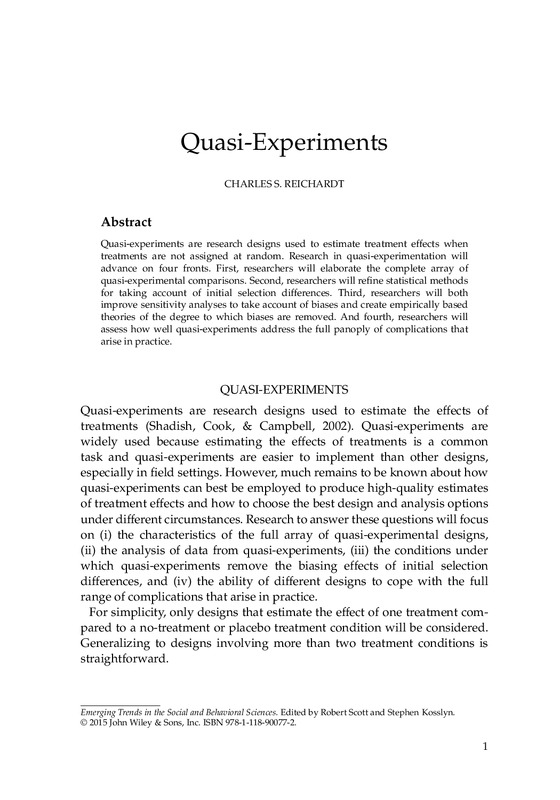
 Quasi‐Experiments