-
Title
-
Delusions
-
Author
-
Coltheart, Max
-
Research Area
-
Psychopathology
-
Topic
-
Mental Disorder Varieties
-
Abstract
-
A delusional belief is a belief adopted on the basis of insufficient evidence and held strongly in the face of much counterevidence. Some people with a delusional condition have a single delusional belief—this is monothematic delusion and much is now understood about what cause the various kinds of monothematic delusion. I describe six kinds of monothematic delusions. Other people with a delusional condition have many different delusional beliefs about a wide variety of topics—this is polythematic delusion, and what could be the causes of polythematic delusional conditions is still very poorly understood.
-
Related Essays
-
What Is Neuroticism, and Can We Treat It? (Psychology), Amantia Ametaj et al.
-
Aggression and Victimization (Psychology), Sheri Bauman and Aryn Taylor
-
Genetics and the Life Course (Sociology), Evan Charney
-
Peers and Adolescent Risk Taking (Psychology), Jason Chein
-
Misinformation and How to Correct It (Psychology), John Cook et al.
-
Problems Attract Problems: A Network Perspective on Mental Disorders (Psychology), Angélique Cramer and Denny Borsboom
-
Expertise (Sociology), Gil Eyal
-
Controlling the Influence of Stereotypes on One's Thoughts (Psychology), Patrick S. Forscher and Patricia G. Devine
-
Emerging Evidence of Addiction in Problematic Eating Behavior (Psychology), Ashley Gearhardt et al.
-
Depression (Psychology), Ian H. Gotlib and Daniella J. Furman
-
Positive Emotion Disturbance (Psychology), June Gruber and John Purcell
-
Family Relationships and Development (Psychology), Joan E. Grusec
-
Insomnia and Sleep Disorders (Psychology), Elizabeth C. Mason and Allison G. Harvey
-
Mental Imagery in Psychological Disorders (Psychology), Emily A. Holmes et al.
-
Normal Negative Emotions and Mental Disorders (Sociology), Allan V. Horwitz
-
Dissociation and Dissociative Identity Disorder (DID) (Psychology), Rafaële J. C. Huntjens and Martin J. Dorahy
-
Computer Technology and Children's Mental Health (Psychology), Philip C. Kendall et al.
-
Cultural Neuroscience: Connecting Culture, Brain, and Genes (Psychology), Shinobu Kitayama and Sarah Huff
-
Mechanisms of Fear Reducation (Psychology), Cynthia L. Lancaster and Marie‐H. Monfils
-
Understanding Risk‐Taking Behavior: Insights from Evolutionary Psychology (Psychology), Karin Machluf and David F. Bjorklund
-
Evolutionary Perspectives on Animal and Human Personality (Anthropology), Joseph H. Manson and Lynn A. Fairbanks
-
Disorders of Consciousness (Psychology), Martin M. Monti
-
Heuristics: Tools for an Uncertain World (Psychology), Hansjörg Neth and Gerd Gigerenzer
-
Social Classification (Sociology), Elizabeth G. Pontikes
-
Cognitive Remediation in Schizophrenia (Psychology), Clare Reeder and Til Wykes
-
Cognitive Bias Modification in Mental (Psychology), Meg M. Reuland et al.
-
Born This Way: Thinking Sociologically about Essentialism (Sociology), Kristen Schilt
-
Clarifying the Nature and Structure of Personality Disorder (Psychology), Takakuni Suzuki and Douglas B. Samuel
-
Taking Personality to the Next Level: What Does It Mean to Know a Person? (Psychology), Simine Vazire and Robert Wilson
-
A Gene‐Environment Approach to Understanding Youth Antisocial Behavior (Psychology), Rebecca Waller et al.
-
Crime and the Life Course (Sociology), Mark Warr and Carmen Gutierrez
-
Rumination (Psychology), Edward R. Watkins
-
Emotion Regulation (Psychology), Paree Zarolia et al.
-
Identifier
-
etrds0072
-
extracted text
-
Delusions
MAX COLTHEART
Abstract
A delusional belief is a belief adopted on the basis of insufficient evidence and held
strongly in the face of much counterevidence. Some people with a delusional condition have a single delusional belief—this is monothematic delusion and much is now
understood about what cause the various kinds of monothematic delusion. I describe
six kinds of monothematic delusions. Other people with a delusional condition have
many different delusional beliefs about a wide variety of topics—this is polythematic
delusion, and what could be the causes of polythematic delusional conditions is still
very poorly understood.
The Diagnostic and Statistical Manual of Mental Disorders, Fourth Edition, Text
Revision (DSM-IV-TR), published by the American Psychiatric Association
(APA, 2000), is a general handbook on psychopathological conditions that is
widely used in psychiatry and clinical psychology. So a good place to begin
a general discussion of delusional conditions might be with that Manual’s
definition of delusion, which is:
“A false belief based on incorrect inference about external reality that is firmly
sustained despite what almost everyone else believes and despite what constitutes incontrovertible and obvious proof or evidence to the contrary. The belief
is not one ordinarily accepted by other members of the person’s culture or subculture (e.g., it is not an article of religious faith).”
However, consideration of this definition soon reveals that it is of no use
to scientists concerned with investigating delusional conditions, and of little
use to clinicians concerned with the diagnosis and management of such conditions. Nevertheless, it does offer a good starting point for any discussion
of delusion, because the various defects of this definition are instructive.
Consider, for example, the requirement that for any belief to be classified
as delusional it must be false. Long ago Jaspers (1913, p. 106) used the
example of delusional jealousy to show why this requirement is incoherent:
Emerging Trends in the Social and Behavioral Sciences. Edited by Robert Scott and Stephen Kosslyn.
© 2015 John Wiley & Sons, Inc. ISBN 978-1-118-90077-2.
1
�2
EMERGING TRENDS IN THE SOCIAL AND BEHAVIORAL SCIENCES
“A delusion of jealousy, for instance, may be recognized by its typical
characteristics without our need to know whether the person has genuine
ground for his jealousy or not. The delusion does not cease to be a delusion
although the spouse of the patient is in fact unfaithful.”
The DSM-IV definition of delusion also requires that any belief that is
ordinarily accepted by other member’s of one’s culture cannot be classified
as delusional. But consider Koro, sometimes referred to as penis panic. Koro
is a condition in which a person believes that his or her sexual organs
(penis in men, vulva or nipples in women) are being retracted into the
body, and that death will follow from full retraction. There are many reports
from South-East Asia of this belief spreading rapidly throughout whole
subcultures. For example, in just 10 days in 1967 in Singapore, 469 cases of
this condition arose (Ngui, 1969); and in June to September 1982, there was
an epidemic of this belief in northeastern India, in three districts of Assam
and two nearby districts of Bengal, to the extent that “for a few weeks, the
whole area was in the grip of a fear of the illness” (Sachdev, 1985, p. 434).
It is hard to see what justification there could possibly be for asserting that
Koro should not count as a delusional condition, yet that assertion follows
from the DSM-IV definition.
In order for a person’s belief about the infidelity of his or her spouse to be
reasonably regarded as delusional, the truth of this belief is irrelevant: what’s
relevant is how good this person’s reasons are for holding the belief. If the
person cannot offer any good evidence to support a belief, and if in addition
there is good evidence that this belief is false (even if in fact it happens be
true), then that is the essence of what we mean by “delusional belief”; and
these characteristics apply equally to an ungrounded belief in one’s spouse’s
infidelity as to an ungrounded belief that one’s sexual organs are shrinking
into one’s body. Similar criticisms can be raised about various other aspects
of the DSM-IV definition (Davies, Coltheart, Langdon, & Breen, 2002).
A much more useful starting point for discussing forms of delusional belief
is the distinction between polythematic and monothematic delusional conditions (Coltheart, 2013).
Some deluded people hold a wide variety of delusional beliefs about many
unrelated topics. For example, the Nobel laureate John Nash, diagnosed with
schizophrenia, believed that he was to become Emperor of Antarctica, that he
was the left foot of God, and that his name was Johann von Nassau (Capps,
2004). Another well-known example of a case of a polythematic delusional
condition is that of Daniel Schreber, a judge in the German Supreme Court in
the nineteenth century; among the things he believed were that he was suffering from softening of the brain, that he had the plague, that divine forces
were preparing him for a sexual union with God, and that this union would
�Delusions
3
Table 1
Some of the Forms of Monothematic Delusion
Type of monothematic delusion
An example of the content of the delusional belief
Capgras delusion
“That woman is not my wife, she is an impostor who
looks like my wife” (the woman in question actually
being the patient’s wife)
“The person I see when I look in a mirror is not me,
but some stranger who looks like me”
“I am dead”
“People I know follow me around in the street, but I
can’t recognize who they are because they are in
disguise”
“Other people can cause my body top move without
my willing such movement”
“This arm (the patient’s own arm) is not mine, it is my
aunt’s”
Mirrored-self misidentification
Cotard delusion
Fregoli delusion
Delusion of alien control
Somatoparaphrenia
create a new race of humans who would restore the world to a lost state of
blessedness (Bell, 2003).
These kinds of polythematic delusional cases strongly contrast with cases
where the deluded person holds only a single delusional belief, or a small
cluster of delusional beliefs centered on a single theme: that is, cases of
monothematic delusion. Many different forms of monothematic delusion
have been reported (for a review of these, see Coltheart, Langdon, & McKay,
2011). Some of these are summarized in Table 1.
In the clinic, polythematic delusion is seen much more often than monothematic delusion. Scientifically, though, monothematic delusion is far better
understood than polythematic delusion. The most extensively studied
monothematic delusion is Capgras delusion, named after Joseph Capgras,
a French psychiatrist who first described the delusion in 1924. People with
Capgras delusion believe that individuals emotionally close to them, such
as family members, have been replaced by strangers who look very similar
or identical to the replaced intimates. Capgras favored a psychodynamic,
even Oedipal, explanation of this delusion, but seminal work by Ellis,
Young, Quayle, and de Pauw (1997) clearly established that it is actually a
neuropsychological condition.
Ellis and colleagues studied the responses of peoples’ autonomic nervous
systems (ANSs) to the sight of faces, testing both people with Capgras delusion and nondeluded psychiatric controls. The ANS is that part of the human
nervous system on which arousal and emotion depend. It is known to react
to the sight of faces, and reacts more strongly when the faces are familiar
�4
EMERGING TRENDS IN THE SOCIAL AND BEHAVIORAL SCIENCES
ones. This is what Ellis and colleagues found in their nondeluded control
patients. But in the patients with Capgras delusion, there was little response
of the ANS to faces, and no greater response when the faces were familiar
than when they were unfamiliar.
Now, when someone sees the face of a highly familiar person such as a
spouse, they would expect a strong response of the ANS. How is a sufferer
from Capgras delusion to understand the absence of a strong response when
they see a spouse’s face? There would not be a strong response if the person
being viewed were a stranger rather than the spouse. That, Ellis and colleagues suggested, is where the idea that the spouse is actually a stranger
comes from.
This seems a highly plausible account of the source of the delusional idea.
But by itself it is not sufficient to explain the presence of the delusional belief,
because this absence of strong autonomic response to familiar faces is also
seen in people who have damage to ventromedial prefrontal cortex, the lower
part of the center of the brain’s frontal lobe area (Tranel, Damasio, & Damasio, 1995). Yet the patients with this form of brain damage are not delusional
about the identities of their family members. Why are they not delusional
when people with Capgras delusion are?
One solution to this puzzle is to propose that there is some additional cognitive impairment that people with Capgras delusion have but people with
damage to ventromedial prefrontal cortex do not have. Without this second
impairment, when the idea “This is not my wife” occurs, this idea does not
become a belief because the evidence against this belief is so strong. If this
is not your wife, how come she looks just like your wife? How come she
knows details of your past life that no stranger would know? How come
everyone—family, friends, and clinicians—is telling you that this woman
really is your wife? Only if something has gone wrong with the patient’s
ability to evaluate potential beliefs with respect to evidence will the absence
of autonomic response to the faces of family members turn into the delusion that these people are not family members, but strangers. It is possible
(Coltheart, 2007, 2010) that this second impairment, this impairment of belief
evaluation, is specifically related to damage to a particular small part of the
right half of the brain, the right lateral prefrontal cortex. Neuropsychological
assessments of people with Capgras delusion do generally show abnormalities of right frontal regions of the brain.
We are thus led to a two-factor theory of Capgras delusion. Factor 1 is the
neuropsychological impairment that prompts the delusional idea. Factor 2 is
a different neuropsychological impairment that prevents this idea from being
rejected despite the strong evidence against it; instead, the idea is adopted as
a belief—a delusional belief.
�Delusions
5
The Two-factor Theory of Monothematic Delusion
It has been proposed (Coltheart et al., 2011) that this kind of two-factor theory doesn’t just offer an explanation for Capgras delusion: it offers explanations for all forms of monothematic delusion. The idea is that we study each
monothematic delusion by first asking two questions:
(a) Where did the delusional idea come from—what prompted it?
(b) Why was this idea not rejected—why was it instead adopted as a belief?
Furthermore, if we want to show that two factors are always necessary if a
monothematic delusion is to be present, we need to show, for each monothematic delusion, that patients have been reported where just the factor (a) for
that delusion is present, and yet the patients are not delusional.
We have already seen how this two-factor theory works for the Capgras
delusion. I will illustrate how the theory works more generally by applying
it to the other five monothematic delusions described in Table 1.
Two patients with the mirrored-self misidentification delusion, TH and FE,
were studied by Breen, Caine, Coltheart, Hendy, & Roberts (2000). Both were
in the early stages of a dementing illness. Patient TH was found to have mirror agnosia—a loss of the ability to understand how mirrors work. For him,
a mirror was the same thing as a window. Since any person you see through
a window is in a different part of space than you, that person cannot be you.
This, Breen et al. (2000) argued, was what prompted the idea in TH that the
person he saw when he looked in the mirror was not himself, but a stranger.
Patient FE did not have mirror agnosia, but he did have an impaired ability to perceive faces, which would have distorted the appearance of his face
when he was looking into a mirror. So the face he saw in the mirror would
not match his memory of what he looked like; and that may have been the
source of the idea that the person he saw in mirrors was not himself but some
stranger. Thus plausible—although different answers to question (a) can be
given.
But people with mirror agnosia are not typically delusional about the identities of people they see in mirrors, and nor is this typically the case for people with impaired ability to perceive faces. So the mirror agnosia and the
impaired face perception are not sufficient to explain the presence of the mirror delusion. However, both TH and FE were found to have neurological
impairment of the right hemispheres of their brains, and it can be argued
that this impairment compromised a cognitive system for belief evaluation
(located in the right half of the brain), which prevented them from rejecting the delusional idea. It was not possible to localize their right-hemisphere
brain impairments more precisely in these two patients, but in a new case
of mirrored-self misidentification recently reported by Villarejo et al. (2011),
�6
EMERGING TRENDS IN THE SOCIAL AND BEHAVIORAL SCIENCES
brain imaging revealed a lesion in the right dorsolateral prefrontal cortex, the
specific brain region suspected to be associated with the cognitive process
of belief evaluation. Hence, the two-factor theory of delusional belief offers
a good account not just of Capgras delusion but also of the mirrored-self
misidentification delusion.
Applications of this theory to explanations of the four other types of
monothematic delusion listed in Table 1 are more speculative, but nevertheless eminently testable. It was suggested by Ramachandran and Blakeslee
(1998) that what prompts the delusional idea in Cotard delusion (I am dead)
is complete failure of the ANS to respond to any kind of stimuli, since
when people are dead there is such complete failure. As Ramachandran
and Blakeslee note, this theory is testable, as all one needs to do is to test
whether in Cotard patients the ANS is completely unresponsive. This has
not yet been investigated in any patents with Cotard delusion. But in any
case, even if this is the source of the delusional idea in Cotard delusion,
it cannot be the full explanation, because of the condition known as pure
autonomic failure. People with this condition show no responses of the ANS
to any kind of stimuli. But they do not show Cotard or any other kind
of delusion. So there needs in addition to be the kind of belief evaluation
impairment that, according to the two-factor theory, is present in all forms of
monothematic delusion. Hence, this theory of the Cotard delusion predicts
not only that patients with Cotard delusion will show complete failure of
the ANS to respond to any kind of stimuli, but also that there should be
damage to regions of the brain associated with the cognitive process of belief
evaluation—presumably, damage to the right dorsolateral prefrontal cortex.
Ramachandran and Blakeslee (1998) have also proposed a speculative theory of Fregoli delusion. If the ANS, instead of being unresponsive to faces as
in Capgras delusion, is over-responsive to faces, then even unfamiliar faces
will feel familiar, promoting the idea that people who are actually strangers
are in fact known to you—which is the Fregoli delusion. That theory is
testable, by measuring how strongly the ANS responds to unfamiliar faces
in people with Fregoli delusion: it should respond strongly. But even if this
prediction were confirmed, the theory would not be sufficient to explain
the delusion, because there are cases of people who experience the faces
of strangers as highly familiar, yet who are not delusional (Vuilleumier,
Mohr, Valenza, Wetzel, & Landis (2003). So once again we need to propose a
second deficit, one of belief evaluation, in order to explain why a delusional
idea turns into a delusional belief in some people; and, also once again, this
directs our attention to assessing the integrity of right dorsolateral prefrontal
cortex in people with Fregoli delusion, since it is damage here which might
be associated with defective belief evaluation.
�Delusions
7
People with the delusion of alien control wrongly believe that actions they
have voluntarily executed were not caused by them but by other people.
How do I normally know, when I execute a voluntary action, that this action
was caused by me and not by some other person? The accepted answer to
this question is that when I form the intention to make a bodily movement, I
create a representation of the sensory feedback that such a movement would
produce, I execute the movement I intended, that generates some sensory
feedback, and the received sensory feedback is compared to the predicted
sensory feedback. If these match, that match is the evidence that it was I
who caused the movement. If either type of feedback is for some reason not
available, or if both are available but the comparison process is not carried
out, the match will not be present, and the absence of this match is evidence
that the movement was caused by someone else, not me (e.g., if someone
picked up my arm and moved it, the match would be absent because I
would not have created a representation of expected feedback). Frith (1992)
proposed that in people with the alien control delusion there is impaired
self-monitoring—that is, an abnormality in the system responsible for this
matching process. That provides a plausible answer to our question (a) that
is, it offers an explanation of what prompts the thought that someone else
caused the movement of part of my body. But in the neurological disorder
known as haptic deafferentation (Fourneret, Paillard, Lamarre, Cole, & Jeannerod, 2002), the patient cannot carry out this matching process because
the disorder prevents any sensory feedback from limb movements. The
patient can still execute limb movements; and, crucially, is not delusional
about who caused these, even though the patient cannot determine that
expected sensory feedback matches received sensory feedback. To arrive at
the alien control belief here, some additional cognitive impairment would
be needed—namely, a failure of accurate belief evaluation.
The sixth of our monothematic delusions, somatoparaphrenia, is typically
seen only in people whose left limbs have been paralyzed because of the
damage to those regions of the right hemisphere of the brain that controls
movements of the left limbs. One might speculate that when a patient finds
that he or she cannot move his or her left arm, the thought crosses his or her
mind is that this might be because the left arm belongs to someone else. But
most patients with this type of paralysis are not delusional about the ownership of their left arms, and if asked why they cannot move the arms will
say that the arms are paralyzed because of the damage to the brain. What
additional problem do somatoparaphrenic patients have that is responsible
for the initial idea about limb ownership becoming a delusional belief? This
might occur when the damage to the right half of the brain involves not just
the motor-control regions of the right hemisphere, but also extends a little forward from these regions—to the right dorsolateral prefrontal cortex, which,
�8
EMERGING TRENDS IN THE SOCIAL AND BEHAVIORAL SCIENCES
the idea is, needs to be intact if the cognitive process of belief evaluation is to
be correctly executed.
In sum, then, bizarre though these monothematic delusional beliefs are,
a great deal of progress has been made over the past 20 years in understanding what causes them to occur. In contrast, polythematic delusional
conditions such as seen in the Nash and Schreber cases cited earlier remain
mysterious—little insight has yet been achieved into what could possibly
cause such conditions.
Much still remains to be done in the study of delusions, however. As noted
above, the idea that Factor 1 in Cotard delusion is the loss of ANS sensitivity to and environmental stimuli, and that Factor 1 in Fregoli delusion is the
occurrence of strong ANS responses to faces even when they are unfamiliar,
are plausible but untested, so work needs to be done on ANS responding in
these two types of monothematic delusional condition. The bold claim that in
all types of monothematic delusion there is abnormality of right dorsolateral
frontal cortex, and that this is because that region of the brain is involved
in the cognitive process of belief evaluation in a variety of ways. It can be
tested in delusional patients by structural or functional MRI focusing on this
brain region; but this claim is also a claim about intact subjects, and so can
be tested with such people. For example, with any tasks that require such
subjects to evaluate beliefs, fMRI work should reveal activity in right dorsolateral frontal cortex, and disruption of the functioning of that region of
the brain by transcranial magnetic stimulation (TMS) should have a specific
harmful effect on the performance of such tasks.
A little work of this kind with intact subjects has recently been reported
by McKay et al. (2013). They used a standard test for vestibular function,
irrigating the left or right external ear canal with cold water. It is known
that this activates regions of contralateral frontal lobe. The authors reasoned
therefore that performance on tasks involving belief formation might be
improved by left-ear (and not right-ear) irrigation. The task they used was
one in which subjects estimated the likelihood that they will contract certain
diseases in the future. People’s belief evaluation systems function poorly
here: they are unreasonably optimistic about the probability of avoiding
disease. Right-ear stimulation did not reduce this unreasonable optimism,
but as predicted left-ear stimulation did—that is, it made the subjects’ belief
evaluations more accurate. Hence, just as future work could employ TMS
over right frontal lobe to impair belief evaluation in intact subjects, future
work could employ left-ear irrigation to improve believe evaluation in intact
subjects.
And of course, there is also much scope for future work using these two
techniques in investigations of people with delusion: what effects will these
techniques have on delusional beliefs? It is already clear that this is a very
�Delusions
9
promising avenue for future research, because left-ear irrigation has already
been shown to transiently abolish two kinds of monothematic delusion. One
of these is anosognosia for hemiplegia (the delusional belief in patients with a
limb paralysis that they have no paralysis; see Cappa, Sterzi, Vallar, & Bisiach,
1987). The other is somatoparaphrenia (Bisiach, Rusconi, & Vallar, 1991).
All of the monothematic delusions discussed so far have been clearly neuropsychological in origin. But there are monothematic delusional conditions
that are not, or at least not clearly, neuropsychological in origin that is, it is
not clear that in such patients there has been brain damage. Hence, another
particularly intriguing direction for future work is to consider whether the
two-factor account of monothematic delusion might apply even in these non
neuropsychological cases.
One example is alien abduction delusion: the belief that you have been
abducted by beings from another planet and subsequently returned to the
Earth. Coltheart et al. (2011, p. 11.21) offer a speculative two-factor explanation of this delusion, in which neither factor is a neuropsychological impairment.
Another example is provided by two conditions connected with body
image.
Firstly, there is anorexia nervosa. It is often proposed that people with this
condition overestimate how large their bodies are. Cornellison, Johns, and
Tovee (2013) provide evidence that this is so; but show that it is also true of
women with low body-mass index (BMI) but no anorexia nervosa. So overestimation of body-size might act as the first factor in a two-factor account
of anorexia nervosa, but if that is so, then a second factor would have to be
identified, which is present in people with low BMI who have anorexia nervosa and absent in people with low BMI who do not have this condition. This
could be elucidated by detailed investigations of the actual beliefs about body
size and body image held by these two groups of people.
Secondly there is body dysmorphic disorder, a delusional belief that some
part of the affected person’s body is defective or ugly when such is not
at all the case. This may be the only delusion exhibited by such people.
If in attempting to understand how this condition arises, one adopted the
two-factor approach, one would seek answers to two questions: (i) what
gave rise in the first place to the idea that some part of the patient’s body
is defective in some way? and (ii) as there is so much evidence against this
idea(what one looks like in the mirror, what other people say) why was it
accepted as a belief rather than being rejected?
It is clear how one might attempt to apply the two-factor theory to non neuropsychological monothematic delusional conditions such as these. Future
work will tell us whether this can successfully be done.
�10
EMERGING TRENDS IN THE SOCIAL AND BEHAVIORAL SCIENCES
REFERENCES
American Psychiatric Association (2000). Diagnostic and statistical manual of mental
disorders, fourth edition, text revision (DSM-IV-TR). Washington, DC: American Psychiatric Association.
Bell, D. (2003). Paranoia. Cambridge, England: Icon.
Bisiach, E., Rusconi, M. L., & Vallar, G. (1991). Remission of somatoparaphrenic delusion through vestibular stimulation. Neuropsychologia, 10, 1029–1031.
Breen, N., Caine, D., Coltheart, M., Hendy, J., & Roberts, C. (2000). Delusional
misidentification. Mind & Language, 15, 74–110 Reprinted in M. Coltheart & M.
Davies (Eds.) Pathologies of belief. Oxford, England: Blackwells.
Cappa, S. F., Sterzi, R., Vallar, G., & Bisiach, E. (1987). Remission of hemineglect and
anosognosia during vestibular stimulation. Neuropsychologia, 25, 775–782.
Capps, D. (2004). John Nash’s delusional decade: A case of paranoid schizophrenia.
Pastoral Psychology, 52, 193–218.
Coltheart, M. (2007). The 33rd Bartlett Lecture: Cognitive neuropsychiatry and delusional belief. Quarterly Journal of Experimental Psychology, 60, 1041–1062.
Coltheart, M. (2010). The neuropsychology of delusions. Annals of the New York
Academy of Sciences, 1191, 16–26.
Coltheart, M. (2013). On the distinction between monothematic and polythematic
delusions: Some comments on On Delusion (Radden, 2011). Mind & Language, 28,
103–112.
Coltheart, M., Langdon, R., & McKay, R. T. (2011). Delusional belief. Annual Review
of Psychology, 62, 271–298.
Cornellison, P. L., Johns, A., & Tovee, M. J. (2013). Body size over-estimation in
women with anorexia nervosa is not qualitatively different from female controls.
Body Image, 10, 103–111.
Davies, M., Coltheart, M., Langdon, R., & Breen, N. (2002). Monothematic delusions:
Towards a two-factor account. Philosophy, Psychiatry & Psychology, 8, 133–158.
Ellis, H. D., Young, A. W., Quayle, A. H., & de Pauw, K. W. (1997). Reduced autonomic responses to faces in Capgras delusion. Proceedings of the Royal Society London B, 264, 1085–1092.
Fourneret, P., Paillard, J., Lamarre, Y., Cole, J., & Jeannerod, M. (2002). Lack of conscious recognition of one’s own actions in a haptically deafferented patient. Neuroreport, 13, 541.
Frith, C. (1992). The cognitive neuropsychology of schizophrenia. Hove, England: Erlbaum.
Jaspers, K. (1913/1963). In J. Hoenig & M. W. Hamilton (Eds.)trans., General psychopathology (2nd ed.). Manchester, England: University Press.
McKay, R., Tamagni, C., Palla, A., Krummenacher, P., Hagemann, S. C. A., Straumann, D., & Brugger, P. (2013). Vestibular stimulation attenuates unrealistic optimism. Cortex, 49(49), 2272–275.
Ngui, P. W. (1969). The Koro epidemic in Singapore. Australian and New Zealand Journal of Psychiatry, 3, 263–266.
�Delusions
11
Ramachandran, V. S., & Blakeslee, S. (1998). Phantoms in the brain: Human nature and
the architecture of the mind. London, England: Fourth Estate.
Sachdev, P. S. (1985). Koro epidemic in North-East India. Australian and New Zealand
Journal of Psychiatry, 19, 433–438.
Tranel, D. H., Damasio, H., & Damasio, A. R. (1995). Double dissociation between
overt and covert face recognition. Journal of Cognitive Neuroscience, 7, 425–32.
Villarejo, A., Martin, V. P., Moreno-Ramos, T., Camacho-Salas, A., Porta-Etessam,
J., & Bermejo-Pareja, F. (2011). Mirrored-self misidentification in a patient without dementia: Evidence for right hemisphere and bifrontal damage. Neurocase, 17,
276–284.
Vuilleumier, P., Mohr, C., Valenza, N., Wetzel, C., & Landis, T. (2003). Hyperfamiliarity for unknown faces after left lateral temporo-occipital venous infarction: A
double dissociation with prosopagnosia. Brain, 126, 889–90.
MAX COLTHEART SHORT BIOGRAPHY
Max Coltheart is a cognitive neuropsychologist with interests in acquired
and developmental disorders of reading and in cognitive-neuropsychiatric
disorders such as delusion and hallucination. He has held academic positions in psychology departments in Australia, Canada, England, and Italy,
and was Director of the Macquarie Centre for Cognitive Science (2000–2008)
at Macquarie University, where he is now Emeritus Professor of Cognitive
Science. He is a Fellow of the Australian Academy of Science, the Academy
of the Social Sciences in Australia, and the British Academy, and in 2010 was
appointed a Member of the Order of Australia by the Australian Government
for his services to children with reading difficulties.
RELATED ESSAYS
What Is Neuroticism, and Can We Treat It? (Psychology), Amantia Ametaj
et al.
Aggression and Victimization (Psychology), Sheri Bauman and Aryn Taylor
Genetics and the Life Course (Sociology), Evan Charney
Peers and Adolescent Risk Taking (Psychology), Jason Chein
Misinformation and How to Correct It (Psychology), John Cook et al.
Problems Attract Problems: A Network Perspective on Mental Disorders
(Psychology), Angélique Cramer and Denny Borsboom
Expertise (Sociology), Gil Eyal
Controlling the Influence of Stereotypes on One’s Thoughts (Psychology),
Patrick S. Forscher and Patricia G. Devine
Emerging Evidence of Addiction in Problematic Eating Behavior (Psychology), Ashley Gearhardt et al.
�12
EMERGING TRENDS IN THE SOCIAL AND BEHAVIORAL SCIENCES
Depression (Psychology), Ian H. Gotlib and Daniella J. Furman
Positive Emotion Disturbance (Psychology), June Gruber and John Purcell
Family Relationships and Development (Psychology), Joan E. Grusec
Insomnia and Sleep Disorders (Psychology), Elizabeth C. Mason and Allison
G. Harvey
Mental Imagery in Psychological Disorders (Psychology), Emily A. Holmes
et al.
Normal Negative Emotions and Mental Disorders (Sociology), Allan V.
Horwitz
Dissociation and Dissociative Identity Disorder (DID) (Psychology), Rafaële
J. C. Huntjens and Martin J. Dorahy
Computer Technology and Children’s Mental Health (Psychology), Philip C.
Kendall et al.
Cultural Neuroscience: Connecting Culture, Brain, and Genes (Psychology),
Shinobu Kitayama and Sarah Huff
Mechanisms of Fear Reducation (Psychology), Cynthia L. Lancaster and
Marie-H. Monfils
Understanding Risk-Taking Behavior: Insights from Evolutionary Psychology (Psychology), Karin Machluf and David F. Bjorklund
Evolutionary Perspectives on Animal and Human Personality (Anthropology), Joseph H. Manson and Lynn A. Fairbanks
Disorders of Consciousness (Psychology), Martin M. Monti
Heuristics: Tools for an Uncertain World (Psychology), Hansjörg Neth and
Gerd Gigerenzer
Social Classification (Sociology), Elizabeth G. Pontikes
Cognitive Remediation in Schizophrenia (Psychology), Clare Reeder and Til
Wykes
Cognitive Bias Modification in Mental (Psychology), Meg M. Reuland et al.
Born This Way: Thinking Sociologically about Essentialism (Sociology),
Kristen Schilt
Clarifying the Nature and Structure of Personality Disorder (Psychology),
Takakuni Suzuki and Douglas B. Samuel
Taking Personality to the Next Level: What Does It Mean to Know a Person?
(Psychology), Simine Vazire and Robert Wilson
A Gene-Environment Approach to Understanding Youth Antisocial Behavior (Psychology), Rebecca Waller et al.
Crime and the Life Course (Sociology), Mark Warr and Carmen Gutierrez
Rumination (Psychology), Edward R. Watkins
Emotion Regulation (Psychology), Paree Zarolia et al.
�
-
Delusions
MAX COLTHEART
Abstract
A delusional belief is a belief adopted on the basis of insufficient evidence and held
strongly in the face of much counterevidence. Some people with a delusional condition have a single delusional belief—this is monothematic delusion and much is now
understood about what cause the various kinds of monothematic delusion. I describe
six kinds of monothematic delusions. Other people with a delusional condition have
many different delusional beliefs about a wide variety of topics—this is polythematic
delusion, and what could be the causes of polythematic delusional conditions is still
very poorly understood.
The Diagnostic and Statistical Manual of Mental Disorders, Fourth Edition, Text
Revision (DSM-IV-TR), published by the American Psychiatric Association
(APA, 2000), is a general handbook on psychopathological conditions that is
widely used in psychiatry and clinical psychology. So a good place to begin
a general discussion of delusional conditions might be with that Manual’s
definition of delusion, which is:
“A false belief based on incorrect inference about external reality that is firmly
sustained despite what almost everyone else believes and despite what constitutes incontrovertible and obvious proof or evidence to the contrary. The belief
is not one ordinarily accepted by other members of the person’s culture or subculture (e.g., it is not an article of religious faith).”
However, consideration of this definition soon reveals that it is of no use
to scientists concerned with investigating delusional conditions, and of little
use to clinicians concerned with the diagnosis and management of such conditions. Nevertheless, it does offer a good starting point for any discussion
of delusion, because the various defects of this definition are instructive.
Consider, for example, the requirement that for any belief to be classified
as delusional it must be false. Long ago Jaspers (1913, p. 106) used the
example of delusional jealousy to show why this requirement is incoherent:
Emerging Trends in the Social and Behavioral Sciences. Edited by Robert Scott and Stephen Kosslyn.
© 2015 John Wiley & Sons, Inc. ISBN 978-1-118-90077-2.
1
�2
EMERGING TRENDS IN THE SOCIAL AND BEHAVIORAL SCIENCES
“A delusion of jealousy, for instance, may be recognized by its typical
characteristics without our need to know whether the person has genuine
ground for his jealousy or not. The delusion does not cease to be a delusion
although the spouse of the patient is in fact unfaithful.”
The DSM-IV definition of delusion also requires that any belief that is
ordinarily accepted by other member’s of one’s culture cannot be classified
as delusional. But consider Koro, sometimes referred to as penis panic. Koro
is a condition in which a person believes that his or her sexual organs
(penis in men, vulva or nipples in women) are being retracted into the
body, and that death will follow from full retraction. There are many reports
from South-East Asia of this belief spreading rapidly throughout whole
subcultures. For example, in just 10 days in 1967 in Singapore, 469 cases of
this condition arose (Ngui, 1969); and in June to September 1982, there was
an epidemic of this belief in northeastern India, in three districts of Assam
and two nearby districts of Bengal, to the extent that “for a few weeks, the
whole area was in the grip of a fear of the illness” (Sachdev, 1985, p. 434).
It is hard to see what justification there could possibly be for asserting that
Koro should not count as a delusional condition, yet that assertion follows
from the DSM-IV definition.
In order for a person’s belief about the infidelity of his or her spouse to be
reasonably regarded as delusional, the truth of this belief is irrelevant: what’s
relevant is how good this person’s reasons are for holding the belief. If the
person cannot offer any good evidence to support a belief, and if in addition
there is good evidence that this belief is false (even if in fact it happens be
true), then that is the essence of what we mean by “delusional belief”; and
these characteristics apply equally to an ungrounded belief in one’s spouse’s
infidelity as to an ungrounded belief that one’s sexual organs are shrinking
into one’s body. Similar criticisms can be raised about various other aspects
of the DSM-IV definition (Davies, Coltheart, Langdon, & Breen, 2002).
A much more useful starting point for discussing forms of delusional belief
is the distinction between polythematic and monothematic delusional conditions (Coltheart, 2013).
Some deluded people hold a wide variety of delusional beliefs about many
unrelated topics. For example, the Nobel laureate John Nash, diagnosed with
schizophrenia, believed that he was to become Emperor of Antarctica, that he
was the left foot of God, and that his name was Johann von Nassau (Capps,
2004). Another well-known example of a case of a polythematic delusional
condition is that of Daniel Schreber, a judge in the German Supreme Court in
the nineteenth century; among the things he believed were that he was suffering from softening of the brain, that he had the plague, that divine forces
were preparing him for a sexual union with God, and that this union would
�Delusions
3
Table 1
Some of the Forms of Monothematic Delusion
Type of monothematic delusion
An example of the content of the delusional belief
Capgras delusion
“That woman is not my wife, she is an impostor who
looks like my wife” (the woman in question actually
being the patient’s wife)
“The person I see when I look in a mirror is not me,
but some stranger who looks like me”
“I am dead”
“People I know follow me around in the street, but I
can’t recognize who they are because they are in
disguise”
“Other people can cause my body top move without
my willing such movement”
“This arm (the patient’s own arm) is not mine, it is my
aunt’s”
Mirrored-self misidentification
Cotard delusion
Fregoli delusion
Delusion of alien control
Somatoparaphrenia
create a new race of humans who would restore the world to a lost state of
blessedness (Bell, 2003).
These kinds of polythematic delusional cases strongly contrast with cases
where the deluded person holds only a single delusional belief, or a small
cluster of delusional beliefs centered on a single theme: that is, cases of
monothematic delusion. Many different forms of monothematic delusion
have been reported (for a review of these, see Coltheart, Langdon, & McKay,
2011). Some of these are summarized in Table 1.
In the clinic, polythematic delusion is seen much more often than monothematic delusion. Scientifically, though, monothematic delusion is far better
understood than polythematic delusion. The most extensively studied
monothematic delusion is Capgras delusion, named after Joseph Capgras,
a French psychiatrist who first described the delusion in 1924. People with
Capgras delusion believe that individuals emotionally close to them, such
as family members, have been replaced by strangers who look very similar
or identical to the replaced intimates. Capgras favored a psychodynamic,
even Oedipal, explanation of this delusion, but seminal work by Ellis,
Young, Quayle, and de Pauw (1997) clearly established that it is actually a
neuropsychological condition.
Ellis and colleagues studied the responses of peoples’ autonomic nervous
systems (ANSs) to the sight of faces, testing both people with Capgras delusion and nondeluded psychiatric controls. The ANS is that part of the human
nervous system on which arousal and emotion depend. It is known to react
to the sight of faces, and reacts more strongly when the faces are familiar
�4
EMERGING TRENDS IN THE SOCIAL AND BEHAVIORAL SCIENCES
ones. This is what Ellis and colleagues found in their nondeluded control
patients. But in the patients with Capgras delusion, there was little response
of the ANS to faces, and no greater response when the faces were familiar
than when they were unfamiliar.
Now, when someone sees the face of a highly familiar person such as a
spouse, they would expect a strong response of the ANS. How is a sufferer
from Capgras delusion to understand the absence of a strong response when
they see a spouse’s face? There would not be a strong response if the person
being viewed were a stranger rather than the spouse. That, Ellis and colleagues suggested, is where the idea that the spouse is actually a stranger
comes from.
This seems a highly plausible account of the source of the delusional idea.
But by itself it is not sufficient to explain the presence of the delusional belief,
because this absence of strong autonomic response to familiar faces is also
seen in people who have damage to ventromedial prefrontal cortex, the lower
part of the center of the brain’s frontal lobe area (Tranel, Damasio, & Damasio, 1995). Yet the patients with this form of brain damage are not delusional
about the identities of their family members. Why are they not delusional
when people with Capgras delusion are?
One solution to this puzzle is to propose that there is some additional cognitive impairment that people with Capgras delusion have but people with
damage to ventromedial prefrontal cortex do not have. Without this second
impairment, when the idea “This is not my wife” occurs, this idea does not
become a belief because the evidence against this belief is so strong. If this
is not your wife, how come she looks just like your wife? How come she
knows details of your past life that no stranger would know? How come
everyone—family, friends, and clinicians—is telling you that this woman
really is your wife? Only if something has gone wrong with the patient’s
ability to evaluate potential beliefs with respect to evidence will the absence
of autonomic response to the faces of family members turn into the delusion that these people are not family members, but strangers. It is possible
(Coltheart, 2007, 2010) that this second impairment, this impairment of belief
evaluation, is specifically related to damage to a particular small part of the
right half of the brain, the right lateral prefrontal cortex. Neuropsychological
assessments of people with Capgras delusion do generally show abnormalities of right frontal regions of the brain.
We are thus led to a two-factor theory of Capgras delusion. Factor 1 is the
neuropsychological impairment that prompts the delusional idea. Factor 2 is
a different neuropsychological impairment that prevents this idea from being
rejected despite the strong evidence against it; instead, the idea is adopted as
a belief—a delusional belief.
�Delusions
5
The Two-factor Theory of Monothematic Delusion
It has been proposed (Coltheart et al., 2011) that this kind of two-factor theory doesn’t just offer an explanation for Capgras delusion: it offers explanations for all forms of monothematic delusion. The idea is that we study each
monothematic delusion by first asking two questions:
(a) Where did the delusional idea come from—what prompted it?
(b) Why was this idea not rejected—why was it instead adopted as a belief?
Furthermore, if we want to show that two factors are always necessary if a
monothematic delusion is to be present, we need to show, for each monothematic delusion, that patients have been reported where just the factor (a) for
that delusion is present, and yet the patients are not delusional.
We have already seen how this two-factor theory works for the Capgras
delusion. I will illustrate how the theory works more generally by applying
it to the other five monothematic delusions described in Table 1.
Two patients with the mirrored-self misidentification delusion, TH and FE,
were studied by Breen, Caine, Coltheart, Hendy, & Roberts (2000). Both were
in the early stages of a dementing illness. Patient TH was found to have mirror agnosia—a loss of the ability to understand how mirrors work. For him,
a mirror was the same thing as a window. Since any person you see through
a window is in a different part of space than you, that person cannot be you.
This, Breen et al. (2000) argued, was what prompted the idea in TH that the
person he saw when he looked in the mirror was not himself, but a stranger.
Patient FE did not have mirror agnosia, but he did have an impaired ability to perceive faces, which would have distorted the appearance of his face
when he was looking into a mirror. So the face he saw in the mirror would
not match his memory of what he looked like; and that may have been the
source of the idea that the person he saw in mirrors was not himself but some
stranger. Thus plausible—although different answers to question (a) can be
given.
But people with mirror agnosia are not typically delusional about the identities of people they see in mirrors, and nor is this typically the case for people with impaired ability to perceive faces. So the mirror agnosia and the
impaired face perception are not sufficient to explain the presence of the mirror delusion. However, both TH and FE were found to have neurological
impairment of the right hemispheres of their brains, and it can be argued
that this impairment compromised a cognitive system for belief evaluation
(located in the right half of the brain), which prevented them from rejecting the delusional idea. It was not possible to localize their right-hemisphere
brain impairments more precisely in these two patients, but in a new case
of mirrored-self misidentification recently reported by Villarejo et al. (2011),
�6
EMERGING TRENDS IN THE SOCIAL AND BEHAVIORAL SCIENCES
brain imaging revealed a lesion in the right dorsolateral prefrontal cortex, the
specific brain region suspected to be associated with the cognitive process
of belief evaluation. Hence, the two-factor theory of delusional belief offers
a good account not just of Capgras delusion but also of the mirrored-self
misidentification delusion.
Applications of this theory to explanations of the four other types of
monothematic delusion listed in Table 1 are more speculative, but nevertheless eminently testable. It was suggested by Ramachandran and Blakeslee
(1998) that what prompts the delusional idea in Cotard delusion (I am dead)
is complete failure of the ANS to respond to any kind of stimuli, since
when people are dead there is such complete failure. As Ramachandran
and Blakeslee note, this theory is testable, as all one needs to do is to test
whether in Cotard patients the ANS is completely unresponsive. This has
not yet been investigated in any patents with Cotard delusion. But in any
case, even if this is the source of the delusional idea in Cotard delusion,
it cannot be the full explanation, because of the condition known as pure
autonomic failure. People with this condition show no responses of the ANS
to any kind of stimuli. But they do not show Cotard or any other kind
of delusion. So there needs in addition to be the kind of belief evaluation
impairment that, according to the two-factor theory, is present in all forms of
monothematic delusion. Hence, this theory of the Cotard delusion predicts
not only that patients with Cotard delusion will show complete failure of
the ANS to respond to any kind of stimuli, but also that there should be
damage to regions of the brain associated with the cognitive process of belief
evaluation—presumably, damage to the right dorsolateral prefrontal cortex.
Ramachandran and Blakeslee (1998) have also proposed a speculative theory of Fregoli delusion. If the ANS, instead of being unresponsive to faces as
in Capgras delusion, is over-responsive to faces, then even unfamiliar faces
will feel familiar, promoting the idea that people who are actually strangers
are in fact known to you—which is the Fregoli delusion. That theory is
testable, by measuring how strongly the ANS responds to unfamiliar faces
in people with Fregoli delusion: it should respond strongly. But even if this
prediction were confirmed, the theory would not be sufficient to explain
the delusion, because there are cases of people who experience the faces
of strangers as highly familiar, yet who are not delusional (Vuilleumier,
Mohr, Valenza, Wetzel, & Landis (2003). So once again we need to propose a
second deficit, one of belief evaluation, in order to explain why a delusional
idea turns into a delusional belief in some people; and, also once again, this
directs our attention to assessing the integrity of right dorsolateral prefrontal
cortex in people with Fregoli delusion, since it is damage here which might
be associated with defective belief evaluation.
�Delusions
7
People with the delusion of alien control wrongly believe that actions they
have voluntarily executed were not caused by them but by other people.
How do I normally know, when I execute a voluntary action, that this action
was caused by me and not by some other person? The accepted answer to
this question is that when I form the intention to make a bodily movement, I
create a representation of the sensory feedback that such a movement would
produce, I execute the movement I intended, that generates some sensory
feedback, and the received sensory feedback is compared to the predicted
sensory feedback. If these match, that match is the evidence that it was I
who caused the movement. If either type of feedback is for some reason not
available, or if both are available but the comparison process is not carried
out, the match will not be present, and the absence of this match is evidence
that the movement was caused by someone else, not me (e.g., if someone
picked up my arm and moved it, the match would be absent because I
would not have created a representation of expected feedback). Frith (1992)
proposed that in people with the alien control delusion there is impaired
self-monitoring—that is, an abnormality in the system responsible for this
matching process. That provides a plausible answer to our question (a) that
is, it offers an explanation of what prompts the thought that someone else
caused the movement of part of my body. But in the neurological disorder
known as haptic deafferentation (Fourneret, Paillard, Lamarre, Cole, & Jeannerod, 2002), the patient cannot carry out this matching process because
the disorder prevents any sensory feedback from limb movements. The
patient can still execute limb movements; and, crucially, is not delusional
about who caused these, even though the patient cannot determine that
expected sensory feedback matches received sensory feedback. To arrive at
the alien control belief here, some additional cognitive impairment would
be needed—namely, a failure of accurate belief evaluation.
The sixth of our monothematic delusions, somatoparaphrenia, is typically
seen only in people whose left limbs have been paralyzed because of the
damage to those regions of the right hemisphere of the brain that controls
movements of the left limbs. One might speculate that when a patient finds
that he or she cannot move his or her left arm, the thought crosses his or her
mind is that this might be because the left arm belongs to someone else. But
most patients with this type of paralysis are not delusional about the ownership of their left arms, and if asked why they cannot move the arms will
say that the arms are paralyzed because of the damage to the brain. What
additional problem do somatoparaphrenic patients have that is responsible
for the initial idea about limb ownership becoming a delusional belief? This
might occur when the damage to the right half of the brain involves not just
the motor-control regions of the right hemisphere, but also extends a little forward from these regions—to the right dorsolateral prefrontal cortex, which,
�8
EMERGING TRENDS IN THE SOCIAL AND BEHAVIORAL SCIENCES
the idea is, needs to be intact if the cognitive process of belief evaluation is to
be correctly executed.
In sum, then, bizarre though these monothematic delusional beliefs are,
a great deal of progress has been made over the past 20 years in understanding what causes them to occur. In contrast, polythematic delusional
conditions such as seen in the Nash and Schreber cases cited earlier remain
mysterious—little insight has yet been achieved into what could possibly
cause such conditions.
Much still remains to be done in the study of delusions, however. As noted
above, the idea that Factor 1 in Cotard delusion is the loss of ANS sensitivity to and environmental stimuli, and that Factor 1 in Fregoli delusion is the
occurrence of strong ANS responses to faces even when they are unfamiliar,
are plausible but untested, so work needs to be done on ANS responding in
these two types of monothematic delusional condition. The bold claim that in
all types of monothematic delusion there is abnormality of right dorsolateral
frontal cortex, and that this is because that region of the brain is involved
in the cognitive process of belief evaluation in a variety of ways. It can be
tested in delusional patients by structural or functional MRI focusing on this
brain region; but this claim is also a claim about intact subjects, and so can
be tested with such people. For example, with any tasks that require such
subjects to evaluate beliefs, fMRI work should reveal activity in right dorsolateral frontal cortex, and disruption of the functioning of that region of
the brain by transcranial magnetic stimulation (TMS) should have a specific
harmful effect on the performance of such tasks.
A little work of this kind with intact subjects has recently been reported
by McKay et al. (2013). They used a standard test for vestibular function,
irrigating the left or right external ear canal with cold water. It is known
that this activates regions of contralateral frontal lobe. The authors reasoned
therefore that performance on tasks involving belief formation might be
improved by left-ear (and not right-ear) irrigation. The task they used was
one in which subjects estimated the likelihood that they will contract certain
diseases in the future. People’s belief evaluation systems function poorly
here: they are unreasonably optimistic about the probability of avoiding
disease. Right-ear stimulation did not reduce this unreasonable optimism,
but as predicted left-ear stimulation did—that is, it made the subjects’ belief
evaluations more accurate. Hence, just as future work could employ TMS
over right frontal lobe to impair belief evaluation in intact subjects, future
work could employ left-ear irrigation to improve believe evaluation in intact
subjects.
And of course, there is also much scope for future work using these two
techniques in investigations of people with delusion: what effects will these
techniques have on delusional beliefs? It is already clear that this is a very
�Delusions
9
promising avenue for future research, because left-ear irrigation has already
been shown to transiently abolish two kinds of monothematic delusion. One
of these is anosognosia for hemiplegia (the delusional belief in patients with a
limb paralysis that they have no paralysis; see Cappa, Sterzi, Vallar, & Bisiach,
1987). The other is somatoparaphrenia (Bisiach, Rusconi, & Vallar, 1991).
All of the monothematic delusions discussed so far have been clearly neuropsychological in origin. But there are monothematic delusional conditions
that are not, or at least not clearly, neuropsychological in origin that is, it is
not clear that in such patients there has been brain damage. Hence, another
particularly intriguing direction for future work is to consider whether the
two-factor account of monothematic delusion might apply even in these non
neuropsychological cases.
One example is alien abduction delusion: the belief that you have been
abducted by beings from another planet and subsequently returned to the
Earth. Coltheart et al. (2011, p. 11.21) offer a speculative two-factor explanation of this delusion, in which neither factor is a neuropsychological impairment.
Another example is provided by two conditions connected with body
image.
Firstly, there is anorexia nervosa. It is often proposed that people with this
condition overestimate how large their bodies are. Cornellison, Johns, and
Tovee (2013) provide evidence that this is so; but show that it is also true of
women with low body-mass index (BMI) but no anorexia nervosa. So overestimation of body-size might act as the first factor in a two-factor account
of anorexia nervosa, but if that is so, then a second factor would have to be
identified, which is present in people with low BMI who have anorexia nervosa and absent in people with low BMI who do not have this condition. This
could be elucidated by detailed investigations of the actual beliefs about body
size and body image held by these two groups of people.
Secondly there is body dysmorphic disorder, a delusional belief that some
part of the affected person’s body is defective or ugly when such is not
at all the case. This may be the only delusion exhibited by such people.
If in attempting to understand how this condition arises, one adopted the
two-factor approach, one would seek answers to two questions: (i) what
gave rise in the first place to the idea that some part of the patient’s body
is defective in some way? and (ii) as there is so much evidence against this
idea(what one looks like in the mirror, what other people say) why was it
accepted as a belief rather than being rejected?
It is clear how one might attempt to apply the two-factor theory to non neuropsychological monothematic delusional conditions such as these. Future
work will tell us whether this can successfully be done.
�10
EMERGING TRENDS IN THE SOCIAL AND BEHAVIORAL SCIENCES
REFERENCES
American Psychiatric Association (2000). Diagnostic and statistical manual of mental
disorders, fourth edition, text revision (DSM-IV-TR). Washington, DC: American Psychiatric Association.
Bell, D. (2003). Paranoia. Cambridge, England: Icon.
Bisiach, E., Rusconi, M. L., & Vallar, G. (1991). Remission of somatoparaphrenic delusion through vestibular stimulation. Neuropsychologia, 10, 1029–1031.
Breen, N., Caine, D., Coltheart, M., Hendy, J., & Roberts, C. (2000). Delusional
misidentification. Mind & Language, 15, 74–110 Reprinted in M. Coltheart & M.
Davies (Eds.) Pathologies of belief. Oxford, England: Blackwells.
Cappa, S. F., Sterzi, R., Vallar, G., & Bisiach, E. (1987). Remission of hemineglect and
anosognosia during vestibular stimulation. Neuropsychologia, 25, 775–782.
Capps, D. (2004). John Nash’s delusional decade: A case of paranoid schizophrenia.
Pastoral Psychology, 52, 193–218.
Coltheart, M. (2007). The 33rd Bartlett Lecture: Cognitive neuropsychiatry and delusional belief. Quarterly Journal of Experimental Psychology, 60, 1041–1062.
Coltheart, M. (2010). The neuropsychology of delusions. Annals of the New York
Academy of Sciences, 1191, 16–26.
Coltheart, M. (2013). On the distinction between monothematic and polythematic
delusions: Some comments on On Delusion (Radden, 2011). Mind & Language, 28,
103–112.
Coltheart, M., Langdon, R., & McKay, R. T. (2011). Delusional belief. Annual Review
of Psychology, 62, 271–298.
Cornellison, P. L., Johns, A., & Tovee, M. J. (2013). Body size over-estimation in
women with anorexia nervosa is not qualitatively different from female controls.
Body Image, 10, 103–111.
Davies, M., Coltheart, M., Langdon, R., & Breen, N. (2002). Monothematic delusions:
Towards a two-factor account. Philosophy, Psychiatry & Psychology, 8, 133–158.
Ellis, H. D., Young, A. W., Quayle, A. H., & de Pauw, K. W. (1997). Reduced autonomic responses to faces in Capgras delusion. Proceedings of the Royal Society London B, 264, 1085–1092.
Fourneret, P., Paillard, J., Lamarre, Y., Cole, J., & Jeannerod, M. (2002). Lack of conscious recognition of one’s own actions in a haptically deafferented patient. Neuroreport, 13, 541.
Frith, C. (1992). The cognitive neuropsychology of schizophrenia. Hove, England: Erlbaum.
Jaspers, K. (1913/1963). In J. Hoenig & M. W. Hamilton (Eds.)trans., General psychopathology (2nd ed.). Manchester, England: University Press.
McKay, R., Tamagni, C., Palla, A., Krummenacher, P., Hagemann, S. C. A., Straumann, D., & Brugger, P. (2013). Vestibular stimulation attenuates unrealistic optimism. Cortex, 49(49), 2272–275.
Ngui, P. W. (1969). The Koro epidemic in Singapore. Australian and New Zealand Journal of Psychiatry, 3, 263–266.
�Delusions
11
Ramachandran, V. S., & Blakeslee, S. (1998). Phantoms in the brain: Human nature and
the architecture of the mind. London, England: Fourth Estate.
Sachdev, P. S. (1985). Koro epidemic in North-East India. Australian and New Zealand
Journal of Psychiatry, 19, 433–438.
Tranel, D. H., Damasio, H., & Damasio, A. R. (1995). Double dissociation between
overt and covert face recognition. Journal of Cognitive Neuroscience, 7, 425–32.
Villarejo, A., Martin, V. P., Moreno-Ramos, T., Camacho-Salas, A., Porta-Etessam,
J., & Bermejo-Pareja, F. (2011). Mirrored-self misidentification in a patient without dementia: Evidence for right hemisphere and bifrontal damage. Neurocase, 17,
276–284.
Vuilleumier, P., Mohr, C., Valenza, N., Wetzel, C., & Landis, T. (2003). Hyperfamiliarity for unknown faces after left lateral temporo-occipital venous infarction: A
double dissociation with prosopagnosia. Brain, 126, 889–90.
MAX COLTHEART SHORT BIOGRAPHY
Max Coltheart is a cognitive neuropsychologist with interests in acquired
and developmental disorders of reading and in cognitive-neuropsychiatric
disorders such as delusion and hallucination. He has held academic positions in psychology departments in Australia, Canada, England, and Italy,
and was Director of the Macquarie Centre for Cognitive Science (2000–2008)
at Macquarie University, where he is now Emeritus Professor of Cognitive
Science. He is a Fellow of the Australian Academy of Science, the Academy
of the Social Sciences in Australia, and the British Academy, and in 2010 was
appointed a Member of the Order of Australia by the Australian Government
for his services to children with reading difficulties.
RELATED ESSAYS
What Is Neuroticism, and Can We Treat It? (Psychology), Amantia Ametaj
et al.
Aggression and Victimization (Psychology), Sheri Bauman and Aryn Taylor
Genetics and the Life Course (Sociology), Evan Charney
Peers and Adolescent Risk Taking (Psychology), Jason Chein
Misinformation and How to Correct It (Psychology), John Cook et al.
Problems Attract Problems: A Network Perspective on Mental Disorders
(Psychology), Angélique Cramer and Denny Borsboom
Expertise (Sociology), Gil Eyal
Controlling the Influence of Stereotypes on One’s Thoughts (Psychology),
Patrick S. Forscher and Patricia G. Devine
Emerging Evidence of Addiction in Problematic Eating Behavior (Psychology), Ashley Gearhardt et al.
�12
EMERGING TRENDS IN THE SOCIAL AND BEHAVIORAL SCIENCES
Depression (Psychology), Ian H. Gotlib and Daniella J. Furman
Positive Emotion Disturbance (Psychology), June Gruber and John Purcell
Family Relationships and Development (Psychology), Joan E. Grusec
Insomnia and Sleep Disorders (Psychology), Elizabeth C. Mason and Allison
G. Harvey
Mental Imagery in Psychological Disorders (Psychology), Emily A. Holmes
et al.
Normal Negative Emotions and Mental Disorders (Sociology), Allan V.
Horwitz
Dissociation and Dissociative Identity Disorder (DID) (Psychology), Rafaële
J. C. Huntjens and Martin J. Dorahy
Computer Technology and Children’s Mental Health (Psychology), Philip C.
Kendall et al.
Cultural Neuroscience: Connecting Culture, Brain, and Genes (Psychology),
Shinobu Kitayama and Sarah Huff
Mechanisms of Fear Reducation (Psychology), Cynthia L. Lancaster and
Marie-H. Monfils
Understanding Risk-Taking Behavior: Insights from Evolutionary Psychology (Psychology), Karin Machluf and David F. Bjorklund
Evolutionary Perspectives on Animal and Human Personality (Anthropology), Joseph H. Manson and Lynn A. Fairbanks
Disorders of Consciousness (Psychology), Martin M. Monti
Heuristics: Tools for an Uncertain World (Psychology), Hansjörg Neth and
Gerd Gigerenzer
Social Classification (Sociology), Elizabeth G. Pontikes
Cognitive Remediation in Schizophrenia (Psychology), Clare Reeder and Til
Wykes
Cognitive Bias Modification in Mental (Psychology), Meg M. Reuland et al.
Born This Way: Thinking Sociologically about Essentialism (Sociology),
Kristen Schilt
Clarifying the Nature and Structure of Personality Disorder (Psychology),
Takakuni Suzuki and Douglas B. Samuel
Taking Personality to the Next Level: What Does It Mean to Know a Person?
(Psychology), Simine Vazire and Robert Wilson
A Gene-Environment Approach to Understanding Youth Antisocial Behavior (Psychology), Rebecca Waller et al.
Crime and the Life Course (Sociology), Mark Warr and Carmen Gutierrez
Rumination (Psychology), Edward R. Watkins
Emotion Regulation (Psychology), Paree Zarolia et al.
�
Delusions
MAX COLTHEART
Abstract
A delusional belief is a belief adopted on the basis of insufficient evidence and held
strongly in the face of much counterevidence. Some people with a delusional condition have a single delusional belief—this is monothematic delusion and much is now
understood about what cause the various kinds of monothematic delusion. I describe
six kinds of monothematic delusions. Other people with a delusional condition have
many different delusional beliefs about a wide variety of topics—this is polythematic
delusion, and what could be the causes of polythematic delusional conditions is still
very poorly understood.
The Diagnostic and Statistical Manual of Mental Disorders, Fourth Edition, Text
Revision (DSM-IV-TR), published by the American Psychiatric Association
(APA, 2000), is a general handbook on psychopathological conditions that is
widely used in psychiatry and clinical psychology. So a good place to begin
a general discussion of delusional conditions might be with that Manual’s
definition of delusion, which is:
“A false belief based on incorrect inference about external reality that is firmly
sustained despite what almost everyone else believes and despite what constitutes incontrovertible and obvious proof or evidence to the contrary. The belief
is not one ordinarily accepted by other members of the person’s culture or subculture (e.g., it is not an article of religious faith).”
However, consideration of this definition soon reveals that it is of no use
to scientists concerned with investigating delusional conditions, and of little
use to clinicians concerned with the diagnosis and management of such conditions. Nevertheless, it does offer a good starting point for any discussion
of delusion, because the various defects of this definition are instructive.
Consider, for example, the requirement that for any belief to be classified
as delusional it must be false. Long ago Jaspers (1913, p. 106) used the
example of delusional jealousy to show why this requirement is incoherent:
Emerging Trends in the Social and Behavioral Sciences. Edited by Robert Scott and Stephen Kosslyn.
© 2015 John Wiley & Sons, Inc. ISBN 978-1-118-90077-2.
1
�2
EMERGING TRENDS IN THE SOCIAL AND BEHAVIORAL SCIENCES
“A delusion of jealousy, for instance, may be recognized by its typical
characteristics without our need to know whether the person has genuine
ground for his jealousy or not. The delusion does not cease to be a delusion
although the spouse of the patient is in fact unfaithful.”
The DSM-IV definition of delusion also requires that any belief that is
ordinarily accepted by other member’s of one’s culture cannot be classified
as delusional. But consider Koro, sometimes referred to as penis panic. Koro
is a condition in which a person believes that his or her sexual organs
(penis in men, vulva or nipples in women) are being retracted into the
body, and that death will follow from full retraction. There are many reports
from South-East Asia of this belief spreading rapidly throughout whole
subcultures. For example, in just 10 days in 1967 in Singapore, 469 cases of
this condition arose (Ngui, 1969); and in June to September 1982, there was
an epidemic of this belief in northeastern India, in three districts of Assam
and two nearby districts of Bengal, to the extent that “for a few weeks, the
whole area was in the grip of a fear of the illness” (Sachdev, 1985, p. 434).
It is hard to see what justification there could possibly be for asserting that
Koro should not count as a delusional condition, yet that assertion follows
from the DSM-IV definition.
In order for a person’s belief about the infidelity of his or her spouse to be
reasonably regarded as delusional, the truth of this belief is irrelevant: what’s
relevant is how good this person’s reasons are for holding the belief. If the
person cannot offer any good evidence to support a belief, and if in addition
there is good evidence that this belief is false (even if in fact it happens be
true), then that is the essence of what we mean by “delusional belief”; and
these characteristics apply equally to an ungrounded belief in one’s spouse’s
infidelity as to an ungrounded belief that one’s sexual organs are shrinking
into one’s body. Similar criticisms can be raised about various other aspects
of the DSM-IV definition (Davies, Coltheart, Langdon, & Breen, 2002).
A much more useful starting point for discussing forms of delusional belief
is the distinction between polythematic and monothematic delusional conditions (Coltheart, 2013).
Some deluded people hold a wide variety of delusional beliefs about many
unrelated topics. For example, the Nobel laureate John Nash, diagnosed with
schizophrenia, believed that he was to become Emperor of Antarctica, that he
was the left foot of God, and that his name was Johann von Nassau (Capps,
2004). Another well-known example of a case of a polythematic delusional
condition is that of Daniel Schreber, a judge in the German Supreme Court in
the nineteenth century; among the things he believed were that he was suffering from softening of the brain, that he had the plague, that divine forces
were preparing him for a sexual union with God, and that this union would
�Delusions
3
Table 1
Some of the Forms of Monothematic Delusion
Type of monothematic delusion
An example of the content of the delusional belief
Capgras delusion
“That woman is not my wife, she is an impostor who
looks like my wife” (the woman in question actually
being the patient’s wife)
“The person I see when I look in a mirror is not me,
but some stranger who looks like me”
“I am dead”
“People I know follow me around in the street, but I
can’t recognize who they are because they are in
disguise”
“Other people can cause my body top move without
my willing such movement”
“This arm (the patient’s own arm) is not mine, it is my
aunt’s”
Mirrored-self misidentification
Cotard delusion
Fregoli delusion
Delusion of alien control
Somatoparaphrenia
create a new race of humans who would restore the world to a lost state of
blessedness (Bell, 2003).
These kinds of polythematic delusional cases strongly contrast with cases
where the deluded person holds only a single delusional belief, or a small
cluster of delusional beliefs centered on a single theme: that is, cases of
monothematic delusion. Many different forms of monothematic delusion
have been reported (for a review of these, see Coltheart, Langdon, & McKay,
2011). Some of these are summarized in Table 1.
In the clinic, polythematic delusion is seen much more often than monothematic delusion. Scientifically, though, monothematic delusion is far better
understood than polythematic delusion. The most extensively studied
monothematic delusion is Capgras delusion, named after Joseph Capgras,
a French psychiatrist who first described the delusion in 1924. People with
Capgras delusion believe that individuals emotionally close to them, such
as family members, have been replaced by strangers who look very similar
or identical to the replaced intimates. Capgras favored a psychodynamic,
even Oedipal, explanation of this delusion, but seminal work by Ellis,
Young, Quayle, and de Pauw (1997) clearly established that it is actually a
neuropsychological condition.
Ellis and colleagues studied the responses of peoples’ autonomic nervous
systems (ANSs) to the sight of faces, testing both people with Capgras delusion and nondeluded psychiatric controls. The ANS is that part of the human
nervous system on which arousal and emotion depend. It is known to react
to the sight of faces, and reacts more strongly when the faces are familiar
�4
EMERGING TRENDS IN THE SOCIAL AND BEHAVIORAL SCIENCES
ones. This is what Ellis and colleagues found in their nondeluded control
patients. But in the patients with Capgras delusion, there was little response
of the ANS to faces, and no greater response when the faces were familiar
than when they were unfamiliar.
Now, when someone sees the face of a highly familiar person such as a
spouse, they would expect a strong response of the ANS. How is a sufferer
from Capgras delusion to understand the absence of a strong response when
they see a spouse’s face? There would not be a strong response if the person
being viewed were a stranger rather than the spouse. That, Ellis and colleagues suggested, is where the idea that the spouse is actually a stranger
comes from.
This seems a highly plausible account of the source of the delusional idea.
But by itself it is not sufficient to explain the presence of the delusional belief,
because this absence of strong autonomic response to familiar faces is also
seen in people who have damage to ventromedial prefrontal cortex, the lower
part of the center of the brain’s frontal lobe area (Tranel, Damasio, & Damasio, 1995). Yet the patients with this form of brain damage are not delusional
about the identities of their family members. Why are they not delusional
when people with Capgras delusion are?
One solution to this puzzle is to propose that there is some additional cognitive impairment that people with Capgras delusion have but people with
damage to ventromedial prefrontal cortex do not have. Without this second
impairment, when the idea “This is not my wife” occurs, this idea does not
become a belief because the evidence against this belief is so strong. If this
is not your wife, how come she looks just like your wife? How come she
knows details of your past life that no stranger would know? How come
everyone—family, friends, and clinicians—is telling you that this woman
really is your wife? Only if something has gone wrong with the patient’s
ability to evaluate potential beliefs with respect to evidence will the absence
of autonomic response to the faces of family members turn into the delusion that these people are not family members, but strangers. It is possible
(Coltheart, 2007, 2010) that this second impairment, this impairment of belief
evaluation, is specifically related to damage to a particular small part of the
right half of the brain, the right lateral prefrontal cortex. Neuropsychological
assessments of people with Capgras delusion do generally show abnormalities of right frontal regions of the brain.
We are thus led to a two-factor theory of Capgras delusion. Factor 1 is the
neuropsychological impairment that prompts the delusional idea. Factor 2 is
a different neuropsychological impairment that prevents this idea from being
rejected despite the strong evidence against it; instead, the idea is adopted as
a belief—a delusional belief.
�Delusions
5
The Two-factor Theory of Monothematic Delusion
It has been proposed (Coltheart et al., 2011) that this kind of two-factor theory doesn’t just offer an explanation for Capgras delusion: it offers explanations for all forms of monothematic delusion. The idea is that we study each
monothematic delusion by first asking two questions:
(a) Where did the delusional idea come from—what prompted it?
(b) Why was this idea not rejected—why was it instead adopted as a belief?
Furthermore, if we want to show that two factors are always necessary if a
monothematic delusion is to be present, we need to show, for each monothematic delusion, that patients have been reported where just the factor (a) for
that delusion is present, and yet the patients are not delusional.
We have already seen how this two-factor theory works for the Capgras
delusion. I will illustrate how the theory works more generally by applying
it to the other five monothematic delusions described in Table 1.
Two patients with the mirrored-self misidentification delusion, TH and FE,
were studied by Breen, Caine, Coltheart, Hendy, & Roberts (2000). Both were
in the early stages of a dementing illness. Patient TH was found to have mirror agnosia—a loss of the ability to understand how mirrors work. For him,
a mirror was the same thing as a window. Since any person you see through
a window is in a different part of space than you, that person cannot be you.
This, Breen et al. (2000) argued, was what prompted the idea in TH that the
person he saw when he looked in the mirror was not himself, but a stranger.
Patient FE did not have mirror agnosia, but he did have an impaired ability to perceive faces, which would have distorted the appearance of his face
when he was looking into a mirror. So the face he saw in the mirror would
not match his memory of what he looked like; and that may have been the
source of the idea that the person he saw in mirrors was not himself but some
stranger. Thus plausible—although different answers to question (a) can be
given.
But people with mirror agnosia are not typically delusional about the identities of people they see in mirrors, and nor is this typically the case for people with impaired ability to perceive faces. So the mirror agnosia and the
impaired face perception are not sufficient to explain the presence of the mirror delusion. However, both TH and FE were found to have neurological
impairment of the right hemispheres of their brains, and it can be argued
that this impairment compromised a cognitive system for belief evaluation
(located in the right half of the brain), which prevented them from rejecting the delusional idea. It was not possible to localize their right-hemisphere
brain impairments more precisely in these two patients, but in a new case
of mirrored-self misidentification recently reported by Villarejo et al. (2011),
�6
EMERGING TRENDS IN THE SOCIAL AND BEHAVIORAL SCIENCES
brain imaging revealed a lesion in the right dorsolateral prefrontal cortex, the
specific brain region suspected to be associated with the cognitive process
of belief evaluation. Hence, the two-factor theory of delusional belief offers
a good account not just of Capgras delusion but also of the mirrored-self
misidentification delusion.
Applications of this theory to explanations of the four other types of
monothematic delusion listed in Table 1 are more speculative, but nevertheless eminently testable. It was suggested by Ramachandran and Blakeslee
(1998) that what prompts the delusional idea in Cotard delusion (I am dead)
is complete failure of the ANS to respond to any kind of stimuli, since
when people are dead there is such complete failure. As Ramachandran
and Blakeslee note, this theory is testable, as all one needs to do is to test
whether in Cotard patients the ANS is completely unresponsive. This has
not yet been investigated in any patents with Cotard delusion. But in any
case, even if this is the source of the delusional idea in Cotard delusion,
it cannot be the full explanation, because of the condition known as pure
autonomic failure. People with this condition show no responses of the ANS
to any kind of stimuli. But they do not show Cotard or any other kind
of delusion. So there needs in addition to be the kind of belief evaluation
impairment that, according to the two-factor theory, is present in all forms of
monothematic delusion. Hence, this theory of the Cotard delusion predicts
not only that patients with Cotard delusion will show complete failure of
the ANS to respond to any kind of stimuli, but also that there should be
damage to regions of the brain associated with the cognitive process of belief
evaluation—presumably, damage to the right dorsolateral prefrontal cortex.
Ramachandran and Blakeslee (1998) have also proposed a speculative theory of Fregoli delusion. If the ANS, instead of being unresponsive to faces as
in Capgras delusion, is over-responsive to faces, then even unfamiliar faces
will feel familiar, promoting the idea that people who are actually strangers
are in fact known to you—which is the Fregoli delusion. That theory is
testable, by measuring how strongly the ANS responds to unfamiliar faces
in people with Fregoli delusion: it should respond strongly. But even if this
prediction were confirmed, the theory would not be sufficient to explain
the delusion, because there are cases of people who experience the faces
of strangers as highly familiar, yet who are not delusional (Vuilleumier,
Mohr, Valenza, Wetzel, & Landis (2003). So once again we need to propose a
second deficit, one of belief evaluation, in order to explain why a delusional
idea turns into a delusional belief in some people; and, also once again, this
directs our attention to assessing the integrity of right dorsolateral prefrontal
cortex in people with Fregoli delusion, since it is damage here which might
be associated with defective belief evaluation.
�Delusions
7
People with the delusion of alien control wrongly believe that actions they
have voluntarily executed were not caused by them but by other people.
How do I normally know, when I execute a voluntary action, that this action
was caused by me and not by some other person? The accepted answer to
this question is that when I form the intention to make a bodily movement, I
create a representation of the sensory feedback that such a movement would
produce, I execute the movement I intended, that generates some sensory
feedback, and the received sensory feedback is compared to the predicted
sensory feedback. If these match, that match is the evidence that it was I
who caused the movement. If either type of feedback is for some reason not
available, or if both are available but the comparison process is not carried
out, the match will not be present, and the absence of this match is evidence
that the movement was caused by someone else, not me (e.g., if someone
picked up my arm and moved it, the match would be absent because I
would not have created a representation of expected feedback). Frith (1992)
proposed that in people with the alien control delusion there is impaired
self-monitoring—that is, an abnormality in the system responsible for this
matching process. That provides a plausible answer to our question (a) that
is, it offers an explanation of what prompts the thought that someone else
caused the movement of part of my body. But in the neurological disorder
known as haptic deafferentation (Fourneret, Paillard, Lamarre, Cole, & Jeannerod, 2002), the patient cannot carry out this matching process because
the disorder prevents any sensory feedback from limb movements. The
patient can still execute limb movements; and, crucially, is not delusional
about who caused these, even though the patient cannot determine that
expected sensory feedback matches received sensory feedback. To arrive at
the alien control belief here, some additional cognitive impairment would
be needed—namely, a failure of accurate belief evaluation.
The sixth of our monothematic delusions, somatoparaphrenia, is typically
seen only in people whose left limbs have been paralyzed because of the
damage to those regions of the right hemisphere of the brain that controls
movements of the left limbs. One might speculate that when a patient finds
that he or she cannot move his or her left arm, the thought crosses his or her
mind is that this might be because the left arm belongs to someone else. But
most patients with this type of paralysis are not delusional about the ownership of their left arms, and if asked why they cannot move the arms will
say that the arms are paralyzed because of the damage to the brain. What
additional problem do somatoparaphrenic patients have that is responsible
for the initial idea about limb ownership becoming a delusional belief? This
might occur when the damage to the right half of the brain involves not just
the motor-control regions of the right hemisphere, but also extends a little forward from these regions—to the right dorsolateral prefrontal cortex, which,
�8
EMERGING TRENDS IN THE SOCIAL AND BEHAVIORAL SCIENCES
the idea is, needs to be intact if the cognitive process of belief evaluation is to
be correctly executed.
In sum, then, bizarre though these monothematic delusional beliefs are,
a great deal of progress has been made over the past 20 years in understanding what causes them to occur. In contrast, polythematic delusional
conditions such as seen in the Nash and Schreber cases cited earlier remain
mysterious—little insight has yet been achieved into what could possibly
cause such conditions.
Much still remains to be done in the study of delusions, however. As noted
above, the idea that Factor 1 in Cotard delusion is the loss of ANS sensitivity to and environmental stimuli, and that Factor 1 in Fregoli delusion is the
occurrence of strong ANS responses to faces even when they are unfamiliar,
are plausible but untested, so work needs to be done on ANS responding in
these two types of monothematic delusional condition. The bold claim that in
all types of monothematic delusion there is abnormality of right dorsolateral
frontal cortex, and that this is because that region of the brain is involved
in the cognitive process of belief evaluation in a variety of ways. It can be
tested in delusional patients by structural or functional MRI focusing on this
brain region; but this claim is also a claim about intact subjects, and so can
be tested with such people. For example, with any tasks that require such
subjects to evaluate beliefs, fMRI work should reveal activity in right dorsolateral frontal cortex, and disruption of the functioning of that region of
the brain by transcranial magnetic stimulation (TMS) should have a specific
harmful effect on the performance of such tasks.
A little work of this kind with intact subjects has recently been reported
by McKay et al. (2013). They used a standard test for vestibular function,
irrigating the left or right external ear canal with cold water. It is known
that this activates regions of contralateral frontal lobe. The authors reasoned
therefore that performance on tasks involving belief formation might be
improved by left-ear (and not right-ear) irrigation. The task they used was
one in which subjects estimated the likelihood that they will contract certain
diseases in the future. People’s belief evaluation systems function poorly
here: they are unreasonably optimistic about the probability of avoiding
disease. Right-ear stimulation did not reduce this unreasonable optimism,
but as predicted left-ear stimulation did—that is, it made the subjects’ belief
evaluations more accurate. Hence, just as future work could employ TMS
over right frontal lobe to impair belief evaluation in intact subjects, future
work could employ left-ear irrigation to improve believe evaluation in intact
subjects.
And of course, there is also much scope for future work using these two
techniques in investigations of people with delusion: what effects will these
techniques have on delusional beliefs? It is already clear that this is a very
�Delusions
9
promising avenue for future research, because left-ear irrigation has already
been shown to transiently abolish two kinds of monothematic delusion. One
of these is anosognosia for hemiplegia (the delusional belief in patients with a
limb paralysis that they have no paralysis; see Cappa, Sterzi, Vallar, & Bisiach,
1987). The other is somatoparaphrenia (Bisiach, Rusconi, & Vallar, 1991).
All of the monothematic delusions discussed so far have been clearly neuropsychological in origin. But there are monothematic delusional conditions
that are not, or at least not clearly, neuropsychological in origin that is, it is
not clear that in such patients there has been brain damage. Hence, another
particularly intriguing direction for future work is to consider whether the
two-factor account of monothematic delusion might apply even in these non
neuropsychological cases.
One example is alien abduction delusion: the belief that you have been
abducted by beings from another planet and subsequently returned to the
Earth. Coltheart et al. (2011, p. 11.21) offer a speculative two-factor explanation of this delusion, in which neither factor is a neuropsychological impairment.
Another example is provided by two conditions connected with body
image.
Firstly, there is anorexia nervosa. It is often proposed that people with this
condition overestimate how large their bodies are. Cornellison, Johns, and
Tovee (2013) provide evidence that this is so; but show that it is also true of
women with low body-mass index (BMI) but no anorexia nervosa. So overestimation of body-size might act as the first factor in a two-factor account
of anorexia nervosa, but if that is so, then a second factor would have to be
identified, which is present in people with low BMI who have anorexia nervosa and absent in people with low BMI who do not have this condition. This
could be elucidated by detailed investigations of the actual beliefs about body
size and body image held by these two groups of people.
Secondly there is body dysmorphic disorder, a delusional belief that some
part of the affected person’s body is defective or ugly when such is not
at all the case. This may be the only delusion exhibited by such people.
If in attempting to understand how this condition arises, one adopted the
two-factor approach, one would seek answers to two questions: (i) what
gave rise in the first place to the idea that some part of the patient’s body
is defective in some way? and (ii) as there is so much evidence against this
idea(what one looks like in the mirror, what other people say) why was it
accepted as a belief rather than being rejected?
It is clear how one might attempt to apply the two-factor theory to non neuropsychological monothematic delusional conditions such as these. Future
work will tell us whether this can successfully be done.
�10
EMERGING TRENDS IN THE SOCIAL AND BEHAVIORAL SCIENCES
REFERENCES
American Psychiatric Association (2000). Diagnostic and statistical manual of mental
disorders, fourth edition, text revision (DSM-IV-TR). Washington, DC: American Psychiatric Association.
Bell, D. (2003). Paranoia. Cambridge, England: Icon.
Bisiach, E., Rusconi, M. L., & Vallar, G. (1991). Remission of somatoparaphrenic delusion through vestibular stimulation. Neuropsychologia, 10, 1029–1031.
Breen, N., Caine, D., Coltheart, M., Hendy, J., & Roberts, C. (2000). Delusional
misidentification. Mind & Language, 15, 74–110 Reprinted in M. Coltheart & M.
Davies (Eds.) Pathologies of belief. Oxford, England: Blackwells.
Cappa, S. F., Sterzi, R., Vallar, G., & Bisiach, E. (1987). Remission of hemineglect and
anosognosia during vestibular stimulation. Neuropsychologia, 25, 775–782.
Capps, D. (2004). John Nash’s delusional decade: A case of paranoid schizophrenia.
Pastoral Psychology, 52, 193–218.
Coltheart, M. (2007). The 33rd Bartlett Lecture: Cognitive neuropsychiatry and delusional belief. Quarterly Journal of Experimental Psychology, 60, 1041–1062.
Coltheart, M. (2010). The neuropsychology of delusions. Annals of the New York
Academy of Sciences, 1191, 16–26.
Coltheart, M. (2013). On the distinction between monothematic and polythematic
delusions: Some comments on On Delusion (Radden, 2011). Mind & Language, 28,
103–112.
Coltheart, M., Langdon, R., & McKay, R. T. (2011). Delusional belief. Annual Review
of Psychology, 62, 271–298.
Cornellison, P. L., Johns, A., & Tovee, M. J. (2013). Body size over-estimation in
women with anorexia nervosa is not qualitatively different from female controls.
Body Image, 10, 103–111.
Davies, M., Coltheart, M., Langdon, R., & Breen, N. (2002). Monothematic delusions:
Towards a two-factor account. Philosophy, Psychiatry & Psychology, 8, 133–158.
Ellis, H. D., Young, A. W., Quayle, A. H., & de Pauw, K. W. (1997). Reduced autonomic responses to faces in Capgras delusion. Proceedings of the Royal Society London B, 264, 1085–1092.
Fourneret, P., Paillard, J., Lamarre, Y., Cole, J., & Jeannerod, M. (2002). Lack of conscious recognition of one’s own actions in a haptically deafferented patient. Neuroreport, 13, 541.
Frith, C. (1992). The cognitive neuropsychology of schizophrenia. Hove, England: Erlbaum.
Jaspers, K. (1913/1963). In J. Hoenig & M. W. Hamilton (Eds.)trans., General psychopathology (2nd ed.). Manchester, England: University Press.
McKay, R., Tamagni, C., Palla, A., Krummenacher, P., Hagemann, S. C. A., Straumann, D., & Brugger, P. (2013). Vestibular stimulation attenuates unrealistic optimism. Cortex, 49(49), 2272–275.
Ngui, P. W. (1969). The Koro epidemic in Singapore. Australian and New Zealand Journal of Psychiatry, 3, 263–266.
�Delusions
11
Ramachandran, V. S., & Blakeslee, S. (1998). Phantoms in the brain: Human nature and
the architecture of the mind. London, England: Fourth Estate.
Sachdev, P. S. (1985). Koro epidemic in North-East India. Australian and New Zealand
Journal of Psychiatry, 19, 433–438.
Tranel, D. H., Damasio, H., & Damasio, A. R. (1995). Double dissociation between
overt and covert face recognition. Journal of Cognitive Neuroscience, 7, 425–32.
Villarejo, A., Martin, V. P., Moreno-Ramos, T., Camacho-Salas, A., Porta-Etessam,
J., & Bermejo-Pareja, F. (2011). Mirrored-self misidentification in a patient without dementia: Evidence for right hemisphere and bifrontal damage. Neurocase, 17,
276–284.
Vuilleumier, P., Mohr, C., Valenza, N., Wetzel, C., & Landis, T. (2003). Hyperfamiliarity for unknown faces after left lateral temporo-occipital venous infarction: A
double dissociation with prosopagnosia. Brain, 126, 889–90.
MAX COLTHEART SHORT BIOGRAPHY
Max Coltheart is a cognitive neuropsychologist with interests in acquired
and developmental disorders of reading and in cognitive-neuropsychiatric
disorders such as delusion and hallucination. He has held academic positions in psychology departments in Australia, Canada, England, and Italy,
and was Director of the Macquarie Centre for Cognitive Science (2000–2008)
at Macquarie University, where he is now Emeritus Professor of Cognitive
Science. He is a Fellow of the Australian Academy of Science, the Academy
of the Social Sciences in Australia, and the British Academy, and in 2010 was
appointed a Member of the Order of Australia by the Australian Government
for his services to children with reading difficulties.
RELATED ESSAYS
What Is Neuroticism, and Can We Treat It? (Psychology), Amantia Ametaj
et al.
Aggression and Victimization (Psychology), Sheri Bauman and Aryn Taylor
Genetics and the Life Course (Sociology), Evan Charney
Peers and Adolescent Risk Taking (Psychology), Jason Chein
Misinformation and How to Correct It (Psychology), John Cook et al.
Problems Attract Problems: A Network Perspective on Mental Disorders
(Psychology), Angélique Cramer and Denny Borsboom
Expertise (Sociology), Gil Eyal
Controlling the Influence of Stereotypes on One’s Thoughts (Psychology),
Patrick S. Forscher and Patricia G. Devine
Emerging Evidence of Addiction in Problematic Eating Behavior (Psychology), Ashley Gearhardt et al.
�12
EMERGING TRENDS IN THE SOCIAL AND BEHAVIORAL SCIENCES
Depression (Psychology), Ian H. Gotlib and Daniella J. Furman
Positive Emotion Disturbance (Psychology), June Gruber and John Purcell
Family Relationships and Development (Psychology), Joan E. Grusec
Insomnia and Sleep Disorders (Psychology), Elizabeth C. Mason and Allison
G. Harvey
Mental Imagery in Psychological Disorders (Psychology), Emily A. Holmes
et al.
Normal Negative Emotions and Mental Disorders (Sociology), Allan V.
Horwitz
Dissociation and Dissociative Identity Disorder (DID) (Psychology), Rafaële
J. C. Huntjens and Martin J. Dorahy
Computer Technology and Children’s Mental Health (Psychology), Philip C.
Kendall et al.
Cultural Neuroscience: Connecting Culture, Brain, and Genes (Psychology),
Shinobu Kitayama and Sarah Huff
Mechanisms of Fear Reducation (Psychology), Cynthia L. Lancaster and
Marie-H. Monfils
Understanding Risk-Taking Behavior: Insights from Evolutionary Psychology (Psychology), Karin Machluf and David F. Bjorklund
Evolutionary Perspectives on Animal and Human Personality (Anthropology), Joseph H. Manson and Lynn A. Fairbanks
Disorders of Consciousness (Psychology), Martin M. Monti
Heuristics: Tools for an Uncertain World (Psychology), Hansjörg Neth and
Gerd Gigerenzer
Social Classification (Sociology), Elizabeth G. Pontikes
Cognitive Remediation in Schizophrenia (Psychology), Clare Reeder and Til
Wykes
Cognitive Bias Modification in Mental (Psychology), Meg M. Reuland et al.
Born This Way: Thinking Sociologically about Essentialism (Sociology),
Kristen Schilt
Clarifying the Nature and Structure of Personality Disorder (Psychology),
Takakuni Suzuki and Douglas B. Samuel
Taking Personality to the Next Level: What Does It Mean to Know a Person?
(Psychology), Simine Vazire and Robert Wilson
A Gene-Environment Approach to Understanding Youth Antisocial Behavior (Psychology), Rebecca Waller et al.
Crime and the Life Course (Sociology), Mark Warr and Carmen Gutierrez
Rumination (Psychology), Edward R. Watkins
Emotion Regulation (Psychology), Paree Zarolia et al.
�
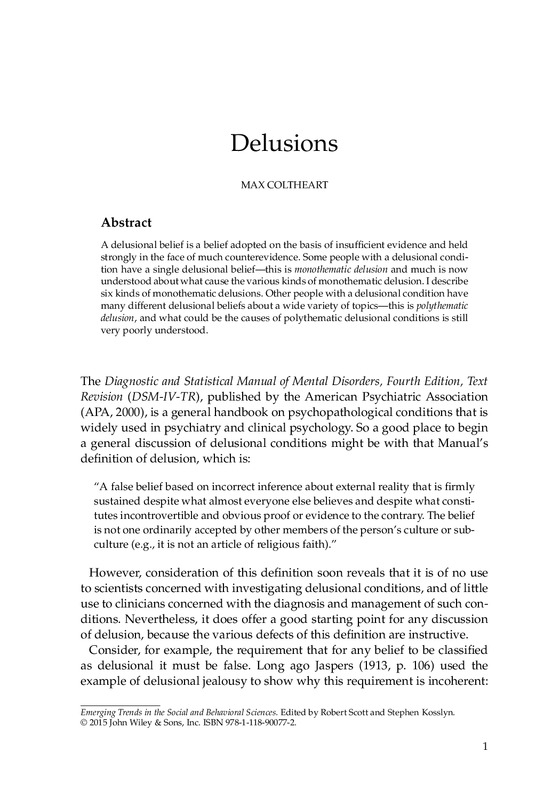
 Delusions