-
Title
-
Between the Devil and the Deep Blue Sea: Refugee Youth in Resettlement
-
Author
-
Kia‐Keating, Maryam
-
Liu, Sabrina R.
-
Sims, Ginette M.
-
Research Area
-
Social Interactions
-
Topic
-
Family Relationships
-
Abstract
-
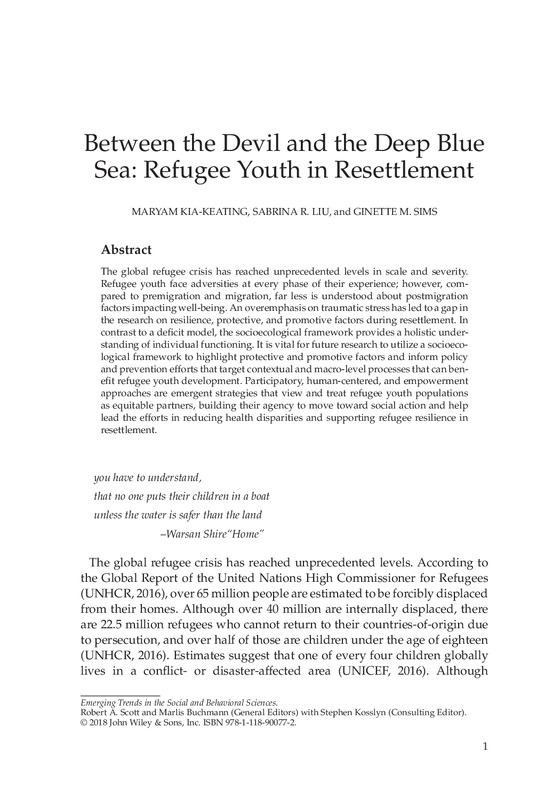
The global refugee crisis has reached unprecedented levels in scale and severity. Refugee youth face adversities at every phase of their experience; however, compared to premigration and migration, far less is understood about postmigration factors impacting well‐being. An overemphasis on traumatic stress has led to a gap in the research on resilience, protective, and promotive factors during resettlement. In contrast to a deficit model, the socioecological framework provides a holistic understanding of individual functioning. It is vital for future research to utilize a socioecological framework to highlight protective and promotive factors and inform policy and prevention efforts that target contextual and macro‐level processes that can benefit refugee youth development. Participatory, human‐centered, and empowerment approaches are emergent strategies that view and treat refugee youth populations as equitable partners, building their agency to move toward social action and help lead the efforts in reducing health disparities and supporting refugee resilience in resettlement.
-
Related Essays
-
Assimilation and Its Discontents (Sociology), Min Zhou
-
Globalization Backlash (Economics), Mabel Berezin
-
Migrant Networks (Sociology), Filiz Garip and Asad L. Asad
-
Ethnic Enclaves (Sociology), Steven J. Gold
-
Immigration and the Changing Status of Asian Americans (Sociology), Jennifer Lee
-
Immigrant Sociocultural Adaptation, Identification, and Belonging (Sociology), Sarah J. Mahler
-
Immigrant Health Paradox (Sociology), Kyriakos S. Markides and Sunshine Rote
-
Politics of Immigration Policy (Political Science), Jeannette Money
-
Cultural Conflict (Sociology), Ian Mullins
-
Empathy Gaps between Helpers and Help‐Seekers: Implications for Cooperation (Psychology), Vanessa K. Bohns and Francis J. Flynn
-
Problems Attract Problems: A Network Perspective on Mental Disorders (Psychology), Angélique Cramer and Denny Borsboom
-
Resilience (Psychology), Erica D. Diminich and George A. Bonanno
-
Immigrant Children and the Transition to Adulthood (Sociology), Roberto G. Gonzales and Benjamin J. Roth
-
Social Network Analysis in the Study of Ethnic Inequalities (Psychology), Frank Kalter
-
Language Proficiency and the Integration of Immigrant Students in the Education System (Education), Petra Stanat and Aileen Edele
-
Motivational Changes Across Adulthood: The Role of Goal Representations for Adult Development and Aging (Psychology), Alexandra M. Freund
-
Immigrant Adolescents: Opportunities and Challenges (Psychology), Peter F. Titzmann and Linda Juang
-
Identifier
-
etrds0460
-
extracted text
-
k
PSYHB etrds0460.tex
V2 - 10/22/2018
6:16 P.M.
Page 1
Between the Devil and the Deep Blue
Sea: Refugee Youth in Resettlement
MARYAM KIA-KEATING, SABRINA R. LIU, and GINETTE M. SIMS
Abstract
k
The global refugee crisis has reached unprecedented levels in scale and severity.
Refugee youth face adversities at every phase of their experience; however, compared to premigration and migration, far less is understood about postmigration
factors impacting well-being. An overemphasis on traumatic stress has led to a gap in
the research on resilience, protective, and promotive factors during resettlement. In
contrast to a deficit model, the socioecological framework provides a holistic understanding of individual functioning. It is vital for future research to utilize a socioecological framework to highlight protective and promotive factors and inform policy
and prevention efforts that target contextual and macro-level processes that can benefit refugee youth development. Participatory, human-centered, and empowerment
approaches are emergent strategies that view and treat refugee youth populations
as equitable partners, building their agency to move toward social action and help
lead the efforts in reducing health disparities and supporting refugee resilience in
resettlement.
k
you have to understand,
that no one puts their children in a boat
unless the water is safer than the land
–Warsan Shire“Home”
The global refugee crisis has reached unprecedented levels. According to
the Global Report of the United Nations High Commissioner for Refugees
(UNHCR, 2016), over 65 million people are estimated to be forcibly displaced
from their homes. Although over 40 million are internally displaced, there
are 22.5 million refugees who cannot return to their countries-of-origin due
to persecution, and over half of those are children under the age of eighteen
(UNHCR, 2016). Estimates suggest that one of every four children globally
lives in a conflict- or disaster-affected area (UNICEF, 2016). Although
Emerging Trends in the Social and Behavioral Sciences.
Robert A. Scott and Marlis Buchmann (General Editors) with Stephen Kosslyn (Consulting Editor).
© 2018 John Wiley & Sons, Inc. ISBN 978-1-118-90077-2.
1
k
�k
PSYHB etrds0460.tex
2
k
V2 - 10/22/2018
6:16 P.M.
Page 2
EMERGING TRENDS IN THE SOCIAL AND BEHAVIORAL SCIENCES
there is a great deal of heterogeneity across samples of those who might
be considered “war-affected,” it is important to recognize that many face
unfathomable circumstances such as incessant airstrikes and chemical
attacks on civilian populations, or severe restrictions on basic needs such as
humanitarian aid, nutrition, education, or medical care (UNICEF, 2016).
Refugee populations around the world shift dependent on war and conflict. In 2016, more than half of all refugees worldwide originated from three
countries: Syria, Afghanistan, and South Sudan. Most recently, Syrian and
Afghani refugee populations have had the highest volume of refugees for
several years and notably, contribute substantially to the percentage of unaccompanied minors, 75,000 of whom fled across borders without adult caregivers in 2016 (UNHCR, 2016). Refugees forced to take extreme measures to
escape do not always succeed. For example, it is estimated that over 8000
died on the Mediterranean Sea trying to reach European borders in the years
2016 and 2017, many of whom were children (International Organization for
Migration, 2018). The hundreds of thousands who survived were exposed to
a treacherous and often traumatic journey.
The phases of premigration and migration are oftentimes the focus of
empirical study because these periods are defined by their exposure to
adversity and traumatic events that initiate flight, and send refugee children and families into upheaval and uncertainty (Porterfield et al., 2010).
Nonetheless, it is critical to underscore the impact of the postmigration or
resettlement period and its stressors. Although research is emerging in this
area, far less is understood about the factors that influence psychosocial
well-being once resettled. Notably, the potential for resettlement, and the
notion of receiving “asylum,” to offer healing, adjustment, and protection
is often curtailed by exposure to new stressors, risks, and apprehension
or outright hostility from their new communities. Children developing in
contexts filled with toxic stress and ongoing disruption and fear as their
families are uprooted, are at risk for negative long-term developmental,
health, and behavioral outcomes (Hanes, Sung, Mutch, & Cherian, 2017). It
is important to pay attention to what is known about the contextual factors
that impact refugee youth well-being during resettlement. This essay takes a
closer look at the burgeoning literature focused on resettlement factors and
offers a critical perspective to consider for emerging trends.
SOCIOECOLOGICAL THEORY: A FOUNDATION
FOR CONTEXTUALIZING REFUGEE YOUTH EXPERIENCES
Socioecological theory provides a holistic foundation for understanding
refugee youth. In this framework, children are understood as nested within
the contexts that influence them at different ecological levels (Bronfenbrenner
k
k
�k
PSYHB etrds0460.tex
V2 - 10/22/2018
Between the Devil and the Deep Blue Sea: Refugee Youth in Resettlement
k
Page 3
3
& Morris, 2006). The reciprocal and interacting relationships between person
and environment at different ecological levels and systems occur over
time, account for shifts and change. They include the individual’s own
resources and capacities, and those related to families, peers, schools,
community, and society. A socioecological theoretical model is applicable
to refugee youth populations to consider key developmental contexts
affecting their psychosocial development in the context of war exposure,
political upheaval, economic and social factors, cultural variables, and
macro-level contexts including national attitudes toward newcomers and
the related policy landscape (Porterfield et al., 2010). For the case of refugees
in resettlement, although some researchers have begun to point to the need
for a socioecological foundation driving prevention and intervention efforts,
there is a scarcity of empirical research examining the multiple levels of
ecological domains impacting youth and how to best impact these. Importantly, although challenges and adversities are often included, few studies
give ample attention to protective or promotive factors that help support
refugee youth psychosocial functioning, growth, health, and achievement in
resettlement.
The over-emphasis placed on individual-level variables often only provides a narrow glimpse of negative psychosocial outcomes and risks
pathologizing refugees because contextual issues are not taken into consideration. In contrast, the socioecological perspective places the interaction
between a person and the environment or context at the forefront. In
fact, a critical examination of the results from a number of empirical
reviews further substantiates the importance of utilizing a socioecological approach. A meta-analysis of 59 independent comparisons of
over 22,000 refugees and over 45,000 nonrefugees, demonstrated that
for resettled refugees, contextual variables, such as economic opportunity and unresolved status of the conflict they had fled, were key
postmigration variables critical to predicting mental health (Porter &
Haslam, 2005). A more recent set of systematic reviews of forcibly displaced children examined 27 studies of 5765 youth resettling in lowand middle-income countries (Reed, Fazel, Jones, Panter-Brick, & Stein,
2012) and 44 studies of 5776 youth resettling in high-income countries
(Fazel, Reed, Panter-Brick, & Stein, 2012). Notably, across both reviews,
only four studies (three of which took place in high-income countries)
assessed postmigration exposure to violence as a predictor of psychosocial
functioning, highlighting the paucity of research on the magnitude of the
role of community and context in resettlement. Further research taking a
range of socioecological factors into consideration during resettlement is
imperative.
k
6:16 P.M.
k
�k
PSYHB etrds0460.tex
4
V2 - 10/22/2018
6:16 P.M.
Page 4
EMERGING TRENDS IN THE SOCIAL AND BEHAVIORAL SCIENCES
RESETTLEMENT STRESSORS
k
The research that does exist on resettlement or postmigration stressors
highlights their significant contribution to the psychological well-being of
refugees, even when accounting for adversities faced premigration and
during migration (Kim, 2016). Resettlement is best conceptualized as the
process which includes adjusting to living in a new society and economy,
acquiring and mastering a new language, and learning new expectations,
customs, and cultural values. Refugee resettlement socio-ecological factors
that impact health and psychosocial outcomes include poverty, discrimination, and reception in the host country, belonging, and acculturative stress
(Kia-Keating & Ellis, 2007; Marks, McKenna, & Garcia Coll, 2018; Porter &
Haslam, 2005; Porterfield et al., 2010).
Once resettled, economic struggles are common and persistent for refugee
youth and families and can have implications for their well-being (Porter &
Haslam, 2005). One study of Iraqi asylum seekers in the Netherlands, found
that poor socioeconomic living conditions (including personal financial problems, family financial obligations, housing problems, lack of privacy, and lack
of a safe environment for children), were strongly associated with lifetime
prevalence of one or more psychiatric disorders (Laban, Gernaat, Komproe,
Van Der Tweel, & De Jong, 2005). Researchers have also noted how economic
challenges faced by refugees in resettlement can perpetuate a cycle of poverty
for not only themselves but for future generations (Kim, 2016).
Prejudice, discrimination, racism, and xenophobia are other significant
adversities faced by refugees in resettlement. Refugees not only may
face interpersonal discrimination due to differences from the majority
culture and/or race, they also experience overt or covert discrimination in
encounters with institutional systems that obstruct their ability to meet their
basic needs and opportunities, such as housing, health care, employment,
professional advancement, and educational access. Discrimination has been
associated with physical and mental health outcomes. For example, experiences of discrimination were significantly linked to stronger depressive
affect among 647 Southeast Asian refugees resettled in Canada (Beiser &
Hou, 2006) and to higher probability of being diagnosed with an anxiety
disorder among 656 Latino and Asian refugees in the United States (Kim,
2016).
Stress related to acculturation, defined as the process of cultural and
psychological change that occurs when integrating beliefs, values, and
knowledge from home culture into host culture, can also contribute to poor
mental health. Refugee families are also vulnerable to acculturation gap
distress, whereby youth acculturate to their new culture at a faster pace
than their parents resulting in family conflict, lower family cohesion, and
k
k
�k
PSYHB etrds0460.tex
V2 - 10/22/2018
Between the Devil and the Deep Blue Sea: Refugee Youth in Resettlement
6:16 P.M.
Page 5
5
negative psychosocial functioning. Acculturative stress has been linked
to poor mental health even when accounting for other major stressors,
including trauma history. Conversely, greater acculturation has often been
associated with higher levels of well-being and school adaptation and less
psychological distress among refugee youth.
UNACCOMPANIED MINORS
k
In general, being unaccompanied when seeking asylum poses as a risk factor
for negative psychological functioning (Fazel et al., 2012; Reed et al., 2012).
The majority of studies on this population have focused on premigration
traumatic experiences rather than resettlement stressors. However, studies
of unaccompanied minors in Norway and Belgium have found that reported
daily stressors increase over time for up to 2 years, including discrimination,
and both social and material stressors (Jensen, Skardalsmo, & Fjermestad,
2014; Vervliet, Lammertyn, Broekaert, & Derluyn, 2014). Moreover, these
daily stressors are associated with increased psychopathology, including
depression, anxiety, and post-traumatic stress disorder.
Thus, this subpopulation of refugee youth faces potential vulnerabilities,
particularly as many enter the foster care system and may encounter
unique challenges associated with adjustment to new family environments
and expectations. Like other refugee youth, many of the struggles that
unaccompanied minors experience ultimately manifest behaviorally and
academically in the place where they spend an abundant portion of their
time: the school context. As such, schools are an opportune context for
prevention and intervention efforts, and asset-building.
RESETTLEMENT PROTECTIVE FACTORS
Investigations of resilience, protective, and promotive factors for youth in
resettlement need greater attention. Using a socioecological perspective
creates a foundation to include multiple levels of positive predictors and
examine healthy outcomes. On an individual level, research has found
that refugee youth sense of agency, self-determination, and autonomy can
promote healthy adjustment (Pieloch, McCullough, & Marks, 2016). These
factors can be facilitated through community programs and services that
provide peer and community resources to empower refugee youth to make
many of their own, informed decisions in resettlement. Furthermore, sense
of hope and meaning have also been linked to refugee youth resilience
(Pieloch et al., 2016). These constructs are often accessed through religious
and spiritual beliefs but could also be developed from activities that help
build agency, empowerment, and self-efficacy.
k
k
�k
PSYHB etrds0460.tex
6
k
V2 - 10/22/2018
6:16 P.M.
Page 6
EMERGING TRENDS IN THE SOCIAL AND BEHAVIORAL SCIENCES
At the family level, existing research points to family stability, family
cohesion, parental support, and parent mental health and well-being as
associated with positive psychosocial functioning among youth resettled in
high-income countries (Fazel et al., 2012). In short, within-family variables
play a central role in youth well-being. Thus, it is crucial to consider how
policies and practices work to decrease family separations, prevent and
reduce family conflicts, and fissures, and enhance family cohesion and
ability to stay intact.
The school domain is another critical context where youth spend the majority of their time; thus, schools can emerge as a source of stress or alternately,
have the potential to be places of hope and opportunity. School experiences
and sense of belonging can be protective, buffering refugee youth from the
negative consequences of resettlement stress (Fazel et al., 2012; Pieloch et al.,
2016). Belonging has been identified as integral to refugee’s sense of their
own health and well-being and acts as a protective resource in the face of
resettlement and acculturative stressors. For youth, schools can also act as
facilitators of belonging, and school belonging among refugee adolescents
in the United States has been associated with higher self-efficacy and lower
psychological distress (Kia-Keating & Ellis, 2007).
It is important for schools to work intentionally to provide support, mentorship, and inclusion, build and sustain a sense of belonging, and establish
stability, safety, and continuity for refugee youth, particularly unaccompanied minors. One of the best ways to accomplish these tasks, particularly
with new waves of refugee arrivals, is to draw from the strengths within the
refugee communities themselves. Many refugees come with skills in professional areas that may not be reflected in the job opportunities they can acquire
upon arrival in a resettlement country. However, their skills and desire to
help their own community, network, and language and cultural knowledge
are indispensable to creating bridges. Similarly, community health workers
are laypersons within a community who are trained to help create a bridge
for their peers in accessing health and mental health information, resources,
and support. Recognition of this vital and accessible but relatively untapped
resource has begun to emerge in greater use of cultural brokers, community
leaders, paraprofessionals, and community health workers.
EMERGING TRENDS: PREVENTION AND PARTICIPATORY ACTION
The sheer number of children and families affected by war and disaster
around the world has reached crisis levels. Given the mass scale of forced
displacement and resettlement, it is of global concern to understand how
to respond to populations who seek and obtain asylum. However, the
scope of research on stressors faced by refugees in resettlement, as well as
k
k
�k
PSYHB etrds0460.tex
V2 - 10/22/2018
Between the Devil and the Deep Blue Sea: Refugee Youth in Resettlement
k
Page 7
7
psychosocial promotive and protective factors, remains limited. Despite
this dearth, there is empirical evidence to suggest that refugee youth who
have just escaped war and persecution can experience increased stress in
resettlement, and postmigration stressors are at times a stronger predictor
of mental health than war exposure.
Moreover, longitudinal studies point to the negative repercussions of
adverse childhood experiences (ACEs), leading to chronic diseases and
early mortality (Hanes et al., 2017). If policies and reception in host countries
increase the number of adversities that refugee youth endure, they are
cumulatively increasing the odds of these negative physical and mental
health outcomes, including life expectancy. For example, in the United
States, recent policy and practice has increased risk of refugee family
separation, despite evidence that family separations during migration and
resettlement are exceptionally damaging and contribute to ongoing distress,
fear, powerlessness, and inner conflict regarding resettlement decisions
(Miller, Hess, Bybee, & Goodkind, 2018). Another example is in Sweden,
where policy and practice has been related to a startlingly new disorder
exclusively documented among hundreds of refugee youth seeking asylum:
uppgivenhetssyndrom or resignation syndrome (RS; Salliqn et al., 2016).
Likened to catatonia, and the tonic immobility related to terror in what is
perceived as an inescapable situation (such that animals and sexual assault
victims experience), symptoms of RS include a gradual progression from
lethargy, stupor, and lack of response to eventual unconsciousness (and a
need to be tube-fed). Given the contextual stressors faced by these youth,
the etiology of the disorder has pointed to the incomprehensible terror
experienced in asylum as refugees wait to find out their fate and the fate of
their family members. The notion of refugee youth willing themselves to
death is a stark reminder of the moral imperative to protect children from
preventable suffering and calls for a long-overdue shift toward scientifically
informed, wellness-focused refugee policies.
By shifting away from the detrimental deficit model which positions
refugees as only vulnerable and victimized, a socioecological framework
helps to recognize the importance of contextual variables that can and
should be addressed at a macro-level. Key contextual variables impacting
refugee youth in resettlement such as poverty, family factors, belonging,
school climate, and community reception, and their relationships and
interactions with one another need further explication to determine the key
social determinants of health and well-being among, often heterogeneous
populations of young refugees. Moreover, prevention and intervention
studies, utilizing a socioecological foundation to develop and test multiple
factors are warranted.
k
6:16 P.M.
k
�k
PSYHB etrds0460.tex
8
k
V2 - 10/22/2018
6:16 P.M.
Page 8
EMERGING TRENDS IN THE SOCIAL AND BEHAVIORAL SCIENCES
The acknowledgment of the complexity of interacting systems, and
the importance of addressing refugee youth needs from a bioecological
perspective, logically leads to utilizing multisystemic, multimodal, and
multilevel approaches to address complex and cumulative trauma and
risk, in addition to building on potential protective factors (Marks et al.,
2018). Refugee youth face profound deprivation and loss, uncertainty, and
instability during critical developmental windows. Empirical investigations
4utilizing a socioecological framework can advance scientific understanding of the social determinants of health and mental health, and lead to
community-based and culturally relevant approaches in prevention and
intervention.
Policies and approaches can support resilience through a focus
on increasing capacity, agency, and empowerment among refugee
youth and communities. Approaches informed by frameworks such as
community-based participatory research (CBPR), participatory action, and
human-centered design, can increase contextual sensitivity and capitalize on
local knowledge to engender change that is meaningful and effective, rather
than solely relying on Western models and/or assumptions of universalism
(Ellis, Kia-Keating, Yusuf, Lincoln, & Nur, 2007).
Approaches such as these empower refugees by allowing them to construct
their own narrative of experiences and supporting their efforts toward social
action and change. As an example, refugees have helped to develop an economy worth over US$50 million at the Kakuma Refugee Camp in Kenya (International Finance Corporation, 2018). The Kakuma refugees and asylum seekers, who own 12% of marketplace businesses within the camp, have actively
created a system of production that has warranted private investment interest and entry into a global marketplace. This example highlights the enormous capacity for refugee resilience and thriving.
The current refugee crisis has global impact and needs to be taken up
as a global responsibility. Therefore, rather than approaching these issues
as country-specific problems, the most effective solutions will likely arise
from nations coming together on a shared agenda for preventing further
suffering. This agenda must be informed by the humanitarian understanding that refugees resettle because there is no other option for them, and aid
must be provided to those in need, in order to prevent further large-scale,
irreparable repercussions. Equally important to this agenda is the scientific
perspective that children, our next generation of global citizens, will suffer
if we do not ensure that their basic needs are met and that they have
the resources and opportunities to learn and grow. Despite accumulating
evidence related to the detrimental health and economic impact of various
resettlement stressors, policies and practices have yet to reflect the scientific
knowledge that much of what refugees are enduring is preventable, and
k
k
�k
PSYHB etrds0460.tex
V2 - 10/22/2018
Between the Devil and the Deep Blue Sea: Refugee Youth in Resettlement
6:16 P.M.
Page 9
9
can be addressed at a macro-level. As the global refugee crisis continues
to unfold, more research needs to include models that integrate protective
and promotive factors with risks to examine both short- and long-term
functioning and healthy outcomes. Gaining a better understanding of which
and how resettlement factors are critical for long-term outcomes will help to
inform individual, community, national, and global resources and policies
that support children’s resilience, healthy development, and as UNICEF
(2016) states, ensure “a fair chance for every child.”
REFERENCES
k
Beiser, M. N. M. N., & Hou, F. (2006). Ethnic identity, resettlement stress and depressive affect among Southeast Asian refugees in Canada. Social Science and Medicine,
63(1), 137–150. doi:10.1016/j.socscimed.2005.12.002.
Bronfenbrenner, U., & Morris, P. A. (2006). The bioecological model of human development. In R. M. Lerner & W. Damon (Eds.), Handbook of child psychology: Theoretical models of human development (Vol. 1, 6th ed., pp. 793–828). Hoboken, NJ: John
Wiley & Sons Inc. doi:10.1002/9780470147658.chpsy0114.
Ellis, B. H., Kia-Keating, M., Yusuf, S., Lincoln, A., & Nur, A. (2007). Ethical research
in refugee communities and the use of community participatory methods. Transcultural Psychiatry, 44(3), 459–481.
Fazel, M., Reed, R. V., Panter-Brick, C., & Stein, A. (2012). Mental health of displaced
and refugee children resettled in high-income countries: Risk and protective factors. The Lancet, 379(9812), 266–282.
Hanes, G., Sung, L., Mutch, R., & Cherian, S. (2017). Adversity and resilience amongst
resettling Western Australian paediatric refugees. Journal of Paediatrics and Child
Health, 53, 882–888. doi:10.1111/jpc.13559.
International Finance Corporation (2018). Kakuma as marketplace: A consumer and market study of a refugee town in northwest Kenya. Accessed from
https://www.ifc.org/wps/wcm/connect/8fb8fab4-af24-4b09-bdff-2109d2c45
974/20180427_Kakuma-as-a-Marketplace_v1.pdf?MOD=AJPERES
International Organization for Migration (2018, January 5). Mediterranean
migrant arrivals reached 171,635 in 2017. Deaths Reach, 3(116). Accessed from
https://www.iom.int/news/mediterranean-migrant-arrivals-reached-1716352017-deaths-reach-3116.
Jensen, T. K., Skardalsmo, E. M. B., & Fjermestad, K. W. (2014). Development of mental health problems: A follow-up study of unaccompanied refugee minors. Child
and Adolescent Psychiatry and Mental Health, 8, 29. doi:10.1186/1753-2000-8-29.
Kia-Keating, M., & Ellis, B. H. (2007). Belonging and connection to school in resettlement: Young refugees, school belonging, and psychosocial adjustment. Clinical
Child Psychology and Psychiatry, 12(1), 29–43.
Kim, I. (2016). Beyond trauma: Post-resettlement factors and mental health outcomes
among Latino and Asian refugees in the United States. Journal of Immigrant and
Minority Health, 18(4), 740–748. doi:10.1007/s10903-015-0251-8.
k
k
�k
PSYHB etrds0460.tex
10
k
V2 - 10/22/2018
6:16 P.M. Page 10
EMERGING TRENDS IN THE SOCIAL AND BEHAVIORAL SCIENCES
Laban, C. J., Gernaat, H. B. P. E., Komproe, I. H., Van Der Tweel, I., & De Jong, J.
T. V. M. (2005). Postmigration living problems and common psychiatric disorders
in Iraqi asylum seekers in the Netherlands. Journal of Nervous and Mental Disease,
193(12), 825–832. doi:10.1097/01.nmd.0000188977.44657.1d.
Marks, A. K., McKenna, J. L., & Garcia Coll, G. (2018). National immigration receiving contexts: A critical aspect of native-born, immigrant, and refugee youth
well-being. European Psychologist, 23, 6–20. doi:10.1027/1016-9040/a000311.
Miller, A., Hess, J. M., Bybee, D., & Goodkind, J. R. (2018). Understanding the mental
health consequences of family separation for refugees: Implications for policy and
practice. American Journal of Orthopsychiatry, 88(1), 26–37. doi:10.1037/ort0000272.
Pieloch, K. A., McCullough, M. B., & Marks, A. K. (2016). Resilience of children with
refugee statuses: A research review. Canadian Psychology/Psychologie Canadienne,
57(4), 330–339. doi:10.1037/cap0000073.
Porter, M., & Haslam, N. (2005). Predisplacement and postdisplacement factors
associated with mental health of refugees and internally displaced persons:
A meta-analysis. Journal of the American Medical Association, 294(5), 602–612.
doi:10.1001/jama.294.5.602.
Porterfield, K., Akinsulure-Smith, A., Benson, M., Betancourt, T., Ellis, H.,
Kia-Keating, M., & Miller, K. (2010). Resilience and recovery after war: Refugee children
and families in the United States. Report of the APA Task Force on the Psychosocial
Effects of War on Children and Families who are Refugees from Armed Conflict
Residing in the United States. Washington, DC: American Psychological Association.
Reed, R. V., Fazel, M., Jones, L., Panter-Brick, C., & Stein, A. (2012). Mental health of displaced and refugee children resettled in low-income and
middle-income countries: Risk and protective factors. The Lancet, 379(9812),
250–265. doi:10.1016/S0140-6736(11)60050-0.
Sallin, K., Lagercrantz, H., Evers, K., Engström, I., Hjern, A., & Petrovic, P. (2016).
Resignation syndrome: Catatonia? Culture-Bound? Frontiers in Behavioral Neuroscience, 10, 1–18. doi:10.3389/fnbeh.2016.00007.
UNHCR (2016). Global trends: Forced displacement in 2016. Retrieved from
http://www.unhcr.org/en-us/statistics/unhcrstats/5943e8a34/global-trendsforced-displacement-2016.html
UNICEF (2016). The state of the world’s children 2016: A fair chance for every
child. Retrieved from https://www.unicef.org/publications/files/UNICEF_
SOWC_2016.pdf
Vervliet, M., Lammertyn, J., Broekaert, E., & Derluyn, I. (2014). Longitudinal
follow-up of the mental health of unaccompanied refugee minors. European Child
and Adolescent Psychiatry, 23(5), 337–346. doi:10.1007/s00787-013-0463-1.
Dr. Maryam Kia-Keating is an associate professor of Clinical Psychology in
the University of California, Santa Barbara (UCSB) Department of Counseling, Clinical, and School Psychology and a Licensed Clinical Psychologist.
Dr. Kia-Keating’s research examines risk and resilience in the context
of trauma, stress, and adverse childhood experiences (ACEs). She has a
k
k
�k
PSYHB etrds0460.tex
V2 - 10/22/2018
Between the Devil and the Deep Blue Sea: Refugee Youth in Resettlement
6:16 P.M. Page 11
11
particular emphasis and expertise in refugee and immigrant populations
facing mass violence, disasters, and persecution. Dr. Kia-Keating served on
the American Psychological Association (APA) Task Force on the Psychosocial
Effects of War on Children and Families who are Refugees from Armed Conflict
Residing in the United States, which published its report on Resilience and
Recovery after War in 2010. She utilizes community-based participatory
research methods to empower communities, inform prevention and intervention efforts, and reduce health disparities. Dr. Kia-Keating’s research has
been funded by the National Institutes of Health.
k
Sabrina Liu is an advanced doctoral student in Clinical Psychology at
the UCSB Department of Counseling, Clinical, and School Psychology.
Her research and clinical interests include resilience in youth exposed to
adversity, and trauma prevention and intervention in culturally diverse
communities. Her work has concentrated on understanding and addressing
the impact of exposure to community violence, adverse childhood experiences (ACEs), mass violence, and natural disasters. Sabrina has served as
associate editor for Translational Issues in Psychological Sciences: Special Issue
on Psychological Perspectives on Refugees and Immigrants.
Ginette M. Sims is a doctoral student in Clinical Psychology at the UCSB
Department of Counseling, Clinical, and School Psychology. Her research
focuses on the impact of sociopolitical factors on the manifestation and treatment of trauma symptomology in marginalized populations. She is interested in the impact of political stigmatization on mental health symptomology in immigrant and ethnic minority college students and the assessment of
trauma symptomology in populations exposed to media depicting the deaths
of African-American men at the hands of the police in the US Black Lives
Matter movement.
RELATED ESSAYS
Assimilation and Its Discontents (Sociology), Min Zhou
Globalization Backlash (Economics), Mabel Berezin
Migrant Networks (Sociology), Filiz Garip and Asad L. Asad
Ethnic Enclaves (Sociology), Steven J. Gold
Immigration and the Changing Status of Asian Americans (Sociology),
Jennifer Lee
Immigrant Sociocultural Adaptation, Identification, and Belonging
(Sociology), Sarah J. Mahler
k
k
�k
PSYHB etrds0460.tex
12
V2 - 10/22/2018
6:16 P.M. Page 12
EMERGING TRENDS IN THE SOCIAL AND BEHAVIORAL SCIENCES
Immigrant Health Paradox (Sociology), Kyriakos S. Markides and Sunshine
Rote
Politics of Immigration Policy (Political Science), Jeannette Money
Cultural Conflict (Sociology), Ian Mullins
Empathy Gaps between Helpers and Help-Seekers: Implications for Cooperation (Psychology), Vanessa K. Bohns and Francis J. Flynn
Problems Attract Problems: A Network Perspective on Mental Disorders
(Psychology), Angélique Cramer and Denny Borsboom
Resilience (Psychology), Erica D. Diminich and George A. Bonanno
Immigrant Children and the Transition to Adulthood (Sociology), Roberto G.
Gonzales and Benjamin J. Roth
Social Network Analysis in the Study of Ethnic Inequalities (Psychology),
Frank Kalter
Language Proficiency and the Integration of Immigrant Students in the
Education System (Education), Petra Stanat and Aileen Edele
Motivational Changes Across Adulthood: The Role of Goal Representations
for Adult Development and Aging (Psychology), Alexandra M. Freund
Immigrant Adolescents: Opportunities and Challenges (Psychology), Peter F.
Titzmann and Linda Juang
k
k
k
�
-
k
PSYHB etrds0460.tex
V2 - 10/22/2018
6:16 P.M.
Page 1
Between the Devil and the Deep Blue
Sea: Refugee Youth in Resettlement
MARYAM KIA-KEATING, SABRINA R. LIU, and GINETTE M. SIMS
Abstract
k
The global refugee crisis has reached unprecedented levels in scale and severity.
Refugee youth face adversities at every phase of their experience; however, compared to premigration and migration, far less is understood about postmigration
factors impacting well-being. An overemphasis on traumatic stress has led to a gap in
the research on resilience, protective, and promotive factors during resettlement. In
contrast to a deficit model, the socioecological framework provides a holistic understanding of individual functioning. It is vital for future research to utilize a socioecological framework to highlight protective and promotive factors and inform policy
and prevention efforts that target contextual and macro-level processes that can benefit refugee youth development. Participatory, human-centered, and empowerment
approaches are emergent strategies that view and treat refugee youth populations
as equitable partners, building their agency to move toward social action and help
lead the efforts in reducing health disparities and supporting refugee resilience in
resettlement.
k
you have to understand,
that no one puts their children in a boat
unless the water is safer than the land
–Warsan Shire“Home”
The global refugee crisis has reached unprecedented levels. According to
the Global Report of the United Nations High Commissioner for Refugees
(UNHCR, 2016), over 65 million people are estimated to be forcibly displaced
from their homes. Although over 40 million are internally displaced, there
are 22.5 million refugees who cannot return to their countries-of-origin due
to persecution, and over half of those are children under the age of eighteen
(UNHCR, 2016). Estimates suggest that one of every four children globally
lives in a conflict- or disaster-affected area (UNICEF, 2016). Although
Emerging Trends in the Social and Behavioral Sciences.
Robert A. Scott and Marlis Buchmann (General Editors) with Stephen Kosslyn (Consulting Editor).
© 2018 John Wiley & Sons, Inc. ISBN 978-1-118-90077-2.
1
k
�k
PSYHB etrds0460.tex
2
k
V2 - 10/22/2018
6:16 P.M.
Page 2
EMERGING TRENDS IN THE SOCIAL AND BEHAVIORAL SCIENCES
there is a great deal of heterogeneity across samples of those who might
be considered “war-affected,” it is important to recognize that many face
unfathomable circumstances such as incessant airstrikes and chemical
attacks on civilian populations, or severe restrictions on basic needs such as
humanitarian aid, nutrition, education, or medical care (UNICEF, 2016).
Refugee populations around the world shift dependent on war and conflict. In 2016, more than half of all refugees worldwide originated from three
countries: Syria, Afghanistan, and South Sudan. Most recently, Syrian and
Afghani refugee populations have had the highest volume of refugees for
several years and notably, contribute substantially to the percentage of unaccompanied minors, 75,000 of whom fled across borders without adult caregivers in 2016 (UNHCR, 2016). Refugees forced to take extreme measures to
escape do not always succeed. For example, it is estimated that over 8000
died on the Mediterranean Sea trying to reach European borders in the years
2016 and 2017, many of whom were children (International Organization for
Migration, 2018). The hundreds of thousands who survived were exposed to
a treacherous and often traumatic journey.
The phases of premigration and migration are oftentimes the focus of
empirical study because these periods are defined by their exposure to
adversity and traumatic events that initiate flight, and send refugee children and families into upheaval and uncertainty (Porterfield et al., 2010).
Nonetheless, it is critical to underscore the impact of the postmigration or
resettlement period and its stressors. Although research is emerging in this
area, far less is understood about the factors that influence psychosocial
well-being once resettled. Notably, the potential for resettlement, and the
notion of receiving “asylum,” to offer healing, adjustment, and protection
is often curtailed by exposure to new stressors, risks, and apprehension
or outright hostility from their new communities. Children developing in
contexts filled with toxic stress and ongoing disruption and fear as their
families are uprooted, are at risk for negative long-term developmental,
health, and behavioral outcomes (Hanes, Sung, Mutch, & Cherian, 2017). It
is important to pay attention to what is known about the contextual factors
that impact refugee youth well-being during resettlement. This essay takes a
closer look at the burgeoning literature focused on resettlement factors and
offers a critical perspective to consider for emerging trends.
SOCIOECOLOGICAL THEORY: A FOUNDATION
FOR CONTEXTUALIZING REFUGEE YOUTH EXPERIENCES
Socioecological theory provides a holistic foundation for understanding
refugee youth. In this framework, children are understood as nested within
the contexts that influence them at different ecological levels (Bronfenbrenner
k
k
�k
PSYHB etrds0460.tex
V2 - 10/22/2018
Between the Devil and the Deep Blue Sea: Refugee Youth in Resettlement
k
Page 3
3
& Morris, 2006). The reciprocal and interacting relationships between person
and environment at different ecological levels and systems occur over
time, account for shifts and change. They include the individual’s own
resources and capacities, and those related to families, peers, schools,
community, and society. A socioecological theoretical model is applicable
to refugee youth populations to consider key developmental contexts
affecting their psychosocial development in the context of war exposure,
political upheaval, economic and social factors, cultural variables, and
macro-level contexts including national attitudes toward newcomers and
the related policy landscape (Porterfield et al., 2010). For the case of refugees
in resettlement, although some researchers have begun to point to the need
for a socioecological foundation driving prevention and intervention efforts,
there is a scarcity of empirical research examining the multiple levels of
ecological domains impacting youth and how to best impact these. Importantly, although challenges and adversities are often included, few studies
give ample attention to protective or promotive factors that help support
refugee youth psychosocial functioning, growth, health, and achievement in
resettlement.
The over-emphasis placed on individual-level variables often only provides a narrow glimpse of negative psychosocial outcomes and risks
pathologizing refugees because contextual issues are not taken into consideration. In contrast, the socioecological perspective places the interaction
between a person and the environment or context at the forefront. In
fact, a critical examination of the results from a number of empirical
reviews further substantiates the importance of utilizing a socioecological approach. A meta-analysis of 59 independent comparisons of
over 22,000 refugees and over 45,000 nonrefugees, demonstrated that
for resettled refugees, contextual variables, such as economic opportunity and unresolved status of the conflict they had fled, were key
postmigration variables critical to predicting mental health (Porter &
Haslam, 2005). A more recent set of systematic reviews of forcibly displaced children examined 27 studies of 5765 youth resettling in lowand middle-income countries (Reed, Fazel, Jones, Panter-Brick, & Stein,
2012) and 44 studies of 5776 youth resettling in high-income countries
(Fazel, Reed, Panter-Brick, & Stein, 2012). Notably, across both reviews,
only four studies (three of which took place in high-income countries)
assessed postmigration exposure to violence as a predictor of psychosocial
functioning, highlighting the paucity of research on the magnitude of the
role of community and context in resettlement. Further research taking a
range of socioecological factors into consideration during resettlement is
imperative.
k
6:16 P.M.
k
�k
PSYHB etrds0460.tex
4
V2 - 10/22/2018
6:16 P.M.
Page 4
EMERGING TRENDS IN THE SOCIAL AND BEHAVIORAL SCIENCES
RESETTLEMENT STRESSORS
k
The research that does exist on resettlement or postmigration stressors
highlights their significant contribution to the psychological well-being of
refugees, even when accounting for adversities faced premigration and
during migration (Kim, 2016). Resettlement is best conceptualized as the
process which includes adjusting to living in a new society and economy,
acquiring and mastering a new language, and learning new expectations,
customs, and cultural values. Refugee resettlement socio-ecological factors
that impact health and psychosocial outcomes include poverty, discrimination, and reception in the host country, belonging, and acculturative stress
(Kia-Keating & Ellis, 2007; Marks, McKenna, & Garcia Coll, 2018; Porter &
Haslam, 2005; Porterfield et al., 2010).
Once resettled, economic struggles are common and persistent for refugee
youth and families and can have implications for their well-being (Porter &
Haslam, 2005). One study of Iraqi asylum seekers in the Netherlands, found
that poor socioeconomic living conditions (including personal financial problems, family financial obligations, housing problems, lack of privacy, and lack
of a safe environment for children), were strongly associated with lifetime
prevalence of one or more psychiatric disorders (Laban, Gernaat, Komproe,
Van Der Tweel, & De Jong, 2005). Researchers have also noted how economic
challenges faced by refugees in resettlement can perpetuate a cycle of poverty
for not only themselves but for future generations (Kim, 2016).
Prejudice, discrimination, racism, and xenophobia are other significant
adversities faced by refugees in resettlement. Refugees not only may
face interpersonal discrimination due to differences from the majority
culture and/or race, they also experience overt or covert discrimination in
encounters with institutional systems that obstruct their ability to meet their
basic needs and opportunities, such as housing, health care, employment,
professional advancement, and educational access. Discrimination has been
associated with physical and mental health outcomes. For example, experiences of discrimination were significantly linked to stronger depressive
affect among 647 Southeast Asian refugees resettled in Canada (Beiser &
Hou, 2006) and to higher probability of being diagnosed with an anxiety
disorder among 656 Latino and Asian refugees in the United States (Kim,
2016).
Stress related to acculturation, defined as the process of cultural and
psychological change that occurs when integrating beliefs, values, and
knowledge from home culture into host culture, can also contribute to poor
mental health. Refugee families are also vulnerable to acculturation gap
distress, whereby youth acculturate to their new culture at a faster pace
than their parents resulting in family conflict, lower family cohesion, and
k
k
�k
PSYHB etrds0460.tex
V2 - 10/22/2018
Between the Devil and the Deep Blue Sea: Refugee Youth in Resettlement
6:16 P.M.
Page 5
5
negative psychosocial functioning. Acculturative stress has been linked
to poor mental health even when accounting for other major stressors,
including trauma history. Conversely, greater acculturation has often been
associated with higher levels of well-being and school adaptation and less
psychological distress among refugee youth.
UNACCOMPANIED MINORS
k
In general, being unaccompanied when seeking asylum poses as a risk factor
for negative psychological functioning (Fazel et al., 2012; Reed et al., 2012).
The majority of studies on this population have focused on premigration
traumatic experiences rather than resettlement stressors. However, studies
of unaccompanied minors in Norway and Belgium have found that reported
daily stressors increase over time for up to 2 years, including discrimination,
and both social and material stressors (Jensen, Skardalsmo, & Fjermestad,
2014; Vervliet, Lammertyn, Broekaert, & Derluyn, 2014). Moreover, these
daily stressors are associated with increased psychopathology, including
depression, anxiety, and post-traumatic stress disorder.
Thus, this subpopulation of refugee youth faces potential vulnerabilities,
particularly as many enter the foster care system and may encounter
unique challenges associated with adjustment to new family environments
and expectations. Like other refugee youth, many of the struggles that
unaccompanied minors experience ultimately manifest behaviorally and
academically in the place where they spend an abundant portion of their
time: the school context. As such, schools are an opportune context for
prevention and intervention efforts, and asset-building.
RESETTLEMENT PROTECTIVE FACTORS
Investigations of resilience, protective, and promotive factors for youth in
resettlement need greater attention. Using a socioecological perspective
creates a foundation to include multiple levels of positive predictors and
examine healthy outcomes. On an individual level, research has found
that refugee youth sense of agency, self-determination, and autonomy can
promote healthy adjustment (Pieloch, McCullough, & Marks, 2016). These
factors can be facilitated through community programs and services that
provide peer and community resources to empower refugee youth to make
many of their own, informed decisions in resettlement. Furthermore, sense
of hope and meaning have also been linked to refugee youth resilience
(Pieloch et al., 2016). These constructs are often accessed through religious
and spiritual beliefs but could also be developed from activities that help
build agency, empowerment, and self-efficacy.
k
k
�k
PSYHB etrds0460.tex
6
k
V2 - 10/22/2018
6:16 P.M.
Page 6
EMERGING TRENDS IN THE SOCIAL AND BEHAVIORAL SCIENCES
At the family level, existing research points to family stability, family
cohesion, parental support, and parent mental health and well-being as
associated with positive psychosocial functioning among youth resettled in
high-income countries (Fazel et al., 2012). In short, within-family variables
play a central role in youth well-being. Thus, it is crucial to consider how
policies and practices work to decrease family separations, prevent and
reduce family conflicts, and fissures, and enhance family cohesion and
ability to stay intact.
The school domain is another critical context where youth spend the majority of their time; thus, schools can emerge as a source of stress or alternately,
have the potential to be places of hope and opportunity. School experiences
and sense of belonging can be protective, buffering refugee youth from the
negative consequences of resettlement stress (Fazel et al., 2012; Pieloch et al.,
2016). Belonging has been identified as integral to refugee’s sense of their
own health and well-being and acts as a protective resource in the face of
resettlement and acculturative stressors. For youth, schools can also act as
facilitators of belonging, and school belonging among refugee adolescents
in the United States has been associated with higher self-efficacy and lower
psychological distress (Kia-Keating & Ellis, 2007).
It is important for schools to work intentionally to provide support, mentorship, and inclusion, build and sustain a sense of belonging, and establish
stability, safety, and continuity for refugee youth, particularly unaccompanied minors. One of the best ways to accomplish these tasks, particularly
with new waves of refugee arrivals, is to draw from the strengths within the
refugee communities themselves. Many refugees come with skills in professional areas that may not be reflected in the job opportunities they can acquire
upon arrival in a resettlement country. However, their skills and desire to
help their own community, network, and language and cultural knowledge
are indispensable to creating bridges. Similarly, community health workers
are laypersons within a community who are trained to help create a bridge
for their peers in accessing health and mental health information, resources,
and support. Recognition of this vital and accessible but relatively untapped
resource has begun to emerge in greater use of cultural brokers, community
leaders, paraprofessionals, and community health workers.
EMERGING TRENDS: PREVENTION AND PARTICIPATORY ACTION
The sheer number of children and families affected by war and disaster
around the world has reached crisis levels. Given the mass scale of forced
displacement and resettlement, it is of global concern to understand how
to respond to populations who seek and obtain asylum. However, the
scope of research on stressors faced by refugees in resettlement, as well as
k
k
�k
PSYHB etrds0460.tex
V2 - 10/22/2018
Between the Devil and the Deep Blue Sea: Refugee Youth in Resettlement
k
Page 7
7
psychosocial promotive and protective factors, remains limited. Despite
this dearth, there is empirical evidence to suggest that refugee youth who
have just escaped war and persecution can experience increased stress in
resettlement, and postmigration stressors are at times a stronger predictor
of mental health than war exposure.
Moreover, longitudinal studies point to the negative repercussions of
adverse childhood experiences (ACEs), leading to chronic diseases and
early mortality (Hanes et al., 2017). If policies and reception in host countries
increase the number of adversities that refugee youth endure, they are
cumulatively increasing the odds of these negative physical and mental
health outcomes, including life expectancy. For example, in the United
States, recent policy and practice has increased risk of refugee family
separation, despite evidence that family separations during migration and
resettlement are exceptionally damaging and contribute to ongoing distress,
fear, powerlessness, and inner conflict regarding resettlement decisions
(Miller, Hess, Bybee, & Goodkind, 2018). Another example is in Sweden,
where policy and practice has been related to a startlingly new disorder
exclusively documented among hundreds of refugee youth seeking asylum:
uppgivenhetssyndrom or resignation syndrome (RS; Salliqn et al., 2016).
Likened to catatonia, and the tonic immobility related to terror in what is
perceived as an inescapable situation (such that animals and sexual assault
victims experience), symptoms of RS include a gradual progression from
lethargy, stupor, and lack of response to eventual unconsciousness (and a
need to be tube-fed). Given the contextual stressors faced by these youth,
the etiology of the disorder has pointed to the incomprehensible terror
experienced in asylum as refugees wait to find out their fate and the fate of
their family members. The notion of refugee youth willing themselves to
death is a stark reminder of the moral imperative to protect children from
preventable suffering and calls for a long-overdue shift toward scientifically
informed, wellness-focused refugee policies.
By shifting away from the detrimental deficit model which positions
refugees as only vulnerable and victimized, a socioecological framework
helps to recognize the importance of contextual variables that can and
should be addressed at a macro-level. Key contextual variables impacting
refugee youth in resettlement such as poverty, family factors, belonging,
school climate, and community reception, and their relationships and
interactions with one another need further explication to determine the key
social determinants of health and well-being among, often heterogeneous
populations of young refugees. Moreover, prevention and intervention
studies, utilizing a socioecological foundation to develop and test multiple
factors are warranted.
k
6:16 P.M.
k
�k
PSYHB etrds0460.tex
8
k
V2 - 10/22/2018
6:16 P.M.
Page 8
EMERGING TRENDS IN THE SOCIAL AND BEHAVIORAL SCIENCES
The acknowledgment of the complexity of interacting systems, and
the importance of addressing refugee youth needs from a bioecological
perspective, logically leads to utilizing multisystemic, multimodal, and
multilevel approaches to address complex and cumulative trauma and
risk, in addition to building on potential protective factors (Marks et al.,
2018). Refugee youth face profound deprivation and loss, uncertainty, and
instability during critical developmental windows. Empirical investigations
4utilizing a socioecological framework can advance scientific understanding of the social determinants of health and mental health, and lead to
community-based and culturally relevant approaches in prevention and
intervention.
Policies and approaches can support resilience through a focus
on increasing capacity, agency, and empowerment among refugee
youth and communities. Approaches informed by frameworks such as
community-based participatory research (CBPR), participatory action, and
human-centered design, can increase contextual sensitivity and capitalize on
local knowledge to engender change that is meaningful and effective, rather
than solely relying on Western models and/or assumptions of universalism
(Ellis, Kia-Keating, Yusuf, Lincoln, & Nur, 2007).
Approaches such as these empower refugees by allowing them to construct
their own narrative of experiences and supporting their efforts toward social
action and change. As an example, refugees have helped to develop an economy worth over US$50 million at the Kakuma Refugee Camp in Kenya (International Finance Corporation, 2018). The Kakuma refugees and asylum seekers, who own 12% of marketplace businesses within the camp, have actively
created a system of production that has warranted private investment interest and entry into a global marketplace. This example highlights the enormous capacity for refugee resilience and thriving.
The current refugee crisis has global impact and needs to be taken up
as a global responsibility. Therefore, rather than approaching these issues
as country-specific problems, the most effective solutions will likely arise
from nations coming together on a shared agenda for preventing further
suffering. This agenda must be informed by the humanitarian understanding that refugees resettle because there is no other option for them, and aid
must be provided to those in need, in order to prevent further large-scale,
irreparable repercussions. Equally important to this agenda is the scientific
perspective that children, our next generation of global citizens, will suffer
if we do not ensure that their basic needs are met and that they have
the resources and opportunities to learn and grow. Despite accumulating
evidence related to the detrimental health and economic impact of various
resettlement stressors, policies and practices have yet to reflect the scientific
knowledge that much of what refugees are enduring is preventable, and
k
k
�k
PSYHB etrds0460.tex
V2 - 10/22/2018
Between the Devil and the Deep Blue Sea: Refugee Youth in Resettlement
6:16 P.M.
Page 9
9
can be addressed at a macro-level. As the global refugee crisis continues
to unfold, more research needs to include models that integrate protective
and promotive factors with risks to examine both short- and long-term
functioning and healthy outcomes. Gaining a better understanding of which
and how resettlement factors are critical for long-term outcomes will help to
inform individual, community, national, and global resources and policies
that support children’s resilience, healthy development, and as UNICEF
(2016) states, ensure “a fair chance for every child.”
REFERENCES
k
Beiser, M. N. M. N., & Hou, F. (2006). Ethnic identity, resettlement stress and depressive affect among Southeast Asian refugees in Canada. Social Science and Medicine,
63(1), 137–150. doi:10.1016/j.socscimed.2005.12.002.
Bronfenbrenner, U., & Morris, P. A. (2006). The bioecological model of human development. In R. M. Lerner & W. Damon (Eds.), Handbook of child psychology: Theoretical models of human development (Vol. 1, 6th ed., pp. 793–828). Hoboken, NJ: John
Wiley & Sons Inc. doi:10.1002/9780470147658.chpsy0114.
Ellis, B. H., Kia-Keating, M., Yusuf, S., Lincoln, A., & Nur, A. (2007). Ethical research
in refugee communities and the use of community participatory methods. Transcultural Psychiatry, 44(3), 459–481.
Fazel, M., Reed, R. V., Panter-Brick, C., & Stein, A. (2012). Mental health of displaced
and refugee children resettled in high-income countries: Risk and protective factors. The Lancet, 379(9812), 266–282.
Hanes, G., Sung, L., Mutch, R., & Cherian, S. (2017). Adversity and resilience amongst
resettling Western Australian paediatric refugees. Journal of Paediatrics and Child
Health, 53, 882–888. doi:10.1111/jpc.13559.
International Finance Corporation (2018). Kakuma as marketplace: A consumer and market study of a refugee town in northwest Kenya. Accessed from
https://www.ifc.org/wps/wcm/connect/8fb8fab4-af24-4b09-bdff-2109d2c45
974/20180427_Kakuma-as-a-Marketplace_v1.pdf?MOD=AJPERES
International Organization for Migration (2018, January 5). Mediterranean
migrant arrivals reached 171,635 in 2017. Deaths Reach, 3(116). Accessed from
https://www.iom.int/news/mediterranean-migrant-arrivals-reached-1716352017-deaths-reach-3116.
Jensen, T. K., Skardalsmo, E. M. B., & Fjermestad, K. W. (2014). Development of mental health problems: A follow-up study of unaccompanied refugee minors. Child
and Adolescent Psychiatry and Mental Health, 8, 29. doi:10.1186/1753-2000-8-29.
Kia-Keating, M., & Ellis, B. H. (2007). Belonging and connection to school in resettlement: Young refugees, school belonging, and psychosocial adjustment. Clinical
Child Psychology and Psychiatry, 12(1), 29–43.
Kim, I. (2016). Beyond trauma: Post-resettlement factors and mental health outcomes
among Latino and Asian refugees in the United States. Journal of Immigrant and
Minority Health, 18(4), 740–748. doi:10.1007/s10903-015-0251-8.
k
k
�k
PSYHB etrds0460.tex
10
k
V2 - 10/22/2018
6:16 P.M. Page 10
EMERGING TRENDS IN THE SOCIAL AND BEHAVIORAL SCIENCES
Laban, C. J., Gernaat, H. B. P. E., Komproe, I. H., Van Der Tweel, I., & De Jong, J.
T. V. M. (2005). Postmigration living problems and common psychiatric disorders
in Iraqi asylum seekers in the Netherlands. Journal of Nervous and Mental Disease,
193(12), 825–832. doi:10.1097/01.nmd.0000188977.44657.1d.
Marks, A. K., McKenna, J. L., & Garcia Coll, G. (2018). National immigration receiving contexts: A critical aspect of native-born, immigrant, and refugee youth
well-being. European Psychologist, 23, 6–20. doi:10.1027/1016-9040/a000311.
Miller, A., Hess, J. M., Bybee, D., & Goodkind, J. R. (2018). Understanding the mental
health consequences of family separation for refugees: Implications for policy and
practice. American Journal of Orthopsychiatry, 88(1), 26–37. doi:10.1037/ort0000272.
Pieloch, K. A., McCullough, M. B., & Marks, A. K. (2016). Resilience of children with
refugee statuses: A research review. Canadian Psychology/Psychologie Canadienne,
57(4), 330–339. doi:10.1037/cap0000073.
Porter, M., & Haslam, N. (2005). Predisplacement and postdisplacement factors
associated with mental health of refugees and internally displaced persons:
A meta-analysis. Journal of the American Medical Association, 294(5), 602–612.
doi:10.1001/jama.294.5.602.
Porterfield, K., Akinsulure-Smith, A., Benson, M., Betancourt, T., Ellis, H.,
Kia-Keating, M., & Miller, K. (2010). Resilience and recovery after war: Refugee children
and families in the United States. Report of the APA Task Force on the Psychosocial
Effects of War on Children and Families who are Refugees from Armed Conflict
Residing in the United States. Washington, DC: American Psychological Association.
Reed, R. V., Fazel, M., Jones, L., Panter-Brick, C., & Stein, A. (2012). Mental health of displaced and refugee children resettled in low-income and
middle-income countries: Risk and protective factors. The Lancet, 379(9812),
250–265. doi:10.1016/S0140-6736(11)60050-0.
Sallin, K., Lagercrantz, H., Evers, K., Engström, I., Hjern, A., & Petrovic, P. (2016).
Resignation syndrome: Catatonia? Culture-Bound? Frontiers in Behavioral Neuroscience, 10, 1–18. doi:10.3389/fnbeh.2016.00007.
UNHCR (2016). Global trends: Forced displacement in 2016. Retrieved from
http://www.unhcr.org/en-us/statistics/unhcrstats/5943e8a34/global-trendsforced-displacement-2016.html
UNICEF (2016). The state of the world’s children 2016: A fair chance for every
child. Retrieved from https://www.unicef.org/publications/files/UNICEF_
SOWC_2016.pdf
Vervliet, M., Lammertyn, J., Broekaert, E., & Derluyn, I. (2014). Longitudinal
follow-up of the mental health of unaccompanied refugee minors. European Child
and Adolescent Psychiatry, 23(5), 337–346. doi:10.1007/s00787-013-0463-1.
Dr. Maryam Kia-Keating is an associate professor of Clinical Psychology in
the University of California, Santa Barbara (UCSB) Department of Counseling, Clinical, and School Psychology and a Licensed Clinical Psychologist.
Dr. Kia-Keating’s research examines risk and resilience in the context
of trauma, stress, and adverse childhood experiences (ACEs). She has a
k
k
�k
PSYHB etrds0460.tex
V2 - 10/22/2018
Between the Devil and the Deep Blue Sea: Refugee Youth in Resettlement
6:16 P.M. Page 11
11
particular emphasis and expertise in refugee and immigrant populations
facing mass violence, disasters, and persecution. Dr. Kia-Keating served on
the American Psychological Association (APA) Task Force on the Psychosocial
Effects of War on Children and Families who are Refugees from Armed Conflict
Residing in the United States, which published its report on Resilience and
Recovery after War in 2010. She utilizes community-based participatory
research methods to empower communities, inform prevention and intervention efforts, and reduce health disparities. Dr. Kia-Keating’s research has
been funded by the National Institutes of Health.
k
Sabrina Liu is an advanced doctoral student in Clinical Psychology at
the UCSB Department of Counseling, Clinical, and School Psychology.
Her research and clinical interests include resilience in youth exposed to
adversity, and trauma prevention and intervention in culturally diverse
communities. Her work has concentrated on understanding and addressing
the impact of exposure to community violence, adverse childhood experiences (ACEs), mass violence, and natural disasters. Sabrina has served as
associate editor for Translational Issues in Psychological Sciences: Special Issue
on Psychological Perspectives on Refugees and Immigrants.
Ginette M. Sims is a doctoral student in Clinical Psychology at the UCSB
Department of Counseling, Clinical, and School Psychology. Her research
focuses on the impact of sociopolitical factors on the manifestation and treatment of trauma symptomology in marginalized populations. She is interested in the impact of political stigmatization on mental health symptomology in immigrant and ethnic minority college students and the assessment of
trauma symptomology in populations exposed to media depicting the deaths
of African-American men at the hands of the police in the US Black Lives
Matter movement.
RELATED ESSAYS
Assimilation and Its Discontents (Sociology), Min Zhou
Globalization Backlash (Economics), Mabel Berezin
Migrant Networks (Sociology), Filiz Garip and Asad L. Asad
Ethnic Enclaves (Sociology), Steven J. Gold
Immigration and the Changing Status of Asian Americans (Sociology),
Jennifer Lee
Immigrant Sociocultural Adaptation, Identification, and Belonging
(Sociology), Sarah J. Mahler
k
k
�k
PSYHB etrds0460.tex
12
V2 - 10/22/2018
6:16 P.M. Page 12
EMERGING TRENDS IN THE SOCIAL AND BEHAVIORAL SCIENCES
Immigrant Health Paradox (Sociology), Kyriakos S. Markides and Sunshine
Rote
Politics of Immigration Policy (Political Science), Jeannette Money
Cultural Conflict (Sociology), Ian Mullins
Empathy Gaps between Helpers and Help-Seekers: Implications for Cooperation (Psychology), Vanessa K. Bohns and Francis J. Flynn
Problems Attract Problems: A Network Perspective on Mental Disorders
(Psychology), Angélique Cramer and Denny Borsboom
Resilience (Psychology), Erica D. Diminich and George A. Bonanno
Immigrant Children and the Transition to Adulthood (Sociology), Roberto G.
Gonzales and Benjamin J. Roth
Social Network Analysis in the Study of Ethnic Inequalities (Psychology),
Frank Kalter
Language Proficiency and the Integration of Immigrant Students in the
Education System (Education), Petra Stanat and Aileen Edele
Motivational Changes Across Adulthood: The Role of Goal Representations
for Adult Development and Aging (Psychology), Alexandra M. Freund
Immigrant Adolescents: Opportunities and Challenges (Psychology), Peter F.
Titzmann and Linda Juang
k
k
k
�
k
PSYHB etrds0460.tex
V2 - 10/22/2018
6:16 P.M.
Page 1
Between the Devil and the Deep Blue
Sea: Refugee Youth in Resettlement
MARYAM KIA-KEATING, SABRINA R. LIU, and GINETTE M. SIMS
Abstract
k
The global refugee crisis has reached unprecedented levels in scale and severity.
Refugee youth face adversities at every phase of their experience; however, compared to premigration and migration, far less is understood about postmigration
factors impacting well-being. An overemphasis on traumatic stress has led to a gap in
the research on resilience, protective, and promotive factors during resettlement. In
contrast to a deficit model, the socioecological framework provides a holistic understanding of individual functioning. It is vital for future research to utilize a socioecological framework to highlight protective and promotive factors and inform policy
and prevention efforts that target contextual and macro-level processes that can benefit refugee youth development. Participatory, human-centered, and empowerment
approaches are emergent strategies that view and treat refugee youth populations
as equitable partners, building their agency to move toward social action and help
lead the efforts in reducing health disparities and supporting refugee resilience in
resettlement.
k
you have to understand,
that no one puts their children in a boat
unless the water is safer than the land
–Warsan Shire“Home”
The global refugee crisis has reached unprecedented levels. According to
the Global Report of the United Nations High Commissioner for Refugees
(UNHCR, 2016), over 65 million people are estimated to be forcibly displaced
from their homes. Although over 40 million are internally displaced, there
are 22.5 million refugees who cannot return to their countries-of-origin due
to persecution, and over half of those are children under the age of eighteen
(UNHCR, 2016). Estimates suggest that one of every four children globally
lives in a conflict- or disaster-affected area (UNICEF, 2016). Although
Emerging Trends in the Social and Behavioral Sciences.
Robert A. Scott and Marlis Buchmann (General Editors) with Stephen Kosslyn (Consulting Editor).
© 2018 John Wiley & Sons, Inc. ISBN 978-1-118-90077-2.
1
k
�k
PSYHB etrds0460.tex
2
k
V2 - 10/22/2018
6:16 P.M.
Page 2
EMERGING TRENDS IN THE SOCIAL AND BEHAVIORAL SCIENCES
there is a great deal of heterogeneity across samples of those who might
be considered “war-affected,” it is important to recognize that many face
unfathomable circumstances such as incessant airstrikes and chemical
attacks on civilian populations, or severe restrictions on basic needs such as
humanitarian aid, nutrition, education, or medical care (UNICEF, 2016).
Refugee populations around the world shift dependent on war and conflict. In 2016, more than half of all refugees worldwide originated from three
countries: Syria, Afghanistan, and South Sudan. Most recently, Syrian and
Afghani refugee populations have had the highest volume of refugees for
several years and notably, contribute substantially to the percentage of unaccompanied minors, 75,000 of whom fled across borders without adult caregivers in 2016 (UNHCR, 2016). Refugees forced to take extreme measures to
escape do not always succeed. For example, it is estimated that over 8000
died on the Mediterranean Sea trying to reach European borders in the years
2016 and 2017, many of whom were children (International Organization for
Migration, 2018). The hundreds of thousands who survived were exposed to
a treacherous and often traumatic journey.
The phases of premigration and migration are oftentimes the focus of
empirical study because these periods are defined by their exposure to
adversity and traumatic events that initiate flight, and send refugee children and families into upheaval and uncertainty (Porterfield et al., 2010).
Nonetheless, it is critical to underscore the impact of the postmigration or
resettlement period and its stressors. Although research is emerging in this
area, far less is understood about the factors that influence psychosocial
well-being once resettled. Notably, the potential for resettlement, and the
notion of receiving “asylum,” to offer healing, adjustment, and protection
is often curtailed by exposure to new stressors, risks, and apprehension
or outright hostility from their new communities. Children developing in
contexts filled with toxic stress and ongoing disruption and fear as their
families are uprooted, are at risk for negative long-term developmental,
health, and behavioral outcomes (Hanes, Sung, Mutch, & Cherian, 2017). It
is important to pay attention to what is known about the contextual factors
that impact refugee youth well-being during resettlement. This essay takes a
closer look at the burgeoning literature focused on resettlement factors and
offers a critical perspective to consider for emerging trends.
SOCIOECOLOGICAL THEORY: A FOUNDATION
FOR CONTEXTUALIZING REFUGEE YOUTH EXPERIENCES
Socioecological theory provides a holistic foundation for understanding
refugee youth. In this framework, children are understood as nested within
the contexts that influence them at different ecological levels (Bronfenbrenner
k
k
�k
PSYHB etrds0460.tex
V2 - 10/22/2018
Between the Devil and the Deep Blue Sea: Refugee Youth in Resettlement
k
Page 3
3
& Morris, 2006). The reciprocal and interacting relationships between person
and environment at different ecological levels and systems occur over
time, account for shifts and change. They include the individual’s own
resources and capacities, and those related to families, peers, schools,
community, and society. A socioecological theoretical model is applicable
to refugee youth populations to consider key developmental contexts
affecting their psychosocial development in the context of war exposure,
political upheaval, economic and social factors, cultural variables, and
macro-level contexts including national attitudes toward newcomers and
the related policy landscape (Porterfield et al., 2010). For the case of refugees
in resettlement, although some researchers have begun to point to the need
for a socioecological foundation driving prevention and intervention efforts,
there is a scarcity of empirical research examining the multiple levels of
ecological domains impacting youth and how to best impact these. Importantly, although challenges and adversities are often included, few studies
give ample attention to protective or promotive factors that help support
refugee youth psychosocial functioning, growth, health, and achievement in
resettlement.
The over-emphasis placed on individual-level variables often only provides a narrow glimpse of negative psychosocial outcomes and risks
pathologizing refugees because contextual issues are not taken into consideration. In contrast, the socioecological perspective places the interaction
between a person and the environment or context at the forefront. In
fact, a critical examination of the results from a number of empirical
reviews further substantiates the importance of utilizing a socioecological approach. A meta-analysis of 59 independent comparisons of
over 22,000 refugees and over 45,000 nonrefugees, demonstrated that
for resettled refugees, contextual variables, such as economic opportunity and unresolved status of the conflict they had fled, were key
postmigration variables critical to predicting mental health (Porter &
Haslam, 2005). A more recent set of systematic reviews of forcibly displaced children examined 27 studies of 5765 youth resettling in lowand middle-income countries (Reed, Fazel, Jones, Panter-Brick, & Stein,
2012) and 44 studies of 5776 youth resettling in high-income countries
(Fazel, Reed, Panter-Brick, & Stein, 2012). Notably, across both reviews,
only four studies (three of which took place in high-income countries)
assessed postmigration exposure to violence as a predictor of psychosocial
functioning, highlighting the paucity of research on the magnitude of the
role of community and context in resettlement. Further research taking a
range of socioecological factors into consideration during resettlement is
imperative.
k
6:16 P.M.
k
�k
PSYHB etrds0460.tex
4
V2 - 10/22/2018
6:16 P.M.
Page 4
EMERGING TRENDS IN THE SOCIAL AND BEHAVIORAL SCIENCES
RESETTLEMENT STRESSORS
k
The research that does exist on resettlement or postmigration stressors
highlights their significant contribution to the psychological well-being of
refugees, even when accounting for adversities faced premigration and
during migration (Kim, 2016). Resettlement is best conceptualized as the
process which includes adjusting to living in a new society and economy,
acquiring and mastering a new language, and learning new expectations,
customs, and cultural values. Refugee resettlement socio-ecological factors
that impact health and psychosocial outcomes include poverty, discrimination, and reception in the host country, belonging, and acculturative stress
(Kia-Keating & Ellis, 2007; Marks, McKenna, & Garcia Coll, 2018; Porter &
Haslam, 2005; Porterfield et al., 2010).
Once resettled, economic struggles are common and persistent for refugee
youth and families and can have implications for their well-being (Porter &
Haslam, 2005). One study of Iraqi asylum seekers in the Netherlands, found
that poor socioeconomic living conditions (including personal financial problems, family financial obligations, housing problems, lack of privacy, and lack
of a safe environment for children), were strongly associated with lifetime
prevalence of one or more psychiatric disorders (Laban, Gernaat, Komproe,
Van Der Tweel, & De Jong, 2005). Researchers have also noted how economic
challenges faced by refugees in resettlement can perpetuate a cycle of poverty
for not only themselves but for future generations (Kim, 2016).
Prejudice, discrimination, racism, and xenophobia are other significant
adversities faced by refugees in resettlement. Refugees not only may
face interpersonal discrimination due to differences from the majority
culture and/or race, they also experience overt or covert discrimination in
encounters with institutional systems that obstruct their ability to meet their
basic needs and opportunities, such as housing, health care, employment,
professional advancement, and educational access. Discrimination has been
associated with physical and mental health outcomes. For example, experiences of discrimination were significantly linked to stronger depressive
affect among 647 Southeast Asian refugees resettled in Canada (Beiser &
Hou, 2006) and to higher probability of being diagnosed with an anxiety
disorder among 656 Latino and Asian refugees in the United States (Kim,
2016).
Stress related to acculturation, defined as the process of cultural and
psychological change that occurs when integrating beliefs, values, and
knowledge from home culture into host culture, can also contribute to poor
mental health. Refugee families are also vulnerable to acculturation gap
distress, whereby youth acculturate to their new culture at a faster pace
than their parents resulting in family conflict, lower family cohesion, and
k
k
�k
PSYHB etrds0460.tex
V2 - 10/22/2018
Between the Devil and the Deep Blue Sea: Refugee Youth in Resettlement
6:16 P.M.
Page 5
5
negative psychosocial functioning. Acculturative stress has been linked
to poor mental health even when accounting for other major stressors,
including trauma history. Conversely, greater acculturation has often been
associated with higher levels of well-being and school adaptation and less
psychological distress among refugee youth.
UNACCOMPANIED MINORS
k
In general, being unaccompanied when seeking asylum poses as a risk factor
for negative psychological functioning (Fazel et al., 2012; Reed et al., 2012).
The majority of studies on this population have focused on premigration
traumatic experiences rather than resettlement stressors. However, studies
of unaccompanied minors in Norway and Belgium have found that reported
daily stressors increase over time for up to 2 years, including discrimination,
and both social and material stressors (Jensen, Skardalsmo, & Fjermestad,
2014; Vervliet, Lammertyn, Broekaert, & Derluyn, 2014). Moreover, these
daily stressors are associated with increased psychopathology, including
depression, anxiety, and post-traumatic stress disorder.
Thus, this subpopulation of refugee youth faces potential vulnerabilities,
particularly as many enter the foster care system and may encounter
unique challenges associated with adjustment to new family environments
and expectations. Like other refugee youth, many of the struggles that
unaccompanied minors experience ultimately manifest behaviorally and
academically in the place where they spend an abundant portion of their
time: the school context. As such, schools are an opportune context for
prevention and intervention efforts, and asset-building.
RESETTLEMENT PROTECTIVE FACTORS
Investigations of resilience, protective, and promotive factors for youth in
resettlement need greater attention. Using a socioecological perspective
creates a foundation to include multiple levels of positive predictors and
examine healthy outcomes. On an individual level, research has found
that refugee youth sense of agency, self-determination, and autonomy can
promote healthy adjustment (Pieloch, McCullough, & Marks, 2016). These
factors can be facilitated through community programs and services that
provide peer and community resources to empower refugee youth to make
many of their own, informed decisions in resettlement. Furthermore, sense
of hope and meaning have also been linked to refugee youth resilience
(Pieloch et al., 2016). These constructs are often accessed through religious
and spiritual beliefs but could also be developed from activities that help
build agency, empowerment, and self-efficacy.
k
k
�k
PSYHB etrds0460.tex
6
k
V2 - 10/22/2018
6:16 P.M.
Page 6
EMERGING TRENDS IN THE SOCIAL AND BEHAVIORAL SCIENCES
At the family level, existing research points to family stability, family
cohesion, parental support, and parent mental health and well-being as
associated with positive psychosocial functioning among youth resettled in
high-income countries (Fazel et al., 2012). In short, within-family variables
play a central role in youth well-being. Thus, it is crucial to consider how
policies and practices work to decrease family separations, prevent and
reduce family conflicts, and fissures, and enhance family cohesion and
ability to stay intact.
The school domain is another critical context where youth spend the majority of their time; thus, schools can emerge as a source of stress or alternately,
have the potential to be places of hope and opportunity. School experiences
and sense of belonging can be protective, buffering refugee youth from the
negative consequences of resettlement stress (Fazel et al., 2012; Pieloch et al.,
2016). Belonging has been identified as integral to refugee’s sense of their
own health and well-being and acts as a protective resource in the face of
resettlement and acculturative stressors. For youth, schools can also act as
facilitators of belonging, and school belonging among refugee adolescents
in the United States has been associated with higher self-efficacy and lower
psychological distress (Kia-Keating & Ellis, 2007).
It is important for schools to work intentionally to provide support, mentorship, and inclusion, build and sustain a sense of belonging, and establish
stability, safety, and continuity for refugee youth, particularly unaccompanied minors. One of the best ways to accomplish these tasks, particularly
with new waves of refugee arrivals, is to draw from the strengths within the
refugee communities themselves. Many refugees come with skills in professional areas that may not be reflected in the job opportunities they can acquire
upon arrival in a resettlement country. However, their skills and desire to
help their own community, network, and language and cultural knowledge
are indispensable to creating bridges. Similarly, community health workers
are laypersons within a community who are trained to help create a bridge
for their peers in accessing health and mental health information, resources,
and support. Recognition of this vital and accessible but relatively untapped
resource has begun to emerge in greater use of cultural brokers, community
leaders, paraprofessionals, and community health workers.
EMERGING TRENDS: PREVENTION AND PARTICIPATORY ACTION
The sheer number of children and families affected by war and disaster
around the world has reached crisis levels. Given the mass scale of forced
displacement and resettlement, it is of global concern to understand how
to respond to populations who seek and obtain asylum. However, the
scope of research on stressors faced by refugees in resettlement, as well as
k
k
�k
PSYHB etrds0460.tex
V2 - 10/22/2018
Between the Devil and the Deep Blue Sea: Refugee Youth in Resettlement
k
Page 7
7
psychosocial promotive and protective factors, remains limited. Despite
this dearth, there is empirical evidence to suggest that refugee youth who
have just escaped war and persecution can experience increased stress in
resettlement, and postmigration stressors are at times a stronger predictor
of mental health than war exposure.
Moreover, longitudinal studies point to the negative repercussions of
adverse childhood experiences (ACEs), leading to chronic diseases and
early mortality (Hanes et al., 2017). If policies and reception in host countries
increase the number of adversities that refugee youth endure, they are
cumulatively increasing the odds of these negative physical and mental
health outcomes, including life expectancy. For example, in the United
States, recent policy and practice has increased risk of refugee family
separation, despite evidence that family separations during migration and
resettlement are exceptionally damaging and contribute to ongoing distress,
fear, powerlessness, and inner conflict regarding resettlement decisions
(Miller, Hess, Bybee, & Goodkind, 2018). Another example is in Sweden,
where policy and practice has been related to a startlingly new disorder
exclusively documented among hundreds of refugee youth seeking asylum:
uppgivenhetssyndrom or resignation syndrome (RS; Salliqn et al., 2016).
Likened to catatonia, and the tonic immobility related to terror in what is
perceived as an inescapable situation (such that animals and sexual assault
victims experience), symptoms of RS include a gradual progression from
lethargy, stupor, and lack of response to eventual unconsciousness (and a
need to be tube-fed). Given the contextual stressors faced by these youth,
the etiology of the disorder has pointed to the incomprehensible terror
experienced in asylum as refugees wait to find out their fate and the fate of
their family members. The notion of refugee youth willing themselves to
death is a stark reminder of the moral imperative to protect children from
preventable suffering and calls for a long-overdue shift toward scientifically
informed, wellness-focused refugee policies.
By shifting away from the detrimental deficit model which positions
refugees as only vulnerable and victimized, a socioecological framework
helps to recognize the importance of contextual variables that can and
should be addressed at a macro-level. Key contextual variables impacting
refugee youth in resettlement such as poverty, family factors, belonging,
school climate, and community reception, and their relationships and
interactions with one another need further explication to determine the key
social determinants of health and well-being among, often heterogeneous
populations of young refugees. Moreover, prevention and intervention
studies, utilizing a socioecological foundation to develop and test multiple
factors are warranted.
k
6:16 P.M.
k
�k
PSYHB etrds0460.tex
8
k
V2 - 10/22/2018
6:16 P.M.
Page 8
EMERGING TRENDS IN THE SOCIAL AND BEHAVIORAL SCIENCES
The acknowledgment of the complexity of interacting systems, and
the importance of addressing refugee youth needs from a bioecological
perspective, logically leads to utilizing multisystemic, multimodal, and
multilevel approaches to address complex and cumulative trauma and
risk, in addition to building on potential protective factors (Marks et al.,
2018). Refugee youth face profound deprivation and loss, uncertainty, and
instability during critical developmental windows. Empirical investigations
4utilizing a socioecological framework can advance scientific understanding of the social determinants of health and mental health, and lead to
community-based and culturally relevant approaches in prevention and
intervention.
Policies and approaches can support resilience through a focus
on increasing capacity, agency, and empowerment among refugee
youth and communities. Approaches informed by frameworks such as
community-based participatory research (CBPR), participatory action, and
human-centered design, can increase contextual sensitivity and capitalize on
local knowledge to engender change that is meaningful and effective, rather
than solely relying on Western models and/or assumptions of universalism
(Ellis, Kia-Keating, Yusuf, Lincoln, & Nur, 2007).
Approaches such as these empower refugees by allowing them to construct
their own narrative of experiences and supporting their efforts toward social
action and change. As an example, refugees have helped to develop an economy worth over US$50 million at the Kakuma Refugee Camp in Kenya (International Finance Corporation, 2018). The Kakuma refugees and asylum seekers, who own 12% of marketplace businesses within the camp, have actively
created a system of production that has warranted private investment interest and entry into a global marketplace. This example highlights the enormous capacity for refugee resilience and thriving.
The current refugee crisis has global impact and needs to be taken up
as a global responsibility. Therefore, rather than approaching these issues
as country-specific problems, the most effective solutions will likely arise
from nations coming together on a shared agenda for preventing further
suffering. This agenda must be informed by the humanitarian understanding that refugees resettle because there is no other option for them, and aid
must be provided to those in need, in order to prevent further large-scale,
irreparable repercussions. Equally important to this agenda is the scientific
perspective that children, our next generation of global citizens, will suffer
if we do not ensure that their basic needs are met and that they have
the resources and opportunities to learn and grow. Despite accumulating
evidence related to the detrimental health and economic impact of various
resettlement stressors, policies and practices have yet to reflect the scientific
knowledge that much of what refugees are enduring is preventable, and
k
k
�k
PSYHB etrds0460.tex
V2 - 10/22/2018
Between the Devil and the Deep Blue Sea: Refugee Youth in Resettlement
6:16 P.M.
Page 9
9
can be addressed at a macro-level. As the global refugee crisis continues
to unfold, more research needs to include models that integrate protective
and promotive factors with risks to examine both short- and long-term
functioning and healthy outcomes. Gaining a better understanding of which
and how resettlement factors are critical for long-term outcomes will help to
inform individual, community, national, and global resources and policies
that support children’s resilience, healthy development, and as UNICEF
(2016) states, ensure “a fair chance for every child.”
REFERENCES
k
Beiser, M. N. M. N., & Hou, F. (2006). Ethnic identity, resettlement stress and depressive affect among Southeast Asian refugees in Canada. Social Science and Medicine,
63(1), 137–150. doi:10.1016/j.socscimed.2005.12.002.
Bronfenbrenner, U., & Morris, P. A. (2006). The bioecological model of human development. In R. M. Lerner & W. Damon (Eds.), Handbook of child psychology: Theoretical models of human development (Vol. 1, 6th ed., pp. 793–828). Hoboken, NJ: John
Wiley & Sons Inc. doi:10.1002/9780470147658.chpsy0114.
Ellis, B. H., Kia-Keating, M., Yusuf, S., Lincoln, A., & Nur, A. (2007). Ethical research
in refugee communities and the use of community participatory methods. Transcultural Psychiatry, 44(3), 459–481.
Fazel, M., Reed, R. V., Panter-Brick, C., & Stein, A. (2012). Mental health of displaced
and refugee children resettled in high-income countries: Risk and protective factors. The Lancet, 379(9812), 266–282.
Hanes, G., Sung, L., Mutch, R., & Cherian, S. (2017). Adversity and resilience amongst
resettling Western Australian paediatric refugees. Journal of Paediatrics and Child
Health, 53, 882–888. doi:10.1111/jpc.13559.
International Finance Corporation (2018). Kakuma as marketplace: A consumer and market study of a refugee town in northwest Kenya. Accessed from
https://www.ifc.org/wps/wcm/connect/8fb8fab4-af24-4b09-bdff-2109d2c45
974/20180427_Kakuma-as-a-Marketplace_v1.pdf?MOD=AJPERES
International Organization for Migration (2018, January 5). Mediterranean
migrant arrivals reached 171,635 in 2017. Deaths Reach, 3(116). Accessed from
https://www.iom.int/news/mediterranean-migrant-arrivals-reached-1716352017-deaths-reach-3116.
Jensen, T. K., Skardalsmo, E. M. B., & Fjermestad, K. W. (2014). Development of mental health problems: A follow-up study of unaccompanied refugee minors. Child
and Adolescent Psychiatry and Mental Health, 8, 29. doi:10.1186/1753-2000-8-29.
Kia-Keating, M., & Ellis, B. H. (2007). Belonging and connection to school in resettlement: Young refugees, school belonging, and psychosocial adjustment. Clinical
Child Psychology and Psychiatry, 12(1), 29–43.
Kim, I. (2016). Beyond trauma: Post-resettlement factors and mental health outcomes
among Latino and Asian refugees in the United States. Journal of Immigrant and
Minority Health, 18(4), 740–748. doi:10.1007/s10903-015-0251-8.
k
k
�k
PSYHB etrds0460.tex
10
k
V2 - 10/22/2018
6:16 P.M. Page 10
EMERGING TRENDS IN THE SOCIAL AND BEHAVIORAL SCIENCES
Laban, C. J., Gernaat, H. B. P. E., Komproe, I. H., Van Der Tweel, I., & De Jong, J.
T. V. M. (2005). Postmigration living problems and common psychiatric disorders
in Iraqi asylum seekers in the Netherlands. Journal of Nervous and Mental Disease,
193(12), 825–832. doi:10.1097/01.nmd.0000188977.44657.1d.
Marks, A. K., McKenna, J. L., & Garcia Coll, G. (2018). National immigration receiving contexts: A critical aspect of native-born, immigrant, and refugee youth
well-being. European Psychologist, 23, 6–20. doi:10.1027/1016-9040/a000311.
Miller, A., Hess, J. M., Bybee, D., & Goodkind, J. R. (2018). Understanding the mental
health consequences of family separation for refugees: Implications for policy and
practice. American Journal of Orthopsychiatry, 88(1), 26–37. doi:10.1037/ort0000272.
Pieloch, K. A., McCullough, M. B., & Marks, A. K. (2016). Resilience of children with
refugee statuses: A research review. Canadian Psychology/Psychologie Canadienne,
57(4), 330–339. doi:10.1037/cap0000073.
Porter, M., & Haslam, N. (2005). Predisplacement and postdisplacement factors
associated with mental health of refugees and internally displaced persons:
A meta-analysis. Journal of the American Medical Association, 294(5), 602–612.
doi:10.1001/jama.294.5.602.
Porterfield, K., Akinsulure-Smith, A., Benson, M., Betancourt, T., Ellis, H.,
Kia-Keating, M., & Miller, K. (2010). Resilience and recovery after war: Refugee children
and families in the United States. Report of the APA Task Force on the Psychosocial
Effects of War on Children and Families who are Refugees from Armed Conflict
Residing in the United States. Washington, DC: American Psychological Association.
Reed, R. V., Fazel, M., Jones, L., Panter-Brick, C., & Stein, A. (2012). Mental health of displaced and refugee children resettled in low-income and
middle-income countries: Risk and protective factors. The Lancet, 379(9812),
250–265. doi:10.1016/S0140-6736(11)60050-0.
Sallin, K., Lagercrantz, H., Evers, K., Engström, I., Hjern, A., & Petrovic, P. (2016).
Resignation syndrome: Catatonia? Culture-Bound? Frontiers in Behavioral Neuroscience, 10, 1–18. doi:10.3389/fnbeh.2016.00007.
UNHCR (2016). Global trends: Forced displacement in 2016. Retrieved from
http://www.unhcr.org/en-us/statistics/unhcrstats/5943e8a34/global-trendsforced-displacement-2016.html
UNICEF (2016). The state of the world’s children 2016: A fair chance for every
child. Retrieved from https://www.unicef.org/publications/files/UNICEF_
SOWC_2016.pdf
Vervliet, M., Lammertyn, J., Broekaert, E., & Derluyn, I. (2014). Longitudinal
follow-up of the mental health of unaccompanied refugee minors. European Child
and Adolescent Psychiatry, 23(5), 337–346. doi:10.1007/s00787-013-0463-1.
Dr. Maryam Kia-Keating is an associate professor of Clinical Psychology in
the University of California, Santa Barbara (UCSB) Department of Counseling, Clinical, and School Psychology and a Licensed Clinical Psychologist.
Dr. Kia-Keating’s research examines risk and resilience in the context
of trauma, stress, and adverse childhood experiences (ACEs). She has a
k
k
�k
PSYHB etrds0460.tex
V2 - 10/22/2018
Between the Devil and the Deep Blue Sea: Refugee Youth in Resettlement
6:16 P.M. Page 11
11
particular emphasis and expertise in refugee and immigrant populations
facing mass violence, disasters, and persecution. Dr. Kia-Keating served on
the American Psychological Association (APA) Task Force on the Psychosocial
Effects of War on Children and Families who are Refugees from Armed Conflict
Residing in the United States, which published its report on Resilience and
Recovery after War in 2010. She utilizes community-based participatory
research methods to empower communities, inform prevention and intervention efforts, and reduce health disparities. Dr. Kia-Keating’s research has
been funded by the National Institutes of Health.
k
Sabrina Liu is an advanced doctoral student in Clinical Psychology at
the UCSB Department of Counseling, Clinical, and School Psychology.
Her research and clinical interests include resilience in youth exposed to
adversity, and trauma prevention and intervention in culturally diverse
communities. Her work has concentrated on understanding and addressing
the impact of exposure to community violence, adverse childhood experiences (ACEs), mass violence, and natural disasters. Sabrina has served as
associate editor for Translational Issues in Psychological Sciences: Special Issue
on Psychological Perspectives on Refugees and Immigrants.
Ginette M. Sims is a doctoral student in Clinical Psychology at the UCSB
Department of Counseling, Clinical, and School Psychology. Her research
focuses on the impact of sociopolitical factors on the manifestation and treatment of trauma symptomology in marginalized populations. She is interested in the impact of political stigmatization on mental health symptomology in immigrant and ethnic minority college students and the assessment of
trauma symptomology in populations exposed to media depicting the deaths
of African-American men at the hands of the police in the US Black Lives
Matter movement.
RELATED ESSAYS
Assimilation and Its Discontents (Sociology), Min Zhou
Globalization Backlash (Economics), Mabel Berezin
Migrant Networks (Sociology), Filiz Garip and Asad L. Asad
Ethnic Enclaves (Sociology), Steven J. Gold
Immigration and the Changing Status of Asian Americans (Sociology),
Jennifer Lee
Immigrant Sociocultural Adaptation, Identification, and Belonging
(Sociology), Sarah J. Mahler
k
k
�k
PSYHB etrds0460.tex
12
V2 - 10/22/2018
6:16 P.M. Page 12
EMERGING TRENDS IN THE SOCIAL AND BEHAVIORAL SCIENCES
Immigrant Health Paradox (Sociology), Kyriakos S. Markides and Sunshine
Rote
Politics of Immigration Policy (Political Science), Jeannette Money
Cultural Conflict (Sociology), Ian Mullins
Empathy Gaps between Helpers and Help-Seekers: Implications for Cooperation (Psychology), Vanessa K. Bohns and Francis J. Flynn
Problems Attract Problems: A Network Perspective on Mental Disorders
(Psychology), Angélique Cramer and Denny Borsboom
Resilience (Psychology), Erica D. Diminich and George A. Bonanno
Immigrant Children and the Transition to Adulthood (Sociology), Roberto G.
Gonzales and Benjamin J. Roth
Social Network Analysis in the Study of Ethnic Inequalities (Psychology),
Frank Kalter
Language Proficiency and the Integration of Immigrant Students in the
Education System (Education), Petra Stanat and Aileen Edele
Motivational Changes Across Adulthood: The Role of Goal Representations
for Adult Development and Aging (Psychology), Alexandra M. Freund
Immigrant Adolescents: Opportunities and Challenges (Psychology), Peter F.
Titzmann and Linda Juang
k
k
k
�