-
Title
-
War and Social Movements
-
Author
-
Tarrow, Sidney
-
Research Area
-
Class, Status and Power
-
Topic
-
Violence, Conflict and Conflict Resolution
-
Abstract
-
In his scientific production, Charles Tilly broke new ground in two major areas: the study of war and state‐building and the study of contentious politics and social movements. Many scholars followed him and elaborated on each of these strands, but few—including Tilly—attempted to link them together. Both in the historical war and state‐building and in recent “new wars,” social movements—and contentious politics in general—play a vigorous but a poorly understood role. Drawing on Tilly's insights, this essay sets out five general hypotheses relating contention to war making and illustrates them with evidence from three historical episodes from French, American, and Italian history, and from the recent experience of the “global war on terror.”
-
Related Essays
-
Mediation in International Conflicts (Political Science), Kyle Beardsley and Nathan Danneman
-
Public Opinion and International Conflict (Political Science), Adam J. Berinsky
-
Gender, Religion, and State in the Middle East (Sociology), Mounira M. Charrad and Amina Zarrugh
-
Domestic Institutions and International Conflict (Political Science), Giacomo Chiozza
-
Interdependence, Development, and Interstate Conflict (Political Science), Erik Gartzke
-
Regime Type and Terrorist Attacks (Political Science), Kara Kingma et al.
-
Reconciliation and Peace‐Making: Insights from Studies on Nonhuman Animals (Anthropology), Sonja E. Koski
-
Domestic Political Institutions and Alliance Politics (Political Science), Michaela Mattes
-
Political Psychology and International Conflict (Political Science), Rose McDermott
-
Cultural Conflict (Sociology), Ian Mullins
-
Intervention and Regime Change (Political Science), John M. Owen IV and Roger G. Herbert Jr.
-
Organizations and the Production of Systemic Risk (Sociology), Charles Perrow
-
Trends in the Analysis of Interstate Rivalries (Political Science), William R. Thompson
-
Why Do States Pursue Nuclear Weapons (or Not) (Political Science), Wilfred Wan and Etel Solingen
-
Identifier
-
etrds0381
-
extracted text
-
War and Social Movements
SIDNEY TARROW
Abstract
In his scientific production, Charles Tilly broke new ground in two major areas: the
study of war and state-building and the study of contentious politics and social
movements. Many scholars followed him and elaborated on each of these strands,
but few—including Tilly—attempted to link them together. Both in the historical war
and state-building and in recent “new wars,” social movements—and contentious
politics in general—play a vigorous but a poorly understood role. Drawing on Tilly’s
insights, this essay sets out five general hypotheses relating contention to war making
and illustrates them with evidence from three historical episodes from French, American, and Italian history, and from the recent experience of the “global war on terror.”
INTRODUCTION
In his vast body of social scientific work, Charles Tilly made two fundamental
contributions to our understanding of the development of the modern state:
•
•
These states—rather than developing naturally out of collective life or
as the result of constitution-making—grew out of war making.
These states developed through the processes of contentious politics—at
a minimum through debates in the public sphere and at a maximum
through revolutions.
The first part of Tilly’s work is best known in political science, particularly in international relations and the study of the state, while the second
is best known in sociology, in particular, in the study of social movements
and contentious politics. However, Tilly never attempted to bring the two
major strands of his work together. As a result, we have a large literature on
the relationships between war and state-building and a separate literature on
the relations between states and social movements. Beginning to bridge the
gap between these two strands of theory and research about war, states, and
contention is the goal of this essay.1
1. The essay is a synthesis of a larger historical and comparative study in preparation called War,
States, and Contention, which combines an analysis of historical war–state-movement interactions with an
extended analysis of the United States from the Civil War to the War on Terror, to be published by Cornell
University Press. For an early product of the research, see Tarrow, 2013.
Emerging Trends in the Social and Behavioral Sciences. Edited by Robert Scott and Stephen Kosslyn.
© 2015 John Wiley & Sons, Inc. ISBN 978-1-118-90077-2.
1
�2
EMERGING TRENDS IN THE SOCIAL AND BEHAVIORAL SCIENCES
FOUNDATIONAL RESEARCH
In his first body of work, Tilly argued forcefully that war and preparations
for war were at the origin of the modern European state (1975, 1985, 1990).
Rulers who wanted to make war needed resources, and this resulted in
the growth of extraction; they also needed an administrative structure
that would turn these resources into war-making capacity, and this led to
state-building. This process created an intimate connection between war
making and state-building: “States,” as Tilly famously wrote, “make war,
but war makes states” (1975:42).
The entire process—granted, over a long period and with fits and starts
along the way—gave citizens political leverage, which made it possible for
them to organize into movements and other forms of what Tilly came to call
“contentious politics” (Tilly, 1984; Mcadam, Tarrow, & Tilly, 2001). To Tilly’s
aphorism that “war made states and states make war,” we might add the
corollary that war and states make movements, and movements both help states to
form and to go to war. This was as close as Tilly came to linking his work on war
and state-building to his contributions to the study of contentious politics.
Tilly’s work on war and state-making inspired a generation of scholars
who extended, criticized, and reinforced his work. However, these scholars
mainly focused on major revolutions and on wars of national liberation
and seldom considered the contributions of social movements that do not
rise to the level of revolution. Moreover, they gave little attention to the
mechanisms that drive the relationships among political contention, war,
and state-building—mechanisms such as the mobilization of mass publics,
resistance to paying the taxes and providing the conscripts to fight wars,
or the formation of social movements that support or oppose war. And
they gave little attention to the role of movements in war making or on the
restructuring of states at war’s end.
At the same time, the second body of Tilly’s work (1978, 1986, 1995)
was influencing another group of scholars, who were more interested in
the organization, the framing, and the repertoires of social movements in
brief historical episodes—usually in the present. Since the 1960s, they no
longer saw movements as irrational or antipolitical, as they had been seen
in the past. And in contrast to the first group of scholars, who mainly used
historical methods, these scholars employed the empirical methods that had
grown up in the study of political parties and public opinion. Particularly
important was the importation of statistical time-series methods from
industrial relations research, applied to episodes of contentious politics, to
which Tilly also made significant contributions (Tilly, 1995; also see Olzak,
1989 and Tarrow, 2008).
However, there was a little attempt to bring together the “top-down” tradition that Tilly had pioneered in his work on war and state-building and
�War and Social Movements
3
his “bottom-up” work on contentious politics. The closest social movement
scholars came to linking movements to state development was with the concept of “political opportunity structure,” which they most often specified as
the relationship between particular movements and state institutions within
particular episodes of contention. They gave less attention to how states provide opportunities and exercise constraints on movements over time, which
would have forced them to consider the role of movements in the construction of modern states and, from there, to examine the role of war in creating
both capacities and constraints of contentious politics.
CUTTING-EDGE HYPOTHESES
In attempting to bridge these two strands of research, my theses can be simply stated as follows:
Hypothesis 1. Political contention often leads to war, especially when contending actors go to war with one another.
Hypothesis 2. Movements, and contentious politics in general, play a key
role in mobilization for war, sometimes working to prevent war but
more often enticing states to go to war.
Hypothesis 3. Movements, and contentious politics in general, play a key
role in war making, sometimes instilling patriotism in citizen armies
and sometimes assuring their defeat by passive or active resistance.
Hypothesis 4. Movements, and contention in general, emerge in war’s wake
with strengthened political opportunities, sometimes changing the
direction of states and sometimes overrunning them.
Hypothesis 5. New wars are more often triggered by transnational social
movements than classical wars and cross the boundaries of porous
states.
I will use the following three historical examples to illustrate these hypotheses:
•
•
•
The French Revolutionary Wars that were begun by a Republican movement that served as a main recruitment mechanism for the citizen army.
The American Civil War, which grew out of territorial contention over
slavery, but increasingly embraced the goals of the abolitionist movement.
The Italian Fascist State, which grew out of the First World War but
through highly contentious politics, destroyed the Liberal state.
I will then turn, briefly, to contemporary wars and their relations to the
transnational movements that have developed over the last decades.
�4
EMERGING TRENDS IN THE SOCIAL AND BEHAVIORAL SCIENCES
KEY ISSUES FOR RESEARCH
HYPOTHESIS 1: FROM CONTENTION TO WAR
One of the main features of Tilly’s perspective on political conflict is that
he saw all forms of contention—from the most conventional to the most
bellicose—as part of the same universe of contentious politics. This caused
no end of grief to scholars working in the social movement tradition, some
of whom thought he was simply using another term for movements, while
others thought he was taking on too much. Granted, the term contentious
politics is maddeningly capacious, but it has the virtue of placing different
forms of contention in relation to one another and of encouraging the
examination of transitions from one to another: for example, the transition
from social movements to revolutions (Goldstone, 1998) or from social
movements to Civil War (Tarrow, 2015, Chapter 4).
The transition from contentious politics to armed conflict results through
a combination of radicalization and escalation. We now know a great deal
about the social and economic structures, and the motivations of insurgents,
which produce civil strife. However, apart from a few fugitive works (e.g.,
see Alimi, 2011; Sambanis & Zinn 2003), we know less about the processes
of escalation and radicalization that transform civil conflict into internal war.
We can see examples of how this happened in all three of our illustrative
cases as follows:
Political contention led to civil war in revolutionary France, when the
Jacobin faction of the Republican coalition launched a reign of terror and
virtue against its political opponents, and fought a civil war against Catholic
counter-revolutionaries in the West, where opposition to the nationalization
of the church and refusal to serve in the army threatened the revolution.2
Contention also escalated into civil war when the American congressional
balance rule that had managed the addition of new states to the Union
broke down, divided the parties along sectional lines, and produced a new
party—the Republicans—which had only a Northern and a Western base
(Weingast, 1998).
Finally, in Italy, what had been deep-rooted but still largely pacific contention before the First World War descended into civil war when a new
movement—Benito Mussolini’s Fascist movement—emerged from the war
with a large and well-armed following of former soldiers, nationalists, and
former socialists (Farneti, 1978).
2. It is not without significance that Tilly’s first major work was on this Vendée rebellion (1964). However, he resisted characterizing it as a civil war. More recent research by Jean-Clément Martin makes clear
that it was a “real” war and not a mere revolt. See his Contre-Révolution, révolution et nation en France,
1789–1799 (1998).
�War and Social Movements
5
HYPOTHESIS 2: MOVEMENTS IN MOBILIZATION FOR WAR
Movements matter in mobilization into war in three major ways:
First, movements that take power frequently extend their assault on the
state into forays against neighboring or unfriendly states. Extension is
best illustrated by the French Republicans who took power after the first
phase of the revolution. Urged on by the sans-culottes of the Paris streets,
and convinced that they faced a coalition of external enemies and internal traitors, the Girondin faction led the country to attack superior forces
of Prussia and Austria on the battlefield. Their Jacobin opponents, who
succeeded the Gironde in power in 1792, executed the King, thereby
assuring that the monarchs they faced on the battlefield would continue
the conflict. By easy—if not entirely logical—stages, the Republican ideology of universal emancipation was transformed into a mission of foreign conquest.
Second, movements can put pressure on states to go to war to achieve their
own political objectives. This was evident in the lead-up to the American
Civil War, as antislavery advocates both within and outside the Republican party put forward the theory that although slavery was protected
by the Constitution in the southern states, freedom was national and
the duty of good patriots was to surround the slaveholder by “a wall
of anti-slavery fire, so that he may see the condemnation of himself and
his system glaring down in letters of light,” as Frederic Douglass put it
in a speech in London.
Third, states sometimes use movements to defeat internal actors who oppose
going to war. This process is shown by the ways in which the Italian
government used the Nationalist movement to pressure public opinion and reluctant legislators—to support intervention in World War One
(Procacci, 1992). The government never had a majority in favor of war,
and the well-organized Socialist opposition opposed it, but Nationalist
demonstrations and the support of the country’s major newspaper, Corriere della Sera, gave the impression of growing support for intervention
on the side of the western allies.
Not all war making is driven by movement support—and indeed, many
countries go to war in the face of substantial opposition—as the United States
did in 1917. However, the support of nationalist or other movements can put
countries over the edge in the decision to go to war. It can also help assure
civilian support for war making and can have major effects on the state in
war’s wake.
�6
EMERGING TRENDS IN THE SOCIAL AND BEHAVIORAL SCIENCES
HYPOTHESIS 3: MOVEMENTS IN WAR MAKING
The support of a mass movement can endow governments that go to war
with a military capacity that they would lack if they depended only on mercenary or conscript armies alone:
The French levée on masse of 1792 was launched with the first of many campaigns to convince volunteers that they were fighting for la patrie, instead of
expanding the power of a distant government. It is probably exaggerated to
claim, as some have done, that French recruits fought with copies of the Declaration of the Rights of Man on their bayonets, but their government made
use of the printing press to flood newly recruited battalions with republican
propaganda.
In the United States, at least part of the success of the Union armies was
due to the support of the abolitionist movement, as well as to the enlistment
of 180,000 ex-slaves who had fled from the South (Goodheart, 2011). Lincoln’s Emancipation Proclamation came too late in the Civil War to change
many minds, but in embracing the Abolitionists’ program, it helped advance
the idea that the war had been fought to end slavery, a goal that had been
ambiguous at the start of the war (Oakes, 2012).
As for the Italians, their shabby performance until the military disaster of
Caporetto was at least in part due to the lack of enthusiasm of peasant and
worker conscripts. Mobilization depended almost entirely on repression of
both the recruits and the civilian population (Kier, 2010). It was only after the
Austrian armies swept south into the Veneto that patriotic associations began
to form to encourage civilian support for the war and bolster the army’s
military prowess. At that stage, the government even promised land to the
peasants at war’s end, a promise that it was unable to keep, thereby helping
to radicalize many peasant ex-soldiers.
HYPOTHESIS 4: MOVEMENTS IN WAR’S WAKE
Tilly popularized the idea that war making strengthens the state and ultimately expands participation. Citizens and states, he reasoned,
•
•
•
•
•
first bargained over the means of war;
then bargained over enforceable claims that would serve their interests
outside the area of war;
that in turn helped to enlarge states’ obligations to their citizens—what
Tilly, somewhat unusually, called protection;
bargaining and protection helped to produce citizens’ rights, and eventually, representation;
We can infer from this that social movements are one of the products of
war making.
�War and Social Movements
7
In Tilly’s reading, this was a long-term process. However, students of
individual wars have seen citizenship expand too. Our three cases offer
evidence of this linkage: The French mass army was a citizen army, which,
as historian Eugen Weber argued, helped turn peasants into Frenchmen
(Weber, 1976). The American Civil War, by freeing the slaves, led to the
passage of the Thirteenth Amendment and, with much delay, to citizenship
for African-Americans (Ackerman, 1998); it also led to the germ of America’s welfare state with the according of pensions to widows and veterans
(Skocpol, 1992). Italy’s participation in World War One led to the expansion
of the electorate to full male suffrage with proportional representation.
The same war also led to the success of a long-term goal of the woman’s
movement in many countries—the passage of female suffrage.
These examples fit well with Tilly’s counter-intuitive notion of war leading to reform, but wars have less salutary results when we look beyond
reformism:
First, war creates bitter internecine conflicts that often survive in war’s
wake. The Vendée and other regional rebellions in France led to
regional/cultural cleavages that survived in the electoral bases of political parties for decades, not to mention the regional split in American
voting behavior that divided North and South after the Civil War (Key,
1949). However, it was in Italy that war had the most dramatic effect
on social and political conflict: The social ravages of the war, added
to the resentments of ex-combatants, led to a radicalization of Italian
nationalism and to the creation of the Fascist movement that overthrew
the Liberal State.
Second, wars almost inevitably lead to emergency legislation and rule
by decree, constricting civil liberties and repressing opposition. These
changes frequently become normalized, leading to a ratchet effect that
can be applied to opponents even after the emergency is over. In revolutionary France, the state of siege, which was originally intended to
govern frontier fortress towns in times of war, was extended across the
country to cities and departments and used whenever cities or regions
threatened Parisian control (Le Gal, 2012). In America, the Civil War
use of military commissions was extended to the Indian Wars in later
decades and was revived from World War Two to the War on Terror.
And in Italy, although the most oppressive forms of military control
were quickly liquidated, the military retained its sense of legal autonomy and failed to act to stem the Fascist threat at war’s end (Mondini,
2006).
�8
EMERGING TRENDS IN THE SOCIAL AND BEHAVIORAL SCIENCES
HYPOTHESIS 5: NEW WARS, POROUS STATES, AND TRANSNATIONAL MOVEMENTS
The wars that illustrated the theses above were all conflicts between states,
or—in the American case—between the national state and a breakaway
regional state. All of these were what Mary Kaldor classifies as “old wars”:
constructions of the centralized, “rationalized,” hierarchically ordered,
territorialized modern state (2006, p 17). However, beginning after World
War Two, wars became less formal, they more frequently involved social
movement actors and they have dragged on for years—often for decades
(Hironaka, 2005; Kaldor, 2006). At the same time, spurred by globalization,
states were becoming more porous (Katzenstein, 2005). And partly dependent on these two trends, movements were becoming more transnational,
both in their capacity to diffuse their messages across borders (Givan,
Roberts, & Soule, 2010) and in the more fundamental sense of organizing
across states (della Porta & Tarrow 2005).
Social scientists have been aware of the growth of transnational movements since the 1990s. However, these were mostly “good” movements:
Human rights and women’s rights groups, environmental groups, and peace
movements that organize in and around international organizations and
used mainly conventional lobbying and educational tactics. They gave rise
to a broad literature on transnational organizing that extended the meaning
of the term movement toward the conventional pole of Tilly’s broad concept
of “contentious politics.”
The phenomenon of transnational movement organizing could be seen
soon after World War Two in the formation of the United World Federalists
(Mazower, 2012, pp. 233–236), and in the 1960s to the 1980s in a succession
of transnational peace and environmental movements. However, with the
end of the Cold War, a new generation of more militant and often violent
movements began to appear, both in the Global North and the Global South.
Sometimes dismissed as nothing more than the product of private “greed”
(Collier, 2000), nonstate transnational movements, often empowered by
fundamentalist religious ideologies, began making war on states in the
1990s and especially in the first decade of the new century.
Movements such as Al-Qaeda are transnationally organized, use network
forms of organization, and depend on diverse sources of funding and recruitment, and this has made them extremely flexible and difficult to suppress.
Not only that, faced by unseen and highly ruthless opponents, states have
found it opportune to ignore the rules of war that developed from the nineteenth century on, even while paying lip service to the Geneva Conventions,
the United Nations, and the defense of freedom.
Consider the United States in the years since the September 11, 2001 massacres. In one sense, it adds positive evidence to Tilly’s teachings about the
effects of war on state-building while in other ways it questions his teaching.
�War and Social Movements
9
On the one hand, the wars since 9/11 have increased the growth of the state.
The civilian state—and especially of the national security state—has grown
enormously. Both military contractors and intelligence firms and technicians
have inflated the size of what has emerged as a vast para-state sector (Priest
& Arkin, 2011). Growing up in quasi-secrecy in the suburbs of Washington
DC and elsewhere since 9/11, this para-state sector carries out tasks that were
once reserved for civil servants; it obeys a logic of profit, rather than a logic
of public service; and it has become difficult to control, as the government
discovered in 2013 in the Snowden affair.
The American state since 9/11 has also grown less sensitive to the values
of its traditional liberal creed, although some observers date this decline to
before the bombings of the World Trade Center and the Pentagon (Katzenstein, Ibrahim, & Rubin, 2010, Margulies 2013). Although the first years after
9/11 brought grisly news of traditional forms of abuse like torture, the war
on Al Queda and its affiliates has also produced a “new war” spinoff: The use
of technologically advanced weapons to assassinate opponents and whoever
happens to be in their vicinity. In such a long-distance war against transnational enemies, in which a few technicians far from the battlefield substitute
for “boots on the ground,” is Tilly’s equation that war leads to state expansion
still valid?
A final change is still too tentative to warrant more than a brief note. Social
movements have long been rooted on territory, based on organizations, and
used a well-hewn repertoire of contention, such as petitions, strikes, demonstrations, and—at the outside—political violence. They have also used legal
mobilization to rein the excess of states making war. However, the most dramatic forms of contention responding to the growth of the American national
security state have been new forms of electronic communication responding
to the new forms of electronic surveillance developed in the War on Terror
by the United States and its allies.
There is a final irony here: Just as the state’s electronic surveillance effortlessly transgresses national boundaries, a journalist in Brazil, a documentary
filmmaker in Berlin, and media sources in Washington, London, and Frankfurt have helped a former NSA electronic technician in Hawaii expose the
results of the state’s transnational electronic spying. The dispersion of state
power across territory in the name of war has produced a dispersion of social
movement activity against it in the name of freedom.
These five hypotheses will, of course, need to be specified more precisely,
their scope conditions investigated, and tested against more rigorous evidence, and on a broader range of cases than the illustrative materials drawn
on here. What I hope to have accomplished here is to contribute to an “emerging trend” of research on the relations among war, state-building, and contentious movements.
�10
EMERGING TRENDS IN THE SOCIAL AND BEHAVIORAL SCIENCES
REFERENCES
Ackerman, B. (1998). We the people: Transformations. Cambridge, MA: Harvard University Press.
Alimi, E. (2011). Relational dynamics in factional adoption of terrorist tactics. Theory
and Society, 40, 95–118.
Collier, P. (2000). Rebellion as a quasi-criminal activity. Journal of Conflict Resolution,
44, 839–53.
della Porta, D., & Tarrow, S. (2005). Transnational protest and global activism. Lanham,
MD: Rowman and Littlefield.
Farneti, P. (1978). Social conflict, parliamentary fragmentation, institutional shift, and
the rise of fascist Italy. In J. a. A. S. Linz (Ed.), The breakdown of democratic regimes
(Vol. II, pp. 3–33). Baltimore and London, England: Johns Hopkins University
Press.
Givan, R. K., Roberts, K., & Soule, S. A. (Eds.) (2010). The diffusion of social movements:
Actors, mechanism, and political effects. New York, NY and Cambridge, MA: Cambridge University Press.
Goldstone, J. A. (1998). Social movements or revolutions? On the evolution and
outcomes of collective action. In M. Giugni, D. McAdam & C. Tilly (Eds.), From
contention to democracy. Lanham, MD: Rowman and Littlefieldch. 6.
Goodheart, A. (2011). 1861: The civil war awakening. New York, NY: Knopf.
Hironaka, A. (2005). Neverending wars: The international community, weak states, and the
perpetuation of civil war. Cambridge, MA: Harvard University Press.
Kaldor, M. (2006). New and old wars : Organized violence in a global era. Cambridge,
England: Polity Press.
Katzenstein, M. F., Ibrahim, L. M., & Rubin, K. D. (2010). The dark side of American
liberalism and Felony Disenfranchisement. Perspectives on Politics, 8, 1035–1054.
Katzenstein, P. J. (2005). A world of regions: Asia and Europe in the American imperium.
Ithaca, NY and London, England: Cornell University Press.
Key, V. O. (1949). Southern poliltics in state and nation. New York, NY: Knopf.
Kier, E. (2010). War and reform: Gaining labor’s compliance on the homefront. In E.
Kier & R. R. Krebs (Eds.), In war’s wake: International conflict and the fate of liberal
democracy (pp. 139–161). New York, NY and Cambridge, MA: Cambridge University Press.
Le Gal, S. (2012). Aux origines du droit à la sureté. In L. Garrido (Ed.), Le Droit à la
sureté: Etat des lieux, état du droit (pp. 19–42). Paris: Editions Cujas.
Mazower, M. (2012). Governing the world: The history of an idea. New York, NY: Penguin.
McAdam, D., Tarrow, S., & Tilly, C. (2001). Dynamics of contention. New York, NY and
Cambridge, MA: Cambridge University Press.
Mondini, M. (2006). La politica delle armi: Il ruolo dell’esercito nell’avvento del fascismo.
Bari, Italy: Laterza.
Oakes, J. (2012). Freedom national: The destruction of slavery in the United States,
1861–1985. New York, NY and London, England: W.W. Norton.
Olzak, S. (1989). Analysis of events in the study of collective action. Annual Review of
Sociology, 15, 119–186.
�War and Social Movements
11
Priest, D., & Arkin, W. M. (2011). Top secret America: The rise of the new American security
state. New York, NY: Little, Brown and Co.
Procacci, G. (1992). State coercion and worker solidarity in Italy (1915–1918); The
moral and political content of social unrest. In L. H. a. G. Sapelli (Ed.), Strikes, social
conflict and the first world war: An international perspective (pp. 145–178). Milano,
Italy: Fondazione Giangiacomo Feltrinelli.
Sambanis, N. and A. Zinn. 2003. The escalation of self-determination movements:
From protest to violence Unpublished paper Thesis, Yale University, Unpublished
paper, Department of Political Science, New Haven.
Skocpol, T. (1992). Protecting soldiers and mothers: The political origins of social policy in
the United States. Cambridge, MA: Harvard University Press.
Tarrow, S. (2008). Studying contentious politics: From eventful history to cycles of
collective action. In D. Rucht, R. Koopmans & F. Neidhart (Eds.), Acts of dissent
(pp. 33–64). Berlin, Germany: Signa.
Tarrow, S. (2013). War, rights, and contention: Lasswell v. Tilly. In S. Ben-Porath &
R. Smith (Eds.), Sovereignty, citizenshiip, and cosmopolitan alternatives (pp. 35–67).
Philadelphia, PA: University of Pennsylvania Press.
Tarrow, S. (2015). War, states, and contention. Ithaca, NY and London, England: Cornell
University Press.
Tilly, C. (1978). From mobilization to revolution. Reading, PA: Addison-Wesley.
Tilly, C. (1984). Social movements and national politics. In C. Bright & S. Harding
(Eds.), Statemaking and social movements (pp. 297–317). Ann Arbor, MI: University
of Michigan Press.
Tilly, C. (1986). The contentious French. Cambridge, MA: Harvard University Press.
Tilly, C. (1995). Popular contention in Great Britain, 1758–1834. Cambridge, MA: Harvard University Press.
Weber, E. (1976). Peasants into Frenchmen: The modernization of rural France. Stanford,
CA: Stanford University Press.
Weingast, B. (1998). Political stability and civil war: Institutions, commitment, and
American democracy. In R. Bates (Ed.), Analytic narratives (pp. 148–193). Princeton,
NJ: Princeton University Press.
FURTHER READING
Bensel, R. F. (1990). Yankee Leviathan. The origins of central authority in America,
1859–1877. New York, NY and Cambridge, MA: Cambridge University Press.
Centeno, M. (2002). Blood and debt: War and the nation-state in latin America. University
Park, PA: Penn State University Press.
della Porta, D., & Diani, M. (1999). Social movements: An introduction. Oxford, England: Blackwell Publishers.
Douglass, F. (1979). In J. Blassingame (Ed.), The Frederick Douglass papers., series one:
Speeches, debates, and interviews (Vol. I). New Haven, CT: Yale University Press.
Ertman, T. (1997). Birth of the Leviathan: Building states and regimes in medeival and early
modern Europe. New York, NY and Cambridge, MA: Cambridge University Press.
�12
EMERGING TRENDS IN THE SOCIAL AND BEHAVIORAL SCIENCES
Gamson, W. A. (1990). The strategy of social protest. Belmont, CA: Wadsworth Pub. Co.
Herbst, J. (2000). State and power in Africa. Princeton, NJ: Princeton University Press.
Keck, M., & Sikkink, K. (1998). Activists beyond borders: Transnational activist networks
in international politics. Ithaca, NY and London, England: Cornell University Press.
Levi, M. (1988). Of rule and revenue. Berkeley and Los Angeles, CA: University of
California Press.
Levi, M. (1997). Consent, dissent, and patrotism. New York, NY and Cambridge, MA:
Cambridge University Press.
Margulies, J. (2013). What changed when everything changed. 9/11 and the making of
national identity. New Haven, CT: Yale University Press.
Martin, J.-C. (1998). Contre-Révolution, révolution et nation en France, 1789–1799. Paris,
France: Seuil.
McAdam, D., McCarthy, J., & Zald, M. N. (1996). Comparative perspectives on social
movements: Political opportunities, mobilizing structures and cultural framings. Cambridge, MA: Cambridge University Press.
Smith, J., Chatfield, C., & Pagnucco, R. (1997). Transnational movements in global politics. Syracuse, NY: Syracuse University Press.
Smith, J., & Johnston, H. (2002). Globalization and resistance: Transnational dimensions
of social movements. Boulder, CO, New York, NY and Lanham, MD: Rowman and
Littlefield.
Smith, J., & Wiest, D. R. (2012). Social movements in the world system: The politics of crisis
and transformation. New York, NY: Russell Sage Foundation Press.
Spruyt, H. (1994). The sovereign state and its competitors: An analysis of system change.
Princeton, NJ: Princeton University Press.
Tarrow, S. (2007). Inside insurgencies: Politics and violence in an age of civil war.
Perspectives on Politics, 5, 587–600.
Tarrow, S. (2011). Power in Movement. New York, NY and Cambridge, MA: Cambridge University PressThird Revised Edition.
Taylor, B. D., & Botea, R. (2008). Tilly tally: War-making and state-making in the contemporary third world. International Studies Review, 10, 27–56.
Tilly, C. (1964). The Vendée. Cambridge, MA: Harvard University Press.
Tilly, C. (1975). The formation of National States in Western Europe. Princeton, NJ: Princeton University Press.
Tilly, C. (1985). War making and state making as organized crime. In P. Evans, R.
Deitrich & T. Skocpol (Eds.), Bringing the state back. New York, NY and Cambridge,
MA: Cambridge University Pressch. 5.
Tilly, C. (1990). Coercion, capital, and European States, AD 990–1992. Cambridge, MA:
Blackwell.
Tilly, C. (2004). Contention and democracy in Europe, 1650–2000. New York, NY and
Cambridge, MA: Cambridge University Press.
Tilly, C. (2007). Democracy. Cambridge, MA: Cambridge University Press.
Tilly, C. (2008). Contentious performances. New York, NY and Cambridge, MA: Cambridge University Press.
�War and Social Movements
13
Van Stekelenberg, J., Roggeband, C., & Klandermans, B. (2013). The changing dynamics
of contention. Minneapolis and St. Paul, MN: University of Minnesota Press.
Zald, M. N., & McCarthy, J. (Eds.) (1987). Social movements in an organizational society:
Collected essays. New Brunswick, Canada: Transaction Books.
SIDNEY TARROW SHORT BIOGRAPHY
Sidney Tarrow (PhD, Berkeley, 1965) is the Emeritus Maxwell M. Upson
Professor of Government at Cornell University and Visiting Professor at
the Cornell Law School. Tarrow has his BA from Syracuse, his MA from
Columbia, and his PhD from Berkeley. His work has covered a variety of
interests, beginning with Italian communism [his first book was Peasant Communism in Southern Italy (Yale, 1967)]. In the 1980s, he turned to a quantitative
and qualitative reconstruction of Italian protest cycle of the late 1960s and
early 1970s, in Democracy and Disorder (Oxford, 1989). His most recent books
are Power in Movement (third edition, Cambridge, 2011), The New Transnational Activism (Cambridge 2005), Strangers at the Gates (Cambridge 2012),
and The Language of Contention (Cambridge 2013). A fellow of the American
Academy of Arts and Sciences, Tarrow has served as Program co-Chair of the
American Political Science Association Annual Convention and as President
of the APSA Section on Comparative Politics. His recent work can be viewed
through this website http://government.arts.cornell.edu/faculty/tarrow/.
RELATED ESSAYS
Mediation in International Conflicts (Political Science), Kyle Beardsley and
Nathan Danneman
Public Opinion and International Conflict (Political Science), Adam J.
Berinsky
Gender, Religion, and State in the Middle East (Sociology), Mounira M.
Charrad and Amina Zarrugh
Domestic Institutions and International Conflict (Political Science), Giacomo
Chiozza
Interdependence, Development, and Interstate Conflict (Political Science),
Erik Gartzke
Regime Type and Terrorist Attacks (Political Science), Kara Kingma et al.
Reconciliation and Peace-Making: Insights from Studies on Nonhuman
Animals (Anthropology), Sonja E. Koski
Domestic Political Institutions and Alliance Politics (Political Science),
Michaela Mattes
Political Psychology and International Conflict (Political Science), Rose
McDermott
Cultural Conflict (Sociology), Ian Mullins
�14
EMERGING TRENDS IN THE SOCIAL AND BEHAVIORAL SCIENCES
Intervention and Regime Change (Political Science), John M. Owen IV and
Roger G. Herbert Jr.
Organizations and the Production of Systemic Risk (Sociology), Charles
Perrow
Trends in the Analysis of Interstate Rivalries (Political Science), William R.
Thompson
Why Do States Pursue Nuclear Weapons (or Not) (Political Science), Wilfred
Wan and Etel Solingen
�
-
War and Social Movements
SIDNEY TARROW
Abstract
In his scientific production, Charles Tilly broke new ground in two major areas: the
study of war and state-building and the study of contentious politics and social
movements. Many scholars followed him and elaborated on each of these strands,
but few—including Tilly—attempted to link them together. Both in the historical war
and state-building and in recent “new wars,” social movements—and contentious
politics in general—play a vigorous but a poorly understood role. Drawing on Tilly’s
insights, this essay sets out five general hypotheses relating contention to war making
and illustrates them with evidence from three historical episodes from French, American, and Italian history, and from the recent experience of the “global war on terror.”
INTRODUCTION
In his vast body of social scientific work, Charles Tilly made two fundamental
contributions to our understanding of the development of the modern state:
•
•
These states—rather than developing naturally out of collective life or
as the result of constitution-making—grew out of war making.
These states developed through the processes of contentious politics—at
a minimum through debates in the public sphere and at a maximum
through revolutions.
The first part of Tilly’s work is best known in political science, particularly in international relations and the study of the state, while the second
is best known in sociology, in particular, in the study of social movements
and contentious politics. However, Tilly never attempted to bring the two
major strands of his work together. As a result, we have a large literature on
the relationships between war and state-building and a separate literature on
the relations between states and social movements. Beginning to bridge the
gap between these two strands of theory and research about war, states, and
contention is the goal of this essay.1
1. The essay is a synthesis of a larger historical and comparative study in preparation called War,
States, and Contention, which combines an analysis of historical war–state-movement interactions with an
extended analysis of the United States from the Civil War to the War on Terror, to be published by Cornell
University Press. For an early product of the research, see Tarrow, 2013.
Emerging Trends in the Social and Behavioral Sciences. Edited by Robert Scott and Stephen Kosslyn.
© 2015 John Wiley & Sons, Inc. ISBN 978-1-118-90077-2.
1
�2
EMERGING TRENDS IN THE SOCIAL AND BEHAVIORAL SCIENCES
FOUNDATIONAL RESEARCH
In his first body of work, Tilly argued forcefully that war and preparations
for war were at the origin of the modern European state (1975, 1985, 1990).
Rulers who wanted to make war needed resources, and this resulted in
the growth of extraction; they also needed an administrative structure
that would turn these resources into war-making capacity, and this led to
state-building. This process created an intimate connection between war
making and state-building: “States,” as Tilly famously wrote, “make war,
but war makes states” (1975:42).
The entire process—granted, over a long period and with fits and starts
along the way—gave citizens political leverage, which made it possible for
them to organize into movements and other forms of what Tilly came to call
“contentious politics” (Tilly, 1984; Mcadam, Tarrow, & Tilly, 2001). To Tilly’s
aphorism that “war made states and states make war,” we might add the
corollary that war and states make movements, and movements both help states to
form and to go to war. This was as close as Tilly came to linking his work on war
and state-building to his contributions to the study of contentious politics.
Tilly’s work on war and state-making inspired a generation of scholars
who extended, criticized, and reinforced his work. However, these scholars
mainly focused on major revolutions and on wars of national liberation
and seldom considered the contributions of social movements that do not
rise to the level of revolution. Moreover, they gave little attention to the
mechanisms that drive the relationships among political contention, war,
and state-building—mechanisms such as the mobilization of mass publics,
resistance to paying the taxes and providing the conscripts to fight wars,
or the formation of social movements that support or oppose war. And
they gave little attention to the role of movements in war making or on the
restructuring of states at war’s end.
At the same time, the second body of Tilly’s work (1978, 1986, 1995)
was influencing another group of scholars, who were more interested in
the organization, the framing, and the repertoires of social movements in
brief historical episodes—usually in the present. Since the 1960s, they no
longer saw movements as irrational or antipolitical, as they had been seen
in the past. And in contrast to the first group of scholars, who mainly used
historical methods, these scholars employed the empirical methods that had
grown up in the study of political parties and public opinion. Particularly
important was the importation of statistical time-series methods from
industrial relations research, applied to episodes of contentious politics, to
which Tilly also made significant contributions (Tilly, 1995; also see Olzak,
1989 and Tarrow, 2008).
However, there was a little attempt to bring together the “top-down” tradition that Tilly had pioneered in his work on war and state-building and
�War and Social Movements
3
his “bottom-up” work on contentious politics. The closest social movement
scholars came to linking movements to state development was with the concept of “political opportunity structure,” which they most often specified as
the relationship between particular movements and state institutions within
particular episodes of contention. They gave less attention to how states provide opportunities and exercise constraints on movements over time, which
would have forced them to consider the role of movements in the construction of modern states and, from there, to examine the role of war in creating
both capacities and constraints of contentious politics.
CUTTING-EDGE HYPOTHESES
In attempting to bridge these two strands of research, my theses can be simply stated as follows:
Hypothesis 1. Political contention often leads to war, especially when contending actors go to war with one another.
Hypothesis 2. Movements, and contentious politics in general, play a key
role in mobilization for war, sometimes working to prevent war but
more often enticing states to go to war.
Hypothesis 3. Movements, and contentious politics in general, play a key
role in war making, sometimes instilling patriotism in citizen armies
and sometimes assuring their defeat by passive or active resistance.
Hypothesis 4. Movements, and contention in general, emerge in war’s wake
with strengthened political opportunities, sometimes changing the
direction of states and sometimes overrunning them.
Hypothesis 5. New wars are more often triggered by transnational social
movements than classical wars and cross the boundaries of porous
states.
I will use the following three historical examples to illustrate these hypotheses:
•
•
•
The French Revolutionary Wars that were begun by a Republican movement that served as a main recruitment mechanism for the citizen army.
The American Civil War, which grew out of territorial contention over
slavery, but increasingly embraced the goals of the abolitionist movement.
The Italian Fascist State, which grew out of the First World War but
through highly contentious politics, destroyed the Liberal state.
I will then turn, briefly, to contemporary wars and their relations to the
transnational movements that have developed over the last decades.
�4
EMERGING TRENDS IN THE SOCIAL AND BEHAVIORAL SCIENCES
KEY ISSUES FOR RESEARCH
HYPOTHESIS 1: FROM CONTENTION TO WAR
One of the main features of Tilly’s perspective on political conflict is that
he saw all forms of contention—from the most conventional to the most
bellicose—as part of the same universe of contentious politics. This caused
no end of grief to scholars working in the social movement tradition, some
of whom thought he was simply using another term for movements, while
others thought he was taking on too much. Granted, the term contentious
politics is maddeningly capacious, but it has the virtue of placing different
forms of contention in relation to one another and of encouraging the
examination of transitions from one to another: for example, the transition
from social movements to revolutions (Goldstone, 1998) or from social
movements to Civil War (Tarrow, 2015, Chapter 4).
The transition from contentious politics to armed conflict results through
a combination of radicalization and escalation. We now know a great deal
about the social and economic structures, and the motivations of insurgents,
which produce civil strife. However, apart from a few fugitive works (e.g.,
see Alimi, 2011; Sambanis & Zinn 2003), we know less about the processes
of escalation and radicalization that transform civil conflict into internal war.
We can see examples of how this happened in all three of our illustrative
cases as follows:
Political contention led to civil war in revolutionary France, when the
Jacobin faction of the Republican coalition launched a reign of terror and
virtue against its political opponents, and fought a civil war against Catholic
counter-revolutionaries in the West, where opposition to the nationalization
of the church and refusal to serve in the army threatened the revolution.2
Contention also escalated into civil war when the American congressional
balance rule that had managed the addition of new states to the Union
broke down, divided the parties along sectional lines, and produced a new
party—the Republicans—which had only a Northern and a Western base
(Weingast, 1998).
Finally, in Italy, what had been deep-rooted but still largely pacific contention before the First World War descended into civil war when a new
movement—Benito Mussolini’s Fascist movement—emerged from the war
with a large and well-armed following of former soldiers, nationalists, and
former socialists (Farneti, 1978).
2. It is not without significance that Tilly’s first major work was on this Vendée rebellion (1964). However, he resisted characterizing it as a civil war. More recent research by Jean-Clément Martin makes clear
that it was a “real” war and not a mere revolt. See his Contre-Révolution, révolution et nation en France,
1789–1799 (1998).
�War and Social Movements
5
HYPOTHESIS 2: MOVEMENTS IN MOBILIZATION FOR WAR
Movements matter in mobilization into war in three major ways:
First, movements that take power frequently extend their assault on the
state into forays against neighboring or unfriendly states. Extension is
best illustrated by the French Republicans who took power after the first
phase of the revolution. Urged on by the sans-culottes of the Paris streets,
and convinced that they faced a coalition of external enemies and internal traitors, the Girondin faction led the country to attack superior forces
of Prussia and Austria on the battlefield. Their Jacobin opponents, who
succeeded the Gironde in power in 1792, executed the King, thereby
assuring that the monarchs they faced on the battlefield would continue
the conflict. By easy—if not entirely logical—stages, the Republican ideology of universal emancipation was transformed into a mission of foreign conquest.
Second, movements can put pressure on states to go to war to achieve their
own political objectives. This was evident in the lead-up to the American
Civil War, as antislavery advocates both within and outside the Republican party put forward the theory that although slavery was protected
by the Constitution in the southern states, freedom was national and
the duty of good patriots was to surround the slaveholder by “a wall
of anti-slavery fire, so that he may see the condemnation of himself and
his system glaring down in letters of light,” as Frederic Douglass put it
in a speech in London.
Third, states sometimes use movements to defeat internal actors who oppose
going to war. This process is shown by the ways in which the Italian
government used the Nationalist movement to pressure public opinion and reluctant legislators—to support intervention in World War One
(Procacci, 1992). The government never had a majority in favor of war,
and the well-organized Socialist opposition opposed it, but Nationalist
demonstrations and the support of the country’s major newspaper, Corriere della Sera, gave the impression of growing support for intervention
on the side of the western allies.
Not all war making is driven by movement support—and indeed, many
countries go to war in the face of substantial opposition—as the United States
did in 1917. However, the support of nationalist or other movements can put
countries over the edge in the decision to go to war. It can also help assure
civilian support for war making and can have major effects on the state in
war’s wake.
�6
EMERGING TRENDS IN THE SOCIAL AND BEHAVIORAL SCIENCES
HYPOTHESIS 3: MOVEMENTS IN WAR MAKING
The support of a mass movement can endow governments that go to war
with a military capacity that they would lack if they depended only on mercenary or conscript armies alone:
The French levée on masse of 1792 was launched with the first of many campaigns to convince volunteers that they were fighting for la patrie, instead of
expanding the power of a distant government. It is probably exaggerated to
claim, as some have done, that French recruits fought with copies of the Declaration of the Rights of Man on their bayonets, but their government made
use of the printing press to flood newly recruited battalions with republican
propaganda.
In the United States, at least part of the success of the Union armies was
due to the support of the abolitionist movement, as well as to the enlistment
of 180,000 ex-slaves who had fled from the South (Goodheart, 2011). Lincoln’s Emancipation Proclamation came too late in the Civil War to change
many minds, but in embracing the Abolitionists’ program, it helped advance
the idea that the war had been fought to end slavery, a goal that had been
ambiguous at the start of the war (Oakes, 2012).
As for the Italians, their shabby performance until the military disaster of
Caporetto was at least in part due to the lack of enthusiasm of peasant and
worker conscripts. Mobilization depended almost entirely on repression of
both the recruits and the civilian population (Kier, 2010). It was only after the
Austrian armies swept south into the Veneto that patriotic associations began
to form to encourage civilian support for the war and bolster the army’s
military prowess. At that stage, the government even promised land to the
peasants at war’s end, a promise that it was unable to keep, thereby helping
to radicalize many peasant ex-soldiers.
HYPOTHESIS 4: MOVEMENTS IN WAR’S WAKE
Tilly popularized the idea that war making strengthens the state and ultimately expands participation. Citizens and states, he reasoned,
•
•
•
•
•
first bargained over the means of war;
then bargained over enforceable claims that would serve their interests
outside the area of war;
that in turn helped to enlarge states’ obligations to their citizens—what
Tilly, somewhat unusually, called protection;
bargaining and protection helped to produce citizens’ rights, and eventually, representation;
We can infer from this that social movements are one of the products of
war making.
�War and Social Movements
7
In Tilly’s reading, this was a long-term process. However, students of
individual wars have seen citizenship expand too. Our three cases offer
evidence of this linkage: The French mass army was a citizen army, which,
as historian Eugen Weber argued, helped turn peasants into Frenchmen
(Weber, 1976). The American Civil War, by freeing the slaves, led to the
passage of the Thirteenth Amendment and, with much delay, to citizenship
for African-Americans (Ackerman, 1998); it also led to the germ of America’s welfare state with the according of pensions to widows and veterans
(Skocpol, 1992). Italy’s participation in World War One led to the expansion
of the electorate to full male suffrage with proportional representation.
The same war also led to the success of a long-term goal of the woman’s
movement in many countries—the passage of female suffrage.
These examples fit well with Tilly’s counter-intuitive notion of war leading to reform, but wars have less salutary results when we look beyond
reformism:
First, war creates bitter internecine conflicts that often survive in war’s
wake. The Vendée and other regional rebellions in France led to
regional/cultural cleavages that survived in the electoral bases of political parties for decades, not to mention the regional split in American
voting behavior that divided North and South after the Civil War (Key,
1949). However, it was in Italy that war had the most dramatic effect
on social and political conflict: The social ravages of the war, added
to the resentments of ex-combatants, led to a radicalization of Italian
nationalism and to the creation of the Fascist movement that overthrew
the Liberal State.
Second, wars almost inevitably lead to emergency legislation and rule
by decree, constricting civil liberties and repressing opposition. These
changes frequently become normalized, leading to a ratchet effect that
can be applied to opponents even after the emergency is over. In revolutionary France, the state of siege, which was originally intended to
govern frontier fortress towns in times of war, was extended across the
country to cities and departments and used whenever cities or regions
threatened Parisian control (Le Gal, 2012). In America, the Civil War
use of military commissions was extended to the Indian Wars in later
decades and was revived from World War Two to the War on Terror.
And in Italy, although the most oppressive forms of military control
were quickly liquidated, the military retained its sense of legal autonomy and failed to act to stem the Fascist threat at war’s end (Mondini,
2006).
�8
EMERGING TRENDS IN THE SOCIAL AND BEHAVIORAL SCIENCES
HYPOTHESIS 5: NEW WARS, POROUS STATES, AND TRANSNATIONAL MOVEMENTS
The wars that illustrated the theses above were all conflicts between states,
or—in the American case—between the national state and a breakaway
regional state. All of these were what Mary Kaldor classifies as “old wars”:
constructions of the centralized, “rationalized,” hierarchically ordered,
territorialized modern state (2006, p 17). However, beginning after World
War Two, wars became less formal, they more frequently involved social
movement actors and they have dragged on for years—often for decades
(Hironaka, 2005; Kaldor, 2006). At the same time, spurred by globalization,
states were becoming more porous (Katzenstein, 2005). And partly dependent on these two trends, movements were becoming more transnational,
both in their capacity to diffuse their messages across borders (Givan,
Roberts, & Soule, 2010) and in the more fundamental sense of organizing
across states (della Porta & Tarrow 2005).
Social scientists have been aware of the growth of transnational movements since the 1990s. However, these were mostly “good” movements:
Human rights and women’s rights groups, environmental groups, and peace
movements that organize in and around international organizations and
used mainly conventional lobbying and educational tactics. They gave rise
to a broad literature on transnational organizing that extended the meaning
of the term movement toward the conventional pole of Tilly’s broad concept
of “contentious politics.”
The phenomenon of transnational movement organizing could be seen
soon after World War Two in the formation of the United World Federalists
(Mazower, 2012, pp. 233–236), and in the 1960s to the 1980s in a succession
of transnational peace and environmental movements. However, with the
end of the Cold War, a new generation of more militant and often violent
movements began to appear, both in the Global North and the Global South.
Sometimes dismissed as nothing more than the product of private “greed”
(Collier, 2000), nonstate transnational movements, often empowered by
fundamentalist religious ideologies, began making war on states in the
1990s and especially in the first decade of the new century.
Movements such as Al-Qaeda are transnationally organized, use network
forms of organization, and depend on diverse sources of funding and recruitment, and this has made them extremely flexible and difficult to suppress.
Not only that, faced by unseen and highly ruthless opponents, states have
found it opportune to ignore the rules of war that developed from the nineteenth century on, even while paying lip service to the Geneva Conventions,
the United Nations, and the defense of freedom.
Consider the United States in the years since the September 11, 2001 massacres. In one sense, it adds positive evidence to Tilly’s teachings about the
effects of war on state-building while in other ways it questions his teaching.
�War and Social Movements
9
On the one hand, the wars since 9/11 have increased the growth of the state.
The civilian state—and especially of the national security state—has grown
enormously. Both military contractors and intelligence firms and technicians
have inflated the size of what has emerged as a vast para-state sector (Priest
& Arkin, 2011). Growing up in quasi-secrecy in the suburbs of Washington
DC and elsewhere since 9/11, this para-state sector carries out tasks that were
once reserved for civil servants; it obeys a logic of profit, rather than a logic
of public service; and it has become difficult to control, as the government
discovered in 2013 in the Snowden affair.
The American state since 9/11 has also grown less sensitive to the values
of its traditional liberal creed, although some observers date this decline to
before the bombings of the World Trade Center and the Pentagon (Katzenstein, Ibrahim, & Rubin, 2010, Margulies 2013). Although the first years after
9/11 brought grisly news of traditional forms of abuse like torture, the war
on Al Queda and its affiliates has also produced a “new war” spinoff: The use
of technologically advanced weapons to assassinate opponents and whoever
happens to be in their vicinity. In such a long-distance war against transnational enemies, in which a few technicians far from the battlefield substitute
for “boots on the ground,” is Tilly’s equation that war leads to state expansion
still valid?
A final change is still too tentative to warrant more than a brief note. Social
movements have long been rooted on territory, based on organizations, and
used a well-hewn repertoire of contention, such as petitions, strikes, demonstrations, and—at the outside—political violence. They have also used legal
mobilization to rein the excess of states making war. However, the most dramatic forms of contention responding to the growth of the American national
security state have been new forms of electronic communication responding
to the new forms of electronic surveillance developed in the War on Terror
by the United States and its allies.
There is a final irony here: Just as the state’s electronic surveillance effortlessly transgresses national boundaries, a journalist in Brazil, a documentary
filmmaker in Berlin, and media sources in Washington, London, and Frankfurt have helped a former NSA electronic technician in Hawaii expose the
results of the state’s transnational electronic spying. The dispersion of state
power across territory in the name of war has produced a dispersion of social
movement activity against it in the name of freedom.
These five hypotheses will, of course, need to be specified more precisely,
their scope conditions investigated, and tested against more rigorous evidence, and on a broader range of cases than the illustrative materials drawn
on here. What I hope to have accomplished here is to contribute to an “emerging trend” of research on the relations among war, state-building, and contentious movements.
�10
EMERGING TRENDS IN THE SOCIAL AND BEHAVIORAL SCIENCES
REFERENCES
Ackerman, B. (1998). We the people: Transformations. Cambridge, MA: Harvard University Press.
Alimi, E. (2011). Relational dynamics in factional adoption of terrorist tactics. Theory
and Society, 40, 95–118.
Collier, P. (2000). Rebellion as a quasi-criminal activity. Journal of Conflict Resolution,
44, 839–53.
della Porta, D., & Tarrow, S. (2005). Transnational protest and global activism. Lanham,
MD: Rowman and Littlefield.
Farneti, P. (1978). Social conflict, parliamentary fragmentation, institutional shift, and
the rise of fascist Italy. In J. a. A. S. Linz (Ed.), The breakdown of democratic regimes
(Vol. II, pp. 3–33). Baltimore and London, England: Johns Hopkins University
Press.
Givan, R. K., Roberts, K., & Soule, S. A. (Eds.) (2010). The diffusion of social movements:
Actors, mechanism, and political effects. New York, NY and Cambridge, MA: Cambridge University Press.
Goldstone, J. A. (1998). Social movements or revolutions? On the evolution and
outcomes of collective action. In M. Giugni, D. McAdam & C. Tilly (Eds.), From
contention to democracy. Lanham, MD: Rowman and Littlefieldch. 6.
Goodheart, A. (2011). 1861: The civil war awakening. New York, NY: Knopf.
Hironaka, A. (2005). Neverending wars: The international community, weak states, and the
perpetuation of civil war. Cambridge, MA: Harvard University Press.
Kaldor, M. (2006). New and old wars : Organized violence in a global era. Cambridge,
England: Polity Press.
Katzenstein, M. F., Ibrahim, L. M., & Rubin, K. D. (2010). The dark side of American
liberalism and Felony Disenfranchisement. Perspectives on Politics, 8, 1035–1054.
Katzenstein, P. J. (2005). A world of regions: Asia and Europe in the American imperium.
Ithaca, NY and London, England: Cornell University Press.
Key, V. O. (1949). Southern poliltics in state and nation. New York, NY: Knopf.
Kier, E. (2010). War and reform: Gaining labor’s compliance on the homefront. In E.
Kier & R. R. Krebs (Eds.), In war’s wake: International conflict and the fate of liberal
democracy (pp. 139–161). New York, NY and Cambridge, MA: Cambridge University Press.
Le Gal, S. (2012). Aux origines du droit à la sureté. In L. Garrido (Ed.), Le Droit à la
sureté: Etat des lieux, état du droit (pp. 19–42). Paris: Editions Cujas.
Mazower, M. (2012). Governing the world: The history of an idea. New York, NY: Penguin.
McAdam, D., Tarrow, S., & Tilly, C. (2001). Dynamics of contention. New York, NY and
Cambridge, MA: Cambridge University Press.
Mondini, M. (2006). La politica delle armi: Il ruolo dell’esercito nell’avvento del fascismo.
Bari, Italy: Laterza.
Oakes, J. (2012). Freedom national: The destruction of slavery in the United States,
1861–1985. New York, NY and London, England: W.W. Norton.
Olzak, S. (1989). Analysis of events in the study of collective action. Annual Review of
Sociology, 15, 119–186.
�War and Social Movements
11
Priest, D., & Arkin, W. M. (2011). Top secret America: The rise of the new American security
state. New York, NY: Little, Brown and Co.
Procacci, G. (1992). State coercion and worker solidarity in Italy (1915–1918); The
moral and political content of social unrest. In L. H. a. G. Sapelli (Ed.), Strikes, social
conflict and the first world war: An international perspective (pp. 145–178). Milano,
Italy: Fondazione Giangiacomo Feltrinelli.
Sambanis, N. and A. Zinn. 2003. The escalation of self-determination movements:
From protest to violence Unpublished paper Thesis, Yale University, Unpublished
paper, Department of Political Science, New Haven.
Skocpol, T. (1992). Protecting soldiers and mothers: The political origins of social policy in
the United States. Cambridge, MA: Harvard University Press.
Tarrow, S. (2008). Studying contentious politics: From eventful history to cycles of
collective action. In D. Rucht, R. Koopmans & F. Neidhart (Eds.), Acts of dissent
(pp. 33–64). Berlin, Germany: Signa.
Tarrow, S. (2013). War, rights, and contention: Lasswell v. Tilly. In S. Ben-Porath &
R. Smith (Eds.), Sovereignty, citizenshiip, and cosmopolitan alternatives (pp. 35–67).
Philadelphia, PA: University of Pennsylvania Press.
Tarrow, S. (2015). War, states, and contention. Ithaca, NY and London, England: Cornell
University Press.
Tilly, C. (1978). From mobilization to revolution. Reading, PA: Addison-Wesley.
Tilly, C. (1984). Social movements and national politics. In C. Bright & S. Harding
(Eds.), Statemaking and social movements (pp. 297–317). Ann Arbor, MI: University
of Michigan Press.
Tilly, C. (1986). The contentious French. Cambridge, MA: Harvard University Press.
Tilly, C. (1995). Popular contention in Great Britain, 1758–1834. Cambridge, MA: Harvard University Press.
Weber, E. (1976). Peasants into Frenchmen: The modernization of rural France. Stanford,
CA: Stanford University Press.
Weingast, B. (1998). Political stability and civil war: Institutions, commitment, and
American democracy. In R. Bates (Ed.), Analytic narratives (pp. 148–193). Princeton,
NJ: Princeton University Press.
FURTHER READING
Bensel, R. F. (1990). Yankee Leviathan. The origins of central authority in America,
1859–1877. New York, NY and Cambridge, MA: Cambridge University Press.
Centeno, M. (2002). Blood and debt: War and the nation-state in latin America. University
Park, PA: Penn State University Press.
della Porta, D., & Diani, M. (1999). Social movements: An introduction. Oxford, England: Blackwell Publishers.
Douglass, F. (1979). In J. Blassingame (Ed.), The Frederick Douglass papers., series one:
Speeches, debates, and interviews (Vol. I). New Haven, CT: Yale University Press.
Ertman, T. (1997). Birth of the Leviathan: Building states and regimes in medeival and early
modern Europe. New York, NY and Cambridge, MA: Cambridge University Press.
�12
EMERGING TRENDS IN THE SOCIAL AND BEHAVIORAL SCIENCES
Gamson, W. A. (1990). The strategy of social protest. Belmont, CA: Wadsworth Pub. Co.
Herbst, J. (2000). State and power in Africa. Princeton, NJ: Princeton University Press.
Keck, M., & Sikkink, K. (1998). Activists beyond borders: Transnational activist networks
in international politics. Ithaca, NY and London, England: Cornell University Press.
Levi, M. (1988). Of rule and revenue. Berkeley and Los Angeles, CA: University of
California Press.
Levi, M. (1997). Consent, dissent, and patrotism. New York, NY and Cambridge, MA:
Cambridge University Press.
Margulies, J. (2013). What changed when everything changed. 9/11 and the making of
national identity. New Haven, CT: Yale University Press.
Martin, J.-C. (1998). Contre-Révolution, révolution et nation en France, 1789–1799. Paris,
France: Seuil.
McAdam, D., McCarthy, J., & Zald, M. N. (1996). Comparative perspectives on social
movements: Political opportunities, mobilizing structures and cultural framings. Cambridge, MA: Cambridge University Press.
Smith, J., Chatfield, C., & Pagnucco, R. (1997). Transnational movements in global politics. Syracuse, NY: Syracuse University Press.
Smith, J., & Johnston, H. (2002). Globalization and resistance: Transnational dimensions
of social movements. Boulder, CO, New York, NY and Lanham, MD: Rowman and
Littlefield.
Smith, J., & Wiest, D. R. (2012). Social movements in the world system: The politics of crisis
and transformation. New York, NY: Russell Sage Foundation Press.
Spruyt, H. (1994). The sovereign state and its competitors: An analysis of system change.
Princeton, NJ: Princeton University Press.
Tarrow, S. (2007). Inside insurgencies: Politics and violence in an age of civil war.
Perspectives on Politics, 5, 587–600.
Tarrow, S. (2011). Power in Movement. New York, NY and Cambridge, MA: Cambridge University PressThird Revised Edition.
Taylor, B. D., & Botea, R. (2008). Tilly tally: War-making and state-making in the contemporary third world. International Studies Review, 10, 27–56.
Tilly, C. (1964). The Vendée. Cambridge, MA: Harvard University Press.
Tilly, C. (1975). The formation of National States in Western Europe. Princeton, NJ: Princeton University Press.
Tilly, C. (1985). War making and state making as organized crime. In P. Evans, R.
Deitrich & T. Skocpol (Eds.), Bringing the state back. New York, NY and Cambridge,
MA: Cambridge University Pressch. 5.
Tilly, C. (1990). Coercion, capital, and European States, AD 990–1992. Cambridge, MA:
Blackwell.
Tilly, C. (2004). Contention and democracy in Europe, 1650–2000. New York, NY and
Cambridge, MA: Cambridge University Press.
Tilly, C. (2007). Democracy. Cambridge, MA: Cambridge University Press.
Tilly, C. (2008). Contentious performances. New York, NY and Cambridge, MA: Cambridge University Press.
�War and Social Movements
13
Van Stekelenberg, J., Roggeband, C., & Klandermans, B. (2013). The changing dynamics
of contention. Minneapolis and St. Paul, MN: University of Minnesota Press.
Zald, M. N., & McCarthy, J. (Eds.) (1987). Social movements in an organizational society:
Collected essays. New Brunswick, Canada: Transaction Books.
SIDNEY TARROW SHORT BIOGRAPHY
Sidney Tarrow (PhD, Berkeley, 1965) is the Emeritus Maxwell M. Upson
Professor of Government at Cornell University and Visiting Professor at
the Cornell Law School. Tarrow has his BA from Syracuse, his MA from
Columbia, and his PhD from Berkeley. His work has covered a variety of
interests, beginning with Italian communism [his first book was Peasant Communism in Southern Italy (Yale, 1967)]. In the 1980s, he turned to a quantitative
and qualitative reconstruction of Italian protest cycle of the late 1960s and
early 1970s, in Democracy and Disorder (Oxford, 1989). His most recent books
are Power in Movement (third edition, Cambridge, 2011), The New Transnational Activism (Cambridge 2005), Strangers at the Gates (Cambridge 2012),
and The Language of Contention (Cambridge 2013). A fellow of the American
Academy of Arts and Sciences, Tarrow has served as Program co-Chair of the
American Political Science Association Annual Convention and as President
of the APSA Section on Comparative Politics. His recent work can be viewed
through this website http://government.arts.cornell.edu/faculty/tarrow/.
RELATED ESSAYS
Mediation in International Conflicts (Political Science), Kyle Beardsley and
Nathan Danneman
Public Opinion and International Conflict (Political Science), Adam J.
Berinsky
Gender, Religion, and State in the Middle East (Sociology), Mounira M.
Charrad and Amina Zarrugh
Domestic Institutions and International Conflict (Political Science), Giacomo
Chiozza
Interdependence, Development, and Interstate Conflict (Political Science),
Erik Gartzke
Regime Type and Terrorist Attacks (Political Science), Kara Kingma et al.
Reconciliation and Peace-Making: Insights from Studies on Nonhuman
Animals (Anthropology), Sonja E. Koski
Domestic Political Institutions and Alliance Politics (Political Science),
Michaela Mattes
Political Psychology and International Conflict (Political Science), Rose
McDermott
Cultural Conflict (Sociology), Ian Mullins
�14
EMERGING TRENDS IN THE SOCIAL AND BEHAVIORAL SCIENCES
Intervention and Regime Change (Political Science), John M. Owen IV and
Roger G. Herbert Jr.
Organizations and the Production of Systemic Risk (Sociology), Charles
Perrow
Trends in the Analysis of Interstate Rivalries (Political Science), William R.
Thompson
Why Do States Pursue Nuclear Weapons (or Not) (Political Science), Wilfred
Wan and Etel Solingen
�
War and Social Movements
SIDNEY TARROW
Abstract
In his scientific production, Charles Tilly broke new ground in two major areas: the
study of war and state-building and the study of contentious politics and social
movements. Many scholars followed him and elaborated on each of these strands,
but few—including Tilly—attempted to link them together. Both in the historical war
and state-building and in recent “new wars,” social movements—and contentious
politics in general—play a vigorous but a poorly understood role. Drawing on Tilly’s
insights, this essay sets out five general hypotheses relating contention to war making
and illustrates them with evidence from three historical episodes from French, American, and Italian history, and from the recent experience of the “global war on terror.”
INTRODUCTION
In his vast body of social scientific work, Charles Tilly made two fundamental
contributions to our understanding of the development of the modern state:
•
•
These states—rather than developing naturally out of collective life or
as the result of constitution-making—grew out of war making.
These states developed through the processes of contentious politics—at
a minimum through debates in the public sphere and at a maximum
through revolutions.
The first part of Tilly’s work is best known in political science, particularly in international relations and the study of the state, while the second
is best known in sociology, in particular, in the study of social movements
and contentious politics. However, Tilly never attempted to bring the two
major strands of his work together. As a result, we have a large literature on
the relationships between war and state-building and a separate literature on
the relations between states and social movements. Beginning to bridge the
gap between these two strands of theory and research about war, states, and
contention is the goal of this essay.1
1. The essay is a synthesis of a larger historical and comparative study in preparation called War,
States, and Contention, which combines an analysis of historical war–state-movement interactions with an
extended analysis of the United States from the Civil War to the War on Terror, to be published by Cornell
University Press. For an early product of the research, see Tarrow, 2013.
Emerging Trends in the Social and Behavioral Sciences. Edited by Robert Scott and Stephen Kosslyn.
© 2015 John Wiley & Sons, Inc. ISBN 978-1-118-90077-2.
1
�2
EMERGING TRENDS IN THE SOCIAL AND BEHAVIORAL SCIENCES
FOUNDATIONAL RESEARCH
In his first body of work, Tilly argued forcefully that war and preparations
for war were at the origin of the modern European state (1975, 1985, 1990).
Rulers who wanted to make war needed resources, and this resulted in
the growth of extraction; they also needed an administrative structure
that would turn these resources into war-making capacity, and this led to
state-building. This process created an intimate connection between war
making and state-building: “States,” as Tilly famously wrote, “make war,
but war makes states” (1975:42).
The entire process—granted, over a long period and with fits and starts
along the way—gave citizens political leverage, which made it possible for
them to organize into movements and other forms of what Tilly came to call
“contentious politics” (Tilly, 1984; Mcadam, Tarrow, & Tilly, 2001). To Tilly’s
aphorism that “war made states and states make war,” we might add the
corollary that war and states make movements, and movements both help states to
form and to go to war. This was as close as Tilly came to linking his work on war
and state-building to his contributions to the study of contentious politics.
Tilly’s work on war and state-making inspired a generation of scholars
who extended, criticized, and reinforced his work. However, these scholars
mainly focused on major revolutions and on wars of national liberation
and seldom considered the contributions of social movements that do not
rise to the level of revolution. Moreover, they gave little attention to the
mechanisms that drive the relationships among political contention, war,
and state-building—mechanisms such as the mobilization of mass publics,
resistance to paying the taxes and providing the conscripts to fight wars,
or the formation of social movements that support or oppose war. And
they gave little attention to the role of movements in war making or on the
restructuring of states at war’s end.
At the same time, the second body of Tilly’s work (1978, 1986, 1995)
was influencing another group of scholars, who were more interested in
the organization, the framing, and the repertoires of social movements in
brief historical episodes—usually in the present. Since the 1960s, they no
longer saw movements as irrational or antipolitical, as they had been seen
in the past. And in contrast to the first group of scholars, who mainly used
historical methods, these scholars employed the empirical methods that had
grown up in the study of political parties and public opinion. Particularly
important was the importation of statistical time-series methods from
industrial relations research, applied to episodes of contentious politics, to
which Tilly also made significant contributions (Tilly, 1995; also see Olzak,
1989 and Tarrow, 2008).
However, there was a little attempt to bring together the “top-down” tradition that Tilly had pioneered in his work on war and state-building and
�War and Social Movements
3
his “bottom-up” work on contentious politics. The closest social movement
scholars came to linking movements to state development was with the concept of “political opportunity structure,” which they most often specified as
the relationship between particular movements and state institutions within
particular episodes of contention. They gave less attention to how states provide opportunities and exercise constraints on movements over time, which
would have forced them to consider the role of movements in the construction of modern states and, from there, to examine the role of war in creating
both capacities and constraints of contentious politics.
CUTTING-EDGE HYPOTHESES
In attempting to bridge these two strands of research, my theses can be simply stated as follows:
Hypothesis 1. Political contention often leads to war, especially when contending actors go to war with one another.
Hypothesis 2. Movements, and contentious politics in general, play a key
role in mobilization for war, sometimes working to prevent war but
more often enticing states to go to war.
Hypothesis 3. Movements, and contentious politics in general, play a key
role in war making, sometimes instilling patriotism in citizen armies
and sometimes assuring their defeat by passive or active resistance.
Hypothesis 4. Movements, and contention in general, emerge in war’s wake
with strengthened political opportunities, sometimes changing the
direction of states and sometimes overrunning them.
Hypothesis 5. New wars are more often triggered by transnational social
movements than classical wars and cross the boundaries of porous
states.
I will use the following three historical examples to illustrate these hypotheses:
•
•
•
The French Revolutionary Wars that were begun by a Republican movement that served as a main recruitment mechanism for the citizen army.
The American Civil War, which grew out of territorial contention over
slavery, but increasingly embraced the goals of the abolitionist movement.
The Italian Fascist State, which grew out of the First World War but
through highly contentious politics, destroyed the Liberal state.
I will then turn, briefly, to contemporary wars and their relations to the
transnational movements that have developed over the last decades.
�4
EMERGING TRENDS IN THE SOCIAL AND BEHAVIORAL SCIENCES
KEY ISSUES FOR RESEARCH
HYPOTHESIS 1: FROM CONTENTION TO WAR
One of the main features of Tilly’s perspective on political conflict is that
he saw all forms of contention—from the most conventional to the most
bellicose—as part of the same universe of contentious politics. This caused
no end of grief to scholars working in the social movement tradition, some
of whom thought he was simply using another term for movements, while
others thought he was taking on too much. Granted, the term contentious
politics is maddeningly capacious, but it has the virtue of placing different
forms of contention in relation to one another and of encouraging the
examination of transitions from one to another: for example, the transition
from social movements to revolutions (Goldstone, 1998) or from social
movements to Civil War (Tarrow, 2015, Chapter 4).
The transition from contentious politics to armed conflict results through
a combination of radicalization and escalation. We now know a great deal
about the social and economic structures, and the motivations of insurgents,
which produce civil strife. However, apart from a few fugitive works (e.g.,
see Alimi, 2011; Sambanis & Zinn 2003), we know less about the processes
of escalation and radicalization that transform civil conflict into internal war.
We can see examples of how this happened in all three of our illustrative
cases as follows:
Political contention led to civil war in revolutionary France, when the
Jacobin faction of the Republican coalition launched a reign of terror and
virtue against its political opponents, and fought a civil war against Catholic
counter-revolutionaries in the West, where opposition to the nationalization
of the church and refusal to serve in the army threatened the revolution.2
Contention also escalated into civil war when the American congressional
balance rule that had managed the addition of new states to the Union
broke down, divided the parties along sectional lines, and produced a new
party—the Republicans—which had only a Northern and a Western base
(Weingast, 1998).
Finally, in Italy, what had been deep-rooted but still largely pacific contention before the First World War descended into civil war when a new
movement—Benito Mussolini’s Fascist movement—emerged from the war
with a large and well-armed following of former soldiers, nationalists, and
former socialists (Farneti, 1978).
2. It is not without significance that Tilly’s first major work was on this Vendée rebellion (1964). However, he resisted characterizing it as a civil war. More recent research by Jean-Clément Martin makes clear
that it was a “real” war and not a mere revolt. See his Contre-Révolution, révolution et nation en France,
1789–1799 (1998).
�War and Social Movements
5
HYPOTHESIS 2: MOVEMENTS IN MOBILIZATION FOR WAR
Movements matter in mobilization into war in three major ways:
First, movements that take power frequently extend their assault on the
state into forays against neighboring or unfriendly states. Extension is
best illustrated by the French Republicans who took power after the first
phase of the revolution. Urged on by the sans-culottes of the Paris streets,
and convinced that they faced a coalition of external enemies and internal traitors, the Girondin faction led the country to attack superior forces
of Prussia and Austria on the battlefield. Their Jacobin opponents, who
succeeded the Gironde in power in 1792, executed the King, thereby
assuring that the monarchs they faced on the battlefield would continue
the conflict. By easy—if not entirely logical—stages, the Republican ideology of universal emancipation was transformed into a mission of foreign conquest.
Second, movements can put pressure on states to go to war to achieve their
own political objectives. This was evident in the lead-up to the American
Civil War, as antislavery advocates both within and outside the Republican party put forward the theory that although slavery was protected
by the Constitution in the southern states, freedom was national and
the duty of good patriots was to surround the slaveholder by “a wall
of anti-slavery fire, so that he may see the condemnation of himself and
his system glaring down in letters of light,” as Frederic Douglass put it
in a speech in London.
Third, states sometimes use movements to defeat internal actors who oppose
going to war. This process is shown by the ways in which the Italian
government used the Nationalist movement to pressure public opinion and reluctant legislators—to support intervention in World War One
(Procacci, 1992). The government never had a majority in favor of war,
and the well-organized Socialist opposition opposed it, but Nationalist
demonstrations and the support of the country’s major newspaper, Corriere della Sera, gave the impression of growing support for intervention
on the side of the western allies.
Not all war making is driven by movement support—and indeed, many
countries go to war in the face of substantial opposition—as the United States
did in 1917. However, the support of nationalist or other movements can put
countries over the edge in the decision to go to war. It can also help assure
civilian support for war making and can have major effects on the state in
war’s wake.
�6
EMERGING TRENDS IN THE SOCIAL AND BEHAVIORAL SCIENCES
HYPOTHESIS 3: MOVEMENTS IN WAR MAKING
The support of a mass movement can endow governments that go to war
with a military capacity that they would lack if they depended only on mercenary or conscript armies alone:
The French levée on masse of 1792 was launched with the first of many campaigns to convince volunteers that they were fighting for la patrie, instead of
expanding the power of a distant government. It is probably exaggerated to
claim, as some have done, that French recruits fought with copies of the Declaration of the Rights of Man on their bayonets, but their government made
use of the printing press to flood newly recruited battalions with republican
propaganda.
In the United States, at least part of the success of the Union armies was
due to the support of the abolitionist movement, as well as to the enlistment
of 180,000 ex-slaves who had fled from the South (Goodheart, 2011). Lincoln’s Emancipation Proclamation came too late in the Civil War to change
many minds, but in embracing the Abolitionists’ program, it helped advance
the idea that the war had been fought to end slavery, a goal that had been
ambiguous at the start of the war (Oakes, 2012).
As for the Italians, their shabby performance until the military disaster of
Caporetto was at least in part due to the lack of enthusiasm of peasant and
worker conscripts. Mobilization depended almost entirely on repression of
both the recruits and the civilian population (Kier, 2010). It was only after the
Austrian armies swept south into the Veneto that patriotic associations began
to form to encourage civilian support for the war and bolster the army’s
military prowess. At that stage, the government even promised land to the
peasants at war’s end, a promise that it was unable to keep, thereby helping
to radicalize many peasant ex-soldiers.
HYPOTHESIS 4: MOVEMENTS IN WAR’S WAKE
Tilly popularized the idea that war making strengthens the state and ultimately expands participation. Citizens and states, he reasoned,
•
•
•
•
•
first bargained over the means of war;
then bargained over enforceable claims that would serve their interests
outside the area of war;
that in turn helped to enlarge states’ obligations to their citizens—what
Tilly, somewhat unusually, called protection;
bargaining and protection helped to produce citizens’ rights, and eventually, representation;
We can infer from this that social movements are one of the products of
war making.
�War and Social Movements
7
In Tilly’s reading, this was a long-term process. However, students of
individual wars have seen citizenship expand too. Our three cases offer
evidence of this linkage: The French mass army was a citizen army, which,
as historian Eugen Weber argued, helped turn peasants into Frenchmen
(Weber, 1976). The American Civil War, by freeing the slaves, led to the
passage of the Thirteenth Amendment and, with much delay, to citizenship
for African-Americans (Ackerman, 1998); it also led to the germ of America’s welfare state with the according of pensions to widows and veterans
(Skocpol, 1992). Italy’s participation in World War One led to the expansion
of the electorate to full male suffrage with proportional representation.
The same war also led to the success of a long-term goal of the woman’s
movement in many countries—the passage of female suffrage.
These examples fit well with Tilly’s counter-intuitive notion of war leading to reform, but wars have less salutary results when we look beyond
reformism:
First, war creates bitter internecine conflicts that often survive in war’s
wake. The Vendée and other regional rebellions in France led to
regional/cultural cleavages that survived in the electoral bases of political parties for decades, not to mention the regional split in American
voting behavior that divided North and South after the Civil War (Key,
1949). However, it was in Italy that war had the most dramatic effect
on social and political conflict: The social ravages of the war, added
to the resentments of ex-combatants, led to a radicalization of Italian
nationalism and to the creation of the Fascist movement that overthrew
the Liberal State.
Second, wars almost inevitably lead to emergency legislation and rule
by decree, constricting civil liberties and repressing opposition. These
changes frequently become normalized, leading to a ratchet effect that
can be applied to opponents even after the emergency is over. In revolutionary France, the state of siege, which was originally intended to
govern frontier fortress towns in times of war, was extended across the
country to cities and departments and used whenever cities or regions
threatened Parisian control (Le Gal, 2012). In America, the Civil War
use of military commissions was extended to the Indian Wars in later
decades and was revived from World War Two to the War on Terror.
And in Italy, although the most oppressive forms of military control
were quickly liquidated, the military retained its sense of legal autonomy and failed to act to stem the Fascist threat at war’s end (Mondini,
2006).
�8
EMERGING TRENDS IN THE SOCIAL AND BEHAVIORAL SCIENCES
HYPOTHESIS 5: NEW WARS, POROUS STATES, AND TRANSNATIONAL MOVEMENTS
The wars that illustrated the theses above were all conflicts between states,
or—in the American case—between the national state and a breakaway
regional state. All of these were what Mary Kaldor classifies as “old wars”:
constructions of the centralized, “rationalized,” hierarchically ordered,
territorialized modern state (2006, p 17). However, beginning after World
War Two, wars became less formal, they more frequently involved social
movement actors and they have dragged on for years—often for decades
(Hironaka, 2005; Kaldor, 2006). At the same time, spurred by globalization,
states were becoming more porous (Katzenstein, 2005). And partly dependent on these two trends, movements were becoming more transnational,
both in their capacity to diffuse their messages across borders (Givan,
Roberts, & Soule, 2010) and in the more fundamental sense of organizing
across states (della Porta & Tarrow 2005).
Social scientists have been aware of the growth of transnational movements since the 1990s. However, these were mostly “good” movements:
Human rights and women’s rights groups, environmental groups, and peace
movements that organize in and around international organizations and
used mainly conventional lobbying and educational tactics. They gave rise
to a broad literature on transnational organizing that extended the meaning
of the term movement toward the conventional pole of Tilly’s broad concept
of “contentious politics.”
The phenomenon of transnational movement organizing could be seen
soon after World War Two in the formation of the United World Federalists
(Mazower, 2012, pp. 233–236), and in the 1960s to the 1980s in a succession
of transnational peace and environmental movements. However, with the
end of the Cold War, a new generation of more militant and often violent
movements began to appear, both in the Global North and the Global South.
Sometimes dismissed as nothing more than the product of private “greed”
(Collier, 2000), nonstate transnational movements, often empowered by
fundamentalist religious ideologies, began making war on states in the
1990s and especially in the first decade of the new century.
Movements such as Al-Qaeda are transnationally organized, use network
forms of organization, and depend on diverse sources of funding and recruitment, and this has made them extremely flexible and difficult to suppress.
Not only that, faced by unseen and highly ruthless opponents, states have
found it opportune to ignore the rules of war that developed from the nineteenth century on, even while paying lip service to the Geneva Conventions,
the United Nations, and the defense of freedom.
Consider the United States in the years since the September 11, 2001 massacres. In one sense, it adds positive evidence to Tilly’s teachings about the
effects of war on state-building while in other ways it questions his teaching.
�War and Social Movements
9
On the one hand, the wars since 9/11 have increased the growth of the state.
The civilian state—and especially of the national security state—has grown
enormously. Both military contractors and intelligence firms and technicians
have inflated the size of what has emerged as a vast para-state sector (Priest
& Arkin, 2011). Growing up in quasi-secrecy in the suburbs of Washington
DC and elsewhere since 9/11, this para-state sector carries out tasks that were
once reserved for civil servants; it obeys a logic of profit, rather than a logic
of public service; and it has become difficult to control, as the government
discovered in 2013 in the Snowden affair.
The American state since 9/11 has also grown less sensitive to the values
of its traditional liberal creed, although some observers date this decline to
before the bombings of the World Trade Center and the Pentagon (Katzenstein, Ibrahim, & Rubin, 2010, Margulies 2013). Although the first years after
9/11 brought grisly news of traditional forms of abuse like torture, the war
on Al Queda and its affiliates has also produced a “new war” spinoff: The use
of technologically advanced weapons to assassinate opponents and whoever
happens to be in their vicinity. In such a long-distance war against transnational enemies, in which a few technicians far from the battlefield substitute
for “boots on the ground,” is Tilly’s equation that war leads to state expansion
still valid?
A final change is still too tentative to warrant more than a brief note. Social
movements have long been rooted on territory, based on organizations, and
used a well-hewn repertoire of contention, such as petitions, strikes, demonstrations, and—at the outside—political violence. They have also used legal
mobilization to rein the excess of states making war. However, the most dramatic forms of contention responding to the growth of the American national
security state have been new forms of electronic communication responding
to the new forms of electronic surveillance developed in the War on Terror
by the United States and its allies.
There is a final irony here: Just as the state’s electronic surveillance effortlessly transgresses national boundaries, a journalist in Brazil, a documentary
filmmaker in Berlin, and media sources in Washington, London, and Frankfurt have helped a former NSA electronic technician in Hawaii expose the
results of the state’s transnational electronic spying. The dispersion of state
power across territory in the name of war has produced a dispersion of social
movement activity against it in the name of freedom.
These five hypotheses will, of course, need to be specified more precisely,
their scope conditions investigated, and tested against more rigorous evidence, and on a broader range of cases than the illustrative materials drawn
on here. What I hope to have accomplished here is to contribute to an “emerging trend” of research on the relations among war, state-building, and contentious movements.
�10
EMERGING TRENDS IN THE SOCIAL AND BEHAVIORAL SCIENCES
REFERENCES
Ackerman, B. (1998). We the people: Transformations. Cambridge, MA: Harvard University Press.
Alimi, E. (2011). Relational dynamics in factional adoption of terrorist tactics. Theory
and Society, 40, 95–118.
Collier, P. (2000). Rebellion as a quasi-criminal activity. Journal of Conflict Resolution,
44, 839–53.
della Porta, D., & Tarrow, S. (2005). Transnational protest and global activism. Lanham,
MD: Rowman and Littlefield.
Farneti, P. (1978). Social conflict, parliamentary fragmentation, institutional shift, and
the rise of fascist Italy. In J. a. A. S. Linz (Ed.), The breakdown of democratic regimes
(Vol. II, pp. 3–33). Baltimore and London, England: Johns Hopkins University
Press.
Givan, R. K., Roberts, K., & Soule, S. A. (Eds.) (2010). The diffusion of social movements:
Actors, mechanism, and political effects. New York, NY and Cambridge, MA: Cambridge University Press.
Goldstone, J. A. (1998). Social movements or revolutions? On the evolution and
outcomes of collective action. In M. Giugni, D. McAdam & C. Tilly (Eds.), From
contention to democracy. Lanham, MD: Rowman and Littlefieldch. 6.
Goodheart, A. (2011). 1861: The civil war awakening. New York, NY: Knopf.
Hironaka, A. (2005). Neverending wars: The international community, weak states, and the
perpetuation of civil war. Cambridge, MA: Harvard University Press.
Kaldor, M. (2006). New and old wars : Organized violence in a global era. Cambridge,
England: Polity Press.
Katzenstein, M. F., Ibrahim, L. M., & Rubin, K. D. (2010). The dark side of American
liberalism and Felony Disenfranchisement. Perspectives on Politics, 8, 1035–1054.
Katzenstein, P. J. (2005). A world of regions: Asia and Europe in the American imperium.
Ithaca, NY and London, England: Cornell University Press.
Key, V. O. (1949). Southern poliltics in state and nation. New York, NY: Knopf.
Kier, E. (2010). War and reform: Gaining labor’s compliance on the homefront. In E.
Kier & R. R. Krebs (Eds.), In war’s wake: International conflict and the fate of liberal
democracy (pp. 139–161). New York, NY and Cambridge, MA: Cambridge University Press.
Le Gal, S. (2012). Aux origines du droit à la sureté. In L. Garrido (Ed.), Le Droit à la
sureté: Etat des lieux, état du droit (pp. 19–42). Paris: Editions Cujas.
Mazower, M. (2012). Governing the world: The history of an idea. New York, NY: Penguin.
McAdam, D., Tarrow, S., & Tilly, C. (2001). Dynamics of contention. New York, NY and
Cambridge, MA: Cambridge University Press.
Mondini, M. (2006). La politica delle armi: Il ruolo dell’esercito nell’avvento del fascismo.
Bari, Italy: Laterza.
Oakes, J. (2012). Freedom national: The destruction of slavery in the United States,
1861–1985. New York, NY and London, England: W.W. Norton.
Olzak, S. (1989). Analysis of events in the study of collective action. Annual Review of
Sociology, 15, 119–186.
�War and Social Movements
11
Priest, D., & Arkin, W. M. (2011). Top secret America: The rise of the new American security
state. New York, NY: Little, Brown and Co.
Procacci, G. (1992). State coercion and worker solidarity in Italy (1915–1918); The
moral and political content of social unrest. In L. H. a. G. Sapelli (Ed.), Strikes, social
conflict and the first world war: An international perspective (pp. 145–178). Milano,
Italy: Fondazione Giangiacomo Feltrinelli.
Sambanis, N. and A. Zinn. 2003. The escalation of self-determination movements:
From protest to violence Unpublished paper Thesis, Yale University, Unpublished
paper, Department of Political Science, New Haven.
Skocpol, T. (1992). Protecting soldiers and mothers: The political origins of social policy in
the United States. Cambridge, MA: Harvard University Press.
Tarrow, S. (2008). Studying contentious politics: From eventful history to cycles of
collective action. In D. Rucht, R. Koopmans & F. Neidhart (Eds.), Acts of dissent
(pp. 33–64). Berlin, Germany: Signa.
Tarrow, S. (2013). War, rights, and contention: Lasswell v. Tilly. In S. Ben-Porath &
R. Smith (Eds.), Sovereignty, citizenshiip, and cosmopolitan alternatives (pp. 35–67).
Philadelphia, PA: University of Pennsylvania Press.
Tarrow, S. (2015). War, states, and contention. Ithaca, NY and London, England: Cornell
University Press.
Tilly, C. (1978). From mobilization to revolution. Reading, PA: Addison-Wesley.
Tilly, C. (1984). Social movements and national politics. In C. Bright & S. Harding
(Eds.), Statemaking and social movements (pp. 297–317). Ann Arbor, MI: University
of Michigan Press.
Tilly, C. (1986). The contentious French. Cambridge, MA: Harvard University Press.
Tilly, C. (1995). Popular contention in Great Britain, 1758–1834. Cambridge, MA: Harvard University Press.
Weber, E. (1976). Peasants into Frenchmen: The modernization of rural France. Stanford,
CA: Stanford University Press.
Weingast, B. (1998). Political stability and civil war: Institutions, commitment, and
American democracy. In R. Bates (Ed.), Analytic narratives (pp. 148–193). Princeton,
NJ: Princeton University Press.
FURTHER READING
Bensel, R. F. (1990). Yankee Leviathan. The origins of central authority in America,
1859–1877. New York, NY and Cambridge, MA: Cambridge University Press.
Centeno, M. (2002). Blood and debt: War and the nation-state in latin America. University
Park, PA: Penn State University Press.
della Porta, D., & Diani, M. (1999). Social movements: An introduction. Oxford, England: Blackwell Publishers.
Douglass, F. (1979). In J. Blassingame (Ed.), The Frederick Douglass papers., series one:
Speeches, debates, and interviews (Vol. I). New Haven, CT: Yale University Press.
Ertman, T. (1997). Birth of the Leviathan: Building states and regimes in medeival and early
modern Europe. New York, NY and Cambridge, MA: Cambridge University Press.
�12
EMERGING TRENDS IN THE SOCIAL AND BEHAVIORAL SCIENCES
Gamson, W. A. (1990). The strategy of social protest. Belmont, CA: Wadsworth Pub. Co.
Herbst, J. (2000). State and power in Africa. Princeton, NJ: Princeton University Press.
Keck, M., & Sikkink, K. (1998). Activists beyond borders: Transnational activist networks
in international politics. Ithaca, NY and London, England: Cornell University Press.
Levi, M. (1988). Of rule and revenue. Berkeley and Los Angeles, CA: University of
California Press.
Levi, M. (1997). Consent, dissent, and patrotism. New York, NY and Cambridge, MA:
Cambridge University Press.
Margulies, J. (2013). What changed when everything changed. 9/11 and the making of
national identity. New Haven, CT: Yale University Press.
Martin, J.-C. (1998). Contre-Révolution, révolution et nation en France, 1789–1799. Paris,
France: Seuil.
McAdam, D., McCarthy, J., & Zald, M. N. (1996). Comparative perspectives on social
movements: Political opportunities, mobilizing structures and cultural framings. Cambridge, MA: Cambridge University Press.
Smith, J., Chatfield, C., & Pagnucco, R. (1997). Transnational movements in global politics. Syracuse, NY: Syracuse University Press.
Smith, J., & Johnston, H. (2002). Globalization and resistance: Transnational dimensions
of social movements. Boulder, CO, New York, NY and Lanham, MD: Rowman and
Littlefield.
Smith, J., & Wiest, D. R. (2012). Social movements in the world system: The politics of crisis
and transformation. New York, NY: Russell Sage Foundation Press.
Spruyt, H. (1994). The sovereign state and its competitors: An analysis of system change.
Princeton, NJ: Princeton University Press.
Tarrow, S. (2007). Inside insurgencies: Politics and violence in an age of civil war.
Perspectives on Politics, 5, 587–600.
Tarrow, S. (2011). Power in Movement. New York, NY and Cambridge, MA: Cambridge University PressThird Revised Edition.
Taylor, B. D., & Botea, R. (2008). Tilly tally: War-making and state-making in the contemporary third world. International Studies Review, 10, 27–56.
Tilly, C. (1964). The Vendée. Cambridge, MA: Harvard University Press.
Tilly, C. (1975). The formation of National States in Western Europe. Princeton, NJ: Princeton University Press.
Tilly, C. (1985). War making and state making as organized crime. In P. Evans, R.
Deitrich & T. Skocpol (Eds.), Bringing the state back. New York, NY and Cambridge,
MA: Cambridge University Pressch. 5.
Tilly, C. (1990). Coercion, capital, and European States, AD 990–1992. Cambridge, MA:
Blackwell.
Tilly, C. (2004). Contention and democracy in Europe, 1650–2000. New York, NY and
Cambridge, MA: Cambridge University Press.
Tilly, C. (2007). Democracy. Cambridge, MA: Cambridge University Press.
Tilly, C. (2008). Contentious performances. New York, NY and Cambridge, MA: Cambridge University Press.
�War and Social Movements
13
Van Stekelenberg, J., Roggeband, C., & Klandermans, B. (2013). The changing dynamics
of contention. Minneapolis and St. Paul, MN: University of Minnesota Press.
Zald, M. N., & McCarthy, J. (Eds.) (1987). Social movements in an organizational society:
Collected essays. New Brunswick, Canada: Transaction Books.
SIDNEY TARROW SHORT BIOGRAPHY
Sidney Tarrow (PhD, Berkeley, 1965) is the Emeritus Maxwell M. Upson
Professor of Government at Cornell University and Visiting Professor at
the Cornell Law School. Tarrow has his BA from Syracuse, his MA from
Columbia, and his PhD from Berkeley. His work has covered a variety of
interests, beginning with Italian communism [his first book was Peasant Communism in Southern Italy (Yale, 1967)]. In the 1980s, he turned to a quantitative
and qualitative reconstruction of Italian protest cycle of the late 1960s and
early 1970s, in Democracy and Disorder (Oxford, 1989). His most recent books
are Power in Movement (third edition, Cambridge, 2011), The New Transnational Activism (Cambridge 2005), Strangers at the Gates (Cambridge 2012),
and The Language of Contention (Cambridge 2013). A fellow of the American
Academy of Arts and Sciences, Tarrow has served as Program co-Chair of the
American Political Science Association Annual Convention and as President
of the APSA Section on Comparative Politics. His recent work can be viewed
through this website http://government.arts.cornell.edu/faculty/tarrow/.
RELATED ESSAYS
Mediation in International Conflicts (Political Science), Kyle Beardsley and
Nathan Danneman
Public Opinion and International Conflict (Political Science), Adam J.
Berinsky
Gender, Religion, and State in the Middle East (Sociology), Mounira M.
Charrad and Amina Zarrugh
Domestic Institutions and International Conflict (Political Science), Giacomo
Chiozza
Interdependence, Development, and Interstate Conflict (Political Science),
Erik Gartzke
Regime Type and Terrorist Attacks (Political Science), Kara Kingma et al.
Reconciliation and Peace-Making: Insights from Studies on Nonhuman
Animals (Anthropology), Sonja E. Koski
Domestic Political Institutions and Alliance Politics (Political Science),
Michaela Mattes
Political Psychology and International Conflict (Political Science), Rose
McDermott
Cultural Conflict (Sociology), Ian Mullins
�14
EMERGING TRENDS IN THE SOCIAL AND BEHAVIORAL SCIENCES
Intervention and Regime Change (Political Science), John M. Owen IV and
Roger G. Herbert Jr.
Organizations and the Production of Systemic Risk (Sociology), Charles
Perrow
Trends in the Analysis of Interstate Rivalries (Political Science), William R.
Thompson
Why Do States Pursue Nuclear Weapons (or Not) (Political Science), Wilfred
Wan and Etel Solingen
�
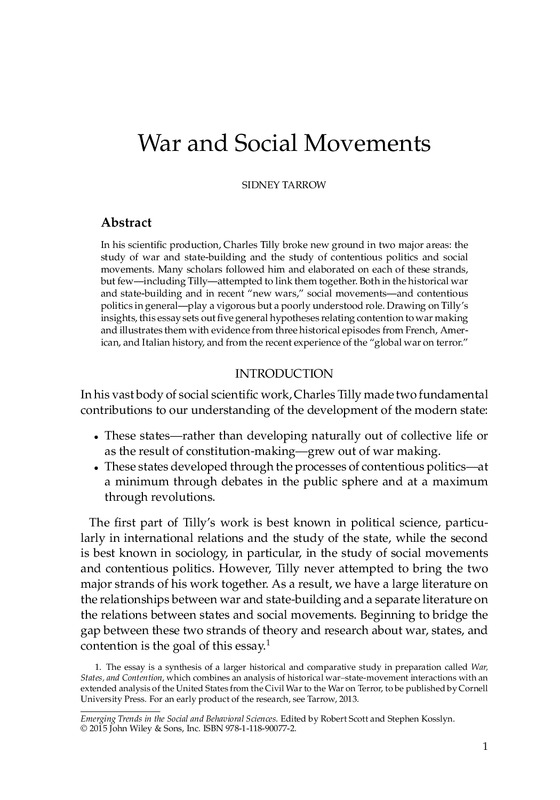
 War and Social Movements