-
Title
-
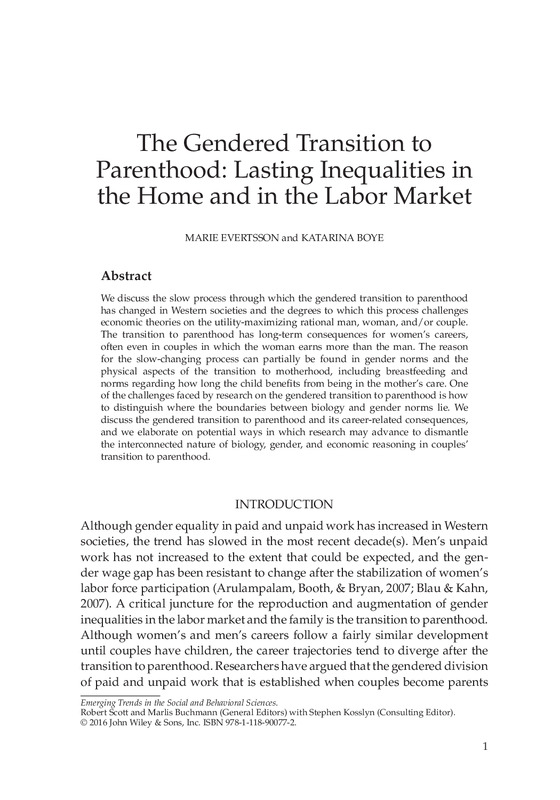
The Gendered Transition to Parenthood: Lasting Inequalities in the Home and in the Labor Market
-
Author
-
Evertsson, Marie
-
Boye, Katarina
-
Research Area
-
Class, Status and Power
-
Topic
-
Gender and Gender Inequality
-
Abstract
-
We discuss the slow process through which the gendered transition to parenthood has changed in Western societies and the degrees to which this process challenges economic theories on the utility‐maximizing rational man, woman, and/or couple. The transition to parenthood has long‐term consequences for women's careers, often even in couples in which the woman earns more than the man. The reason for the slow‐changing process can partially be found in gender norms and the physical aspects of the transition to motherhood, including breastfeeding and norms regarding how long the child benefits from being in the mother's care. One of the challenges faced by research on the gendered transition to parenthood is how to distinguish where the boundaries between biology and gender norms lie. We discuss the gendered transition to parenthood and its career‐related consequences, and we elaborate on potential ways in which research may advance to dismantle the interconnected nature of biology, gender, and economic reasoning in couples' transition to parenthood.
-
Related Essays
-
The Underrepresentation of Women in Elective Office (Political Science), Sarah F. Anzia
-
Rent, Rent‐Seeking, and Social Inequality (Sociology), Beth Red Bird and David B. Grusky
-
The Sexual Division of Labor (Anthropology), Rebecca Bliege Bird and Brian F. Codding
-
Stereotype Content (Sociology), Beatrice H. Capestany and Lasana T. Harris
-
Why So Few Women in Mathematically Intensive Fields? (Psychology), Stephen J. Ceci and Wendy M. Williams
-
Gender, Religion, and State in the Middle East (Sociology), Mounira M. Charrad and Amina Zarrugh
-
Misinformation and How to Correct It (Psychology), John Cook et al.
-
Cognitive Processes Involved in Stereotyping (Psychology), Susan T. Fiske and Cydney H. Dupree
-
Controlling the Influence of Stereotypes on One's Thoughts (Psychology), Patrick S. Forscher and Patricia G. Devine
-
Changing Family Patterns (Sociology), Kathleen Gerson and Stacy Torres
-
Family Relationships and Development (Psychology), Joan E. Grusec
-
The Future of Employment, Wages, and Technological Change (Economics), Michael J. Handel
-
Divorce (Sociology), Juho Härkönen
-
Grandmothers and the Evolution of Human Sociality (Anthropology), Kristen Hawkes and James Coxworth
-
The Reorganization of Work (Sociology), Charles Heckscher
-
Gender Segregation in Higher Education (Sociology), Alexandra Hendley and Maria Charles
-
Family Formation in Times of Labor Market Insecurities (Sociology), Johannes Huinink
-
Transformation of the Employment Relationship (Sociology), Arne L. Kalleberg and Peter V. Marsden
-
Maternal and Paternal Employment across the Life Course (Sociology), Michaela Kreyenfeld
-
Women Running for Office (Political Science), Jennifer L. Lawless
-
The Future of Marriage (Sociology), Elizabeth Aura McClintock
-
Gender Inequality in Educational Attainment (Sociology), Anne McDaniel and Claudia Buchmann
-
Gender and Women's Influence in Public Settings (Political Science), Tali Mendelberg et al.
-
Returns to Education in Different Labor Market Contexts (Sociology), Klaus Schöemann and Rolf Becker
-
Gender and the Transition to Adulthood: A Diverse Pathways View (Sociology), Ingrid Schoon
-
Family Income Composition (Sociology), Kristin E. Smith
-
Transnational Work Careers (Sociology), Roland Verwiebe
-
Gender and Work (Sociology), Christine L. Williams and Megan Tobias Neely
-
Recent Demographic Trends and the Family (Sociology), Lawrence L. Wu
-
Identifier
-
etrds0399
-
extracted text
-
The Gendered Transition to
Parenthood: Lasting Inequalities in
the Home and in the Labor Market
MARIE EVERTSSON and KATARINA BOYE
Abstract
We discuss the slow process through which the gendered transition to parenthood
has changed in Western societies and the degrees to which this process challenges
economic theories on the utility-maximizing rational man, woman, and/or couple.
The transition to parenthood has long-term consequences for women’s careers,
often even in couples in which the woman earns more than the man. The reason
for the slow-changing process can partially be found in gender norms and the
physical aspects of the transition to motherhood, including breastfeeding and
norms regarding how long the child benefits from being in the mother’s care. One
of the challenges faced by research on the gendered transition to parenthood is how
to distinguish where the boundaries between biology and gender norms lie. We
discuss the gendered transition to parenthood and its career-related consequences,
and we elaborate on potential ways in which research may advance to dismantle
the interconnected nature of biology, gender, and economic reasoning in couples’
transition to parenthood.
INTRODUCTION
Although gender equality in paid and unpaid work has increased in Western
societies, the trend has slowed in the most recent decade(s). Men’s unpaid
work has not increased to the extent that could be expected, and the gender wage gap has been resistant to change after the stabilization of women’s
labor force participation (Arulampalam, Booth, & Bryan, 2007; Blau & Kahn,
2007). A critical juncture for the reproduction and augmentation of gender
inequalities in the labor market and the family is the transition to parenthood.
Although women’s and men’s careers follow a fairly similar development
until couples have children, the career trajectories tend to diverge after the
transition to parenthood. Researchers have argued that the gendered division
of paid and unpaid work that is established when couples become parents
Emerging Trends in the Social and Behavioral Sciences.
Robert Scott and Marlis Buchmann (General Editors) with Stephen Kosslyn (Consulting Editor).
© 2016 John Wiley & Sons, Inc. ISBN 978-1-118-90077-2.
1
�2
EMERGING TRENDS IN THE SOCIAL AND BEHAVIORAL SCIENCES
is the single most important reason for lasting gender inequalities in the
labor market. The remaining gender wage gap, which seems impossible to
eliminate, despite women’s increasing educational credentials, professional
experience, and work hours (Arulampalamet al., 2007), has been proposed
as support for this assumption. Furthermore, a growing body of research is
finding associations between fathers’ engagement in the care of their small
children and the father–child relationship later in the children’s lives. The
more involved fathers have been in childcare, as indicated by parental leave
uptake, the more satisfied they seem to be with the relationship with the child
(Haas & Hwang, 2008), and the more frequent the contact they have with
their children after a divorce or separation (Duvander & Jans, 2009; Westphal,
Poortman, & van der Lippe, 2014). Fathers who have taken longer parental
leaves also subsequently perform more care work and housework (Almqvist
& Duvander, 2014; Nepomnyaschy & Waldfogel, 2007). In this context, an
intriguing question is why the gendered division of care work and labor
market work remains, despite its consequences for women’s careers and its
presumed links with men’s relationships with their children.
In an international context, the degree to which mothers return to the
job that they had before the birth of the child or quit work entirely varies
with social policies and gender culture, among other things (cf. Steiber &
Haas, 2012; Uunk, 2015). Not least important are the family leave policies
that are in place in the countries in focus and the length of any maternity,
paternity, and parental leave made available to parents. In countries where
job-protected leaves are moderate to long and include some financial
compensation, women find it easier to return to the job that they had before
the birth of the child (compared to countries in which such leaves are very
short and/or unpaid) (cf. Pettit & Hook, 2005). The availability of childcare
is also of vital importance. When spots in day care centers are scarce and/or
their costs are high, women in low-paid jobs may have little reason to go
back to paid work, to the detriment of their economic independence and
causing considerable financial vulnerability in the event of divorce. Higher
educated women return to paid work faster after a parental leave than lower
educated women but may have difficulties pursuing their career if they are
the parents taking the main responsibility for childcare (for instance, by
working part-time) (e.g., Aisenbrey, Evertsson, & Grunow, 2009).
Undoubtedly, there is variation in the extent to which women choose to
and want to stay home to care for a child. In research on the gendered transition to parenthood, it is important to separate any preferences to stay home
with a child and scale down the career from the structures that force some
women to do so against their will. Although it is often very difficult, it is
important to separate women’s choices and more or less voluntary behavior
from potential employers’ discrimination toward women and/or mothers.
�The Gendered Transition to Parenthood
3
This issue brings us to the very forefront of the research field, highlighting
some of the challenges with which contemporary scholars struggle and the
more intriguing solutions that may lie ahead.
We focus on the transition to parenthood and discuss why this issue
remains a gendered experience in all Western societies, including the Nordic
countries, which are considered to be among the most gender-equal in
the world. Our focus is on general trends at the national and international
levels. The transition to parenthood may have implications other than those
suggested here for women and men in non-Western societies and in specific
groups within Western countries. For example, earlier longitudinal research
indicates variation in the extent to which (changes in) the number of children
and the time spent on housework influence wages among ethnic majority
groups versus minority groups [for a comparison among white, black, and
Hispanic women in the United States, see Parrott (2014)]. Although such
variation and its implications are certainly important, we use the limited
space that we have at our disposal to focus on the major trends. In other
words, the findings that we describe and discuss are of most relevance for the
majority groups in their respective societies, and although the perspective
of intersectionality is important, we refrain from developing it here.
Dividing the essay into three parts, we first discuss theories and research
on women’s and men’s career breaks and care leaves connected to childbirth
and, second, discuss how these career breaks influence women’s careers,
income, and wages. We end by providing some suggestions for how the
research field may develop and explore potential new grounds in the future.
A CHILD IS BORN—WHO CARES?
The delivery and labor connected to giving birth are supervised by professionals in public hospitals but are considered to be one of the most private
moments that a couple can share. As the family returns home, friends
and family line up to congratulate them and celebrate the newborn. The
transition to parenthood is framed by the institutional context, norms,
and expectations. According to the current discourses on parenthood, the
fact that the (biological) mother is the parent who has carried the child
during pregnancy and—in most cases—breastfeeds it during its first few
months creates a special bond between the mother and child, a bond that is
considered to come naturally, almost automatically (Evertsson & Grunow,
2016; Miller, 2007). In contrast, according to this view, the father–child bond
needs to be actively built and constructed. To some extent, it also seems to be
the mother’s duty to ensure that this bond is created and facilitated (Alsarve,
Boye, & Roman, 2016). Given that the mother is the first (and, often, main)
carer of the child, she may appear as an expert, which could scare off the
�4
EMERGING TRENDS IN THE SOCIAL AND BEHAVIORAL SCIENCES
father. We find examples of these different perceptions of the respective
bonds between the child and its mother and father in interviews with
European parents-to-be (Grunow & Evertsson, 2016). Parents frequently
have varying ideas on what is needed for the father–child bond to be created
and maintained. In some contexts, the father spending some time with
the child together with the mother in evenings after work is considered
sufficient, whereas in others, the father spending considerable time on his
own with the child is deemed important. Apart from potential financial
concerns, which are further discussed below, individual and societal norms
with regard to the “good” mother/father and ideals with regard to the
child’s best interests structure the division of care work and the degree to
which the mother and father will spend time away from paid work to care
for the small child.
SPECIALIZATION, RELATIVE RESOURCES/BARGAINING AND THE
SOCIAL CONSTRUCTION OF GENDER
One important reason why couples may divide the care work and paid work
unequally is that doing so is frequently financially rational for the family. On
average, men earn more than women do, and fathers’ labor market prospects
may be better than women’s are. According to Becker (1981), couples benefit
when one of the spouses specializes in paid work and the other specializes in
care work and housework. Given that people become better at doing things
they do often, it would be financially rational for the family as a whole if,
for instance, the man was allowed to specialize in paid work if he were the
parent earning the most in the family. This perspective seems reasonable to
the extent that it may be financially beneficial for the couple to let the person
who earns the least take the longest parental leave and/or work part-time,
if needed, when the children are small. Nevertheless, in the long run, it is
seldom the case that full-blown specialization by one of the spouses in unpaid
work and care would benefit the family or the person specializing in this
work. When childcare is cheap and the mother’s wage is comparable to the
father’s, the family benefits the most financially if both spouses work in paid
labor once any maternity/parental leave is exhausted.
Another perspective, related to the former but acknowledging the power
differences arising in couples in which one spouse earns more than the other,
is the relative resource or bargaining perspective (Blood & Wolfe, 1960; Lundberg & Pollak, 1996). According to this perspective, the resources in terms of
income and status that each person possesses govern the division of paid
and unpaid work in the family. The person with the greater resources has a
benefit in negotiations in the family, with the results that he/she negotiates
a smaller share of the unpaid work compared to the partner who earns less.
�The Gendered Transition to Parenthood
5
The relative resource/bargaining perspective has been tested in studies on
coupled women’s and men’s time spent on housework. Nevertheless, it is
less clear whether we can assume that time spent with children is also influenced by relative resources. It seems reasonable to expect that, to some extent,
all parents would like to spend time with their children. However, parents
also value their paid work and the total family income. Hence, it would continue to be financially rational for the couple to allow the person earning the
most to spend the least amount of time in housework and care work. According to this perspective, we would not expect pure specialization but rather
greater or smaller shares of care and unpaid work, depending on the relative
resources of the individuals in question.
A third perspective suggests that neither specialization theory nor the relative resource/bargaining perspective can explain the division of paid and
unpaid work. Instead, the performance of care work and housework signals
gender and can be used as a way of socially constructing or doing gender
(Fenstermaker Berk, 1985; West & Zimmerman, 1987). According to this perspective, with the goal of being accepted by the social environment, people
continuously recreate gender in all of their social interactions. Performing
care work and housework is one way to do the female gender, whereas the
male gender may be done by performing other types of work (and even by
avoiding performing care work and housework). For example, a woman and
a man in a relationship may divide care work and housework traditionally
to send socially agreed-upon signals about their gender both to each other
and to the people around them.
Much as gender is done in social interaction, so are motherhood and fatherhood. To a far greater extent than fathers, mothers continue to be expected
to be guided primarily by the ethics of the child’s best interests, even when
they work as many hours in paid work as men do (Hays, 1996; Ribbens
McCarthy, Edwards, & Gillies, 2000). Motherhood comes with an expectation of self-sacrifice that tends to be associated with feelings of guilt. To be
a “good” mother and, ultimately, a “real” woman, a mother is expected to
structure her life around her children and to relinquish any activities that may
benefit her, such as paid work and leisure, if they are not beneficial to her children (Elvin-Nowak & Thomsson, 2001; Miller, 2007). By contrast, fathers can
draw on several discourses that provide alternative positions in relation to
fatherhood (Miller, 2012). Drawing on the traditional provider role, fathers
want or feel a need to spend sufficient time and energy on paid work to
economically provide for the family. Although doing so may mean a great
amount of time and energy for some fathers, self-sacrifice in itself, that is,
relinquishing activities and interests that are not associated with the child’s
well-being, is not traditionally demanded of a “good” father. Fathers may
�6
EMERGING TRENDS IN THE SOCIAL AND BEHAVIORAL SCIENCES
also draw on a “new fatherhood” discourse that brings with it the expectations that fathers will be more actively involved in childcare, although not
always to the same degree or in the same ways as mothers [Björk (2013)
on Sweden, Magaraggia (2012) on Italy, Miller (2012) on the United Kingdom, and Grunow & Evertsson (2016) on several European countries]. Hence,
to a large extent, fatherhood and motherhood remain different social constructs that frame not only the expectations from their social environment
that mothers and fathers meet but also the expectations that they have of
themselves as parents. These expectations and gender norms have a bearing
on women’s return to paid work after a family leave (when to return and for
how many hours) and structure women’s and men’s short- and long-term
career prospects.
CAREER-RELATED CONSEQUENCES OF PARENTAL (OR FAMILY)
LEAVE TAKING1
There is ample evidence in Western societies for motherhood penalties and
fatherhood premiums in terms of wage and career (Bygren & Gähler, 2012;
Cooke, 2014; Gangl & Ziefle, 2009; Hodges & Budig, 2010; Sigle-Rushton &
Waldfogel, 2007). Mothers tend to earn lower wages and have smaller career
opportunities, such as less access to supervisory positions, than do women
without children. Correspondingly, the fatherhood premium implies higher
wages and better career prospects among fathers than among other men. The
presence and strength of these penalties and premiums vary between countries. In the Nordic countries, studies tends to find fatherhood premiums but
no or only small motherhood penalties (Bygren & Gähler, 2012; Petersen,
Penner, & Høgsnes, 2014). Some Swedish studies even find higher wages
among mothers than among nonmothers (Boschini, Håkanson, Rosén, & Sjögren, 2011; Magnusson & Nermo, 2014). Selectivity into paid work and into
motherhood is low in Sweden (where fertility rates are close to replacement
level). In contexts in which female employment is high and parental leave
policies are generous, statistical discrimination against women of fertile age
may be greater than any discrimination between mothers and nonmothers
(cf. Mandel & Semyonov, 2005; Ruhm, 1998).
The disadvantages faced by mothers in the labor market compared to
women without children or compared to men and fathers are linked to their
lower labor market activity due to care responsibilities, not least of which
are caused by parental leave. Job-protected, earnings-related parental leave
facilitates mothers’ remaining in the labor market, and it has contributed to
1 Leaves to care for a child are not always supported by social policies such as parental leave. We
indicate this point by referring to family leaves in this heading, but in the following, we use the term
parental leave to also include family leaves.
�The Gendered Transition to Parenthood
7
high labor market participation, particularly for mothers with less education
(Korpi, Ferrarini, & Englund, 2013). However, there are thresholds for
when job-protected leaves become too long that make it difficult for women
to return to the same job. A study by Pettit and Hook (2005) shows that
although parental leave rights are positively linked to increased female
labor force participation at the country level, parental leaves of 3 years or
more discourage employment among women with small children. Hence,
in countries where the job-protected parental leave is long, women have
difficulties returning to paid work after the leave period is over. The length
of the parental leave break also influences women’s prospects in the labor
market upon returning to work (Aisenbrey et al., 2009; Gangl & Ziefle, 2009).
Aisenbrey et al. show that in the United States, where women’s national
job-protected leaves are short and where the Family and Medical Leave
Act gives parents the right to 3 months of unpaid leave, even short periods
away from paid work are detrimental to women’s careers. In Sweden, where
parents can share 16 months of leave between them and norms suggest that
children should not start day care before 1 year of age, women’s careers
are less affected by a parental leave break and are affected only for those
taking more than a year of leave. The latter group experiences a reduced
transition intensity to higher-prestige jobs, but no discernible increase in the
risk of downward mobility is observed (Aisenbreyet al., 2009; Evertsson &
Duvander, 2011).
Theoretical explanations of why care-related absences tend to be linked
to negative labor market outcomes relate to human capital theory and
employers’ expectations of employees. Human capital is the knowledge
and skills required during education and work experience. During work
interruptions, human capital does not increase and may even deteriorate due
to, for example, missed on-the-job training and any changes to old routines
or technologies (Mincer & Polachek, 1974). According to this perspective,
human capital loses more in value the longer an employee is away from
work. If human capital depreciation were the only explaining factor for any
lower wages among those with work interruptions, all absences from the
labor market would have a similar association with labor market outcomes,
regardless of the reason for the absence (provided that the leave were not
due to training or further education). However, studies of wage effects
have found differences between different forms of absence, such as between
different forms of care-related leaves and unemployment (Albrecht, Edin,
Sundström, & Vroman, 1999; S.V. Arun, T. Arun, & Borooah, 2004; Theunissen, Verbruggen, Forrier, & Sels, 2011). The association is also stronger for
men than it is for women (Albrecht et al., 1999; Theunissen et al., 2011) and
has been found to be nonlinear among men (Evertsson, 2016). Therefore,
�8
EMERGING TRENDS IN THE SOCIAL AND BEHAVIORAL SCIENCES
factors other than human capital depreciation are likely to influence the link
between care leaves and wages.
One theory that, to some extent, challenges the assumptions of human
capital theory is signaling theory. Signaling theory suggests that employers
may perceive a career break as a signal of work commitment (Spence,
1973, see also Albrecht et al., 1999). Relatedly, the wage- and career-related
consequences of any work interruptions may vary, depending on the reason
for the interruption and the degree to which an interruption is perceived as
voluntary (Ketsche & Branscomb, 2003). In this context, men’s parental leave
taking may be perceived as more voluntary than women’s parental leave
taking and, as a result, men may be punished more due to taking parental
leave compared to other forms of leave (Albrecht et al., 1999).
Another theory that has implications for how employers value the transition to parenthood and any care-related leaves is expectation states theory.
According to Ridgeway and Correll (2004), care work is devalued in society
and, therefore, mothers, who carry the main responsibility for this type of
work, are accorded a lower status than are nonmothers and men. Motherhood can be a signal that leads to expectations that a person puts less effort
into work and is less capable. For example, mothers may be expected to be
unwilling to work overtime and/or likely to leave work on short notice, for
instance, when a child falls ill. By contrast, fathers are expected to be less
engaged in care work and to be more committed employees due to their
traditional breadwinner role and greater financial burden (i.e., providing for
a spouse and children). Consequently, the implication is that fathers are more
deserving of status than are men without children (Ridgeway & Correll,
2004). If men take parental leave, then this behavior may be interpreted as a
signal that they do a large share of the childcare in the household. By taking
leave, they violate the conventional masculinity norms and the norms that
portray fathers as the dependable financial providers for their families (cf.
Acker, 1990; Connell, 1995).
Although there are undoubtedly other theories of relevance in regard to
explaining the career-related consequences of the gendered transition to parenthood, these are some of the most prominent. However, it is important to
note that human capital theory is the only theory that, ideally, should be of
any relevance to the career-related consequences of parental leaves and family leave breaks. Any devaluation of care should not influence wages, and if
commitment to the job is unaffected by any accumulated leave, then signaling effects should be unaffected as well.
To summarize, norms with regard to “good” mothering and fathering have
different meanings in the workplace and in the home. They influence parents’
division of care work and paid work and the manner in which family, friends,
and employers (who expect men to take little responsibility for care) respond
�The Gendered Transition to Parenthood
9
to this division of work. Gender norms are internalized and imperative to
our way of socially constructing motherhood and fatherhood. They influence how we act and the responses that we receive because of our actions,
whether we like it or not, and whether we attempt to oppose the norms or not.
Thinking in terms of social change and increasing gender equality, the greatest challenge seems to be relaxing the expectations placed on mothers to be
self-sacrificing carers and instead raising the expectations placed on fathers.
If fathers take a greater share of the leaves to care for small children, then any
statistical discrimination against women in the labor market should decrease
and the benefits to employers of using parental leave as a signal of work commitment should diminish. However, achieving changes along these lines is
not an easy task; therefore, we argue for a stronger research focus on what
we perceive to be examples of when norms with regard to “good” parenting
hinder mothers from realizing their true and desired potential in their work
lives. Similarly, we should devote special attention to the social structures,
norms, and institutions that prevent fathers from realizing their full potential as carers. In the following, we provide some suggestions regarding how
research may respond to this challenge.
THOUGHTS ON A FORWARD-REACHING FRAMEWORK
Although theories on relative resources/bargaining and specialization have
been proposed to explain the gendered division of paid and unpaid work
in the household, their applicability in regard to explaining the gendered
transition to parenthood and parents’ division of care and labor market
work in Western societies is more questionable. Nevertheless, parents
often claim that financial considerations are among the main reasons why
mothers, not fathers, spend time away from work on care (Almqvist, 2008;
Schmidt, Rieder, Zartler, Schadler, & Richter, 2015). It is more beneficial
for the person earning the most to invest more in paid work. According to
a conflicting theory, it is the doing of gender and the gender norms that
govern what is considered “good” mothering and fathering that are of
most importance. Mothers are often perceived to be the main and most
important carers, at least during the period of infancy, and frequently,
there is variation in parents’ perceptions with regard to the point at which
the child is considered able to be comfortably separated from its mother
(Grunow & Evertsson, 2016; Miller, 2007, 2012). In an attempt to disentangle
the prioritization of gender norms on parenting from financially rational
decision-making, we propose the inclusion of same-sex parents in studies
of gendered parenthood and labor market outcomes. By studying the extent
to which the sex of the spouse determines how motherhood and fatherhood
are socially constructed, researchers can begin to disentangle the processes
�10
EMERGING TRENDS IN THE SOCIAL AND BEHAVIORAL SCIENCES
related to the reproduction of gender in the family and the labor market,
employer expectations, potential discrimination, and the physical aspects
of childbirth and breastfeeding. Such studies would specifically focus on
the transition to parenthood for biological mothers to explore the extent to
which the sex of the partner influences the mother’s parental leave taking,
care work, and subsequent labor market outcomes.
First, researchers could ask how the formation of motherhood and fatherhood identities interacts with biology to produce a division of paid work
and care work in families with small children. Controlling for significant
background characteristics, to what extent is an equal division of care (e.g.,
parental leave uptake) and paid work more common in same-sex couples
than in heterosexual couples? With a focus on biological mothers, there
should be no systematic differences in the extent to which they need to
recover from birth in the two groups of couples.
Second, by focusing on the link between own care leaves and wages in the
full group of mothers (comparing biological to nonbiological mothers in heterosexual and same-sex couples), studies have the potential to reveal any
unfavorable treatment on the part of employers toward biological mothers
compared to mothers who have not carried the child. A comparison of the
wage outcome for leave taking among fathers and nonbiological mothers
could also put the results in perspective and contribute to our understanding
of motherhood penalties versus fatherhood premiums.
Studies such as those suggested above undoubtedly have limitations.
Same-sex couples are special to the extent that—among other reasons—on
average, they may have been working harder to become parents than many
heterosexual couples do. This factor may have implications for their sharing
of parental and care leaves. In addition, they may undoubtedly be exposed
to other types of discrimination compared to heterosexual women and
men. Nevertheless, studies indicate that, on average, homosexual women
have higher wages than heterosexual women do (Waite & Denier, 2015).
By controlling for wage levels before birth, selectivity issues such as these
should be diminished when biological mothers in same-sex couples are
compared to those in heterosexual couples. A second limiting factor is data
availability. To conduct studies such as these, large-scale data that include a
sufficiently large group of same-sex respondents for researchers to arrive at
well-founded statistical results and conclusions are required.
The transition to parenthood is a complex and life-changing process.
Studying it in detail requires innovative and, occasionally, complicated
methods and research designs. Therefore, we would like to conclude with
a few remarks regarding the potential benefits of combining statistical
methods and large-scale quantitative studies with small-scale, in-depth
interview studies. Both have their benefits and disadvantages, and given the
�The Gendered Transition to Parenthood
11
ways in which they may complement each other, we should not be afraid of
considering a multi- or mixed-methods approach if such an approach has the
potential to answer a given research question. One method by which to learn
more about the complex process of the transition to parenthood is combining
research on quantitative, longitudinal studies with qualitative, longitudinal
in-depth interviews. By focusing on longitudinal data and interviews,
researchers will be able to capture more fully the process without having to
lean on retrospective accounts that may be biased due to recall error and
adaptive preferences. Using fixed-effect models in large-scale, quantitative
studies, researchers can control for over time stable characteristics that
may influence selectivity into parenthood and its work-related outcome.
In addition, small-scale qualitative studies can be used as a complement.
Although they do not allow generalizations to the full population, they give
us a unique understanding of some of the plans, expectations, norms, ideals,
and institutions that frame how parents talk about and negotiate their way
through the transition to parenthood and “become” mothers and fathers.
REFERENCES
Acker, J. (1990). Hierarchies, jobs, bodies: A theory of gendered organizations. Gender
& Society, 4, 139–158.
Aisenbrey, S., Evertsson, M., & Grunow, D. (2009). Is there a career penalty for mothers’ time out? A comparison of Germany, Sweden and the United States. Social
Forces, 88, 573–605.
Albrecht, J. W., Edin, P.-A., Sundström, M., & Vroman, S. B. (1999). Career interruptions and subsequent earnings: A reexamination using Swedish data. The Journal
of Human Resources, 34(2), 294–311.
Almqvist, A.-L. (2008). Why most Swedish fathers and few French fathers use
paid parental leave: An exploratory qualitative study of parents. Fathering, 6(2),
192–200.
Almqvist, A.-L., & Duvander, A.-Z. (2014). Changes in gender equality? Swedish
fathers’ parental leave, division of childcare and housework. Journal of Family Studies, 20(1), 19–27.
Alsarve, J., Boye, K., & Roman, C. (2016). The crossroads of equality and biology. The
child’s best interest and constructions of motherhood and fatherhood in SwedenChapter 4. In D. Grunow & M. Evertsson (Eds.), Couples’ transitions to parenthood:
Analysing gender and work in Europe. Celtenham, UK: Edward Elgar Publishing.
Arulampalam, W., Booth, A. L., & Bryan, M. L. (2007). Is there a glass ceiling over
Europe? Exploring the gender pay gap across the wage distribution. Industrial and
Labor Relations Review, 60(2), 163–186.
Arun, S. V., Arun, T., & Borooah, V. K. (2004). The effect of career breaks on the working lives of women. Feminist Economics, 10(1), 65–84.
Becker, G. S. (1981). A treatise on the family. Cambridge, MA: Harvard University
Press.
�12
EMERGING TRENDS IN THE SOCIAL AND BEHAVIORAL SCIENCES
Björk, S. (2013). Doing morally intelligible fatherhood: Swedish fathers’ accounts of
their parental part-time work choices. Fathering, 11(2), 221–237.
Blau, F. D., & Kahn, L. M. (2007). The gender pay gap: Have women gone as far as
they can? Academy of Management Perspectives, 21(1), 7–23.
Blood, R. O., & Wolfe, D. M. (1960). Husbands and wives. Glencoe, IL: Free Press.
Boschini, A., Håkanson, C., Rosén, Å., & Sjögren, A. (2011). Trading off or having it all?
Completed fertility and mid-career earnings of Swedish men and women. IFAU working
paper 2011, p. 15.
Bygren, M., & Gähler, M. (2012). Family formation and men’s and women’s attainment of workplace authority. Social Forces, 90(3), 795–816.
Connell, R. W. (1995). Masculinities. Cambridge, MA: Polity.
Cooke, L. P. (2014). Gendered parenthood penalties and premiums across the Earnings distribution in Australia, the United Kingdom, and the United States. European Sociological Review, 30(3), 360–372.
Duvander, A.-Z., & Jans, A.-C. (2009). Consequences of fathers’ parental leave use:
Evidence from Sweden. Finnish Yearbook of Population Research, 44, 49–62.
Elvin-Nowak, Y., & Thomsson, H. (2001). Motherhood as idea and practice. A discursive understanding of employed mothers in Sweden. Gender & Society, 15(3),
407–428.
Evertsson, M. (2016). Parental leave and careers—women and men’s
wages after parental leave in Sweden. Advances in Life Course Research
10.1016/j.alcr.2016.02.002.
Evertsson, M., & Duvander, A.-Z. (2011). Parental leave—possibility or trap? Does
family leave length affect Swedish women’s labor market opportunities? European
Sociological Review, 27, 435–450.
Evertsson, M., & Grunow, D. (2016). Narratives on the transition to parenthood
in eight European countries. The importance of gender culture and welfare
regimeChapter 12. In D. Grunow & M. Evertsson (Eds.), Couples’ transitions to
parenthood: Analysing gender and work in Europe. Celtenham, UK: Edward Elgar
Publishing.
Fenstermaker Berk, S. (1985). The gender factory. The apportionment of work in American
households. New York, NY: Plenum Press.
Gangl, M., & Ziefle, A. (2009). Motherhood, labor force behavior and women’s
careers: An empirical assessment of the wage penalty for motherhood in Britain,
Germany, and the United States. Demography, 46(2), 341–369.
Grunow, D., & Evertsson, M. (Eds.) (2016). Couples’ transitions to parenthood: Analysing
gender and work in Europe. Edward Elgar Publishing.
Haas, L., & Hwang, C. P. (2008). The impact of taking parental leave on fathers’
participation in childcare and relationships with children: Lessons from Sweden.
Community, Work & Family, 11(1), 85–104.
Hays, S. (1996). The cultural contradictions of motherhood. New Haven, USA: Yale University Press.
Hodges, M. J., & Budig, M. J. (2010). Who gets the daddy bonus? Organizational
hegemonic masculinity and the impact of fatherhood on earnings. Gender & Society, 24(6), 717–745.
�The Gendered Transition to Parenthood
13
Ketsche, P. G., & Branscomb, L. (2003). The long-term costs of career interruptions.
Journal of Health Care Management, 48(1), 30–44.
Korpi, W., Ferrarini, T., & Englund, S. (2013). Women’s opportunities under different family policy constellations: Gender, class, and inequality tradeoffs in Western
countries re-examined. Social Politics, 20(1), 1–40.
Lundberg, S., & Pollak, R. A. (1996). Bargaining and distribution in marriage. The
Journal of Economic Perspectives, 10, 139–158.
Magaraggia, S. (2012). Tensions between fatherhood and the social construction of
masculinity in Italy. Current Sociology, 61(1), 76–92.
Magnusson, C., & Nermo, M. (2014). Familjeansvar och könslöneskillnader. In
K. Boye & M. Nermo (Eds.), Lönsamt arbete—familjeansvarets fördelning och konsekvenser (pp. 227–255. Research report for the Delegation for Gender Equality in
Working Life. SOU 2014:28). Stockholm: Fritzes.
Mandel, H., & Semyonov, M. (2005). Family policies, wage structures, and gender
gaps: Source of earnings inequality in 20 countries. American Sociological Review,
70, 949–967.
Miller, T. (2007). Is this what motherhood is all about? Weaving experiences and
discourse through transition to first-time motherhood. Gender & Society, 21(3),
337–358.
Miller, T. (2012). Balancing caring and paid work in the UK: Narrating ‘choices’ as
first-time parents. International Review of Sociology, 22(1), 39–52.
Mincer, J., & Polachek, S. (1974). Family investments in human capital: Earnings of
women. The Journal of Political Economy, 82(2 Part 2:), 76–108.
Nepomnyaschy, L., & Waldfogel, J. (2007). Paternity leave and fathers’ involvement
with their young children. Community, Work & Family, 10(4), 427–453.
Parrott, H. M. (2014). Housework, children, and women’s wages across racial–ethnic
groups. Social Science Research, 46, 72–84.
Petersen, T., Penner, A. M., & Høgsnes, G. (2014). From motherhood penalties to
husband premia: The new challenge for gender equality and family policy, lessons
from Norway. American Journal of Sociology, 119(5), 1434–1472.
Pettit, B., & Hook, J. (2005). The structure of women’s employment in comparative
perspective. Social Forces, 84(2), 779–801.
Ribbens McCarthy, J., Edwards, R., & Gillies, V. (2000). Moral tales of the child and
the adult: Narratives of contemporary family lives under changing circumstances.
Sociology, 34(4), 785–803.
Ridgeway, C. L., & Correll, S. J. (2004). Motherhood as a status characteristic. Journal
of Social Issues, 60(4), 683–700.
Ruhm, C. R. (1998). The economic consequences of parental leave mandates: Lessons
from Europe. The Quarterly Journal of Economics, 113(1), 285–317.
Schmidt, E.-M., Rieder, I., Zartler, U., Schadler, C., & Richter, R. (2015). Parental constructions of masculinity at the transition to parenthood: The division of parental
leave among Austrian couples. International Review of Sociology, 25(3), 373–386.
Sigle-Rushton, W., & Waldfogel, J. (2007). Motherhood and women’s earnings in
Anglo-American, Continental European, and Nordic Countries. Feminist Economics, 13(2), 55–91.
�14
EMERGING TRENDS IN THE SOCIAL AND BEHAVIORAL SCIENCES
Spence, M. (1973). Job market signaling. Quarterly Journal of Economics, 87(3), 355–374.
Steiber, N., & Haas, B. (2012). Advances in explaining women’s employment patterns. Socio-Economic Review, 10(2), 343–367.
Theunissen, G., Verbruggen, M., Forrier, A., & Sels, L. (2011). Career sidestep, wage
setback? The impact of different types of employment interruptions on wages.
Gender, Work and Organization, 18(S1), e110–e131.
Uunk, W. (2015). Does the cultural context matter? The effect of a country’s
gender-role attitudes on female labor supply. European Societies, 17(2), 176–198.
Waite, S., & Denier, N. (2015). Gay pay for straight work: Mechanisms generating
disadvantage. Gender & Society, 29(4), 561–588.
West, C., & Zimmerman, D. H. (1987). Doing gender. Gender & Society, 1, 125–151.
Westphal, S. K., Poortman, A.-R., & van der Lippe, T. (2014). Non-resident
father–child contact across divorce cohorts: The role of father involvement during
marriage. European Sociological Review, 30(4), 444–456.
MARIE EVERTSSON SHORT BIOGRAPHY
Marie Evertsson is an Associate Professor of Sociology at the Department
of Sociology, Stockholm University. She is a member of the Stockholm University Linnaeus Center on Social Policy and Family Dynamics in Europe
(SPaDE). Her research focuses on gender (in)equalities in the home and in
the labor market. In an internationally comparative perspective, her work
focuses on the link between social policies and gender culture, and how this
relates to women’s and men’s transition to parenthood and its career-related
consequences. She is the editor of Couples’ Transitions to Parenthood: Analysing
Gender and Work in Europe with Daniela Grunow (published by Edward Elgar,
2016). Her research articles have been published in journals such as European
Sociological Review, Journal of Marriage and Family, and Social Forces.
KATARINA BOYE SHORT BIOGRAPHY
Katarina Boye is a research fellow in sociology at the Swedish Institute for
Social Research. She is affiliated with the Stockholm University Linnaeus
Center on Social Policy and Family Dynamics in Europe (SPaDE). She studies
the intersection between the family and the labor market and focuses particularly on the consequences of the division of work between men and women.
She currently studies gender differences in labor market outcomes linked to
division of care, housework, and paid work. A main topic in this research is
the transition to parenthood and the social construction of motherhood and
fatherhood. Boye’s work has been published in journals such as the European
Sociological Review, Social Indicators Research, and European Societies.
�The Gendered Transition to Parenthood
15
RELATED ESSAYS
The Underrepresentation of Women in Elective Office (Political Science),
Sarah F. Anzia
Rent, Rent-Seeking, and Social Inequality (Sociology), Beth Red Bird and
David B. Grusky
The Sexual Division of Labor (Anthropology), Rebecca Bliege Bird and Brian
F. Codding
Stereotype Content (Sociology), Beatrice H. Capestany and Lasana T. Harris
Why So Few Women in Mathematically Intensive Fields? (Psychology),
Stephen J. Ceci and Wendy M. Williams
Gender, Religion, and State in the Middle East (Sociology), Mounira M.
Charrad and Amina Zarrugh
Misinformation and How to Correct It (Psychology), John Cook et al.
Cognitive Processes Involved in Stereotyping (Psychology), Susan T. Fiske
and Cydney H. Dupree
Controlling the Influence of Stereotypes on One’s Thoughts (Psychology),
Patrick S. Forscher and Patricia G. Devine
Changing Family Patterns (Sociology), Kathleen Gerson and Stacy Torres
Family Relationships and Development (Psychology), Joan E. Grusec
The Future of Employment, Wages, and Technological Change (Economics),
Michael J. Handel
Divorce (Sociology), Juho Härkönen
Grandmothers and the Evolution of Human Sociality (Anthropology), Kristen
Hawkes and James Coxworth
The Reorganization of Work (Sociology), Charles Heckscher
Gender Segregation in Higher Education (Sociology), Alexandra Hendley
and Maria Charles
Family Formation in Times of Labor Market Insecurities (Sociology), Johannes
Huinink
Transformation of the Employment Relationship (Sociology), Arne L. Kalleberg and Peter V. Marsden
Maternal and Paternal Employment across the Life Course (Sociology),
Michaela Kreyenfeld
Women Running for Office (Political Science), Jennifer L. Lawless
The Future of Marriage (Sociology), Elizabeth Aura McClintock
Gender Inequality in Educational Attainment (Sociology), Anne McDaniel
and Claudia Buchmann
Gender and Women’s Influence in Public Settings (Political Science), Tali
Mendelberg et al.
Returns to Education in Different Labor Market Contexts (Sociology), Klaus
Schöemann and Rolf Becker
�16
EMERGING TRENDS IN THE SOCIAL AND BEHAVIORAL SCIENCES
Gender and the Transition to Adulthood: A Diverse Pathways View (Sociology), Ingrid Schoon
Family Income Composition (Sociology), Kristin E. Smith
Transnational Work Careers (Sociology), Roland Verwiebe
Gender and Work (Sociology), Christine L. Williams and Megan Tobias Neely
Recent Demographic Trends and the Family (Sociology), Lawrence L. Wu
�
-
The Gendered Transition to
Parenthood: Lasting Inequalities in
the Home and in the Labor Market
MARIE EVERTSSON and KATARINA BOYE
Abstract
We discuss the slow process through which the gendered transition to parenthood
has changed in Western societies and the degrees to which this process challenges
economic theories on the utility-maximizing rational man, woman, and/or couple.
The transition to parenthood has long-term consequences for women’s careers,
often even in couples in which the woman earns more than the man. The reason
for the slow-changing process can partially be found in gender norms and the
physical aspects of the transition to motherhood, including breastfeeding and
norms regarding how long the child benefits from being in the mother’s care. One
of the challenges faced by research on the gendered transition to parenthood is how
to distinguish where the boundaries between biology and gender norms lie. We
discuss the gendered transition to parenthood and its career-related consequences,
and we elaborate on potential ways in which research may advance to dismantle
the interconnected nature of biology, gender, and economic reasoning in couples’
transition to parenthood.
INTRODUCTION
Although gender equality in paid and unpaid work has increased in Western
societies, the trend has slowed in the most recent decade(s). Men’s unpaid
work has not increased to the extent that could be expected, and the gender wage gap has been resistant to change after the stabilization of women’s
labor force participation (Arulampalam, Booth, & Bryan, 2007; Blau & Kahn,
2007). A critical juncture for the reproduction and augmentation of gender
inequalities in the labor market and the family is the transition to parenthood.
Although women’s and men’s careers follow a fairly similar development
until couples have children, the career trajectories tend to diverge after the
transition to parenthood. Researchers have argued that the gendered division
of paid and unpaid work that is established when couples become parents
Emerging Trends in the Social and Behavioral Sciences.
Robert Scott and Marlis Buchmann (General Editors) with Stephen Kosslyn (Consulting Editor).
© 2016 John Wiley & Sons, Inc. ISBN 978-1-118-90077-2.
1
�2
EMERGING TRENDS IN THE SOCIAL AND BEHAVIORAL SCIENCES
is the single most important reason for lasting gender inequalities in the
labor market. The remaining gender wage gap, which seems impossible to
eliminate, despite women’s increasing educational credentials, professional
experience, and work hours (Arulampalamet al., 2007), has been proposed
as support for this assumption. Furthermore, a growing body of research is
finding associations between fathers’ engagement in the care of their small
children and the father–child relationship later in the children’s lives. The
more involved fathers have been in childcare, as indicated by parental leave
uptake, the more satisfied they seem to be with the relationship with the child
(Haas & Hwang, 2008), and the more frequent the contact they have with
their children after a divorce or separation (Duvander & Jans, 2009; Westphal,
Poortman, & van der Lippe, 2014). Fathers who have taken longer parental
leaves also subsequently perform more care work and housework (Almqvist
& Duvander, 2014; Nepomnyaschy & Waldfogel, 2007). In this context, an
intriguing question is why the gendered division of care work and labor
market work remains, despite its consequences for women’s careers and its
presumed links with men’s relationships with their children.
In an international context, the degree to which mothers return to the
job that they had before the birth of the child or quit work entirely varies
with social policies and gender culture, among other things (cf. Steiber &
Haas, 2012; Uunk, 2015). Not least important are the family leave policies
that are in place in the countries in focus and the length of any maternity,
paternity, and parental leave made available to parents. In countries where
job-protected leaves are moderate to long and include some financial
compensation, women find it easier to return to the job that they had before
the birth of the child (compared to countries in which such leaves are very
short and/or unpaid) (cf. Pettit & Hook, 2005). The availability of childcare
is also of vital importance. When spots in day care centers are scarce and/or
their costs are high, women in low-paid jobs may have little reason to go
back to paid work, to the detriment of their economic independence and
causing considerable financial vulnerability in the event of divorce. Higher
educated women return to paid work faster after a parental leave than lower
educated women but may have difficulties pursuing their career if they are
the parents taking the main responsibility for childcare (for instance, by
working part-time) (e.g., Aisenbrey, Evertsson, & Grunow, 2009).
Undoubtedly, there is variation in the extent to which women choose to
and want to stay home to care for a child. In research on the gendered transition to parenthood, it is important to separate any preferences to stay home
with a child and scale down the career from the structures that force some
women to do so against their will. Although it is often very difficult, it is
important to separate women’s choices and more or less voluntary behavior
from potential employers’ discrimination toward women and/or mothers.
�The Gendered Transition to Parenthood
3
This issue brings us to the very forefront of the research field, highlighting
some of the challenges with which contemporary scholars struggle and the
more intriguing solutions that may lie ahead.
We focus on the transition to parenthood and discuss why this issue
remains a gendered experience in all Western societies, including the Nordic
countries, which are considered to be among the most gender-equal in
the world. Our focus is on general trends at the national and international
levels. The transition to parenthood may have implications other than those
suggested here for women and men in non-Western societies and in specific
groups within Western countries. For example, earlier longitudinal research
indicates variation in the extent to which (changes in) the number of children
and the time spent on housework influence wages among ethnic majority
groups versus minority groups [for a comparison among white, black, and
Hispanic women in the United States, see Parrott (2014)]. Although such
variation and its implications are certainly important, we use the limited
space that we have at our disposal to focus on the major trends. In other
words, the findings that we describe and discuss are of most relevance for the
majority groups in their respective societies, and although the perspective
of intersectionality is important, we refrain from developing it here.
Dividing the essay into three parts, we first discuss theories and research
on women’s and men’s career breaks and care leaves connected to childbirth
and, second, discuss how these career breaks influence women’s careers,
income, and wages. We end by providing some suggestions for how the
research field may develop and explore potential new grounds in the future.
A CHILD IS BORN—WHO CARES?
The delivery and labor connected to giving birth are supervised by professionals in public hospitals but are considered to be one of the most private
moments that a couple can share. As the family returns home, friends
and family line up to congratulate them and celebrate the newborn. The
transition to parenthood is framed by the institutional context, norms,
and expectations. According to the current discourses on parenthood, the
fact that the (biological) mother is the parent who has carried the child
during pregnancy and—in most cases—breastfeeds it during its first few
months creates a special bond between the mother and child, a bond that is
considered to come naturally, almost automatically (Evertsson & Grunow,
2016; Miller, 2007). In contrast, according to this view, the father–child bond
needs to be actively built and constructed. To some extent, it also seems to be
the mother’s duty to ensure that this bond is created and facilitated (Alsarve,
Boye, & Roman, 2016). Given that the mother is the first (and, often, main)
carer of the child, she may appear as an expert, which could scare off the
�4
EMERGING TRENDS IN THE SOCIAL AND BEHAVIORAL SCIENCES
father. We find examples of these different perceptions of the respective
bonds between the child and its mother and father in interviews with
European parents-to-be (Grunow & Evertsson, 2016). Parents frequently
have varying ideas on what is needed for the father–child bond to be created
and maintained. In some contexts, the father spending some time with
the child together with the mother in evenings after work is considered
sufficient, whereas in others, the father spending considerable time on his
own with the child is deemed important. Apart from potential financial
concerns, which are further discussed below, individual and societal norms
with regard to the “good” mother/father and ideals with regard to the
child’s best interests structure the division of care work and the degree to
which the mother and father will spend time away from paid work to care
for the small child.
SPECIALIZATION, RELATIVE RESOURCES/BARGAINING AND THE
SOCIAL CONSTRUCTION OF GENDER
One important reason why couples may divide the care work and paid work
unequally is that doing so is frequently financially rational for the family. On
average, men earn more than women do, and fathers’ labor market prospects
may be better than women’s are. According to Becker (1981), couples benefit
when one of the spouses specializes in paid work and the other specializes in
care work and housework. Given that people become better at doing things
they do often, it would be financially rational for the family as a whole if,
for instance, the man was allowed to specialize in paid work if he were the
parent earning the most in the family. This perspective seems reasonable to
the extent that it may be financially beneficial for the couple to let the person
who earns the least take the longest parental leave and/or work part-time,
if needed, when the children are small. Nevertheless, in the long run, it is
seldom the case that full-blown specialization by one of the spouses in unpaid
work and care would benefit the family or the person specializing in this
work. When childcare is cheap and the mother’s wage is comparable to the
father’s, the family benefits the most financially if both spouses work in paid
labor once any maternity/parental leave is exhausted.
Another perspective, related to the former but acknowledging the power
differences arising in couples in which one spouse earns more than the other,
is the relative resource or bargaining perspective (Blood & Wolfe, 1960; Lundberg & Pollak, 1996). According to this perspective, the resources in terms of
income and status that each person possesses govern the division of paid
and unpaid work in the family. The person with the greater resources has a
benefit in negotiations in the family, with the results that he/she negotiates
a smaller share of the unpaid work compared to the partner who earns less.
�The Gendered Transition to Parenthood
5
The relative resource/bargaining perspective has been tested in studies on
coupled women’s and men’s time spent on housework. Nevertheless, it is
less clear whether we can assume that time spent with children is also influenced by relative resources. It seems reasonable to expect that, to some extent,
all parents would like to spend time with their children. However, parents
also value their paid work and the total family income. Hence, it would continue to be financially rational for the couple to allow the person earning the
most to spend the least amount of time in housework and care work. According to this perspective, we would not expect pure specialization but rather
greater or smaller shares of care and unpaid work, depending on the relative
resources of the individuals in question.
A third perspective suggests that neither specialization theory nor the relative resource/bargaining perspective can explain the division of paid and
unpaid work. Instead, the performance of care work and housework signals
gender and can be used as a way of socially constructing or doing gender
(Fenstermaker Berk, 1985; West & Zimmerman, 1987). According to this perspective, with the goal of being accepted by the social environment, people
continuously recreate gender in all of their social interactions. Performing
care work and housework is one way to do the female gender, whereas the
male gender may be done by performing other types of work (and even by
avoiding performing care work and housework). For example, a woman and
a man in a relationship may divide care work and housework traditionally
to send socially agreed-upon signals about their gender both to each other
and to the people around them.
Much as gender is done in social interaction, so are motherhood and fatherhood. To a far greater extent than fathers, mothers continue to be expected
to be guided primarily by the ethics of the child’s best interests, even when
they work as many hours in paid work as men do (Hays, 1996; Ribbens
McCarthy, Edwards, & Gillies, 2000). Motherhood comes with an expectation of self-sacrifice that tends to be associated with feelings of guilt. To be
a “good” mother and, ultimately, a “real” woman, a mother is expected to
structure her life around her children and to relinquish any activities that may
benefit her, such as paid work and leisure, if they are not beneficial to her children (Elvin-Nowak & Thomsson, 2001; Miller, 2007). By contrast, fathers can
draw on several discourses that provide alternative positions in relation to
fatherhood (Miller, 2012). Drawing on the traditional provider role, fathers
want or feel a need to spend sufficient time and energy on paid work to
economically provide for the family. Although doing so may mean a great
amount of time and energy for some fathers, self-sacrifice in itself, that is,
relinquishing activities and interests that are not associated with the child’s
well-being, is not traditionally demanded of a “good” father. Fathers may
�6
EMERGING TRENDS IN THE SOCIAL AND BEHAVIORAL SCIENCES
also draw on a “new fatherhood” discourse that brings with it the expectations that fathers will be more actively involved in childcare, although not
always to the same degree or in the same ways as mothers [Björk (2013)
on Sweden, Magaraggia (2012) on Italy, Miller (2012) on the United Kingdom, and Grunow & Evertsson (2016) on several European countries]. Hence,
to a large extent, fatherhood and motherhood remain different social constructs that frame not only the expectations from their social environment
that mothers and fathers meet but also the expectations that they have of
themselves as parents. These expectations and gender norms have a bearing
on women’s return to paid work after a family leave (when to return and for
how many hours) and structure women’s and men’s short- and long-term
career prospects.
CAREER-RELATED CONSEQUENCES OF PARENTAL (OR FAMILY)
LEAVE TAKING1
There is ample evidence in Western societies for motherhood penalties and
fatherhood premiums in terms of wage and career (Bygren & Gähler, 2012;
Cooke, 2014; Gangl & Ziefle, 2009; Hodges & Budig, 2010; Sigle-Rushton &
Waldfogel, 2007). Mothers tend to earn lower wages and have smaller career
opportunities, such as less access to supervisory positions, than do women
without children. Correspondingly, the fatherhood premium implies higher
wages and better career prospects among fathers than among other men. The
presence and strength of these penalties and premiums vary between countries. In the Nordic countries, studies tends to find fatherhood premiums but
no or only small motherhood penalties (Bygren & Gähler, 2012; Petersen,
Penner, & Høgsnes, 2014). Some Swedish studies even find higher wages
among mothers than among nonmothers (Boschini, Håkanson, Rosén, & Sjögren, 2011; Magnusson & Nermo, 2014). Selectivity into paid work and into
motherhood is low in Sweden (where fertility rates are close to replacement
level). In contexts in which female employment is high and parental leave
policies are generous, statistical discrimination against women of fertile age
may be greater than any discrimination between mothers and nonmothers
(cf. Mandel & Semyonov, 2005; Ruhm, 1998).
The disadvantages faced by mothers in the labor market compared to
women without children or compared to men and fathers are linked to their
lower labor market activity due to care responsibilities, not least of which
are caused by parental leave. Job-protected, earnings-related parental leave
facilitates mothers’ remaining in the labor market, and it has contributed to
1 Leaves to care for a child are not always supported by social policies such as parental leave. We
indicate this point by referring to family leaves in this heading, but in the following, we use the term
parental leave to also include family leaves.
�The Gendered Transition to Parenthood
7
high labor market participation, particularly for mothers with less education
(Korpi, Ferrarini, & Englund, 2013). However, there are thresholds for
when job-protected leaves become too long that make it difficult for women
to return to the same job. A study by Pettit and Hook (2005) shows that
although parental leave rights are positively linked to increased female
labor force participation at the country level, parental leaves of 3 years or
more discourage employment among women with small children. Hence,
in countries where the job-protected parental leave is long, women have
difficulties returning to paid work after the leave period is over. The length
of the parental leave break also influences women’s prospects in the labor
market upon returning to work (Aisenbrey et al., 2009; Gangl & Ziefle, 2009).
Aisenbrey et al. show that in the United States, where women’s national
job-protected leaves are short and where the Family and Medical Leave
Act gives parents the right to 3 months of unpaid leave, even short periods
away from paid work are detrimental to women’s careers. In Sweden, where
parents can share 16 months of leave between them and norms suggest that
children should not start day care before 1 year of age, women’s careers
are less affected by a parental leave break and are affected only for those
taking more than a year of leave. The latter group experiences a reduced
transition intensity to higher-prestige jobs, but no discernible increase in the
risk of downward mobility is observed (Aisenbreyet al., 2009; Evertsson &
Duvander, 2011).
Theoretical explanations of why care-related absences tend to be linked
to negative labor market outcomes relate to human capital theory and
employers’ expectations of employees. Human capital is the knowledge
and skills required during education and work experience. During work
interruptions, human capital does not increase and may even deteriorate due
to, for example, missed on-the-job training and any changes to old routines
or technologies (Mincer & Polachek, 1974). According to this perspective,
human capital loses more in value the longer an employee is away from
work. If human capital depreciation were the only explaining factor for any
lower wages among those with work interruptions, all absences from the
labor market would have a similar association with labor market outcomes,
regardless of the reason for the absence (provided that the leave were not
due to training or further education). However, studies of wage effects
have found differences between different forms of absence, such as between
different forms of care-related leaves and unemployment (Albrecht, Edin,
Sundström, & Vroman, 1999; S.V. Arun, T. Arun, & Borooah, 2004; Theunissen, Verbruggen, Forrier, & Sels, 2011). The association is also stronger for
men than it is for women (Albrecht et al., 1999; Theunissen et al., 2011) and
has been found to be nonlinear among men (Evertsson, 2016). Therefore,
�8
EMERGING TRENDS IN THE SOCIAL AND BEHAVIORAL SCIENCES
factors other than human capital depreciation are likely to influence the link
between care leaves and wages.
One theory that, to some extent, challenges the assumptions of human
capital theory is signaling theory. Signaling theory suggests that employers
may perceive a career break as a signal of work commitment (Spence,
1973, see also Albrecht et al., 1999). Relatedly, the wage- and career-related
consequences of any work interruptions may vary, depending on the reason
for the interruption and the degree to which an interruption is perceived as
voluntary (Ketsche & Branscomb, 2003). In this context, men’s parental leave
taking may be perceived as more voluntary than women’s parental leave
taking and, as a result, men may be punished more due to taking parental
leave compared to other forms of leave (Albrecht et al., 1999).
Another theory that has implications for how employers value the transition to parenthood and any care-related leaves is expectation states theory.
According to Ridgeway and Correll (2004), care work is devalued in society
and, therefore, mothers, who carry the main responsibility for this type of
work, are accorded a lower status than are nonmothers and men. Motherhood can be a signal that leads to expectations that a person puts less effort
into work and is less capable. For example, mothers may be expected to be
unwilling to work overtime and/or likely to leave work on short notice, for
instance, when a child falls ill. By contrast, fathers are expected to be less
engaged in care work and to be more committed employees due to their
traditional breadwinner role and greater financial burden (i.e., providing for
a spouse and children). Consequently, the implication is that fathers are more
deserving of status than are men without children (Ridgeway & Correll,
2004). If men take parental leave, then this behavior may be interpreted as a
signal that they do a large share of the childcare in the household. By taking
leave, they violate the conventional masculinity norms and the norms that
portray fathers as the dependable financial providers for their families (cf.
Acker, 1990; Connell, 1995).
Although there are undoubtedly other theories of relevance in regard to
explaining the career-related consequences of the gendered transition to parenthood, these are some of the most prominent. However, it is important to
note that human capital theory is the only theory that, ideally, should be of
any relevance to the career-related consequences of parental leaves and family leave breaks. Any devaluation of care should not influence wages, and if
commitment to the job is unaffected by any accumulated leave, then signaling effects should be unaffected as well.
To summarize, norms with regard to “good” mothering and fathering have
different meanings in the workplace and in the home. They influence parents’
division of care work and paid work and the manner in which family, friends,
and employers (who expect men to take little responsibility for care) respond
�The Gendered Transition to Parenthood
9
to this division of work. Gender norms are internalized and imperative to
our way of socially constructing motherhood and fatherhood. They influence how we act and the responses that we receive because of our actions,
whether we like it or not, and whether we attempt to oppose the norms or not.
Thinking in terms of social change and increasing gender equality, the greatest challenge seems to be relaxing the expectations placed on mothers to be
self-sacrificing carers and instead raising the expectations placed on fathers.
If fathers take a greater share of the leaves to care for small children, then any
statistical discrimination against women in the labor market should decrease
and the benefits to employers of using parental leave as a signal of work commitment should diminish. However, achieving changes along these lines is
not an easy task; therefore, we argue for a stronger research focus on what
we perceive to be examples of when norms with regard to “good” parenting
hinder mothers from realizing their true and desired potential in their work
lives. Similarly, we should devote special attention to the social structures,
norms, and institutions that prevent fathers from realizing their full potential as carers. In the following, we provide some suggestions regarding how
research may respond to this challenge.
THOUGHTS ON A FORWARD-REACHING FRAMEWORK
Although theories on relative resources/bargaining and specialization have
been proposed to explain the gendered division of paid and unpaid work
in the household, their applicability in regard to explaining the gendered
transition to parenthood and parents’ division of care and labor market
work in Western societies is more questionable. Nevertheless, parents
often claim that financial considerations are among the main reasons why
mothers, not fathers, spend time away from work on care (Almqvist, 2008;
Schmidt, Rieder, Zartler, Schadler, & Richter, 2015). It is more beneficial
for the person earning the most to invest more in paid work. According to
a conflicting theory, it is the doing of gender and the gender norms that
govern what is considered “good” mothering and fathering that are of
most importance. Mothers are often perceived to be the main and most
important carers, at least during the period of infancy, and frequently,
there is variation in parents’ perceptions with regard to the point at which
the child is considered able to be comfortably separated from its mother
(Grunow & Evertsson, 2016; Miller, 2007, 2012). In an attempt to disentangle
the prioritization of gender norms on parenting from financially rational
decision-making, we propose the inclusion of same-sex parents in studies
of gendered parenthood and labor market outcomes. By studying the extent
to which the sex of the spouse determines how motherhood and fatherhood
are socially constructed, researchers can begin to disentangle the processes
�10
EMERGING TRENDS IN THE SOCIAL AND BEHAVIORAL SCIENCES
related to the reproduction of gender in the family and the labor market,
employer expectations, potential discrimination, and the physical aspects
of childbirth and breastfeeding. Such studies would specifically focus on
the transition to parenthood for biological mothers to explore the extent to
which the sex of the partner influences the mother’s parental leave taking,
care work, and subsequent labor market outcomes.
First, researchers could ask how the formation of motherhood and fatherhood identities interacts with biology to produce a division of paid work
and care work in families with small children. Controlling for significant
background characteristics, to what extent is an equal division of care (e.g.,
parental leave uptake) and paid work more common in same-sex couples
than in heterosexual couples? With a focus on biological mothers, there
should be no systematic differences in the extent to which they need to
recover from birth in the two groups of couples.
Second, by focusing on the link between own care leaves and wages in the
full group of mothers (comparing biological to nonbiological mothers in heterosexual and same-sex couples), studies have the potential to reveal any
unfavorable treatment on the part of employers toward biological mothers
compared to mothers who have not carried the child. A comparison of the
wage outcome for leave taking among fathers and nonbiological mothers
could also put the results in perspective and contribute to our understanding
of motherhood penalties versus fatherhood premiums.
Studies such as those suggested above undoubtedly have limitations.
Same-sex couples are special to the extent that—among other reasons—on
average, they may have been working harder to become parents than many
heterosexual couples do. This factor may have implications for their sharing
of parental and care leaves. In addition, they may undoubtedly be exposed
to other types of discrimination compared to heterosexual women and
men. Nevertheless, studies indicate that, on average, homosexual women
have higher wages than heterosexual women do (Waite & Denier, 2015).
By controlling for wage levels before birth, selectivity issues such as these
should be diminished when biological mothers in same-sex couples are
compared to those in heterosexual couples. A second limiting factor is data
availability. To conduct studies such as these, large-scale data that include a
sufficiently large group of same-sex respondents for researchers to arrive at
well-founded statistical results and conclusions are required.
The transition to parenthood is a complex and life-changing process.
Studying it in detail requires innovative and, occasionally, complicated
methods and research designs. Therefore, we would like to conclude with
a few remarks regarding the potential benefits of combining statistical
methods and large-scale quantitative studies with small-scale, in-depth
interview studies. Both have their benefits and disadvantages, and given the
�The Gendered Transition to Parenthood
11
ways in which they may complement each other, we should not be afraid of
considering a multi- or mixed-methods approach if such an approach has the
potential to answer a given research question. One method by which to learn
more about the complex process of the transition to parenthood is combining
research on quantitative, longitudinal studies with qualitative, longitudinal
in-depth interviews. By focusing on longitudinal data and interviews,
researchers will be able to capture more fully the process without having to
lean on retrospective accounts that may be biased due to recall error and
adaptive preferences. Using fixed-effect models in large-scale, quantitative
studies, researchers can control for over time stable characteristics that
may influence selectivity into parenthood and its work-related outcome.
In addition, small-scale qualitative studies can be used as a complement.
Although they do not allow generalizations to the full population, they give
us a unique understanding of some of the plans, expectations, norms, ideals,
and institutions that frame how parents talk about and negotiate their way
through the transition to parenthood and “become” mothers and fathers.
REFERENCES
Acker, J. (1990). Hierarchies, jobs, bodies: A theory of gendered organizations. Gender
& Society, 4, 139–158.
Aisenbrey, S., Evertsson, M., & Grunow, D. (2009). Is there a career penalty for mothers’ time out? A comparison of Germany, Sweden and the United States. Social
Forces, 88, 573–605.
Albrecht, J. W., Edin, P.-A., Sundström, M., & Vroman, S. B. (1999). Career interruptions and subsequent earnings: A reexamination using Swedish data. The Journal
of Human Resources, 34(2), 294–311.
Almqvist, A.-L. (2008). Why most Swedish fathers and few French fathers use
paid parental leave: An exploratory qualitative study of parents. Fathering, 6(2),
192–200.
Almqvist, A.-L., & Duvander, A.-Z. (2014). Changes in gender equality? Swedish
fathers’ parental leave, division of childcare and housework. Journal of Family Studies, 20(1), 19–27.
Alsarve, J., Boye, K., & Roman, C. (2016). The crossroads of equality and biology. The
child’s best interest and constructions of motherhood and fatherhood in SwedenChapter 4. In D. Grunow & M. Evertsson (Eds.), Couples’ transitions to parenthood:
Analysing gender and work in Europe. Celtenham, UK: Edward Elgar Publishing.
Arulampalam, W., Booth, A. L., & Bryan, M. L. (2007). Is there a glass ceiling over
Europe? Exploring the gender pay gap across the wage distribution. Industrial and
Labor Relations Review, 60(2), 163–186.
Arun, S. V., Arun, T., & Borooah, V. K. (2004). The effect of career breaks on the working lives of women. Feminist Economics, 10(1), 65–84.
Becker, G. S. (1981). A treatise on the family. Cambridge, MA: Harvard University
Press.
�12
EMERGING TRENDS IN THE SOCIAL AND BEHAVIORAL SCIENCES
Björk, S. (2013). Doing morally intelligible fatherhood: Swedish fathers’ accounts of
their parental part-time work choices. Fathering, 11(2), 221–237.
Blau, F. D., & Kahn, L. M. (2007). The gender pay gap: Have women gone as far as
they can? Academy of Management Perspectives, 21(1), 7–23.
Blood, R. O., & Wolfe, D. M. (1960). Husbands and wives. Glencoe, IL: Free Press.
Boschini, A., Håkanson, C., Rosén, Å., & Sjögren, A. (2011). Trading off or having it all?
Completed fertility and mid-career earnings of Swedish men and women. IFAU working
paper 2011, p. 15.
Bygren, M., & Gähler, M. (2012). Family formation and men’s and women’s attainment of workplace authority. Social Forces, 90(3), 795–816.
Connell, R. W. (1995). Masculinities. Cambridge, MA: Polity.
Cooke, L. P. (2014). Gendered parenthood penalties and premiums across the Earnings distribution in Australia, the United Kingdom, and the United States. European Sociological Review, 30(3), 360–372.
Duvander, A.-Z., & Jans, A.-C. (2009). Consequences of fathers’ parental leave use:
Evidence from Sweden. Finnish Yearbook of Population Research, 44, 49–62.
Elvin-Nowak, Y., & Thomsson, H. (2001). Motherhood as idea and practice. A discursive understanding of employed mothers in Sweden. Gender & Society, 15(3),
407–428.
Evertsson, M. (2016). Parental leave and careers—women and men’s
wages after parental leave in Sweden. Advances in Life Course Research
10.1016/j.alcr.2016.02.002.
Evertsson, M., & Duvander, A.-Z. (2011). Parental leave—possibility or trap? Does
family leave length affect Swedish women’s labor market opportunities? European
Sociological Review, 27, 435–450.
Evertsson, M., & Grunow, D. (2016). Narratives on the transition to parenthood
in eight European countries. The importance of gender culture and welfare
regimeChapter 12. In D. Grunow & M. Evertsson (Eds.), Couples’ transitions to
parenthood: Analysing gender and work in Europe. Celtenham, UK: Edward Elgar
Publishing.
Fenstermaker Berk, S. (1985). The gender factory. The apportionment of work in American
households. New York, NY: Plenum Press.
Gangl, M., & Ziefle, A. (2009). Motherhood, labor force behavior and women’s
careers: An empirical assessment of the wage penalty for motherhood in Britain,
Germany, and the United States. Demography, 46(2), 341–369.
Grunow, D., & Evertsson, M. (Eds.) (2016). Couples’ transitions to parenthood: Analysing
gender and work in Europe. Edward Elgar Publishing.
Haas, L., & Hwang, C. P. (2008). The impact of taking parental leave on fathers’
participation in childcare and relationships with children: Lessons from Sweden.
Community, Work & Family, 11(1), 85–104.
Hays, S. (1996). The cultural contradictions of motherhood. New Haven, USA: Yale University Press.
Hodges, M. J., & Budig, M. J. (2010). Who gets the daddy bonus? Organizational
hegemonic masculinity and the impact of fatherhood on earnings. Gender & Society, 24(6), 717–745.
�The Gendered Transition to Parenthood
13
Ketsche, P. G., & Branscomb, L. (2003). The long-term costs of career interruptions.
Journal of Health Care Management, 48(1), 30–44.
Korpi, W., Ferrarini, T., & Englund, S. (2013). Women’s opportunities under different family policy constellations: Gender, class, and inequality tradeoffs in Western
countries re-examined. Social Politics, 20(1), 1–40.
Lundberg, S., & Pollak, R. A. (1996). Bargaining and distribution in marriage. The
Journal of Economic Perspectives, 10, 139–158.
Magaraggia, S. (2012). Tensions between fatherhood and the social construction of
masculinity in Italy. Current Sociology, 61(1), 76–92.
Magnusson, C., & Nermo, M. (2014). Familjeansvar och könslöneskillnader. In
K. Boye & M. Nermo (Eds.), Lönsamt arbete—familjeansvarets fördelning och konsekvenser (pp. 227–255. Research report for the Delegation for Gender Equality in
Working Life. SOU 2014:28). Stockholm: Fritzes.
Mandel, H., & Semyonov, M. (2005). Family policies, wage structures, and gender
gaps: Source of earnings inequality in 20 countries. American Sociological Review,
70, 949–967.
Miller, T. (2007). Is this what motherhood is all about? Weaving experiences and
discourse through transition to first-time motherhood. Gender & Society, 21(3),
337–358.
Miller, T. (2012). Balancing caring and paid work in the UK: Narrating ‘choices’ as
first-time parents. International Review of Sociology, 22(1), 39–52.
Mincer, J., & Polachek, S. (1974). Family investments in human capital: Earnings of
women. The Journal of Political Economy, 82(2 Part 2:), 76–108.
Nepomnyaschy, L., & Waldfogel, J. (2007). Paternity leave and fathers’ involvement
with their young children. Community, Work & Family, 10(4), 427–453.
Parrott, H. M. (2014). Housework, children, and women’s wages across racial–ethnic
groups. Social Science Research, 46, 72–84.
Petersen, T., Penner, A. M., & Høgsnes, G. (2014). From motherhood penalties to
husband premia: The new challenge for gender equality and family policy, lessons
from Norway. American Journal of Sociology, 119(5), 1434–1472.
Pettit, B., & Hook, J. (2005). The structure of women’s employment in comparative
perspective. Social Forces, 84(2), 779–801.
Ribbens McCarthy, J., Edwards, R., & Gillies, V. (2000). Moral tales of the child and
the adult: Narratives of contemporary family lives under changing circumstances.
Sociology, 34(4), 785–803.
Ridgeway, C. L., & Correll, S. J. (2004). Motherhood as a status characteristic. Journal
of Social Issues, 60(4), 683–700.
Ruhm, C. R. (1998). The economic consequences of parental leave mandates: Lessons
from Europe. The Quarterly Journal of Economics, 113(1), 285–317.
Schmidt, E.-M., Rieder, I., Zartler, U., Schadler, C., & Richter, R. (2015). Parental constructions of masculinity at the transition to parenthood: The division of parental
leave among Austrian couples. International Review of Sociology, 25(3), 373–386.
Sigle-Rushton, W., & Waldfogel, J. (2007). Motherhood and women’s earnings in
Anglo-American, Continental European, and Nordic Countries. Feminist Economics, 13(2), 55–91.
�14
EMERGING TRENDS IN THE SOCIAL AND BEHAVIORAL SCIENCES
Spence, M. (1973). Job market signaling. Quarterly Journal of Economics, 87(3), 355–374.
Steiber, N., & Haas, B. (2012). Advances in explaining women’s employment patterns. Socio-Economic Review, 10(2), 343–367.
Theunissen, G., Verbruggen, M., Forrier, A., & Sels, L. (2011). Career sidestep, wage
setback? The impact of different types of employment interruptions on wages.
Gender, Work and Organization, 18(S1), e110–e131.
Uunk, W. (2015). Does the cultural context matter? The effect of a country’s
gender-role attitudes on female labor supply. European Societies, 17(2), 176–198.
Waite, S., & Denier, N. (2015). Gay pay for straight work: Mechanisms generating
disadvantage. Gender & Society, 29(4), 561–588.
West, C., & Zimmerman, D. H. (1987). Doing gender. Gender & Society, 1, 125–151.
Westphal, S. K., Poortman, A.-R., & van der Lippe, T. (2014). Non-resident
father–child contact across divorce cohorts: The role of father involvement during
marriage. European Sociological Review, 30(4), 444–456.
MARIE EVERTSSON SHORT BIOGRAPHY
Marie Evertsson is an Associate Professor of Sociology at the Department
of Sociology, Stockholm University. She is a member of the Stockholm University Linnaeus Center on Social Policy and Family Dynamics in Europe
(SPaDE). Her research focuses on gender (in)equalities in the home and in
the labor market. In an internationally comparative perspective, her work
focuses on the link between social policies and gender culture, and how this
relates to women’s and men’s transition to parenthood and its career-related
consequences. She is the editor of Couples’ Transitions to Parenthood: Analysing
Gender and Work in Europe with Daniela Grunow (published by Edward Elgar,
2016). Her research articles have been published in journals such as European
Sociological Review, Journal of Marriage and Family, and Social Forces.
KATARINA BOYE SHORT BIOGRAPHY
Katarina Boye is a research fellow in sociology at the Swedish Institute for
Social Research. She is affiliated with the Stockholm University Linnaeus
Center on Social Policy and Family Dynamics in Europe (SPaDE). She studies
the intersection between the family and the labor market and focuses particularly on the consequences of the division of work between men and women.
She currently studies gender differences in labor market outcomes linked to
division of care, housework, and paid work. A main topic in this research is
the transition to parenthood and the social construction of motherhood and
fatherhood. Boye’s work has been published in journals such as the European
Sociological Review, Social Indicators Research, and European Societies.
�The Gendered Transition to Parenthood
15
RELATED ESSAYS
The Underrepresentation of Women in Elective Office (Political Science),
Sarah F. Anzia
Rent, Rent-Seeking, and Social Inequality (Sociology), Beth Red Bird and
David B. Grusky
The Sexual Division of Labor (Anthropology), Rebecca Bliege Bird and Brian
F. Codding
Stereotype Content (Sociology), Beatrice H. Capestany and Lasana T. Harris
Why So Few Women in Mathematically Intensive Fields? (Psychology),
Stephen J. Ceci and Wendy M. Williams
Gender, Religion, and State in the Middle East (Sociology), Mounira M.
Charrad and Amina Zarrugh
Misinformation and How to Correct It (Psychology), John Cook et al.
Cognitive Processes Involved in Stereotyping (Psychology), Susan T. Fiske
and Cydney H. Dupree
Controlling the Influence of Stereotypes on One’s Thoughts (Psychology),
Patrick S. Forscher and Patricia G. Devine
Changing Family Patterns (Sociology), Kathleen Gerson and Stacy Torres
Family Relationships and Development (Psychology), Joan E. Grusec
The Future of Employment, Wages, and Technological Change (Economics),
Michael J. Handel
Divorce (Sociology), Juho Härkönen
Grandmothers and the Evolution of Human Sociality (Anthropology), Kristen
Hawkes and James Coxworth
The Reorganization of Work (Sociology), Charles Heckscher
Gender Segregation in Higher Education (Sociology), Alexandra Hendley
and Maria Charles
Family Formation in Times of Labor Market Insecurities (Sociology), Johannes
Huinink
Transformation of the Employment Relationship (Sociology), Arne L. Kalleberg and Peter V. Marsden
Maternal and Paternal Employment across the Life Course (Sociology),
Michaela Kreyenfeld
Women Running for Office (Political Science), Jennifer L. Lawless
The Future of Marriage (Sociology), Elizabeth Aura McClintock
Gender Inequality in Educational Attainment (Sociology), Anne McDaniel
and Claudia Buchmann
Gender and Women’s Influence in Public Settings (Political Science), Tali
Mendelberg et al.
Returns to Education in Different Labor Market Contexts (Sociology), Klaus
Schöemann and Rolf Becker
�16
EMERGING TRENDS IN THE SOCIAL AND BEHAVIORAL SCIENCES
Gender and the Transition to Adulthood: A Diverse Pathways View (Sociology), Ingrid Schoon
Family Income Composition (Sociology), Kristin E. Smith
Transnational Work Careers (Sociology), Roland Verwiebe
Gender and Work (Sociology), Christine L. Williams and Megan Tobias Neely
Recent Demographic Trends and the Family (Sociology), Lawrence L. Wu
�
The Gendered Transition to
Parenthood: Lasting Inequalities in
the Home and in the Labor Market
MARIE EVERTSSON and KATARINA BOYE
Abstract
We discuss the slow process through which the gendered transition to parenthood
has changed in Western societies and the degrees to which this process challenges
economic theories on the utility-maximizing rational man, woman, and/or couple.
The transition to parenthood has long-term consequences for women’s careers,
often even in couples in which the woman earns more than the man. The reason
for the slow-changing process can partially be found in gender norms and the
physical aspects of the transition to motherhood, including breastfeeding and
norms regarding how long the child benefits from being in the mother’s care. One
of the challenges faced by research on the gendered transition to parenthood is how
to distinguish where the boundaries between biology and gender norms lie. We
discuss the gendered transition to parenthood and its career-related consequences,
and we elaborate on potential ways in which research may advance to dismantle
the interconnected nature of biology, gender, and economic reasoning in couples’
transition to parenthood.
INTRODUCTION
Although gender equality in paid and unpaid work has increased in Western
societies, the trend has slowed in the most recent decade(s). Men’s unpaid
work has not increased to the extent that could be expected, and the gender wage gap has been resistant to change after the stabilization of women’s
labor force participation (Arulampalam, Booth, & Bryan, 2007; Blau & Kahn,
2007). A critical juncture for the reproduction and augmentation of gender
inequalities in the labor market and the family is the transition to parenthood.
Although women’s and men’s careers follow a fairly similar development
until couples have children, the career trajectories tend to diverge after the
transition to parenthood. Researchers have argued that the gendered division
of paid and unpaid work that is established when couples become parents
Emerging Trends in the Social and Behavioral Sciences.
Robert Scott and Marlis Buchmann (General Editors) with Stephen Kosslyn (Consulting Editor).
© 2016 John Wiley & Sons, Inc. ISBN 978-1-118-90077-2.
1
�2
EMERGING TRENDS IN THE SOCIAL AND BEHAVIORAL SCIENCES
is the single most important reason for lasting gender inequalities in the
labor market. The remaining gender wage gap, which seems impossible to
eliminate, despite women’s increasing educational credentials, professional
experience, and work hours (Arulampalamet al., 2007), has been proposed
as support for this assumption. Furthermore, a growing body of research is
finding associations between fathers’ engagement in the care of their small
children and the father–child relationship later in the children’s lives. The
more involved fathers have been in childcare, as indicated by parental leave
uptake, the more satisfied they seem to be with the relationship with the child
(Haas & Hwang, 2008), and the more frequent the contact they have with
their children after a divorce or separation (Duvander & Jans, 2009; Westphal,
Poortman, & van der Lippe, 2014). Fathers who have taken longer parental
leaves also subsequently perform more care work and housework (Almqvist
& Duvander, 2014; Nepomnyaschy & Waldfogel, 2007). In this context, an
intriguing question is why the gendered division of care work and labor
market work remains, despite its consequences for women’s careers and its
presumed links with men’s relationships with their children.
In an international context, the degree to which mothers return to the
job that they had before the birth of the child or quit work entirely varies
with social policies and gender culture, among other things (cf. Steiber &
Haas, 2012; Uunk, 2015). Not least important are the family leave policies
that are in place in the countries in focus and the length of any maternity,
paternity, and parental leave made available to parents. In countries where
job-protected leaves are moderate to long and include some financial
compensation, women find it easier to return to the job that they had before
the birth of the child (compared to countries in which such leaves are very
short and/or unpaid) (cf. Pettit & Hook, 2005). The availability of childcare
is also of vital importance. When spots in day care centers are scarce and/or
their costs are high, women in low-paid jobs may have little reason to go
back to paid work, to the detriment of their economic independence and
causing considerable financial vulnerability in the event of divorce. Higher
educated women return to paid work faster after a parental leave than lower
educated women but may have difficulties pursuing their career if they are
the parents taking the main responsibility for childcare (for instance, by
working part-time) (e.g., Aisenbrey, Evertsson, & Grunow, 2009).
Undoubtedly, there is variation in the extent to which women choose to
and want to stay home to care for a child. In research on the gendered transition to parenthood, it is important to separate any preferences to stay home
with a child and scale down the career from the structures that force some
women to do so against their will. Although it is often very difficult, it is
important to separate women’s choices and more or less voluntary behavior
from potential employers’ discrimination toward women and/or mothers.
�The Gendered Transition to Parenthood
3
This issue brings us to the very forefront of the research field, highlighting
some of the challenges with which contemporary scholars struggle and the
more intriguing solutions that may lie ahead.
We focus on the transition to parenthood and discuss why this issue
remains a gendered experience in all Western societies, including the Nordic
countries, which are considered to be among the most gender-equal in
the world. Our focus is on general trends at the national and international
levels. The transition to parenthood may have implications other than those
suggested here for women and men in non-Western societies and in specific
groups within Western countries. For example, earlier longitudinal research
indicates variation in the extent to which (changes in) the number of children
and the time spent on housework influence wages among ethnic majority
groups versus minority groups [for a comparison among white, black, and
Hispanic women in the United States, see Parrott (2014)]. Although such
variation and its implications are certainly important, we use the limited
space that we have at our disposal to focus on the major trends. In other
words, the findings that we describe and discuss are of most relevance for the
majority groups in their respective societies, and although the perspective
of intersectionality is important, we refrain from developing it here.
Dividing the essay into three parts, we first discuss theories and research
on women’s and men’s career breaks and care leaves connected to childbirth
and, second, discuss how these career breaks influence women’s careers,
income, and wages. We end by providing some suggestions for how the
research field may develop and explore potential new grounds in the future.
A CHILD IS BORN—WHO CARES?
The delivery and labor connected to giving birth are supervised by professionals in public hospitals but are considered to be one of the most private
moments that a couple can share. As the family returns home, friends
and family line up to congratulate them and celebrate the newborn. The
transition to parenthood is framed by the institutional context, norms,
and expectations. According to the current discourses on parenthood, the
fact that the (biological) mother is the parent who has carried the child
during pregnancy and—in most cases—breastfeeds it during its first few
months creates a special bond between the mother and child, a bond that is
considered to come naturally, almost automatically (Evertsson & Grunow,
2016; Miller, 2007). In contrast, according to this view, the father–child bond
needs to be actively built and constructed. To some extent, it also seems to be
the mother’s duty to ensure that this bond is created and facilitated (Alsarve,
Boye, & Roman, 2016). Given that the mother is the first (and, often, main)
carer of the child, she may appear as an expert, which could scare off the
�4
EMERGING TRENDS IN THE SOCIAL AND BEHAVIORAL SCIENCES
father. We find examples of these different perceptions of the respective
bonds between the child and its mother and father in interviews with
European parents-to-be (Grunow & Evertsson, 2016). Parents frequently
have varying ideas on what is needed for the father–child bond to be created
and maintained. In some contexts, the father spending some time with
the child together with the mother in evenings after work is considered
sufficient, whereas in others, the father spending considerable time on his
own with the child is deemed important. Apart from potential financial
concerns, which are further discussed below, individual and societal norms
with regard to the “good” mother/father and ideals with regard to the
child’s best interests structure the division of care work and the degree to
which the mother and father will spend time away from paid work to care
for the small child.
SPECIALIZATION, RELATIVE RESOURCES/BARGAINING AND THE
SOCIAL CONSTRUCTION OF GENDER
One important reason why couples may divide the care work and paid work
unequally is that doing so is frequently financially rational for the family. On
average, men earn more than women do, and fathers’ labor market prospects
may be better than women’s are. According to Becker (1981), couples benefit
when one of the spouses specializes in paid work and the other specializes in
care work and housework. Given that people become better at doing things
they do often, it would be financially rational for the family as a whole if,
for instance, the man was allowed to specialize in paid work if he were the
parent earning the most in the family. This perspective seems reasonable to
the extent that it may be financially beneficial for the couple to let the person
who earns the least take the longest parental leave and/or work part-time,
if needed, when the children are small. Nevertheless, in the long run, it is
seldom the case that full-blown specialization by one of the spouses in unpaid
work and care would benefit the family or the person specializing in this
work. When childcare is cheap and the mother’s wage is comparable to the
father’s, the family benefits the most financially if both spouses work in paid
labor once any maternity/parental leave is exhausted.
Another perspective, related to the former but acknowledging the power
differences arising in couples in which one spouse earns more than the other,
is the relative resource or bargaining perspective (Blood & Wolfe, 1960; Lundberg & Pollak, 1996). According to this perspective, the resources in terms of
income and status that each person possesses govern the division of paid
and unpaid work in the family. The person with the greater resources has a
benefit in negotiations in the family, with the results that he/she negotiates
a smaller share of the unpaid work compared to the partner who earns less.
�The Gendered Transition to Parenthood
5
The relative resource/bargaining perspective has been tested in studies on
coupled women’s and men’s time spent on housework. Nevertheless, it is
less clear whether we can assume that time spent with children is also influenced by relative resources. It seems reasonable to expect that, to some extent,
all parents would like to spend time with their children. However, parents
also value their paid work and the total family income. Hence, it would continue to be financially rational for the couple to allow the person earning the
most to spend the least amount of time in housework and care work. According to this perspective, we would not expect pure specialization but rather
greater or smaller shares of care and unpaid work, depending on the relative
resources of the individuals in question.
A third perspective suggests that neither specialization theory nor the relative resource/bargaining perspective can explain the division of paid and
unpaid work. Instead, the performance of care work and housework signals
gender and can be used as a way of socially constructing or doing gender
(Fenstermaker Berk, 1985; West & Zimmerman, 1987). According to this perspective, with the goal of being accepted by the social environment, people
continuously recreate gender in all of their social interactions. Performing
care work and housework is one way to do the female gender, whereas the
male gender may be done by performing other types of work (and even by
avoiding performing care work and housework). For example, a woman and
a man in a relationship may divide care work and housework traditionally
to send socially agreed-upon signals about their gender both to each other
and to the people around them.
Much as gender is done in social interaction, so are motherhood and fatherhood. To a far greater extent than fathers, mothers continue to be expected
to be guided primarily by the ethics of the child’s best interests, even when
they work as many hours in paid work as men do (Hays, 1996; Ribbens
McCarthy, Edwards, & Gillies, 2000). Motherhood comes with an expectation of self-sacrifice that tends to be associated with feelings of guilt. To be
a “good” mother and, ultimately, a “real” woman, a mother is expected to
structure her life around her children and to relinquish any activities that may
benefit her, such as paid work and leisure, if they are not beneficial to her children (Elvin-Nowak & Thomsson, 2001; Miller, 2007). By contrast, fathers can
draw on several discourses that provide alternative positions in relation to
fatherhood (Miller, 2012). Drawing on the traditional provider role, fathers
want or feel a need to spend sufficient time and energy on paid work to
economically provide for the family. Although doing so may mean a great
amount of time and energy for some fathers, self-sacrifice in itself, that is,
relinquishing activities and interests that are not associated with the child’s
well-being, is not traditionally demanded of a “good” father. Fathers may
�6
EMERGING TRENDS IN THE SOCIAL AND BEHAVIORAL SCIENCES
also draw on a “new fatherhood” discourse that brings with it the expectations that fathers will be more actively involved in childcare, although not
always to the same degree or in the same ways as mothers [Björk (2013)
on Sweden, Magaraggia (2012) on Italy, Miller (2012) on the United Kingdom, and Grunow & Evertsson (2016) on several European countries]. Hence,
to a large extent, fatherhood and motherhood remain different social constructs that frame not only the expectations from their social environment
that mothers and fathers meet but also the expectations that they have of
themselves as parents. These expectations and gender norms have a bearing
on women’s return to paid work after a family leave (when to return and for
how many hours) and structure women’s and men’s short- and long-term
career prospects.
CAREER-RELATED CONSEQUENCES OF PARENTAL (OR FAMILY)
LEAVE TAKING1
There is ample evidence in Western societies for motherhood penalties and
fatherhood premiums in terms of wage and career (Bygren & Gähler, 2012;
Cooke, 2014; Gangl & Ziefle, 2009; Hodges & Budig, 2010; Sigle-Rushton &
Waldfogel, 2007). Mothers tend to earn lower wages and have smaller career
opportunities, such as less access to supervisory positions, than do women
without children. Correspondingly, the fatherhood premium implies higher
wages and better career prospects among fathers than among other men. The
presence and strength of these penalties and premiums vary between countries. In the Nordic countries, studies tends to find fatherhood premiums but
no or only small motherhood penalties (Bygren & Gähler, 2012; Petersen,
Penner, & Høgsnes, 2014). Some Swedish studies even find higher wages
among mothers than among nonmothers (Boschini, Håkanson, Rosén, & Sjögren, 2011; Magnusson & Nermo, 2014). Selectivity into paid work and into
motherhood is low in Sweden (where fertility rates are close to replacement
level). In contexts in which female employment is high and parental leave
policies are generous, statistical discrimination against women of fertile age
may be greater than any discrimination between mothers and nonmothers
(cf. Mandel & Semyonov, 2005; Ruhm, 1998).
The disadvantages faced by mothers in the labor market compared to
women without children or compared to men and fathers are linked to their
lower labor market activity due to care responsibilities, not least of which
are caused by parental leave. Job-protected, earnings-related parental leave
facilitates mothers’ remaining in the labor market, and it has contributed to
1 Leaves to care for a child are not always supported by social policies such as parental leave. We
indicate this point by referring to family leaves in this heading, but in the following, we use the term
parental leave to also include family leaves.
�The Gendered Transition to Parenthood
7
high labor market participation, particularly for mothers with less education
(Korpi, Ferrarini, & Englund, 2013). However, there are thresholds for
when job-protected leaves become too long that make it difficult for women
to return to the same job. A study by Pettit and Hook (2005) shows that
although parental leave rights are positively linked to increased female
labor force participation at the country level, parental leaves of 3 years or
more discourage employment among women with small children. Hence,
in countries where the job-protected parental leave is long, women have
difficulties returning to paid work after the leave period is over. The length
of the parental leave break also influences women’s prospects in the labor
market upon returning to work (Aisenbrey et al., 2009; Gangl & Ziefle, 2009).
Aisenbrey et al. show that in the United States, where women’s national
job-protected leaves are short and where the Family and Medical Leave
Act gives parents the right to 3 months of unpaid leave, even short periods
away from paid work are detrimental to women’s careers. In Sweden, where
parents can share 16 months of leave between them and norms suggest that
children should not start day care before 1 year of age, women’s careers
are less affected by a parental leave break and are affected only for those
taking more than a year of leave. The latter group experiences a reduced
transition intensity to higher-prestige jobs, but no discernible increase in the
risk of downward mobility is observed (Aisenbreyet al., 2009; Evertsson &
Duvander, 2011).
Theoretical explanations of why care-related absences tend to be linked
to negative labor market outcomes relate to human capital theory and
employers’ expectations of employees. Human capital is the knowledge
and skills required during education and work experience. During work
interruptions, human capital does not increase and may even deteriorate due
to, for example, missed on-the-job training and any changes to old routines
or technologies (Mincer & Polachek, 1974). According to this perspective,
human capital loses more in value the longer an employee is away from
work. If human capital depreciation were the only explaining factor for any
lower wages among those with work interruptions, all absences from the
labor market would have a similar association with labor market outcomes,
regardless of the reason for the absence (provided that the leave were not
due to training or further education). However, studies of wage effects
have found differences between different forms of absence, such as between
different forms of care-related leaves and unemployment (Albrecht, Edin,
Sundström, & Vroman, 1999; S.V. Arun, T. Arun, & Borooah, 2004; Theunissen, Verbruggen, Forrier, & Sels, 2011). The association is also stronger for
men than it is for women (Albrecht et al., 1999; Theunissen et al., 2011) and
has been found to be nonlinear among men (Evertsson, 2016). Therefore,
�8
EMERGING TRENDS IN THE SOCIAL AND BEHAVIORAL SCIENCES
factors other than human capital depreciation are likely to influence the link
between care leaves and wages.
One theory that, to some extent, challenges the assumptions of human
capital theory is signaling theory. Signaling theory suggests that employers
may perceive a career break as a signal of work commitment (Spence,
1973, see also Albrecht et al., 1999). Relatedly, the wage- and career-related
consequences of any work interruptions may vary, depending on the reason
for the interruption and the degree to which an interruption is perceived as
voluntary (Ketsche & Branscomb, 2003). In this context, men’s parental leave
taking may be perceived as more voluntary than women’s parental leave
taking and, as a result, men may be punished more due to taking parental
leave compared to other forms of leave (Albrecht et al., 1999).
Another theory that has implications for how employers value the transition to parenthood and any care-related leaves is expectation states theory.
According to Ridgeway and Correll (2004), care work is devalued in society
and, therefore, mothers, who carry the main responsibility for this type of
work, are accorded a lower status than are nonmothers and men. Motherhood can be a signal that leads to expectations that a person puts less effort
into work and is less capable. For example, mothers may be expected to be
unwilling to work overtime and/or likely to leave work on short notice, for
instance, when a child falls ill. By contrast, fathers are expected to be less
engaged in care work and to be more committed employees due to their
traditional breadwinner role and greater financial burden (i.e., providing for
a spouse and children). Consequently, the implication is that fathers are more
deserving of status than are men without children (Ridgeway & Correll,
2004). If men take parental leave, then this behavior may be interpreted as a
signal that they do a large share of the childcare in the household. By taking
leave, they violate the conventional masculinity norms and the norms that
portray fathers as the dependable financial providers for their families (cf.
Acker, 1990; Connell, 1995).
Although there are undoubtedly other theories of relevance in regard to
explaining the career-related consequences of the gendered transition to parenthood, these are some of the most prominent. However, it is important to
note that human capital theory is the only theory that, ideally, should be of
any relevance to the career-related consequences of parental leaves and family leave breaks. Any devaluation of care should not influence wages, and if
commitment to the job is unaffected by any accumulated leave, then signaling effects should be unaffected as well.
To summarize, norms with regard to “good” mothering and fathering have
different meanings in the workplace and in the home. They influence parents’
division of care work and paid work and the manner in which family, friends,
and employers (who expect men to take little responsibility for care) respond
�The Gendered Transition to Parenthood
9
to this division of work. Gender norms are internalized and imperative to
our way of socially constructing motherhood and fatherhood. They influence how we act and the responses that we receive because of our actions,
whether we like it or not, and whether we attempt to oppose the norms or not.
Thinking in terms of social change and increasing gender equality, the greatest challenge seems to be relaxing the expectations placed on mothers to be
self-sacrificing carers and instead raising the expectations placed on fathers.
If fathers take a greater share of the leaves to care for small children, then any
statistical discrimination against women in the labor market should decrease
and the benefits to employers of using parental leave as a signal of work commitment should diminish. However, achieving changes along these lines is
not an easy task; therefore, we argue for a stronger research focus on what
we perceive to be examples of when norms with regard to “good” parenting
hinder mothers from realizing their true and desired potential in their work
lives. Similarly, we should devote special attention to the social structures,
norms, and institutions that prevent fathers from realizing their full potential as carers. In the following, we provide some suggestions regarding how
research may respond to this challenge.
THOUGHTS ON A FORWARD-REACHING FRAMEWORK
Although theories on relative resources/bargaining and specialization have
been proposed to explain the gendered division of paid and unpaid work
in the household, their applicability in regard to explaining the gendered
transition to parenthood and parents’ division of care and labor market
work in Western societies is more questionable. Nevertheless, parents
often claim that financial considerations are among the main reasons why
mothers, not fathers, spend time away from work on care (Almqvist, 2008;
Schmidt, Rieder, Zartler, Schadler, & Richter, 2015). It is more beneficial
for the person earning the most to invest more in paid work. According to
a conflicting theory, it is the doing of gender and the gender norms that
govern what is considered “good” mothering and fathering that are of
most importance. Mothers are often perceived to be the main and most
important carers, at least during the period of infancy, and frequently,
there is variation in parents’ perceptions with regard to the point at which
the child is considered able to be comfortably separated from its mother
(Grunow & Evertsson, 2016; Miller, 2007, 2012). In an attempt to disentangle
the prioritization of gender norms on parenting from financially rational
decision-making, we propose the inclusion of same-sex parents in studies
of gendered parenthood and labor market outcomes. By studying the extent
to which the sex of the spouse determines how motherhood and fatherhood
are socially constructed, researchers can begin to disentangle the processes
�10
EMERGING TRENDS IN THE SOCIAL AND BEHAVIORAL SCIENCES
related to the reproduction of gender in the family and the labor market,
employer expectations, potential discrimination, and the physical aspects
of childbirth and breastfeeding. Such studies would specifically focus on
the transition to parenthood for biological mothers to explore the extent to
which the sex of the partner influences the mother’s parental leave taking,
care work, and subsequent labor market outcomes.
First, researchers could ask how the formation of motherhood and fatherhood identities interacts with biology to produce a division of paid work
and care work in families with small children. Controlling for significant
background characteristics, to what extent is an equal division of care (e.g.,
parental leave uptake) and paid work more common in same-sex couples
than in heterosexual couples? With a focus on biological mothers, there
should be no systematic differences in the extent to which they need to
recover from birth in the two groups of couples.
Second, by focusing on the link between own care leaves and wages in the
full group of mothers (comparing biological to nonbiological mothers in heterosexual and same-sex couples), studies have the potential to reveal any
unfavorable treatment on the part of employers toward biological mothers
compared to mothers who have not carried the child. A comparison of the
wage outcome for leave taking among fathers and nonbiological mothers
could also put the results in perspective and contribute to our understanding
of motherhood penalties versus fatherhood premiums.
Studies such as those suggested above undoubtedly have limitations.
Same-sex couples are special to the extent that—among other reasons—on
average, they may have been working harder to become parents than many
heterosexual couples do. This factor may have implications for their sharing
of parental and care leaves. In addition, they may undoubtedly be exposed
to other types of discrimination compared to heterosexual women and
men. Nevertheless, studies indicate that, on average, homosexual women
have higher wages than heterosexual women do (Waite & Denier, 2015).
By controlling for wage levels before birth, selectivity issues such as these
should be diminished when biological mothers in same-sex couples are
compared to those in heterosexual couples. A second limiting factor is data
availability. To conduct studies such as these, large-scale data that include a
sufficiently large group of same-sex respondents for researchers to arrive at
well-founded statistical results and conclusions are required.
The transition to parenthood is a complex and life-changing process.
Studying it in detail requires innovative and, occasionally, complicated
methods and research designs. Therefore, we would like to conclude with
a few remarks regarding the potential benefits of combining statistical
methods and large-scale quantitative studies with small-scale, in-depth
interview studies. Both have their benefits and disadvantages, and given the
�The Gendered Transition to Parenthood
11
ways in which they may complement each other, we should not be afraid of
considering a multi- or mixed-methods approach if such an approach has the
potential to answer a given research question. One method by which to learn
more about the complex process of the transition to parenthood is combining
research on quantitative, longitudinal studies with qualitative, longitudinal
in-depth interviews. By focusing on longitudinal data and interviews,
researchers will be able to capture more fully the process without having to
lean on retrospective accounts that may be biased due to recall error and
adaptive preferences. Using fixed-effect models in large-scale, quantitative
studies, researchers can control for over time stable characteristics that
may influence selectivity into parenthood and its work-related outcome.
In addition, small-scale qualitative studies can be used as a complement.
Although they do not allow generalizations to the full population, they give
us a unique understanding of some of the plans, expectations, norms, ideals,
and institutions that frame how parents talk about and negotiate their way
through the transition to parenthood and “become” mothers and fathers.
REFERENCES
Acker, J. (1990). Hierarchies, jobs, bodies: A theory of gendered organizations. Gender
& Society, 4, 139–158.
Aisenbrey, S., Evertsson, M., & Grunow, D. (2009). Is there a career penalty for mothers’ time out? A comparison of Germany, Sweden and the United States. Social
Forces, 88, 573–605.
Albrecht, J. W., Edin, P.-A., Sundström, M., & Vroman, S. B. (1999). Career interruptions and subsequent earnings: A reexamination using Swedish data. The Journal
of Human Resources, 34(2), 294–311.
Almqvist, A.-L. (2008). Why most Swedish fathers and few French fathers use
paid parental leave: An exploratory qualitative study of parents. Fathering, 6(2),
192–200.
Almqvist, A.-L., & Duvander, A.-Z. (2014). Changes in gender equality? Swedish
fathers’ parental leave, division of childcare and housework. Journal of Family Studies, 20(1), 19–27.
Alsarve, J., Boye, K., & Roman, C. (2016). The crossroads of equality and biology. The
child’s best interest and constructions of motherhood and fatherhood in SwedenChapter 4. In D. Grunow & M. Evertsson (Eds.), Couples’ transitions to parenthood:
Analysing gender and work in Europe. Celtenham, UK: Edward Elgar Publishing.
Arulampalam, W., Booth, A. L., & Bryan, M. L. (2007). Is there a glass ceiling over
Europe? Exploring the gender pay gap across the wage distribution. Industrial and
Labor Relations Review, 60(2), 163–186.
Arun, S. V., Arun, T., & Borooah, V. K. (2004). The effect of career breaks on the working lives of women. Feminist Economics, 10(1), 65–84.
Becker, G. S. (1981). A treatise on the family. Cambridge, MA: Harvard University
Press.
�12
EMERGING TRENDS IN THE SOCIAL AND BEHAVIORAL SCIENCES
Björk, S. (2013). Doing morally intelligible fatherhood: Swedish fathers’ accounts of
their parental part-time work choices. Fathering, 11(2), 221–237.
Blau, F. D., & Kahn, L. M. (2007). The gender pay gap: Have women gone as far as
they can? Academy of Management Perspectives, 21(1), 7–23.
Blood, R. O., & Wolfe, D. M. (1960). Husbands and wives. Glencoe, IL: Free Press.
Boschini, A., Håkanson, C., Rosén, Å., & Sjögren, A. (2011). Trading off or having it all?
Completed fertility and mid-career earnings of Swedish men and women. IFAU working
paper 2011, p. 15.
Bygren, M., & Gähler, M. (2012). Family formation and men’s and women’s attainment of workplace authority. Social Forces, 90(3), 795–816.
Connell, R. W. (1995). Masculinities. Cambridge, MA: Polity.
Cooke, L. P. (2014). Gendered parenthood penalties and premiums across the Earnings distribution in Australia, the United Kingdom, and the United States. European Sociological Review, 30(3), 360–372.
Duvander, A.-Z., & Jans, A.-C. (2009). Consequences of fathers’ parental leave use:
Evidence from Sweden. Finnish Yearbook of Population Research, 44, 49–62.
Elvin-Nowak, Y., & Thomsson, H. (2001). Motherhood as idea and practice. A discursive understanding of employed mothers in Sweden. Gender & Society, 15(3),
407–428.
Evertsson, M. (2016). Parental leave and careers—women and men’s
wages after parental leave in Sweden. Advances in Life Course Research
10.1016/j.alcr.2016.02.002.
Evertsson, M., & Duvander, A.-Z. (2011). Parental leave—possibility or trap? Does
family leave length affect Swedish women’s labor market opportunities? European
Sociological Review, 27, 435–450.
Evertsson, M., & Grunow, D. (2016). Narratives on the transition to parenthood
in eight European countries. The importance of gender culture and welfare
regimeChapter 12. In D. Grunow & M. Evertsson (Eds.), Couples’ transitions to
parenthood: Analysing gender and work in Europe. Celtenham, UK: Edward Elgar
Publishing.
Fenstermaker Berk, S. (1985). The gender factory. The apportionment of work in American
households. New York, NY: Plenum Press.
Gangl, M., & Ziefle, A. (2009). Motherhood, labor force behavior and women’s
careers: An empirical assessment of the wage penalty for motherhood in Britain,
Germany, and the United States. Demography, 46(2), 341–369.
Grunow, D., & Evertsson, M. (Eds.) (2016). Couples’ transitions to parenthood: Analysing
gender and work in Europe. Edward Elgar Publishing.
Haas, L., & Hwang, C. P. (2008). The impact of taking parental leave on fathers’
participation in childcare and relationships with children: Lessons from Sweden.
Community, Work & Family, 11(1), 85–104.
Hays, S. (1996). The cultural contradictions of motherhood. New Haven, USA: Yale University Press.
Hodges, M. J., & Budig, M. J. (2010). Who gets the daddy bonus? Organizational
hegemonic masculinity and the impact of fatherhood on earnings. Gender & Society, 24(6), 717–745.
�The Gendered Transition to Parenthood
13
Ketsche, P. G., & Branscomb, L. (2003). The long-term costs of career interruptions.
Journal of Health Care Management, 48(1), 30–44.
Korpi, W., Ferrarini, T., & Englund, S. (2013). Women’s opportunities under different family policy constellations: Gender, class, and inequality tradeoffs in Western
countries re-examined. Social Politics, 20(1), 1–40.
Lundberg, S., & Pollak, R. A. (1996). Bargaining and distribution in marriage. The
Journal of Economic Perspectives, 10, 139–158.
Magaraggia, S. (2012). Tensions between fatherhood and the social construction of
masculinity in Italy. Current Sociology, 61(1), 76–92.
Magnusson, C., & Nermo, M. (2014). Familjeansvar och könslöneskillnader. In
K. Boye & M. Nermo (Eds.), Lönsamt arbete—familjeansvarets fördelning och konsekvenser (pp. 227–255. Research report for the Delegation for Gender Equality in
Working Life. SOU 2014:28). Stockholm: Fritzes.
Mandel, H., & Semyonov, M. (2005). Family policies, wage structures, and gender
gaps: Source of earnings inequality in 20 countries. American Sociological Review,
70, 949–967.
Miller, T. (2007). Is this what motherhood is all about? Weaving experiences and
discourse through transition to first-time motherhood. Gender & Society, 21(3),
337–358.
Miller, T. (2012). Balancing caring and paid work in the UK: Narrating ‘choices’ as
first-time parents. International Review of Sociology, 22(1), 39–52.
Mincer, J., & Polachek, S. (1974). Family investments in human capital: Earnings of
women. The Journal of Political Economy, 82(2 Part 2:), 76–108.
Nepomnyaschy, L., & Waldfogel, J. (2007). Paternity leave and fathers’ involvement
with their young children. Community, Work & Family, 10(4), 427–453.
Parrott, H. M. (2014). Housework, children, and women’s wages across racial–ethnic
groups. Social Science Research, 46, 72–84.
Petersen, T., Penner, A. M., & Høgsnes, G. (2014). From motherhood penalties to
husband premia: The new challenge for gender equality and family policy, lessons
from Norway. American Journal of Sociology, 119(5), 1434–1472.
Pettit, B., & Hook, J. (2005). The structure of women’s employment in comparative
perspective. Social Forces, 84(2), 779–801.
Ribbens McCarthy, J., Edwards, R., & Gillies, V. (2000). Moral tales of the child and
the adult: Narratives of contemporary family lives under changing circumstances.
Sociology, 34(4), 785–803.
Ridgeway, C. L., & Correll, S. J. (2004). Motherhood as a status characteristic. Journal
of Social Issues, 60(4), 683–700.
Ruhm, C. R. (1998). The economic consequences of parental leave mandates: Lessons
from Europe. The Quarterly Journal of Economics, 113(1), 285–317.
Schmidt, E.-M., Rieder, I., Zartler, U., Schadler, C., & Richter, R. (2015). Parental constructions of masculinity at the transition to parenthood: The division of parental
leave among Austrian couples. International Review of Sociology, 25(3), 373–386.
Sigle-Rushton, W., & Waldfogel, J. (2007). Motherhood and women’s earnings in
Anglo-American, Continental European, and Nordic Countries. Feminist Economics, 13(2), 55–91.
�14
EMERGING TRENDS IN THE SOCIAL AND BEHAVIORAL SCIENCES
Spence, M. (1973). Job market signaling. Quarterly Journal of Economics, 87(3), 355–374.
Steiber, N., & Haas, B. (2012). Advances in explaining women’s employment patterns. Socio-Economic Review, 10(2), 343–367.
Theunissen, G., Verbruggen, M., Forrier, A., & Sels, L. (2011). Career sidestep, wage
setback? The impact of different types of employment interruptions on wages.
Gender, Work and Organization, 18(S1), e110–e131.
Uunk, W. (2015). Does the cultural context matter? The effect of a country’s
gender-role attitudes on female labor supply. European Societies, 17(2), 176–198.
Waite, S., & Denier, N. (2015). Gay pay for straight work: Mechanisms generating
disadvantage. Gender & Society, 29(4), 561–588.
West, C., & Zimmerman, D. H. (1987). Doing gender. Gender & Society, 1, 125–151.
Westphal, S. K., Poortman, A.-R., & van der Lippe, T. (2014). Non-resident
father–child contact across divorce cohorts: The role of father involvement during
marriage. European Sociological Review, 30(4), 444–456.
MARIE EVERTSSON SHORT BIOGRAPHY
Marie Evertsson is an Associate Professor of Sociology at the Department
of Sociology, Stockholm University. She is a member of the Stockholm University Linnaeus Center on Social Policy and Family Dynamics in Europe
(SPaDE). Her research focuses on gender (in)equalities in the home and in
the labor market. In an internationally comparative perspective, her work
focuses on the link between social policies and gender culture, and how this
relates to women’s and men’s transition to parenthood and its career-related
consequences. She is the editor of Couples’ Transitions to Parenthood: Analysing
Gender and Work in Europe with Daniela Grunow (published by Edward Elgar,
2016). Her research articles have been published in journals such as European
Sociological Review, Journal of Marriage and Family, and Social Forces.
KATARINA BOYE SHORT BIOGRAPHY
Katarina Boye is a research fellow in sociology at the Swedish Institute for
Social Research. She is affiliated with the Stockholm University Linnaeus
Center on Social Policy and Family Dynamics in Europe (SPaDE). She studies
the intersection between the family and the labor market and focuses particularly on the consequences of the division of work between men and women.
She currently studies gender differences in labor market outcomes linked to
division of care, housework, and paid work. A main topic in this research is
the transition to parenthood and the social construction of motherhood and
fatherhood. Boye’s work has been published in journals such as the European
Sociological Review, Social Indicators Research, and European Societies.
�The Gendered Transition to Parenthood
15
RELATED ESSAYS
The Underrepresentation of Women in Elective Office (Political Science),
Sarah F. Anzia
Rent, Rent-Seeking, and Social Inequality (Sociology), Beth Red Bird and
David B. Grusky
The Sexual Division of Labor (Anthropology), Rebecca Bliege Bird and Brian
F. Codding
Stereotype Content (Sociology), Beatrice H. Capestany and Lasana T. Harris
Why So Few Women in Mathematically Intensive Fields? (Psychology),
Stephen J. Ceci and Wendy M. Williams
Gender, Religion, and State in the Middle East (Sociology), Mounira M.
Charrad and Amina Zarrugh
Misinformation and How to Correct It (Psychology), John Cook et al.
Cognitive Processes Involved in Stereotyping (Psychology), Susan T. Fiske
and Cydney H. Dupree
Controlling the Influence of Stereotypes on One’s Thoughts (Psychology),
Patrick S. Forscher and Patricia G. Devine
Changing Family Patterns (Sociology), Kathleen Gerson and Stacy Torres
Family Relationships and Development (Psychology), Joan E. Grusec
The Future of Employment, Wages, and Technological Change (Economics),
Michael J. Handel
Divorce (Sociology), Juho Härkönen
Grandmothers and the Evolution of Human Sociality (Anthropology), Kristen
Hawkes and James Coxworth
The Reorganization of Work (Sociology), Charles Heckscher
Gender Segregation in Higher Education (Sociology), Alexandra Hendley
and Maria Charles
Family Formation in Times of Labor Market Insecurities (Sociology), Johannes
Huinink
Transformation of the Employment Relationship (Sociology), Arne L. Kalleberg and Peter V. Marsden
Maternal and Paternal Employment across the Life Course (Sociology),
Michaela Kreyenfeld
Women Running for Office (Political Science), Jennifer L. Lawless
The Future of Marriage (Sociology), Elizabeth Aura McClintock
Gender Inequality in Educational Attainment (Sociology), Anne McDaniel
and Claudia Buchmann
Gender and Women’s Influence in Public Settings (Political Science), Tali
Mendelberg et al.
Returns to Education in Different Labor Market Contexts (Sociology), Klaus
Schöemann and Rolf Becker
�16
EMERGING TRENDS IN THE SOCIAL AND BEHAVIORAL SCIENCES
Gender and the Transition to Adulthood: A Diverse Pathways View (Sociology), Ingrid Schoon
Family Income Composition (Sociology), Kristin E. Smith
Transnational Work Careers (Sociology), Roland Verwiebe
Gender and Work (Sociology), Christine L. Williams and Megan Tobias Neely
Recent Demographic Trends and the Family (Sociology), Lawrence L. Wu
�