-
Title
-
The Emerging Field of Social and Behavioral Epigenetics
-
Author
-
Mulligan, Connie J.
-
Research Area
-
Special Areas of Interdisciplinary Study
-
Topic
-
Biology, the Individual and Society
-
Abstract
-
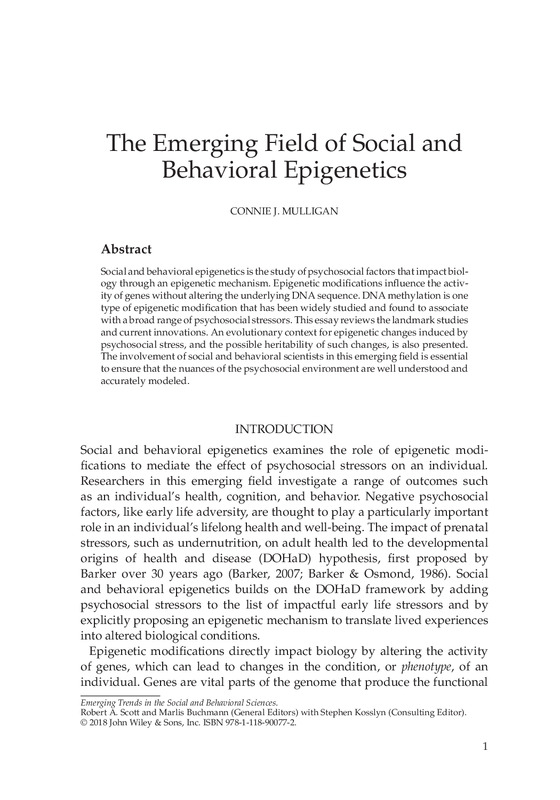
Social and behavioral epigenetics is the study of psychosocial factors that impact biology through an epigenetic mechanism. Epigenetic modifications influence the activity of genes without altering the underlying DNA sequence. DNA methylation is one type of epigenetic modification that has been widely studied and found to associate with a broad range of psychosocial stressors. This essay reviews the landmark studies and current innovations. An evolutionary context for epigenetic changes induced by psychosocial stress, and the possible heritability of such changes, is also presented. The involvement of social and behavioral scientists in this emerging field is essential to ensure that the nuances of the psychosocial environment are well understood and accurately modeled.
-
Related Essays
-
Social Epigenetics: Incorporating Epigenetic Effects as Social Cause and Consequence (Sociology), Douglas L. Anderton and Kathleen F. Arcaro
-
Inefficiencies in Health Care Provision (Economics), James F. Burgess et al.
-
Self‐Fulfilling Prophesies, Placebo Effects, and the Social–Psychological Creation of Reality (Sociology), Alia Crum and Damon J. Phillips
-
Genetics and Social Behavior (Anthropology), Henry Harpending and Gregory Cochran
-
An Evolutionary Perspective on Developmental Plasticity (Psychology), Sarah Hartman and Jay Belsky
-
Genetic and Environmental Approaches to Political Science (Political Science), Zoltán Fazekas and Peter K. Hatemi
-
Niche Construction: Implications for Human Sciences (Anthropology), Kevin N. Laland and Michael O'Brien
-
Immigrant Health Paradox (Sociology), Kyriakos S. Markides and Sunshine Rote
-
Rationing of Health Care (Sociology), David Mechanic
-
Health and Social Inequality (Sociology), Bernice A. Pescosolido
-
Social Relationships and Health in Older Adulthood (Psychology), Theodore F. Robles and Josephine A. Menkin
-
The Role of Cultural, Social, and Psychological Factors in Disease and Illness (Sociology), Robert A. Scott
-
Social, Psychological, and Physiological Reactions to Stress (Psychology), Bruce S. McEwen and Craig A. McEwen
-
The Intergenerational Transmission of Fertility (Sociology), Laura Bernardi
-
Identifier
-
etrds0447
-
extracted text
-
k
PSYHB etrds0447.tex
V2 - 10/22/2018
6:14 P.M.
Page 1
The Emerging Field of Social and
Behavioral Epigenetics
CONNIE J. MULLIGAN
Abstract
Social and behavioral epigenetics is the study of psychosocial factors that impact biology through an epigenetic mechanism. Epigenetic modifications influence the activity of genes without altering the underlying DNA sequence. DNA methylation is one
type of epigenetic modification that has been widely studied and found to associate
with a broad range of psychosocial stressors. This essay reviews the landmark studies
and current innovations. An evolutionary context for epigenetic changes induced by
psychosocial stress, and the possible heritability of such changes, is also presented.
The involvement of social and behavioral scientists in this emerging field is essential
to ensure that the nuances of the psychosocial environment are well understood and
accurately modeled.
k
k
INTRODUCTION
Social and behavioral epigenetics examines the role of epigenetic modifications to mediate the effect of psychosocial stressors on an individual.
Researchers in this emerging field investigate a range of outcomes such
as an individual’s health, cognition, and behavior. Negative psychosocial
factors, like early life adversity, are thought to play a particularly important
role in an individual’s lifelong health and well-being. The impact of prenatal
stressors, such as undernutrition, on adult health led to the developmental
origins of health and disease (DOHaD) hypothesis, first proposed by
Barker over 30 years ago (Barker, 2007; Barker & Osmond, 1986). Social
and behavioral epigenetics builds on the DOHaD framework by adding
psychosocial stressors to the list of impactful early life stressors and by
explicitly proposing an epigenetic mechanism to translate lived experiences
into altered biological conditions.
Epigenetic modifications directly impact biology by altering the activity
of genes, which can lead to changes in the condition, or phenotype, of an
individual. Genes are vital parts of the genome that produce the functional
Emerging Trends in the Social and Behavioral Sciences.
Robert A. Scott and Marlis Buchmann (General Editors) with Stephen Kosslyn (Consulting Editor).
© 2018 John Wiley & Sons, Inc. ISBN 978-1-118-90077-2.
1
k
�k
PSYHB etrds0447.tex
2
k
V2 - 10/22/2018
6:14 P.M.
Page 2
EMERGING TRENDS IN THE SOCIAL AND BEHAVIORAL SCIENCES
molecules, typically proteins, that create an individual’s unique phenotype.
Epigenetic modifications do not change the underlying deoxyribonucleic
acid (DNA) sequence of the genome but are one of the ways in which
the activity, or expression, of genes can be influenced. DNA methylation
is an important type of epigenetic modification wherein methyl groups are
added to the existing DNA sequence, most often at a cytosine followed by
a guanosine, that is, a CpG site. Originally, DNA methylation was found to
“silence” genes, or turn off their expression, when methylation occurred in
the promoter region before the start of a gene. More recently, research has
shown that gene expression can be either increased or decreased depending
on the region of the gene that is methylated as well as the cell and tissue
type (Jones, 2012; Plongthongkum, Diep, & Zhang, 2014).
Epigenetics has been studied for decades by molecular biologists who focus
on molecular mechanisms, such as how methylation at one particular site
affects the expression of a gene. More recently, social scientists have started to
participate in epigenetic research in order to provide an essential perspective
on human health and well-being that includes the social, psychological, and
behavioral dimensions (Hall, 2014).
Using a social and behavioral epigenetics framework, the prediction is that
lifetime social and behavioral stressors produce changes in DNA methylation that lead to changes in gene expression that lead to changes in condition or phenotype. Furthermore, the altered condition may then feedback to
influence the process in a cyclical manner. For example, poverty may create certain epigenetic changes that alter the expression of genes that increase
an individual’s risk of developing depression that then further entrenches
the individual in poverty. The full range of psychosocial factors that individuals experience, including both negative and positive events, may leave
epigenetic marks that continue to affect individuals throughout their lives.
Thus, social scientists bring a unique perspective that is essential to fully
understanding the complexities of health and well-being throughout the life
course.
Even though epigenetic modifications do not alter the underlying DNA
sequence, it is possible that certain epigenetic modifications may be heritable. The heritability of psychosocial stressor-induced epigenetic marks
creates the possibility that individuals’ responses to social and behavioral
stressors experienced during their lifetime may be passed on to future
generations. Transgenerational inheritance of psychosocial stressor-induced
epigenetic changes is one of the most controversial aspects of social and
behavioral epigenetics. Even if only a small set of genes is subject to heritable, psychosocial stressor-induced epigenetic modification, that intriguing
possibility suggests that both Darwin and Lamarck might have been correct
in aspects of their theories of evolution and heritability. Furthermore, the
k
k
�k
PSYHB etrds0447.tex
V2 - 10/22/2018
The Emerging Field of Social and Behavioral Epigenetics
6:14 P.M.
Page 3
3
possibility of a heritable epigenetic signature of psychosocial stress has
profound implications for our understanding and attempts to ameliorate
some of society’s most vexing problems, including multigenerational cycles
of violence, abuse, and poverty.
FOUNDATIONAL RESEARCH
k
Over the past decade, the field of social and behavioral epigenetics has
continued to emerge and knowledge gaps have been identified as multiple
disciplines contribute to the effort, creating a truly transdisciplinary field.
The search for epigenetic signatures of social and behavioral factors began
in the early 2000s. In 2004, Szyf and Meaney published the most highly cited
paper ever in Nature Neuroscience (over 3000 citations) entitled “Epigenetic
programming by maternal behavior” (Weaver et al., 2004). They identified
differences in DNA methylation in the brains of rat offspring that associated
with differences in maternal nurturing behaviors, that is, pup licking
and grooming, arched-back nursing. The changes in DNA methylation
occurred at the glucocorticoid receptor gene (short name = GR), which is a gene
involved in the HPA axis response to stress. The methylation changes affected
the ability of the GR gene to produce its protein. These differences only
emerged after the first week of life when the behavioral differences between
high- and low-nurturing mothers were also most apparent. And the DNA
methylation patterns persisted into adulthood demonstrating a possible
mechanism for the long-lasting effect of early psychosocial events. Furthermore, the methylation differences were reversible with cross-fostering of the
rat pups, that is, within 12 h of birth, if biological offspring of high and low
nurturing mothers were cross-fostered to low and high nurturing mothers,
respectively, they developed the methylation profile associated with the
rearing mother. These results suggest that the DNA methylation differences
in the offspring were not merely correlational but were a direct response to
maternal nurturing behavior.
Five years later, Meaney and Szyf demonstrated similar changes in DNA
methylation in humans. Specifically, they identified significant differences in DNA methylation in the human version of the GR gene (short
name = NR3C1) in suicide victims with a history of childhood abuse relative
to suicide victims with no history of childhood abuse and nonsuicide
controls (McGowan et al., 2009). Furthermore, they found increased DNA
methylation and decreased NR3C1 expression in the abused suicide victims
that is consistent with the known effect of DNA methylation in gene promoters on gene expression. These results suggest that the early childhood abuse
and later suicide may have been causal and mediated by the methylation
and expression changes in the NR3C1 gene.
k
k
�k
PSYHB etrds0447.tex
4
k
V2 - 10/22/2018
6:14 P.M.
Page 4
EMERGING TRENDS IN THE SOCIAL AND BEHAVIORAL SCIENCES
Since these ground-breaking studies, many more papers have been
published that report changes in DNA methylation associated with a
diverse range of psychosocial stressors. For instance, multiple studies have
shown an epigenetic effect of socioeconomic status (SES), with childhood
status impacting adult methylation more than adult status (Borghol et al.,
2012; McDade et al., 2017; Needham et al., 2015). Also, Fumagalli et al.
(2018) found associations between early life stress (i.e., very preterm birth),
DNA methylation at the serotonin transporter gene (this gene, SLC6A4, is
involved in a range of conditions including post-traumatic stress disorder
(PTSD) and depression-susceptibility in trauma-exposed individuals), and
socio-emotional development at 12 months, demonstrating a role for DNA
methylation in the influence of psychosocial stressors after the initial exposure. A number of studies have shown that prenatal exposure to maternal
stress is associated with changes in DNA methylation in offspring and
altered health outcomes such as birth weight, infant cortisol stress response,
and expression of genes involved in immune functions (Mulligan, D’Errico,
Stees, & Hughes, 2012; Nemoda & Szyf, 2017; Oberlander et al., 2008).
Some epigenetic studies have focused on more controversial topics, such
as the biological basis of sexual orientation. Using a mouse model, Vilain’s
group found that perinatal exposure to testosterone induced relatively modest methylation changes in the brain at birth but that 20-fold more genes
exhibited differential methylation in the adult (Ghahramani et al., 2014). This
impact of early hormone exposure on adult methylation was independent
of adult hormone levels. Vilain’s group also studied masculinized women
to test these results in humans. Specifically, women who were exposed to
high levels of testosterone in utero due to a genetic condition that produces
excessive testosterone (called congenital adrenal hyperplasia) showed much
higher rates of nonheterosexual orientation than nonexposed women and
Ngun and Vilain (2014) suggest an epigenetic mechanism to mediate the
long-term effects of hormone exposure.
GROWING PAINS OF AN EMERGING FIELD
Given the exponential growth in the number of published studies, there is
concern that the role for epigenetics has been overstated, particularly with
respect to the influence of social and behavioral factors on DNA methylation
(Miller, 2010). In response, some researchers have developed hypotheses to
test in humans based on results from animal models and they have come
up empty-handed. For instance, University of British Columbia researchers
hypothesized that SES might be analogous to the nurturing behaviors in rats
in Szyf and Meaney’s studies (see the previous section), and they predicted
increased methylation at NR3C1 in association with low SES. However, they
k
k
�k
PSYHB etrds0447.tex
V2 - 10/22/2018
The Emerging Field of Social and Behavioral Epigenetics
k
Page 5
5
did not find any evidence of altered DNA methylation despite seeing the
expected reduced glucocorticoid response and increased cortisol indicative of a stress response (Chen, Miller, Kobor, & Cole, 2010; Miller et al.,
2009). Other groups (Rijlaarsdam et al., 2016; Ryan, Mansell, Fransquet, &
Saffery, 2017) have used meta-analyses to look for common results across
multiple studies or tested new population samples to confirm previous
results and have found no association of maternal stress and newborn DNA
methylation in contrast to published studies, including those listed in the
previous section. However, when combining studies in meta-analyses, it
almost always means that different stress measures are combined, that is,
depression, anxiety, intimate partner violence, etc., or that new composite
stress measures are created, so that the meta-analysis is testing a different
hypothesis than the original studies. This issue is particularly salient when
moving from animal models to humans, for example, SES may not be the
most appropriate human analog for nurturing behaviors in rat mothers.
Furthermore, when attempting to replicate results in new populations, it is
possible that the original results are valid but do not manifest in the same
way in other populations. This lack of replication may be especially likely
with DNA methylation studies where we are still learning exactly how
DNA methylation impacts gene expression and phenotype, for example, it
is possible that the same stress exposure may alter methylation at different
CpG sites in different populations but may have similar functional effects
on gene expression and outcome.
An instructive set of comments and responses were published by Szyf’s
and Kobor’s groups in response to the previously mentioned study of SES
and DNA methylation by Borghol et al. (2012). Lam et al. (2012) questioned
whether the statistical approach used by Borghol et al. (2012) to analyze
CpG sites was appropriate and questioned why Borghol et al. (2012) found
so many CpG sites associated with SES (n = 1252) when Lam et al. (2012)
found only three associated sites. In their response, Suderman et al. (2013)
pointed out that both studies found associations of early life SES and DNA
methylation despite differences in methods (the DNA methylation datasets
were generated using different platforms) and different populations (US
vs UK). They further pointed out that their intent was not to claim that
particular CpG sites were specifically modified by early life SES, but to
establish that early life SES was generally associated with DNA methylation
in adult blood samples, a result found by both groups and captured in their
title—“Epigenomic socioeconomic studies more similar than different.”
In their second response, Lam et al. (2013) focused on the possibility that
Borghol et al. (2012) did not properly account for differences in types of cells
in whole blood samples and they propose that cell type differences could
be driving the association with SES rather than methylation differences.
k
6:14 P.M.
k
�k
PSYHB etrds0447.tex
6
k
V2 - 10/22/2018
6:14 P.M.
Page 6
EMERGING TRENDS IN THE SOCIAL AND BEHAVIORAL SCIENCES
Ultimately, however, they concluded that “both of our studies support a
general association of early-life SES and adult DNA methylation” (Lam
et al., 2013, E1247). This is an enlightening exchange because it illustrates,
publicly and in some detail, how different scientists can interpret the same
results in different ways depending on their perspective and expectations,
that is, was the critical result the identification, and replication, of specific CpG sites or a more general association between DNA methylation
and SES?
The Szyf and Kobor papers also highlighted the problem of cell type heterogeneity, which has emerged as an important issue in epigenetic studies.
Venous blood is composed of multiple cell types, including erythrocytes,
leucocytes, and platelets, and the proportions of these cells can change in
response to stress. Furthermore, each cell type has unique epigenetic marks
so a change in cell type could result in an altered epigenetic signal even
though the epigenetic change was not a direct result of the stress exposure.
The solution is to control for cell type heterogeneity so that only epigenetic
changes above and beyond those associated with changes in cell types are
measured. Multiple methods papers have now been published to allow correction for cell type heterogeneity in different tissues (Houseman et al., 2012).
In our study of prenatal exposure to maternal stress in mother-newborn
dyads in the Democratic Republic of Congo (DRC), we originally found
associations between maternal stress and DNA methylation in both maternal
venous blood and newborn cord blood samples, but after correction for cell
type differences, only the associations in maternal blood remained (Clukay,
Hughes, Rodney, Kertes, & Mulligan, 2018).
Good science is self-correcting. Several issues have emerged in epigenetic
studies that are actively being investigated and addressed. Correction for
cell type heterogeneity is one such issue—solutions to the problem continue
to be developed and their use is becoming standard in current studies.
Another active area of study is the ability of easily accessible tissues, like
blood and saliva, to accurately reflect stress responses that primarily occur
in the brain or other tissues. Most studies addressing this issue have compared DNA methylation changes in multiple tissues and they usually find
different methylation profiles between different tissue types (Agha et al.,
2015; Hannon, Lunnon, Schalkwyk, & Mill, 2015). However, epigenetically
determined changes in gene expression are part of the differentiation
process by which cells with the same genome become different types of
cells. Thus, different methylation profiles in different tissues are expected.
The question remains, are there methylation differences, above and beyond
the tissue-specific differences, that associate with a stressor or outcome of
interest and that are congruent across tissues? Few studies have directly
addressed this question.
k
k
�k
PSYHB etrds0447.tex
V2 - 10/22/2018
The Emerging Field of Social and Behavioral Epigenetics
6:14 P.M.
Page 7
7
PUTTING THINGS IN PERSPECTIVE
k
In order to step back and address the social and behavioral epigenetic
skeptics, it is useful to think about the questions that define the field. Most
fundamentally, does it make biological or evolutionary sense that DNA
methylation could be sensitive to psychosocial stressors? If so, what would
the methylation signatures look like and where in the genome would we
look for them? Would different stressors leave different signatures? How
long might these methylation signatures persist? A few months? Years?
Generations? Could methylation signatures at different genes persist for
different periods of time?
An evolutionary perspective is useful when pondering these questions.
Epigenetically influenced changes in gene expression in response to psychosocial stress may have evolved in order to provide rapid, short-term
responses to changes in the psychosocial environment without changing the underlying DNA sequence (Mulligan, 2016). In contrast, genetic
changes to the genome sequence would provide long-term adaptation to
the environment since they occur more infrequently over many generations. Epigenetic response to psychosocial stressors may have evolved in
humans as an adaptation to increasingly complex stressors that are not
experienced by simpler organisms; for example, contrast the experience
of sexual violence in humans to the heat exposure that is used to elicit a
stress response in bacteria. Furthermore, some environmentally sensitive
epigenetic signatures may have evolved to be transmitted and maintained
in future generations so as to preserve information about the original
stressor; these would be heritable, environmentally induced epigenetic
modifications.
The number of genes involved in an epigenetic response to a psychosocial stressor is likely to be small relative to the ∼20,000 genes in the human
genome since the majority of genes must continue to function regardless of
changes in the environment. These epigenetically modifiable genes may have
evolved to be sensitive to environmental cues in order to improve adaptability and fitness. In our study of prenatal exposure to maternal stress in
the DRC, we found that only 212 CpG sites, out of >400,000 studied sites,
correlated with maternal stress (with a false discovery rate of 5%), suggesting a very small number of environmentally sensitive, modifiable CpG sites
(Rodney & Mulligan, 2014).
Furthermore, it is possible that only extreme stressors will leave strong and
easily detectable epigenetic marks on the genome, on the assumption that
humans and other organisms have evolved to tolerate everyday stressors.
That is not to say that more moderate stressors do not leave an epigenetic
signature, but that such an epigenetic signature may be weaker or more
k
k
�k
PSYHB etrds0447.tex
8
V2 - 10/22/2018
6:14 P.M.
Page 8
EMERGING TRENDS IN THE SOCIAL AND BEHAVIORAL SCIENCES
diffuse across the genome and, therefore, more difficult to detect. In support
of the idea that extreme stressors have the biggest impact, we found that war
stress and personal experience of rape had the greatest effect on newborn
DNA methylation and birth weight when compared to milder stressors
like material deprivation and mundane stress (Mulligan et al., 2012). Study
of extreme stressors may help inform studies of more moderate stressors
by identifying the genes, gene contexts (e.g., promoters vs enhancers),
and parts of the genome with the most environmentally sensitive, epigenetically modifiable sites, thus allowing future studies to focus on those
sites.
APPLICATIONS AND FUTURE DIRECTIONS
k
The implications that an individual’s experiences can leave a permanent
mark, all the way down to the genome, that may persist throughout an
individual’s lifetime are enormous and thought-provoking. An obvious
question is, can this information be used to help people? The fact that
methylation marks are changeable suggests that we may be able to intervene
in cases of early life adversity to improve later life health and well-being.
Currently, multiple studies are searching for “epi-signatures” of particular conditions that will allow more accurate diagnosis of disease and earlier identification of conditions that would benefit from early intervention.
Aref-Eshghi et al. (2018) identified DNA methylation signatures in venous
blood samples that were specific for nine out of 14 tested neurodevelopmental syndromes, thus allowing for more accurate diagnosis and early treatment. In a study of alcohol dependence, Brückmann, Di Santo, Karle, Batra,
and Nieratschker (2016) found that hypomethylation of the GDAP1 gene (a
member of the ganglioside-induced differentiation-associated protein family that is involved in neuronal development) was a biomarker for disease
severity. Furthermore, the hypomethylation was reversed during an alcohol
treatment program, suggesting that GDAP1 methylation could also be used
as a biomarker for treatment outcome and highlighting the lability of DNA
methylation marks.
Studies of epi-signatures of psychosocial stressors with a predictive
application for future conditions are more limited. McDade et al., 2017
identified psychosocial and biological exposures that predicted DNA
methylation at genes involved in inflammation, which is a risk factor for
multiple diseases of aging. In a study of childhood stress, Nätt, Johansson,
Faresjö, Ludvigsson, and Thorsell (2015) found changes in DNA methylation in 5-year-olds similar to those seen in normal aging, suggesting
that these DNA methylation changes may help predict future disease
susceptibility.
k
k
�k
PSYHB etrds0447.tex
V2 - 10/22/2018
The Emerging Field of Social and Behavioral Epigenetics
k
Page 9
9
The studies listed above suggest promise for the use of DNA methylation
as a biomarker for different stress exposures and resultant health outcomes.
But what about purposely manipulating DNA methylation to improve
health and well-being? Some intriguing studies have been conducted in
animal models. Dietary supplementation of genistein to pregnant mice
caused a striking shift in coat color in their offspring and was associated
with increased methylation upstream of the pigment-producing Agouti
gene (Dolinoy, Weidman, Waterland, & Jirtle, 2006). Furthermore, the
genistein-induced hypermethylation persisted into adulthood and protected
offspring from obesity. Genistein is a plant-derived estrogen, found in
soy, that has been linked to cancer prevention and the levels of in utero
supplementation used in the study were comparable to levels in humans
who consume high-soy diets. In another study, researchers tested the idea
that DNA methylation may directly influence social behavior by manipulating DNA methylation in order to alter social status in African cichlid
fish (Lenkov, Lee, Lenkov, Swafford, & Fernald, 2016). Low-status animals
who were injected with DNA methylating agents were statistically likely
to increase in social rank whereas those injected with demethylating agents
were statistically unlikely to increase in rank.
If the animal model results translate to humans, they suggest we may be
able to devise treatments to reverse epigenetic alterations made in response
to stress exposures, albeit with a lot of additional study. In our DRC study, we
hope to study breastfeeding as a treatment to mitigate the effects of prenatal
exposure to maternal stress and test if the DNA methylation profile changes
from a high-stress profile to a low-stress one. Ultimately, successful intervention will depend on robust measurement and modeling of the nuances of the
psychosocial environment as well as a detailed understanding of the epigenetic mechanisms that mediate the impact of psychosocial stressors on health
and well-being.
The large number of published studies may give a false impression that we
have a firm understanding of the epigenetic impact of stressors and, furthermore, that every kind of stressor leaves an epigenetic signature. However,
as in any emerging field, initial reports tended to focus on positive results.
Recently, the field has begun to mature to the point that negative associations are being published, for example, no association was found between
victimization during childhood and DNA methylation (Marzi et al., 2018).
Publication of negative results is a good step forward since, from an evolutionary perspective, it does not make sense that every stressor we experience
will alter our DNA methylation and gene expression and subsequent phenotypes. It is not yet possible to predict which stressors will leave an epigenetic
mark, and which ones will not, so we must study the effect of a wide range
of stressors and publish both positive and negative findings.
k
6:14 P.M.
k
�k
PSYHB etrds0447.tex
10
V2 - 10/22/2018
6:14 P.M. Page 10
EMERGING TRENDS IN THE SOCIAL AND BEHAVIORAL SCIENCES
SUMMARY
•
•
•
•
•
•
k
•
Social and behavioral epigenetics is the study of psychosocial factors that
impact biology through a proposed epigenetic mechanism.
Epigenetic responses to psychosocial stressors may have evolved
in order to provide rapid, short-term responses to changes in the
psychosocial environment without changing the underlying DNA
sequence.
Some environmentally induced epigenetic changes may be heritable in
order to preserve information across generations about past stressful
exposures.
Many studies have found associations between DNA methylation and a
wide range of psychosocial stressors, including direct and prenatal exposures.
The number of genes, and regions of the genome, that are sensitive to
the psychosocial environment and epigenetically modifiable is likely to
be small.
Future studies should investigate a wide range of psychosocial stressors,
in multiple populations at different ages and stages of development, by
assaying an increasingly complete set of epigenetic modifications across
multiple genes and regions of the genome.
The publication of positive and negative results is critical in order to
better understand which stressors are processed through an epigenetic
mechanism.
GLOSSARY
Methyl group
DNA methylation
Cytosine, guanosine
Promoter
Phenotype
Glucocorticoid receptor gene
One carbon molecule plus three
hydrogen molecules.
Attachment of a methyl group at a
specific position in the DNA sequence.
Two of the four variable parts of a DNA
sequence, that is, cytosines, guanosines,
adenosines, and thymines.
The region before the start of a gene that
helps control how much protein is made
from the gene.
The observable characteristics of an
organism, including morphology,
development, physiology, and behavior.
The gene that encodes the receptor that
binds glucocorticoid hormones, such as
k
k
�k
PSYHB etrds0447.tex
V2 - 10/22/2018
The Emerging Field of Social and Behavioral Epigenetics
HPA axis
6:14 P.M. Page 11
11
cortisol, and is involved in the HPA-axis
stress response.
The hypothalamo–pituitary–adrenal axis
of organs and hormones that mediates
the body’s automatic response to stress.
ACKNOWLEDGMENTS
Sincere gratitude is due to the study participants and colleagues from HEAL
Africa and the Democratic Republic of Congo, from Jordan and Syria, and
from Tallahassee, FL, without whom none of my research would be possible.
Appreciation goes to current and past Mulligan lab members. Funding was
provided by NSF grants BCS 1719866, 1448213, 1231264, and 0820687 and
grants from the University of Florida (UF) Clinical and Translational Science
Institute, UF College of Liberal Arts and Science, and a UF Research Opportunity Seed Fund award.
REFERENCES
k
Agha, G., Houseman, E. A., Kelsey, K. T., Eaton, C. B., Buka, S. L., & Loucks, E. B.
(2015). Adiposity is associated with DNA methylation profile in adipose tissue.
International Journal of Epidemiology, 44(4), 1277–1287. doi:10.1093/ije/dyu236.
Aref-Eshghi, E., Rodenhiser, D. I., Schenkel, L. C., Lin, H., Skinner, C., Ainsworth,
P., & Sadikovic, B. (2018). Genomic DNA methylation signatures enable concurrent diagnosis and clinical genetic variant classification in neurodevelopmental syndromes. The American Journal of Human Genetics, 102(1), 156–174.
doi:10.1016/j.ajhg.2017.12.008.
Barker, D. J. (2007). The origins of the developmental origins theory. Journal of Internal
Medicine, 261(5), 412–417. doi:10.1111/j.1365-2796.2007.01809.x.
Barker, D. J., & Osmond, C. (1986). Infant mortality, childhood nutrition, and
ischaemic heart disease in England and Wales. Lancet, 1(8489), 1077–1081.
Borghol, N., Suderman, M., McArdle, W., Racine, A., Hallett, M., Pembrey,
M., … Szyf, M. (2012). Associations with early-life socio-economic position
in adult DNA methylation. International Journal of Epidemiology, 41(1), 62–74.
doi:10.1093/ije/dyr147.
Brückmann, C., Di Santo, A., Karle, K. N., Batra, A., & Nieratschker, V. (2016). Validation of differential GDAP1 DNA methylation in alcohol dependence and its
potential function as a biomarker for disease severity and therapy outcome. Epigenetics, 11(6), 456–463. doi:10.1080/15592294.2016.1179411.
Chen, E., Miller, G. E., Kobor, M. S., & Cole, S. W. (2010). Maternal warmth buffers
the effects of low early-life socioeconomic status on pro-inflammatory signaling
in adulthood. Molecular Psychiatry, 16, 729. doi:10.1038/mp.2010.53.
Clukay, C. J., Hughes, D. A., Rodney, N. C., Kertes, D. A., & Mulligan, C. J.
(2018). DNA methylation of methylation complex genes in relation to stress and
k
k
�k
PSYHB etrds0447.tex
12
k
V2 - 10/22/2018
6:14 P.M. Page 12
EMERGING TRENDS IN THE SOCIAL AND BEHAVIORAL SCIENCES
genome-wide methylation in mother–newborn dyads. American Journal of Physical
Anthropology, 165(1), 173–182. doi:10.1002/ajpa.23341.
Dolinoy, D. C., Weidman, J. R., Waterland, R. A., & Jirtle, R. L. (2006). Maternal genistein alters coat color and protects Avy mouse offspring from obesity by modifying
the fetal epigenome. Environmental Health Perspectives, 114(4), 567–572.
Fumagalli, M., Provenzi, L., De Carli, P., Dessimone, F., Sirgiovanni, I., Giorda, R., …
Montirosso, R. (2018). From early stress to 12-month development in very preterm
infants: Preliminary findings on epigenetic mechanisms and brain growth. PLoS
One, 13(1), e0190602. doi:10.1371/journal.pone.0190602.
Ghahramani, N. M., Ngun, T. C., Chen, P.-Y., Tian, Y., Krishnan, S., Muir, S., …
Vilain, E. (2014). The effects of perinatal testosterone exposure on the DNA methylome of the mouse brain are late-emerging. Biology of Sex Differences, 5(1), 8.
doi:10.1186/2042-6410-5-8.
Hall, S. S. (2014). Behaviour and biology: The accidental epigeneticist. Nature, 505,
14–17.
Hannon, E., Lunnon, K., Schalkwyk, L., & Mill, J. (2015). Interindividual methylomic
variation across blood, cortex, and cerebellum: implications for epigenetic studies
of neurological and neuropsychiatric phenotypes. Epigenetics, 10(11), 1024–1032.
doi:10.1080/15592294.2015.1100786.
Houseman, E. A., Accomando, W. P., Koestler, D. C., Christensen, B. C., Marsit, C. J., Nelson, H. H., … Kelsey, K. T. (2012). DNA methylation arrays as
surrogate measures of cell mixture distribution. BMC Bioinformatics, 13(1), 86.
doi:10.1186/1471-2105-13-86.
Jones, P. A. (2012). Functions of DNA methylation: islands, start sites, gene bodies
and beyond. Nature Reviews Genetics, 13(7), 484–492.
Lam, L. L., Emberly, E., Fraser, H. B., Neumann, S. M., Chen, E., Miller, G.
E., & Kobor, M. S. (2012). Factors underlying variable DNA methylation in
a human community cohort. Proceedings of the National Academy of Sciences,
109(Supplement 2), 17253–17260. doi:10.1073/pnas.1121249109.
Lam, L. L., Emberly, E., Fraser, H. B., Neumann, S. M., Chen, E., Miller, G. E., &
Kobor, M. S. (2013). Reply to Suderman et al.: Importance of accounting for blood
cell composition in epigenetic studies. Proceedings of the National Academy of Sciences, 110(14), E1247. doi:10.1073/pnas.1222104110.
Lenkov, K., Lee, M. H., Lenkov, O. D., Swafford, A., & Fernald, R. D. (2016). Epigenetic DNA methylation linked to social dominance. PLoS One, 10(12), e0144750.
doi:10.1371/journal.pone.0144750.
Marzi, S. J., Sugden, K., Arseneault, L., Belsky, D. W., Burrage, J., Corcoran,
D. L., … Caspi, A. (2018). Analysis of DNA methylation in young people: limited evidence for an association between victimization stress and epigenetic variation in blood. American Journal of Psychiatry, 175(6), 517–529.
doi:10.1176/appi.ajp.2017.17060693.
McDade, T. W., Ryan, C., Jones, M. J., MacIsaac, J. L., Morin, A. M., Meyer, J. M.,
& Kuzawa, C. W. (2017). Social and physical environments early in development
predict DNA methylation of inflammatory genes in young adulthood. Proceedings
k
k
�k
PSYHB etrds0447.tex
V2 - 10/22/2018
The Emerging Field of Social and Behavioral Epigenetics
k
6:14 P.M. Page 13
13
of the National Academy of Sciences of the United States of America, 114(29), 7611–7616.
doi:10.1073/pnas.1620661114.
McGowan, P. O., Sasaki, A., D’Alessio, A. C., Dymov, S., Labonte, B., Szyf, M.,
& Meaney, M. J. (2009). Epigenetic regulation of the glucocorticoid receptor in
human brain associates with childhood abuse. Nature Neuroscience, 12(3), 342–348.
Miller, G. (2010). Epigenetics. The seductive allure of behavioral epigenetics. Science,
329(5987), 24–27.
Miller, G. E., Chen, E., Fok, A. K., Walker, H., Lim, A., Nicholls, E. F., &
Kobor, M. S. (2009). Low early-life social class leaves a biological residue
manifested by decreased glucocorticoid and increased proinflammatory signaling. Proceedings of the National Academy of Sciences, 106(34), 14716–14721.
doi:10.1073/pnas.0902971106.
Mulligan, C. J. (2016). Early environments, stress, and the epigenetics of human
health. Annual Review of Anthropology, 45, 233–249.
Mulligan, C. J., D’Errico, N. C., Stees, J., & Hughes, D. A. (2012). Methylation changes
at NR3C1 in newborns associate with maternal prenatal stress exposure and newborn birth weight. Epigenetics, 7(8), 853–857. doi:10.4161/epi.21180.
Nätt, D., Johansson, I., Faresjö, T., Ludvigsson, J., & Thorsell, A. (2015). High cortisol
in 5-year-old children causes loss of DNA methylation in SINE retrotransposons:
a possible role for ZNF263 in stress-related diseases. Clinical Epigenetics, 7(1), 91.
doi:10.1186/s13148-015-0123-z.
Needham, B. L., Smith, J. A., Zhao, W., Wang, X., Mukherjee, B., Kardia, S. L. R.,
& Diez Roux, A. V. (2015). Life course socioeconomic status and DNA methylation in genes related to stress reactivity and inflammation: The multi-ethnic
study of atherosclerosis. Epigenetics, 10(10), 958–969. doi:10.1080/15592294.2015.
1085139.
Nemoda, Z., & Szyf, M. (2017). Epigenetic alterations and prenatal maternal depression. Birth Defects Research, 109(12), 888–897. doi:10.1002/bdr2.1081.
Ngun, T. C., & Vilain, E. (2014). Chapter eight—The biological basis of human sexual
orientation: Is there a role for epigenetics? Advances in Genetics, 86, 167–184.
Oberlander, T. F., Weinberg, J., Papsdorf, M., Grunau, R., Misri, S., & Devlin, A. M.
(2008). Prenatal exposure to maternal depression, neonatal methylation of human
glucocorticoid receptor gene (NR3C1) and infant cortisol stress responses. Epigenetics, 3(2), 97–106.
Plongthongkum, N., Diep, D. H., & Zhang, K. (2014). Advances in the profiling of
DNA modifications: cytosine methylation and beyond. Nature Reviews Genetics,
15(10), 647–661. doi:10.1038/nrg3772.
Rijlaarsdam, J., Pappa, I., Walton, E., Bakermans-Kranenburg, M. J., Mileva-Seitz, V.
R., Rippe, R. C. A., … van Ijzendoorn, M. H. (2016). An epigenome-wide association meta-analysis of prenatal maternal stress in neonates: A model approach for
replication. Epigenetics, 11(2), 140–149. doi:10.1080/15592294.2016.1145329.
Rodney, N. C., & Mulligan, C. J. (2014). A biocultural study of the effects of maternal stress on mother and newborn health in the Democratic Republic of Congo.
American Journal of Physical Anthropology, 155(2), 200–209. doi:10.1002/ajpa.22568.
k
k
�k
PSYHB etrds0447.tex
14
V2 - 10/22/2018
6:14 P.M. Page 14
EMERGING TRENDS IN THE SOCIAL AND BEHAVIORAL SCIENCES
Ryan, J., Mansell, T., Fransquet, P., & Saffery, R. (2017). Does maternal mental
well-being in pregnancy impact the early human epigenome? Epigenomics, 9(3),
313–332. doi:10.2217/epi-2016-0118.
Suderman, M., Borghol, N., Pappas, J. J., McArdle, W., Racine, A., Hallett,
M. T., & Szyf, M. (2013). Epigenomic socioeconomic studies more similar
than different. Proceedings of the National Academy of Sciences, 110(14), E1246.
doi:10.1073/pnas.1221019110.
Weaver, I. C., Cervoni, N., Champagne, F. A., D’Alessio, A. C., Sharma, S., Seckl, J.
R., & Meaney, M. J. (2004). Epigenetic programming by maternal behavior. Nature
Neuroscience, 7(8), 847–854.
k
Connie J. Mulligan is a professor in the Department of Anthropology and
the Genetics Institute at the University of Florida, Gainesville, Florida. She
conducts research on epigenetic and genetic signatures of psychosocial
stress. Her projects include the investigation of an epigenetic mechanism to
mediate the impact of maternal stress on newborns in the Democratic Republic of Congo, the genetics and epigenetics of exposure to war trauma in Syrian
refugees, and the genetic and biocultural risk factors for complex diseases
and related racial disparities in African Americans living in Tallahassee. She
was Chair of the Academic Organizing Committee of the NSF/NIH/RCUK
Interagency Epigenetics Workshop Advisory Board and, in 2014, she
organized an international workshop on social and behavioral epigenetics
that included both social and biological scientists (see workshop report at
www.nichd.nih.gov/about/meetings/2014/Documents/ExecSocialBehav
Epigenetics_Sum.pdf). Mulligan is the current President of the American Association of Anthropological Genetics. For more information, see
http://users.clas.ufl.edu/cmulligan/Webpage/.
RELATED ESSAYS
Social Epigenetics: Incorporating Epigenetic Effects as Social Cause and
Consequence (Sociology), Douglas L. Anderton and Kathleen F. Arcaro
Inefficiencies in Health Care Provision (Economics), James F. Burgess et al.
Self-Fulfilling Prophesies, Placebo Effects, and the Social–Psychological
Creation of Reality (Sociology), Alia Crum and Damon J. Phillips
Genetics and Social Behavior (Anthropology), Henry Harpending and Gregory Cochran
An Evolutionary Perspective on Developmental Plasticity (Psychology),
Sarah Hartman and Jay Belsky
Genetic and Environmental Approaches to Political Science (Political Science),
Zoltán Fazekas and Peter K. Hatemi
Niche Construction: Implications for Human Sciences (Anthropology), Kevin
N. Laland and Michael O’Brien
Immigrant Health Paradox (Sociology), Kyriakos S. Markides and Sunshine
k
k
�k
PSYHB etrds0447.tex
V2 - 10/22/2018
The Emerging Field of Social and Behavioral Epigenetics
6:14 P.M. Page 15
15
Rote
Rationing of Health Care (Sociology), David Mechanic
Health and Social Inequality (Sociology), Bernice A. Pescosolido
Social Relationships and Health in Older Adulthood (Psychology), Theodore
F. Robles and Josephine A. Menkin
The Role of Cultural, Social, and Psychological Factors in Disease and Illness
(Sociology), Robert A. Scott
Social, Psychological, and Physiological Reactions to Stress (Psychology),
Bruce S. McEwen and Craig A. McEwen
The Intergenerational Transmission of Fertility (Sociology), Laura Bernardi
k
k
k
�
-
k
PSYHB etrds0447.tex
V2 - 10/22/2018
6:14 P.M.
Page 1
The Emerging Field of Social and
Behavioral Epigenetics
CONNIE J. MULLIGAN
Abstract
Social and behavioral epigenetics is the study of psychosocial factors that impact biology through an epigenetic mechanism. Epigenetic modifications influence the activity of genes without altering the underlying DNA sequence. DNA methylation is one
type of epigenetic modification that has been widely studied and found to associate
with a broad range of psychosocial stressors. This essay reviews the landmark studies
and current innovations. An evolutionary context for epigenetic changes induced by
psychosocial stress, and the possible heritability of such changes, is also presented.
The involvement of social and behavioral scientists in this emerging field is essential
to ensure that the nuances of the psychosocial environment are well understood and
accurately modeled.
k
k
INTRODUCTION
Social and behavioral epigenetics examines the role of epigenetic modifications to mediate the effect of psychosocial stressors on an individual.
Researchers in this emerging field investigate a range of outcomes such
as an individual’s health, cognition, and behavior. Negative psychosocial
factors, like early life adversity, are thought to play a particularly important
role in an individual’s lifelong health and well-being. The impact of prenatal
stressors, such as undernutrition, on adult health led to the developmental
origins of health and disease (DOHaD) hypothesis, first proposed by
Barker over 30 years ago (Barker, 2007; Barker & Osmond, 1986). Social
and behavioral epigenetics builds on the DOHaD framework by adding
psychosocial stressors to the list of impactful early life stressors and by
explicitly proposing an epigenetic mechanism to translate lived experiences
into altered biological conditions.
Epigenetic modifications directly impact biology by altering the activity
of genes, which can lead to changes in the condition, or phenotype, of an
individual. Genes are vital parts of the genome that produce the functional
Emerging Trends in the Social and Behavioral Sciences.
Robert A. Scott and Marlis Buchmann (General Editors) with Stephen Kosslyn (Consulting Editor).
© 2018 John Wiley & Sons, Inc. ISBN 978-1-118-90077-2.
1
k
�k
PSYHB etrds0447.tex
2
k
V2 - 10/22/2018
6:14 P.M.
Page 2
EMERGING TRENDS IN THE SOCIAL AND BEHAVIORAL SCIENCES
molecules, typically proteins, that create an individual’s unique phenotype.
Epigenetic modifications do not change the underlying deoxyribonucleic
acid (DNA) sequence of the genome but are one of the ways in which
the activity, or expression, of genes can be influenced. DNA methylation
is an important type of epigenetic modification wherein methyl groups are
added to the existing DNA sequence, most often at a cytosine followed by
a guanosine, that is, a CpG site. Originally, DNA methylation was found to
“silence” genes, or turn off their expression, when methylation occurred in
the promoter region before the start of a gene. More recently, research has
shown that gene expression can be either increased or decreased depending
on the region of the gene that is methylated as well as the cell and tissue
type (Jones, 2012; Plongthongkum, Diep, & Zhang, 2014).
Epigenetics has been studied for decades by molecular biologists who focus
on molecular mechanisms, such as how methylation at one particular site
affects the expression of a gene. More recently, social scientists have started to
participate in epigenetic research in order to provide an essential perspective
on human health and well-being that includes the social, psychological, and
behavioral dimensions (Hall, 2014).
Using a social and behavioral epigenetics framework, the prediction is that
lifetime social and behavioral stressors produce changes in DNA methylation that lead to changes in gene expression that lead to changes in condition or phenotype. Furthermore, the altered condition may then feedback to
influence the process in a cyclical manner. For example, poverty may create certain epigenetic changes that alter the expression of genes that increase
an individual’s risk of developing depression that then further entrenches
the individual in poverty. The full range of psychosocial factors that individuals experience, including both negative and positive events, may leave
epigenetic marks that continue to affect individuals throughout their lives.
Thus, social scientists bring a unique perspective that is essential to fully
understanding the complexities of health and well-being throughout the life
course.
Even though epigenetic modifications do not alter the underlying DNA
sequence, it is possible that certain epigenetic modifications may be heritable. The heritability of psychosocial stressor-induced epigenetic marks
creates the possibility that individuals’ responses to social and behavioral
stressors experienced during their lifetime may be passed on to future
generations. Transgenerational inheritance of psychosocial stressor-induced
epigenetic changes is one of the most controversial aspects of social and
behavioral epigenetics. Even if only a small set of genes is subject to heritable, psychosocial stressor-induced epigenetic modification, that intriguing
possibility suggests that both Darwin and Lamarck might have been correct
in aspects of their theories of evolution and heritability. Furthermore, the
k
k
�k
PSYHB etrds0447.tex
V2 - 10/22/2018
The Emerging Field of Social and Behavioral Epigenetics
6:14 P.M.
Page 3
3
possibility of a heritable epigenetic signature of psychosocial stress has
profound implications for our understanding and attempts to ameliorate
some of society’s most vexing problems, including multigenerational cycles
of violence, abuse, and poverty.
FOUNDATIONAL RESEARCH
k
Over the past decade, the field of social and behavioral epigenetics has
continued to emerge and knowledge gaps have been identified as multiple
disciplines contribute to the effort, creating a truly transdisciplinary field.
The search for epigenetic signatures of social and behavioral factors began
in the early 2000s. In 2004, Szyf and Meaney published the most highly cited
paper ever in Nature Neuroscience (over 3000 citations) entitled “Epigenetic
programming by maternal behavior” (Weaver et al., 2004). They identified
differences in DNA methylation in the brains of rat offspring that associated
with differences in maternal nurturing behaviors, that is, pup licking
and grooming, arched-back nursing. The changes in DNA methylation
occurred at the glucocorticoid receptor gene (short name = GR), which is a gene
involved in the HPA axis response to stress. The methylation changes affected
the ability of the GR gene to produce its protein. These differences only
emerged after the first week of life when the behavioral differences between
high- and low-nurturing mothers were also most apparent. And the DNA
methylation patterns persisted into adulthood demonstrating a possible
mechanism for the long-lasting effect of early psychosocial events. Furthermore, the methylation differences were reversible with cross-fostering of the
rat pups, that is, within 12 h of birth, if biological offspring of high and low
nurturing mothers were cross-fostered to low and high nurturing mothers,
respectively, they developed the methylation profile associated with the
rearing mother. These results suggest that the DNA methylation differences
in the offspring were not merely correlational but were a direct response to
maternal nurturing behavior.
Five years later, Meaney and Szyf demonstrated similar changes in DNA
methylation in humans. Specifically, they identified significant differences in DNA methylation in the human version of the GR gene (short
name = NR3C1) in suicide victims with a history of childhood abuse relative
to suicide victims with no history of childhood abuse and nonsuicide
controls (McGowan et al., 2009). Furthermore, they found increased DNA
methylation and decreased NR3C1 expression in the abused suicide victims
that is consistent with the known effect of DNA methylation in gene promoters on gene expression. These results suggest that the early childhood abuse
and later suicide may have been causal and mediated by the methylation
and expression changes in the NR3C1 gene.
k
k
�k
PSYHB etrds0447.tex
4
k
V2 - 10/22/2018
6:14 P.M.
Page 4
EMERGING TRENDS IN THE SOCIAL AND BEHAVIORAL SCIENCES
Since these ground-breaking studies, many more papers have been
published that report changes in DNA methylation associated with a
diverse range of psychosocial stressors. For instance, multiple studies have
shown an epigenetic effect of socioeconomic status (SES), with childhood
status impacting adult methylation more than adult status (Borghol et al.,
2012; McDade et al., 2017; Needham et al., 2015). Also, Fumagalli et al.
(2018) found associations between early life stress (i.e., very preterm birth),
DNA methylation at the serotonin transporter gene (this gene, SLC6A4, is
involved in a range of conditions including post-traumatic stress disorder
(PTSD) and depression-susceptibility in trauma-exposed individuals), and
socio-emotional development at 12 months, demonstrating a role for DNA
methylation in the influence of psychosocial stressors after the initial exposure. A number of studies have shown that prenatal exposure to maternal
stress is associated with changes in DNA methylation in offspring and
altered health outcomes such as birth weight, infant cortisol stress response,
and expression of genes involved in immune functions (Mulligan, D’Errico,
Stees, & Hughes, 2012; Nemoda & Szyf, 2017; Oberlander et al., 2008).
Some epigenetic studies have focused on more controversial topics, such
as the biological basis of sexual orientation. Using a mouse model, Vilain’s
group found that perinatal exposure to testosterone induced relatively modest methylation changes in the brain at birth but that 20-fold more genes
exhibited differential methylation in the adult (Ghahramani et al., 2014). This
impact of early hormone exposure on adult methylation was independent
of adult hormone levels. Vilain’s group also studied masculinized women
to test these results in humans. Specifically, women who were exposed to
high levels of testosterone in utero due to a genetic condition that produces
excessive testosterone (called congenital adrenal hyperplasia) showed much
higher rates of nonheterosexual orientation than nonexposed women and
Ngun and Vilain (2014) suggest an epigenetic mechanism to mediate the
long-term effects of hormone exposure.
GROWING PAINS OF AN EMERGING FIELD
Given the exponential growth in the number of published studies, there is
concern that the role for epigenetics has been overstated, particularly with
respect to the influence of social and behavioral factors on DNA methylation
(Miller, 2010). In response, some researchers have developed hypotheses to
test in humans based on results from animal models and they have come
up empty-handed. For instance, University of British Columbia researchers
hypothesized that SES might be analogous to the nurturing behaviors in rats
in Szyf and Meaney’s studies (see the previous section), and they predicted
increased methylation at NR3C1 in association with low SES. However, they
k
k
�k
PSYHB etrds0447.tex
V2 - 10/22/2018
The Emerging Field of Social and Behavioral Epigenetics
k
Page 5
5
did not find any evidence of altered DNA methylation despite seeing the
expected reduced glucocorticoid response and increased cortisol indicative of a stress response (Chen, Miller, Kobor, & Cole, 2010; Miller et al.,
2009). Other groups (Rijlaarsdam et al., 2016; Ryan, Mansell, Fransquet, &
Saffery, 2017) have used meta-analyses to look for common results across
multiple studies or tested new population samples to confirm previous
results and have found no association of maternal stress and newborn DNA
methylation in contrast to published studies, including those listed in the
previous section. However, when combining studies in meta-analyses, it
almost always means that different stress measures are combined, that is,
depression, anxiety, intimate partner violence, etc., or that new composite
stress measures are created, so that the meta-analysis is testing a different
hypothesis than the original studies. This issue is particularly salient when
moving from animal models to humans, for example, SES may not be the
most appropriate human analog for nurturing behaviors in rat mothers.
Furthermore, when attempting to replicate results in new populations, it is
possible that the original results are valid but do not manifest in the same
way in other populations. This lack of replication may be especially likely
with DNA methylation studies where we are still learning exactly how
DNA methylation impacts gene expression and phenotype, for example, it
is possible that the same stress exposure may alter methylation at different
CpG sites in different populations but may have similar functional effects
on gene expression and outcome.
An instructive set of comments and responses were published by Szyf’s
and Kobor’s groups in response to the previously mentioned study of SES
and DNA methylation by Borghol et al. (2012). Lam et al. (2012) questioned
whether the statistical approach used by Borghol et al. (2012) to analyze
CpG sites was appropriate and questioned why Borghol et al. (2012) found
so many CpG sites associated with SES (n = 1252) when Lam et al. (2012)
found only three associated sites. In their response, Suderman et al. (2013)
pointed out that both studies found associations of early life SES and DNA
methylation despite differences in methods (the DNA methylation datasets
were generated using different platforms) and different populations (US
vs UK). They further pointed out that their intent was not to claim that
particular CpG sites were specifically modified by early life SES, but to
establish that early life SES was generally associated with DNA methylation
in adult blood samples, a result found by both groups and captured in their
title—“Epigenomic socioeconomic studies more similar than different.”
In their second response, Lam et al. (2013) focused on the possibility that
Borghol et al. (2012) did not properly account for differences in types of cells
in whole blood samples and they propose that cell type differences could
be driving the association with SES rather than methylation differences.
k
6:14 P.M.
k
�k
PSYHB etrds0447.tex
6
k
V2 - 10/22/2018
6:14 P.M.
Page 6
EMERGING TRENDS IN THE SOCIAL AND BEHAVIORAL SCIENCES
Ultimately, however, they concluded that “both of our studies support a
general association of early-life SES and adult DNA methylation” (Lam
et al., 2013, E1247). This is an enlightening exchange because it illustrates,
publicly and in some detail, how different scientists can interpret the same
results in different ways depending on their perspective and expectations,
that is, was the critical result the identification, and replication, of specific CpG sites or a more general association between DNA methylation
and SES?
The Szyf and Kobor papers also highlighted the problem of cell type heterogeneity, which has emerged as an important issue in epigenetic studies.
Venous blood is composed of multiple cell types, including erythrocytes,
leucocytes, and platelets, and the proportions of these cells can change in
response to stress. Furthermore, each cell type has unique epigenetic marks
so a change in cell type could result in an altered epigenetic signal even
though the epigenetic change was not a direct result of the stress exposure.
The solution is to control for cell type heterogeneity so that only epigenetic
changes above and beyond those associated with changes in cell types are
measured. Multiple methods papers have now been published to allow correction for cell type heterogeneity in different tissues (Houseman et al., 2012).
In our study of prenatal exposure to maternal stress in mother-newborn
dyads in the Democratic Republic of Congo (DRC), we originally found
associations between maternal stress and DNA methylation in both maternal
venous blood and newborn cord blood samples, but after correction for cell
type differences, only the associations in maternal blood remained (Clukay,
Hughes, Rodney, Kertes, & Mulligan, 2018).
Good science is self-correcting. Several issues have emerged in epigenetic
studies that are actively being investigated and addressed. Correction for
cell type heterogeneity is one such issue—solutions to the problem continue
to be developed and their use is becoming standard in current studies.
Another active area of study is the ability of easily accessible tissues, like
blood and saliva, to accurately reflect stress responses that primarily occur
in the brain or other tissues. Most studies addressing this issue have compared DNA methylation changes in multiple tissues and they usually find
different methylation profiles between different tissue types (Agha et al.,
2015; Hannon, Lunnon, Schalkwyk, & Mill, 2015). However, epigenetically
determined changes in gene expression are part of the differentiation
process by which cells with the same genome become different types of
cells. Thus, different methylation profiles in different tissues are expected.
The question remains, are there methylation differences, above and beyond
the tissue-specific differences, that associate with a stressor or outcome of
interest and that are congruent across tissues? Few studies have directly
addressed this question.
k
k
�k
PSYHB etrds0447.tex
V2 - 10/22/2018
The Emerging Field of Social and Behavioral Epigenetics
6:14 P.M.
Page 7
7
PUTTING THINGS IN PERSPECTIVE
k
In order to step back and address the social and behavioral epigenetic
skeptics, it is useful to think about the questions that define the field. Most
fundamentally, does it make biological or evolutionary sense that DNA
methylation could be sensitive to psychosocial stressors? If so, what would
the methylation signatures look like and where in the genome would we
look for them? Would different stressors leave different signatures? How
long might these methylation signatures persist? A few months? Years?
Generations? Could methylation signatures at different genes persist for
different periods of time?
An evolutionary perspective is useful when pondering these questions.
Epigenetically influenced changes in gene expression in response to psychosocial stress may have evolved in order to provide rapid, short-term
responses to changes in the psychosocial environment without changing the underlying DNA sequence (Mulligan, 2016). In contrast, genetic
changes to the genome sequence would provide long-term adaptation to
the environment since they occur more infrequently over many generations. Epigenetic response to psychosocial stressors may have evolved in
humans as an adaptation to increasingly complex stressors that are not
experienced by simpler organisms; for example, contrast the experience
of sexual violence in humans to the heat exposure that is used to elicit a
stress response in bacteria. Furthermore, some environmentally sensitive
epigenetic signatures may have evolved to be transmitted and maintained
in future generations so as to preserve information about the original
stressor; these would be heritable, environmentally induced epigenetic
modifications.
The number of genes involved in an epigenetic response to a psychosocial stressor is likely to be small relative to the ∼20,000 genes in the human
genome since the majority of genes must continue to function regardless of
changes in the environment. These epigenetically modifiable genes may have
evolved to be sensitive to environmental cues in order to improve adaptability and fitness. In our study of prenatal exposure to maternal stress in
the DRC, we found that only 212 CpG sites, out of >400,000 studied sites,
correlated with maternal stress (with a false discovery rate of 5%), suggesting a very small number of environmentally sensitive, modifiable CpG sites
(Rodney & Mulligan, 2014).
Furthermore, it is possible that only extreme stressors will leave strong and
easily detectable epigenetic marks on the genome, on the assumption that
humans and other organisms have evolved to tolerate everyday stressors.
That is not to say that more moderate stressors do not leave an epigenetic
signature, but that such an epigenetic signature may be weaker or more
k
k
�k
PSYHB etrds0447.tex
8
V2 - 10/22/2018
6:14 P.M.
Page 8
EMERGING TRENDS IN THE SOCIAL AND BEHAVIORAL SCIENCES
diffuse across the genome and, therefore, more difficult to detect. In support
of the idea that extreme stressors have the biggest impact, we found that war
stress and personal experience of rape had the greatest effect on newborn
DNA methylation and birth weight when compared to milder stressors
like material deprivation and mundane stress (Mulligan et al., 2012). Study
of extreme stressors may help inform studies of more moderate stressors
by identifying the genes, gene contexts (e.g., promoters vs enhancers),
and parts of the genome with the most environmentally sensitive, epigenetically modifiable sites, thus allowing future studies to focus on those
sites.
APPLICATIONS AND FUTURE DIRECTIONS
k
The implications that an individual’s experiences can leave a permanent
mark, all the way down to the genome, that may persist throughout an
individual’s lifetime are enormous and thought-provoking. An obvious
question is, can this information be used to help people? The fact that
methylation marks are changeable suggests that we may be able to intervene
in cases of early life adversity to improve later life health and well-being.
Currently, multiple studies are searching for “epi-signatures” of particular conditions that will allow more accurate diagnosis of disease and earlier identification of conditions that would benefit from early intervention.
Aref-Eshghi et al. (2018) identified DNA methylation signatures in venous
blood samples that were specific for nine out of 14 tested neurodevelopmental syndromes, thus allowing for more accurate diagnosis and early treatment. In a study of alcohol dependence, Brückmann, Di Santo, Karle, Batra,
and Nieratschker (2016) found that hypomethylation of the GDAP1 gene (a
member of the ganglioside-induced differentiation-associated protein family that is involved in neuronal development) was a biomarker for disease
severity. Furthermore, the hypomethylation was reversed during an alcohol
treatment program, suggesting that GDAP1 methylation could also be used
as a biomarker for treatment outcome and highlighting the lability of DNA
methylation marks.
Studies of epi-signatures of psychosocial stressors with a predictive
application for future conditions are more limited. McDade et al., 2017
identified psychosocial and biological exposures that predicted DNA
methylation at genes involved in inflammation, which is a risk factor for
multiple diseases of aging. In a study of childhood stress, Nätt, Johansson,
Faresjö, Ludvigsson, and Thorsell (2015) found changes in DNA methylation in 5-year-olds similar to those seen in normal aging, suggesting
that these DNA methylation changes may help predict future disease
susceptibility.
k
k
�k
PSYHB etrds0447.tex
V2 - 10/22/2018
The Emerging Field of Social and Behavioral Epigenetics
k
Page 9
9
The studies listed above suggest promise for the use of DNA methylation
as a biomarker for different stress exposures and resultant health outcomes.
But what about purposely manipulating DNA methylation to improve
health and well-being? Some intriguing studies have been conducted in
animal models. Dietary supplementation of genistein to pregnant mice
caused a striking shift in coat color in their offspring and was associated
with increased methylation upstream of the pigment-producing Agouti
gene (Dolinoy, Weidman, Waterland, & Jirtle, 2006). Furthermore, the
genistein-induced hypermethylation persisted into adulthood and protected
offspring from obesity. Genistein is a plant-derived estrogen, found in
soy, that has been linked to cancer prevention and the levels of in utero
supplementation used in the study were comparable to levels in humans
who consume high-soy diets. In another study, researchers tested the idea
that DNA methylation may directly influence social behavior by manipulating DNA methylation in order to alter social status in African cichlid
fish (Lenkov, Lee, Lenkov, Swafford, & Fernald, 2016). Low-status animals
who were injected with DNA methylating agents were statistically likely
to increase in social rank whereas those injected with demethylating agents
were statistically unlikely to increase in rank.
If the animal model results translate to humans, they suggest we may be
able to devise treatments to reverse epigenetic alterations made in response
to stress exposures, albeit with a lot of additional study. In our DRC study, we
hope to study breastfeeding as a treatment to mitigate the effects of prenatal
exposure to maternal stress and test if the DNA methylation profile changes
from a high-stress profile to a low-stress one. Ultimately, successful intervention will depend on robust measurement and modeling of the nuances of the
psychosocial environment as well as a detailed understanding of the epigenetic mechanisms that mediate the impact of psychosocial stressors on health
and well-being.
The large number of published studies may give a false impression that we
have a firm understanding of the epigenetic impact of stressors and, furthermore, that every kind of stressor leaves an epigenetic signature. However,
as in any emerging field, initial reports tended to focus on positive results.
Recently, the field has begun to mature to the point that negative associations are being published, for example, no association was found between
victimization during childhood and DNA methylation (Marzi et al., 2018).
Publication of negative results is a good step forward since, from an evolutionary perspective, it does not make sense that every stressor we experience
will alter our DNA methylation and gene expression and subsequent phenotypes. It is not yet possible to predict which stressors will leave an epigenetic
mark, and which ones will not, so we must study the effect of a wide range
of stressors and publish both positive and negative findings.
k
6:14 P.M.
k
�k
PSYHB etrds0447.tex
10
V2 - 10/22/2018
6:14 P.M. Page 10
EMERGING TRENDS IN THE SOCIAL AND BEHAVIORAL SCIENCES
SUMMARY
•
•
•
•
•
•
k
•
Social and behavioral epigenetics is the study of psychosocial factors that
impact biology through a proposed epigenetic mechanism.
Epigenetic responses to psychosocial stressors may have evolved
in order to provide rapid, short-term responses to changes in the
psychosocial environment without changing the underlying DNA
sequence.
Some environmentally induced epigenetic changes may be heritable in
order to preserve information across generations about past stressful
exposures.
Many studies have found associations between DNA methylation and a
wide range of psychosocial stressors, including direct and prenatal exposures.
The number of genes, and regions of the genome, that are sensitive to
the psychosocial environment and epigenetically modifiable is likely to
be small.
Future studies should investigate a wide range of psychosocial stressors,
in multiple populations at different ages and stages of development, by
assaying an increasingly complete set of epigenetic modifications across
multiple genes and regions of the genome.
The publication of positive and negative results is critical in order to
better understand which stressors are processed through an epigenetic
mechanism.
GLOSSARY
Methyl group
DNA methylation
Cytosine, guanosine
Promoter
Phenotype
Glucocorticoid receptor gene
One carbon molecule plus three
hydrogen molecules.
Attachment of a methyl group at a
specific position in the DNA sequence.
Two of the four variable parts of a DNA
sequence, that is, cytosines, guanosines,
adenosines, and thymines.
The region before the start of a gene that
helps control how much protein is made
from the gene.
The observable characteristics of an
organism, including morphology,
development, physiology, and behavior.
The gene that encodes the receptor that
binds glucocorticoid hormones, such as
k
k
�k
PSYHB etrds0447.tex
V2 - 10/22/2018
The Emerging Field of Social and Behavioral Epigenetics
HPA axis
6:14 P.M. Page 11
11
cortisol, and is involved in the HPA-axis
stress response.
The hypothalamo–pituitary–adrenal axis
of organs and hormones that mediates
the body’s automatic response to stress.
ACKNOWLEDGMENTS
Sincere gratitude is due to the study participants and colleagues from HEAL
Africa and the Democratic Republic of Congo, from Jordan and Syria, and
from Tallahassee, FL, without whom none of my research would be possible.
Appreciation goes to current and past Mulligan lab members. Funding was
provided by NSF grants BCS 1719866, 1448213, 1231264, and 0820687 and
grants from the University of Florida (UF) Clinical and Translational Science
Institute, UF College of Liberal Arts and Science, and a UF Research Opportunity Seed Fund award.
REFERENCES
k
Agha, G., Houseman, E. A., Kelsey, K. T., Eaton, C. B., Buka, S. L., & Loucks, E. B.
(2015). Adiposity is associated with DNA methylation profile in adipose tissue.
International Journal of Epidemiology, 44(4), 1277–1287. doi:10.1093/ije/dyu236.
Aref-Eshghi, E., Rodenhiser, D. I., Schenkel, L. C., Lin, H., Skinner, C., Ainsworth,
P., & Sadikovic, B. (2018). Genomic DNA methylation signatures enable concurrent diagnosis and clinical genetic variant classification in neurodevelopmental syndromes. The American Journal of Human Genetics, 102(1), 156–174.
doi:10.1016/j.ajhg.2017.12.008.
Barker, D. J. (2007). The origins of the developmental origins theory. Journal of Internal
Medicine, 261(5), 412–417. doi:10.1111/j.1365-2796.2007.01809.x.
Barker, D. J., & Osmond, C. (1986). Infant mortality, childhood nutrition, and
ischaemic heart disease in England and Wales. Lancet, 1(8489), 1077–1081.
Borghol, N., Suderman, M., McArdle, W., Racine, A., Hallett, M., Pembrey,
M., … Szyf, M. (2012). Associations with early-life socio-economic position
in adult DNA methylation. International Journal of Epidemiology, 41(1), 62–74.
doi:10.1093/ije/dyr147.
Brückmann, C., Di Santo, A., Karle, K. N., Batra, A., & Nieratschker, V. (2016). Validation of differential GDAP1 DNA methylation in alcohol dependence and its
potential function as a biomarker for disease severity and therapy outcome. Epigenetics, 11(6), 456–463. doi:10.1080/15592294.2016.1179411.
Chen, E., Miller, G. E., Kobor, M. S., & Cole, S. W. (2010). Maternal warmth buffers
the effects of low early-life socioeconomic status on pro-inflammatory signaling
in adulthood. Molecular Psychiatry, 16, 729. doi:10.1038/mp.2010.53.
Clukay, C. J., Hughes, D. A., Rodney, N. C., Kertes, D. A., & Mulligan, C. J.
(2018). DNA methylation of methylation complex genes in relation to stress and
k
k
�k
PSYHB etrds0447.tex
12
k
V2 - 10/22/2018
6:14 P.M. Page 12
EMERGING TRENDS IN THE SOCIAL AND BEHAVIORAL SCIENCES
genome-wide methylation in mother–newborn dyads. American Journal of Physical
Anthropology, 165(1), 173–182. doi:10.1002/ajpa.23341.
Dolinoy, D. C., Weidman, J. R., Waterland, R. A., & Jirtle, R. L. (2006). Maternal genistein alters coat color and protects Avy mouse offspring from obesity by modifying
the fetal epigenome. Environmental Health Perspectives, 114(4), 567–572.
Fumagalli, M., Provenzi, L., De Carli, P., Dessimone, F., Sirgiovanni, I., Giorda, R., …
Montirosso, R. (2018). From early stress to 12-month development in very preterm
infants: Preliminary findings on epigenetic mechanisms and brain growth. PLoS
One, 13(1), e0190602. doi:10.1371/journal.pone.0190602.
Ghahramani, N. M., Ngun, T. C., Chen, P.-Y., Tian, Y., Krishnan, S., Muir, S., …
Vilain, E. (2014). The effects of perinatal testosterone exposure on the DNA methylome of the mouse brain are late-emerging. Biology of Sex Differences, 5(1), 8.
doi:10.1186/2042-6410-5-8.
Hall, S. S. (2014). Behaviour and biology: The accidental epigeneticist. Nature, 505,
14–17.
Hannon, E., Lunnon, K., Schalkwyk, L., & Mill, J. (2015). Interindividual methylomic
variation across blood, cortex, and cerebellum: implications for epigenetic studies
of neurological and neuropsychiatric phenotypes. Epigenetics, 10(11), 1024–1032.
doi:10.1080/15592294.2015.1100786.
Houseman, E. A., Accomando, W. P., Koestler, D. C., Christensen, B. C., Marsit, C. J., Nelson, H. H., … Kelsey, K. T. (2012). DNA methylation arrays as
surrogate measures of cell mixture distribution. BMC Bioinformatics, 13(1), 86.
doi:10.1186/1471-2105-13-86.
Jones, P. A. (2012). Functions of DNA methylation: islands, start sites, gene bodies
and beyond. Nature Reviews Genetics, 13(7), 484–492.
Lam, L. L., Emberly, E., Fraser, H. B., Neumann, S. M., Chen, E., Miller, G.
E., & Kobor, M. S. (2012). Factors underlying variable DNA methylation in
a human community cohort. Proceedings of the National Academy of Sciences,
109(Supplement 2), 17253–17260. doi:10.1073/pnas.1121249109.
Lam, L. L., Emberly, E., Fraser, H. B., Neumann, S. M., Chen, E., Miller, G. E., &
Kobor, M. S. (2013). Reply to Suderman et al.: Importance of accounting for blood
cell composition in epigenetic studies. Proceedings of the National Academy of Sciences, 110(14), E1247. doi:10.1073/pnas.1222104110.
Lenkov, K., Lee, M. H., Lenkov, O. D., Swafford, A., & Fernald, R. D. (2016). Epigenetic DNA methylation linked to social dominance. PLoS One, 10(12), e0144750.
doi:10.1371/journal.pone.0144750.
Marzi, S. J., Sugden, K., Arseneault, L., Belsky, D. W., Burrage, J., Corcoran,
D. L., … Caspi, A. (2018). Analysis of DNA methylation in young people: limited evidence for an association between victimization stress and epigenetic variation in blood. American Journal of Psychiatry, 175(6), 517–529.
doi:10.1176/appi.ajp.2017.17060693.
McDade, T. W., Ryan, C., Jones, M. J., MacIsaac, J. L., Morin, A. M., Meyer, J. M.,
& Kuzawa, C. W. (2017). Social and physical environments early in development
predict DNA methylation of inflammatory genes in young adulthood. Proceedings
k
k
�k
PSYHB etrds0447.tex
V2 - 10/22/2018
The Emerging Field of Social and Behavioral Epigenetics
k
6:14 P.M. Page 13
13
of the National Academy of Sciences of the United States of America, 114(29), 7611–7616.
doi:10.1073/pnas.1620661114.
McGowan, P. O., Sasaki, A., D’Alessio, A. C., Dymov, S., Labonte, B., Szyf, M.,
& Meaney, M. J. (2009). Epigenetic regulation of the glucocorticoid receptor in
human brain associates with childhood abuse. Nature Neuroscience, 12(3), 342–348.
Miller, G. (2010). Epigenetics. The seductive allure of behavioral epigenetics. Science,
329(5987), 24–27.
Miller, G. E., Chen, E., Fok, A. K., Walker, H., Lim, A., Nicholls, E. F., &
Kobor, M. S. (2009). Low early-life social class leaves a biological residue
manifested by decreased glucocorticoid and increased proinflammatory signaling. Proceedings of the National Academy of Sciences, 106(34), 14716–14721.
doi:10.1073/pnas.0902971106.
Mulligan, C. J. (2016). Early environments, stress, and the epigenetics of human
health. Annual Review of Anthropology, 45, 233–249.
Mulligan, C. J., D’Errico, N. C., Stees, J., & Hughes, D. A. (2012). Methylation changes
at NR3C1 in newborns associate with maternal prenatal stress exposure and newborn birth weight. Epigenetics, 7(8), 853–857. doi:10.4161/epi.21180.
Nätt, D., Johansson, I., Faresjö, T., Ludvigsson, J., & Thorsell, A. (2015). High cortisol
in 5-year-old children causes loss of DNA methylation in SINE retrotransposons:
a possible role for ZNF263 in stress-related diseases. Clinical Epigenetics, 7(1), 91.
doi:10.1186/s13148-015-0123-z.
Needham, B. L., Smith, J. A., Zhao, W., Wang, X., Mukherjee, B., Kardia, S. L. R.,
& Diez Roux, A. V. (2015). Life course socioeconomic status and DNA methylation in genes related to stress reactivity and inflammation: The multi-ethnic
study of atherosclerosis. Epigenetics, 10(10), 958–969. doi:10.1080/15592294.2015.
1085139.
Nemoda, Z., & Szyf, M. (2017). Epigenetic alterations and prenatal maternal depression. Birth Defects Research, 109(12), 888–897. doi:10.1002/bdr2.1081.
Ngun, T. C., & Vilain, E. (2014). Chapter eight—The biological basis of human sexual
orientation: Is there a role for epigenetics? Advances in Genetics, 86, 167–184.
Oberlander, T. F., Weinberg, J., Papsdorf, M., Grunau, R., Misri, S., & Devlin, A. M.
(2008). Prenatal exposure to maternal depression, neonatal methylation of human
glucocorticoid receptor gene (NR3C1) and infant cortisol stress responses. Epigenetics, 3(2), 97–106.
Plongthongkum, N., Diep, D. H., & Zhang, K. (2014). Advances in the profiling of
DNA modifications: cytosine methylation and beyond. Nature Reviews Genetics,
15(10), 647–661. doi:10.1038/nrg3772.
Rijlaarsdam, J., Pappa, I., Walton, E., Bakermans-Kranenburg, M. J., Mileva-Seitz, V.
R., Rippe, R. C. A., … van Ijzendoorn, M. H. (2016). An epigenome-wide association meta-analysis of prenatal maternal stress in neonates: A model approach for
replication. Epigenetics, 11(2), 140–149. doi:10.1080/15592294.2016.1145329.
Rodney, N. C., & Mulligan, C. J. (2014). A biocultural study of the effects of maternal stress on mother and newborn health in the Democratic Republic of Congo.
American Journal of Physical Anthropology, 155(2), 200–209. doi:10.1002/ajpa.22568.
k
k
�k
PSYHB etrds0447.tex
14
V2 - 10/22/2018
6:14 P.M. Page 14
EMERGING TRENDS IN THE SOCIAL AND BEHAVIORAL SCIENCES
Ryan, J., Mansell, T., Fransquet, P., & Saffery, R. (2017). Does maternal mental
well-being in pregnancy impact the early human epigenome? Epigenomics, 9(3),
313–332. doi:10.2217/epi-2016-0118.
Suderman, M., Borghol, N., Pappas, J. J., McArdle, W., Racine, A., Hallett,
M. T., & Szyf, M. (2013). Epigenomic socioeconomic studies more similar
than different. Proceedings of the National Academy of Sciences, 110(14), E1246.
doi:10.1073/pnas.1221019110.
Weaver, I. C., Cervoni, N., Champagne, F. A., D’Alessio, A. C., Sharma, S., Seckl, J.
R., & Meaney, M. J. (2004). Epigenetic programming by maternal behavior. Nature
Neuroscience, 7(8), 847–854.
k
Connie J. Mulligan is a professor in the Department of Anthropology and
the Genetics Institute at the University of Florida, Gainesville, Florida. She
conducts research on epigenetic and genetic signatures of psychosocial
stress. Her projects include the investigation of an epigenetic mechanism to
mediate the impact of maternal stress on newborns in the Democratic Republic of Congo, the genetics and epigenetics of exposure to war trauma in Syrian
refugees, and the genetic and biocultural risk factors for complex diseases
and related racial disparities in African Americans living in Tallahassee. She
was Chair of the Academic Organizing Committee of the NSF/NIH/RCUK
Interagency Epigenetics Workshop Advisory Board and, in 2014, she
organized an international workshop on social and behavioral epigenetics
that included both social and biological scientists (see workshop report at
www.nichd.nih.gov/about/meetings/2014/Documents/ExecSocialBehav
Epigenetics_Sum.pdf). Mulligan is the current President of the American Association of Anthropological Genetics. For more information, see
http://users.clas.ufl.edu/cmulligan/Webpage/.
RELATED ESSAYS
Social Epigenetics: Incorporating Epigenetic Effects as Social Cause and
Consequence (Sociology), Douglas L. Anderton and Kathleen F. Arcaro
Inefficiencies in Health Care Provision (Economics), James F. Burgess et al.
Self-Fulfilling Prophesies, Placebo Effects, and the Social–Psychological
Creation of Reality (Sociology), Alia Crum and Damon J. Phillips
Genetics and Social Behavior (Anthropology), Henry Harpending and Gregory Cochran
An Evolutionary Perspective on Developmental Plasticity (Psychology),
Sarah Hartman and Jay Belsky
Genetic and Environmental Approaches to Political Science (Political Science),
Zoltán Fazekas and Peter K. Hatemi
Niche Construction: Implications for Human Sciences (Anthropology), Kevin
N. Laland and Michael O’Brien
Immigrant Health Paradox (Sociology), Kyriakos S. Markides and Sunshine
k
k
�k
PSYHB etrds0447.tex
V2 - 10/22/2018
The Emerging Field of Social and Behavioral Epigenetics
6:14 P.M. Page 15
15
Rote
Rationing of Health Care (Sociology), David Mechanic
Health and Social Inequality (Sociology), Bernice A. Pescosolido
Social Relationships and Health in Older Adulthood (Psychology), Theodore
F. Robles and Josephine A. Menkin
The Role of Cultural, Social, and Psychological Factors in Disease and Illness
(Sociology), Robert A. Scott
Social, Psychological, and Physiological Reactions to Stress (Psychology),
Bruce S. McEwen and Craig A. McEwen
The Intergenerational Transmission of Fertility (Sociology), Laura Bernardi
k
k
k
�
k
PSYHB etrds0447.tex
V2 - 10/22/2018
6:14 P.M.
Page 1
The Emerging Field of Social and
Behavioral Epigenetics
CONNIE J. MULLIGAN
Abstract
Social and behavioral epigenetics is the study of psychosocial factors that impact biology through an epigenetic mechanism. Epigenetic modifications influence the activity of genes without altering the underlying DNA sequence. DNA methylation is one
type of epigenetic modification that has been widely studied and found to associate
with a broad range of psychosocial stressors. This essay reviews the landmark studies
and current innovations. An evolutionary context for epigenetic changes induced by
psychosocial stress, and the possible heritability of such changes, is also presented.
The involvement of social and behavioral scientists in this emerging field is essential
to ensure that the nuances of the psychosocial environment are well understood and
accurately modeled.
k
k
INTRODUCTION
Social and behavioral epigenetics examines the role of epigenetic modifications to mediate the effect of psychosocial stressors on an individual.
Researchers in this emerging field investigate a range of outcomes such
as an individual’s health, cognition, and behavior. Negative psychosocial
factors, like early life adversity, are thought to play a particularly important
role in an individual’s lifelong health and well-being. The impact of prenatal
stressors, such as undernutrition, on adult health led to the developmental
origins of health and disease (DOHaD) hypothesis, first proposed by
Barker over 30 years ago (Barker, 2007; Barker & Osmond, 1986). Social
and behavioral epigenetics builds on the DOHaD framework by adding
psychosocial stressors to the list of impactful early life stressors and by
explicitly proposing an epigenetic mechanism to translate lived experiences
into altered biological conditions.
Epigenetic modifications directly impact biology by altering the activity
of genes, which can lead to changes in the condition, or phenotype, of an
individual. Genes are vital parts of the genome that produce the functional
Emerging Trends in the Social and Behavioral Sciences.
Robert A. Scott and Marlis Buchmann (General Editors) with Stephen Kosslyn (Consulting Editor).
© 2018 John Wiley & Sons, Inc. ISBN 978-1-118-90077-2.
1
k
�k
PSYHB etrds0447.tex
2
k
V2 - 10/22/2018
6:14 P.M.
Page 2
EMERGING TRENDS IN THE SOCIAL AND BEHAVIORAL SCIENCES
molecules, typically proteins, that create an individual’s unique phenotype.
Epigenetic modifications do not change the underlying deoxyribonucleic
acid (DNA) sequence of the genome but are one of the ways in which
the activity, or expression, of genes can be influenced. DNA methylation
is an important type of epigenetic modification wherein methyl groups are
added to the existing DNA sequence, most often at a cytosine followed by
a guanosine, that is, a CpG site. Originally, DNA methylation was found to
“silence” genes, or turn off their expression, when methylation occurred in
the promoter region before the start of a gene. More recently, research has
shown that gene expression can be either increased or decreased depending
on the region of the gene that is methylated as well as the cell and tissue
type (Jones, 2012; Plongthongkum, Diep, & Zhang, 2014).
Epigenetics has been studied for decades by molecular biologists who focus
on molecular mechanisms, such as how methylation at one particular site
affects the expression of a gene. More recently, social scientists have started to
participate in epigenetic research in order to provide an essential perspective
on human health and well-being that includes the social, psychological, and
behavioral dimensions (Hall, 2014).
Using a social and behavioral epigenetics framework, the prediction is that
lifetime social and behavioral stressors produce changes in DNA methylation that lead to changes in gene expression that lead to changes in condition or phenotype. Furthermore, the altered condition may then feedback to
influence the process in a cyclical manner. For example, poverty may create certain epigenetic changes that alter the expression of genes that increase
an individual’s risk of developing depression that then further entrenches
the individual in poverty. The full range of psychosocial factors that individuals experience, including both negative and positive events, may leave
epigenetic marks that continue to affect individuals throughout their lives.
Thus, social scientists bring a unique perspective that is essential to fully
understanding the complexities of health and well-being throughout the life
course.
Even though epigenetic modifications do not alter the underlying DNA
sequence, it is possible that certain epigenetic modifications may be heritable. The heritability of psychosocial stressor-induced epigenetic marks
creates the possibility that individuals’ responses to social and behavioral
stressors experienced during their lifetime may be passed on to future
generations. Transgenerational inheritance of psychosocial stressor-induced
epigenetic changes is one of the most controversial aspects of social and
behavioral epigenetics. Even if only a small set of genes is subject to heritable, psychosocial stressor-induced epigenetic modification, that intriguing
possibility suggests that both Darwin and Lamarck might have been correct
in aspects of their theories of evolution and heritability. Furthermore, the
k
k
�k
PSYHB etrds0447.tex
V2 - 10/22/2018
The Emerging Field of Social and Behavioral Epigenetics
6:14 P.M.
Page 3
3
possibility of a heritable epigenetic signature of psychosocial stress has
profound implications for our understanding and attempts to ameliorate
some of society’s most vexing problems, including multigenerational cycles
of violence, abuse, and poverty.
FOUNDATIONAL RESEARCH
k
Over the past decade, the field of social and behavioral epigenetics has
continued to emerge and knowledge gaps have been identified as multiple
disciplines contribute to the effort, creating a truly transdisciplinary field.
The search for epigenetic signatures of social and behavioral factors began
in the early 2000s. In 2004, Szyf and Meaney published the most highly cited
paper ever in Nature Neuroscience (over 3000 citations) entitled “Epigenetic
programming by maternal behavior” (Weaver et al., 2004). They identified
differences in DNA methylation in the brains of rat offspring that associated
with differences in maternal nurturing behaviors, that is, pup licking
and grooming, arched-back nursing. The changes in DNA methylation
occurred at the glucocorticoid receptor gene (short name = GR), which is a gene
involved in the HPA axis response to stress. The methylation changes affected
the ability of the GR gene to produce its protein. These differences only
emerged after the first week of life when the behavioral differences between
high- and low-nurturing mothers were also most apparent. And the DNA
methylation patterns persisted into adulthood demonstrating a possible
mechanism for the long-lasting effect of early psychosocial events. Furthermore, the methylation differences were reversible with cross-fostering of the
rat pups, that is, within 12 h of birth, if biological offspring of high and low
nurturing mothers were cross-fostered to low and high nurturing mothers,
respectively, they developed the methylation profile associated with the
rearing mother. These results suggest that the DNA methylation differences
in the offspring were not merely correlational but were a direct response to
maternal nurturing behavior.
Five years later, Meaney and Szyf demonstrated similar changes in DNA
methylation in humans. Specifically, they identified significant differences in DNA methylation in the human version of the GR gene (short
name = NR3C1) in suicide victims with a history of childhood abuse relative
to suicide victims with no history of childhood abuse and nonsuicide
controls (McGowan et al., 2009). Furthermore, they found increased DNA
methylation and decreased NR3C1 expression in the abused suicide victims
that is consistent with the known effect of DNA methylation in gene promoters on gene expression. These results suggest that the early childhood abuse
and later suicide may have been causal and mediated by the methylation
and expression changes in the NR3C1 gene.
k
k
�k
PSYHB etrds0447.tex
4
k
V2 - 10/22/2018
6:14 P.M.
Page 4
EMERGING TRENDS IN THE SOCIAL AND BEHAVIORAL SCIENCES
Since these ground-breaking studies, many more papers have been
published that report changes in DNA methylation associated with a
diverse range of psychosocial stressors. For instance, multiple studies have
shown an epigenetic effect of socioeconomic status (SES), with childhood
status impacting adult methylation more than adult status (Borghol et al.,
2012; McDade et al., 2017; Needham et al., 2015). Also, Fumagalli et al.
(2018) found associations between early life stress (i.e., very preterm birth),
DNA methylation at the serotonin transporter gene (this gene, SLC6A4, is
involved in a range of conditions including post-traumatic stress disorder
(PTSD) and depression-susceptibility in trauma-exposed individuals), and
socio-emotional development at 12 months, demonstrating a role for DNA
methylation in the influence of psychosocial stressors after the initial exposure. A number of studies have shown that prenatal exposure to maternal
stress is associated with changes in DNA methylation in offspring and
altered health outcomes such as birth weight, infant cortisol stress response,
and expression of genes involved in immune functions (Mulligan, D’Errico,
Stees, & Hughes, 2012; Nemoda & Szyf, 2017; Oberlander et al., 2008).
Some epigenetic studies have focused on more controversial topics, such
as the biological basis of sexual orientation. Using a mouse model, Vilain’s
group found that perinatal exposure to testosterone induced relatively modest methylation changes in the brain at birth but that 20-fold more genes
exhibited differential methylation in the adult (Ghahramani et al., 2014). This
impact of early hormone exposure on adult methylation was independent
of adult hormone levels. Vilain’s group also studied masculinized women
to test these results in humans. Specifically, women who were exposed to
high levels of testosterone in utero due to a genetic condition that produces
excessive testosterone (called congenital adrenal hyperplasia) showed much
higher rates of nonheterosexual orientation than nonexposed women and
Ngun and Vilain (2014) suggest an epigenetic mechanism to mediate the
long-term effects of hormone exposure.
GROWING PAINS OF AN EMERGING FIELD
Given the exponential growth in the number of published studies, there is
concern that the role for epigenetics has been overstated, particularly with
respect to the influence of social and behavioral factors on DNA methylation
(Miller, 2010). In response, some researchers have developed hypotheses to
test in humans based on results from animal models and they have come
up empty-handed. For instance, University of British Columbia researchers
hypothesized that SES might be analogous to the nurturing behaviors in rats
in Szyf and Meaney’s studies (see the previous section), and they predicted
increased methylation at NR3C1 in association with low SES. However, they
k
k
�k
PSYHB etrds0447.tex
V2 - 10/22/2018
The Emerging Field of Social and Behavioral Epigenetics
k
Page 5
5
did not find any evidence of altered DNA methylation despite seeing the
expected reduced glucocorticoid response and increased cortisol indicative of a stress response (Chen, Miller, Kobor, & Cole, 2010; Miller et al.,
2009). Other groups (Rijlaarsdam et al., 2016; Ryan, Mansell, Fransquet, &
Saffery, 2017) have used meta-analyses to look for common results across
multiple studies or tested new population samples to confirm previous
results and have found no association of maternal stress and newborn DNA
methylation in contrast to published studies, including those listed in the
previous section. However, when combining studies in meta-analyses, it
almost always means that different stress measures are combined, that is,
depression, anxiety, intimate partner violence, etc., or that new composite
stress measures are created, so that the meta-analysis is testing a different
hypothesis than the original studies. This issue is particularly salient when
moving from animal models to humans, for example, SES may not be the
most appropriate human analog for nurturing behaviors in rat mothers.
Furthermore, when attempting to replicate results in new populations, it is
possible that the original results are valid but do not manifest in the same
way in other populations. This lack of replication may be especially likely
with DNA methylation studies where we are still learning exactly how
DNA methylation impacts gene expression and phenotype, for example, it
is possible that the same stress exposure may alter methylation at different
CpG sites in different populations but may have similar functional effects
on gene expression and outcome.
An instructive set of comments and responses were published by Szyf’s
and Kobor’s groups in response to the previously mentioned study of SES
and DNA methylation by Borghol et al. (2012). Lam et al. (2012) questioned
whether the statistical approach used by Borghol et al. (2012) to analyze
CpG sites was appropriate and questioned why Borghol et al. (2012) found
so many CpG sites associated with SES (n = 1252) when Lam et al. (2012)
found only three associated sites. In their response, Suderman et al. (2013)
pointed out that both studies found associations of early life SES and DNA
methylation despite differences in methods (the DNA methylation datasets
were generated using different platforms) and different populations (US
vs UK). They further pointed out that their intent was not to claim that
particular CpG sites were specifically modified by early life SES, but to
establish that early life SES was generally associated with DNA methylation
in adult blood samples, a result found by both groups and captured in their
title—“Epigenomic socioeconomic studies more similar than different.”
In their second response, Lam et al. (2013) focused on the possibility that
Borghol et al. (2012) did not properly account for differences in types of cells
in whole blood samples and they propose that cell type differences could
be driving the association with SES rather than methylation differences.
k
6:14 P.M.
k
�k
PSYHB etrds0447.tex
6
k
V2 - 10/22/2018
6:14 P.M.
Page 6
EMERGING TRENDS IN THE SOCIAL AND BEHAVIORAL SCIENCES
Ultimately, however, they concluded that “both of our studies support a
general association of early-life SES and adult DNA methylation” (Lam
et al., 2013, E1247). This is an enlightening exchange because it illustrates,
publicly and in some detail, how different scientists can interpret the same
results in different ways depending on their perspective and expectations,
that is, was the critical result the identification, and replication, of specific CpG sites or a more general association between DNA methylation
and SES?
The Szyf and Kobor papers also highlighted the problem of cell type heterogeneity, which has emerged as an important issue in epigenetic studies.
Venous blood is composed of multiple cell types, including erythrocytes,
leucocytes, and platelets, and the proportions of these cells can change in
response to stress. Furthermore, each cell type has unique epigenetic marks
so a change in cell type could result in an altered epigenetic signal even
though the epigenetic change was not a direct result of the stress exposure.
The solution is to control for cell type heterogeneity so that only epigenetic
changes above and beyond those associated with changes in cell types are
measured. Multiple methods papers have now been published to allow correction for cell type heterogeneity in different tissues (Houseman et al., 2012).
In our study of prenatal exposure to maternal stress in mother-newborn
dyads in the Democratic Republic of Congo (DRC), we originally found
associations between maternal stress and DNA methylation in both maternal
venous blood and newborn cord blood samples, but after correction for cell
type differences, only the associations in maternal blood remained (Clukay,
Hughes, Rodney, Kertes, & Mulligan, 2018).
Good science is self-correcting. Several issues have emerged in epigenetic
studies that are actively being investigated and addressed. Correction for
cell type heterogeneity is one such issue—solutions to the problem continue
to be developed and their use is becoming standard in current studies.
Another active area of study is the ability of easily accessible tissues, like
blood and saliva, to accurately reflect stress responses that primarily occur
in the brain or other tissues. Most studies addressing this issue have compared DNA methylation changes in multiple tissues and they usually find
different methylation profiles between different tissue types (Agha et al.,
2015; Hannon, Lunnon, Schalkwyk, & Mill, 2015). However, epigenetically
determined changes in gene expression are part of the differentiation
process by which cells with the same genome become different types of
cells. Thus, different methylation profiles in different tissues are expected.
The question remains, are there methylation differences, above and beyond
the tissue-specific differences, that associate with a stressor or outcome of
interest and that are congruent across tissues? Few studies have directly
addressed this question.
k
k
�k
PSYHB etrds0447.tex
V2 - 10/22/2018
The Emerging Field of Social and Behavioral Epigenetics
6:14 P.M.
Page 7
7
PUTTING THINGS IN PERSPECTIVE
k
In order to step back and address the social and behavioral epigenetic
skeptics, it is useful to think about the questions that define the field. Most
fundamentally, does it make biological or evolutionary sense that DNA
methylation could be sensitive to psychosocial stressors? If so, what would
the methylation signatures look like and where in the genome would we
look for them? Would different stressors leave different signatures? How
long might these methylation signatures persist? A few months? Years?
Generations? Could methylation signatures at different genes persist for
different periods of time?
An evolutionary perspective is useful when pondering these questions.
Epigenetically influenced changes in gene expression in response to psychosocial stress may have evolved in order to provide rapid, short-term
responses to changes in the psychosocial environment without changing the underlying DNA sequence (Mulligan, 2016). In contrast, genetic
changes to the genome sequence would provide long-term adaptation to
the environment since they occur more infrequently over many generations. Epigenetic response to psychosocial stressors may have evolved in
humans as an adaptation to increasingly complex stressors that are not
experienced by simpler organisms; for example, contrast the experience
of sexual violence in humans to the heat exposure that is used to elicit a
stress response in bacteria. Furthermore, some environmentally sensitive
epigenetic signatures may have evolved to be transmitted and maintained
in future generations so as to preserve information about the original
stressor; these would be heritable, environmentally induced epigenetic
modifications.
The number of genes involved in an epigenetic response to a psychosocial stressor is likely to be small relative to the ∼20,000 genes in the human
genome since the majority of genes must continue to function regardless of
changes in the environment. These epigenetically modifiable genes may have
evolved to be sensitive to environmental cues in order to improve adaptability and fitness. In our study of prenatal exposure to maternal stress in
the DRC, we found that only 212 CpG sites, out of >400,000 studied sites,
correlated with maternal stress (with a false discovery rate of 5%), suggesting a very small number of environmentally sensitive, modifiable CpG sites
(Rodney & Mulligan, 2014).
Furthermore, it is possible that only extreme stressors will leave strong and
easily detectable epigenetic marks on the genome, on the assumption that
humans and other organisms have evolved to tolerate everyday stressors.
That is not to say that more moderate stressors do not leave an epigenetic
signature, but that such an epigenetic signature may be weaker or more
k
k
�k
PSYHB etrds0447.tex
8
V2 - 10/22/2018
6:14 P.M.
Page 8
EMERGING TRENDS IN THE SOCIAL AND BEHAVIORAL SCIENCES
diffuse across the genome and, therefore, more difficult to detect. In support
of the idea that extreme stressors have the biggest impact, we found that war
stress and personal experience of rape had the greatest effect on newborn
DNA methylation and birth weight when compared to milder stressors
like material deprivation and mundane stress (Mulligan et al., 2012). Study
of extreme stressors may help inform studies of more moderate stressors
by identifying the genes, gene contexts (e.g., promoters vs enhancers),
and parts of the genome with the most environmentally sensitive, epigenetically modifiable sites, thus allowing future studies to focus on those
sites.
APPLICATIONS AND FUTURE DIRECTIONS
k
The implications that an individual’s experiences can leave a permanent
mark, all the way down to the genome, that may persist throughout an
individual’s lifetime are enormous and thought-provoking. An obvious
question is, can this information be used to help people? The fact that
methylation marks are changeable suggests that we may be able to intervene
in cases of early life adversity to improve later life health and well-being.
Currently, multiple studies are searching for “epi-signatures” of particular conditions that will allow more accurate diagnosis of disease and earlier identification of conditions that would benefit from early intervention.
Aref-Eshghi et al. (2018) identified DNA methylation signatures in venous
blood samples that were specific for nine out of 14 tested neurodevelopmental syndromes, thus allowing for more accurate diagnosis and early treatment. In a study of alcohol dependence, Brückmann, Di Santo, Karle, Batra,
and Nieratschker (2016) found that hypomethylation of the GDAP1 gene (a
member of the ganglioside-induced differentiation-associated protein family that is involved in neuronal development) was a biomarker for disease
severity. Furthermore, the hypomethylation was reversed during an alcohol
treatment program, suggesting that GDAP1 methylation could also be used
as a biomarker for treatment outcome and highlighting the lability of DNA
methylation marks.
Studies of epi-signatures of psychosocial stressors with a predictive
application for future conditions are more limited. McDade et al., 2017
identified psychosocial and biological exposures that predicted DNA
methylation at genes involved in inflammation, which is a risk factor for
multiple diseases of aging. In a study of childhood stress, Nätt, Johansson,
Faresjö, Ludvigsson, and Thorsell (2015) found changes in DNA methylation in 5-year-olds similar to those seen in normal aging, suggesting
that these DNA methylation changes may help predict future disease
susceptibility.
k
k
�k
PSYHB etrds0447.tex
V2 - 10/22/2018
The Emerging Field of Social and Behavioral Epigenetics
k
Page 9
9
The studies listed above suggest promise for the use of DNA methylation
as a biomarker for different stress exposures and resultant health outcomes.
But what about purposely manipulating DNA methylation to improve
health and well-being? Some intriguing studies have been conducted in
animal models. Dietary supplementation of genistein to pregnant mice
caused a striking shift in coat color in their offspring and was associated
with increased methylation upstream of the pigment-producing Agouti
gene (Dolinoy, Weidman, Waterland, & Jirtle, 2006). Furthermore, the
genistein-induced hypermethylation persisted into adulthood and protected
offspring from obesity. Genistein is a plant-derived estrogen, found in
soy, that has been linked to cancer prevention and the levels of in utero
supplementation used in the study were comparable to levels in humans
who consume high-soy diets. In another study, researchers tested the idea
that DNA methylation may directly influence social behavior by manipulating DNA methylation in order to alter social status in African cichlid
fish (Lenkov, Lee, Lenkov, Swafford, & Fernald, 2016). Low-status animals
who were injected with DNA methylating agents were statistically likely
to increase in social rank whereas those injected with demethylating agents
were statistically unlikely to increase in rank.
If the animal model results translate to humans, they suggest we may be
able to devise treatments to reverse epigenetic alterations made in response
to stress exposures, albeit with a lot of additional study. In our DRC study, we
hope to study breastfeeding as a treatment to mitigate the effects of prenatal
exposure to maternal stress and test if the DNA methylation profile changes
from a high-stress profile to a low-stress one. Ultimately, successful intervention will depend on robust measurement and modeling of the nuances of the
psychosocial environment as well as a detailed understanding of the epigenetic mechanisms that mediate the impact of psychosocial stressors on health
and well-being.
The large number of published studies may give a false impression that we
have a firm understanding of the epigenetic impact of stressors and, furthermore, that every kind of stressor leaves an epigenetic signature. However,
as in any emerging field, initial reports tended to focus on positive results.
Recently, the field has begun to mature to the point that negative associations are being published, for example, no association was found between
victimization during childhood and DNA methylation (Marzi et al., 2018).
Publication of negative results is a good step forward since, from an evolutionary perspective, it does not make sense that every stressor we experience
will alter our DNA methylation and gene expression and subsequent phenotypes. It is not yet possible to predict which stressors will leave an epigenetic
mark, and which ones will not, so we must study the effect of a wide range
of stressors and publish both positive and negative findings.
k
6:14 P.M.
k
�k
PSYHB etrds0447.tex
10
V2 - 10/22/2018
6:14 P.M. Page 10
EMERGING TRENDS IN THE SOCIAL AND BEHAVIORAL SCIENCES
SUMMARY
•
•
•
•
•
•
k
•
Social and behavioral epigenetics is the study of psychosocial factors that
impact biology through a proposed epigenetic mechanism.
Epigenetic responses to psychosocial stressors may have evolved
in order to provide rapid, short-term responses to changes in the
psychosocial environment without changing the underlying DNA
sequence.
Some environmentally induced epigenetic changes may be heritable in
order to preserve information across generations about past stressful
exposures.
Many studies have found associations between DNA methylation and a
wide range of psychosocial stressors, including direct and prenatal exposures.
The number of genes, and regions of the genome, that are sensitive to
the psychosocial environment and epigenetically modifiable is likely to
be small.
Future studies should investigate a wide range of psychosocial stressors,
in multiple populations at different ages and stages of development, by
assaying an increasingly complete set of epigenetic modifications across
multiple genes and regions of the genome.
The publication of positive and negative results is critical in order to
better understand which stressors are processed through an epigenetic
mechanism.
GLOSSARY
Methyl group
DNA methylation
Cytosine, guanosine
Promoter
Phenotype
Glucocorticoid receptor gene
One carbon molecule plus three
hydrogen molecules.
Attachment of a methyl group at a
specific position in the DNA sequence.
Two of the four variable parts of a DNA
sequence, that is, cytosines, guanosines,
adenosines, and thymines.
The region before the start of a gene that
helps control how much protein is made
from the gene.
The observable characteristics of an
organism, including morphology,
development, physiology, and behavior.
The gene that encodes the receptor that
binds glucocorticoid hormones, such as
k
k
�k
PSYHB etrds0447.tex
V2 - 10/22/2018
The Emerging Field of Social and Behavioral Epigenetics
HPA axis
6:14 P.M. Page 11
11
cortisol, and is involved in the HPA-axis
stress response.
The hypothalamo–pituitary–adrenal axis
of organs and hormones that mediates
the body’s automatic response to stress.
ACKNOWLEDGMENTS
Sincere gratitude is due to the study participants and colleagues from HEAL
Africa and the Democratic Republic of Congo, from Jordan and Syria, and
from Tallahassee, FL, without whom none of my research would be possible.
Appreciation goes to current and past Mulligan lab members. Funding was
provided by NSF grants BCS 1719866, 1448213, 1231264, and 0820687 and
grants from the University of Florida (UF) Clinical and Translational Science
Institute, UF College of Liberal Arts and Science, and a UF Research Opportunity Seed Fund award.
REFERENCES
k
Agha, G., Houseman, E. A., Kelsey, K. T., Eaton, C. B., Buka, S. L., & Loucks, E. B.
(2015). Adiposity is associated with DNA methylation profile in adipose tissue.
International Journal of Epidemiology, 44(4), 1277–1287. doi:10.1093/ije/dyu236.
Aref-Eshghi, E., Rodenhiser, D. I., Schenkel, L. C., Lin, H., Skinner, C., Ainsworth,
P., & Sadikovic, B. (2018). Genomic DNA methylation signatures enable concurrent diagnosis and clinical genetic variant classification in neurodevelopmental syndromes. The American Journal of Human Genetics, 102(1), 156–174.
doi:10.1016/j.ajhg.2017.12.008.
Barker, D. J. (2007). The origins of the developmental origins theory. Journal of Internal
Medicine, 261(5), 412–417. doi:10.1111/j.1365-2796.2007.01809.x.
Barker, D. J., & Osmond, C. (1986). Infant mortality, childhood nutrition, and
ischaemic heart disease in England and Wales. Lancet, 1(8489), 1077–1081.
Borghol, N., Suderman, M., McArdle, W., Racine, A., Hallett, M., Pembrey,
M., … Szyf, M. (2012). Associations with early-life socio-economic position
in adult DNA methylation. International Journal of Epidemiology, 41(1), 62–74.
doi:10.1093/ije/dyr147.
Brückmann, C., Di Santo, A., Karle, K. N., Batra, A., & Nieratschker, V. (2016). Validation of differential GDAP1 DNA methylation in alcohol dependence and its
potential function as a biomarker for disease severity and therapy outcome. Epigenetics, 11(6), 456–463. doi:10.1080/15592294.2016.1179411.
Chen, E., Miller, G. E., Kobor, M. S., & Cole, S. W. (2010). Maternal warmth buffers
the effects of low early-life socioeconomic status on pro-inflammatory signaling
in adulthood. Molecular Psychiatry, 16, 729. doi:10.1038/mp.2010.53.
Clukay, C. J., Hughes, D. A., Rodney, N. C., Kertes, D. A., & Mulligan, C. J.
(2018). DNA methylation of methylation complex genes in relation to stress and
k
k
�k
PSYHB etrds0447.tex
12
k
V2 - 10/22/2018
6:14 P.M. Page 12
EMERGING TRENDS IN THE SOCIAL AND BEHAVIORAL SCIENCES
genome-wide methylation in mother–newborn dyads. American Journal of Physical
Anthropology, 165(1), 173–182. doi:10.1002/ajpa.23341.
Dolinoy, D. C., Weidman, J. R., Waterland, R. A., & Jirtle, R. L. (2006). Maternal genistein alters coat color and protects Avy mouse offspring from obesity by modifying
the fetal epigenome. Environmental Health Perspectives, 114(4), 567–572.
Fumagalli, M., Provenzi, L., De Carli, P., Dessimone, F., Sirgiovanni, I., Giorda, R., …
Montirosso, R. (2018). From early stress to 12-month development in very preterm
infants: Preliminary findings on epigenetic mechanisms and brain growth. PLoS
One, 13(1), e0190602. doi:10.1371/journal.pone.0190602.
Ghahramani, N. M., Ngun, T. C., Chen, P.-Y., Tian, Y., Krishnan, S., Muir, S., …
Vilain, E. (2014). The effects of perinatal testosterone exposure on the DNA methylome of the mouse brain are late-emerging. Biology of Sex Differences, 5(1), 8.
doi:10.1186/2042-6410-5-8.
Hall, S. S. (2014). Behaviour and biology: The accidental epigeneticist. Nature, 505,
14–17.
Hannon, E., Lunnon, K., Schalkwyk, L., & Mill, J. (2015). Interindividual methylomic
variation across blood, cortex, and cerebellum: implications for epigenetic studies
of neurological and neuropsychiatric phenotypes. Epigenetics, 10(11), 1024–1032.
doi:10.1080/15592294.2015.1100786.
Houseman, E. A., Accomando, W. P., Koestler, D. C., Christensen, B. C., Marsit, C. J., Nelson, H. H., … Kelsey, K. T. (2012). DNA methylation arrays as
surrogate measures of cell mixture distribution. BMC Bioinformatics, 13(1), 86.
doi:10.1186/1471-2105-13-86.
Jones, P. A. (2012). Functions of DNA methylation: islands, start sites, gene bodies
and beyond. Nature Reviews Genetics, 13(7), 484–492.
Lam, L. L., Emberly, E., Fraser, H. B., Neumann, S. M., Chen, E., Miller, G.
E., & Kobor, M. S. (2012). Factors underlying variable DNA methylation in
a human community cohort. Proceedings of the National Academy of Sciences,
109(Supplement 2), 17253–17260. doi:10.1073/pnas.1121249109.
Lam, L. L., Emberly, E., Fraser, H. B., Neumann, S. M., Chen, E., Miller, G. E., &
Kobor, M. S. (2013). Reply to Suderman et al.: Importance of accounting for blood
cell composition in epigenetic studies. Proceedings of the National Academy of Sciences, 110(14), E1247. doi:10.1073/pnas.1222104110.
Lenkov, K., Lee, M. H., Lenkov, O. D., Swafford, A., & Fernald, R. D. (2016). Epigenetic DNA methylation linked to social dominance. PLoS One, 10(12), e0144750.
doi:10.1371/journal.pone.0144750.
Marzi, S. J., Sugden, K., Arseneault, L., Belsky, D. W., Burrage, J., Corcoran,
D. L., … Caspi, A. (2018). Analysis of DNA methylation in young people: limited evidence for an association between victimization stress and epigenetic variation in blood. American Journal of Psychiatry, 175(6), 517–529.
doi:10.1176/appi.ajp.2017.17060693.
McDade, T. W., Ryan, C., Jones, M. J., MacIsaac, J. L., Morin, A. M., Meyer, J. M.,
& Kuzawa, C. W. (2017). Social and physical environments early in development
predict DNA methylation of inflammatory genes in young adulthood. Proceedings
k
k
�k
PSYHB etrds0447.tex
V2 - 10/22/2018
The Emerging Field of Social and Behavioral Epigenetics
k
6:14 P.M. Page 13
13
of the National Academy of Sciences of the United States of America, 114(29), 7611–7616.
doi:10.1073/pnas.1620661114.
McGowan, P. O., Sasaki, A., D’Alessio, A. C., Dymov, S., Labonte, B., Szyf, M.,
& Meaney, M. J. (2009). Epigenetic regulation of the glucocorticoid receptor in
human brain associates with childhood abuse. Nature Neuroscience, 12(3), 342–348.
Miller, G. (2010). Epigenetics. The seductive allure of behavioral epigenetics. Science,
329(5987), 24–27.
Miller, G. E., Chen, E., Fok, A. K., Walker, H., Lim, A., Nicholls, E. F., &
Kobor, M. S. (2009). Low early-life social class leaves a biological residue
manifested by decreased glucocorticoid and increased proinflammatory signaling. Proceedings of the National Academy of Sciences, 106(34), 14716–14721.
doi:10.1073/pnas.0902971106.
Mulligan, C. J. (2016). Early environments, stress, and the epigenetics of human
health. Annual Review of Anthropology, 45, 233–249.
Mulligan, C. J., D’Errico, N. C., Stees, J., & Hughes, D. A. (2012). Methylation changes
at NR3C1 in newborns associate with maternal prenatal stress exposure and newborn birth weight. Epigenetics, 7(8), 853–857. doi:10.4161/epi.21180.
Nätt, D., Johansson, I., Faresjö, T., Ludvigsson, J., & Thorsell, A. (2015). High cortisol
in 5-year-old children causes loss of DNA methylation in SINE retrotransposons:
a possible role for ZNF263 in stress-related diseases. Clinical Epigenetics, 7(1), 91.
doi:10.1186/s13148-015-0123-z.
Needham, B. L., Smith, J. A., Zhao, W., Wang, X., Mukherjee, B., Kardia, S. L. R.,
& Diez Roux, A. V. (2015). Life course socioeconomic status and DNA methylation in genes related to stress reactivity and inflammation: The multi-ethnic
study of atherosclerosis. Epigenetics, 10(10), 958–969. doi:10.1080/15592294.2015.
1085139.
Nemoda, Z., & Szyf, M. (2017). Epigenetic alterations and prenatal maternal depression. Birth Defects Research, 109(12), 888–897. doi:10.1002/bdr2.1081.
Ngun, T. C., & Vilain, E. (2014). Chapter eight—The biological basis of human sexual
orientation: Is there a role for epigenetics? Advances in Genetics, 86, 167–184.
Oberlander, T. F., Weinberg, J., Papsdorf, M., Grunau, R., Misri, S., & Devlin, A. M.
(2008). Prenatal exposure to maternal depression, neonatal methylation of human
glucocorticoid receptor gene (NR3C1) and infant cortisol stress responses. Epigenetics, 3(2), 97–106.
Plongthongkum, N., Diep, D. H., & Zhang, K. (2014). Advances in the profiling of
DNA modifications: cytosine methylation and beyond. Nature Reviews Genetics,
15(10), 647–661. doi:10.1038/nrg3772.
Rijlaarsdam, J., Pappa, I., Walton, E., Bakermans-Kranenburg, M. J., Mileva-Seitz, V.
R., Rippe, R. C. A., … van Ijzendoorn, M. H. (2016). An epigenome-wide association meta-analysis of prenatal maternal stress in neonates: A model approach for
replication. Epigenetics, 11(2), 140–149. doi:10.1080/15592294.2016.1145329.
Rodney, N. C., & Mulligan, C. J. (2014). A biocultural study of the effects of maternal stress on mother and newborn health in the Democratic Republic of Congo.
American Journal of Physical Anthropology, 155(2), 200–209. doi:10.1002/ajpa.22568.
k
k
�k
PSYHB etrds0447.tex
14
V2 - 10/22/2018
6:14 P.M. Page 14
EMERGING TRENDS IN THE SOCIAL AND BEHAVIORAL SCIENCES
Ryan, J., Mansell, T., Fransquet, P., & Saffery, R. (2017). Does maternal mental
well-being in pregnancy impact the early human epigenome? Epigenomics, 9(3),
313–332. doi:10.2217/epi-2016-0118.
Suderman, M., Borghol, N., Pappas, J. J., McArdle, W., Racine, A., Hallett,
M. T., & Szyf, M. (2013). Epigenomic socioeconomic studies more similar
than different. Proceedings of the National Academy of Sciences, 110(14), E1246.
doi:10.1073/pnas.1221019110.
Weaver, I. C., Cervoni, N., Champagne, F. A., D’Alessio, A. C., Sharma, S., Seckl, J.
R., & Meaney, M. J. (2004). Epigenetic programming by maternal behavior. Nature
Neuroscience, 7(8), 847–854.
k
Connie J. Mulligan is a professor in the Department of Anthropology and
the Genetics Institute at the University of Florida, Gainesville, Florida. She
conducts research on epigenetic and genetic signatures of psychosocial
stress. Her projects include the investigation of an epigenetic mechanism to
mediate the impact of maternal stress on newborns in the Democratic Republic of Congo, the genetics and epigenetics of exposure to war trauma in Syrian
refugees, and the genetic and biocultural risk factors for complex diseases
and related racial disparities in African Americans living in Tallahassee. She
was Chair of the Academic Organizing Committee of the NSF/NIH/RCUK
Interagency Epigenetics Workshop Advisory Board and, in 2014, she
organized an international workshop on social and behavioral epigenetics
that included both social and biological scientists (see workshop report at
www.nichd.nih.gov/about/meetings/2014/Documents/ExecSocialBehav
Epigenetics_Sum.pdf). Mulligan is the current President of the American Association of Anthropological Genetics. For more information, see
http://users.clas.ufl.edu/cmulligan/Webpage/.
RELATED ESSAYS
Social Epigenetics: Incorporating Epigenetic Effects as Social Cause and
Consequence (Sociology), Douglas L. Anderton and Kathleen F. Arcaro
Inefficiencies in Health Care Provision (Economics), James F. Burgess et al.
Self-Fulfilling Prophesies, Placebo Effects, and the Social–Psychological
Creation of Reality (Sociology), Alia Crum and Damon J. Phillips
Genetics and Social Behavior (Anthropology), Henry Harpending and Gregory Cochran
An Evolutionary Perspective on Developmental Plasticity (Psychology),
Sarah Hartman and Jay Belsky
Genetic and Environmental Approaches to Political Science (Political Science),
Zoltán Fazekas and Peter K. Hatemi
Niche Construction: Implications for Human Sciences (Anthropology), Kevin
N. Laland and Michael O’Brien
Immigrant Health Paradox (Sociology), Kyriakos S. Markides and Sunshine
k
k
�k
PSYHB etrds0447.tex
V2 - 10/22/2018
The Emerging Field of Social and Behavioral Epigenetics
6:14 P.M. Page 15
15
Rote
Rationing of Health Care (Sociology), David Mechanic
Health and Social Inequality (Sociology), Bernice A. Pescosolido
Social Relationships and Health in Older Adulthood (Psychology), Theodore
F. Robles and Josephine A. Menkin
The Role of Cultural, Social, and Psychological Factors in Disease and Illness
(Sociology), Robert A. Scott
Social, Psychological, and Physiological Reactions to Stress (Psychology),
Bruce S. McEwen and Craig A. McEwen
The Intergenerational Transmission of Fertility (Sociology), Laura Bernardi
k
k
k
�