Niche Construction: Implications for Human Sciences
Media
Part of Niche Construction: Implications for Human Sciences
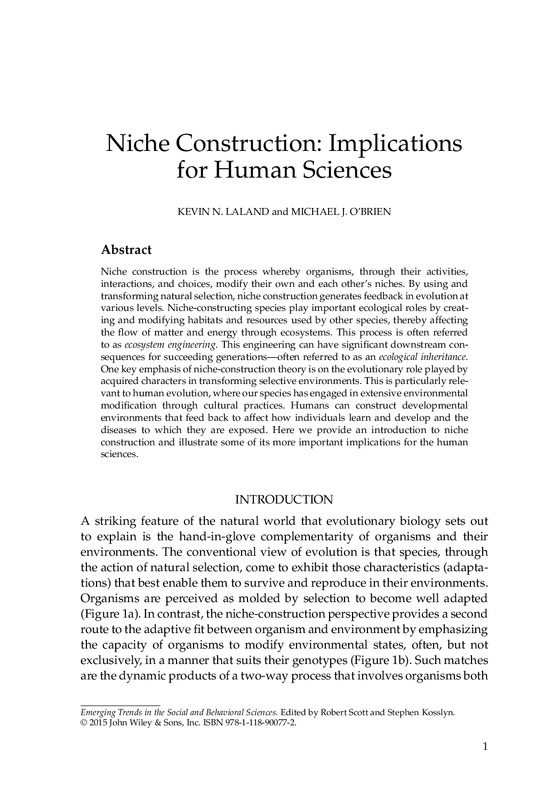
- Title
- Niche Construction: Implications for Human Sciences
- extracted text
-
Niche Construction: Implications
for Human Sciences
KEVIN N. LALAND and MICHAEL J. O’BRIEN
Abstract
Niche construction is the process whereby organisms, through their activities,
interactions, and choices, modify their own and each other’s niches. By using and
transforming natural selection, niche construction generates feedback in evolution at
various levels. Niche-constructing species play important ecological roles by creating and modifying habitats and resources used by other species, thereby affecting
the flow of matter and energy through ecosystems. This process is often referred
to as ecosystem engineering. This engineering can have significant downstream consequences for succeeding generations—often referred to as an ecological inheritance.
One key emphasis of niche-construction theory is on the evolutionary role played by
acquired characters in transforming selective environments. This is particularly relevant to human evolution, where our species has engaged in extensive environmental
modification through cultural practices. Humans can construct developmental
environments that feed back to affect how individuals learn and develop and the
diseases to which they are exposed. Here we provide an introduction to niche
construction and illustrate some of its more important implications for the human
sciences.
INTRODUCTION
A striking feature of the natural world that evolutionary biology sets out
to explain is the hand-in-glove complementarity of organisms and their
environments. The conventional view of evolution is that species, through
the action of natural selection, come to exhibit those characteristics (adaptations) that best enable them to survive and reproduce in their environments.
Organisms are perceived as molded by selection to become well adapted
(Figure 1a). In contrast, the niche-construction perspective provides a second
route to the adaptive fit between organism and environment by emphasizing
the capacity of organisms to modify environmental states, often, but not
exclusively, in a manner that suits their genotypes (Figure 1b). Such matches
are the dynamic products of a two-way process that involves organisms both
Emerging Trends in the Social and Behavioral Sciences. Edited by Robert Scott and Stephen Kosslyn.
© 2015 John Wiley & Sons, Inc. ISBN 978-1-118-90077-2.
1
2
EMERGING TRENDS IN THE SOCIAL AND BEHAVIORAL SCIENCES
Et
Natural selection
Gene pool
Population
of organisms
Time
Genetic inheritance
t
t+1
Et+1
Natural selection
Gene pool
Population
of organisms
Gene pool
Population
of organisms
(a)
Niche construction
t
Et
Genetic inheritance
Time
Ecological inheritance
Natural selection
Niche construction
t+1
Et+1
Gene pool
Population
of organisms
Natural selection
(b)
Figure 1 Two views of evolution (from Laland & O’Brien, 2011). Under the
conventional perspective (a), niche construction is recognized as a product of
natural selection but not as an evolutionary process. Inheritance is primarily
genetic. Under the niche-construction perspective (b), niche construction is
recognized as an evolutionary process. Here, ecological inheritance plays a
parallel role to genetic inheritance.
responding to “problems” posed by their environments through selection
and setting themselves new problems by changing environments through
niche construction. Niche-construction theory thus treats evolutionary
change as organisms codirecting their own evolution.
Niche Construction: Implications for Human Sciences
3
FOUNDATIONS
Niche construction is all around us, often occurring in subtle ways, as
illustrated by animals building nests and burrows, plants changing levels
of atmospheric gases, and bacteria fixing nutrients. This emphasis on the
modification of habitat by organisms is shared by ecologists who emphasize
“ecosystem engineering,” by which organisms modulate flows of energy
and matter through environments (Cuddington, 2011). Such engineering
activity can have significant impacts on community structure, composition,
and diversity. Young beavers, for example, inherit from their parents not
only a local environment comprising a dam, a lake, and a lodge but also
an altered community of microorganisms, plants, and animals. Moreover,
niche construction/ecosystem engineering can generate long-term effects
on ecosystems. For example, beaver dams deteriorate without beaver
activity, but this leads to meadows that can persist for nearly a century
and rarely return to the original vegetation. Such legacies are known as
ecological inheritance—modified biotic and abiotic states, bequeathed by
niche-constructing organisms to descendant organisms—and can be viewed
as an additional inheritance system (Figure 1b).
Ecological inheritance requires intergenerational persistence, often
through repeated acts of construction, of whatever physical—or, in the case
of humans, cultural—changes are caused by ancestral organisms in the
local selective environments of their descendants (Odling-Smee & Laland,
2011). Through their niche construction/ecosystem engineering, organisms
produce and destroy habitats and resources for other organisms, generating
an additional “engineering web” of connectedness and control that regulates
ecosystem functioning in conjunction with the well-established webs of
trophically connected organisms. Environmental changes that exemplify
human niche construction, such as habitat degradation, deforestation, and
industrial and urban development, often destroy the control webs that
underlie ecosystems. Fortunately, we can use our own niche construction
and that of other engineering species in novel restoration and management
methods that complement established conservation strategies (Laland &
Boogert, 2010).
MODERN RESEARCH
Many researchers, including human scientists, have found the nicheconstruction framework useful. For instance, archaeologist Smith (2011)
proposes a cultural niche-construction model of initial domestication that
presents a fresh alternative to optimal-foraging-theory accounts of the
origins of agriculture and supersedes it in explanatory power. Linguist
Bickerton (2009) builds a new account of the evolution of language around
4
EMERGING TRENDS IN THE SOCIAL AND BEHAVIORAL SCIENCES
niche-construction theory. Buchanan et al. (2011) apply it to ethnographic
data to explore the causes of cross-cultural variation in the diversity of
subsistence toolkits, finding that predictions from niche-construction theory
provide a good fit to the data, unlike established theories. Other successes
include a suite of novel theoretical and empirical findings related to landform, ecosystem and population dynamics, macroevolutionary change,
cultural evolution, and agriculture (e.g., Kendal et al., 2011; Rowley-Conwy
& Layton, 2011).
The niche-construction perspective encourages the tracing of causal
influences through ecosystems rather than treating each bout of selection
separately, such that the full ramifications of anthropogenic activity can be
better understood. This can be illustrated by the familiar example of West
African populations who cut clearings in forests to grow their yams. When it
rains, these clearings inadvertently create puddles that function as breeding
grounds for malaria-carrying mosquitoes. Exposure to malaria in turn favors
the hemoglobin sickle-cell allele (HbS) that confers resistance to malaria in
heterozygote humans. Here, causality flows through the ecosystem, from
cultural to genetic and back to cultural processes, and from one species to
the next, driven by iterative bouts of niche construction and selection, at
multiple levels (O’Brien & Laland, 2012) (Figure 2).
This tracing of causality is also a theme of a recent development in ecology,
known as eco-evolutionary dynamics (Odling-Smee et al., 2013). More generally,
niche-construction theory has established that genetic and cultural processes
can also affect the rate of change of allelic frequencies in response to selection
and greatly influence the pattern and rate of evolutionary processes.
Niche-construction theory promotes a systems approach to exploring
human evolution and ecology, and a key issue for future researchers will be
to devise realistic means of doing this. The sheer complexity of engineering
webs and the challenge of tracing causal chains through ecosystems appear
to be a daunting ordeal. In reality, standard methods regularly and successfully deployed by archaeologists, ecologists, and evolutionary biologists
can be combined to good effect (Laland & O’Brien, 2010; O’Brien & Laland,
2012). What is different is the focus of investigation, which moves from
the study of the ecological impact or evolutionary response in a single
taxon to the investigation of human eco-evolutionary systems, pathways, or
networks. This requires that researchers go beyond the normal practice of
evolutionary biology and ask, “What causes the selection pressures leading
to a specific evolutionary response?” rather than treating those selection
pressures as a starting point. It also requires researchers to go beyond
the normal practice of ecosystem ecology and ask, “What evolutionary
ramifications follow from species’ ecological impacts on biota and abiota?”
The key to progress is to break down complicated pathways in networks into
Niche Construction: Implications for Human Sciences
Crop
planting
1
4
Medical treatments for malaria
5
Pesticide treatments for
mosquitoes
5
Planting and
consumption
of yams
2
3
8
6
Alleles conferring resistance to
pesticides in mosquitoes
HbS allele
7
9
Medical treatment for Sicklecell disease
10
Figure 2 Construction chain depicting the causal influences following a cultural
niche-constructing practice, here the planting of yams in West Africa (from O’Brien
& Laland, 2012). Planting, which involves deforestation, (1) inadvertently promotes
the spread of malaria by leaving standing pools of water, leading to selection for
the hemoglobin sickle-cell (HbS) allele. The resulting incidence of sickle-cell
disease (2) favors the planting of yams and other crops with medicinal benefits
[yams contain the anti-sickling agent thiocyanate (Agbai, 1986)], which (3) further
promotes the spread of (HbS) and (4) scaffolds the development and/or
application of medical treatments for malaria, as well as (5) pesticide treatments
for mosquitoes, which (6) generates selection for alleles conferring resistance to
pesticides in mosquitoes. The spread of sickle cell (7) scaffolds the development
and/or application of medical treatments for sickle-cell disease. Pesticide
treatment of mosquitoes (8), medical treatment for sufferers of sickle-cell disease
(9), and malaria victims (10), affect the intensity of selection on the (HbS) allele.
tractable component pieces, subject each to analysis, and then reconstruct
the network, including the strength of interactions and how they vary
over time to gain a systems-level understanding. Where relevant data are
available, statistical approaches such as structural equation modeling and
causal graphs can help isolate or confirm putative causal influences and/or
reject causal hypotheses that are inconsistent with the data.
A focus on niche construction has important implications for how
researchers view the relationship among genetic evolution, developmental
processes, and cultural change. First, niche-constructing organisms cannot be
treated as merely “vehicles” for their genes because they also modify selection pressures in their own and in other species’ environments. In the process,
they introduce feedback to both ontogenetic and evolutionary (genetic and
cultural) processes. Alongside others, we have suggested that this active,
constructive conception of the role of organisms in evolution, and indeed
6
EMERGING TRENDS IN THE SOCIAL AND BEHAVIORAL SCIENCES
in ontogeny, fits well with conceptualizations of human agency that are
widespread within the human sciences (Laland & O’Brien, 2010, 2011; Laland
et al., 2000; O’Brien & Laland, 2012; Odling-Smee et al., 2003). Second, there is
no requirement for niche construction to result directly from genetic variation
in order for it to modify natural selection. Humans modify their environments largely through cultural processes, and it is this reliance on culture
that lends human niche construction a special potency (Kendal et al., 2011).
This dual role for phenotypes in evolution does imply that a complete
understanding of the relationship between human genes and cultural
processes must not only acknowledge genetic and cultural inheritance
but also take into account the legacy of modified selection pressures in
environments (Odling-Smee & Laland, 2011). It is readily apparent that
contemporary humans are born into a massively constructed world, with
an ecological inheritance that includes a legacy of houses, hospitals, farms,
factories, computers, satellites, and the World Wide Web (Flynn et al., 2013).
All organisms inherit genetic information, and this is the most fundamental source of information that underpins niche construction. However,
some factors in the environment can potentially change many times within
the lifespan of the animal, and natural selection has selected for processes
allowing individuals to adjust on a within-lifetime basis, some of which are
adaptations for acquiring knowledge. The processes underpinning learning
have also been shaped by natural selection, leaving some associations
formed more readily than others. However, it does not follow that all
acquired knowledge need be pre-specified by selection or under genetic
control. In theory, our genes could specify a tolerance space for our acquired
information and less frequently the content within it. In contrast to the position of most evolutionary psychologists (e.g., Pinker, 1997), that would leave
human learning a relatively open program—one capable of introducing novelty into phenotypic design space and modifying environmental conditions
in a manner that potentially generates selective feedback at multiple levels.
ISSUES FOR FUTURE RESEARCH
The discussion highlights an important issue for future research: investigation of the extent to which human cultural practices are controlled by
genetic information and the nature of the evolved predispositions that
shape human cultural learning. This is currently very much a moot point
among evolution-and-human-behavior researchers, with evolutionary psychologists and cultural evolutionists taking very different positions (Laland
& Brown, 2011). Is human social learning shaped by evolved structure
in the mind to be biased to acquiring content—from choosing sugar-rich
foods to admiring specific body shapes—that proved adaptive among our
Niche Construction: Implications for Human Sciences
7
Pleistocene ancestors, as suggested by many evolutionary psychologists?
Alternatively, is human learning dominated by general rules, such as copying the highest payoff behavior or conforming to the local norm, acquired
largely independent of their content, as claimed by cultural evolutionists?
One major difference that niche construction makes to the evolutionary process is that acquired characteristics can play a role in evolution through their
influence on the selective environment. The existence of examples such as
the evolution of adult lactose absorption and salivary amylase in response
to dairy products and starch introduced into human diets by human agriculture shows that human activities can generate novel phenotypes and modify
selection, but it remains to be seen how representative these are (Laland et al.,
2010; O’Brien & Laland, 2012).
Niche construction modifies selection not only at the genetic level but at the
ontogenetic and cultural levels as well, facilitating learning and mediating
cultural traditions, with consequences that not only feed back to the constructor population but also modify selection for other organisms. For example,
the construction of towns and cities created new health hazards associated
with large-scale human aggregation, such as the rapid and large-scale
spread of disease, resulting in epidemics. Humans may respond to this
novel selection pressure exclusively or in combination (i) through biological
evolution, with selection of resistant genotypes, (ii) at the ontogenetic level,
for instance, by developing antibodies that confer some immunity, or (iii)
through cultural evolution—for example, by creating hospitals, medicines,
and vaccines. Future research will establish the prevalence of these different
types of response and delineate rules specifying when each occurs.
A plausible hypothesis is that where a culturally transmitted response to
human niche construction is not possible, perhaps because a population lacks
the requisite knowledge or technology, then a genetic response will occur.
A familiar example is the coevolution of dairy farming and the allele for
adult lactose absorption, where several lines of evidence now support the
hypothesis that dairy farming created the selection pressures that favored
this allele in pastoralist populations. Cultural niche construction can also
generate selection on other species, most obviously domesticates. The spread
of dairy farming also affected geographical variation in milk-protein genes
in European cattle breeds, which covary with present-day patterns of lactose
tolerance in humans.
Recent thinking suggests that this kind of selective feedback from human
cultural activities to human (and other species) genes may be a general
feature of human evolution. Gene–culture coevolution may even be the
dominant form of evolution experienced by our species. Geneticists have
identified several hundred human genes subject to selective sweeps over
the past 50,000 years or less. When one considers the functionality of these
8
EMERGING TRENDS IN THE SOCIAL AND BEHAVIORAL SCIENCES
genes, it would seem many alleles have been favored as selective responses
to human cultural activities (Laland et al., 2010). However, much work
remains in order to confirm this.
In summary, niche-construction theory offers conceptual tools not yet readily used within the human sciences, such as a variety of experimental and
theoretical methods for establishing where niche construction is consequential and quantifying its impact. Such tools may be pertinent for researchers
interested in exploring the agency of humans in constructing their world and
shaping their development. Niche-construction theory also offers theoretically and empirically derived insights into the dynamics of evolving systems, which could add to the tools used by archaeologists, anthropologists,
and psychologists interested in understanding similarly complex dynamic
systems.
REFERENCES
Agbai, O. (1986). Anti-sickling effect of dietary thiocyanate in prophylactic control
of sickle cell anemia. Journal of National Medical Association, 78, 1053–1056.
Bickerton, D. (2009). Adam’s tongue: How humans made language, how language made
humans. New York, NY: Hill and Wang.
Buchanan, B., O’Brien, M. J., & Collard, M. (2011). The impact of niche construction on
the structure of toolkits of hunter-gatherers and food producers. Biological Theory,
6, 251–259.
Cuddington, K. (2011). Legacy effects: The persistent impact of ecological interactions. Biological Theory, 6, 203–210.
Flynn, E. G., Laland, K. N., Kendal, R. L., & Kendal, J. R. (2013). Developmental niche
construction. Developmental Science, 16, 296–313.
Kendal, J. R., Tehrani, J. J., & Odling-Smee, F. J. (2011). Human niche construction in
interdisciplinary focus. Philosophical Transactions of the Royal Society B, 366, 785–792.
Laland, K. N., & Boogert, N. J. (2010). Niche construction, co-evolution and biodiversity. Ecological Economics, 69, 731–736.
Laland, K. N., & Brown, G. (2011). Sense and nonsense (2nd ed.). Oxford, England:
Oxford University Press.
Laland, K. N., & O’Brien, M. J. (2010). Niche construction theory and archaeology.
Journal of Archaeological Method and Theory, 17, 303–322.
Laland, K. N., & O’Brien, M. J. (2011). Cultural niche construction: An introduction.
Biological Theory, 6, 191–202.
Laland, K. N., Odling-Smee, F. J., & Feldman, M. W. (2000). Niche construction,
biological evolution, and cultural change. Behavioral and Brain Science, 23, 131–175.
Laland, K. N., Odling-Smee, F. J., & Myles, S. (2010). How culture has shaped
the human genome: Bringing genetics and the human sciences together. Nature
Reviews Genetics, 11, 137–148.
O’Brien, M., & Laland, K. N. (2012). Genes, culture and agriculture: An example of
human niche construction. Current Anthropology, 53, 434–470.
Niche Construction: Implications for Human Sciences
9
Odling-Smee, F. J., Erwin, D. H., Palcovaks, E. P., Feldman, M. W., & Laland, K.
N. (2013). Niche construction theory: A practical guide for ecologists. Quarterly
Review of Biology, 88, 3–28.
Odling-Smee, F. J., & Laland, K. N. (2011). Ecological inheritance and cultural inheritance: What are they and how do they differ? Biological Theory, 6, 220–230.
Odling-Smee, F. J., Laland, K. N., & Feldman, M. W. (2003). Niche construction:
The neglected process in evolution. Princeton, NJ: Princeton University Press.
Pinker, S. (1997). How the mind works. London, England: Allen Lane.
Rowley-Conwy, P., & Layton, R. (2011). Foraging and farming as niche construction:
Stable and unstable adaptations. Philosophical Transactions of the Royal Society B,
366, 849–862.
Smith, B. D. (2011). A cultural niche construction theory of initial domestication.
Biological Theory, 6, 260–271.
KEVIN N. LALAND SHORT BIOGRAPHY
Kevin N. Laland is Professor in the School of Biology at the University of
St Andrews (Bute Medical Building, Queen’s Terrace, St Andrews, Scotland
KY16 9TS, UK). His principal interests are in the general area of animal
behavior and evolution, with a specific focus on animal social learning,
cultural evolution, and niche construction. He is engaged in empirical
studies of animal social learning and innovation, including experimental
work with fish, birds, nonhuman primates, and humans. This laboratory
work is complemented by theoretical investigations of the role of niche
construction in evolution, the diffusion dynamics of learned behavior, and
the coevolution of genes and culture throughout human evolution.
MICHAEL J. O’BRIEN SHORT BIOGRAPHY
Michael J. O’Brien is Professor in the Department of Anthropology and
Dean of the College of Arts and Science at the University of Missouri (317
Lowry Hall, Columbia, Missouri 65211, USA). His principal interests are the
dynamics of information flow in modern societies; the role of agriculture
in human niche construction; the coevolution of genes and culture; and the
first thousand or so years of the human occupation of North America.
RELATED ESSAYS
Global Economic Networks (Sociology), Nina Bandelj et al.
Neighborhoods and Cognitive Development (Psychology), Jondou Chen and
Jeanne Brooks-Gunn
Coevolution of Decision-Making and Social Environments (Sociology),
Elizabeth Bruch et al.
10
EMERGING TRENDS IN THE SOCIAL AND BEHAVIORAL SCIENCES
Gender Segregation in Higher Education (Sociology), Alexandra Hendley
and Maria Charles
Elites (Sociology), Johan S. G. Chu and Mark S. Mizruchi
Adaptation for Culture (Anthropology), Jill M. Church
Delusions (Psychology), Max Coltheart
Problems Attract Problems: A Network Perspective on Mental Disorders
(Psychology), Angélique Cramer and Denny Borsboom
Micro-Cultures (Sociology), Gary Alan Fine
Architecture of Markets (Sociology), Neil Fligstein and Ryan Calder
Culture and Social Networks (Sociology), Jan A. Fuhse
Migrant Networks (Sociology), Filiz Garip and Asad L. Asad
Ethnic Enclaves (Sociology), Steven J. Gold
Cultural Neuroscience: Connecting Culture, Brain, and Genes (Psychology),
Shinobu Kitayama and Sarah Huff
The Psychological Impacts of Cyberlife Engagement (Psychology), Virginia S.
Y. Kwan and Jessica E. Bodford
Culture, Diffusion, and Networks in Social Animals (Anthropology), Janet
Mann and Lisa Singh
Knowledge Transfer (Psychology), Timothy J. Nokes-Malach and J. Elizabeth
Richey
Social Classification (Sociology), Elizabeth G. Pontikes
Born This Way: Thinking Sociologically about Essentialism (Sociology),
Kristen Schilt
Primate Allomaternal Care (Anthropology), Stacey Tecot and Andrea Baden
Creativity in Teams (Psychology), Leigh L. Thompson and Elizabeth Ruth
Wilson
What is Special about Specialization? (Archaeology), Anne P. Underhill
AIDS and Social Networks (Sociology), Alexander Weinreb et al.
-
Niche Construction: Implications
for Human Sciences
KEVIN N. LALAND and MICHAEL J. O’BRIEN
Abstract
Niche construction is the process whereby organisms, through their activities,
interactions, and choices, modify their own and each other’s niches. By using and
transforming natural selection, niche construction generates feedback in evolution at
various levels. Niche-constructing species play important ecological roles by creating and modifying habitats and resources used by other species, thereby affecting
the flow of matter and energy through ecosystems. This process is often referred
to as ecosystem engineering. This engineering can have significant downstream consequences for succeeding generations—often referred to as an ecological inheritance.
One key emphasis of niche-construction theory is on the evolutionary role played by
acquired characters in transforming selective environments. This is particularly relevant to human evolution, where our species has engaged in extensive environmental
modification through cultural practices. Humans can construct developmental
environments that feed back to affect how individuals learn and develop and the
diseases to which they are exposed. Here we provide an introduction to niche
construction and illustrate some of its more important implications for the human
sciences.
INTRODUCTION
A striking feature of the natural world that evolutionary biology sets out
to explain is the hand-in-glove complementarity of organisms and their
environments. The conventional view of evolution is that species, through
the action of natural selection, come to exhibit those characteristics (adaptations) that best enable them to survive and reproduce in their environments.
Organisms are perceived as molded by selection to become well adapted
(Figure 1a). In contrast, the niche-construction perspective provides a second
route to the adaptive fit between organism and environment by emphasizing
the capacity of organisms to modify environmental states, often, but not
exclusively, in a manner that suits their genotypes (Figure 1b). Such matches
are the dynamic products of a two-way process that involves organisms both
Emerging Trends in the Social and Behavioral Sciences. Edited by Robert Scott and Stephen Kosslyn.
© 2015 John Wiley & Sons, Inc. ISBN 978-1-118-90077-2.
1
2
EMERGING TRENDS IN THE SOCIAL AND BEHAVIORAL SCIENCES
Et
Natural selection
Gene pool
Population
of organisms
Time
Genetic inheritance
t
t+1
Et+1
Natural selection
Gene pool
Population
of organisms
Gene pool
Population
of organisms
(a)
Niche construction
t
Et
Genetic inheritance
Time
Ecological inheritance
Natural selection
Niche construction
t+1
Et+1
Gene pool
Population
of organisms
Natural selection
(b)
Figure 1 Two views of evolution (from Laland & O’Brien, 2011). Under the
conventional perspective (a), niche construction is recognized as a product of
natural selection but not as an evolutionary process. Inheritance is primarily
genetic. Under the niche-construction perspective (b), niche construction is
recognized as an evolutionary process. Here, ecological inheritance plays a
parallel role to genetic inheritance.
responding to “problems” posed by their environments through selection
and setting themselves new problems by changing environments through
niche construction. Niche-construction theory thus treats evolutionary
change as organisms codirecting their own evolution.
Niche Construction: Implications for Human Sciences
3
FOUNDATIONS
Niche construction is all around us, often occurring in subtle ways, as
illustrated by animals building nests and burrows, plants changing levels
of atmospheric gases, and bacteria fixing nutrients. This emphasis on the
modification of habitat by organisms is shared by ecologists who emphasize
“ecosystem engineering,” by which organisms modulate flows of energy
and matter through environments (Cuddington, 2011). Such engineering
activity can have significant impacts on community structure, composition,
and diversity. Young beavers, for example, inherit from their parents not
only a local environment comprising a dam, a lake, and a lodge but also
an altered community of microorganisms, plants, and animals. Moreover,
niche construction/ecosystem engineering can generate long-term effects
on ecosystems. For example, beaver dams deteriorate without beaver
activity, but this leads to meadows that can persist for nearly a century
and rarely return to the original vegetation. Such legacies are known as
ecological inheritance—modified biotic and abiotic states, bequeathed by
niche-constructing organisms to descendant organisms—and can be viewed
as an additional inheritance system (Figure 1b).
Ecological inheritance requires intergenerational persistence, often
through repeated acts of construction, of whatever physical—or, in the case
of humans, cultural—changes are caused by ancestral organisms in the
local selective environments of their descendants (Odling-Smee & Laland,
2011). Through their niche construction/ecosystem engineering, organisms
produce and destroy habitats and resources for other organisms, generating
an additional “engineering web” of connectedness and control that regulates
ecosystem functioning in conjunction with the well-established webs of
trophically connected organisms. Environmental changes that exemplify
human niche construction, such as habitat degradation, deforestation, and
industrial and urban development, often destroy the control webs that
underlie ecosystems. Fortunately, we can use our own niche construction
and that of other engineering species in novel restoration and management
methods that complement established conservation strategies (Laland &
Boogert, 2010).
MODERN RESEARCH
Many researchers, including human scientists, have found the nicheconstruction framework useful. For instance, archaeologist Smith (2011)
proposes a cultural niche-construction model of initial domestication that
presents a fresh alternative to optimal-foraging-theory accounts of the
origins of agriculture and supersedes it in explanatory power. Linguist
Bickerton (2009) builds a new account of the evolution of language around
4
EMERGING TRENDS IN THE SOCIAL AND BEHAVIORAL SCIENCES
niche-construction theory. Buchanan et al. (2011) apply it to ethnographic
data to explore the causes of cross-cultural variation in the diversity of
subsistence toolkits, finding that predictions from niche-construction theory
provide a good fit to the data, unlike established theories. Other successes
include a suite of novel theoretical and empirical findings related to landform, ecosystem and population dynamics, macroevolutionary change,
cultural evolution, and agriculture (e.g., Kendal et al., 2011; Rowley-Conwy
& Layton, 2011).
The niche-construction perspective encourages the tracing of causal
influences through ecosystems rather than treating each bout of selection
separately, such that the full ramifications of anthropogenic activity can be
better understood. This can be illustrated by the familiar example of West
African populations who cut clearings in forests to grow their yams. When it
rains, these clearings inadvertently create puddles that function as breeding
grounds for malaria-carrying mosquitoes. Exposure to malaria in turn favors
the hemoglobin sickle-cell allele (HbS) that confers resistance to malaria in
heterozygote humans. Here, causality flows through the ecosystem, from
cultural to genetic and back to cultural processes, and from one species to
the next, driven by iterative bouts of niche construction and selection, at
multiple levels (O’Brien & Laland, 2012) (Figure 2).
This tracing of causality is also a theme of a recent development in ecology,
known as eco-evolutionary dynamics (Odling-Smee et al., 2013). More generally,
niche-construction theory has established that genetic and cultural processes
can also affect the rate of change of allelic frequencies in response to selection
and greatly influence the pattern and rate of evolutionary processes.
Niche-construction theory promotes a systems approach to exploring
human evolution and ecology, and a key issue for future researchers will be
to devise realistic means of doing this. The sheer complexity of engineering
webs and the challenge of tracing causal chains through ecosystems appear
to be a daunting ordeal. In reality, standard methods regularly and successfully deployed by archaeologists, ecologists, and evolutionary biologists
can be combined to good effect (Laland & O’Brien, 2010; O’Brien & Laland,
2012). What is different is the focus of investigation, which moves from
the study of the ecological impact or evolutionary response in a single
taxon to the investigation of human eco-evolutionary systems, pathways, or
networks. This requires that researchers go beyond the normal practice of
evolutionary biology and ask, “What causes the selection pressures leading
to a specific evolutionary response?” rather than treating those selection
pressures as a starting point. It also requires researchers to go beyond
the normal practice of ecosystem ecology and ask, “What evolutionary
ramifications follow from species’ ecological impacts on biota and abiota?”
The key to progress is to break down complicated pathways in networks into
Niche Construction: Implications for Human Sciences
Crop
planting
1
4
Medical treatments for malaria
5
Pesticide treatments for
mosquitoes
5
Planting and
consumption
of yams
2
3
8
6
Alleles conferring resistance to
pesticides in mosquitoes
HbS allele
7
9
Medical treatment for Sicklecell disease
10
Figure 2 Construction chain depicting the causal influences following a cultural
niche-constructing practice, here the planting of yams in West Africa (from O’Brien
& Laland, 2012). Planting, which involves deforestation, (1) inadvertently promotes
the spread of malaria by leaving standing pools of water, leading to selection for
the hemoglobin sickle-cell (HbS) allele. The resulting incidence of sickle-cell
disease (2) favors the planting of yams and other crops with medicinal benefits
[yams contain the anti-sickling agent thiocyanate (Agbai, 1986)], which (3) further
promotes the spread of (HbS) and (4) scaffolds the development and/or
application of medical treatments for malaria, as well as (5) pesticide treatments
for mosquitoes, which (6) generates selection for alleles conferring resistance to
pesticides in mosquitoes. The spread of sickle cell (7) scaffolds the development
and/or application of medical treatments for sickle-cell disease. Pesticide
treatment of mosquitoes (8), medical treatment for sufferers of sickle-cell disease
(9), and malaria victims (10), affect the intensity of selection on the (HbS) allele.
tractable component pieces, subject each to analysis, and then reconstruct
the network, including the strength of interactions and how they vary
over time to gain a systems-level understanding. Where relevant data are
available, statistical approaches such as structural equation modeling and
causal graphs can help isolate or confirm putative causal influences and/or
reject causal hypotheses that are inconsistent with the data.
A focus on niche construction has important implications for how
researchers view the relationship among genetic evolution, developmental
processes, and cultural change. First, niche-constructing organisms cannot be
treated as merely “vehicles” for their genes because they also modify selection pressures in their own and in other species’ environments. In the process,
they introduce feedback to both ontogenetic and evolutionary (genetic and
cultural) processes. Alongside others, we have suggested that this active,
constructive conception of the role of organisms in evolution, and indeed
6
EMERGING TRENDS IN THE SOCIAL AND BEHAVIORAL SCIENCES
in ontogeny, fits well with conceptualizations of human agency that are
widespread within the human sciences (Laland & O’Brien, 2010, 2011; Laland
et al., 2000; O’Brien & Laland, 2012; Odling-Smee et al., 2003). Second, there is
no requirement for niche construction to result directly from genetic variation
in order for it to modify natural selection. Humans modify their environments largely through cultural processes, and it is this reliance on culture
that lends human niche construction a special potency (Kendal et al., 2011).
This dual role for phenotypes in evolution does imply that a complete
understanding of the relationship between human genes and cultural
processes must not only acknowledge genetic and cultural inheritance
but also take into account the legacy of modified selection pressures in
environments (Odling-Smee & Laland, 2011). It is readily apparent that
contemporary humans are born into a massively constructed world, with
an ecological inheritance that includes a legacy of houses, hospitals, farms,
factories, computers, satellites, and the World Wide Web (Flynn et al., 2013).
All organisms inherit genetic information, and this is the most fundamental source of information that underpins niche construction. However,
some factors in the environment can potentially change many times within
the lifespan of the animal, and natural selection has selected for processes
allowing individuals to adjust on a within-lifetime basis, some of which are
adaptations for acquiring knowledge. The processes underpinning learning
have also been shaped by natural selection, leaving some associations
formed more readily than others. However, it does not follow that all
acquired knowledge need be pre-specified by selection or under genetic
control. In theory, our genes could specify a tolerance space for our acquired
information and less frequently the content within it. In contrast to the position of most evolutionary psychologists (e.g., Pinker, 1997), that would leave
human learning a relatively open program—one capable of introducing novelty into phenotypic design space and modifying environmental conditions
in a manner that potentially generates selective feedback at multiple levels.
ISSUES FOR FUTURE RESEARCH
The discussion highlights an important issue for future research: investigation of the extent to which human cultural practices are controlled by
genetic information and the nature of the evolved predispositions that
shape human cultural learning. This is currently very much a moot point
among evolution-and-human-behavior researchers, with evolutionary psychologists and cultural evolutionists taking very different positions (Laland
& Brown, 2011). Is human social learning shaped by evolved structure
in the mind to be biased to acquiring content—from choosing sugar-rich
foods to admiring specific body shapes—that proved adaptive among our
Niche Construction: Implications for Human Sciences
7
Pleistocene ancestors, as suggested by many evolutionary psychologists?
Alternatively, is human learning dominated by general rules, such as copying the highest payoff behavior or conforming to the local norm, acquired
largely independent of their content, as claimed by cultural evolutionists?
One major difference that niche construction makes to the evolutionary process is that acquired characteristics can play a role in evolution through their
influence on the selective environment. The existence of examples such as
the evolution of adult lactose absorption and salivary amylase in response
to dairy products and starch introduced into human diets by human agriculture shows that human activities can generate novel phenotypes and modify
selection, but it remains to be seen how representative these are (Laland et al.,
2010; O’Brien & Laland, 2012).
Niche construction modifies selection not only at the genetic level but at the
ontogenetic and cultural levels as well, facilitating learning and mediating
cultural traditions, with consequences that not only feed back to the constructor population but also modify selection for other organisms. For example,
the construction of towns and cities created new health hazards associated
with large-scale human aggregation, such as the rapid and large-scale
spread of disease, resulting in epidemics. Humans may respond to this
novel selection pressure exclusively or in combination (i) through biological
evolution, with selection of resistant genotypes, (ii) at the ontogenetic level,
for instance, by developing antibodies that confer some immunity, or (iii)
through cultural evolution—for example, by creating hospitals, medicines,
and vaccines. Future research will establish the prevalence of these different
types of response and delineate rules specifying when each occurs.
A plausible hypothesis is that where a culturally transmitted response to
human niche construction is not possible, perhaps because a population lacks
the requisite knowledge or technology, then a genetic response will occur.
A familiar example is the coevolution of dairy farming and the allele for
adult lactose absorption, where several lines of evidence now support the
hypothesis that dairy farming created the selection pressures that favored
this allele in pastoralist populations. Cultural niche construction can also
generate selection on other species, most obviously domesticates. The spread
of dairy farming also affected geographical variation in milk-protein genes
in European cattle breeds, which covary with present-day patterns of lactose
tolerance in humans.
Recent thinking suggests that this kind of selective feedback from human
cultural activities to human (and other species) genes may be a general
feature of human evolution. Gene–culture coevolution may even be the
dominant form of evolution experienced by our species. Geneticists have
identified several hundred human genes subject to selective sweeps over
the past 50,000 years or less. When one considers the functionality of these
8
EMERGING TRENDS IN THE SOCIAL AND BEHAVIORAL SCIENCES
genes, it would seem many alleles have been favored as selective responses
to human cultural activities (Laland et al., 2010). However, much work
remains in order to confirm this.
In summary, niche-construction theory offers conceptual tools not yet readily used within the human sciences, such as a variety of experimental and
theoretical methods for establishing where niche construction is consequential and quantifying its impact. Such tools may be pertinent for researchers
interested in exploring the agency of humans in constructing their world and
shaping their development. Niche-construction theory also offers theoretically and empirically derived insights into the dynamics of evolving systems, which could add to the tools used by archaeologists, anthropologists,
and psychologists interested in understanding similarly complex dynamic
systems.
REFERENCES
Agbai, O. (1986). Anti-sickling effect of dietary thiocyanate in prophylactic control
of sickle cell anemia. Journal of National Medical Association, 78, 1053–1056.
Bickerton, D. (2009). Adam’s tongue: How humans made language, how language made
humans. New York, NY: Hill and Wang.
Buchanan, B., O’Brien, M. J., & Collard, M. (2011). The impact of niche construction on
the structure of toolkits of hunter-gatherers and food producers. Biological Theory,
6, 251–259.
Cuddington, K. (2011). Legacy effects: The persistent impact of ecological interactions. Biological Theory, 6, 203–210.
Flynn, E. G., Laland, K. N., Kendal, R. L., & Kendal, J. R. (2013). Developmental niche
construction. Developmental Science, 16, 296–313.
Kendal, J. R., Tehrani, J. J., & Odling-Smee, F. J. (2011). Human niche construction in
interdisciplinary focus. Philosophical Transactions of the Royal Society B, 366, 785–792.
Laland, K. N., & Boogert, N. J. (2010). Niche construction, co-evolution and biodiversity. Ecological Economics, 69, 731–736.
Laland, K. N., & Brown, G. (2011). Sense and nonsense (2nd ed.). Oxford, England:
Oxford University Press.
Laland, K. N., & O’Brien, M. J. (2010). Niche construction theory and archaeology.
Journal of Archaeological Method and Theory, 17, 303–322.
Laland, K. N., & O’Brien, M. J. (2011). Cultural niche construction: An introduction.
Biological Theory, 6, 191–202.
Laland, K. N., Odling-Smee, F. J., & Feldman, M. W. (2000). Niche construction,
biological evolution, and cultural change. Behavioral and Brain Science, 23, 131–175.
Laland, K. N., Odling-Smee, F. J., & Myles, S. (2010). How culture has shaped
the human genome: Bringing genetics and the human sciences together. Nature
Reviews Genetics, 11, 137–148.
O’Brien, M., & Laland, K. N. (2012). Genes, culture and agriculture: An example of
human niche construction. Current Anthropology, 53, 434–470.
Niche Construction: Implications for Human Sciences
9
Odling-Smee, F. J., Erwin, D. H., Palcovaks, E. P., Feldman, M. W., & Laland, K.
N. (2013). Niche construction theory: A practical guide for ecologists. Quarterly
Review of Biology, 88, 3–28.
Odling-Smee, F. J., & Laland, K. N. (2011). Ecological inheritance and cultural inheritance: What are they and how do they differ? Biological Theory, 6, 220–230.
Odling-Smee, F. J., Laland, K. N., & Feldman, M. W. (2003). Niche construction:
The neglected process in evolution. Princeton, NJ: Princeton University Press.
Pinker, S. (1997). How the mind works. London, England: Allen Lane.
Rowley-Conwy, P., & Layton, R. (2011). Foraging and farming as niche construction:
Stable and unstable adaptations. Philosophical Transactions of the Royal Society B,
366, 849–862.
Smith, B. D. (2011). A cultural niche construction theory of initial domestication.
Biological Theory, 6, 260–271.
KEVIN N. LALAND SHORT BIOGRAPHY
Kevin N. Laland is Professor in the School of Biology at the University of
St Andrews (Bute Medical Building, Queen’s Terrace, St Andrews, Scotland
KY16 9TS, UK). His principal interests are in the general area of animal
behavior and evolution, with a specific focus on animal social learning,
cultural evolution, and niche construction. He is engaged in empirical
studies of animal social learning and innovation, including experimental
work with fish, birds, nonhuman primates, and humans. This laboratory
work is complemented by theoretical investigations of the role of niche
construction in evolution, the diffusion dynamics of learned behavior, and
the coevolution of genes and culture throughout human evolution.
MICHAEL J. O’BRIEN SHORT BIOGRAPHY
Michael J. O’Brien is Professor in the Department of Anthropology and
Dean of the College of Arts and Science at the University of Missouri (317
Lowry Hall, Columbia, Missouri 65211, USA). His principal interests are the
dynamics of information flow in modern societies; the role of agriculture
in human niche construction; the coevolution of genes and culture; and the
first thousand or so years of the human occupation of North America.
RELATED ESSAYS
Global Economic Networks (Sociology), Nina Bandelj et al.
Neighborhoods and Cognitive Development (Psychology), Jondou Chen and
Jeanne Brooks-Gunn
Coevolution of Decision-Making and Social Environments (Sociology),
Elizabeth Bruch et al.
10
EMERGING TRENDS IN THE SOCIAL AND BEHAVIORAL SCIENCES
Gender Segregation in Higher Education (Sociology), Alexandra Hendley
and Maria Charles
Elites (Sociology), Johan S. G. Chu and Mark S. Mizruchi
Adaptation for Culture (Anthropology), Jill M. Church
Delusions (Psychology), Max Coltheart
Problems Attract Problems: A Network Perspective on Mental Disorders
(Psychology), Angélique Cramer and Denny Borsboom
Micro-Cultures (Sociology), Gary Alan Fine
Architecture of Markets (Sociology), Neil Fligstein and Ryan Calder
Culture and Social Networks (Sociology), Jan A. Fuhse
Migrant Networks (Sociology), Filiz Garip and Asad L. Asad
Ethnic Enclaves (Sociology), Steven J. Gold
Cultural Neuroscience: Connecting Culture, Brain, and Genes (Psychology),
Shinobu Kitayama and Sarah Huff
The Psychological Impacts of Cyberlife Engagement (Psychology), Virginia S.
Y. Kwan and Jessica E. Bodford
Culture, Diffusion, and Networks in Social Animals (Anthropology), Janet
Mann and Lisa Singh
Knowledge Transfer (Psychology), Timothy J. Nokes-Malach and J. Elizabeth
Richey
Social Classification (Sociology), Elizabeth G. Pontikes
Born This Way: Thinking Sociologically about Essentialism (Sociology),
Kristen Schilt
Primate Allomaternal Care (Anthropology), Stacey Tecot and Andrea Baden
Creativity in Teams (Psychology), Leigh L. Thompson and Elizabeth Ruth
Wilson
What is Special about Specialization? (Archaeology), Anne P. Underhill
AIDS and Social Networks (Sociology), Alexander Weinreb et al.