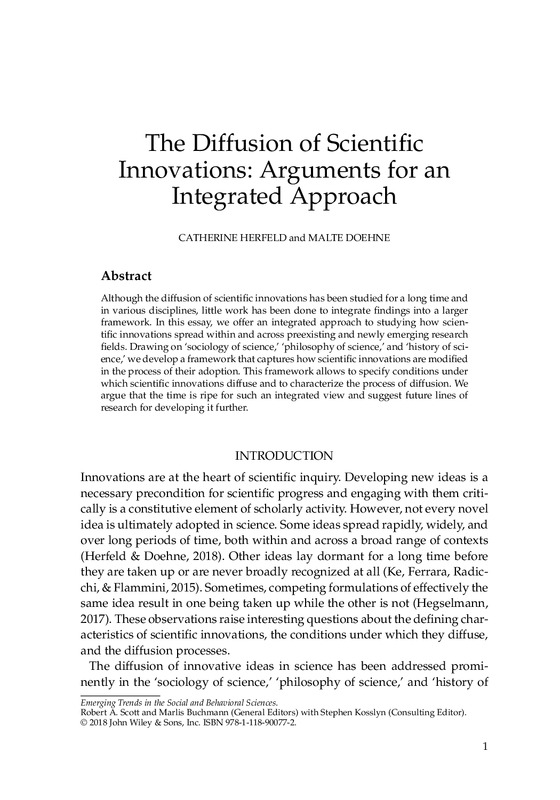
The Diffusion of Scientific Innovations: Arguments for an Integrated Approach
Media
Part of The Diffusion of Scientific Innovations: Arguments for an Integrated Approach
- Title
- The Diffusion of Scientific Innovations: Arguments for an Integrated Approach
- extracted text
-
k
PSYHB etrds0462.tex
V2 - 10/22/2018
6:17 P.M.
Page 1
The Diffusion of Scientific
Innovations: Arguments for an
Integrated Approach
CATHERINE HERFELD and MALTE DOEHNE
Abstract
k
Although the diffusion of scientific innovations has been studied for a long time and
in various disciplines, little work has been done to integrate findings into a larger
framework. In this essay, we offer an integrated approach to studying how scientific innovations spread within and across preexisting and newly emerging research
fields. Drawing on ‘sociology of science,’ ‘philosophy of science,’ and ‘history of science,’ we develop a framework that captures how scientific innovations are modified
in the process of their adoption. This framework allows to specify conditions under
which scientific innovations diffuse and to characterize the process of diffusion. We
argue that the time is ripe for such an integrated view and suggest future lines of
research for developing it further.
k
INTRODUCTION
Innovations are at the heart of scientific inquiry. Developing new ideas is a
necessary precondition for scientific progress and engaging with them critically is a constitutive element of scholarly activity. However, not every novel
idea is ultimately adopted in science. Some ideas spread rapidly, widely, and
over long periods of time, both within and across a broad range of contexts
(Herfeld & Doehne, 2018). Other ideas lay dormant for a long time before
they are taken up or are never broadly recognized at all (Ke, Ferrara, Radicchi, & Flammini, 2015). Sometimes, competing formulations of effectively the
same idea result in one being taken up while the other is not (Hegselmann,
2017). These observations raise interesting questions about the defining characteristics of scientific innovations, the conditions under which they diffuse,
and the diffusion processes.
The diffusion of innovative ideas in science has been addressed prominently in the ‘sociology of science,’ ‘philosophy of science,’ and ‘history of
Emerging Trends in the Social and Behavioral Sciences.
Robert A. Scott and Marlis Buchmann (General Editors) with Stephen Kosslyn (Consulting Editor).
© 2018 John Wiley & Sons, Inc. ISBN 978-1-118-90077-2.
1
k
k
PSYHB etrds0462.tex
2
k
V2 - 10/22/2018
6:17 P.M.
Page 2
EMERGING TRENDS IN THE SOCIAL AND BEHAVIORAL SCIENCES
science’. As the theoretical frameworks used in these fields differ substantially, the benefits of integrating findings across disciplines (or lack thereof)
have been a matter of recurrent debates, albeit with differing emphases
(Riesch, 2014). While philosophers of science have long focused on rational
reconstructions and on justificatory issues involved in adopting novel theories in science, while historians of science have highlighted the contingencies
involved in the adoption of new ideas, and sociologists of science have
focused on social contexts of knowledge production. While sociologists have
acknowledged the benefits of theoretical frameworks for studying science,
alongside historians, they have generally dismissed purely conceptual
approaches in favor of empirical case studies and analyses (Merton, 1973).
In this essay, we argue that one important step toward improving our
understanding of the diffusion of scientific innovation is to systematically
integrate relevant research findings into a systematic framework. As we
observe a confluence in the use of new methodologies across these three
disciplines, we propose that it is time to recalibrate, and where appropriate.
Relax, disciplinary boundaries when studying the diffusion of novel ideas
in science.
In the following sections, we develop this argument in detail. We begin by
offering a definition of scientific innovation, which highlights that new theories are modified as they spread within and across preexisting and newly
forming fields of academic inquiry. Then, we outline a general account of
the diffusion of scientific innovations that focuses on, (i) how new scientific
ideas, once formulated, are adopted, and (ii) how novel ideas are thereby
integrated into the larger body of knowledge that they become part of. Third,
we discuss reasons why historians-, philosophers-, and sociologists of science
might welcome a methodologically integrated approach. We conclude with
an outlook of how studies of the diffusion of scientific innovations could be
developed further in each of the three disciplines.
SCIENTIFIC INNOVATIONS
While a large literature is concerned with scientific innovations, a clear and
agreed-upon definition of scientific innovation is missing. Arguably, inflationary use has stripped the concept of “innovation” of much of its substance
(Godin, 2015). It is unclear at the outset what counts as an innovative idea
or what characterizes an innovative research program. Oftentimes, scientific innovations are not conceptually distinguished from scientific discoveries, inventions in science, new scientific theories, research programs, or
paradigms, and newly produced knowledge more generally. This mixes up
very distinct endeavors in science. Finally, it is unsatisfactory that philosophers of science, who tackle conceptual questions about the adoption of new
k
k
k
PSYHB etrds0462.tex
V2 - 10/22/2018
The Diffusion of Scientific Innovations: Arguments for an Integrated Approach
k
Page 3
3
theories or the nature of scientific discovery, rarely specify what they mean
by a scientific innovation at all (Sturm, forthcoming).
To develop a definition of “scientific innovation,” it is instructive to
first consider the literature on innovation more generally. Everett Rogers
famously defined innovation as “an idea, practice, or object that is perceived as new by an individual or other unit of adoption” (Rogers, 2003
[1962], p. 11). In Rogers view, for something to be an innovation, it must
be adopted. This aspect is particularly important in science, where new
ideas can lie dormant for a long time before their importance is recognized (Ke et al., 2015). Rogers defines diffusion as a process in which an
innovation is communicated among the members of a social system and
over time (Rogers, 2003 [1962]). In the same way, novel ideas in science
diffuse within and across existing and newly forming communities of
scientists and in a social and institutional context within which knowledge
is produced.
While Rogers’ general definition captures characteristics that are relevant to
the diffusion of scientific innovations, it treats the innovation itself as a good
whose essential properties remain unchanged in the diffusion process. However, this fails to characterize scientific innovations. Most scientists will consider new ideas—be they innovative theories or models, techniques, instruments, or concepts—only insofar as those ideas relate to their preexisting
knowledge base and they can perceive their relevance for problems in their
respective fields (Latour, 1987). The adoption of an innovative contribution
depends crucially upon its potential of doing so. In its original formulation,
a novel idea will often be applicable to some but not necessarily many problems. For it to spread widely and across research fields, a scientific innovation
must, therefore, undergo various processes of modification and, sometimes,
transformation (see Merz, 2018 for discussions of various accounts). As an
inherent part of the diffusion process, a scientific innovation is elaborated
upon and clarified in ways that render it applicable to distinct problems in
different domains.
The modification of scientific innovations is particularly important in
light of another, closely related observation. For a novel scientific idea to be
adopted, it must overcome what Kuhn (1977b [1959]) has described as an
“essential tension.” This essential tension arises from the fact that scientific
innovations must be novel on the one hand but must also align with and
connect to previous research on the other. Scientists engage with, and
adopt, a scientific innovation when it fits not only with accepted epistemic
and methodological standards of the field but also with at least parts of
the conceptual and theoretical toolbox used in their discipline. As Foster,
Rzhetsky, and Evans (2015) have pointed out, this essential tension underlies
well-known dichotomies in philosophy- and sociology of science. While
k
6:17 P.M.
k
k
PSYHB etrds0462.tex
4
k
V2 - 10/22/2018
6:17 P.M.
Page 4
EMERGING TRENDS IN THE SOCIAL AND BEHAVIORAL SCIENCES
sociologists of science have identified tensions between ‘succession’ and
‘subversion’ (Bourdieu, 1975) or ‘relevance’ and ‘originality’ (Whitley, 2000),
philosophers of science have considered tensions between ‘conformity’ and
‘dissent’ (Polanyi, 1969) or ‘exploration’ and ‘exploitation’ (Thoma, 2015;
Weisberg & Muldoon, 2009).
Scientific innovations resolve the essential tension by being modified in
ways that fit with the established concepts, theoretical frameworks, and
practices of the respective field while preserving their novelty (Kuhn, 1977b
[1959]). As epistemic standards, theoretical frameworks, core concepts, and
scientific practices vary across fields, the diffusion of scientific innovations
demands context-specific modifications. As the problems that a scientific
innovation is applied to will vary across fields, many variants of the original
innovation can emerge. While each originates in the same innovation, these
variants will differ in significant respects. By undertaking such modifications, scientists engaging with the innovation bridge the gap between
novelty and alignment in ways that are compatible with their discipline’s
demands.
Against this background, our basic contention is that studies of the diffusion of scientific innovations must capture these conceptual modifications
and how they shape and reconfigure possibilities for subsequent adoptions.
While sociologists-, philosophers-, and historians of science have studied
scientific innovations and their diffusion, their methodologies seldom
account for such conceptual modification processes. Instead, sociologists
of science have emphasized how social context, scholarly networks, and
institutional conditions affect processes of knowledge diffusion and knowledge production (Kronegger, Mali, Anuška, & Patrick, 2011; Merton, 1973;
Whitley, Gläser, & Laudel, 2018), how different institutional contexts shape
their diffusion (Abbott, 2001; Crane, 1972), and condition the scientist’s
choice between high-risk and conservative research strategies (Foster et al.,
2015). Historians of science have studied scientific innovations in detailed
case studies to highlight the circumstances in which so-called revolutions
or fundamental disciplinary changes occurred, such as from Newtonian
mechanics to Einstein’s relativity theory, or the Darwinian revolution
(Godin, 2015; Kuhn, 1962). And philosophers of science have devoted
themselves to explicating concepts, studying the logic of scientific inquiry
and scientific discovery (Schickore 2018), the nature of scientific progress
(Niiniluoto, 2017), rational theory choice and theory change (Kuhn, 1977a;
Okasha, 2011), and conditions under which science is a rational enterprise.
Rarely, however, have these fields unified their results, let alone have they
focused on how the elements they each highlight separately shape the
conceptual modifications that are prerequisites for the diffusion of scientific
innovations.
k
k
k
PSYHB etrds0462.tex
V2 - 10/22/2018
The Diffusion of Scientific Innovations: Arguments for an Integrated Approach
6:17 P.M.
Page 5
5
AN INTEGRATED APPROACH TO THE DIFFUSION OF SCIENTIFIC
INNOVATIONS
k
We propose an account of scientific innovations that integrates methodological and conceptual findings from philosophy-, sociology-, and history of
science. This framework accounts for the modification of the scientific innovation in the process of its diffusion by constructing a network representation
of the process outcome. We illustrate this framework by drawing on a study
of the early diffusion of Rational Choice Theories (RCT) within and across
the social and behavioral sciences (Herfeld & Doehne, 2018). The framework
allows tracing the diffusion of scientific innovations across fields and systematically examining the conditions for their diffusion. We take this approach to
exemplify how a methodological and conceptual integration can be mutually
beneficial for the three disciplines in the study of scientific innovations.
We take up the idea from innovation studies and the sociology of science
that innovations spread within social networks and that the relevant actors
occupy different roles in such processes (Coleman, Katz, & Menzel, 1966;
Rogers, 2003 [1962]; Valente, 1995). We, furthermore, ground our analysis
empirically by drawing upon quantitative network analysis. Combining a
quantitative method with a historical case study allows for an empirically
rich yet systematic study to subsequently generalize from one case to other
cases and draw conceptual conclusions that are of interest for philosophical
and sociological accounts of scientific innovations alike.
Overcoming Kuhn’s essential tension involves a step-wise process of
engaging with the novel scientific idea. In the process, scientists and their
contributions take on different roles, depending on the type of modifications
they undertake in the diffusion process. The proposed framework distinguishes three modification stages that a newly formulated idea undergoes
in the diffusion process. These are elaboration, translation, and specialization.
Each stage requires the skills of different types of researchers, and each stage
brings forth different types of publications. In total, we distinguish four roles
that research contributions can occupy in the diffusion process: innovator,
elaborator, translator, or specialist. Each contribution plays a distinct but
essential role in facilitating the adoption of the scientific innovation. Figure 1
offers a schematic representation of the diffusion process.
First, there is the novel idea itself, the scientific innovation. To identify
it, a precise understanding of the (historical) context is needed in which
it was first formulated. The benefit of hindsight and the fact that the
innovation is by definition adopted in subsequent research facilitates this
first step of the analysis. In our case study of the early spread of RCT, for
example, we identified John von Neumann’s and Oskar Morgenstern’s
seminal Theory of Games and Economic Behavior (1944) as containing the set
k
k
k
PSYHB etrds0462.tex
6
V2 - 10/22/2018
6:17 P.M.
Page 6
EMERGING TRENDS IN THE SOCIAL AND BEHAVIORAL SCIENCES
Elaboration and
translation
Innovation
Elaborator
Translator
Specialist
Specialized fields of research
Figure 1 Schematic representation of the different modification steps that a
scientific innovation undergoes in its diffusion process.
k
of novel ideas. The Theory of Games contained two innovative contributions
to theories of rational decision-making: (i) an axiomatic representation of
the long-standing principle of expected utility and (ii) the minimax theorem
as a “rule” for rational action in situations of strategic uncertainty. Both
contributions were conceptually novel in that they represented human
behavior by a set of formal techniques taken from mathematical logic,
probability theory, axiomatic set theory, and topology. Nowadays, RCT are
used in a large number of disciplines and have been integrated into a variety
of social scientific approaches to study individual and social behavior.
An important step in the diffusion of the scientific innovation is its elaboration in ways that develop its conceptual, theoretical, and/or empirical
usefulness. At the outset, only a few scientists start engaging with the innovation in its initial formulation. Their primary task is to elaborate the idea’s
potentials. Elaborator contributions clarify open issues, raise new questions in
relation to the idea, or reformulate parts of the idea in new terms. While elaborators can suggest new uses for the scientific innovation, they do not themselves motivate a separate line of inquiry, nor do they lead to the formation
of new specialities. Rather, they contribute to the innovation’s clarification
and its conceptual, theoretical, and/or empirical development so that later
contributions can draw on it once others have been convinced of its general
usefulness.
Scientific innovations are ultimately taken up in specialized areas. This is
realized by specialist contributions. Specialists contribute to what Kuhn (1962)
referred to as ‘normal science.’ They address clearly defined research questions that tackle field-specific problems in their respective specialty. Therefore, specialist contributions adopt a scientific innovation only when it has
k
k
k
PSYHB etrds0462.tex
V2 - 10/22/2018
The Diffusion of Scientific Innovations: Arguments for an Integrated Approach
k
Page 7
7
already been modified in such a way that its usefulness has been established
within their community. For instance, RCT became applied in specialized
subfields of economics, sociology, psychology, political science, organization
theory, and biology, among others (Erickson, 2010) only once scholars recognized their benefits for solving specific problems in those fields.
A scientific innovation spreads into specialties via translator contributions.
Translators connect elaborator contributions to specialized research fields by
and make the innovation accessible, relatable, and applicable to specialist
research outside of the domain in which it originated. This requires what
Collins and Evans (2007) have referred to as “interactional experts”, that is,
scholars who have the ability to converse in disciplinary languages other
than their own. Translators accomplish this because they are closely connected to their specialty and reach the specialists. For instance, before sociologists and psychologists began using RCT, it required translators from both
fields who were well-versed in mathematics without being mathematicians
themselves.
This general role typology captures the main characteristics of scientific
innovations, it reveals the conditions under which they diffuse, and thereby
offers a characterization of the diffusion process. The four roles capture the
core modification steps that are required for scientific innovations to overcome Kuhn’s essential tension. Elaboration, translation, and specialization
are each preconditions for the diffusion of a scientific innovation. Translators, in particular, reflect and absorb the essential tension, as they establish a
bridge between the elaborated innovation and specialist subfields of inquiry.
They make a substantially novel contribution while aligning the original idea
with the expected methodological and epistemic principles of their specialty.
As such, successful translator contributions enable the spread of the innovation into specialist fields. Table 1 summarizes the four types of contributions that are needed for a scientific innovation to spread across research
fields.
Detailed knowledge of the innovation allows for a qualitative assessment
of the status of later publications vis-à-vis the original. Did subsequent
contributions elaborate on core themes Or did they translate the innovation
and facilitate its spread into newly-forming or preexisting research fields?
In our study of the early diffusion of RCT, we used network analysis to
systematically identify elaborator, translator, and specialist contributions
from their positions in a co-citation network of publications that are cited
together with the Theory of Games (cf. Herfeld & Doehne, 2018 for details).
While this allowed us to identify and characterize each role in a systematic
and generalizable way, it would in many cases also be feasible to identify
elaborators, translators, and specialists from archival materials, interviews,
or field observations.
k
6:17 P.M.
k
k
PSYHB etrds0462.tex
8
V2 - 10/22/2018
6:17 P.M.
Page 8
EMERGING TRENDS IN THE SOCIAL AND BEHAVIORAL SCIENCES
Table 1
Characterization of the Role Typology
Role
Innovator
Elaborator
Translator
Specialist
Function
Formulates
a novel idea
Explicates and clarifies the original idea
Reformulates the idea
and makes it accessible to specialist
research
Addresses
field-specific
questions using
translated versions of the
initial idea
Contributes to the
spread of the idea
but does not relate
to a particular field
of inquiry
k
Resolves the essential
tension confronted by
the initial idea
This framework exemplifies the benefits of pursuing an integrated
approach to the study of scientific innovations. It draws on philosophy
of science to explicate the concept of a scientific innovation and to draw
attention to the essential tension that is inherent to the diffusion of scientific
innovations. A classification of how particular scholars and their works
contributed to the subsequent modification and diffusion of the original
idea requires detailed historical and sociological accounts of the processes
involved. The task of tracing the diffusion process and classifying subsequent works in terms of their contributions benefits from diffusion studies
originating in the sociology of science. As such, the role typology that is
summarized in Table 1 is informed by methods from philosophy-, history-,
and sociology of science. It serves as a general classification scheme of scientific contributions in the study of scientific innovations. As such, it captures
the essential features of the modification process that are characteristic of
scientific innovations.
EMERGING TRENDS SUGGEST AN INTEGRATED APPROACH
What do we gain from studying the diffusion of scientific innovations in an
integrated way? We suggest that a framework that integrates methodological
and conceptual aspects is needed to systematically examine the conditions
under which knowledge in general, and scientific innovations in particular,
spread. One might argue that disciplinary separations, the strong fragmentation, and reinforcement of the division of cognitive labor cannot be easily
overcome. However, we see reason to be optimistic about meeting this challenge. In each of the three disciplines, the history-, sociology-, and philosophy
of science, emerging trends in the methods being used point toward a relaxing (or shifting) of disciplinary boundaries. Moreover, we contend that the
conceptual and methodological contributions in each of the three fields stand
k
k
k
PSYHB etrds0462.tex
V2 - 10/22/2018
The Diffusion of Scientific Innovations: Arguments for an Integrated Approach
6:17 P.M.
Page 9
9
Philosophy of science
• Explication
• Conceptual analysis
• Justification
History of science
• Narrative and rich
description
• Case-study approach
Sociology of science
• Conceptualization of
contexts and configurations
• empirical methods
Figure 2 Benefits of an integrated approach on the methodological and
conceptual level for philosophy-, history-, and sociology of science.
k
to enrich the others when studying scientific innovations and their diffusion.1
As regards the first reason, we observe that the adoption of new methods is
resulting in an (unintended) methodological convergence of the three fields.
While generalization about the three fields is misplaced, we note an growing
overlap between, and compatibilities among, new methods and instruments
being drawn upon in each discipline. This emerging body of work, which
draws on simulation methods, quantitative empirical analyses, and increasingly large datasets, speaks to a careful recalibration of longstanding disciplinary divides (Bearman, 2015; Claveau & Gingras, 2016; Herfeld & Doehne,
2018; Klein, Marx, & Fischbach, 2018). The observed use of such methods
across disciplines indicates that the involved researchers are less concerned
with upholding disciplinary boundaries than with answering pressing questions in their fields. Figure 2 offers a schematic of how scholars in each field
stand to benefit from acknowledging the efforts of the other two disciplines
respectively.
Some parts of history of science are increasingly characterized by a focus
on offering “rich, thickly descriptive, local studies” that emphasize not primarily the ideas and discoveries of great thinkers but the scientific practices
that scientists engage in (Lightman, 2016, p. 1). To study different forms of
knowledge, how knowledge is constructed in specific contexts, as well as
how and why knowledge circulates, historians of science increasingly engage
with scholarship from a variety of fields. Some overlap with science studies
and the sociology of science is indicative for this. Complementing historical case studies with formal methods such as network analysis, simulation,
1. A large literature in science studies has made contributions toward an integrative approach. While
we generally favour this literature, our suggestion is less comprehensive in that we emphasize methodological and conceptual integration.
k
k
k
PSYHB etrds0462.tex
10
k
V2 - 10/22/2018
6:17 P.M. Page 10
EMERGING TRENDS IN THE SOCIAL AND BEHAVIORAL SCIENCES
and data analysis can further substantiate historical case studies (Bearman,
Moody, & Faris, 2002). Along these lines, historical episodes in science are
being studied by modeling the configurations in which innovations occur
(Claveau & Gingras, 2016; Herfeld & Doehne, 2018; Klein et al., 2018; Wright,
2016).
In social epistemology and philosophy of science as well, there is an
emerging trend toward using qualitative and quantitative methods from the
social sciences and ethnography (Mayo-Wilson, Zollman, & Danks, 2011;
Nersessian, 2012). Increasingly, philosophers of science draw upon formal
modeling tools from decision and game theory, along with simulation
techniques, to study the dynamics and structures of scientific communities
(Alexander, Himmelreich, & Thompson, 2015; O’Connor & Bruner, 2017;
Weisberg & Muldoon, 2009; Zollman, 2013). While these studies generally
justify the roles that scientists occupy in a community on the basis of
plausibility considerations, those roles and their impact on outcomes are
seldom justified empirically.
Martini and Pinto (2017) have argued that the models being espoused by
philosophers of science are too far removed from the empirical reality that
they are intended to illuminate. They point out an empirical challenge that
future research in philosophy should strive to connect models with their target systems by testing them against data. Similarly, Crupi and Hartmann
(2010) have argued that empirical methods can complement formal methods. Turning to sociology- and history of science seems a natural step forward for philosophy of science. Not only would empirical approaches inform
philosophical assumptions and concepts. Integrated studies allow for generalizations and conceptual contributions (e.g., the role typology) that inform
explication and conceptual analysis in philosophy.
As they turn to bibliometric and other publication-related data (e.g.,
Web-of-Science) to study scientific innovations, sociologists of science stand
to benefit from the work of historians- and philosophers of science. From
the historian of science, they can obtain not only the detailed historical
knowledge that is needed for casing their analyses but also a finer understanding for idiosyncratic and context-specific features that are relevant to
the particular case at hand. Moreover, historical accounts stand to enrich,
complement, and validate analytically derived findings. For our own study
of the early spread of RCT, for example, we relied on detailed historical
accounts and knowledge of the early diffusion process as a baseline for
assessing the validity of the empirically derived diffusion measure. Only by
comparing our findings with the detailed historical accounts of the period
were we able to interpret our findings and assess their validity. Moreover,
as sociologists of science turn to the task of evaluating the effects of institutional configurations on publication output and success, philosophers of
k
k
k
PSYHB etrds0462.tex
V2 - 10/22/2018
The Diffusion of Scientific Innovations: Arguments for an Integrated Approach
6:17 P.M. Page 11
11
science can offer normative criteria for appraising ongoing developments.
Furthermore, sociologically informed analyses of large data repositories call
for conceptual precision and careful explications of the key concepts used
in their analyses, particularly as they relate to the justification of normative
claims. Philosophers of science can contribute towards achieving both.
OUTLOOK
k
An integrated approach to the study of scientific innovations and their diffusion allows for a more comprehensive understanding of scientific innovations and the mechanisms underlying their diffusion. On the basis of such
an integrated analysis, science policy makers can implement the conditions
necessary for scientific innovations to occur where desired; they could design
research environments conducive for the development of scientific innovations and for their successful adoption. This is important, as current incentive
structures are often counterproductive to basic research or to elaborating on
novel ideas of which the impact and success is uncertain. As large funding
schemes want to ensure innovative research, project evaluations should also
be in proper conceptual foundations and an adequate definition of scientific
innovations.
While we suggest that emerging methodological trends in all three fields are
conducive to overcoming disciplinary barriers, this methodological and conceptual integration remains to be explicitly fostered within and across those
disciplines. Furthermore, general frameworks stand to be validated by applications to a variety of contexts and empirical tests. The framework we have
presented here, for example, remains to be applied to other scientific innovations in the natural and social sciences. Promising examples include the early
diffusion of Feynman diagrams, bioevolutionary theory, the Lotka–Volterra
model, or the prisoner’s dilemma. These representations, theories, concepts,
and models have been recognized as successful instances of novel ideas and
have spread widely within and across fields. Examinations of the early diffusion of these scientific innovations can reveal the extent to which they, too,
spread through a process of elaboration, translation, and specialization, as
the model we have presented suggests.
A wider application of the role typology and the concepts it introduces
will inform further explication of the roles that scientists and/or their
contributions occupy in the diffusion process. By offering fine-grained
micro-analyses of the processes involved in elaboration, translation, and
specialization, historical and sociological analyses help to further specify
the definition of the concept of scientific innovations in the first place, a
conceptual gap in the literature that needs to be filled. As one example, Lisciandra and Nagatsu (forthcoming) examine why translation of the expected
k
k
k
PSYHB etrds0462.tex
12
V2 - 10/22/2018
6:17 P.M. Page 12
EMERGING TRENDS IN THE SOCIAL AND BEHAVIORAL SCIENCES
utility principle enabled its diffusion into psychology while the absence
of translation prevented the game theoretic concepts of von Neumann
and Morgenstern from spreading widely into psychology. Future research
should aim at a richer and more complete understanding of the diffusion of
scientific innovations by combining a case-study approach from the history
of science with conceptual contributions from philosophy of science and
empirical methods from the sociology of science.
REFERENCES
k
Abbott, A. (2001). Chaos of disciplines. Chicago, IL: University of Chicago Press.
Alexander, J., Himmelreich, J., & Thompson, C. (2015). Epistemic landscapes, optimal search, and the division of cognitive labor. Philosophy of Science, 82(3), 424–453.
Bearman, Peter. 2015. Big data and historical social science. Big Data & Society 2(2),
1–5. doi: 10.1177/2053951715612497
Bearman, P., Moody, J., & Faris, R. (2002). Networks and history. Complexity, 8(1),
61–71.
Bourdieu, P. (1975). The specificity of the scientific field and the social conditions of
the progress of reason. Information (International Social Science Council), 14(6), 19–47.
Claveau, F., & Gingras, Y. (2016). Macrodynamics of economics: A bibliometric history. History of Political Economy, 48(4), 551–592.
Coleman, J., Katz, E., & Menzel, H. (1966). Medical innovation : A diffusion study. Indianapolis, IN: Bobbs-Merrill Co.
Collins, H., & Evans, R. (2007). Rethinking expertise. Chicago, UK: University of
Chicago Press.
Crane, D. (1972). Invisible colleges: Diffusion of knowledge in scientific communities.
Chicago, UK: University of Chicago Press.
Crupi, V., & Hartmann, S. (2010). Formal and empirical methods in philosophy of
science. In S. F. (Ed.), The present situation in the philosophy of science (pp. 87–98).
Berlin: Springer.
Erickson, P. (2010). Mathematical models, rational choice, and the search for cold war
culture. Isis, 101(2), 386–392.
Foster, J., Rzhetsky, A., & Evans, J. (2015). Tradition and innovation in scientists’
research strategies. American Sociological Review, 80(5), 875–908.
Godin, B. (2015). Innovation contested: The idea of innovation over the centuries. London,
UK: Routledge.
Hegselmann, R. (2017). Thomas C. Schelling and James M. Sakoda: The intellectual,
technical, and social history of a model. Journal of Artificial Societies and Social Simulation, 20(3), 19–152.
Herfeld, C., & Doehne, M. (2018). The diffusion of scientific innovations: A role
typology. Studies in the History and Philosophy of Science (Part A), forthc., 1–18.
doi:10.1016/j.shpsa.2017.12.001
Ke, Q., Ferrara, E., Radicchi, F., & Flammini, A. (2015). Defining and identifying
sleeping beauties in science. Proceedings of the National Academy of Sciences, 112(24),
7426–7431.
k
k
k
PSYHB etrds0462.tex
V2 - 10/22/2018
The Diffusion of Scientific Innovations: Arguments for an Integrated Approach
k
6:17 P.M. Page 13
13
Klein, D., Marx, J., & Fischbach, K. (2018). Agent-based modeling in social science, history, and philosophy. An introduction. Historical Social Research/Historische
Sozialforschung, 43(163), 7–27.
Kronegger, L., Mali, F., Anuška, F., & Patrick, D. (2011). Collaboration structures in
Slovenian Scientific Communities. Scientometrics, 90(2), 631–647.
Kuhn, T. (1962). The structure of scientific revolutions. Chicago, UK: University of
Chicago Press.
Kuhn, T. (1977a). Objectivity, value judgment, and theory choice. In A. Bird & J. Ladyman (Eds.), Arguing about science (pp. 74–86). New York, NY: Routledge.
Kuhn, T. (1977b [1959]). The essential tension. Tradition and innovation in scientific
research. In T. S. Kuhn (Ed.), The essential tension, selected studies in scientific tradition
and change (pp. 225–249). Chicago, UK: University of Chicago Press.
Latour, B. (1987). Science in action: How to follow scientists and engineers through society.
Cambridge, MA: Harvard University Press.
Lightman, B. (2016). A companion to the history of science. Malden, Oxford, West Sussex:
John Wiley & Sons.
Lisciandra, C., & Nagatsu, M. (2018). Why is Behavioral Game Theory Economists’
Game? The concept of beliefs in equilibrium. In M. Taishido, S. Egashira, W. Hands
& U. Mäki (Eds.), A genealogy of self-interest in economics. Dordrecht: Springer.
Martini, C., & Pinto, M. F. (2017). Modeling the social organization of science. European Journal for Philosophy of Science, 7(2), 221–238.
Mayo-Wilson, C., Zollman, K., & Danks, D. (2011). The independence thesis:
When individual and social epistemology diverge. Philosophy of Science, 78(4),
653–677.
Merton, R. (1973). The sociology of science: Theoretical and empirical investigations.
Chicago, IL: University of Chicago Press.
Merz, M. (2018). Epistemic innovation. In A. Windeler, W. Rammert, H. Knoblauch
& M. Hutter (Eds.), Innovation society today (pp. 325–339). Wiesbaden: Springer.
Nersessian, N. (2012). Modeling practices in conceptual innovation: An ethnographic study of a neural engineering research laboratory. In U. Feest & F. Steinle
(Eds.), Scientific concepts and investigative practice (pp. 245–269). Berlin, Germany:
DeGruyter.
Niiniluoto, I. (2017). Optimistic realism about scientific progress. Synthese, 194(9),
3291–3309.
O’Connor, C., & Bruner, J. (2017). Dynamics and diversity in epistemic communities.
Erkenntnis, 1–19.
Okasha, S. (2011). Theory Choice and Social Choice: Kuhn Versus Arrow. Mind,
120(477), 83–115.
Polanyi, M. (1969). Knowing and being (essays). Chicago, IL: University of Chicago
Press.
Riesch, H. (2014). Philosophy, history and sociology of science: Interdisciplinary relations and complex social identities. Studies in History and Philosophy of Science Part
A, 48, 30–37.
Rogers, E. (2003 [1962]). Diffusion of innovations. New York, NY: Free Press.
k
k
k
PSYHB etrds0462.tex
14
V2 - 10/22/2018
6:17 P.M. Page 14
EMERGING TRENDS IN THE SOCIAL AND BEHAVIORAL SCIENCES
Schickore, J. (2018). Scientific discovery. In E. Zalta (Ed.), The Stanford Encyclopedia of Philosophy (Summer 2018 Edition), https://plato.stanford.edu/archives/
sum2018/entries/scientific-discovery/
Sturm, T. (forthcoming). Scientific innovation and models of rationality. Theoria.
Thoma, J. (2015). The epistemic division of labor revisited. Philosophy of Science, 82(3),
454–472.
Valente, T. (1995). Network models of the diffusion of innovations. Cresskill, NJ: Hampton
Press.
Von Neumann, J., & Morgenstern, O. (1944). Theory of games and economic behavior.
Princeton, NJ: Princeton University Press.
Weisberg, M., & Muldoon, R. (2009). Epistemic landscapes and the division of cognitive labor. Philosophy of Science, 76(2), 225–252.
Whitley, R. (2000). The intellectual and social organization of the sciences. New York, NY:
Oxford University Press.
Whitley, R., Gläser, J., & Laudel, G. (2018). The impact of changing funding and
authority relationships on scientific innovations. Minerva, 56(1), 109–134.
Wright, C. (2016). The 1920s Viennese intellectual community as a center for ideas
exchange: A network analysis. History of Political Economy, 48(4), 593–634.
Zollman, K. (2013). Network epistemology: Communication in epistemic communities. Philosophy Compass, 8(1), 15–27.
k
Catherine Herfeld is assistant professor of social theory and philosophy of
the social sciences at the University of Zurich, Switzerland. Her research
focuses on the diffusion of scientific innovations and on the history and epistemic status of rational choice theories in economics, among other topics.
Malte Doehne is a postdoctoral researcher at the chair for economic sociology of the University of Zurich, Switzerland. His research interests include
relational sociology, network analysis, and the diffusion of innovations.
RELATED ESSAYS
Expertise (Sociology), Gil Eyal
Innovation (Economics), Adam B. Jaffe
Knowledge Transfer (Psychology), Timothy J. Nokes-Malach and J. Elizabeth
Richey
Technology Diffusion (Economics), Adam B. Jaffe
The Development of Expertise in Scientific Research (Education), David F.
Feldon
An Emerging Trend: Is Big Data the End of Theory? (Sociology), Michael W.
Macy
Diffusion: From Facebook to (Management) Fashion (Sociology), David
Strang and Kelly Patterson
k
k
-
k
PSYHB etrds0462.tex
V2 - 10/22/2018
6:17 P.M.
Page 1
The Diffusion of Scientific
Innovations: Arguments for an
Integrated Approach
CATHERINE HERFELD and MALTE DOEHNE
Abstract
k
Although the diffusion of scientific innovations has been studied for a long time and
in various disciplines, little work has been done to integrate findings into a larger
framework. In this essay, we offer an integrated approach to studying how scientific innovations spread within and across preexisting and newly emerging research
fields. Drawing on ‘sociology of science,’ ‘philosophy of science,’ and ‘history of science,’ we develop a framework that captures how scientific innovations are modified
in the process of their adoption. This framework allows to specify conditions under
which scientific innovations diffuse and to characterize the process of diffusion. We
argue that the time is ripe for such an integrated view and suggest future lines of
research for developing it further.
k
INTRODUCTION
Innovations are at the heart of scientific inquiry. Developing new ideas is a
necessary precondition for scientific progress and engaging with them critically is a constitutive element of scholarly activity. However, not every novel
idea is ultimately adopted in science. Some ideas spread rapidly, widely, and
over long periods of time, both within and across a broad range of contexts
(Herfeld & Doehne, 2018). Other ideas lay dormant for a long time before
they are taken up or are never broadly recognized at all (Ke, Ferrara, Radicchi, & Flammini, 2015). Sometimes, competing formulations of effectively the
same idea result in one being taken up while the other is not (Hegselmann,
2017). These observations raise interesting questions about the defining characteristics of scientific innovations, the conditions under which they diffuse,
and the diffusion processes.
The diffusion of innovative ideas in science has been addressed prominently in the ‘sociology of science,’ ‘philosophy of science,’ and ‘history of
Emerging Trends in the Social and Behavioral Sciences.
Robert A. Scott and Marlis Buchmann (General Editors) with Stephen Kosslyn (Consulting Editor).
© 2018 John Wiley & Sons, Inc. ISBN 978-1-118-90077-2.
1
k
k
PSYHB etrds0462.tex
2
k
V2 - 10/22/2018
6:17 P.M.
Page 2
EMERGING TRENDS IN THE SOCIAL AND BEHAVIORAL SCIENCES
science’. As the theoretical frameworks used in these fields differ substantially, the benefits of integrating findings across disciplines (or lack thereof)
have been a matter of recurrent debates, albeit with differing emphases
(Riesch, 2014). While philosophers of science have long focused on rational
reconstructions and on justificatory issues involved in adopting novel theories in science, while historians of science have highlighted the contingencies
involved in the adoption of new ideas, and sociologists of science have
focused on social contexts of knowledge production. While sociologists have
acknowledged the benefits of theoretical frameworks for studying science,
alongside historians, they have generally dismissed purely conceptual
approaches in favor of empirical case studies and analyses (Merton, 1973).
In this essay, we argue that one important step toward improving our
understanding of the diffusion of scientific innovation is to systematically
integrate relevant research findings into a systematic framework. As we
observe a confluence in the use of new methodologies across these three
disciplines, we propose that it is time to recalibrate, and where appropriate.
Relax, disciplinary boundaries when studying the diffusion of novel ideas
in science.
In the following sections, we develop this argument in detail. We begin by
offering a definition of scientific innovation, which highlights that new theories are modified as they spread within and across preexisting and newly
forming fields of academic inquiry. Then, we outline a general account of
the diffusion of scientific innovations that focuses on, (i) how new scientific
ideas, once formulated, are adopted, and (ii) how novel ideas are thereby
integrated into the larger body of knowledge that they become part of. Third,
we discuss reasons why historians-, philosophers-, and sociologists of science
might welcome a methodologically integrated approach. We conclude with
an outlook of how studies of the diffusion of scientific innovations could be
developed further in each of the three disciplines.
SCIENTIFIC INNOVATIONS
While a large literature is concerned with scientific innovations, a clear and
agreed-upon definition of scientific innovation is missing. Arguably, inflationary use has stripped the concept of “innovation” of much of its substance
(Godin, 2015). It is unclear at the outset what counts as an innovative idea
or what characterizes an innovative research program. Oftentimes, scientific innovations are not conceptually distinguished from scientific discoveries, inventions in science, new scientific theories, research programs, or
paradigms, and newly produced knowledge more generally. This mixes up
very distinct endeavors in science. Finally, it is unsatisfactory that philosophers of science, who tackle conceptual questions about the adoption of new
k
k
k
PSYHB etrds0462.tex
V2 - 10/22/2018
The Diffusion of Scientific Innovations: Arguments for an Integrated Approach
k
Page 3
3
theories or the nature of scientific discovery, rarely specify what they mean
by a scientific innovation at all (Sturm, forthcoming).
To develop a definition of “scientific innovation,” it is instructive to
first consider the literature on innovation more generally. Everett Rogers
famously defined innovation as “an idea, practice, or object that is perceived as new by an individual or other unit of adoption” (Rogers, 2003
[1962], p. 11). In Rogers view, for something to be an innovation, it must
be adopted. This aspect is particularly important in science, where new
ideas can lie dormant for a long time before their importance is recognized (Ke et al., 2015). Rogers defines diffusion as a process in which an
innovation is communicated among the members of a social system and
over time (Rogers, 2003 [1962]). In the same way, novel ideas in science
diffuse within and across existing and newly forming communities of
scientists and in a social and institutional context within which knowledge
is produced.
While Rogers’ general definition captures characteristics that are relevant to
the diffusion of scientific innovations, it treats the innovation itself as a good
whose essential properties remain unchanged in the diffusion process. However, this fails to characterize scientific innovations. Most scientists will consider new ideas—be they innovative theories or models, techniques, instruments, or concepts—only insofar as those ideas relate to their preexisting
knowledge base and they can perceive their relevance for problems in their
respective fields (Latour, 1987). The adoption of an innovative contribution
depends crucially upon its potential of doing so. In its original formulation,
a novel idea will often be applicable to some but not necessarily many problems. For it to spread widely and across research fields, a scientific innovation
must, therefore, undergo various processes of modification and, sometimes,
transformation (see Merz, 2018 for discussions of various accounts). As an
inherent part of the diffusion process, a scientific innovation is elaborated
upon and clarified in ways that render it applicable to distinct problems in
different domains.
The modification of scientific innovations is particularly important in
light of another, closely related observation. For a novel scientific idea to be
adopted, it must overcome what Kuhn (1977b [1959]) has described as an
“essential tension.” This essential tension arises from the fact that scientific
innovations must be novel on the one hand but must also align with and
connect to previous research on the other. Scientists engage with, and
adopt, a scientific innovation when it fits not only with accepted epistemic
and methodological standards of the field but also with at least parts of
the conceptual and theoretical toolbox used in their discipline. As Foster,
Rzhetsky, and Evans (2015) have pointed out, this essential tension underlies
well-known dichotomies in philosophy- and sociology of science. While
k
6:17 P.M.
k
k
PSYHB etrds0462.tex
4
k
V2 - 10/22/2018
6:17 P.M.
Page 4
EMERGING TRENDS IN THE SOCIAL AND BEHAVIORAL SCIENCES
sociologists of science have identified tensions between ‘succession’ and
‘subversion’ (Bourdieu, 1975) or ‘relevance’ and ‘originality’ (Whitley, 2000),
philosophers of science have considered tensions between ‘conformity’ and
‘dissent’ (Polanyi, 1969) or ‘exploration’ and ‘exploitation’ (Thoma, 2015;
Weisberg & Muldoon, 2009).
Scientific innovations resolve the essential tension by being modified in
ways that fit with the established concepts, theoretical frameworks, and
practices of the respective field while preserving their novelty (Kuhn, 1977b
[1959]). As epistemic standards, theoretical frameworks, core concepts, and
scientific practices vary across fields, the diffusion of scientific innovations
demands context-specific modifications. As the problems that a scientific
innovation is applied to will vary across fields, many variants of the original
innovation can emerge. While each originates in the same innovation, these
variants will differ in significant respects. By undertaking such modifications, scientists engaging with the innovation bridge the gap between
novelty and alignment in ways that are compatible with their discipline’s
demands.
Against this background, our basic contention is that studies of the diffusion of scientific innovations must capture these conceptual modifications
and how they shape and reconfigure possibilities for subsequent adoptions.
While sociologists-, philosophers-, and historians of science have studied
scientific innovations and their diffusion, their methodologies seldom
account for such conceptual modification processes. Instead, sociologists
of science have emphasized how social context, scholarly networks, and
institutional conditions affect processes of knowledge diffusion and knowledge production (Kronegger, Mali, Anuška, & Patrick, 2011; Merton, 1973;
Whitley, Gläser, & Laudel, 2018), how different institutional contexts shape
their diffusion (Abbott, 2001; Crane, 1972), and condition the scientist’s
choice between high-risk and conservative research strategies (Foster et al.,
2015). Historians of science have studied scientific innovations in detailed
case studies to highlight the circumstances in which so-called revolutions
or fundamental disciplinary changes occurred, such as from Newtonian
mechanics to Einstein’s relativity theory, or the Darwinian revolution
(Godin, 2015; Kuhn, 1962). And philosophers of science have devoted
themselves to explicating concepts, studying the logic of scientific inquiry
and scientific discovery (Schickore 2018), the nature of scientific progress
(Niiniluoto, 2017), rational theory choice and theory change (Kuhn, 1977a;
Okasha, 2011), and conditions under which science is a rational enterprise.
Rarely, however, have these fields unified their results, let alone have they
focused on how the elements they each highlight separately shape the
conceptual modifications that are prerequisites for the diffusion of scientific
innovations.
k
k
k
PSYHB etrds0462.tex
V2 - 10/22/2018
The Diffusion of Scientific Innovations: Arguments for an Integrated Approach
6:17 P.M.
Page 5
5
AN INTEGRATED APPROACH TO THE DIFFUSION OF SCIENTIFIC
INNOVATIONS
k
We propose an account of scientific innovations that integrates methodological and conceptual findings from philosophy-, sociology-, and history of
science. This framework accounts for the modification of the scientific innovation in the process of its diffusion by constructing a network representation
of the process outcome. We illustrate this framework by drawing on a study
of the early diffusion of Rational Choice Theories (RCT) within and across
the social and behavioral sciences (Herfeld & Doehne, 2018). The framework
allows tracing the diffusion of scientific innovations across fields and systematically examining the conditions for their diffusion. We take this approach to
exemplify how a methodological and conceptual integration can be mutually
beneficial for the three disciplines in the study of scientific innovations.
We take up the idea from innovation studies and the sociology of science
that innovations spread within social networks and that the relevant actors
occupy different roles in such processes (Coleman, Katz, & Menzel, 1966;
Rogers, 2003 [1962]; Valente, 1995). We, furthermore, ground our analysis
empirically by drawing upon quantitative network analysis. Combining a
quantitative method with a historical case study allows for an empirically
rich yet systematic study to subsequently generalize from one case to other
cases and draw conceptual conclusions that are of interest for philosophical
and sociological accounts of scientific innovations alike.
Overcoming Kuhn’s essential tension involves a step-wise process of
engaging with the novel scientific idea. In the process, scientists and their
contributions take on different roles, depending on the type of modifications
they undertake in the diffusion process. The proposed framework distinguishes three modification stages that a newly formulated idea undergoes
in the diffusion process. These are elaboration, translation, and specialization.
Each stage requires the skills of different types of researchers, and each stage
brings forth different types of publications. In total, we distinguish four roles
that research contributions can occupy in the diffusion process: innovator,
elaborator, translator, or specialist. Each contribution plays a distinct but
essential role in facilitating the adoption of the scientific innovation. Figure 1
offers a schematic representation of the diffusion process.
First, there is the novel idea itself, the scientific innovation. To identify
it, a precise understanding of the (historical) context is needed in which
it was first formulated. The benefit of hindsight and the fact that the
innovation is by definition adopted in subsequent research facilitates this
first step of the analysis. In our case study of the early spread of RCT, for
example, we identified John von Neumann’s and Oskar Morgenstern’s
seminal Theory of Games and Economic Behavior (1944) as containing the set
k
k
k
PSYHB etrds0462.tex
6
V2 - 10/22/2018
6:17 P.M.
Page 6
EMERGING TRENDS IN THE SOCIAL AND BEHAVIORAL SCIENCES
Elaboration and
translation
Innovation
Elaborator
Translator
Specialist
Specialized fields of research
Figure 1 Schematic representation of the different modification steps that a
scientific innovation undergoes in its diffusion process.
k
of novel ideas. The Theory of Games contained two innovative contributions
to theories of rational decision-making: (i) an axiomatic representation of
the long-standing principle of expected utility and (ii) the minimax theorem
as a “rule” for rational action in situations of strategic uncertainty. Both
contributions were conceptually novel in that they represented human
behavior by a set of formal techniques taken from mathematical logic,
probability theory, axiomatic set theory, and topology. Nowadays, RCT are
used in a large number of disciplines and have been integrated into a variety
of social scientific approaches to study individual and social behavior.
An important step in the diffusion of the scientific innovation is its elaboration in ways that develop its conceptual, theoretical, and/or empirical
usefulness. At the outset, only a few scientists start engaging with the innovation in its initial formulation. Their primary task is to elaborate the idea’s
potentials. Elaborator contributions clarify open issues, raise new questions in
relation to the idea, or reformulate parts of the idea in new terms. While elaborators can suggest new uses for the scientific innovation, they do not themselves motivate a separate line of inquiry, nor do they lead to the formation
of new specialities. Rather, they contribute to the innovation’s clarification
and its conceptual, theoretical, and/or empirical development so that later
contributions can draw on it once others have been convinced of its general
usefulness.
Scientific innovations are ultimately taken up in specialized areas. This is
realized by specialist contributions. Specialists contribute to what Kuhn (1962)
referred to as ‘normal science.’ They address clearly defined research questions that tackle field-specific problems in their respective specialty. Therefore, specialist contributions adopt a scientific innovation only when it has
k
k
k
PSYHB etrds0462.tex
V2 - 10/22/2018
The Diffusion of Scientific Innovations: Arguments for an Integrated Approach
k
Page 7
7
already been modified in such a way that its usefulness has been established
within their community. For instance, RCT became applied in specialized
subfields of economics, sociology, psychology, political science, organization
theory, and biology, among others (Erickson, 2010) only once scholars recognized their benefits for solving specific problems in those fields.
A scientific innovation spreads into specialties via translator contributions.
Translators connect elaborator contributions to specialized research fields by
and make the innovation accessible, relatable, and applicable to specialist
research outside of the domain in which it originated. This requires what
Collins and Evans (2007) have referred to as “interactional experts”, that is,
scholars who have the ability to converse in disciplinary languages other
than their own. Translators accomplish this because they are closely connected to their specialty and reach the specialists. For instance, before sociologists and psychologists began using RCT, it required translators from both
fields who were well-versed in mathematics without being mathematicians
themselves.
This general role typology captures the main characteristics of scientific
innovations, it reveals the conditions under which they diffuse, and thereby
offers a characterization of the diffusion process. The four roles capture the
core modification steps that are required for scientific innovations to overcome Kuhn’s essential tension. Elaboration, translation, and specialization
are each preconditions for the diffusion of a scientific innovation. Translators, in particular, reflect and absorb the essential tension, as they establish a
bridge between the elaborated innovation and specialist subfields of inquiry.
They make a substantially novel contribution while aligning the original idea
with the expected methodological and epistemic principles of their specialty.
As such, successful translator contributions enable the spread of the innovation into specialist fields. Table 1 summarizes the four types of contributions that are needed for a scientific innovation to spread across research
fields.
Detailed knowledge of the innovation allows for a qualitative assessment
of the status of later publications vis-à-vis the original. Did subsequent
contributions elaborate on core themes Or did they translate the innovation
and facilitate its spread into newly-forming or preexisting research fields?
In our study of the early diffusion of RCT, we used network analysis to
systematically identify elaborator, translator, and specialist contributions
from their positions in a co-citation network of publications that are cited
together with the Theory of Games (cf. Herfeld & Doehne, 2018 for details).
While this allowed us to identify and characterize each role in a systematic
and generalizable way, it would in many cases also be feasible to identify
elaborators, translators, and specialists from archival materials, interviews,
or field observations.
k
6:17 P.M.
k
k
PSYHB etrds0462.tex
8
V2 - 10/22/2018
6:17 P.M.
Page 8
EMERGING TRENDS IN THE SOCIAL AND BEHAVIORAL SCIENCES
Table 1
Characterization of the Role Typology
Role
Innovator
Elaborator
Translator
Specialist
Function
Formulates
a novel idea
Explicates and clarifies the original idea
Reformulates the idea
and makes it accessible to specialist
research
Addresses
field-specific
questions using
translated versions of the
initial idea
Contributes to the
spread of the idea
but does not relate
to a particular field
of inquiry
k
Resolves the essential
tension confronted by
the initial idea
This framework exemplifies the benefits of pursuing an integrated
approach to the study of scientific innovations. It draws on philosophy
of science to explicate the concept of a scientific innovation and to draw
attention to the essential tension that is inherent to the diffusion of scientific
innovations. A classification of how particular scholars and their works
contributed to the subsequent modification and diffusion of the original
idea requires detailed historical and sociological accounts of the processes
involved. The task of tracing the diffusion process and classifying subsequent works in terms of their contributions benefits from diffusion studies
originating in the sociology of science. As such, the role typology that is
summarized in Table 1 is informed by methods from philosophy-, history-,
and sociology of science. It serves as a general classification scheme of scientific contributions in the study of scientific innovations. As such, it captures
the essential features of the modification process that are characteristic of
scientific innovations.
EMERGING TRENDS SUGGEST AN INTEGRATED APPROACH
What do we gain from studying the diffusion of scientific innovations in an
integrated way? We suggest that a framework that integrates methodological
and conceptual aspects is needed to systematically examine the conditions
under which knowledge in general, and scientific innovations in particular,
spread. One might argue that disciplinary separations, the strong fragmentation, and reinforcement of the division of cognitive labor cannot be easily
overcome. However, we see reason to be optimistic about meeting this challenge. In each of the three disciplines, the history-, sociology-, and philosophy
of science, emerging trends in the methods being used point toward a relaxing (or shifting) of disciplinary boundaries. Moreover, we contend that the
conceptual and methodological contributions in each of the three fields stand
k
k
k
PSYHB etrds0462.tex
V2 - 10/22/2018
The Diffusion of Scientific Innovations: Arguments for an Integrated Approach
6:17 P.M.
Page 9
9
Philosophy of science
• Explication
• Conceptual analysis
• Justification
History of science
• Narrative and rich
description
• Case-study approach
Sociology of science
• Conceptualization of
contexts and configurations
• empirical methods
Figure 2 Benefits of an integrated approach on the methodological and
conceptual level for philosophy-, history-, and sociology of science.
k
to enrich the others when studying scientific innovations and their diffusion.1
As regards the first reason, we observe that the adoption of new methods is
resulting in an (unintended) methodological convergence of the three fields.
While generalization about the three fields is misplaced, we note an growing
overlap between, and compatibilities among, new methods and instruments
being drawn upon in each discipline. This emerging body of work, which
draws on simulation methods, quantitative empirical analyses, and increasingly large datasets, speaks to a careful recalibration of longstanding disciplinary divides (Bearman, 2015; Claveau & Gingras, 2016; Herfeld & Doehne,
2018; Klein, Marx, & Fischbach, 2018). The observed use of such methods
across disciplines indicates that the involved researchers are less concerned
with upholding disciplinary boundaries than with answering pressing questions in their fields. Figure 2 offers a schematic of how scholars in each field
stand to benefit from acknowledging the efforts of the other two disciplines
respectively.
Some parts of history of science are increasingly characterized by a focus
on offering “rich, thickly descriptive, local studies” that emphasize not primarily the ideas and discoveries of great thinkers but the scientific practices
that scientists engage in (Lightman, 2016, p. 1). To study different forms of
knowledge, how knowledge is constructed in specific contexts, as well as
how and why knowledge circulates, historians of science increasingly engage
with scholarship from a variety of fields. Some overlap with science studies
and the sociology of science is indicative for this. Complementing historical case studies with formal methods such as network analysis, simulation,
1. A large literature in science studies has made contributions toward an integrative approach. While
we generally favour this literature, our suggestion is less comprehensive in that we emphasize methodological and conceptual integration.
k
k
k
PSYHB etrds0462.tex
10
k
V2 - 10/22/2018
6:17 P.M. Page 10
EMERGING TRENDS IN THE SOCIAL AND BEHAVIORAL SCIENCES
and data analysis can further substantiate historical case studies (Bearman,
Moody, & Faris, 2002). Along these lines, historical episodes in science are
being studied by modeling the configurations in which innovations occur
(Claveau & Gingras, 2016; Herfeld & Doehne, 2018; Klein et al., 2018; Wright,
2016).
In social epistemology and philosophy of science as well, there is an
emerging trend toward using qualitative and quantitative methods from the
social sciences and ethnography (Mayo-Wilson, Zollman, & Danks, 2011;
Nersessian, 2012). Increasingly, philosophers of science draw upon formal
modeling tools from decision and game theory, along with simulation
techniques, to study the dynamics and structures of scientific communities
(Alexander, Himmelreich, & Thompson, 2015; O’Connor & Bruner, 2017;
Weisberg & Muldoon, 2009; Zollman, 2013). While these studies generally
justify the roles that scientists occupy in a community on the basis of
plausibility considerations, those roles and their impact on outcomes are
seldom justified empirically.
Martini and Pinto (2017) have argued that the models being espoused by
philosophers of science are too far removed from the empirical reality that
they are intended to illuminate. They point out an empirical challenge that
future research in philosophy should strive to connect models with their target systems by testing them against data. Similarly, Crupi and Hartmann
(2010) have argued that empirical methods can complement formal methods. Turning to sociology- and history of science seems a natural step forward for philosophy of science. Not only would empirical approaches inform
philosophical assumptions and concepts. Integrated studies allow for generalizations and conceptual contributions (e.g., the role typology) that inform
explication and conceptual analysis in philosophy.
As they turn to bibliometric and other publication-related data (e.g.,
Web-of-Science) to study scientific innovations, sociologists of science stand
to benefit from the work of historians- and philosophers of science. From
the historian of science, they can obtain not only the detailed historical
knowledge that is needed for casing their analyses but also a finer understanding for idiosyncratic and context-specific features that are relevant to
the particular case at hand. Moreover, historical accounts stand to enrich,
complement, and validate analytically derived findings. For our own study
of the early spread of RCT, for example, we relied on detailed historical
accounts and knowledge of the early diffusion process as a baseline for
assessing the validity of the empirically derived diffusion measure. Only by
comparing our findings with the detailed historical accounts of the period
were we able to interpret our findings and assess their validity. Moreover,
as sociologists of science turn to the task of evaluating the effects of institutional configurations on publication output and success, philosophers of
k
k
k
PSYHB etrds0462.tex
V2 - 10/22/2018
The Diffusion of Scientific Innovations: Arguments for an Integrated Approach
6:17 P.M. Page 11
11
science can offer normative criteria for appraising ongoing developments.
Furthermore, sociologically informed analyses of large data repositories call
for conceptual precision and careful explications of the key concepts used
in their analyses, particularly as they relate to the justification of normative
claims. Philosophers of science can contribute towards achieving both.
OUTLOOK
k
An integrated approach to the study of scientific innovations and their diffusion allows for a more comprehensive understanding of scientific innovations and the mechanisms underlying their diffusion. On the basis of such
an integrated analysis, science policy makers can implement the conditions
necessary for scientific innovations to occur where desired; they could design
research environments conducive for the development of scientific innovations and for their successful adoption. This is important, as current incentive
structures are often counterproductive to basic research or to elaborating on
novel ideas of which the impact and success is uncertain. As large funding
schemes want to ensure innovative research, project evaluations should also
be in proper conceptual foundations and an adequate definition of scientific
innovations.
While we suggest that emerging methodological trends in all three fields are
conducive to overcoming disciplinary barriers, this methodological and conceptual integration remains to be explicitly fostered within and across those
disciplines. Furthermore, general frameworks stand to be validated by applications to a variety of contexts and empirical tests. The framework we have
presented here, for example, remains to be applied to other scientific innovations in the natural and social sciences. Promising examples include the early
diffusion of Feynman diagrams, bioevolutionary theory, the Lotka–Volterra
model, or the prisoner’s dilemma. These representations, theories, concepts,
and models have been recognized as successful instances of novel ideas and
have spread widely within and across fields. Examinations of the early diffusion of these scientific innovations can reveal the extent to which they, too,
spread through a process of elaboration, translation, and specialization, as
the model we have presented suggests.
A wider application of the role typology and the concepts it introduces
will inform further explication of the roles that scientists and/or their
contributions occupy in the diffusion process. By offering fine-grained
micro-analyses of the processes involved in elaboration, translation, and
specialization, historical and sociological analyses help to further specify
the definition of the concept of scientific innovations in the first place, a
conceptual gap in the literature that needs to be filled. As one example, Lisciandra and Nagatsu (forthcoming) examine why translation of the expected
k
k
k
PSYHB etrds0462.tex
12
V2 - 10/22/2018
6:17 P.M. Page 12
EMERGING TRENDS IN THE SOCIAL AND BEHAVIORAL SCIENCES
utility principle enabled its diffusion into psychology while the absence
of translation prevented the game theoretic concepts of von Neumann
and Morgenstern from spreading widely into psychology. Future research
should aim at a richer and more complete understanding of the diffusion of
scientific innovations by combining a case-study approach from the history
of science with conceptual contributions from philosophy of science and
empirical methods from the sociology of science.
REFERENCES
k
Abbott, A. (2001). Chaos of disciplines. Chicago, IL: University of Chicago Press.
Alexander, J., Himmelreich, J., & Thompson, C. (2015). Epistemic landscapes, optimal search, and the division of cognitive labor. Philosophy of Science, 82(3), 424–453.
Bearman, Peter. 2015. Big data and historical social science. Big Data & Society 2(2),
1–5. doi: 10.1177/2053951715612497
Bearman, P., Moody, J., & Faris, R. (2002). Networks and history. Complexity, 8(1),
61–71.
Bourdieu, P. (1975). The specificity of the scientific field and the social conditions of
the progress of reason. Information (International Social Science Council), 14(6), 19–47.
Claveau, F., & Gingras, Y. (2016). Macrodynamics of economics: A bibliometric history. History of Political Economy, 48(4), 551–592.
Coleman, J., Katz, E., & Menzel, H. (1966). Medical innovation : A diffusion study. Indianapolis, IN: Bobbs-Merrill Co.
Collins, H., & Evans, R. (2007). Rethinking expertise. Chicago, UK: University of
Chicago Press.
Crane, D. (1972). Invisible colleges: Diffusion of knowledge in scientific communities.
Chicago, UK: University of Chicago Press.
Crupi, V., & Hartmann, S. (2010). Formal and empirical methods in philosophy of
science. In S. F. (Ed.), The present situation in the philosophy of science (pp. 87–98).
Berlin: Springer.
Erickson, P. (2010). Mathematical models, rational choice, and the search for cold war
culture. Isis, 101(2), 386–392.
Foster, J., Rzhetsky, A., & Evans, J. (2015). Tradition and innovation in scientists’
research strategies. American Sociological Review, 80(5), 875–908.
Godin, B. (2015). Innovation contested: The idea of innovation over the centuries. London,
UK: Routledge.
Hegselmann, R. (2017). Thomas C. Schelling and James M. Sakoda: The intellectual,
technical, and social history of a model. Journal of Artificial Societies and Social Simulation, 20(3), 19–152.
Herfeld, C., & Doehne, M. (2018). The diffusion of scientific innovations: A role
typology. Studies in the History and Philosophy of Science (Part A), forthc., 1–18.
doi:10.1016/j.shpsa.2017.12.001
Ke, Q., Ferrara, E., Radicchi, F., & Flammini, A. (2015). Defining and identifying
sleeping beauties in science. Proceedings of the National Academy of Sciences, 112(24),
7426–7431.
k
k
k
PSYHB etrds0462.tex
V2 - 10/22/2018
The Diffusion of Scientific Innovations: Arguments for an Integrated Approach
k
6:17 P.M. Page 13
13
Klein, D., Marx, J., & Fischbach, K. (2018). Agent-based modeling in social science, history, and philosophy. An introduction. Historical Social Research/Historische
Sozialforschung, 43(163), 7–27.
Kronegger, L., Mali, F., Anuška, F., & Patrick, D. (2011). Collaboration structures in
Slovenian Scientific Communities. Scientometrics, 90(2), 631–647.
Kuhn, T. (1962). The structure of scientific revolutions. Chicago, UK: University of
Chicago Press.
Kuhn, T. (1977a). Objectivity, value judgment, and theory choice. In A. Bird & J. Ladyman (Eds.), Arguing about science (pp. 74–86). New York, NY: Routledge.
Kuhn, T. (1977b [1959]). The essential tension. Tradition and innovation in scientific
research. In T. S. Kuhn (Ed.), The essential tension, selected studies in scientific tradition
and change (pp. 225–249). Chicago, UK: University of Chicago Press.
Latour, B. (1987). Science in action: How to follow scientists and engineers through society.
Cambridge, MA: Harvard University Press.
Lightman, B. (2016). A companion to the history of science. Malden, Oxford, West Sussex:
John Wiley & Sons.
Lisciandra, C., & Nagatsu, M. (2018). Why is Behavioral Game Theory Economists’
Game? The concept of beliefs in equilibrium. In M. Taishido, S. Egashira, W. Hands
& U. Mäki (Eds.), A genealogy of self-interest in economics. Dordrecht: Springer.
Martini, C., & Pinto, M. F. (2017). Modeling the social organization of science. European Journal for Philosophy of Science, 7(2), 221–238.
Mayo-Wilson, C., Zollman, K., & Danks, D. (2011). The independence thesis:
When individual and social epistemology diverge. Philosophy of Science, 78(4),
653–677.
Merton, R. (1973). The sociology of science: Theoretical and empirical investigations.
Chicago, IL: University of Chicago Press.
Merz, M. (2018). Epistemic innovation. In A. Windeler, W. Rammert, H. Knoblauch
& M. Hutter (Eds.), Innovation society today (pp. 325–339). Wiesbaden: Springer.
Nersessian, N. (2012). Modeling practices in conceptual innovation: An ethnographic study of a neural engineering research laboratory. In U. Feest & F. Steinle
(Eds.), Scientific concepts and investigative practice (pp. 245–269). Berlin, Germany:
DeGruyter.
Niiniluoto, I. (2017). Optimistic realism about scientific progress. Synthese, 194(9),
3291–3309.
O’Connor, C., & Bruner, J. (2017). Dynamics and diversity in epistemic communities.
Erkenntnis, 1–19.
Okasha, S. (2011). Theory Choice and Social Choice: Kuhn Versus Arrow. Mind,
120(477), 83–115.
Polanyi, M. (1969). Knowing and being (essays). Chicago, IL: University of Chicago
Press.
Riesch, H. (2014). Philosophy, history and sociology of science: Interdisciplinary relations and complex social identities. Studies in History and Philosophy of Science Part
A, 48, 30–37.
Rogers, E. (2003 [1962]). Diffusion of innovations. New York, NY: Free Press.
k
k
k
PSYHB etrds0462.tex
14
V2 - 10/22/2018
6:17 P.M. Page 14
EMERGING TRENDS IN THE SOCIAL AND BEHAVIORAL SCIENCES
Schickore, J. (2018). Scientific discovery. In E. Zalta (Ed.), The Stanford Encyclopedia of Philosophy (Summer 2018 Edition), https://plato.stanford.edu/archives/
sum2018/entries/scientific-discovery/
Sturm, T. (forthcoming). Scientific innovation and models of rationality. Theoria.
Thoma, J. (2015). The epistemic division of labor revisited. Philosophy of Science, 82(3),
454–472.
Valente, T. (1995). Network models of the diffusion of innovations. Cresskill, NJ: Hampton
Press.
Von Neumann, J., & Morgenstern, O. (1944). Theory of games and economic behavior.
Princeton, NJ: Princeton University Press.
Weisberg, M., & Muldoon, R. (2009). Epistemic landscapes and the division of cognitive labor. Philosophy of Science, 76(2), 225–252.
Whitley, R. (2000). The intellectual and social organization of the sciences. New York, NY:
Oxford University Press.
Whitley, R., Gläser, J., & Laudel, G. (2018). The impact of changing funding and
authority relationships on scientific innovations. Minerva, 56(1), 109–134.
Wright, C. (2016). The 1920s Viennese intellectual community as a center for ideas
exchange: A network analysis. History of Political Economy, 48(4), 593–634.
Zollman, K. (2013). Network epistemology: Communication in epistemic communities. Philosophy Compass, 8(1), 15–27.
k
Catherine Herfeld is assistant professor of social theory and philosophy of
the social sciences at the University of Zurich, Switzerland. Her research
focuses on the diffusion of scientific innovations and on the history and epistemic status of rational choice theories in economics, among other topics.
Malte Doehne is a postdoctoral researcher at the chair for economic sociology of the University of Zurich, Switzerland. His research interests include
relational sociology, network analysis, and the diffusion of innovations.
RELATED ESSAYS
Expertise (Sociology), Gil Eyal
Innovation (Economics), Adam B. Jaffe
Knowledge Transfer (Psychology), Timothy J. Nokes-Malach and J. Elizabeth
Richey
Technology Diffusion (Economics), Adam B. Jaffe
The Development of Expertise in Scientific Research (Education), David F.
Feldon
An Emerging Trend: Is Big Data the End of Theory? (Sociology), Michael W.
Macy
Diffusion: From Facebook to (Management) Fashion (Sociology), David
Strang and Kelly Patterson
k
k