Trends in Street Crime and the Crime Drop
Media
Part of Trends in Street Crime and the Crime Drop
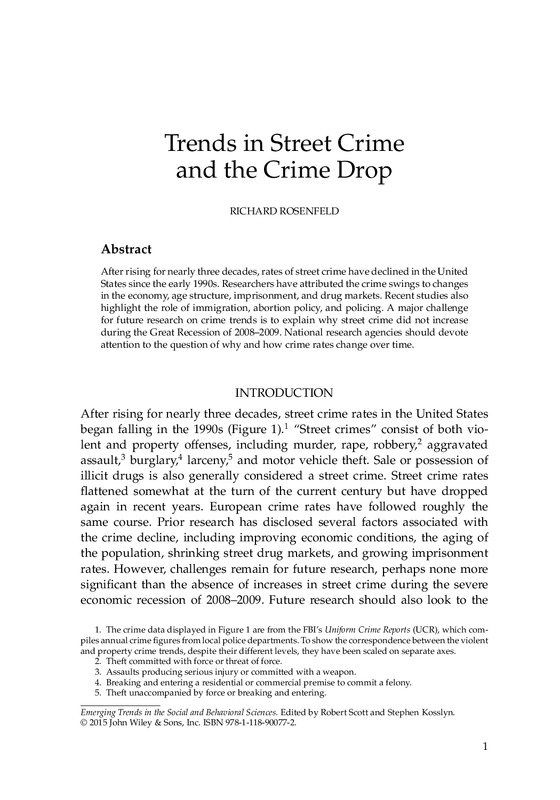
- Title
- Trends in Street Crime and the Crime Drop
- extracted text
-
Trends in Street Crime
and the Crime Drop
RICHARD ROSENFELD
Abstract
After rising for nearly three decades, rates of street crime have declined in the United
States since the early 1990s. Researchers have attributed the crime swings to changes
in the economy, age structure, imprisonment, and drug markets. Recent studies also
highlight the role of immigration, abortion policy, and policing. A major challenge
for future research on crime trends is to explain why street crime did not increase
during the Great Recession of 2008–2009. National research agencies should devote
attention to the question of why and how crime rates change over time.
INTRODUCTION
After rising for nearly three decades, street crime rates in the United States
began falling in the 1990s (Figure 1).1 “Street crimes” consist of both violent and property offenses, including murder, rape, robbery,2 aggravated
assault,3 burglary,4 larceny,5 and motor vehicle theft. Sale or possession of
illicit drugs is also generally considered a street crime. Street crime rates
flattened somewhat at the turn of the current century but have dropped
again in recent years. European crime rates have followed roughly the
same course. Prior research has disclosed several factors associated with
the crime decline, including improving economic conditions, the aging of
the population, shrinking street drug markets, and growing imprisonment
rates. However, challenges remain for future research, perhaps none more
significant than the absence of increases in street crime during the severe
economic recession of 2008–2009. Future research should also look to the
1. The crime data displayed in Figure 1 are from the FBI’s Uniform Crime Reports (UCR), which compiles annual crime figures from local police departments. To show the correspondence between the violent
and property crime trends, despite their different levels, they have been scaled on separate axes.
2. Theft committed with force or threat of force.
3. Assaults producing serious injury or committed with a weapon.
4. Breaking and entering a residential or commercial premise to commit a felony.
5. Theft unaccompanied by force or breaking and entering.
Emerging Trends in the Social and Behavioral Sciences. Edited by Robert Scott and Stephen Kosslyn.
© 2015 John Wiley & Sons, Inc. ISBN 978-1-118-90077-2.
1
2
EMERGING TRENDS IN THE SOCIAL AND BEHAVIORAL SCIENCES
6000
800
700
5000
600
4000
500
Property crime
400
3000
Violent crime
300
2000
200
1000
100
0
1960
Source: Bureau of Justice Statistics; Uniform Crime Reports
0
1965
1970
1975
1980
1985
1990
1995
2000
2005
2010
Figure 1 U.S. violent and property crimes per 100,000 population, 1960–2011.
future, literally, by incorporating advances in forecasting methods into
analyses of crime trends. Finally, the quantity and quality of future research
will depend on incentives from policymakers to make the study of crime
trends a priority area of inquiry in the social sciences.
FOUNDATIONAL RESEARCH
The study of changing crime rates dates to the beginnings of the discipline
of sociology. It was a chief concern of the nineteenth century “moral statisticians” who investigated the relationship between living conditions and theft,
murder, suicide, and related matters widely regarded as religious transgressions. Economic conditions and performance figured centrally in early efforts
to explain changes in crime rates over time. Beginning in the twentieth century, social scientists directed attention to the impact of the business cycle on
crime rates. The results of that research were decidedly mixed. Some studies confirmed the conventional view that crime increases during economic
downturns and declines during recoveries; others showed just the opposite
pattern. By midcentury, reviews of the research literature concluded that no
consistent relationship exists between the economy and crime trends.
Regardless of the state of the economy, involvement in street crime is
greater among adolescents and young adults than older adults. When the
youthful segment of the population grows, as it did in the United States
after World War II, street crime rates tend to increase. The postwar baby
boomers entered their crime-prone years in the mid-1960s and, as shown
Trends in Street Crime and the Crime Drop
3
in Figure 1, crime rates began a steep rise. As the baby boomers aged out
of their crime-prone years and were replaced by smaller age cohorts, crime
rates fell for a few years. Some estimates attribute as much as 20% of the
change in American street crime rates between the 1960s and 1980s to these
shifts in age composition alone.
Demography is not always destiny in the study of crime trends. Most
of the temporal variation in crime rates does not result from changes in
the age composition of the population. That became clear when violent
crime rates began increasing again in the mid-1980s, even as the population
of adolescents and young adults was shrinking. Murders, robberies, and
aggravated assaults were rising within this age cohort; in fact, the increase in
youth violence accounted for all of the increase in the U.S. violent crime rate
from the mid-1980s to the early 1990s. An important reason is the spread of
crack-cocaine markets and the use of firearms by youthful drug dealers to
settle disputes with customers and other sellers and to protect themselves
against street robbers.
U.S. imprisonment rates skyrocketed during the 1980s and 1990s. By the
turn of the century state and federal prisons housed over 1.3 million inmates,
four times the number of prisoners in 1980. There remains little question that
the imprisonment boom contributed to the crime drop, although researchers
disagree about the magnitude and duration of its effect. Recent research suggests, however, that the crime-reduction effects of prison expansion may be
self-limiting. We now turn to this and other “cutting-edge” studies of trends
in street crime.
CUTTING-EDGE RESEARCH
Studies focusing on the economy, age structure, drug markets, and imprisonment form the substantive foundation of research on street crime trends.
Recent research has disclosed new causal factors and produced new substantive explanations of how the more familiar factors operate, primarily with
respect to how economic conditions affect crime trends. Other cutting-edge
research stimulates new ways of thinking about the relationship among
crime trends and social demography, imprisonment growth, and policing.
ECONOMY AND CRIME: BEYOND THE UNEMPLOYMENT RATE
Decades of research led to the conclusion that the connection between economic conditions and changes in crime rates over time is illusive at best.
However, the longitudinal research has begun to tell a more consistent story:
crime rates rise as economic conditions worsen and fall as they improve. An
4
EMERGING TRENDS IN THE SOCIAL AND BEHAVIORAL SCIENCES
important reason for the disparate results of the earlier and more recent studies of crime trends is the use of a broader array of economic indicators in the
recent research.
The unemployment rate was by far the indicator of choice in the early longitudinal research on the economy and crime. Unemployment is certainly
a key indicator of economic performance, but it is limited in important
respects. The official unemployment measure omits those who have
stopped looking for work and dropped out of the labor force. Perhaps most
pertinent to its use in longitudinal research, unemployment is a lagging
indicator of economic change—the last to respond as economic conditions
worsen or improve—which may obscure the temporal connection between
unemployment and crime.
By contrast, the recent longitudinal studies that incorporate more inclusive
and leading economic indicators, such as consumer sentiment and economic
growth, suggest that rates of street crime fall as the economy grows and consumers become more confident about their financial prospects. That is a large
part of the story of the dramatic decrease in crime during the 1990s, when the
economy was expanding at record rates and crime rates fell to lows not seen
since the 1960s. Moreover, economic conditions have been linked directly to
trends in property crime and indirectly, through property crime, to trends
in violent crime. This is an impressive track record for a research area long
regarded as inconclusive, if not moribund.
IMMIGRATION AND ABORTION POLICY
Prior research on demographic change and crime trends focused on the role
of the changing age structure of the population. Recent research has turned
attention to how immigration and accompanying changes in the ethnic mix
of the population influence crime rates. Initially, most of this research was
cross sectional in design and showed that U.S. cities or neighborhoods with
large numbers of immigrants, primarily from Mexico and Central and South
America, have crime rates that are lower than would be expected on the basis
of the new arrivals’ marginal economic status. Longitudinal research has now
begun to disclose, however, that immigration contributes to lower levels of
crime over time as well. This work has important implications for current
policy debates regarding the impact of immigration on public safety.
Perhaps the most controversial and widely publicized addition to research
on crime trends comes from studies of the impact of abortion policy changes
on the crime drop of the 1990s in the United States. Abortion was legalized
in the 1970s and the number of abortions quickly increased. According to
Trends in Street Crime and the Crime Drop
5
the researchers, fewer unwanted births, especially among economically disadvantaged women, resulted in fewer “high-risk” children reaching adolescence in the late 1980s and early 1990s. Consequently, crime rates decreased.
This conclusion has been hotly contested in the research literature and the
extent to which the legalization of abortion contributed to the crime drop
remains uncertain. However, the underlying proposition that children born
in poverty and other disadvantaged circumstances are at elevated risk for
delinquency and crime later in life is generally accepted in the social sciences
and is an important premise of a prominent field of study known as life course
criminology.
DIMINISHING RETURNS OF IMPRISONMENT
Prior research has shown that crime rates drop with increases in imprisonment. However, recent research suggests that the relationship between
imprisonment and crime trends is not strictly linear; after a point, further
growth in imprisonment yields smaller crime reductions, or even crime
increases. The point of diminishing returns to imprisonment may have
already been reached in the United States. An important task for future
research is to identify the mechanisms that limit the crime-reduction
effects of prison expansion and to evaluate the impact on public safety of
supervision of offenders in the community.
HOT SPOTS POLICING
Researchers have long been interested in how policing affects crime. Early
research focused on the relationship between the number of police officers
and city crime rates and yielded mixed results. Some studies found no
relationship, some found lower crime rates in places with more officers per
capita, and some found higher crime rates where there are more officers.
These inconsistent results confirmed the view held by many criminologists,
including leading police researchers, that the police have little detectable
influence on crime rates.
An important limitation of these early efforts to estimate the effect of the
number of police officers on crime is their failure to account for the fact that
cities with high or rising crime rates tend to add more officers. That is at least
in part why many of the studies found that cities with more police have more
crime. Something of a breakthrough was achieved by later studies that were
better able to separate the influence of police on crime from the influence
of crime on police. That research indicated that, other things equal, places
with more police per capita have lower crime rates. However with the new
findings came a new question: Which police activities reduce crime?
6
EMERGING TRENDS IN THE SOCIAL AND BEHAVIORAL SCIENCES
The real breakthrough in modern policing research emerged from two
seemingly straightforward observations: (i) Street crime is not evenly
distributed in a city but is highly concentrated in small crime “hot spots.”
(ii) Criminals tend to avoid or commit less crime in locations where the
police are present. Putting the two observations together—putting the “cops
on the dots”—is the crux of hot-spots enforcement strategies. Evaluations of
hot-spots enforcement have shown that it reduces crime in the hot spots and
generally does not displace it to other areas of the city. In fact, several studies
have found a “diffusion of benefits” whereby crime also decreases in areas
near the hot spots. Not all police departments that claim to pursue hot-spots
enforcement do so with equal rigor or effect, however, and the contribution
of such “smart” policing to overall trends in street crime remains to be
determined in future research.
In addition to evaluating the impact of hot spots enforcement on crime
trends, future research should focus on the crime-reduction effects of probation and other alternatives to imprisonment. However, perhaps the most vexing challenge facing crime-trends researchers is to explain why crime rates
fell during the “Great Recession.”
A KEY ISSUE FOR FUTURE RESEARCH
Just as a new research consensus was developing around the proposition that
street crime increases during economic downturns, the United States entered
the Great Recession of 2008–2009, by many measures the worst economic
downturn since the Great Depression of the 1930s. However, crime rates did
not increase, as they had during previous recessions, as shown in Figure 1,
they fell. We might conclude from this conundrum that, for some reason,
the turnaround in crime rates has been delayed and eventually crime will
increase. That hypothesis would be consistent with the 2011 upturns in both
violent and property crime revealed by the National Crime Victimization
Survey (NCVS),6 but we would still have to explain the delayed response of
crime to deteriorating economic conditions, 3 years out from the official end
of the recession. Moreover, since the early 1990s, the NCVS and the UCR, the
other major statistical system for tracking crime in the United States, have
registered similar year-to-year changes in crime rates. Yet, as we have seen,
the 2011 UCR showed continued crime declines in 2011.
6. The NCVS compiles data on criminal victimizations from nationally representative household surveys of persons age 12 and over. Unlike the UCR (see Foot note 1), the NCVS includes crimes that were
not reported to the police.
Trends in Street Crime and the Crime Drop
7
Another possibility is that the earlier view that little or no relationship exists
between crime and the economy is correct after all. However, that explanation would have to contend with the recent research evidence, from multiple studies, that street crime goes up when the economy turns down. A
final possibility is that the Great Recession differed from previous downturns in ways that explain why crime did not increase. The Great Recession
was similar to previous recessions in several key respects: unemployment
rose, economic growth stalled, and the public’s confidence in the economy
plummeted. However, it did differ in one important way: inflation was at a
historic low point. Prices actually decreased in 2009, the first instance of U.S.
price deflation in over 50 years.
If crime rates respond to inflation, that could explain why crime did not
increase during the economic collapse of the 1930s and rose rapidly during
the prosperous 1960s, two periods often cited by critics of the thesis that crime
and economic conditions are closely coupled. Prolonged price deflation was a
defining feature of the Great Depression and a two-decade inflationary spiral
in the United States was ignited in the mid-1960s. Several early studies found
that street crimes rise with increases in inflation, but inflation has not figured
centrally in the recent research on crime trends that expanded the scope of
economic indicators beyond the unemployment rate. Before concluding that
crime trends are unrelated to economic conditions, it seems wise to exhaust
the full range of economic indicators that may help to clarify the complex
association between crime and the economy.
CONCLUDING COMMENTS
If an overarching theme emerges from this brief tour of research on crime
trends, it is that research is never ending. Conclusions from early research
are overturned or modified by later studies, which in turn produce new puzzles for future research. This is a sign of a healthy research area but also one
that is in need of a theoretical framework that organizes the results of past
research and points to the most productive areas for future inquiry. Agencies
such as the National Academy of Sciences, the National Institute of Justice,
and the National Science Foundation can play an important role in providing the resources and incentives needed to develop this framework for the
study of trends in street crime and also to extend the study of crime trends to
fraud, corruption, price-fixing, and other so-called white-collar offenses. As
the study of crime trends matures, greater attention should also be directed
to forecasting future crime rates by adopting recent advances in forecasting methods from economics. Few areas in the social sciences offer as many
opportunities for important and challenging research as the study of why
and how crime rates change over time.
8
EMERGING TRENDS IN THE SOCIAL AND BEHAVIORAL SCIENCES
FURTHER READING
Arvanites, T. M., & Defina, R. H. (2006). Business cycles and street crime. Criminology,
44, 139–164.
Blumstein, A., & Wallman, J. (Eds.) (2006). The crime drop in America (rev. ed.). New
York, NY: Cambridge University Press.
Braga, A. A., & Weisburd, D. L. (2010). Policing problem places: Crime hot spots and
effective prevention. New York, NY: Oxford University Press.
Cook, P. J., & Zarkin, G. A. (1985). Crime and the business cycle. Journal of Legal Studies, 14, 115–128.
Donohue, J. J., III, & Levitt, S. D. (2001). The impact of legalized abortion on crime.
Quarterly Journal of Economics, 116, 379–420.
Eisner, M. (2001). Modernization, self-control, and lethal violence: The long-term
dynamics of European homicide rates in theoretical perspective. British Journal of
Criminology, 41, 618–638.
Goldberger, A., & Rosenfeld, R. (Eds.) (2009). Understanding crime trends. Washington, DC: National Academies Press.
Liedka, R. V., Piehl, A. M., & Useem, B. (2006). The crime-control effect of incarceration: Does scale matter? Criminology and Public Policy, 5, 245–276.
Rosenfeld, R. (2009). Crime is the problem: Homicide, acquisitive crime, and economic conditions. Journal of Quantitative Criminology, 25, 287–306.
Rosenfeld, R. (2011). Changing crime rates. In J. Q. Wilson & J. Petersilia (Eds.), Crime
and public policy. New York, NY: Oxford University Press.
Rosenfeld, R., & Fornango, R. (2007). The impact of economic conditions on robbery
and property crime: The role of consumer sentiment. Criminology, 45, 735–769.
Rosenfeld, R., & Messner, S. F. (2009). The crime drop in comparative perspective: The
impact of the economy and imprisonment on American and European burglary
rates. British Journal of Sociology, 60, 445–471.
Rosenfeld, R., & Messner, S. F. (2013). Crime and the economy. London, England: Sage.
Roth, R. (2009). American homicide. Cambridge, MA: Harvard University Press.
Stowell, J., Messner, S. F., McGeever, K., & Raffalovich, L. E. (2009). Immigration and
the recent crime drop in the U. S.: A pooled, cross-sectional time-series analysis of
metropolitan areas. Criminology, 47, 889–928.
Zimring, F. E. (2006). The great American crime decline. New York, NY: Oxford University Press.
ON-LINE RESOURCES
National Crime Victimization Survey (http://bjs.ojp.usdoj.gov/index.cfm?ty=
dcdetail&iid=245).
Uniform Crime Reports (http://www.fbi.gov/about-us/cjis/ucr/ucr).
Trends in Street Crime and the Crime Drop
9
RICHARD ROSENFELD SHORT BIOGRAPHY
Richard Rosenfeld is Founders Professor of Criminology and Criminal Justice at the University of Missouri—St. Louis. He is coauthor with Steven F.
Messner of Crime and the America Dream (Cengage, 2013, 5th ed.) and Crime
and the Economy (Sage, 2013). He has written widely on crime trends and
criminal justice policy. He was President of the American Society in 2010 and
currently serves on the Science Advisory Board of the Office of Justice Programs, U. S. Department of Justice.
Web pages: http://www.umsl.edu/ccj/faculty/rosenfeld.html;
http://www.crimetrends.com
RELATED ESSAYS
Deterrence (Sociology), Robert Apel and Daniel S. Nagin
Politics of Criminal Justice (Sociology), Vanessa Barker
Normal Negative Emotions and Mental Disorders (Sociology), Allan V.
Horwitz
Reconciliation and Peace-Making: Insights from Studies on Nonhuman
Animals (Anthropology), Sonja E. Koski
Capital Punishment (Sociology), Mona Lynch
Bringing the Study of Street Gangs Back into the Mainstream (Sociology),
James F. Short, Jr. and Lorine A. Hughes
Bullying, Aggression, and Human Development (Psychology), Samuel E.
Ehrenreich and Marion K. Underwood
Incarceration and Health (Sociology), Christopher Wildeman
-
Trends in Street Crime
and the Crime Drop
RICHARD ROSENFELD
Abstract
After rising for nearly three decades, rates of street crime have declined in the United
States since the early 1990s. Researchers have attributed the crime swings to changes
in the economy, age structure, imprisonment, and drug markets. Recent studies also
highlight the role of immigration, abortion policy, and policing. A major challenge
for future research on crime trends is to explain why street crime did not increase
during the Great Recession of 2008–2009. National research agencies should devote
attention to the question of why and how crime rates change over time.
INTRODUCTION
After rising for nearly three decades, street crime rates in the United States
began falling in the 1990s (Figure 1).1 “Street crimes” consist of both violent and property offenses, including murder, rape, robbery,2 aggravated
assault,3 burglary,4 larceny,5 and motor vehicle theft. Sale or possession of
illicit drugs is also generally considered a street crime. Street crime rates
flattened somewhat at the turn of the current century but have dropped
again in recent years. European crime rates have followed roughly the
same course. Prior research has disclosed several factors associated with
the crime decline, including improving economic conditions, the aging of
the population, shrinking street drug markets, and growing imprisonment
rates. However, challenges remain for future research, perhaps none more
significant than the absence of increases in street crime during the severe
economic recession of 2008–2009. Future research should also look to the
1. The crime data displayed in Figure 1 are from the FBI’s Uniform Crime Reports (UCR), which compiles annual crime figures from local police departments. To show the correspondence between the violent
and property crime trends, despite their different levels, they have been scaled on separate axes.
2. Theft committed with force or threat of force.
3. Assaults producing serious injury or committed with a weapon.
4. Breaking and entering a residential or commercial premise to commit a felony.
5. Theft unaccompanied by force or breaking and entering.
Emerging Trends in the Social and Behavioral Sciences. Edited by Robert Scott and Stephen Kosslyn.
© 2015 John Wiley & Sons, Inc. ISBN 978-1-118-90077-2.
1
2
EMERGING TRENDS IN THE SOCIAL AND BEHAVIORAL SCIENCES
6000
800
700
5000
600
4000
500
Property crime
400
3000
Violent crime
300
2000
200
1000
100
0
1960
Source: Bureau of Justice Statistics; Uniform Crime Reports
0
1965
1970
1975
1980
1985
1990
1995
2000
2005
2010
Figure 1 U.S. violent and property crimes per 100,000 population, 1960–2011.
future, literally, by incorporating advances in forecasting methods into
analyses of crime trends. Finally, the quantity and quality of future research
will depend on incentives from policymakers to make the study of crime
trends a priority area of inquiry in the social sciences.
FOUNDATIONAL RESEARCH
The study of changing crime rates dates to the beginnings of the discipline
of sociology. It was a chief concern of the nineteenth century “moral statisticians” who investigated the relationship between living conditions and theft,
murder, suicide, and related matters widely regarded as religious transgressions. Economic conditions and performance figured centrally in early efforts
to explain changes in crime rates over time. Beginning in the twentieth century, social scientists directed attention to the impact of the business cycle on
crime rates. The results of that research were decidedly mixed. Some studies confirmed the conventional view that crime increases during economic
downturns and declines during recoveries; others showed just the opposite
pattern. By midcentury, reviews of the research literature concluded that no
consistent relationship exists between the economy and crime trends.
Regardless of the state of the economy, involvement in street crime is
greater among adolescents and young adults than older adults. When the
youthful segment of the population grows, as it did in the United States
after World War II, street crime rates tend to increase. The postwar baby
boomers entered their crime-prone years in the mid-1960s and, as shown
Trends in Street Crime and the Crime Drop
3
in Figure 1, crime rates began a steep rise. As the baby boomers aged out
of their crime-prone years and were replaced by smaller age cohorts, crime
rates fell for a few years. Some estimates attribute as much as 20% of the
change in American street crime rates between the 1960s and 1980s to these
shifts in age composition alone.
Demography is not always destiny in the study of crime trends. Most
of the temporal variation in crime rates does not result from changes in
the age composition of the population. That became clear when violent
crime rates began increasing again in the mid-1980s, even as the population
of adolescents and young adults was shrinking. Murders, robberies, and
aggravated assaults were rising within this age cohort; in fact, the increase in
youth violence accounted for all of the increase in the U.S. violent crime rate
from the mid-1980s to the early 1990s. An important reason is the spread of
crack-cocaine markets and the use of firearms by youthful drug dealers to
settle disputes with customers and other sellers and to protect themselves
against street robbers.
U.S. imprisonment rates skyrocketed during the 1980s and 1990s. By the
turn of the century state and federal prisons housed over 1.3 million inmates,
four times the number of prisoners in 1980. There remains little question that
the imprisonment boom contributed to the crime drop, although researchers
disagree about the magnitude and duration of its effect. Recent research suggests, however, that the crime-reduction effects of prison expansion may be
self-limiting. We now turn to this and other “cutting-edge” studies of trends
in street crime.
CUTTING-EDGE RESEARCH
Studies focusing on the economy, age structure, drug markets, and imprisonment form the substantive foundation of research on street crime trends.
Recent research has disclosed new causal factors and produced new substantive explanations of how the more familiar factors operate, primarily with
respect to how economic conditions affect crime trends. Other cutting-edge
research stimulates new ways of thinking about the relationship among
crime trends and social demography, imprisonment growth, and policing.
ECONOMY AND CRIME: BEYOND THE UNEMPLOYMENT RATE
Decades of research led to the conclusion that the connection between economic conditions and changes in crime rates over time is illusive at best.
However, the longitudinal research has begun to tell a more consistent story:
crime rates rise as economic conditions worsen and fall as they improve. An
4
EMERGING TRENDS IN THE SOCIAL AND BEHAVIORAL SCIENCES
important reason for the disparate results of the earlier and more recent studies of crime trends is the use of a broader array of economic indicators in the
recent research.
The unemployment rate was by far the indicator of choice in the early longitudinal research on the economy and crime. Unemployment is certainly
a key indicator of economic performance, but it is limited in important
respects. The official unemployment measure omits those who have
stopped looking for work and dropped out of the labor force. Perhaps most
pertinent to its use in longitudinal research, unemployment is a lagging
indicator of economic change—the last to respond as economic conditions
worsen or improve—which may obscure the temporal connection between
unemployment and crime.
By contrast, the recent longitudinal studies that incorporate more inclusive
and leading economic indicators, such as consumer sentiment and economic
growth, suggest that rates of street crime fall as the economy grows and consumers become more confident about their financial prospects. That is a large
part of the story of the dramatic decrease in crime during the 1990s, when the
economy was expanding at record rates and crime rates fell to lows not seen
since the 1960s. Moreover, economic conditions have been linked directly to
trends in property crime and indirectly, through property crime, to trends
in violent crime. This is an impressive track record for a research area long
regarded as inconclusive, if not moribund.
IMMIGRATION AND ABORTION POLICY
Prior research on demographic change and crime trends focused on the role
of the changing age structure of the population. Recent research has turned
attention to how immigration and accompanying changes in the ethnic mix
of the population influence crime rates. Initially, most of this research was
cross sectional in design and showed that U.S. cities or neighborhoods with
large numbers of immigrants, primarily from Mexico and Central and South
America, have crime rates that are lower than would be expected on the basis
of the new arrivals’ marginal economic status. Longitudinal research has now
begun to disclose, however, that immigration contributes to lower levels of
crime over time as well. This work has important implications for current
policy debates regarding the impact of immigration on public safety.
Perhaps the most controversial and widely publicized addition to research
on crime trends comes from studies of the impact of abortion policy changes
on the crime drop of the 1990s in the United States. Abortion was legalized
in the 1970s and the number of abortions quickly increased. According to
Trends in Street Crime and the Crime Drop
5
the researchers, fewer unwanted births, especially among economically disadvantaged women, resulted in fewer “high-risk” children reaching adolescence in the late 1980s and early 1990s. Consequently, crime rates decreased.
This conclusion has been hotly contested in the research literature and the
extent to which the legalization of abortion contributed to the crime drop
remains uncertain. However, the underlying proposition that children born
in poverty and other disadvantaged circumstances are at elevated risk for
delinquency and crime later in life is generally accepted in the social sciences
and is an important premise of a prominent field of study known as life course
criminology.
DIMINISHING RETURNS OF IMPRISONMENT
Prior research has shown that crime rates drop with increases in imprisonment. However, recent research suggests that the relationship between
imprisonment and crime trends is not strictly linear; after a point, further
growth in imprisonment yields smaller crime reductions, or even crime
increases. The point of diminishing returns to imprisonment may have
already been reached in the United States. An important task for future
research is to identify the mechanisms that limit the crime-reduction
effects of prison expansion and to evaluate the impact on public safety of
supervision of offenders in the community.
HOT SPOTS POLICING
Researchers have long been interested in how policing affects crime. Early
research focused on the relationship between the number of police officers
and city crime rates and yielded mixed results. Some studies found no
relationship, some found lower crime rates in places with more officers per
capita, and some found higher crime rates where there are more officers.
These inconsistent results confirmed the view held by many criminologists,
including leading police researchers, that the police have little detectable
influence on crime rates.
An important limitation of these early efforts to estimate the effect of the
number of police officers on crime is their failure to account for the fact that
cities with high or rising crime rates tend to add more officers. That is at least
in part why many of the studies found that cities with more police have more
crime. Something of a breakthrough was achieved by later studies that were
better able to separate the influence of police on crime from the influence
of crime on police. That research indicated that, other things equal, places
with more police per capita have lower crime rates. However with the new
findings came a new question: Which police activities reduce crime?
6
EMERGING TRENDS IN THE SOCIAL AND BEHAVIORAL SCIENCES
The real breakthrough in modern policing research emerged from two
seemingly straightforward observations: (i) Street crime is not evenly
distributed in a city but is highly concentrated in small crime “hot spots.”
(ii) Criminals tend to avoid or commit less crime in locations where the
police are present. Putting the two observations together—putting the “cops
on the dots”—is the crux of hot-spots enforcement strategies. Evaluations of
hot-spots enforcement have shown that it reduces crime in the hot spots and
generally does not displace it to other areas of the city. In fact, several studies
have found a “diffusion of benefits” whereby crime also decreases in areas
near the hot spots. Not all police departments that claim to pursue hot-spots
enforcement do so with equal rigor or effect, however, and the contribution
of such “smart” policing to overall trends in street crime remains to be
determined in future research.
In addition to evaluating the impact of hot spots enforcement on crime
trends, future research should focus on the crime-reduction effects of probation and other alternatives to imprisonment. However, perhaps the most vexing challenge facing crime-trends researchers is to explain why crime rates
fell during the “Great Recession.”
A KEY ISSUE FOR FUTURE RESEARCH
Just as a new research consensus was developing around the proposition that
street crime increases during economic downturns, the United States entered
the Great Recession of 2008–2009, by many measures the worst economic
downturn since the Great Depression of the 1930s. However, crime rates did
not increase, as they had during previous recessions, as shown in Figure 1,
they fell. We might conclude from this conundrum that, for some reason,
the turnaround in crime rates has been delayed and eventually crime will
increase. That hypothesis would be consistent with the 2011 upturns in both
violent and property crime revealed by the National Crime Victimization
Survey (NCVS),6 but we would still have to explain the delayed response of
crime to deteriorating economic conditions, 3 years out from the official end
of the recession. Moreover, since the early 1990s, the NCVS and the UCR, the
other major statistical system for tracking crime in the United States, have
registered similar year-to-year changes in crime rates. Yet, as we have seen,
the 2011 UCR showed continued crime declines in 2011.
6. The NCVS compiles data on criminal victimizations from nationally representative household surveys of persons age 12 and over. Unlike the UCR (see Foot note 1), the NCVS includes crimes that were
not reported to the police.
Trends in Street Crime and the Crime Drop
7
Another possibility is that the earlier view that little or no relationship exists
between crime and the economy is correct after all. However, that explanation would have to contend with the recent research evidence, from multiple studies, that street crime goes up when the economy turns down. A
final possibility is that the Great Recession differed from previous downturns in ways that explain why crime did not increase. The Great Recession
was similar to previous recessions in several key respects: unemployment
rose, economic growth stalled, and the public’s confidence in the economy
plummeted. However, it did differ in one important way: inflation was at a
historic low point. Prices actually decreased in 2009, the first instance of U.S.
price deflation in over 50 years.
If crime rates respond to inflation, that could explain why crime did not
increase during the economic collapse of the 1930s and rose rapidly during
the prosperous 1960s, two periods often cited by critics of the thesis that crime
and economic conditions are closely coupled. Prolonged price deflation was a
defining feature of the Great Depression and a two-decade inflationary spiral
in the United States was ignited in the mid-1960s. Several early studies found
that street crimes rise with increases in inflation, but inflation has not figured
centrally in the recent research on crime trends that expanded the scope of
economic indicators beyond the unemployment rate. Before concluding that
crime trends are unrelated to economic conditions, it seems wise to exhaust
the full range of economic indicators that may help to clarify the complex
association between crime and the economy.
CONCLUDING COMMENTS
If an overarching theme emerges from this brief tour of research on crime
trends, it is that research is never ending. Conclusions from early research
are overturned or modified by later studies, which in turn produce new puzzles for future research. This is a sign of a healthy research area but also one
that is in need of a theoretical framework that organizes the results of past
research and points to the most productive areas for future inquiry. Agencies
such as the National Academy of Sciences, the National Institute of Justice,
and the National Science Foundation can play an important role in providing the resources and incentives needed to develop this framework for the
study of trends in street crime and also to extend the study of crime trends to
fraud, corruption, price-fixing, and other so-called white-collar offenses. As
the study of crime trends matures, greater attention should also be directed
to forecasting future crime rates by adopting recent advances in forecasting methods from economics. Few areas in the social sciences offer as many
opportunities for important and challenging research as the study of why
and how crime rates change over time.
8
EMERGING TRENDS IN THE SOCIAL AND BEHAVIORAL SCIENCES
FURTHER READING
Arvanites, T. M., & Defina, R. H. (2006). Business cycles and street crime. Criminology,
44, 139–164.
Blumstein, A., & Wallman, J. (Eds.) (2006). The crime drop in America (rev. ed.). New
York, NY: Cambridge University Press.
Braga, A. A., & Weisburd, D. L. (2010). Policing problem places: Crime hot spots and
effective prevention. New York, NY: Oxford University Press.
Cook, P. J., & Zarkin, G. A. (1985). Crime and the business cycle. Journal of Legal Studies, 14, 115–128.
Donohue, J. J., III, & Levitt, S. D. (2001). The impact of legalized abortion on crime.
Quarterly Journal of Economics, 116, 379–420.
Eisner, M. (2001). Modernization, self-control, and lethal violence: The long-term
dynamics of European homicide rates in theoretical perspective. British Journal of
Criminology, 41, 618–638.
Goldberger, A., & Rosenfeld, R. (Eds.) (2009). Understanding crime trends. Washington, DC: National Academies Press.
Liedka, R. V., Piehl, A. M., & Useem, B. (2006). The crime-control effect of incarceration: Does scale matter? Criminology and Public Policy, 5, 245–276.
Rosenfeld, R. (2009). Crime is the problem: Homicide, acquisitive crime, and economic conditions. Journal of Quantitative Criminology, 25, 287–306.
Rosenfeld, R. (2011). Changing crime rates. In J. Q. Wilson & J. Petersilia (Eds.), Crime
and public policy. New York, NY: Oxford University Press.
Rosenfeld, R., & Fornango, R. (2007). The impact of economic conditions on robbery
and property crime: The role of consumer sentiment. Criminology, 45, 735–769.
Rosenfeld, R., & Messner, S. F. (2009). The crime drop in comparative perspective: The
impact of the economy and imprisonment on American and European burglary
rates. British Journal of Sociology, 60, 445–471.
Rosenfeld, R., & Messner, S. F. (2013). Crime and the economy. London, England: Sage.
Roth, R. (2009). American homicide. Cambridge, MA: Harvard University Press.
Stowell, J., Messner, S. F., McGeever, K., & Raffalovich, L. E. (2009). Immigration and
the recent crime drop in the U. S.: A pooled, cross-sectional time-series analysis of
metropolitan areas. Criminology, 47, 889–928.
Zimring, F. E. (2006). The great American crime decline. New York, NY: Oxford University Press.
ON-LINE RESOURCES
National Crime Victimization Survey (http://bjs.ojp.usdoj.gov/index.cfm?ty=
dcdetail&iid=245).
Uniform Crime Reports (http://www.fbi.gov/about-us/cjis/ucr/ucr).
Trends in Street Crime and the Crime Drop
9
RICHARD ROSENFELD SHORT BIOGRAPHY
Richard Rosenfeld is Founders Professor of Criminology and Criminal Justice at the University of Missouri—St. Louis. He is coauthor with Steven F.
Messner of Crime and the America Dream (Cengage, 2013, 5th ed.) and Crime
and the Economy (Sage, 2013). He has written widely on crime trends and
criminal justice policy. He was President of the American Society in 2010 and
currently serves on the Science Advisory Board of the Office of Justice Programs, U. S. Department of Justice.
Web pages: http://www.umsl.edu/ccj/faculty/rosenfeld.html;
http://www.crimetrends.com
RELATED ESSAYS
Deterrence (Sociology), Robert Apel and Daniel S. Nagin
Politics of Criminal Justice (Sociology), Vanessa Barker
Normal Negative Emotions and Mental Disorders (Sociology), Allan V.
Horwitz
Reconciliation and Peace-Making: Insights from Studies on Nonhuman
Animals (Anthropology), Sonja E. Koski
Capital Punishment (Sociology), Mona Lynch
Bringing the Study of Street Gangs Back into the Mainstream (Sociology),
James F. Short, Jr. and Lorine A. Hughes
Bullying, Aggression, and Human Development (Psychology), Samuel E.
Ehrenreich and Marion K. Underwood
Incarceration and Health (Sociology), Christopher Wildeman