The Roots of Moral Reasoning and Behavior in Infants
Media
Part of The Roots of Moral Reasoning and Behavior in Infants
- Title
- The Roots of Moral Reasoning and Behavior in Infants
- extracted text
-
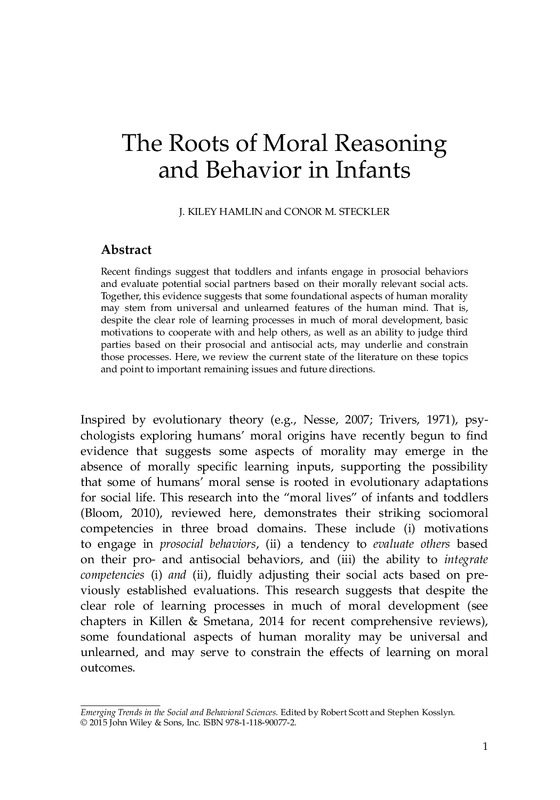
The Roots of Moral Reasoning
and Behavior in Infants
J. KILEY HAMLIN and CONOR M. STECKLER
Abstract
Recent findings suggest that toddlers and infants engage in prosocial behaviors
and evaluate potential social partners based on their morally relevant social acts.
Together, this evidence suggests that some foundational aspects of human morality
may stem from universal and unlearned features of the human mind. That is,
despite the clear role of learning processes in much of moral development, basic
motivations to cooperate with and help others, as well as an ability to judge third
parties based on their prosocial and antisocial acts, may underlie and constrain
those processes. Here, we review the current state of the literature on these topics
and point to important remaining issues and future directions.
Inspired by evolutionary theory (e.g., Nesse, 2007; Trivers, 1971), psychologists exploring humans’ moral origins have recently begun to find
evidence that suggests some aspects of morality may emerge in the
absence of morally specific learning inputs, supporting the possibility
that some of humans’ moral sense is rooted in evolutionary adaptations
for social life. This research into the “moral lives” of infants and toddlers
(Bloom, 2010), reviewed here, demonstrates their striking sociomoral
competencies in three broad domains. These include (i) motivations
to engage in prosocial behaviors, (ii) a tendency to evaluate others based
on their pro- and antisocial behaviors, and (iii) the ability to integrate
competencies (i) and (ii), fluidly adjusting their social acts based on previously established evaluations. This research suggests that despite the
clear role of learning processes in much of moral development (see
chapters in Killen & Smetana, 2014 for recent comprehensive reviews),
some foundational aspects of human morality may be universal and
unlearned, and may serve to constrain the effects of learning on moral
outcomes.
Emerging Trends in the Social and Behavioral Sciences. Edited by Robert Scott and Stephen Kosslyn.
© 2015 John Wiley & Sons, Inc. ISBN 978-1-118-90077-2.
1
2
EMERGING TRENDS IN THE SOCIAL AND BEHAVIORAL SCIENCES
THE EMERGENCE OF PROSOCIAL BEHAVIOR
Infants and toddlers reliably engage in a variety of behaviors that demonstrate a concern for, and a desire to improve, others’ welfare. From birth,
infants cry in response to others’ cries, but not to sounds matched on various
acoustic properties (e.g., Sagi & Hoffman, 1976); this has been interpreted as
a rudimentary empathic response. By 8–10 months, infants begin to show a
desire to understand the cause of others’ distress (Roth-Hanania, Davidov, &
Zahn-Waxler, 2011), and 18- to 25-month olds display concern for those who
have been harmed even if they are not overtly distressed (Vaish, Carpenter, & Tomasello, 2009). Finally, infants’ level of concern for distressed others
is positively associated with their tendency to provide comfort in real time
(Zahn-Waxler, Radke-Yarrow, Wagner, & Chapman, 1992), whereas 14-month
olds’ active disregard for others is associated with the development of antisocial traits later in life (Rhee et al., 2013).
In addition to responding to distress cues, infants also attend to and assist
with others’ instrumental needs. However, 12-month olds will point helpfully toward an object they know an adult is searching for (Liszkowski, Carpenter, Striano, & Tomasello, 2006), and 14- to 18-month olds actively assist
others in a variety of unfulfilled goals (e.g., Warneken & Tomasello, 2006).
Providing assistance appears to be intrinsically motivated and rooted in genuine concern for others. For example, toddlers’ rate of helping others meet
their unfulfilled goals is uninfluenced by whether a parent is in the room
(Warneken & Tomasello, 2013a), and those who receive extrinsic rewards for
helping subsequently helpless (Warneken & Tomasello, 2008). Finally, rather
than being solely based on the emotional cues provided by someone in pursuit of an unfulfilled goal, 12-month olds also provide assistance to those
who are unaware that they need help, by pointing to alert an individual of a
hazardous object in their path (Knudsen & Liszkowski, 2012).
Rather than merely responding to alleviate others’ distress or unfulfilled
goals, toddlers are prosocial in more “positive” ways as well. For instance,
toddlers will in some cases share objects with individuals who have not asked
for them (e.g., Hay, Castle, Davies, Demetriou, & Stimson, 1999). These generous acts may be driven by toddlers’ finding giving emotionally rewarding:
They are happier after giving treats than after receiving them, and are happier
still when giving their own treats (Aknin, Hamlin, & Dunn, 2012). Together,
this growing body of work suggests that infants and toddlers are intrinsically motivated to alleviate others’ distress, assist others’ needs, and share
information and resources.
The Roots of Moral Reasoning and Behavior in Infants
3
THE EMERGENCE OF SOCIOMORAL EVALUATION
Even before they are physically capable of engaging in any of the prosocial
behaviors identified above, preverbal infants evaluate third parties for their
prosocial and antisocial acts, preferring individuals who have acted prosocially to those who have acted antisocially. In these studies, infants are presented with 3-character “morality plays” in which a “Protagonist” demonstrates an unfulfilled goal to climb up a hill, to open a box, or to retrieve
a dropped ball (among others; see Figure 1 for schematics of prosocial and
antisocial events). The Protagonist’s goal is then facilitated by a “Helper” and
blocked by a “Hinderer”; subsequently, infants are presented with the Helper
and Hinderer side by side and their “preference” is determined by which one
they look longer toward and/or touch first.
Infants as young as 3 months of age gaze longer toward Helpers than toward
Hinderers, and, by the time they can reach reliably, selectively touch Helpers
over Hinderers (Hamlin & Wynn, 2011; Hamlin, Wynn, & Bloom, 2007, 2010).
These preferences do not appear to stem from nonsocial aspects of helping and hindering scenes, given that infants do not prefer characters who
direct physically identical “prosocial/antisocial” actions toward nonagents,
or toward agents who do not demonstrate an unfulfilled goal (Hamlin, under
review; Hamlin & Wynn, 2011; but see Scarf, Imuta, Colombo, & Hayne,
2012). Nor do they stem from preferring those who were associated with better outcomes: 8- to 10-month-old infants evaluate agents based on their mental states, such as whether they intended to be prosocial or antisocial (Hamlin,
2013; Hamlin, Ullman, Tenenbaum, Goodman, & Baker, 2013). Like adults,
infants evaluate intentionally prosocial and antisocial behaviors in context:
4.5-month olds prefer those who intentionally hinder third parties who previously harmed others (Hamlin, 2014; see also Hamlin, Wynn, Bloom, & Mahajan, 2011) and 9-month olds prefer those who hinder individuals who do not
share infants’ own food preferences (Hamlin, Mahajan, Liberman, & Wynn,
2013).
To demonstrate such preferences, infants must understand various aspects
of these sociomoral interactions. If infants did not attribute unfulfilled
goals to Protagonists, did not recognize the role of Helpers and Hinderers
in facilitating and blocking those goals, and/or could not distinguish
mentalistic from physical aspects of social behaviors, then they would not be
able to distinguish characters as selectively as they do. That said, there has
been no evidence in the social evaluation studies reviewed above to suggest
that infants expect individuals to behave prosocially: Across studies, infants
attend equally to prosocial and antisocial acts. This (lack of) attentional pattern suggests that infants’ choices of prosocial over antisocial others cannot
be attributed to liking those who are more or less familiar after the puppet
4
EMERGING TRENDS IN THE SOCIAL AND BEHAVIORAL SCIENCES
A. Helper—pushes P up hill
B. Hinderer—pushes P down hill
A. Helper—Open box
B. Hinderer—Closes box
A. Helper—Gives ball
x2
x2
B. Hinderer—Takes ball
x2
x2
Figure 1 Prosocial and antisocial events shown to infants. Top two rows
represent the Hill scenario (used in Hamlin, Wynn, & Bloom, 2007, 2010). Middle
two rows represent the Box scenario (used in Hamlin & Wynn, 2011; Hamlin, Wynn,
Bloom, & Mahajan, 2011). Bottom two rows represent Ball scenario (used in Hamlin
& Wynn, 2011; Hamlin, Mahajan, Liberman, & Wynn, 2013; Hamlin et al., 2011).
events or who meet some social expectation versus violate one, providing
further evidence that infants’ puppet choices reflect sociomoral evaluations.
Despite this, generating notions about the regularities of the sociomoral
world is surely critical to optimal moral development, and several studies
suggest that infants do develop expectations about some sociomoral interactions by late in the first or early in the second year of life. For instance,
The Roots of Moral Reasoning and Behavior in Infants
5
9-month olds look longer when two individuals with opposing preferences
interact positively (compared to negatively), but look longer when those
with shared preferences interact negatively (compared to positively),
suggesting they expect similar others to affiliate positively and dissimilar
others not to (Liberman, Kinzler, & Woodward, 2013). In addition, 10- to
13-month olds (but not 8-month olds) expect larger individuals to dominate
smaller ones (Thomsen, Frankenhuis, Ingold-Smith, & Carey, 2011; see
also Mascaro & Csibra, 2012). In the sociomoral domain of “fair” resource
distributions, 15- to 16-month olds attend longer following events in which
resources are distributed unequally versus equally between two agents
(Schmidt & Sommerville, 2011; Sommerville, Schmidt, Yun, & Burns, 2013).
Expectations for fairness may emerge as a result of engaging in prosocial
actions oneself: 15-month olds who give away a more desirable object attend
longer following unfair than fair distributions, demonstrating sensitivity to
fairness, whereas those who give a less desirable object do not (Schmidt &
Sommerville, 2011; Sommerville et al., 2013). By 21 months, infants’ expectations for fairness are sensitive to contextual factors such as the relative effort
expended by recipients; if only one agent works to clean up a mess of toys,
21-month olds look longer following equal distributions compared to when
both work and are given equal amounts (Sloane, Baillargeon, & Premack,
2012). Finally, consistent with their preferences for helpers over hinderers,
16-month olds selectively reach for equal versus unequal distributors (Geraci
& Surian, 2011).
Infants also generate expectations about how both recipients and independent observers of prosocial and antisocial acts will behave toward the
pro- and antisocial agents. However, 12-month olds predict (measured via
their anticipatory eye movements) that recipients of helping and hindering
will later approach the Helper versus the Hinderer (Fawcett & Liszkowski,
2012) and distinguish events in which Climbers approach Helpers versus
Hinderers (Kuhlmeier, Wynn, & Bloom, 2003). This ability appears to emerge
between 6 and 10 months, and is facilitated by the characters having eyes
(Hamlin et al., 2007). 16-month olds distinguish events when fair versus
unfair distributors are approached by an uninvolved observer (Geraci &
Surian, 2011), and 10-month olds do so when the approach is accompanied
by a positive rewarding action only when the observers had visual access
to the distributions (Meristo & Surian, 2013). That 10-month olds (in Geraci
& Surian, 2011) fail to distinguish events that involve only approaching
fair and unfair distributors but (in Meristo & Surian, 2013) successfully
distinguish events that involve both approaching and rewarding them
could reflect that simple approaches are relatively more ambiguous than are
approaches with a clear goal (to reward).
6
EMERGING TRENDS IN THE SOCIAL AND BEHAVIORAL SCIENCES
Overall, studies examining infants’ looking patterns consistently show that
older infants—but in some cases not younger ones—are sensitive to the likelihood of various social interactions following prosocial and antisocial acts,
and are even capable of generating predictions about future social acts that
have not yet occurred. Younger infants’ “failing” in these looking time tasks
but “succeeding” at distinguishing helpers from hinderers in forced-choice
preference tasks makes some sense, given that generating notions of how
others will behave toward third parties may be more cognitively taxing than
to prefer a character oneself. More specifically, the employed looking time
tasks require infants to assess the mental states of others in order to generate
expectations about their social behaviors, which may require infants to
inhibit their own evaluations of the characters and/or past experiences
with the acts. It remains to be seen whether developing expectations for
others’ sociomoral acts requires active or observational experience with
social interactions in infants’ daily lives (see, e.g., Sommerville et al., 2013) or
whether older infants’ relatively more mature abilities stem from some other
and as of yet untested domain-general feature of the developing mind. With
those caveats in mind, together this body of work demonstrates impressive
sociomoral evaluation and sociomoral understanding from quite early in
development.
INTEGRATING EVALUATIONS AND BEHAVIORS—PUNISHMENT
AND SELECTIVE PROSOCIALITY
An important task of navigating the social world is an ability to use
social evaluations productively, that is, to adjust one’s social behaviors
toward potential social partners depending on their past prosocial or
antisocial acts. At a broad level, individuals should not only selectively
interact with prosocial and avoid antisocial others but also behave in
ways that promote others’ future prosocial acts and reduce antisocial
ones. Because studies of early sociomoral behavior and evaluation involve
young and physically immature subjects, research on the development
of evaluation-behavior integration is limited. However, a few studies of
this sort have been carried out. In one study, 20-month olds who were
denied a toy both intentionally (when one adult was teasing them) and
unintentionally (when another adult tried but failed to hand them the
toy) subsequently helped the unwilling experimenter over the unable one
when both reached unsuccessfully for an object. Critically, in a second
study in which one adult successfully handed over a toy and a second
tried but failed to do so, toddlers did not selectively help the able giver,
suggesting their selective helping in the first study was in response to
the prosocial intention of the willing versus unwilling experimenter, and
The Roots of Moral Reasoning and Behavior in Infants
7
not an identification of which might successfully help them in the future
(Dunfield & Kuhlmeier, 2010). This selectivity is not unique to situations
in which toddlers themselves are the targets of prosocial and antisocial
acts: 16-month olds emulate or acquire information from those who have
treated others prosocially but not antisocially (Hamlin & Wynn, 2012), and
21-month olds choose to give resources to prosocial instead of antisocial
others but choose to take from antisocial instead of prosocial ones (Hamlin,
et al., 2011). Notably, when the potential targets of toddlers’ giving and
taking acts have previously received rather than performed prosocial
and antisocial behaviors, more toddlers give a resource to the victim of
antisociality than to the beneficiary of prosociality, and more take a resource
from the beneficiary than from the victim (see also Vaish et al., 2009). Thus,
early evaluation-driven social acts appear to reflect more than low level
valence-matching wherein positive (or negative) actions are performed
toward those previously involved, in any way, in positive or negative acts.
Instead, toddlers adjust their social behaviors based on both others’ prior
prosocial or antisocial actions and prosocial or antisocial experiences, in
markedly different ways.
Yet, some studies have failed to find evidence of selectivity in sociomoral
behaviors until a year or more later in development than in the studies
just described. For instance, Warneken and Tomasello (2013b) found that a
partner’s previously helping or not helping a child to obtain an out-of-reach
object did not affect whether children (at either age 2.5 or 3.5) helped
that individual in return, and it was not until age 3.5 that toddlers preferentially shared with a partner who had shared with them. In a study
in which 16- to 27-month olds observed prosocial/antisocial acts directed
at third parties, only the oldest toddlers selectively helped those who
had helped versus hindered (Dahl, Schuck, & Campos, 2013), and when
3- and 4.5-year olds were given 3 biscuits to distribute between Helpers
and Hinderers, only 4.5-year olds tended to give the last biscuit to the
Helper (Kenward & Dahl, 2011). Such conflicting results suggest that an
important future task will be to clarify in which domains, under which
circumstances, and at what point in development evaluation-behavior
integration occurs.
In sum, recent research suggests that the sociomoral capacities of infants
and toddlers are well beyond what has been attributed to them in traditional
theories of social and moral development. Although this research is not without its critics (see, e.g., Scarf et al., 2012), even the possibility that infants have
any sort of moral life represents a significant change from previous decades.
Still, the research itself is just in its infancy, and much about the ontogenesis of humans’ sociomoral sense remains to be explored. The last section
8
EMERGING TRENDS IN THE SOCIAL AND BEHAVIORAL SCIENCES
of this essay will pursue a few of the many questions remaining for future
research.
FUTURE DIRECTIONS
WHAT IS THE ROLE OF EMOTION IN INFANTS’ SOCIOMORAL EVALUATIONS?
Whether moral judgment is fundamentally “cognitive” or fundamentally
“emotional” has divided moral theorizing at least since the Enlightenment.
Although the role of emotion in motivating prosocial behavior in toddlers
is well documented (see section a), most research into the development
of moral judgments has traditionally taken a cognitive approach (e.g.,
Kohlberg, 1969). However, the argument that emotional processing is
critical for moral judgments has recently been gaining empirical support
in adults and children (see, e.g., Haidt, 2001; Rottman & Kelemen, 2012),
and infant-onset lesions to brain regions supporting emotional processing
negatively impact the development of both moral behavior and moral reasoning later in life (Anderson, Bechara, Damasio, Tranel, & Damasio, 1999;
Taber-Thomas et al., 2014). With this evidence in mind, an interesting avenue
for future research will be to determine whether infants’ social evaluations
are better conceived of as “computationally cold,” cognitive judgments
(akin to “1 + 1 = 3 is incorrect”) or “computationally hot,” emotional ones
(akin to “when I see hindering I feel badly”).
Whether emotion plays any role in infants’ sociomoral evaluations could
be explored in various ways. One possibility would be to simply measure
babies’ emotional reactions immediately after they observe both prosocial
and antisocial acts and examine whether they react differently to each type.
If so, one could examine whether infants who express stronger/weaker emotional reactions to prosocial and antisocial behaviors show more/less robust
social evaluations. Such a methodology would be merely correlational, and
so would not reveal whether infants’ emotional experiences cause their social
evaluations or the other way around; however, identifying a relationship
between infants’ emotional reactions to the third party social interactions
they observe and their tendency to prefer Helpers to Hinderers would at
least serve to bolster claims that infants puppet choices reflect true evaluations. An alternative method might involve inducing emotion in infants during their observation of prosocial and antisocial events. If emotions play some
causal role in infants’ evaluations, then inducing a valence-consistent emotion (positive emotion during prosocial events, negative emotion during antisocial events) should make infants’ evaluations stronger, whereas inducing
a valence-inconsistent emotion should disrupt them.
The Roots of Moral Reasoning and Behavior in Infants
9
ARE DEMONSTRATIONS OF SOCIOMORAL ACTION AND EVALUATION IN INFANTS AND TODDLERS
ECOLOGICALLY VALID?
Many of the experiments and studies reviewed previously were conducted
in the lab, and thus it is worth asking how generalizable these findings
are. First, infants are always strongly encouraged to act (versus not act)
by placing them in scenarios where they are likely to make a behavioral
response, in which there is often only one of two possibilities (i.e., infants
are put into a “forced-choice” paradigm); it is unclear whether they would
act similarly under other circumstances. Second, many of these studies
(particularly those examining infants’ evaluations) employ puppets or
animated shapes as their stimuli, thus it is worth keeping in mind that much
of the time, infants’ evaluations have not been tested using humans as the
agents (but see, e.g., Dunfield & Kuhlmeier, 2010 for positive results using
human agents). In addition, in social evaluation experiments, infants are
typically shown the same prosocial and antisocial acts over and over again
in order to ensure sufficient processing, whereas the real social world does
not regularly provide playbacks of others’ nice and mean behaviors. Indeed,
outside of the laboratory infants presumably see individuals engaging in
both prosocial and antisocial behaviors toward the same target, given that
minor contextual nuances (many that infants presumably cannot perceive)
influence whether most behaviors should be considered nice, mean, or
neither one. For instance, infants may see an older sibling be given food by
a parent in one context (such as during dinner) and have food taken away in
a different context (such as when he or she is eating too many sweets).
The disconnect, then, between the ways in which infants have been tested
in the lab and the nature of real social interactions may mean that we know
less about infants’ actual sociomoral lives than we may suspect. This is not to
say that the research reviewed herein is uninteresting or unimportant, and it
surely represents a “proof of concept” whereby, given sufficiently supportive
contexts, infants can help others, share resources, tell the good guys from the
bad guys, and punish appropriately. Perhaps nascent forms of these behaviors and evaluations do occur in infants’ daily lives as infants actively learn,
refine, and incorporate different social systems together early in development; this may prepare them to adequately deal with the social world during
childhood and beyond. On the other hand, perhaps everyday social interactions are too complex, too opaque, or happen too fast for infants to process
them, and their nascent prosociality is trumped by other, self-oriented motivations. Much more research is needed to achieve a thorough understanding
of the ecological realities of sociomoral development from infancy.
10
EMERGING TRENDS IN THE SOCIAL AND BEHAVIORAL SCIENCES
DO INDIVIDUAL DIFFERENCES IN INFANTS’ SOCIOMORAL PERFORMANCE PREDICT IMPORTANT
OUTCOME VARIABLES LATER IN DEVELOPMENT?
While researchers are increasingly exploring individual differences surrounding the development of pro- or antisocial behaviors (e.g., Rhee et al.,
2013), studies of infants’ social evaluations are by and large studies of the
“average” infant, whereby if many infants prefer prosocial characters or
predict that others will too, it is concluded that all infants can do so, at least
most of the time. Indeed, given that the great majority of infants respond
similarly, and that there are a multitude of reasons (such as sleepiness or
hunger) why any one infant might not perform as predicted on a given
day, this might be an accurate assumption. That said, recently researchers
have begun to probe whether there are meaningful individual differences
in tasks of infant social cognition that predict later social functioning. For
example, the speed at which infants habituate to a social interaction predicts
their Theory of Mind development (broadly, the ability to consider others’
thoughts as separate from one’s own and from reality) at age 4 (Wellman,
Lopez-Duran, LaBounty, & Hamilton, 2008), as do individual differences in
looking time to expected versus unexpected social interactions (Yamaguchi,
Kuhlmeier, Wynn, & vanMarle, 2009). Interestingly, the latter study suggests
that the relationship between infant cognition results and later Theory of
Mind is domain specific: Infants’ performance in a nonsocial domain did
not predict their later Theory of Mind. A noteworthy avenue for future
research, then, might be to explore how or whether individual differences
in performance on sociomoral evaluation tasks in infancy predict later
sociomoral functioning. Do infants who consistently choose antisocial
others, for example, show different patterns of moral development than
those who choose prosocial ones? Exploring these possibilities might shed
light on very early risk factors for the development of various social and
moral developmental disorders.
CONCLUSION
Although much remains to be uncovered, the extant findings on sociomoral
development within the first 2 years of life nevertheless demonstrate some
very early emerging foundations for certain aspects of human morality,
which may act to constrain subsequent moral development. Because of these
young (and in many cases, preverbal) babies’ very limited opportunities to
learn such foundations from experience in the world, this research suggests
that—as proposed by evolutionary biologists and psychologists—the moral
mind does not begin a blank slate, and that humans likely possess some
universal adaptations for social living. Still, many questions remain, only a
The Roots of Moral Reasoning and Behavior in Infants
11
few of which we have outlined here; we hope that this review will inspire
research into these exciting new directions.
REFERENCES
Aknin, L. B., Hamlin, J. K., & Dunn, E. W. (2012). Giving leads to happiness in young
children. Plos One, 7(6), 1–4. doi:10.1371/journal.pone.0039211
Anderson, S., Bechara, A., Damasio, H., Tranel, D., & Damasio, A. (1999). Impairment
of social and moral behavior related to early damage in human prefrontal cortex.
Nature Neuroscience, 2(11), 1032–1037.
Bloom, P. (2010). The moral life of babies. New York Times Magazine, 9 May.
Dahl, A., Schuck, R. K., & Campos, J. J. (2013). Do young toddlers act on their
social preferences? Developmental Psychology, 49(10), 1964–1970. doi:10.1037/
a0031460
Dunfield, K. A., & Kuhlmeier, V. A. (2010). Intention-mediated selective helping in
infancy. Psychological Science, 21, 523–527.
Fawcett, C., & Liszkowski, U. (2012). Infants anticipate others’ social preferences.
Infant and Child Development, 21, 239–249. doi:10.1002/icd.739
Geraci, A., & Surian, L. (2011). The developmental roots of fairness: infants’ reactions to equal and unequal distributions of resources. Developmental Science, 14(5),
1012–1020. doi:10.1111/j.1467-7687.2011.01048.x
Haidt, J. (2001). The emotional dog and its rational tail: a social intuitionist approach
to moral judgment. Psychological Review, 108, 814–834.
Hamlin, J. K. (2013). Failed attempts to help and harm: Intention versus outcome
in preverbal infants’ social evaluations. Cognition, 128(3), 451–474. doi:10.1016/
j.cognition.2013.04.004
Hamlin, J. K. (2014). Context-dependent social evaluation in 4.5-month-old human
infants: the role of domain-general versus domain-specific processes in the development of social evaluation. Frontiers in Psychology, 5, 614.
Hamlin, J. K. (under review). The eyes have it: The role of cues to agency and
goal-directedness in infants’ social evaluations. University of British Columbia.
Hamlin, J. K., Mahajan, N., Liberman, Z., & Wynn, K. (2013). Not like me =
bad: Infants prefer those who harm dissimilar others. Psychological Science, 24(4),
589–594. doi:10.1177/0956797612457785
Hamlin, J. K., Ullman, T., Tenenbaum, J., Goodman, N., & Baker, C. (2013). The
mentalistic basis of core social cognition: experiments in preverbal infants and a
computational model. Developmental Science, 16, 209–226.
Hamlin, J. K., & Wynn, K. (2011). Young infants prefer prosocial to antisocial others.
Cognitive Development, 26, 30–39.
Hamlin, J. K., & Wynn, K. (2012). Who knows what’s good to eat? Infants fail to match
the food preferences of antisocial others. Cognitive Development, 27, 227–239.
Hamlin, J. K., Wynn, K., & Bloom, P. (2007). Social evaluation by preverbal infants.
Nature, 450, 557–559.
12
EMERGING TRENDS IN THE SOCIAL AND BEHAVIORAL SCIENCES
Hamlin, J. K., Wynn, K., & Bloom, P. (2010). Three-month-olds show a negativity bias
in their social evaluations. Developmental Science, 13, 923–929.
Hamlin, J. K., Wynn, K., Bloom, P., & Mahajan, N. (2011). How infants and toddlers
react to antisocial others. Proceedings of the National Academy of Sciences of the United
States of America. doi:10.1073/pnas.1110306108
Hay, D., Castle, J., Davies, L., Demetriou, H., & Stimson, C. (1999). Prosocial
action in very early childhood. Journal of Child Psychology and Psychiatry, 40(6),
905–916.
Kenward, B., & Dahl, M. (2011). Preschoolers distribute scarce resources according
to the moral valence of recipients’ previous actions. Developmental Psychology, 47,
1054–1064.
Killen, M., & Smetana, J. G. (2014). Handbook of moral development. New York, NY:
Psychology Press.
Knudsen, B., & Liszkowski, U. (2012). One-year-olds warn others about negative
action outcomes. Journal of Cognition and Development, 14, 424–436.
Kohlberg, L. (1969). Stages in the development of moral thought and action. New York,
NY: Holt, Rinehart & Winston.
Kuhlmeier, V., Wynn, K., & Bloom, P. (2003). Attribution of dispositional states by
12-month-olds. Psychological Science, 14, 402–408.
Liberman, Z., Kinzler, K. D., & Woodward, A. L. (2013). Friends or foes: Infants use
shared evaluations to infer others’ social relationships. Journal of Experimental Psychology: General, 143, 966–971.
Liszkowski, U., Carpenter, M., Striano, T., & Tomasello, M. (2006). 12- and 18-MonthOlds point to provide information for others. Journal of Cognition and Development,
7(2), 173–187.
Mascaro, O., & Csibra, G. (2012). Representation of stable dominance relations by
human infants. Proceedings of the National Academy of Sciences, 109, 6862–6867.
Meristo, M., & Surian, L. (2013). Do infants detect indirect reciprocity? Cognition,
129(1), 102–113. doi:10.1016/j.cognition.2013.06.006
Nesse, R. (2007). Runaway social selection for displays of partner value and altruism.
Biological Theory, 2(2), 143–155.
Rhee, S., Friedman, N. P., Boeldt, D. L., Corley, R. P., Hewitt, J. K., Knafo, A.,
… , Zahn-Waxler, C. (2013). Early concern and disregard for others as predictors of antisocial behavior. Journal of Child Psychology & Psychiatry, 54(2), 157–166.
doi:10.1111/j.1469-7610.2012.02574.x
Roth-Hanania, R., Davidov, M., & Zahn-Waxler, C. (2011). Empathy development
from 8 to 16 months: Early signs of concern for others. Infant Behavior & Development, 34(3), 447–458. doi:10.1016/j.infbeh.2011.04.007
Rottman, J., & Kelemen, D. (2012). Aliens behaving badly: Children’s acquisition of
novel purity-based morals. Cognition, 124(3), 356–360.
Sagi, A., & Hoffman, M. L. (1976). Empathic distress in the newborn. Developmental
Psychology, 12, 175.
Scarf, D., Imuta, K., Colombo, M., Hayne, H., & Botbol, M. (2012). Social evaluation
or simple association? Simple associations may explain moral reasoning in infants.
Plos One, 7(8), 1–4. doi:10.1371/journal.pone.0042698
The Roots of Moral Reasoning and Behavior in Infants
13
Schmidt, M. H., & Sommerville, J. A. (2011). Fairness expectations and altruistic sharing in 15-month-old human infants. Plos One, 6(10), 1–7. doi:10.1371/
journal.pone.0023223
Sloane, S., Baillargeon, R., & Premack, D. (2012). Do infants have a sense of fairness?
Psychological Science (Sage Publications Inc.), 23(2), 196–204.
Sommerville, J. A., Schmidt, M. H., Yun, J., & Burns, M. (2013). The development
of fairness expectations and prosocial behavior in the second year of life. Infancy,
18(1), 40–66. doi:10.1111/j.1532-7078.2012.00129.x
Taber-Thomas, B., Asp, E., Koenigs, M., Sutterer, M., Anderson, S., & Tranel, D.
(2014). Arrested development: Early prefrontal lesions impair the maturation of
moral judgement. Brain, 137, 1254–1261. doi:10.1093/brain/awt377
Thomsen, L., Frankenhuis, W. E., Ingold-Smith, M., & Carey, S. (2011). Big and
mighty: preverbal infants mentally represent social dominance. Science, 331,
477–480.
Trivers, R. L. (1971). The evolution of reciprocal altruism. Quarterly Review of Biology,
46, 35–57.
Vaish, A., Carpenter, M., & Tomasello, M. (2009). Sympathy through affective perspective taking and its relation to prosocial behavior in toddlers. Developmental
Psychology, 45(2), 534–543.
Warneken, F., & Tomasello, M. (2006). Altruistic helping in human infants and young
chimpanzees. Science, 311(5765), 1301–1303.
Warneken, F., & Tomasello, M. (2008). Extrinsic rewards undermine altruistic tendencies in 20-month-olds. Developmental Psychology, 44(6), 1785–1788. doi:10.1037/
a0013860
Warneken, F., & Tomasello, M. (2013a). Parental presence and encouragement do not
influence helping in young children. Infancy, 18, 345–368.
Warneken, F., & Tomasello, M. (2013b). The emergence of contingent reciprocity
in young children. Journal of Experimental Child Psychology, 116(2), 338–350.
doi:10.1016/j.jecp.2013.06.002
Wellman, H. M., Lopez-Duran, S., LaBounty, J., & Hamilton, B. (2008). Infant attention to intentional action predicts preschool theory of mind. Developmental Psychology, 44, 618–623.
Yamaguchi, M., Kuhlmeier, V., Wynn, K., & vanMarle, K. (2009). Continuity in
social cognition from infancy to childhood. Developmental Science, 12(5), 746–752.
doi:10.1111/j.1467-7687.2008.00813.x
Zahn-Waxler, C., Radke-Yarrow, M., Wagner, E., & Chapman, M. (1992). Development of concern for others. Developmental Psychology, 28(1), 126–136. doi:10.1037/
0012-1649.28.1.126
FURTHER READING
Bloom, P. (2013). Just babies: The origins of good and evil. New York, NY: Random House
LLC.
Hamlin, K. (2013). Moral judgment and action in preverbal infants and toddlers:
Evidence for an innate moral core. Current Directions in Psychological Science, 22,
186–193.
14
EMERGING TRENDS IN THE SOCIAL AND BEHAVIORAL SCIENCES
J. KILEY HAMLIN SHORT BIOGRAPHY
J. Kiley Hamlin is a Tier II Canada Research Chair and an Assistant Professor
in the Department of Psychology at the University of British Columbia. She
examines the emergence of social and moral cognition and behavior in the
first 2 years of life. In 2014, she was awarded the Janet Taylor Spence Award
for transformational early career contributions to psychological science by
the Association for Psychological Science.
CONOR M. STECKLER SHORT BIOGRAPHY
Conor M. Steckler is a PhD student in the Department of Psychology
at the University of British Columbia. He is studying various aspects of
morality including its developmental origins and cognitive and emotional
underpinnings.
RELATED ESSAYS
Lived Religion (Sociology), Nancy T. Ammerman
Identity Fusion (Psychology), Michael D. Burhmester and William B. Swann
Jr.
Understanding the Adaptive Functions of Morality from a Cognitive Psychological Perspective (Psychology), James Dungan and Liane Young
Micro-Cultures (Sociology), Gary Alan Fine
Moral Identity (Psychology), Sam A. Hardy and Gustavo Carlo
Regulatory Focus Theory (Psychology), E. Tory Higgins
Social Aspects of Memory (Psychology), William Hirst and Charles B. Stone
The Development of Social Trust (Psychology), Vikram K. Jaswal and Marissa
B. Drell
Cultural Neuroscience: Connecting Culture, Brain, and Genes (Psychology),
Shinobu Kitayama and Sarah Huff
Civic Engagement (Sociology), Peter Levine
Media and the development of Identity (Psychology), Adriana M. Manago
Identity-Based Motivation (Psychology), Daphna Oyserman
The Sociology of Religious Experience (Sociology), Douglas Porpora
-
The Roots of Moral Reasoning
and Behavior in Infants
J. KILEY HAMLIN and CONOR M. STECKLER
Abstract
Recent findings suggest that toddlers and infants engage in prosocial behaviors
and evaluate potential social partners based on their morally relevant social acts.
Together, this evidence suggests that some foundational aspects of human morality
may stem from universal and unlearned features of the human mind. That is,
despite the clear role of learning processes in much of moral development, basic
motivations to cooperate with and help others, as well as an ability to judge third
parties based on their prosocial and antisocial acts, may underlie and constrain
those processes. Here, we review the current state of the literature on these topics
and point to important remaining issues and future directions.
Inspired by evolutionary theory (e.g., Nesse, 2007; Trivers, 1971), psychologists exploring humans’ moral origins have recently begun to find
evidence that suggests some aspects of morality may emerge in the
absence of morally specific learning inputs, supporting the possibility
that some of humans’ moral sense is rooted in evolutionary adaptations
for social life. This research into the “moral lives” of infants and toddlers
(Bloom, 2010), reviewed here, demonstrates their striking sociomoral
competencies in three broad domains. These include (i) motivations
to engage in prosocial behaviors, (ii) a tendency to evaluate others based
on their pro- and antisocial behaviors, and (iii) the ability to integrate
competencies (i) and (ii), fluidly adjusting their social acts based on previously established evaluations. This research suggests that despite the
clear role of learning processes in much of moral development (see
chapters in Killen & Smetana, 2014 for recent comprehensive reviews),
some foundational aspects of human morality may be universal and
unlearned, and may serve to constrain the effects of learning on moral
outcomes.
Emerging Trends in the Social and Behavioral Sciences. Edited by Robert Scott and Stephen Kosslyn.
© 2015 John Wiley & Sons, Inc. ISBN 978-1-118-90077-2.
1
2
EMERGING TRENDS IN THE SOCIAL AND BEHAVIORAL SCIENCES
THE EMERGENCE OF PROSOCIAL BEHAVIOR
Infants and toddlers reliably engage in a variety of behaviors that demonstrate a concern for, and a desire to improve, others’ welfare. From birth,
infants cry in response to others’ cries, but not to sounds matched on various
acoustic properties (e.g., Sagi & Hoffman, 1976); this has been interpreted as
a rudimentary empathic response. By 8–10 months, infants begin to show a
desire to understand the cause of others’ distress (Roth-Hanania, Davidov, &
Zahn-Waxler, 2011), and 18- to 25-month olds display concern for those who
have been harmed even if they are not overtly distressed (Vaish, Carpenter, & Tomasello, 2009). Finally, infants’ level of concern for distressed others
is positively associated with their tendency to provide comfort in real time
(Zahn-Waxler, Radke-Yarrow, Wagner, & Chapman, 1992), whereas 14-month
olds’ active disregard for others is associated with the development of antisocial traits later in life (Rhee et al., 2013).
In addition to responding to distress cues, infants also attend to and assist
with others’ instrumental needs. However, 12-month olds will point helpfully toward an object they know an adult is searching for (Liszkowski, Carpenter, Striano, & Tomasello, 2006), and 14- to 18-month olds actively assist
others in a variety of unfulfilled goals (e.g., Warneken & Tomasello, 2006).
Providing assistance appears to be intrinsically motivated and rooted in genuine concern for others. For example, toddlers’ rate of helping others meet
their unfulfilled goals is uninfluenced by whether a parent is in the room
(Warneken & Tomasello, 2013a), and those who receive extrinsic rewards for
helping subsequently helpless (Warneken & Tomasello, 2008). Finally, rather
than being solely based on the emotional cues provided by someone in pursuit of an unfulfilled goal, 12-month olds also provide assistance to those
who are unaware that they need help, by pointing to alert an individual of a
hazardous object in their path (Knudsen & Liszkowski, 2012).
Rather than merely responding to alleviate others’ distress or unfulfilled
goals, toddlers are prosocial in more “positive” ways as well. For instance,
toddlers will in some cases share objects with individuals who have not asked
for them (e.g., Hay, Castle, Davies, Demetriou, & Stimson, 1999). These generous acts may be driven by toddlers’ finding giving emotionally rewarding:
They are happier after giving treats than after receiving them, and are happier
still when giving their own treats (Aknin, Hamlin, & Dunn, 2012). Together,
this growing body of work suggests that infants and toddlers are intrinsically motivated to alleviate others’ distress, assist others’ needs, and share
information and resources.
The Roots of Moral Reasoning and Behavior in Infants
3
THE EMERGENCE OF SOCIOMORAL EVALUATION
Even before they are physically capable of engaging in any of the prosocial
behaviors identified above, preverbal infants evaluate third parties for their
prosocial and antisocial acts, preferring individuals who have acted prosocially to those who have acted antisocially. In these studies, infants are presented with 3-character “morality plays” in which a “Protagonist” demonstrates an unfulfilled goal to climb up a hill, to open a box, or to retrieve
a dropped ball (among others; see Figure 1 for schematics of prosocial and
antisocial events). The Protagonist’s goal is then facilitated by a “Helper” and
blocked by a “Hinderer”; subsequently, infants are presented with the Helper
and Hinderer side by side and their “preference” is determined by which one
they look longer toward and/or touch first.
Infants as young as 3 months of age gaze longer toward Helpers than toward
Hinderers, and, by the time they can reach reliably, selectively touch Helpers
over Hinderers (Hamlin & Wynn, 2011; Hamlin, Wynn, & Bloom, 2007, 2010).
These preferences do not appear to stem from nonsocial aspects of helping and hindering scenes, given that infants do not prefer characters who
direct physically identical “prosocial/antisocial” actions toward nonagents,
or toward agents who do not demonstrate an unfulfilled goal (Hamlin, under
review; Hamlin & Wynn, 2011; but see Scarf, Imuta, Colombo, & Hayne,
2012). Nor do they stem from preferring those who were associated with better outcomes: 8- to 10-month-old infants evaluate agents based on their mental states, such as whether they intended to be prosocial or antisocial (Hamlin,
2013; Hamlin, Ullman, Tenenbaum, Goodman, & Baker, 2013). Like adults,
infants evaluate intentionally prosocial and antisocial behaviors in context:
4.5-month olds prefer those who intentionally hinder third parties who previously harmed others (Hamlin, 2014; see also Hamlin, Wynn, Bloom, & Mahajan, 2011) and 9-month olds prefer those who hinder individuals who do not
share infants’ own food preferences (Hamlin, Mahajan, Liberman, & Wynn,
2013).
To demonstrate such preferences, infants must understand various aspects
of these sociomoral interactions. If infants did not attribute unfulfilled
goals to Protagonists, did not recognize the role of Helpers and Hinderers
in facilitating and blocking those goals, and/or could not distinguish
mentalistic from physical aspects of social behaviors, then they would not be
able to distinguish characters as selectively as they do. That said, there has
been no evidence in the social evaluation studies reviewed above to suggest
that infants expect individuals to behave prosocially: Across studies, infants
attend equally to prosocial and antisocial acts. This (lack of) attentional pattern suggests that infants’ choices of prosocial over antisocial others cannot
be attributed to liking those who are more or less familiar after the puppet
4
EMERGING TRENDS IN THE SOCIAL AND BEHAVIORAL SCIENCES
A. Helper—pushes P up hill
B. Hinderer—pushes P down hill
A. Helper—Open box
B. Hinderer—Closes box
A. Helper—Gives ball
x2
x2
B. Hinderer—Takes ball
x2
x2
Figure 1 Prosocial and antisocial events shown to infants. Top two rows
represent the Hill scenario (used in Hamlin, Wynn, & Bloom, 2007, 2010). Middle
two rows represent the Box scenario (used in Hamlin & Wynn, 2011; Hamlin, Wynn,
Bloom, & Mahajan, 2011). Bottom two rows represent Ball scenario (used in Hamlin
& Wynn, 2011; Hamlin, Mahajan, Liberman, & Wynn, 2013; Hamlin et al., 2011).
events or who meet some social expectation versus violate one, providing
further evidence that infants’ puppet choices reflect sociomoral evaluations.
Despite this, generating notions about the regularities of the sociomoral
world is surely critical to optimal moral development, and several studies
suggest that infants do develop expectations about some sociomoral interactions by late in the first or early in the second year of life. For instance,
The Roots of Moral Reasoning and Behavior in Infants
5
9-month olds look longer when two individuals with opposing preferences
interact positively (compared to negatively), but look longer when those
with shared preferences interact negatively (compared to positively),
suggesting they expect similar others to affiliate positively and dissimilar
others not to (Liberman, Kinzler, & Woodward, 2013). In addition, 10- to
13-month olds (but not 8-month olds) expect larger individuals to dominate
smaller ones (Thomsen, Frankenhuis, Ingold-Smith, & Carey, 2011; see
also Mascaro & Csibra, 2012). In the sociomoral domain of “fair” resource
distributions, 15- to 16-month olds attend longer following events in which
resources are distributed unequally versus equally between two agents
(Schmidt & Sommerville, 2011; Sommerville, Schmidt, Yun, & Burns, 2013).
Expectations for fairness may emerge as a result of engaging in prosocial
actions oneself: 15-month olds who give away a more desirable object attend
longer following unfair than fair distributions, demonstrating sensitivity to
fairness, whereas those who give a less desirable object do not (Schmidt &
Sommerville, 2011; Sommerville et al., 2013). By 21 months, infants’ expectations for fairness are sensitive to contextual factors such as the relative effort
expended by recipients; if only one agent works to clean up a mess of toys,
21-month olds look longer following equal distributions compared to when
both work and are given equal amounts (Sloane, Baillargeon, & Premack,
2012). Finally, consistent with their preferences for helpers over hinderers,
16-month olds selectively reach for equal versus unequal distributors (Geraci
& Surian, 2011).
Infants also generate expectations about how both recipients and independent observers of prosocial and antisocial acts will behave toward the
pro- and antisocial agents. However, 12-month olds predict (measured via
their anticipatory eye movements) that recipients of helping and hindering
will later approach the Helper versus the Hinderer (Fawcett & Liszkowski,
2012) and distinguish events in which Climbers approach Helpers versus
Hinderers (Kuhlmeier, Wynn, & Bloom, 2003). This ability appears to emerge
between 6 and 10 months, and is facilitated by the characters having eyes
(Hamlin et al., 2007). 16-month olds distinguish events when fair versus
unfair distributors are approached by an uninvolved observer (Geraci &
Surian, 2011), and 10-month olds do so when the approach is accompanied
by a positive rewarding action only when the observers had visual access
to the distributions (Meristo & Surian, 2013). That 10-month olds (in Geraci
& Surian, 2011) fail to distinguish events that involve only approaching
fair and unfair distributors but (in Meristo & Surian, 2013) successfully
distinguish events that involve both approaching and rewarding them
could reflect that simple approaches are relatively more ambiguous than are
approaches with a clear goal (to reward).
6
EMERGING TRENDS IN THE SOCIAL AND BEHAVIORAL SCIENCES
Overall, studies examining infants’ looking patterns consistently show that
older infants—but in some cases not younger ones—are sensitive to the likelihood of various social interactions following prosocial and antisocial acts,
and are even capable of generating predictions about future social acts that
have not yet occurred. Younger infants’ “failing” in these looking time tasks
but “succeeding” at distinguishing helpers from hinderers in forced-choice
preference tasks makes some sense, given that generating notions of how
others will behave toward third parties may be more cognitively taxing than
to prefer a character oneself. More specifically, the employed looking time
tasks require infants to assess the mental states of others in order to generate
expectations about their social behaviors, which may require infants to
inhibit their own evaluations of the characters and/or past experiences
with the acts. It remains to be seen whether developing expectations for
others’ sociomoral acts requires active or observational experience with
social interactions in infants’ daily lives (see, e.g., Sommerville et al., 2013) or
whether older infants’ relatively more mature abilities stem from some other
and as of yet untested domain-general feature of the developing mind. With
those caveats in mind, together this body of work demonstrates impressive
sociomoral evaluation and sociomoral understanding from quite early in
development.
INTEGRATING EVALUATIONS AND BEHAVIORS—PUNISHMENT
AND SELECTIVE PROSOCIALITY
An important task of navigating the social world is an ability to use
social evaluations productively, that is, to adjust one’s social behaviors
toward potential social partners depending on their past prosocial or
antisocial acts. At a broad level, individuals should not only selectively
interact with prosocial and avoid antisocial others but also behave in
ways that promote others’ future prosocial acts and reduce antisocial
ones. Because studies of early sociomoral behavior and evaluation involve
young and physically immature subjects, research on the development
of evaluation-behavior integration is limited. However, a few studies of
this sort have been carried out. In one study, 20-month olds who were
denied a toy both intentionally (when one adult was teasing them) and
unintentionally (when another adult tried but failed to hand them the
toy) subsequently helped the unwilling experimenter over the unable one
when both reached unsuccessfully for an object. Critically, in a second
study in which one adult successfully handed over a toy and a second
tried but failed to do so, toddlers did not selectively help the able giver,
suggesting their selective helping in the first study was in response to
the prosocial intention of the willing versus unwilling experimenter, and
The Roots of Moral Reasoning and Behavior in Infants
7
not an identification of which might successfully help them in the future
(Dunfield & Kuhlmeier, 2010). This selectivity is not unique to situations
in which toddlers themselves are the targets of prosocial and antisocial
acts: 16-month olds emulate or acquire information from those who have
treated others prosocially but not antisocially (Hamlin & Wynn, 2012), and
21-month olds choose to give resources to prosocial instead of antisocial
others but choose to take from antisocial instead of prosocial ones (Hamlin,
et al., 2011). Notably, when the potential targets of toddlers’ giving and
taking acts have previously received rather than performed prosocial
and antisocial behaviors, more toddlers give a resource to the victim of
antisociality than to the beneficiary of prosociality, and more take a resource
from the beneficiary than from the victim (see also Vaish et al., 2009). Thus,
early evaluation-driven social acts appear to reflect more than low level
valence-matching wherein positive (or negative) actions are performed
toward those previously involved, in any way, in positive or negative acts.
Instead, toddlers adjust their social behaviors based on both others’ prior
prosocial or antisocial actions and prosocial or antisocial experiences, in
markedly different ways.
Yet, some studies have failed to find evidence of selectivity in sociomoral
behaviors until a year or more later in development than in the studies
just described. For instance, Warneken and Tomasello (2013b) found that a
partner’s previously helping or not helping a child to obtain an out-of-reach
object did not affect whether children (at either age 2.5 or 3.5) helped
that individual in return, and it was not until age 3.5 that toddlers preferentially shared with a partner who had shared with them. In a study
in which 16- to 27-month olds observed prosocial/antisocial acts directed
at third parties, only the oldest toddlers selectively helped those who
had helped versus hindered (Dahl, Schuck, & Campos, 2013), and when
3- and 4.5-year olds were given 3 biscuits to distribute between Helpers
and Hinderers, only 4.5-year olds tended to give the last biscuit to the
Helper (Kenward & Dahl, 2011). Such conflicting results suggest that an
important future task will be to clarify in which domains, under which
circumstances, and at what point in development evaluation-behavior
integration occurs.
In sum, recent research suggests that the sociomoral capacities of infants
and toddlers are well beyond what has been attributed to them in traditional
theories of social and moral development. Although this research is not without its critics (see, e.g., Scarf et al., 2012), even the possibility that infants have
any sort of moral life represents a significant change from previous decades.
Still, the research itself is just in its infancy, and much about the ontogenesis of humans’ sociomoral sense remains to be explored. The last section
8
EMERGING TRENDS IN THE SOCIAL AND BEHAVIORAL SCIENCES
of this essay will pursue a few of the many questions remaining for future
research.
FUTURE DIRECTIONS
WHAT IS THE ROLE OF EMOTION IN INFANTS’ SOCIOMORAL EVALUATIONS?
Whether moral judgment is fundamentally “cognitive” or fundamentally
“emotional” has divided moral theorizing at least since the Enlightenment.
Although the role of emotion in motivating prosocial behavior in toddlers
is well documented (see section a), most research into the development
of moral judgments has traditionally taken a cognitive approach (e.g.,
Kohlberg, 1969). However, the argument that emotional processing is
critical for moral judgments has recently been gaining empirical support
in adults and children (see, e.g., Haidt, 2001; Rottman & Kelemen, 2012),
and infant-onset lesions to brain regions supporting emotional processing
negatively impact the development of both moral behavior and moral reasoning later in life (Anderson, Bechara, Damasio, Tranel, & Damasio, 1999;
Taber-Thomas et al., 2014). With this evidence in mind, an interesting avenue
for future research will be to determine whether infants’ social evaluations
are better conceived of as “computationally cold,” cognitive judgments
(akin to “1 + 1 = 3 is incorrect”) or “computationally hot,” emotional ones
(akin to “when I see hindering I feel badly”).
Whether emotion plays any role in infants’ sociomoral evaluations could
be explored in various ways. One possibility would be to simply measure
babies’ emotional reactions immediately after they observe both prosocial
and antisocial acts and examine whether they react differently to each type.
If so, one could examine whether infants who express stronger/weaker emotional reactions to prosocial and antisocial behaviors show more/less robust
social evaluations. Such a methodology would be merely correlational, and
so would not reveal whether infants’ emotional experiences cause their social
evaluations or the other way around; however, identifying a relationship
between infants’ emotional reactions to the third party social interactions
they observe and their tendency to prefer Helpers to Hinderers would at
least serve to bolster claims that infants puppet choices reflect true evaluations. An alternative method might involve inducing emotion in infants during their observation of prosocial and antisocial events. If emotions play some
causal role in infants’ evaluations, then inducing a valence-consistent emotion (positive emotion during prosocial events, negative emotion during antisocial events) should make infants’ evaluations stronger, whereas inducing
a valence-inconsistent emotion should disrupt them.
The Roots of Moral Reasoning and Behavior in Infants
9
ARE DEMONSTRATIONS OF SOCIOMORAL ACTION AND EVALUATION IN INFANTS AND TODDLERS
ECOLOGICALLY VALID?
Many of the experiments and studies reviewed previously were conducted
in the lab, and thus it is worth asking how generalizable these findings
are. First, infants are always strongly encouraged to act (versus not act)
by placing them in scenarios where they are likely to make a behavioral
response, in which there is often only one of two possibilities (i.e., infants
are put into a “forced-choice” paradigm); it is unclear whether they would
act similarly under other circumstances. Second, many of these studies
(particularly those examining infants’ evaluations) employ puppets or
animated shapes as their stimuli, thus it is worth keeping in mind that much
of the time, infants’ evaluations have not been tested using humans as the
agents (but see, e.g., Dunfield & Kuhlmeier, 2010 for positive results using
human agents). In addition, in social evaluation experiments, infants are
typically shown the same prosocial and antisocial acts over and over again
in order to ensure sufficient processing, whereas the real social world does
not regularly provide playbacks of others’ nice and mean behaviors. Indeed,
outside of the laboratory infants presumably see individuals engaging in
both prosocial and antisocial behaviors toward the same target, given that
minor contextual nuances (many that infants presumably cannot perceive)
influence whether most behaviors should be considered nice, mean, or
neither one. For instance, infants may see an older sibling be given food by
a parent in one context (such as during dinner) and have food taken away in
a different context (such as when he or she is eating too many sweets).
The disconnect, then, between the ways in which infants have been tested
in the lab and the nature of real social interactions may mean that we know
less about infants’ actual sociomoral lives than we may suspect. This is not to
say that the research reviewed herein is uninteresting or unimportant, and it
surely represents a “proof of concept” whereby, given sufficiently supportive
contexts, infants can help others, share resources, tell the good guys from the
bad guys, and punish appropriately. Perhaps nascent forms of these behaviors and evaluations do occur in infants’ daily lives as infants actively learn,
refine, and incorporate different social systems together early in development; this may prepare them to adequately deal with the social world during
childhood and beyond. On the other hand, perhaps everyday social interactions are too complex, too opaque, or happen too fast for infants to process
them, and their nascent prosociality is trumped by other, self-oriented motivations. Much more research is needed to achieve a thorough understanding
of the ecological realities of sociomoral development from infancy.
10
EMERGING TRENDS IN THE SOCIAL AND BEHAVIORAL SCIENCES
DO INDIVIDUAL DIFFERENCES IN INFANTS’ SOCIOMORAL PERFORMANCE PREDICT IMPORTANT
OUTCOME VARIABLES LATER IN DEVELOPMENT?
While researchers are increasingly exploring individual differences surrounding the development of pro- or antisocial behaviors (e.g., Rhee et al.,
2013), studies of infants’ social evaluations are by and large studies of the
“average” infant, whereby if many infants prefer prosocial characters or
predict that others will too, it is concluded that all infants can do so, at least
most of the time. Indeed, given that the great majority of infants respond
similarly, and that there are a multitude of reasons (such as sleepiness or
hunger) why any one infant might not perform as predicted on a given
day, this might be an accurate assumption. That said, recently researchers
have begun to probe whether there are meaningful individual differences
in tasks of infant social cognition that predict later social functioning. For
example, the speed at which infants habituate to a social interaction predicts
their Theory of Mind development (broadly, the ability to consider others’
thoughts as separate from one’s own and from reality) at age 4 (Wellman,
Lopez-Duran, LaBounty, & Hamilton, 2008), as do individual differences in
looking time to expected versus unexpected social interactions (Yamaguchi,
Kuhlmeier, Wynn, & vanMarle, 2009). Interestingly, the latter study suggests
that the relationship between infant cognition results and later Theory of
Mind is domain specific: Infants’ performance in a nonsocial domain did
not predict their later Theory of Mind. A noteworthy avenue for future
research, then, might be to explore how or whether individual differences
in performance on sociomoral evaluation tasks in infancy predict later
sociomoral functioning. Do infants who consistently choose antisocial
others, for example, show different patterns of moral development than
those who choose prosocial ones? Exploring these possibilities might shed
light on very early risk factors for the development of various social and
moral developmental disorders.
CONCLUSION
Although much remains to be uncovered, the extant findings on sociomoral
development within the first 2 years of life nevertheless demonstrate some
very early emerging foundations for certain aspects of human morality,
which may act to constrain subsequent moral development. Because of these
young (and in many cases, preverbal) babies’ very limited opportunities to
learn such foundations from experience in the world, this research suggests
that—as proposed by evolutionary biologists and psychologists—the moral
mind does not begin a blank slate, and that humans likely possess some
universal adaptations for social living. Still, many questions remain, only a
The Roots of Moral Reasoning and Behavior in Infants
11
few of which we have outlined here; we hope that this review will inspire
research into these exciting new directions.
REFERENCES
Aknin, L. B., Hamlin, J. K., & Dunn, E. W. (2012). Giving leads to happiness in young
children. Plos One, 7(6), 1–4. doi:10.1371/journal.pone.0039211
Anderson, S., Bechara, A., Damasio, H., Tranel, D., & Damasio, A. (1999). Impairment
of social and moral behavior related to early damage in human prefrontal cortex.
Nature Neuroscience, 2(11), 1032–1037.
Bloom, P. (2010). The moral life of babies. New York Times Magazine, 9 May.
Dahl, A., Schuck, R. K., & Campos, J. J. (2013). Do young toddlers act on their
social preferences? Developmental Psychology, 49(10), 1964–1970. doi:10.1037/
a0031460
Dunfield, K. A., & Kuhlmeier, V. A. (2010). Intention-mediated selective helping in
infancy. Psychological Science, 21, 523–527.
Fawcett, C., & Liszkowski, U. (2012). Infants anticipate others’ social preferences.
Infant and Child Development, 21, 239–249. doi:10.1002/icd.739
Geraci, A., & Surian, L. (2011). The developmental roots of fairness: infants’ reactions to equal and unequal distributions of resources. Developmental Science, 14(5),
1012–1020. doi:10.1111/j.1467-7687.2011.01048.x
Haidt, J. (2001). The emotional dog and its rational tail: a social intuitionist approach
to moral judgment. Psychological Review, 108, 814–834.
Hamlin, J. K. (2013). Failed attempts to help and harm: Intention versus outcome
in preverbal infants’ social evaluations. Cognition, 128(3), 451–474. doi:10.1016/
j.cognition.2013.04.004
Hamlin, J. K. (2014). Context-dependent social evaluation in 4.5-month-old human
infants: the role of domain-general versus domain-specific processes in the development of social evaluation. Frontiers in Psychology, 5, 614.
Hamlin, J. K. (under review). The eyes have it: The role of cues to agency and
goal-directedness in infants’ social evaluations. University of British Columbia.
Hamlin, J. K., Mahajan, N., Liberman, Z., & Wynn, K. (2013). Not like me =
bad: Infants prefer those who harm dissimilar others. Psychological Science, 24(4),
589–594. doi:10.1177/0956797612457785
Hamlin, J. K., Ullman, T., Tenenbaum, J., Goodman, N., & Baker, C. (2013). The
mentalistic basis of core social cognition: experiments in preverbal infants and a
computational model. Developmental Science, 16, 209–226.
Hamlin, J. K., & Wynn, K. (2011). Young infants prefer prosocial to antisocial others.
Cognitive Development, 26, 30–39.
Hamlin, J. K., & Wynn, K. (2012). Who knows what’s good to eat? Infants fail to match
the food preferences of antisocial others. Cognitive Development, 27, 227–239.
Hamlin, J. K., Wynn, K., & Bloom, P. (2007). Social evaluation by preverbal infants.
Nature, 450, 557–559.
12
EMERGING TRENDS IN THE SOCIAL AND BEHAVIORAL SCIENCES
Hamlin, J. K., Wynn, K., & Bloom, P. (2010). Three-month-olds show a negativity bias
in their social evaluations. Developmental Science, 13, 923–929.
Hamlin, J. K., Wynn, K., Bloom, P., & Mahajan, N. (2011). How infants and toddlers
react to antisocial others. Proceedings of the National Academy of Sciences of the United
States of America. doi:10.1073/pnas.1110306108
Hay, D., Castle, J., Davies, L., Demetriou, H., & Stimson, C. (1999). Prosocial
action in very early childhood. Journal of Child Psychology and Psychiatry, 40(6),
905–916.
Kenward, B., & Dahl, M. (2011). Preschoolers distribute scarce resources according
to the moral valence of recipients’ previous actions. Developmental Psychology, 47,
1054–1064.
Killen, M., & Smetana, J. G. (2014). Handbook of moral development. New York, NY:
Psychology Press.
Knudsen, B., & Liszkowski, U. (2012). One-year-olds warn others about negative
action outcomes. Journal of Cognition and Development, 14, 424–436.
Kohlberg, L. (1969). Stages in the development of moral thought and action. New York,
NY: Holt, Rinehart & Winston.
Kuhlmeier, V., Wynn, K., & Bloom, P. (2003). Attribution of dispositional states by
12-month-olds. Psychological Science, 14, 402–408.
Liberman, Z., Kinzler, K. D., & Woodward, A. L. (2013). Friends or foes: Infants use
shared evaluations to infer others’ social relationships. Journal of Experimental Psychology: General, 143, 966–971.
Liszkowski, U., Carpenter, M., Striano, T., & Tomasello, M. (2006). 12- and 18-MonthOlds point to provide information for others. Journal of Cognition and Development,
7(2), 173–187.
Mascaro, O., & Csibra, G. (2012). Representation of stable dominance relations by
human infants. Proceedings of the National Academy of Sciences, 109, 6862–6867.
Meristo, M., & Surian, L. (2013). Do infants detect indirect reciprocity? Cognition,
129(1), 102–113. doi:10.1016/j.cognition.2013.06.006
Nesse, R. (2007). Runaway social selection for displays of partner value and altruism.
Biological Theory, 2(2), 143–155.
Rhee, S., Friedman, N. P., Boeldt, D. L., Corley, R. P., Hewitt, J. K., Knafo, A.,
… , Zahn-Waxler, C. (2013). Early concern and disregard for others as predictors of antisocial behavior. Journal of Child Psychology & Psychiatry, 54(2), 157–166.
doi:10.1111/j.1469-7610.2012.02574.x
Roth-Hanania, R., Davidov, M., & Zahn-Waxler, C. (2011). Empathy development
from 8 to 16 months: Early signs of concern for others. Infant Behavior & Development, 34(3), 447–458. doi:10.1016/j.infbeh.2011.04.007
Rottman, J., & Kelemen, D. (2012). Aliens behaving badly: Children’s acquisition of
novel purity-based morals. Cognition, 124(3), 356–360.
Sagi, A., & Hoffman, M. L. (1976). Empathic distress in the newborn. Developmental
Psychology, 12, 175.
Scarf, D., Imuta, K., Colombo, M., Hayne, H., & Botbol, M. (2012). Social evaluation
or simple association? Simple associations may explain moral reasoning in infants.
Plos One, 7(8), 1–4. doi:10.1371/journal.pone.0042698
The Roots of Moral Reasoning and Behavior in Infants
13
Schmidt, M. H., & Sommerville, J. A. (2011). Fairness expectations and altruistic sharing in 15-month-old human infants. Plos One, 6(10), 1–7. doi:10.1371/
journal.pone.0023223
Sloane, S., Baillargeon, R., & Premack, D. (2012). Do infants have a sense of fairness?
Psychological Science (Sage Publications Inc.), 23(2), 196–204.
Sommerville, J. A., Schmidt, M. H., Yun, J., & Burns, M. (2013). The development
of fairness expectations and prosocial behavior in the second year of life. Infancy,
18(1), 40–66. doi:10.1111/j.1532-7078.2012.00129.x
Taber-Thomas, B., Asp, E., Koenigs, M., Sutterer, M., Anderson, S., & Tranel, D.
(2014). Arrested development: Early prefrontal lesions impair the maturation of
moral judgement. Brain, 137, 1254–1261. doi:10.1093/brain/awt377
Thomsen, L., Frankenhuis, W. E., Ingold-Smith, M., & Carey, S. (2011). Big and
mighty: preverbal infants mentally represent social dominance. Science, 331,
477–480.
Trivers, R. L. (1971). The evolution of reciprocal altruism. Quarterly Review of Biology,
46, 35–57.
Vaish, A., Carpenter, M., & Tomasello, M. (2009). Sympathy through affective perspective taking and its relation to prosocial behavior in toddlers. Developmental
Psychology, 45(2), 534–543.
Warneken, F., & Tomasello, M. (2006). Altruistic helping in human infants and young
chimpanzees. Science, 311(5765), 1301–1303.
Warneken, F., & Tomasello, M. (2008). Extrinsic rewards undermine altruistic tendencies in 20-month-olds. Developmental Psychology, 44(6), 1785–1788. doi:10.1037/
a0013860
Warneken, F., & Tomasello, M. (2013a). Parental presence and encouragement do not
influence helping in young children. Infancy, 18, 345–368.
Warneken, F., & Tomasello, M. (2013b). The emergence of contingent reciprocity
in young children. Journal of Experimental Child Psychology, 116(2), 338–350.
doi:10.1016/j.jecp.2013.06.002
Wellman, H. M., Lopez-Duran, S., LaBounty, J., & Hamilton, B. (2008). Infant attention to intentional action predicts preschool theory of mind. Developmental Psychology, 44, 618–623.
Yamaguchi, M., Kuhlmeier, V., Wynn, K., & vanMarle, K. (2009). Continuity in
social cognition from infancy to childhood. Developmental Science, 12(5), 746–752.
doi:10.1111/j.1467-7687.2008.00813.x
Zahn-Waxler, C., Radke-Yarrow, M., Wagner, E., & Chapman, M. (1992). Development of concern for others. Developmental Psychology, 28(1), 126–136. doi:10.1037/
0012-1649.28.1.126
FURTHER READING
Bloom, P. (2013). Just babies: The origins of good and evil. New York, NY: Random House
LLC.
Hamlin, K. (2013). Moral judgment and action in preverbal infants and toddlers:
Evidence for an innate moral core. Current Directions in Psychological Science, 22,
186–193.
14
EMERGING TRENDS IN THE SOCIAL AND BEHAVIORAL SCIENCES
J. KILEY HAMLIN SHORT BIOGRAPHY
J. Kiley Hamlin is a Tier II Canada Research Chair and an Assistant Professor
in the Department of Psychology at the University of British Columbia. She
examines the emergence of social and moral cognition and behavior in the
first 2 years of life. In 2014, she was awarded the Janet Taylor Spence Award
for transformational early career contributions to psychological science by
the Association for Psychological Science.
CONOR M. STECKLER SHORT BIOGRAPHY
Conor M. Steckler is a PhD student in the Department of Psychology
at the University of British Columbia. He is studying various aspects of
morality including its developmental origins and cognitive and emotional
underpinnings.
RELATED ESSAYS
Lived Religion (Sociology), Nancy T. Ammerman
Identity Fusion (Psychology), Michael D. Burhmester and William B. Swann
Jr.
Understanding the Adaptive Functions of Morality from a Cognitive Psychological Perspective (Psychology), James Dungan and Liane Young
Micro-Cultures (Sociology), Gary Alan Fine
Moral Identity (Psychology), Sam A. Hardy and Gustavo Carlo
Regulatory Focus Theory (Psychology), E. Tory Higgins
Social Aspects of Memory (Psychology), William Hirst and Charles B. Stone
The Development of Social Trust (Psychology), Vikram K. Jaswal and Marissa
B. Drell
Cultural Neuroscience: Connecting Culture, Brain, and Genes (Psychology),
Shinobu Kitayama and Sarah Huff
Civic Engagement (Sociology), Peter Levine
Media and the development of Identity (Psychology), Adriana M. Manago
Identity-Based Motivation (Psychology), Daphna Oyserman
The Sociology of Religious Experience (Sociology), Douglas Porpora